Questions · Page 2 of 5

Answer the questions.[Phy-2M]

Question 512 Marks
Your eye contains a convex lens. Why is it unwise to look at the sun?
Answer
It is unwise to look at the sun because the convex lens focusses a lot of sun rays into our eyes and this may damage them.
View full question & answer
Question 522 Marks
You are provided with two lenses of focal lengths 10cm and 20cm. Which of the two lenses would you suggest to obtain greater convergence on refracted light? Justify your choice.
Answer
Given that,

f1 = 10cm = 0.1m

f2 = 20cm = 0.2m

Power of convergence is given by,

$\text{p}=\frac{1}{\text{f}}$

So, $\frac{1}{0.1}=10\text{D}$

$\text{p}_2=\frac{1}{0.2}=5\text{D}$

Since $\text{p}_1>\text{p}_2$

So the lens with focal length 10cm has greater convergence of refracted light.

View full question & answer
Question 532 Marks
Write the word AMBULANCE as it would appear when reflected in a plane mirror. Why is it sometimes written in this way (as its mirror image) on the front of an ambulance?
Answer


Because while driving our car. if we see in our rear-view mirror that the hospital van is coming from behind, then we get the laterally inverted image and read its as AMBULANCE and give way for it to pass throught.
View full question & answer
Question 542 Marks
Write the formula for a lens connecting image distance (υ), object distance (u) and the focal length (f). How does the lens formula differ from the mirror formula?
Answer
Formula for a lens connecting image distance (v), object distance (u) and the focal length (f) is,

$\frac{1}{\text{v}}-\frac{1}{\text{u}}=\frac{1}{\text{f}}$

This is the lens formula.

The lens formula has a minus sign (-) between $\frac{1}{\text{v}}$ and $\frac{1}{\text{u}}$ wheres the mirror formula has a plus sign (+) between $\frac{1}{\text{v}}$  and $\frac{1}{\text{u}}$ 

$\frac{1}{\text{v}}+\frac{1}{\text{u}}=\frac{1}{\text{f}}$

View full question & answer
Question 552 Marks
Write down the magnification formula for a lens in terms of object distance and image distance. How does this magnification formula for a lens differ from the corresponding formula for a mirror?
Answer
Magnification (m) fomula for a lens is:

$\text{m}=\frac{\text{v}(\text{distance of image})}{\text{u}(\text{distance of object})}$

Magnification fomula for a mirror has a minus sign (-) but the Magnification fomula for a lens has to minus sign.

Magnification fomula for a mirror is: 

$\text{m}=-\frac{\text{v}(\text{distance of image})}{\text{u}(\text{distance of object})}$

View full question & answer
Question 562 Marks
Write down a formula for the magnification produced by a concave mirror.
  1. In terms of height of object and height of image.
  2. In terms of object distance and image distance.
Answer
The formula for the magnification (m) produced by a concave mirror,

  1. In terms of the height of an object (h) and the height of an image (h') is as follows:

$\text{Magnification (m)} = \frac{\text{height of image}}{\text{height of object}} = \frac{\text{h}'}{\text{h}}$

  1. In terms of the object distance (u) and the image distance (v) is as follows:

$\text{Magnification (m)} = −\frac{\text{image distance}} {\text{object distance}} =\frac{\text{v}}{\text{u}}​​​​​​​$ 

View full question & answer
Question 572 Marks
With the help of a ray diagram explain why a concave lens diverges the rays of a parallel beam of light.
Answer
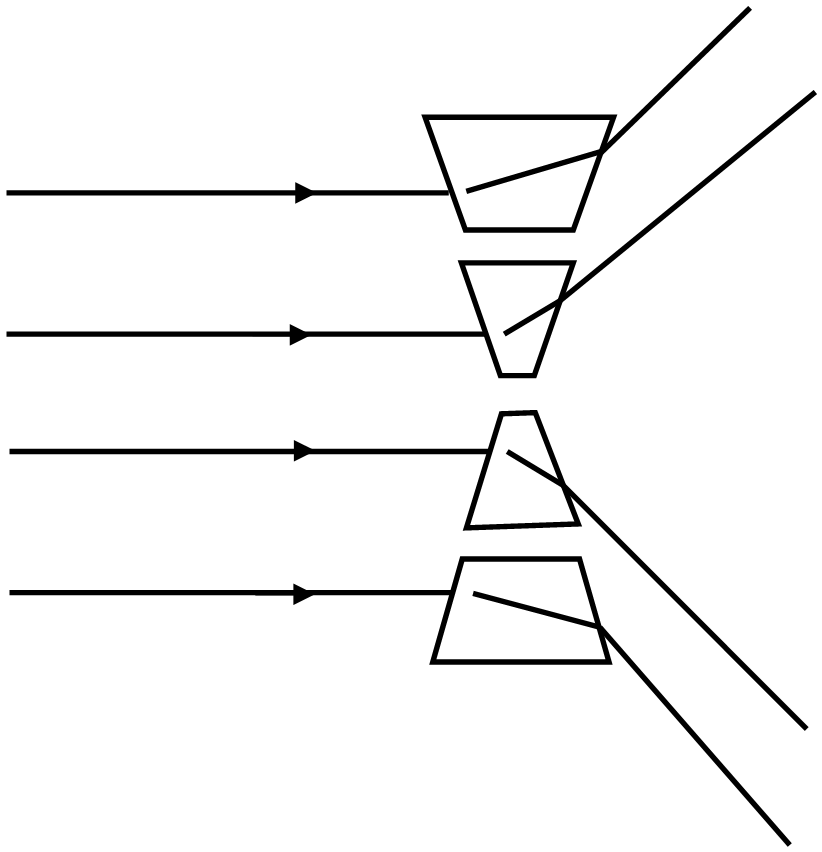
Concave lens, like any other lens works on the principle of refraction. We can divide a lens into tiny pieces which resemble a triangular prism. When a ray of light falls on it, due to the shape of the lens piece, the light refracts either inwards our outwards. Concave lens is such that it is thicker outside and thinner inside (opposite to that of a convex lens), so the light rays are refracted outwards and thus they diverge.
View full question & answer
Question 582 Marks
With the help of a ray diagram, determine the position, nature and size of the image formed of an object placed at the centre of curvature of a concave mirror.
Answer
When an object is placed at the centre of curvature (C) of a concave mirror, the image formed is:
  1. At the centre of curvature (C).
  2. Real and inverted.
  3. Of same size as the object.
View full question & answer
Question 592 Marks
With the help of a labelled ray diagram, describe how a converging mirror can be used to give an enlarged upright image of an object.
Answer


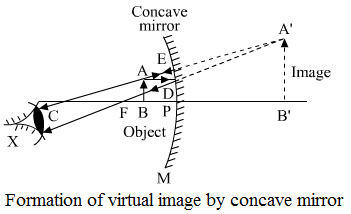
For obtaining an enlarged upright image of an object, the object is placed between focus (F).
View full question & answer
Question 602 Marks
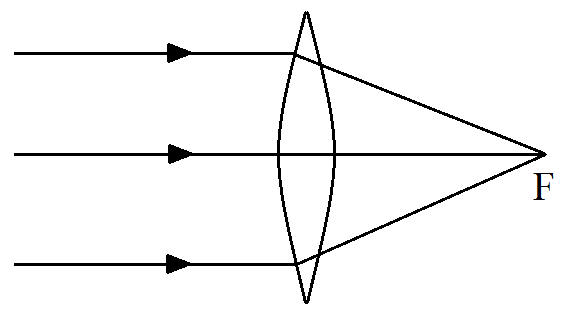
With the help of a labelled diagram explain how a convex lens converges a beam of parallel light rays.
Answer
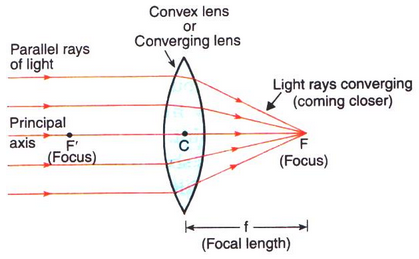
When a beam of light rays parallel to one another and also to the principal axis of the convex lens fall on the lens, the incident rays pass through the lens and get refracted according to the laws of refraction. All the rays, after passing through the lens, converge at the same point F (focus) on the other side of the lens.
View full question & answer
Question 612 Marks
With the help of a labelled diagram, explain how a concave lens diverges a beam of parallel light rays.
Answer


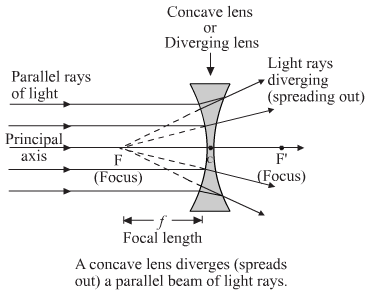
When a beam of light rays parallel to one another and also to the principal axis of the concave lens fall on the lens, the incident rays pass through the lens and get refracted according to the laws of refraction. All the rays spread out after passing through the lens. These diverging rays when produced backwards appear to meet at a point F (focus) on the left side of the lens.
View full question & answer
Question 622 Marks
With the help of a diagram, show how when light falls obliquely on the side of a rectangular glass slab the emergent ray is parallel to the incident ray.
View full question & answer
Question 632 Marks
Why do we prefer a convex mirror as a rear-view mirror in vehicles?
Answer
Convex mirrors give a virtual, erect, and diminished image of the objects placed in front of them. They are preferred as a rear-view mirror in vehicles because they give a wider field of view, which allows the driver to see most of the traffic behind him.
View full question & answer
Question 642 Marks
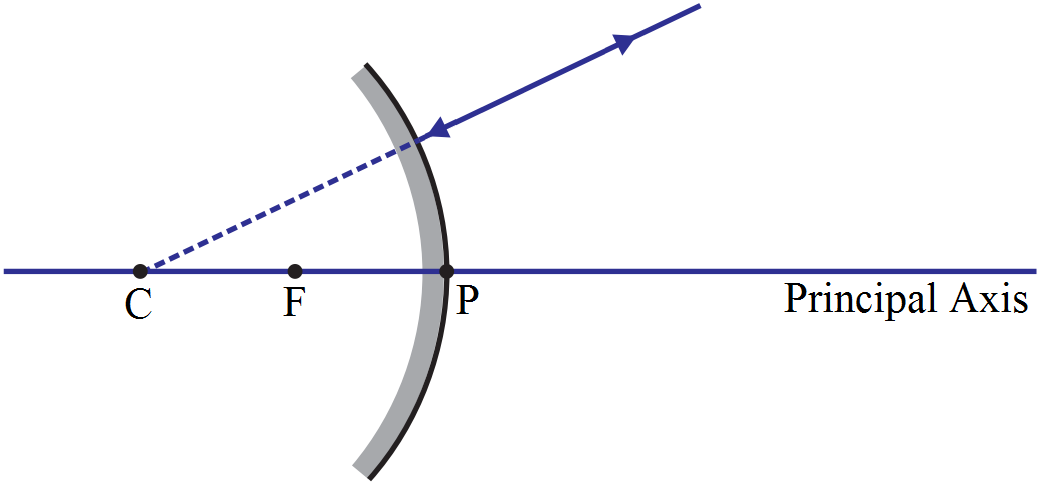
Why does a ray of light passing through the centre of curvature of a concave mirror gets reflected along same path after reflection?
Answer
A ray of light passing through the centre of curvature of a concave mirror retraces its path (gets reflected along the same path), because as the ray of light passes through centre of curvature of a concave mirror it strikes the mirror along the normal i.e. it incidences on to the mirror at 90 degree. Hence the incident ray coincides with the normal.
Therefore angle of incidence = 0 so, as we know according to law of reflection.
angle of reflection = 0, hence the angle of reflection too become zero degree, thus ray of light retraces its path.
View full question & answer
Question 652 Marks
Why does a driver prefer to use a convex mirror as a rear-view mirror in a vehicle?
Answer
A driver prefers to use a convex mirror as a rear-view mirror because:
  1. A convex mirror always produces an erect image of the objects.
  2. A convex mirror has wider field of view.
View full question & answer
Question 662 Marks
Why does a beam of light when it enters glass at an angle? Why does it not bend if it inters the glass at right angles?
Answer
When a beam of light enters glass at an angle, the speed changes and therefore the direction of light changes i.e., bending of light occurs. When a beam of light falls at right angles to the surface of glass, all parts of light waves reach the glass at the same time, enter the glass at the same time and hence slow down at the same time. Due to this no change in direction of light takes place i.e., bending of light does not take place.
View full question & answer
Question 672 Marks
Why can you not use a concave mirror as a rear-view mirror in vehicles?
Answer
We cannot use a concave mirror as a rear-view mirror in vehicles because a concave mirror produces inverted images of distant objects. So, all the vehicles will be seen running upside down in the mirror.
View full question & answer
Question 682 Marks
Which type of mirror is used in a solar furnace? Support your answer with reason.
Answer
Concave mirror is used in a solar furnace. The solar furnace is placed at the focus of a large concave reflector. When parallel rays of light from the sun fall on the surface of the concave mirror, rays gets reflected and meet at the focus of the mirror due to the converging nature of concave mirror. Thus, the furnace kept at the focus becomes very hot. Even steel can be melted in this furnace.
View full question & answer
Question 692 Marks
Which of the following diagrams shows the ray of light refracted correctly?
Answer
Diagram E shows that the ray of light is refracted correctly. When a light ray goes from a rarer medium to a denser medium, it bends towards the normal. This principle is replicated in this diagram.
View full question & answer
Question 702 Marks
Which lens would you prefer to use while reading small letters from a dictionary?
Answer
A convex lens gives a magnified image of an object when it is placed between the radius of curvature and focal length. Also, magnification is more for convex lenses having shorter focal length. Therefore, for reading small letters, a convex lens of focal length 5cm should be used.
View full question & answer
Question 712 Marks
Which kind of mirrors are used in the headlights of a motorcar and why?
Answer
Concave mirrors are used in headlights of car. The position of the is placed nearer to the focus of the concave. The reason is that the main purpose of the head lights is to focus or show the light for larger area as much as possible and to send a beam of light infront of the car. Because light from a source comes in all directions (diffration) and in case of head lights we don't want to face the light towards us. And we want to change the direction of those rays which are coming to us to travel along the road. This problem is solved by placing light source or bulb at the focus of the concave mirror because the light rays coming from focus towards the mirror after reflection goes parallel to principal axis or along the road.
View full question & answer
Question 722 Marks
Which kind of mirror is used in the headlights of a car? Why is it used for this purpose?
Answer
Concave mirror is used in the headlights of a car. This is because when a lighted bulb is placed at the focus of a concave mirror reflector, then the diverging light rays of the bulb are collected by the concave reflector and then reflected to produce a strong, parallel-sided beam of light (which travels a considerable distance in the darkness of night).
View full question & answer
Question 732 Marks
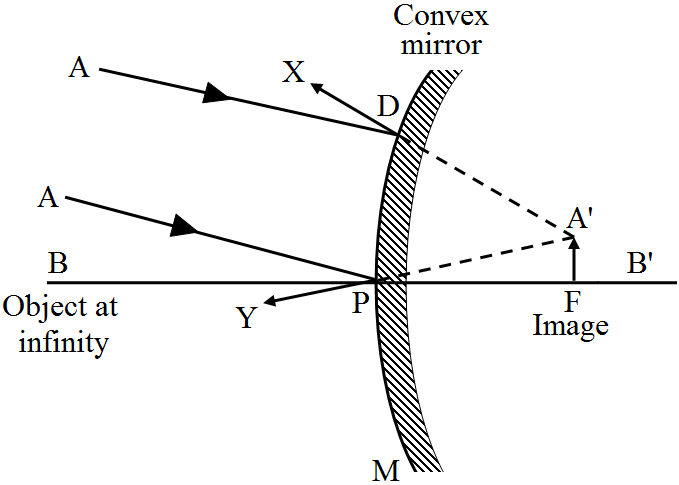
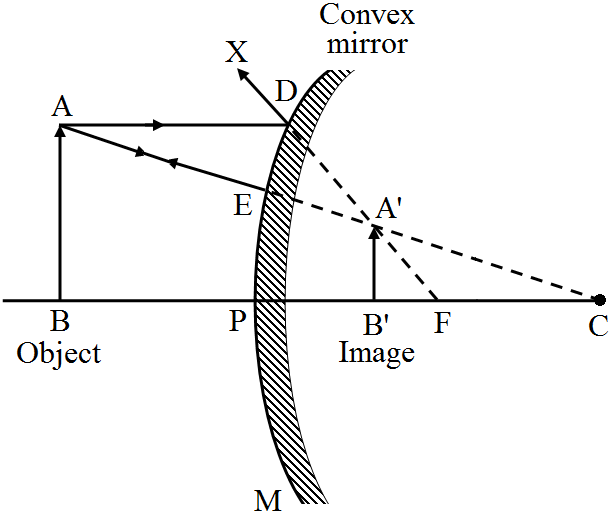
Where would the image be formed by a convex mirror if the object is placed:
  1. Between infinity and pole of the mirror?
  2. At infinity?
Draw labelled ray-diagrams to show the formation of image in both the cases.
Answer
  1. Image will form between pole and focus.


  1. At focus.

View full question & answer
Question 742 Marks
Where must the object be placed for the image formed by a converging lens to be:
  1. Real, inverted and smaller than the object?
  2. Real, inverted and same size as the object?
  3. Real, inverted and larger than the object?
  4. Virtual, upright and larger than the object?
Answer
  1. Beyond 2F.
  2. At 2F.
  3. Between F and 2F.
  4. Between F and optical centre.
View full question & answer
Question 752 Marks
When an object is placed at a distance of 36cm from a convex lens, an image of the same size as the object is formed. What will be the nature of image formed when the object is placed at a distance of:
  1. 10cm from the lens?
  2. 20cm from the lens?
Answer
  1. The image will be virtual and magnified. We know that a convex lens forms the image of the same size as that of the object when the object is placed at 2f. Thus, the focal length of the lens is 13cm. In this case, the object is placed between the focus​(f) and the optic centre. This position of the object results in the formation of a virtual and magnified image.
  2. The image will be real and magnified because the object is placed between 2f and f.
View full question & answer
Question 762 Marks
When an object is placed at a distance of 15cm from a concave mirror, its image is formed at 10cm in front of the mirror. Calculate the focal length of the mirror.
Answer
u = -15cm, v = -10cm

f = ?

We know that

$\frac{1}{\text{v}}+\frac{1}{\text{u}}=\frac{1}{\text{f}}$ 

$\Rightarrow\frac{1}{(-10)}+\frac{1}{(-15)}=\frac{1}{\text{f}}$

$\Rightarrow\frac{1}{\text{f}}=\frac{1}{10}-\frac{1}{15}= \frac{-3-2}{30}=-\frac{5}{30}=-\frac{1}{6}$

$\therefore \text{f}=-6\text{cm}$

$\therefore $ The focal length of the concave mirror is 6cm.
View full question & answer
Question 772 Marks
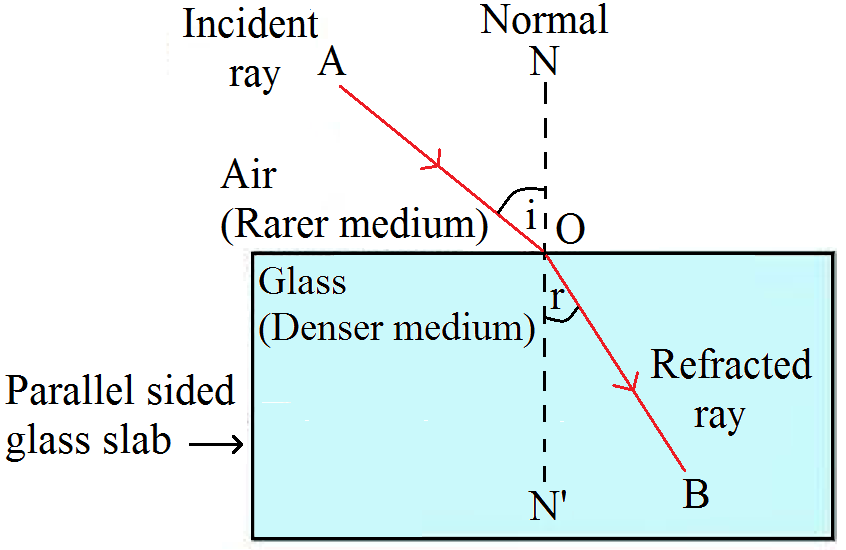
When a light ray passes from air into glass, what happens to its speed? Draw a diagram to show which way the ray of light bends.
Answer


The ray of light bends towards the normal.
View full question & answer
Question 782 Marks
When a fork is seen through lenses A and B one by one, it appears as shown in the diagrams. What is the nature of (i) lens A, and (ii) lens B? Give reason for your answer.
Answer
When the fork is seen through lens A, it appears to be diminished. Such diminished object is observed when it is placed near a concave lens. Therefore, lens A is concave, i.e., diverging in nature. When the fork is seen through lens B, it appears to be enlarged. Such enlarged image is formed by a convex lens when an object is placed between the lens and its focus. Therefore, lens B is a convex, i.e., converging in nature.
View full question & answer
Question 792 Marks
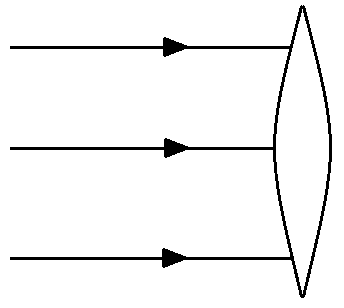
What type of lens is shown in the diagram on the right? What will happen to the parallel rays of light? Show by completing the ray diagram.
Answer
The lens shown in convex. the parallel rays will converge to a point called focus (F).
View full question & answer
Question 802 Marks
What kind of lens can form:
  1. An inverted magnified image?
  2. An erect magnified image?
  3. An inverted diminished image?
  4. An erect diminished image?
Answer
  1. A convex lens can form an inverted magnified image.
  2. A convex lens can form an erect magnified image.
  3. A convex lens can form an inverted diminished image.
  4. A concave lens can form an erect diminished image.
View full question & answer
Question 812 Marks
What is the unit of power of a lens? Define the unit of power of a lens.
Answer
Unit of power of a lens is dioptre. One dioptre is the power of a lens whose focal length is 1 metre.
View full question & answer
Question 822 Marks
What is the speed of light in a medium of refractive index $\frac{6}{5}$ if its speed in air is 3,00,000 km/ s?
Answer
Refractive index of medium $=\frac{6}{5}=1.2$

Speed of light in air = 3, 00, 000km/ s

We know that

$\text{Refractuive index of the medium}=\frac{\text{Speed of light in air}}{\text{Speed of light in medium }}$

$1.2=\frac{300000}{\text{speed of light medium}}$

${\text{Speed of light in medium}}=250000\text{km/ s}$

View full question & answer
Question 832 Marks
What is the relation between the focal length and radius of curvature of a spherical mirror (concave mirror or convex mirror)? Calculate the focal length of a spherical mirror whose radius of curvature is 25cm.
Answer
For a spherical mirror the principal focus (F) lies exactly mid-way between the pole (P) and centre of curvature (C). So, the focal length (f) of a spherical mirror is equal to half of its radius of curvature (R).

$\text{f}=\frac{\text{R}}{2}$

R= 25cm (Given)

f = ?

We know that

$\text{f}=\frac{\text{R}}{2}$

$=\frac{25}{2}$

$\text{f} = 12.5\text{cm}$

View full question & answer
Question 842 Marks
What is the position of the image when an object is placed at a distance of 20cm from a concave mirror of focal length 20cm?
Answer
Object distance, u = -20cm

Focal length, f = -20cm (concave mirror)

lmage distance, v = ?

$\frac{1}{\text{v}}+ \frac{1}{\text{u}}=\frac{1}{\text{f}}$

$\Rightarrow\frac{1}{\text{v}}+ \frac{1}{(-20)}=\frac{1}{\text{(-20)}}$

$\Rightarrow \frac{1}{\text{v}}=0$

$\therefore \text{v}=\text{infinity}$

View full question & answer
Question 852 Marks
What is the position of image when an object is placed at a distance of 10cm from a convex lens of focal length 10cm?
Answer
U = -10cm, f = 10cm

We have,

$\frac{1}{\text{v}}-\frac{1}{\text{u}}=\frac{1}{\text{f}}$

$\frac{1}{\text{v}}-\frac{1}{-10}=\frac{1}{10}$

$\frac{1}{\text{v}}=0$

$\text{v}=\frac{1}{0}=\infty$

At infinity.
View full question & answer
Question 862 Marks
What is the magnification produced by a rear view mirror fitted in vehicles?
Answer
The convex mirror forms virtual, erect and diminished image of the object and rearview mirror also form some type of image.
Therefore, magnification (m) produced by a rear view mirror fitted in vehicles is less than one i.e., m < 1.
Magnification (m) $=\frac{\text{Image height}}{\text{Objects height}}$ 
View full question & answer
Question 872 Marks
What is the difference between a real image and a virtual image? Give one example of each type of image.
Answer
Real image can be obtained on a screen because light rays actually pass through a real image but virtual image cannot be formed on screen because light rays do not actually pass through a virtual image.
Example:
The image formed on a cinema screen is an example of real image.
The image formed by a plane mirror is a virtual image.
View full question & answer
Question 882 Marks
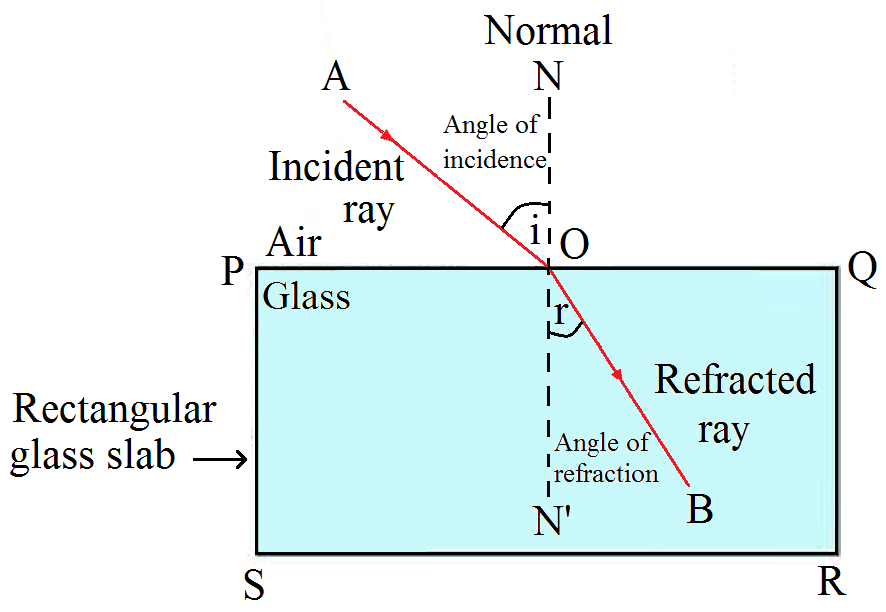
What is meant by ‘refraction of light’? Draw a labelled ray diagram to show the refraction of light.
Answer
The change in direction of light when it passes from one medium to another obliquely, is called refraction of light.
View full question & answer
Question 892 Marks
What is meant by:
  1. Principal focus of a convex mirror.
  2. Focal length of a convex mirror?
Answer
  1. Principal focus of a convex mirror: The principal focus of a convex mirror is a point on its principal axis from which a beam of light rays, initially parallel to the axis, appears to diverge after being reflected from the convex mirror.

  2. Focal length of a concave mirror: The focal length of a convex mirror is the distance from the pole (P) to its principal focus (F).
View full question & answer
Question 902 Marks
What is meant by:
Draw diagram to show the action of convex mirror on a beam of parallel light rays. Mark on this diagram principal axis, focus F, centre of curvature C, pole P and focal length ƒ, of the convex mirror.
View full question & answer
Question 912 Marks
What do you understand by the power of a lens? Name one factor on which the power of a lens depends.
Answer
Power of a lens is a measure of the degree of convergence or divergence of light rays falling in it. Power of a lens depends of its focal length.
View full question & answer
Question 922 Marks
What do you mean by laterally inverted?
Answer
When the image of an object is erect but is inverted in the lateral side it is called lateral inversion ie the left side comes to the right and the right comes to the left.
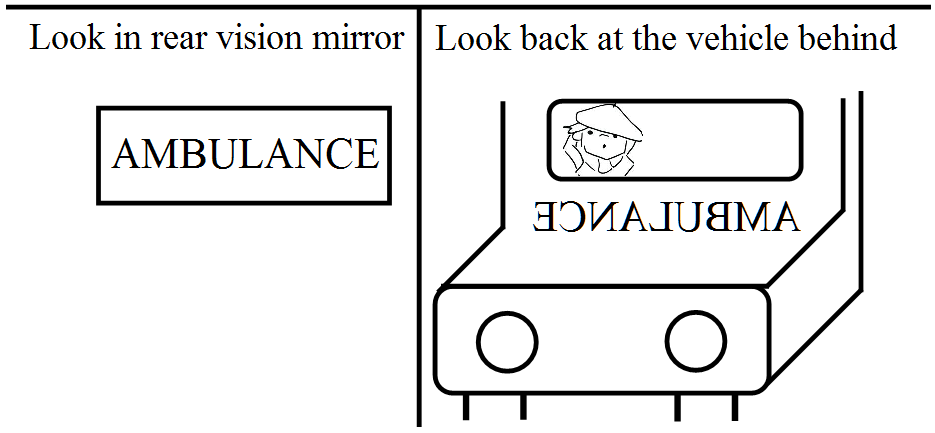
For example, the word AMBULANCE is painted left-right inverted on the ambulance so that when the driver of a vehicle in front looks into his rear-view mirror, he can make out the word AMBULANCE quickly and give way. As shown in the figure below.
View full question & answer
Question 932 Marks
What are the important differences between looking at a photograph of your face and looking at yourself in a plane mirror?
Answer
A image of our face in a plane mirror is laterally inverted, so left is right and right is left. However, in a photograph of our face this is not the case. A mirror surface is smooth, so the reflection by a mirror is a regular reflection. A parallel beam of light incident on it, gets scattered by making reflected rays in different directions.
View full question & answer
Question 942 Marks
Three convex lenses are available having focal lengths of 4cm, 40cm and 4m respectively. Which one would you choose as a magnifying glass and why?
Answer
Converx lens having 4cm focal length-because it will produce greatest magnification.
View full question & answer
Question 952 Marks
The velocity of light in water is $\frac{3}{4}$ times the velocity of light in vacuum. Find the refractive index of water.
Answer
Suppose velocity of light in vacuum $=\text{v}$
Then velocity of light in water $=\frac{3}{4}\text{v}$
Now we have a relation,
Refractive index of a medium (water) $=\frac{\text{Speed of light in vacuum}}{\text{Speed of light in medium (water)}}$
So, $\frac{\frac{\text{v}}{3}}{4\text{v}}=1.33$
View full question & answer
Question 962 Marks
The speed of light in water is 2.25 × 10m/s. If the speed of light in vacuum be 3 × 10⁸m/s, calculate the refractive index of water.
Answer
Speed of light in vacuum = 3.0 × 108m/ s

Speed of light in water = 2.25 × 108m/ s

Refractive index of water = ?

We know that

$\text{Refractive index of water}=\frac{\text{Speed of light in vacuum}}{\text{Speed of light in water}}$

$\text{Refractive index of water}=\frac{3\times10^8}{2.25\times10^8}=1.33$

View full question & answer
Question 972 Marks
The refractive index of water with respect to vacuum is $\frac{4}{3}$ and refractive index of vacuum with respect to glass is $\frac{2}{3}$ If the speed the speed of light in glass is 2 × 10⁸ms-1, find the speed of light in (i) vacuum, (ii) water.
Answer
Refractive index of water w.r.t air $=\frac{4}{3}$

$\text{n}_\text{wa}=\frac{\text{v}_\text{a}}{\text{v}_\text{w}}$

$\frac{4}{3}=\frac{3\times10^8}{\text{v}_\text{w}}$

On calculating we get velocity of light in water -2.25 x 10⁸m/s

View full question & answer
Question 982 Marks
The refractive index of glass is 1.5. Calculate the speed of light in glass. The speed of light in air is 3.0 × 10⁸ ms-1.
Answer
Given,

Refractive index of glass = 1.5

Speed of light in air = 3.0 × 108m/ s

$\text{Refractive index of glass}=\frac{\text{Speed of light in air}}{\text{Speed of light in glass}}$

$1.5=\frac{3\times10^8}{\text{Speed of light in glass}}$

$\text{Speed of light in glass}=2\times10^8\text{m/ s}$

View full question & answer
Question 992 Marks
The optician’s prescription for a spectacle lens is marked +0.5D. What is the:
  1. Nature of spectacle lens?
  2. Focal length of spectacle lens?
Answer
  1. Concave lens.
  2. $\text{P}=+0.5\text{D}$

$\text{P}=\frac{1}{\text{f}}$

$\text{f}=\frac{1}{\text{P}}=\frac{1}{0.5}=2\text{m}$
View full question & answer
Question 1002 Marks
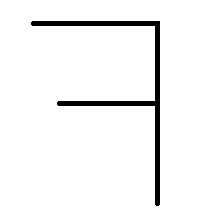
The letter F is placed in front of a plane mirror:
  1. How would its image look like when seen in a plane mirror?
  2. What is the name of the phenomenon involved?
Answer
  1.  


  1. Lateral inversion.
View full question & answer
Answer the questions.[Phy-2M] - Page 2 - Science STD 10 Questions - Vidyadip