Questions · Page 3 of 5

Answer the questions.[Phy-2M]

Question 1012 Marks
The lens A produces a magnification of, -0.6 whereas lens B produces a magnification of +0.6:
  1. What is the nature of lens A?
  2. What is the nature of lens B?
Answer
  1. Convex lens (since image is real, inverted and diminished).
  2. Concave lens (since image is virtual, erect and diminished).
View full question & answer
Question 1022 Marks
The following table gives the refractive indices of a few media,
 
1
2
3
4
5
Medium:
Water
Crown glass
Rock salt
Ruby
Diamond
Refractive index:
1.33
1.52
1.54
1.71
2.42
Use this table to give an example of:
  1. A medium pair so that light speeds up when it goes from one of these medium to another.
  2. A medium pair so that light slows down when it goes from one of these medium to another.
Answer
  1. Light speeds up as it travels from a denser medium to a rarer one, ie., from a medium with a higher refractive index to one with a lower refractive index. An example would be the medium pair of diamond and water, where light travels from diamond to water.
  2. Using the same argument, light slows down as it travels from a medium with a lower refractive index to one with a higher refractive index. Therefore, the medium pair of crown glass and ruby can be taken as an example, where light moves from the crown glass to the ruby.
View full question & answer
Question 1032 Marks
The focal length of a lens is +150mm. What kind of lens is it and what is its power?
Answer
$\text{f}=+150\text{mm}=+0.15\text{m}$

It is a convex lens since its focal length is positive.

$\text{P}=\frac{1}{\text{f}}=\frac{1}{0.15}=+6.66\text{D}$

View full question & answer
Question 1042 Marks
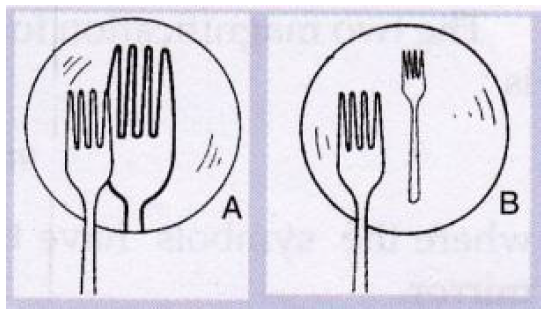
The diagrams show the appearance of a fork when placed in front of and close to two mirrors A and B, turn by turn.

  1. Which mirror is convex.
  2. Which mirror is concave.

Give reasons for your choice.

Answer
  1. Mirror B is convex, as it forms a small image.
  2. Mirror A is concave, as it forms a large image.
View full question & answer
Question 1052 Marks
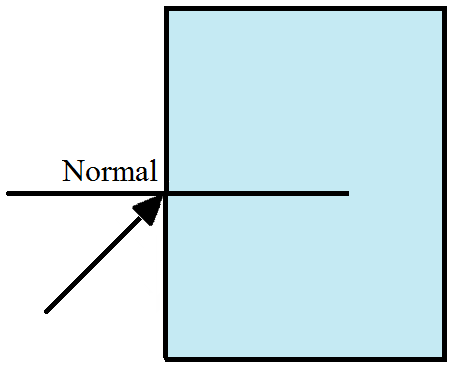
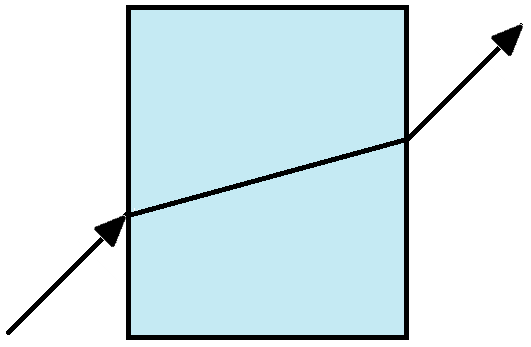
The diagram given alongside shows a ray of light entering a rectangular block of glass:
  1. Copy the diagram and draw the normal at the point of entry.
  2. Draw the approximate path of the ray of light through the glass block and out of the other side.
Answer
  1.  


  1.  

View full question & answer
Question 1062 Marks
The boy walks towards the mirror at a speed of 1m/ s. At what speed does his image approach him?
Answer
When the boy walks towards the mirror at a speed of 1m/ s, his image will also appear to move towards the mirror at the same speed of 1m/ s. So, the speed at which his image approach him will be 2m/ s + 2m/ s = 4m/ s.
View full question & answer
Question 1072 Marks
State two factors on which the lateral displacement of the emergent ray depends.
Answer
Factors on which the lateral displacement depends are:
  1. Angle of incidence.
  2. Thickness of glass slab.
  3. Refractive index of glass slab.
View full question & answer
Question 1092 Marks
State the uses of plane mirrors.
Answer
Uses of Plane mirrors:
  1. Plane mirrors are used to see ourselves. The mirrors on our dressing table and in bathrooms are plane mirrors.
  2. Plane mirrors are fitted at blind turns of some busy roads so that drivers can see the vehicles coming from the other side and prevent accidents.
  3. Plane mirrors are used to make periscopes.
  4. Plane mirrors are fixed on the inside walls of certain shops to make them look bigger.
View full question & answer
Question 1102 Marks
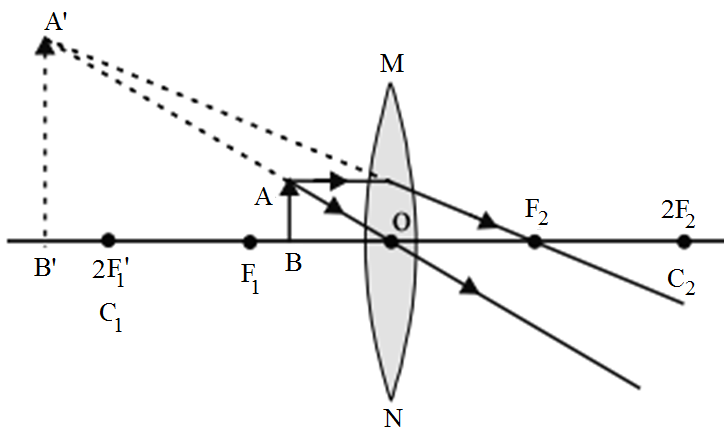
State one practical application the use of such a lens with the object in position (i) and (ii).
Answer
  1. Used in film projector.
  2. Used as a magnifying glass.
View full question & answer
Question 1112 Marks
State and define the S.I. unit of power of a lens.
Answer
Power of lens is the ability of the lens to converge the rays of light falling on it. It can also be defined as $\text{P}=\frac{1}{\text{f}}$ where f is the focal length. Dioptre is the S.I. unit of power of lens. One Dioptre is the power of a lens whose focal length is 1 metre.
View full question & answer
Question 1122 Marks
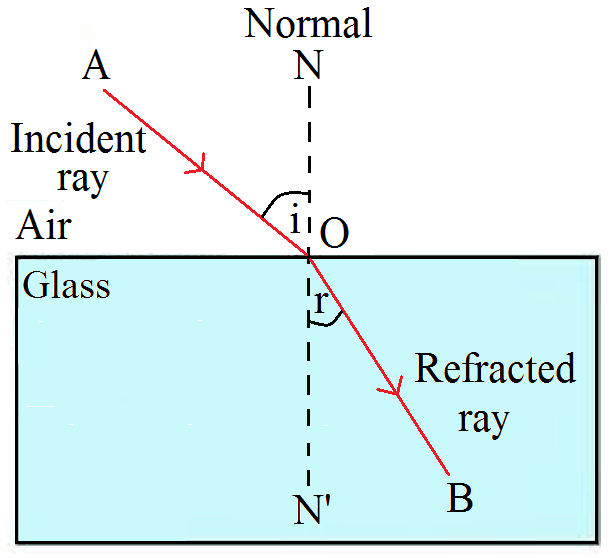
State and explain the laws of refraction of light with the help of a labelled diagram.
Answer
Laws of refraction,

First law: According to the first law of refraction, the incident ray, the refracted ray and the normal at the point of incidence, all lie in the same.
Second law: According to the second law of refraction, the ratio of the angle of incidence to the point of incidence, all lie in the same plane.
View full question & answer
Question 1132 Marks
State and define the SI unit of power of a lens.
Answer
The power of the lens is the reciprocal of the focal length of the lens. The SI unit of the power is diopter. it is denoted by D.
View full question & answer
Question 1142 Marks
Show the lateral displacement of the ray on the diagram.
Answer
The lateral displacement is shown in the above diagram.
View full question & answer
Question 1152 Marks
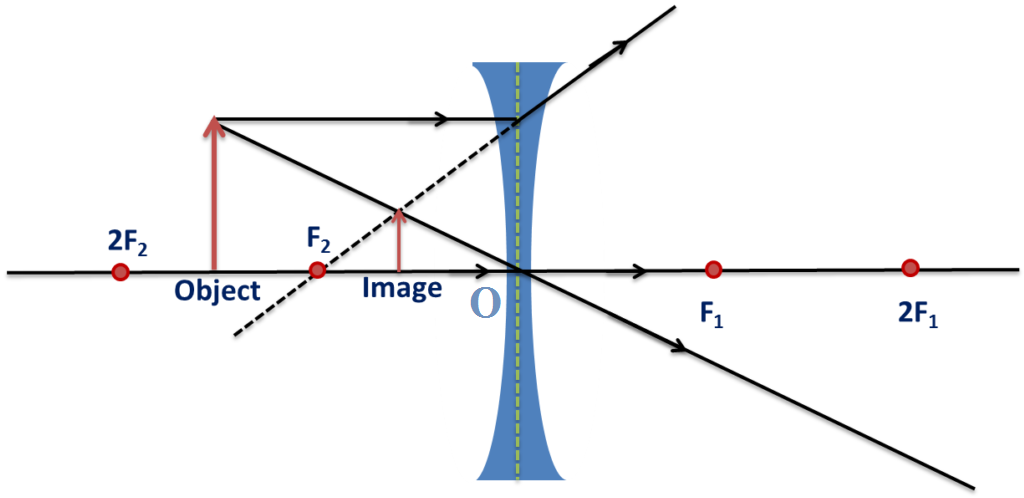
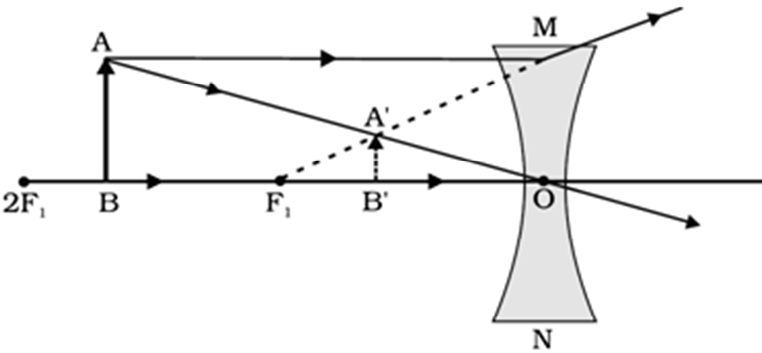
Show by drawing a ray-diagram that the image of an object formed by a concave lens is virtual, erect and diminished.
View full question & answer
Question 1162 Marks
Refractive indices of four media A, B, C and D are given below:
Medium
Refractive index
A
B
C
D
1.33
1.44
1.52
1.65
In which of these four media is the speed of light:
  1. Maximum, and
  2. Minimum?
Answer
The refractive index of a medium is related to the speed of light as follows:

$\text{Refractive index}=\frac{\text{Speed of light in vacuum}}{\text{speed of light in a mediums}}$

Since the speed of light in vacuum is a constant, the refractive index becomes inversely proportional to the speed of light in a medium.

  1. The speed of light is maximum in a medium that has the lowest refractive index, i.e., medium A.
  2. The speed of light is minimum in a medium that has the highest refractive index, i.e., medium D.
View full question & answer
Question 1172 Marks
Refractive index of diamond with respect to glass is 1.6 and absolute refractive index of glass is 1.5. Find out the absolute refractive index of diamond.
Answer
Let, refractive index of diamond with respect to air = nDA = absolute refractive index of diamond,

refractive index of glass with respect to air = nGA = absolute refractive index of glass,

refractive index of diamond with respect to glass = nDG

Given,

NDG = 1.6 and nGA = 1.5

Now, $\text{n}_\text{DG}=\frac{\text{n}_{\text{DA}}}{\text{n}_{\text{GA}}}$

⇒ nDA = nDG × nGA

⇒ nDA = 1.6 × 1.5 = 2.4

View full question & answer
Question 1182 Marks
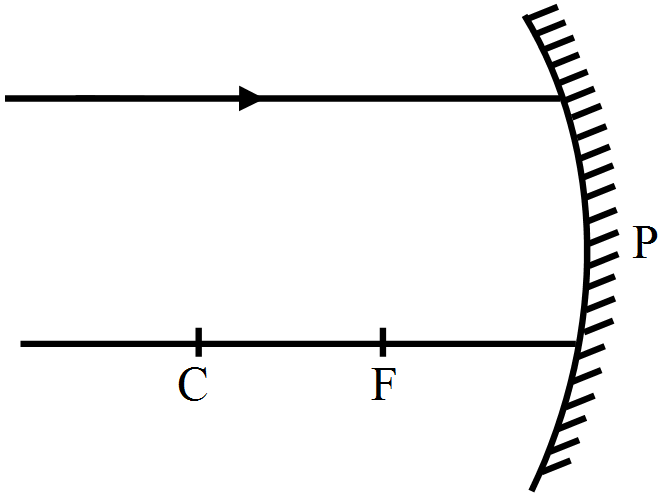
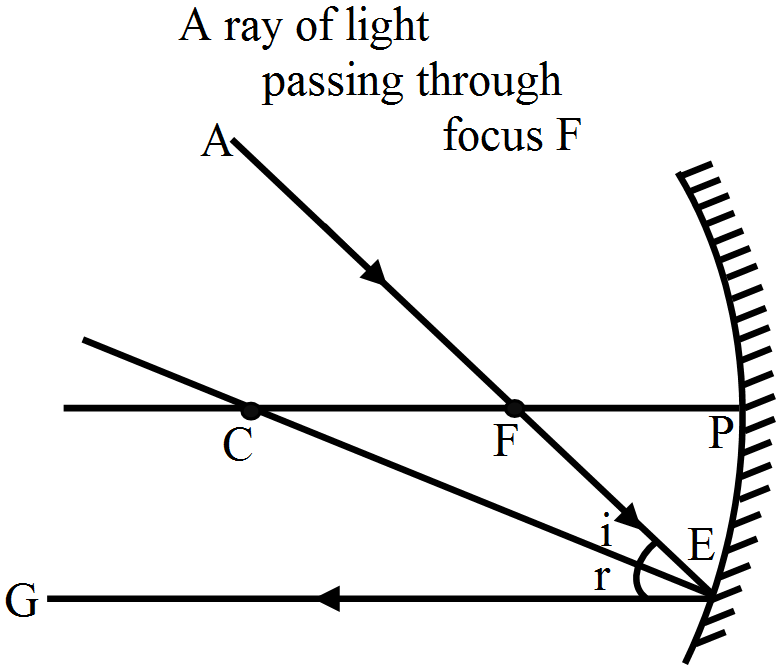
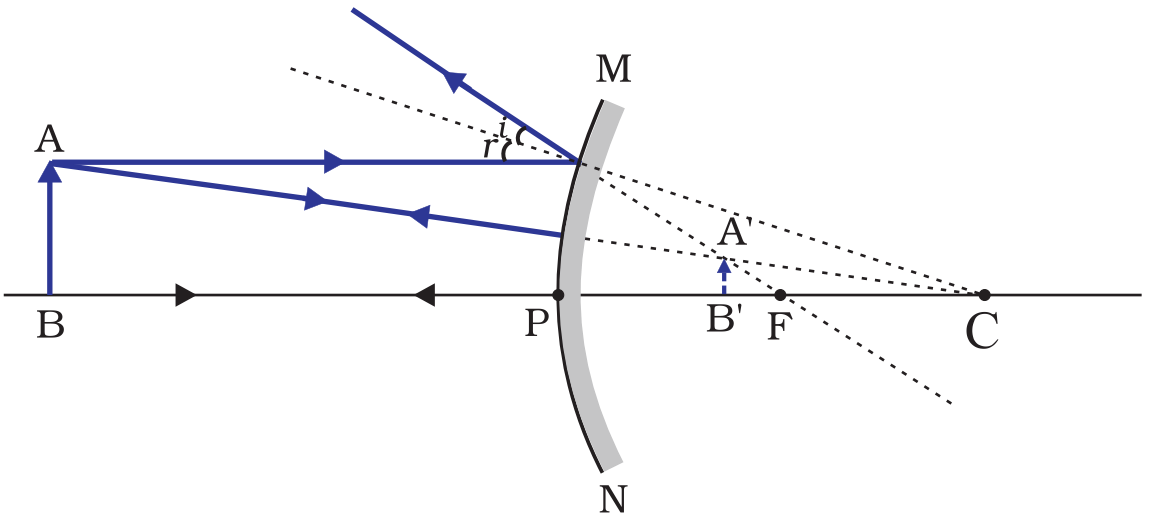
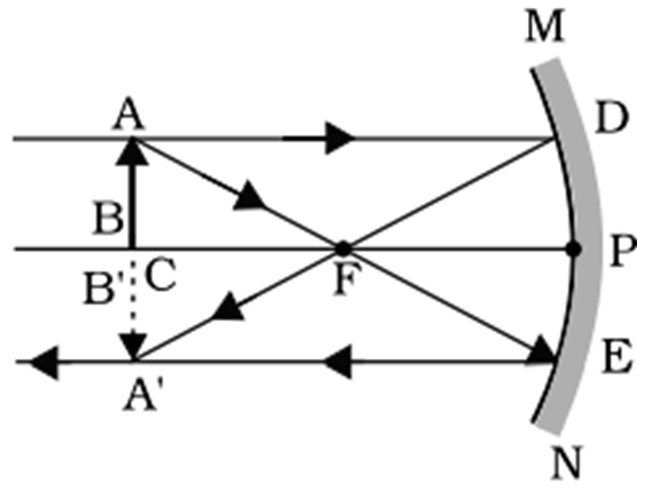
Redraw the following diagram on your answer sheet and show the path of the reflected ray. Also mark the angle of incidence $(\angle\text{i})$ and the angle of reflection $(\angle\text{r})$ on the diagram.

Answer
When a ray of light passes through the focus of a concave mirror then it becomes parallel to the principal axis. Here incident ray AE is passing through the focus F of concave mirror and strikes the mirror at E, then it gets reflected through path EG parallel to the axis.
Also, Angle of incidence = angle of reflection
$\angle\text{i}=\angle\text{r}$
View full question & answer
Question 1192 Marks
  1. How can you bend light away from the normal?
  2. How must light travel out of a substance if it is not going to be refracted?
Answer
  1. We can bend light away from the normal by making the light to enter from a denser medium to a rarer medium.
  2. Light will not refract if it travels at the right angles to the surface of the substance.
View full question & answer
Question 1202 Marks
  1. Find the nature, position and magnification of the images formed by a convex lens of focal length 0.20 m if the object is placed at a distance of:
  1. 0.50m
  2. 0.25m
  3. 0.15m
  1. Which of the above cases represents the use of convex lens in a film projector, in a camera, and as a magnifying glass?
Answer
  1. f = 0.20m
  1. u = 0.05m

Lens formula, $\frac{1}{\text{v}}-\frac{1}{\text{u}}=\frac{1}{\text{f}}$

$\frac{1}{\text{v}}-\frac{1}{-0.50}=\frac{1}{0.20}$

$\frac{1}{\text{v}}=\frac{1}{0.20}-\frac{1}{0.50}$

$\text{v}=0.33\text{m}$

Image is formed 0.33m behind the lens.

$\text{m}=\frac{\text{v}}{\text{u}}=\frac{0.33}{-0.50}=-0.66$

Image is real and inverted.

  1. $\text{u}=-0.25\text{m}$

Lens formula, $\frac{1}{\text{v}}-\frac{1}{\text{u}}=\frac{1}{\text{f}}$

$\frac{1}{\text{v}}-\frac{1}{-0.25}=\frac{1}{0.20}$

$\frac{1}{\text{v}}=\frac{1}{0.20}-\frac{1}{0.25}$

$\text{v}=1\text{m}$

Image is formed 1m behind the lens.

$\text{m}=\frac{\text{v}}{\text{u}}=\frac{1}{-0.25}=-4$

Image is real and inverted.

  1. $\text{u}=-0.15\text{m}$

Lens formula, $\frac{1}{\text{v}}-\frac{1}{\text{u}}=\frac{1}{\text{f}}$

$\frac{1}{\text{v}}-\frac{1}{-0.15}=\frac{1}{0.20}$

$\frac{1}{\text{v}}=\frac{1}{0.20}-\frac{1}{0.15}$

$\text{v}=-0.60\text{m}$

Image is formula 0.60m in front of the lens.

$\text{m}=\frac{\text{v}}{\text{u}}=\frac{-0.6}{-0.15}=+4$

Image is virtual and erect.

  1. Film projector, Case (ii)

Camera, Case (i)

Magnifying glass, Case (iii)
View full question & answer
Question 1212 Marks
Name the type of mirror used by dentists. How does it help?
Answer
Concave mirror is used by dentists. The dentist holds a small concave mirror in such a way that the tooth lies within its focus. A magnified image of the tooth is then seen by the dentist in the concave mirror. Since the tooth looks much bigger, it becomes easy to examine the defect in the tooth.
View full question & answer
Question 1222 Marks
Name the two types of spherical mirrors. What type of mirror is represented by the:
  1. Back side of a shining steel spoon?
  2. Front side of a shining steel spoon?
Answer
Two types of spherical mirrors are:
  1. Concave mirror.
  2. Convex mirror.
Type of mirror represented by the:
  1. Back side of a shining steel spoon – convex mirror.
  2. Front side of a shining steel spoon – concave mirror.
View full question & answer
Question 1232 Marks
Name the lens which always forms a virtual image of an object.
Answer
A concave lens always forms the virtual image of an object.
View full question & answer
Question 1242 Marks
List some things that convex lens and concave mirror have in common.
Answer
Both, convex lens and concave mirror, converge parallel rays of light coming from infinity (parallel to the principal axis) at the focus.
View full question & answer
Question 1252 Marks
List some things that concave lens and convex mirror have in common.
Answer
Both, concave lens and convex mirror, diverge parallel rays of light coming from infinity (parallel to the principal axis).
View full question & answer
Question 1262 Marks
Light travels through air at 300 million ms-1. On entering water it slows down to 225 million ms-1. Calculate the refractive index of water.
Answer
Speed of light in air = 300 million ms-1

Speed of light in water = 225 million ms-1

We know that,

$\text{Refractive index of water}=\frac{\text{Speed of light in air}}{\text{Speed of light in water}}$

$\text{Refractive index of water}=\frac{300\text{ million m}/ \text{ s}}{225\text{million m}/\text{s}}=1.33$

View full question & answer
Question 1272 Marks
Light travels more quickly through water than through glass:
  1. Which is optically denser: Water or glass?
  2. If a ray of light passes from glass into water, which way will it bend: Towards the normal or away from the normal?
Answer
  1. Glass is optically denser than the water.
  2. The ray will bend away from the normal.
View full question & answer
Question 1282 Marks
Light enters from air to glass having refractive index 1.50. What is the speed of light in the glass? The speed of light in vacuum is 3 × 10⁸ m s–1.
Answer
Refractive index of a medium, n= Speed of light in vacuum/Speed of light in the medium
Speed of light in vacuum, c = 3 × 10⁸ ms-1
Refractive index of glass, ng = 1.50
Speed of light in the glass, v = Speed of light in vacuum/ Refractive index of glass
= c/ng
= 3 × 10⁸/1.50 = 2 × 10⁸ ms-1.
View full question & answer
Question 1292 Marks
Light enters from air into diamond which has a refractive index of 2.42. Calculate the speed of light in diamond. The speed of light in air is 3.0 × 10⁸ms-1.
Answer
Given,

Refractive index of diamond = 2.42

Speed of light in air = 3.0 × 108m/ s

We know that,

Refractive index of diamond $=\frac{\text{Speed of light in air}}{\text{Speed of light in diamond}}$

$2.42=\frac{3\times10^8}{\text{Speed of light diamond}}$

Speed of light diamond = 1.239 × 108m/ s

View full question & answer
Question 1302 Marks
It is desired to obtain an erect image of an object, using concave mirror of focal length of 12cm.
Will the image be smaller or larger than the object? Draw ray diagram to show the formation of image in this case.
Answer
The image will larger than the object.
View full question & answer
Question 1312 Marks
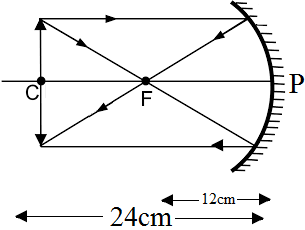
It is desired to obtain an erect image of an object, using concave mirror of focal length of 12cm.
Where will the image of this object be, if it is placed 24cm in front of the mirror? Draw ray diagram for this situation also to justify your answer.
Show the positions of pole, principal focus and the centre of curvature in the above ray diagrams.
Answer
Image will be 24cm in front of the mirror.
View full question & answer
Question 1322 Marks
If two lenses (convex) are in contact with each other, what happens to the ray after refraction?
Answer
When the lens are kept in contact with each other, the power is added
P = p1 + p2
P has increased : $\frac{1}{\text{f}}$ has increased
f has decreased : the focal point is nearer to the lens.
So, if the ray is coming from infinite, it will bend more and pass from the new focus.
View full question & answer
Question 1332 Marks
If the object is moved further away from the mirror, what changes are there in the position and size of the image?
Answer
If the object is moved further away from the mirror, the image is formed nearer to the mirror and the size goes on decreasing.
View full question & answer
Question 1342 Marks
If the magnification of an image formed by a mirror is positive, what does it mean?
Answer
It means that both the object and the image formed by a spherical mirror (concave or convex) are erect (I.e., upright). An erect image is always virtual. Thus, positive magnification indicates that the image formed by a spherical mirror is virtual.
Linear magnification (m): Linear magnification produced by a mirror is the ratio of the size of the image formed (denoted by h') to the ratio of the size of the object.
View full question & answer
Question 1352 Marks
If the magnification of a body of size 1m is 2, what is the size of the image?
Answer
Size of object, h1 = 1m

Magnification, m = 2

Size of image, h2 = ?

$\text{m}=\frac{\text{h}_2}{\text{h}_1}$

$2=\frac{\text{h}_2}{1}$

$\text{h}_2= 2\text{m}$

View full question & answer
Question 1362 Marks
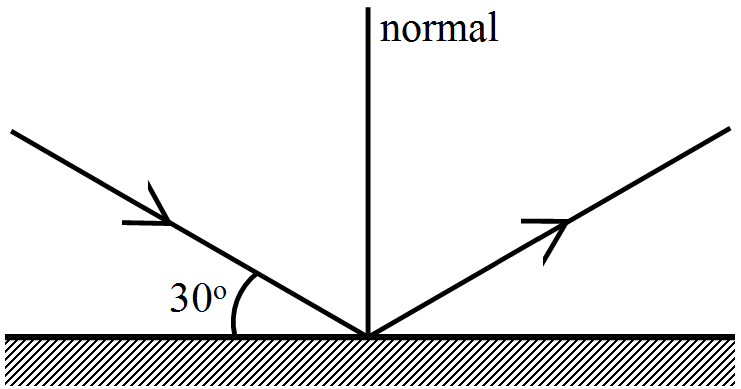
If a ray of light is incident on a plane mirror such that it makes an angle of 30with the mirror, then will be the angle of reflection?
Answer
According to the law of reflection, the angle of incidence and angle of reflection are equal. Both these angles are measured with respect to a line normal to the reflection surface.
Ray of light strikes the mirror at an angle of 30°.
⇒ It will make an angle of 60° (90° - 30°) with the normal. As shown in the figure below.

$\therefore$ Angle of incidence = 60°.
Now, By laws of reflection;
Angle of Incidence = Angle of reflection;
⇒ Angle of reflection = 60°.
Hence Angle of reflection is 60°.
View full question & answer
Question 1372 Marks
If a ray of light enters from alcohol to air. The refractive index of alcohol is 1.36. Calculate the speed of light in alcohol with respect to air.
Answer
Speed of light in vacuum = 3 × 10⁸m/s.

Refractive index $(\mu)=\frac{\text{c (speed of light in vaccum)}}{\text{v (speed of light in alcohol)}}$

$\Rightarrow1.36=\frac{3\times10^8}{\text{speed of light in alcohol}}$

$\Rightarrow\text{speed of light in alcohol}=\frac{3\times10^8}{1.36}$

$\therefore$ speed of light in alcohol = 2.21 × 10⁸m/s

speed of light in alcohol with respect to air is 2.21 x 10⁸ms-1

View full question & answer
Question 1382 Marks
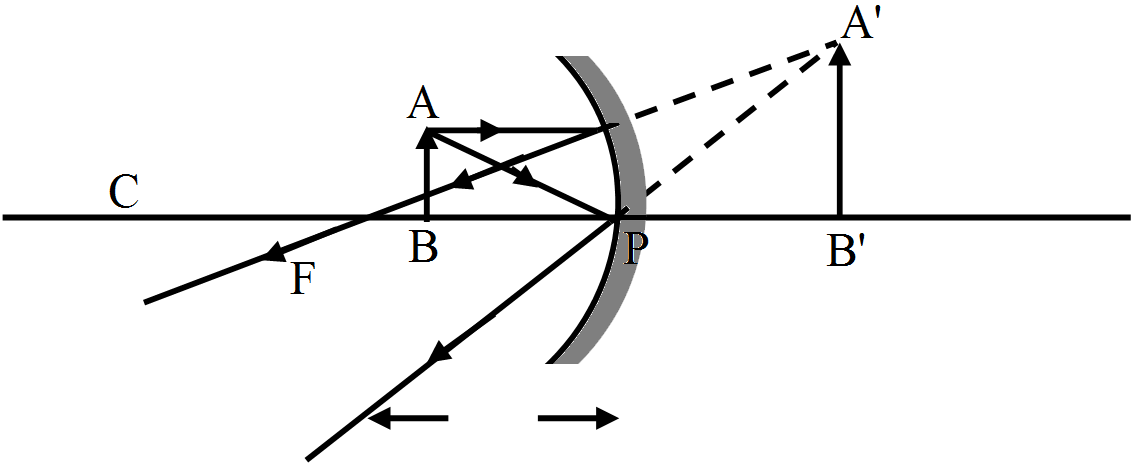
If an object is placed at a distance of 8cm from a concave mirror of focal length 10cm, discuss the nature of the image formed by drawing the ray diagram.
Answer
The focal length of the mirror is PF = 10cm.

The object is placed at B such that PB = 8cm. This means that the object lies between the pole and focus of the concave mirror. The image formed is virtual, erect and magnified.

View full question & answer
Question 1392 Marks
Identify the device used as a spherical mirror or lens in following cases, when the image formed is virtual and erect in each case.

Object is placed between the focus and device, image formed is enlarged and on the same side as that of the object.

Answer
Convex lens is used.
View full question & answer
Question 1402 Marks
Identify the device used as a spherical mirror or lens in following cases, when the image formed is virtual and erect in each case.

Object is placed between infinity and device, image formed is diminished and between pole and focus, behind it.

Answer
Convex mirror is used.
View full question & answer
Question 1412 Marks
Identify the device used as a spherical mirror or lens in following cases, when the image formed is virtual and erect in each case.

Object is placed between infinity and device, image formed is diminished and between focus and optical centre on the same side as that of the object.

Answer
Concave lens is used.
View full question & answer
Question 1422 Marks
Identify the device used as a spherical mirror or lens in following cases, when the image formed is virtual and erect in each case.
Object is placed between device and its focus, image formed is enlarged and behind it.
Answer
Concave mirror is used.
View full question & answer
Question 1432 Marks
How will you distinguish between a plane mirror, a concave mirror and a convex mirror without touching them?
Answer
We can distinguish between a plane mirror, a concave mirror and a convex mirror by bringing our face close to each mirror, turn by turn. If the image is of the same size as our face, it is a plane mirror. If the image is magnified, it is a concave mirror. If the image is diminished, it is a convex mirror.
View full question & answer
Question 1442 Marks
How is the reflection of light ray from a plane mirror different from the refraction of light ray as it enters a block of glass?
Answer
In case of reflection, the angle of reflection is equal to the angle of incidence. On the other hand, in case of refraction, the angle of refraction is not equal to the angle of incidence.
View full question & answer
Question 1452 Marks
How does the light have to enter the glass:
  1. To produce a large amount of bending?
  2. For no refraction to happen?
Answer
  1. To produce a large amount of bending, the light ray has to enter the glass with a large angle of incidence.
  2. For no refraction, the light ray has to enter the glass perpendicularly.
View full question & answer
Question 1462 Marks
How could you find the focal length of a convex lens rapidly but approximately?
Answer
To determine the focal length of a convex lens, we put the convex lens in a holder and keep it in front of a distant object like a window or tree, so that the rays coming from the window pass through it. A cardboard screen is put behind the lens. We change the distance of the screen from the convex lens until a clear inverted image of the window is formed on the screen. Measure the distance of the screen from the lens with a scale. This distance will be the focal length of convex lens.
View full question & answer
Question 1472 Marks
Give two uses of a convex mirror. Explain why you would choose convex mirror for these uses.
Answer
Two uses of convex mirror:
  1. A convex mirror is used as a rear-view mirror in vehicles because it forms erect and dimished images of the objects and has a wider field of view.
  2. Big convex mirrors are used as security mirror in shops so that a large number of goods displayed in the shop can be seen in the convex mirror.
View full question & answer
Question 1482 Marks
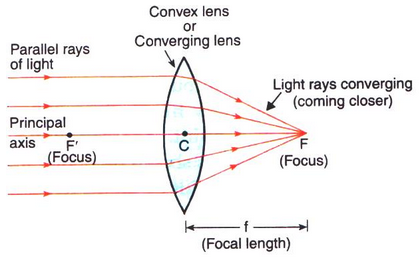
Explain with the help of a diagram, why the convex lens is also called a converging lens.
Answer
A convex lens also known as converging type because it converges a parallel beam of light rays passing through it.
View full question & answer
Question 1492 Marks
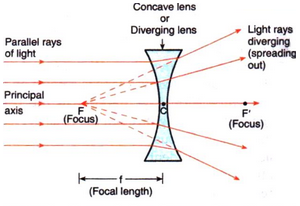
Explain with the help of a diagram, why the concave lens is also called a diverging lens.
Answer
A concave lens is known as diverging lens because it diverges the parallel rays of light passing through it.
View full question & answer
Question 1502 Marks
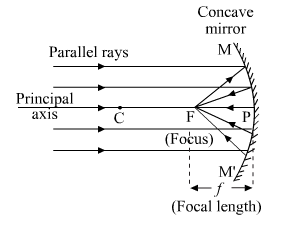
Explain with a suitable diagram, how a concave mirror converges a parallel beam of light rays. Mark clearly the pole, focus and centre of curvature of concave mirror in this diagram.
Answer


All the light rays which are parallel to the principal axis of a concave mirror, converge at the the principal focus (F) after reflection from the mirror. Since a concave mirror converges a parallel beam of light rays, it is also called a converging mirror.
View full question & answer
Answer the questions.[Phy-2M] - Page 3 - Science STD 10 Questions - Vidyadip