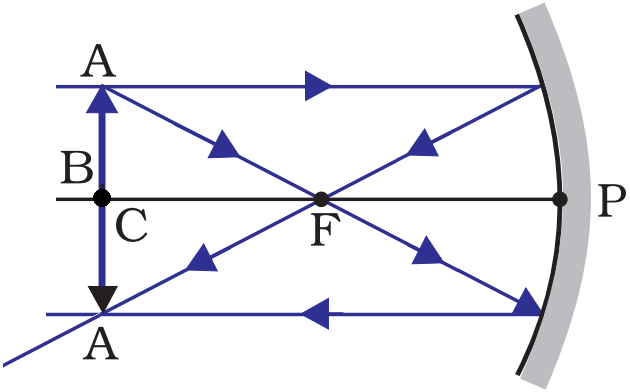
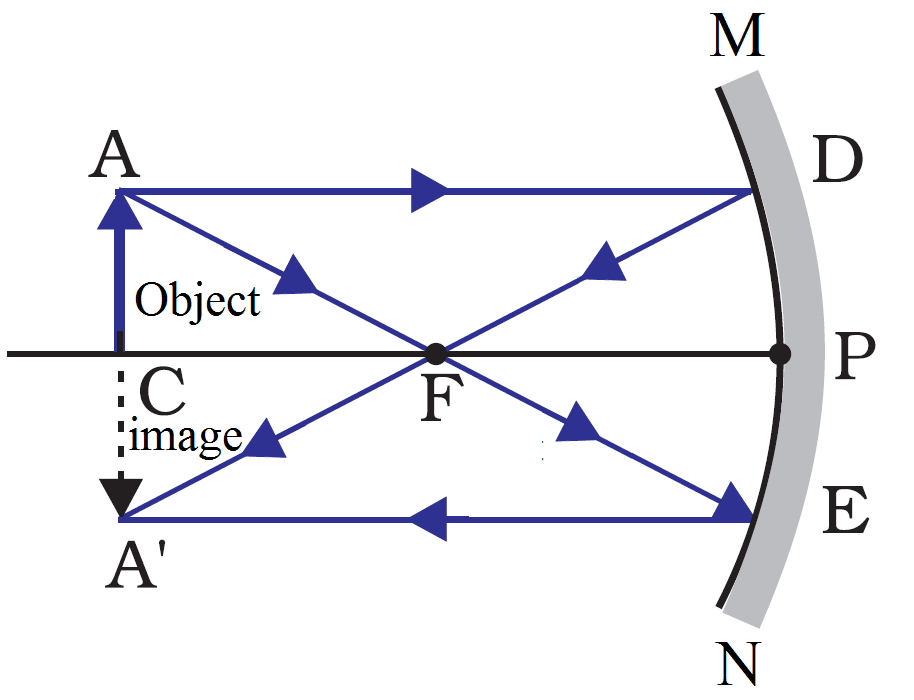
Position of the image: at the centre of curvature
Size of the image: Enlarged
Nature of the image: Real and inverted.
$\frac{1}{u} = \frac{1}{24} - \frac{1}{18}$
$= \frac{3 - 4}{72} = \frac{-1}{72}$
$\therefore u = -72 \text{ cm}$
Object should be placed at a distance of 72 cm from the lens.
$m = \frac{v}{u}$
$= \frac{+ 24}{-72}$
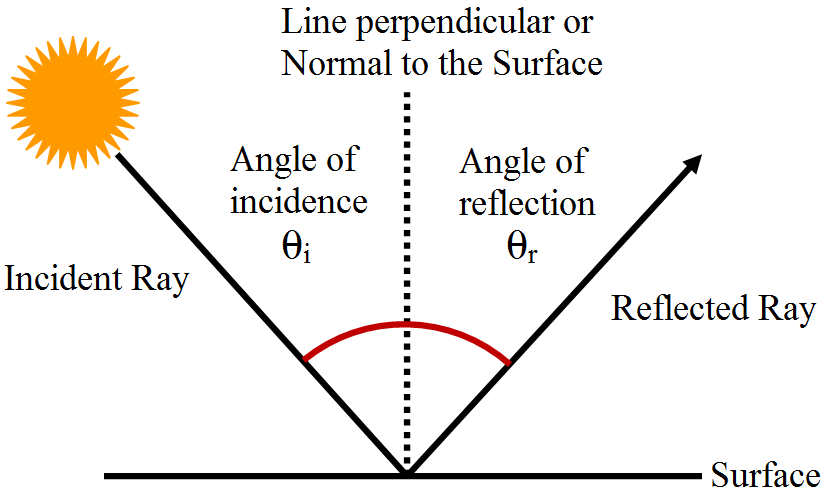
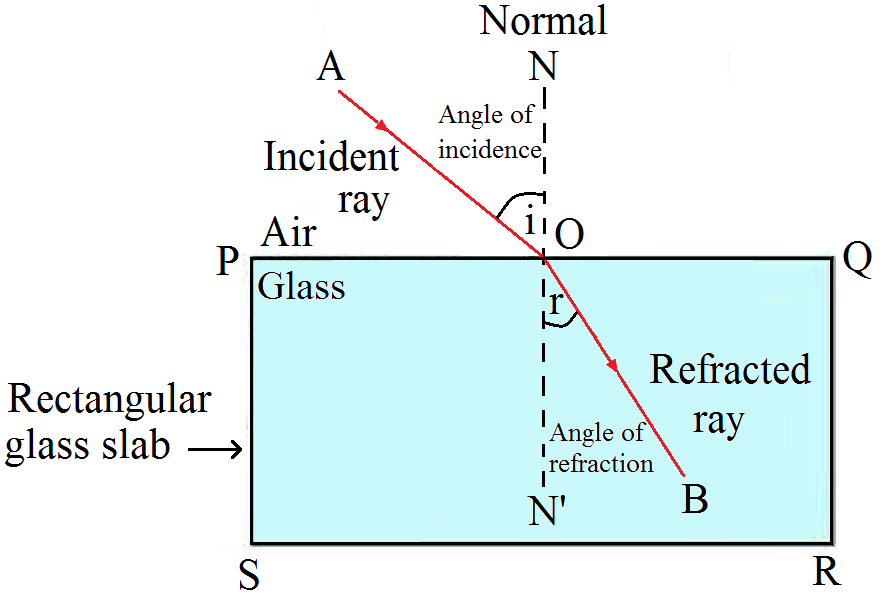
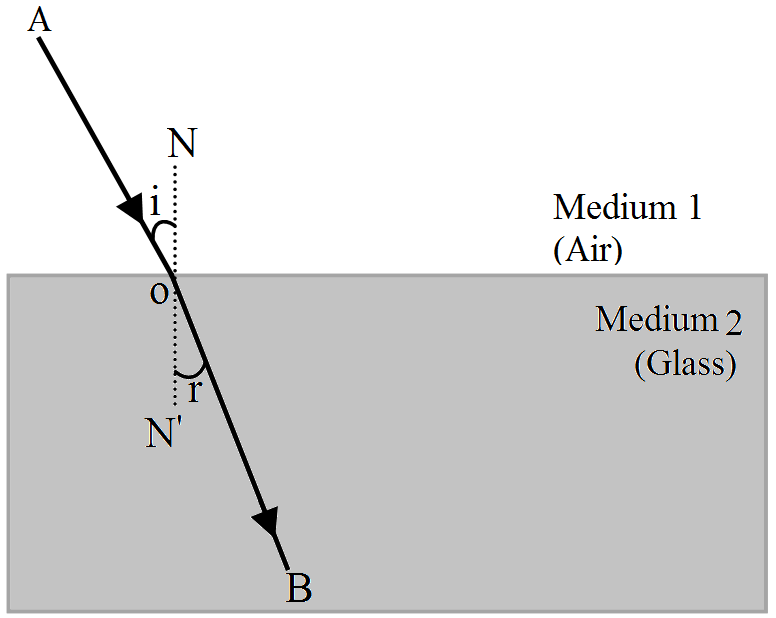
$\frac{\sin\text{i}}{\sin\text{r}}=\text{constant}={^1}\text{n}_2=\frac{\text{n}_2}{\text{n}_1}$
This law is also known as Snell’s law.
The constant, written as 1n2, is called the refractive index of the second medium with respect to the first medium.
Absolute refractive index of a medium:
When a beam of light is going from vacuum to another medium, the value of the refractive index is called absolute refractive index.
The refractive index of vacuum (air) is always 1. The absolute refractive index is denoted by the symbol n2.
$\text{n}_2=\frac{\text{Refractive index of medium}}{\text{Refractive index of vacuum (air)}}=\frac{\text{Speed of light in vacuum}}{\text{Speed of light in the medium}}=\frac{\text{c}}{\text{v}}$
$\therefore\ \text{n}_2=\frac{\text{c}}{\text{v}}$
The power of a lens is the measure of degree of convergence or divergence of light rays falling on it. The SI unit of power of a lens is dioptre denoted by ‘D’.
The power of a lens is given by,
$\text{P}=\frac{1}{\text{f (in metres)}}$
$\therefore$ For lens of focal length 40cm, f = 0.4m
$\therefore\ \text{P}=\frac{1}{0.4}=+2.5\text{D}$
The lens is convex lens and is used to correct hypermetropia.
For lens of focal length -20cm, f = 0.2m
$\therefore\ \text{P}=\frac{1}{-0.2}=-5.0\text{D}$
The lens is concave lens and is used to correct myopia.
$\text{P}=\frac{1}{\text{F}}$
Focal length of any lens is the point where light converges. So, if focal length is more then the lens has converged the light to a larger distance that is it has converged less. Whereas, if the focal length is less then the light is converged at a smaller distance that is converged more. So, we can affirm that lens of 20cm should be used to converge light to a larger extent.$\frac{\sin\text{i}}{\sin\text{r}}=\text{n}$
Given, The refractive index of air with respect to glass is $\frac{-2}{3}$ Refractive index of water with respect to air $=\frac{4}{3}$ Speed of light in glass $=2\times10^8\text{m/s}$ Refractive index of air with respect to glass $\text{n}_\text{ag}=\frac{\text{V}_\text{g}}{\text{V}_\text{a}}$ $\frac{\text{V}_\text{g}}{\text{V}_\text{a}}=\frac{2}{3}$
$\frac{2\ \times\ 10^8}{\text{V}_\text{a}}=\frac{2}{3}$
$\text{V}_\text{a}=2\times10^{8}\text{m/s}$

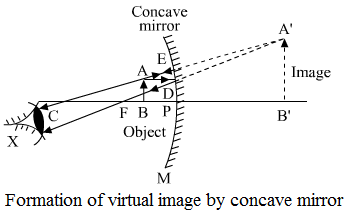
Image is virtual in both the cases.


$\text{u}= -50\text{cm},$
$\text{m}=-\frac{1}{2}$
$\text{m}=-\frac{\text{v}}{\text{u}}$
$-\frac{1}{2}=\frac{\text{v}}{-50}$
$\text{v}=-25\text{cm}$
We know$\frac{1}{\text{v}}+\frac{1}{\text{u}}=\frac{1}{\text{f}}$
$\Rightarrow\frac{1}{-25}+\frac{1}{-50}=\frac{1}{\text{f}}$
$\Rightarrow\frac{-3}{-50}=-\frac{1}{\text{f}}$
$\Rightarrow\text{f}=\frac{-50}{3}\text{cm}$
Case 2:
$\text{m}=\frac{1}{2}$
$\text{f}=\frac{-50}{3}$
$\text{m}=-\frac{1}{5}=-\frac{\text{v}}{\text{u}}$
$\text{v}=-\frac{\text{u}}{5}$
Now,$\frac{1}{\text{v}}+\frac{1}{\text{u}}=\frac{1}{\text{f}}$
$\frac{5}{\text{u}}+\frac{1}{\text{u}}=\frac{-3}{50}$
$\frac{6}{\text{u}}=-\frac{-3}{50}$
$\text{u}=\frac{600}{-3}=-100\text{cm}$
u = -20cm, m = -3cm, for the real image
$\text{m}=-\frac{\text{m}}{\text{u}}$
$\therefore \text{m}=-3=-\frac{\text{v}}{(-20)}$
$\Rightarrow\text{v}= -60\text{cm}$
We have
$\frac{1}{\text{v}}+\frac{1}{\text{u}}=\frac{1}{\text{f}}$
$\Rightarrow \frac{1}{(-60)}+\frac{1}{(-20)}=\frac{1}{\text{f}}$
$\frac{1}{\text{f}}=-\frac{1}{60}-\frac{1}{20}=\frac{-1-3}{60}=\frac{1}{15}$
$\text{f}=-15\text{cm}$
$\text{m}=-\frac{\text{v}}{\text{u}}$
$\therefore \text{m}=-3=-\frac{\text{v}}{(-20)}\Rightarrow \text{v}=-3\text{u}$
We have
$\frac{1}{\text{v}}+\frac{1}{\text{u}}=\frac{1}{\text{f}}$
$\Rightarrow \frac{1}{\text{(3u)}}+\frac{1}{\text{u}}=\frac{1}{(-15)}$
$\Rightarrow \frac{-1+3}{\text{3u}}=-\frac{1}{15}$
$\Rightarrow \text{u}=-\frac{2\times15}{3}=-10\text{cm}$
So object should be placed 10cm from the concave mirror.


The spherical mirrors are of two types:

$\Rightarrow-2.5=\frac{1}{\text{f (in meters)}}$
$\Rightarrow\text{f (in meters)}=\frac{-1}{2.5}=\frac{-1}{\frac{5}{2}}$
$\Rightarrow\text{f (in meters)}=-\frac{2}{5}=-0.4\text{m}$
Now 1m = 100cm ⇒ -0.4m = -40cm Hence the focal length of lens is -40cm.$\text{p}=+2\text{D}$
Using the the formula,
We get,
$\frac{1}{\text{f}}=2$
${\text{f}}=\frac{1}{2}$
${\text{f}}=0.5\text{m}$
$\text{f}=50\text{cm}$
The lens is convex lens of focal length = 0.5m = 50cm
$\text{p}=+4\text{D}$
Using the the formula,
We get,
$\frac{1}{\text{f}}=-4$
${\text{f}}=\frac{1}{-4}$
${\text{f}}=-0.25\text{m}$
$\text{f}=-25\text{cm}$
The lens is concave lens of focal length = -0.25m = -25cm
$\text{f (in m)}=\frac{1}{\text{p}}$
Sign convention for f and P:$1\text{m}=100\text{cm}\Rightarrow0.25\text{m}=25\text{cm.}$
Hence the focal length is -25cm$\text{f}_\text{A}=\frac{1}{\text{P}_\text{A}}=\frac{1}{2}=+0.5\text{m}=+50\text{cm}$
Lens A is a convex lens.
$\text{P}_\text{B}=-4\text{D}$
$\text{f}_\text{B}=\frac{1}{\text{f}_\text{B}}=\frac{1}{-4}=-0.25\text{m}=-25\text{cm}$
Lens B is a concave lens.
$\text{P}_\text{A}=\frac{1}{\text{f}_\text{A}}=\frac{1}{+0.2}=+5\text{D}$
$\text{P}_\text{B}=\frac{1}{\text{f}_\text{B}}=\frac{1}{-0.1}=-10\text{D}$
P = PA + PB = +5D + (-10D) = -5D
f = ?
We know that
$\text{f}=\frac{\text{R}}{2}=\frac{50}{2}=25\text{cm}$
$_\text{n}\text{w}_\text{a}=\frac{_\text{n}\text{g}_\text{a}}{_\text{n}\text{w}_\text{a}}=\frac{\big(\frac{3}{2}\big)}{\big(\frac{4}{3}\big)}=\frac{9}{8}$
$_\text{n}\text{w}_\text{a}=\frac{_\text{n}\text{g}_\text{a}}{_\text{n}\text{w}_\text{a}}=\frac{\big(\frac{4}{3}\big)}{\big(\frac{3}{2}\big)}=\frac{8}{9}$
$\Rightarrow\text{g}\mu\text{w}=\frac{4\times2}{3\times3}=\frac{8}{9}$
$\therefore$ Refractive index of water w.r.t glass is $\frac{8}{9}.$
$\text{f}=\frac{\text{R}}{2}=1\text{m}$
u = -3.5m We konw that$\Rightarrow\frac{1}{\text{v}}+\frac{1}{(-3.5)}=\frac{1}{1}$
$\Rightarrow\frac{1}{\text{v}}=1+\frac{1}{3.5}=1+\frac{10}{30}=1+\frac{2}{7}=\frac{9}{7}$
$\therefore \text{v}=\frac{7}{9}=0.77\text{m}$
$\text{u}=-2\text{v}=-2\times10=-20\text{cm}$
So, the image is fomed 0.77m in behind the mirror.
AS m is positive, so image formed is virtual and efect.
$\text{R}=2\text{f}$
$\Rightarrow50=2\text{f}$
$\Rightarrow\text{f}=\frac{50}{2}=25\text{cm}$
Focal length $=25\text{cm}.$ When an object is kept at the focus of the concave mirror then the image is formed at infinity.$\text{P}=\frac{1}{\text{f}_\text{x}}+\frac{\text{1}}{\text{f}_\text{y}}$
$5=\frac{100}{15}+\frac{\text{1}}{\text{f}_\text{y}}$
$\frac{\text{1}}{\text{f}_\text{y}}=5-\frac{100}{15}$
$=\frac{-25}{15}$
${\text{f}_\text{y}}=-0.6\text{m}=-60\text{cm}$
$\frac{1}{\text{f}}=\frac{1}{120}-\Big(-\frac{1}{60}\Big)$
$=\frac{1}{120}+\frac{1}{60}$
$=\frac{3}{120}=40$
$\text{f}=+40\text{cm}$
Therefore Focal length of lens is 40cm.$\frac{\text{H(image)}}{\text{H(object)}}=\frac{\text{v}}{\text{u}}$
$\text{H}_\text{i}=-\frac{120}{60}\times5$
$=-10\text{cm}$
Height of image is 10cm. Negative sign means image is real and inverted.$2(\text{lb}+\text{bh}+\text{lh})=4650$
$\text{u}=-45\text{cm}$
$\text{v}=90\text{cm}$
$\therefore\text{ Lence is convex}$
$\frac{1}{\text{f}}=\frac{1}{\text{v}}+\frac{1}{\text{u}}$
$\frac{1}{\text{f}}=\frac{1}{90}+\frac{1}{45}$
$\frac{1}{\text{f}}=\frac{1+2}{90}=\frac{3}{90}$
$\frac{1}{\text{f}}=\frac{1}{30}=+30\text{cm}$
$\frac{\text{v}}{\text{u}}=\frac{\text{h}_\text{i}}{\text{h}_0}$
$\frac{90}{-45}=\frac{2}{\text{h}_0}\frac{\text{h}_\text{i}}{\text{h}_0}=2$
$\frac{90}{-45}=\frac{\text{h}_\text{i}}{2}$
$\text{h}_\text{i}=\frac{90\times2}{-45}=-4\text{cm}$
Here, image distance, v = +80cm
Magnification, m = -3
Object distance, u = ?
Now, magnification,
$\text{m}=\frac{\text{v}}{\text{u}}\Rightarrow\ -3=\frac{80}{\text{u}}\ \text{or u }=\frac{-80}{3}\text{cm}$Nature of image will be real, magnified and inverted. The image will be formed beyond 2F.
By using lens formula,
$\frac{1}{\text{v}}-\frac{1}{\text{u}}=\frac{1}{\text{f}}$
$\Rightarrow\ \frac{1}{\text{f}}=\frac{1}{80}-\frac{3}{-80}=\frac{1}{20}\text{ or f }=20\text{cm}$
Focal length is positive so, the lens is convex.
$\text{m}=\frac{\text{v}}{\text{u}}=-3$
$\text{v}=-3\text{u}$
Put in eq. (i) -u - 3u = 80 -4u = 80 u = -20cm Distance lens from filament is 20cm v = -3u = 60cm Lens formula, $\frac{1}{\text{v}}-\frac{1}{\text{u}}=\frac{1}{\text{f}}$$\frac{1}{60}-\frac{1}{-20}=\frac{1}{\text{f}}$
$\frac{1}{\text{f}}=\frac{1+3}{60}=\frac{4}{60}$
$\text{f}=15\text{cm}$
$\frac{1}{\text{v}}-\frac{1}{\text{u}}=\frac{1}{\text{f}}$
$\frac{1}{\text{v}}-\frac{1}{-150}=\frac{1}{100}$
$\frac{1}{\text{v}}=\frac{1}{100}-\frac{1}{150}$
$\frac{1}{\text{v}}=\frac{1}{300}$
$\text{v}=+300\text{mm}$
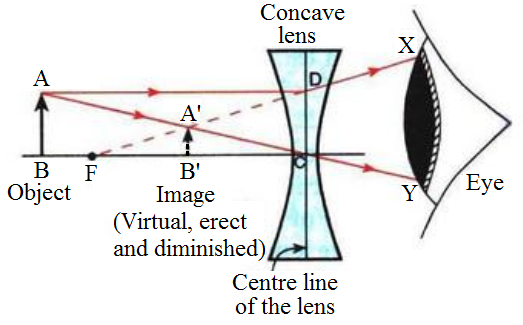
The image formed by converging lens is real, inverted and magnified (2 times). It is formed behind the converging lens. On the other hand, the image formed by diverging lens is virtual, crect and diminished. It is formed in front of the diverging lens.$\frac{1}{\text{v}}+\frac{1}{\text{u}}=\frac{1}{\text{f}}$
or, $\frac{3}{\text{u}}-\frac{1}{\text{u}}=-\frac{1}{20}$ or, $\frac{3-1}{\text{u}}=-\frac{1}{20}$ or, $\text{u}=-40\text{cm}$ Using this, we can find image distance:$\frac{1}{\text{v}}+\frac{1}{\text{u}}=\frac{1}{\text{f}}$
or, $\frac{1}{\text{v}}-\frac{1}{40}=-\frac{1}{20}$ or, $\frac{1}{\text{v}}=-\frac{1}{20}+\frac{1}{40}$ or, $\frac{-2+1}{40}=-\frac{1}{40}$But above value of image distance does not match with our initial assumption. This means that the mirror is not a concave mirror but a convex mirror. Let us calculate with the assumption that it is a convex mirror.
$\frac{1}{\text{v}}+\frac{1}{\text{u}}=\frac{1}{\text{f}}$
or, $\frac{1}{\text{v}}-\frac{1}{40}=-\frac{1}{20}$ or, $\frac{1}{\text{v}}=-\frac{1}{20}+\frac{1}{40}=\frac{3}{40}$ or, $\text{v}=\frac{40}{3}\text{cm}$Nature of mirror: convex mirror.
Nature of image: Smaller than object, erect and virtual.

u = -24cm
f = 8cm
Lens formula, $\frac{1}{\text{v}}-\frac{1}{\text{u}}=\frac{1}{\text{f}}$
$\frac{1}{\text{v}}-\frac{1}{-24}=\frac{1}{8}$
$\frac{1}{\text{v}}=\frac{1}{12}$
$\text{v}=12\text{cm}$
Image is formed 12cm behind the lens.
$\text{m}=\frac{\text{v}}{\text{u}}=\frac{\text{h}_2}{\text{h}_1}$
$\frac{12}{-24}=\frac{\text{h}_2}{3}$
$\text{h}_2=-1.5\text{cm}$
Image is 1.5cm hight, real and inverted.
h1 = 3cm
f = 8cm
Lens formula, $\frac{1}{\text{v}}-\frac{1}{\text{u}}=\frac{1}{\text{f}}$
$\frac{1}{\text{v}}-\frac{1}{-3}=\frac{1}{8}$
$\frac{1}{\text{v}}=-\frac{5}{24}$
${\text{v}}=-4.8\text{cm}$
Image is formed 4.8cm in front of the lens.
$\text{m}=\frac{\text{v}}{\text{u}}=\frac{\text{h}_2}{\text{h}_1}$
$\frac{-4.8}{-3}=\frac{\text{h}_2}{3}$
$\text{h}_2=+4.8\text{cm}$
Image is 4.8cm high, virtual and erect.