Questions

case /data -based [Phy-4M]

🎯

Test yourself on this topic

12 questions · timed · auto-graded

Question 14 Marks
You are given the following current- time graphs from two different sources:
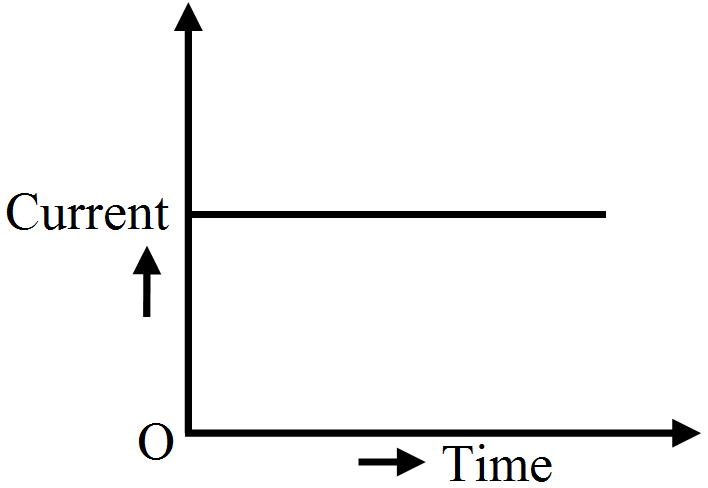
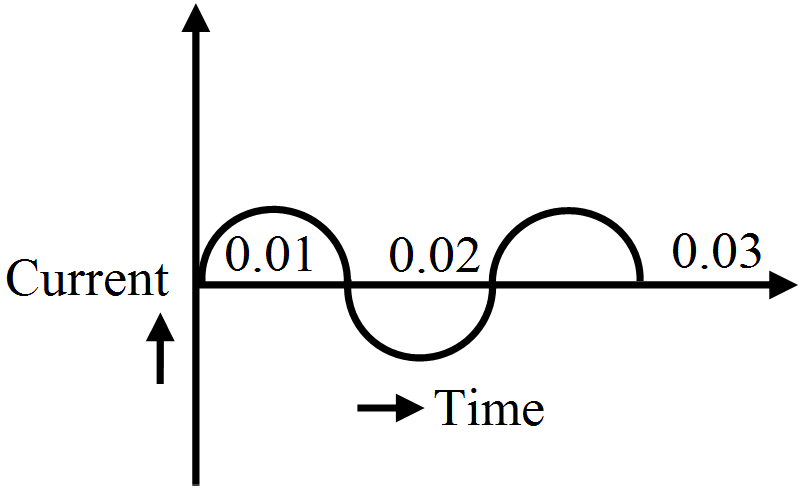
Now, answer the following questions:
  1. Name the type of current in two cases. 
  2. Identify any one source for each type of these currents. 
  3. What is the frequency of current in case (b) in India?
Use above graphs to write two differences between the current in two cases.
Answer
In graph (a) current is constant and in graph (b) current is different.
1. Source of (a) is battery and source of (b) is AC generator.
2. 50Hz frequency of current in case b.
3.
Alternating currentDirect current
1.
Both the magnitude and direction of current varies within equal intervals of time.
Direction of current does not vary with time and remains constant.
2.
The frequency of ac is 50Hz or 60Hz depending upon the country.
The frequency for direct current is zero.
View full question & answer
Question 24 Marks
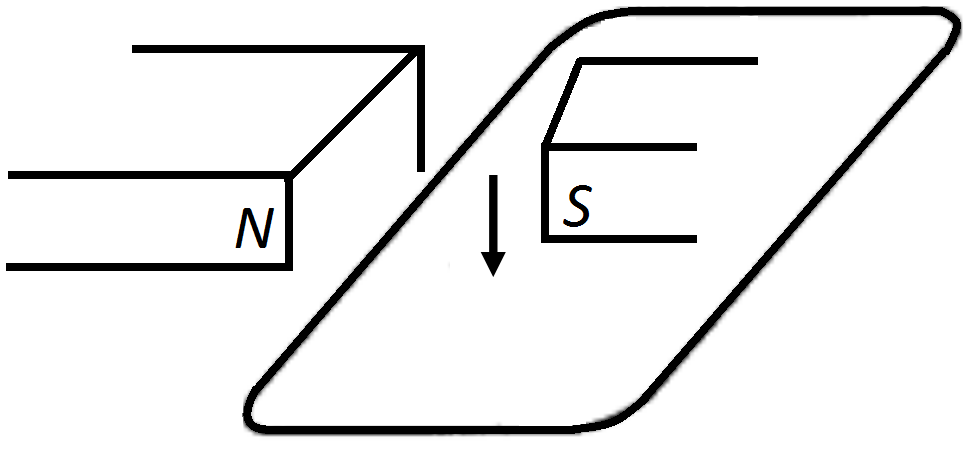
The wire in Figure below is being moved downwards through the magnetic field so as to produce induced current.


What would be the effect of:
  1. Moving the wire at a higher speed?
  2. Moving the wire upwards rather than downwards?
  3. Using a stronger magnet?
  4. Holding the wire still in the magnetic field?
  5. Moving the wire parallel to the magnetic field lines?
Answer
  1. If the wire is moved at a higher speed, the flow of current will increase.
  2. If the wire is moved upwards rather than downwards, the flow of current will reverse.
  3. If we use a stronger magnet, the flow of current will increase.
  4. If the wire is held still in the magnetic field, the flow of current will be zero.
  5. If the wire is moved parallel to magnetic field lines, the flow of current will be zero.
View full question & answer
Question 34 Marks
Read the following and answer any three questions from (i) to (iv).

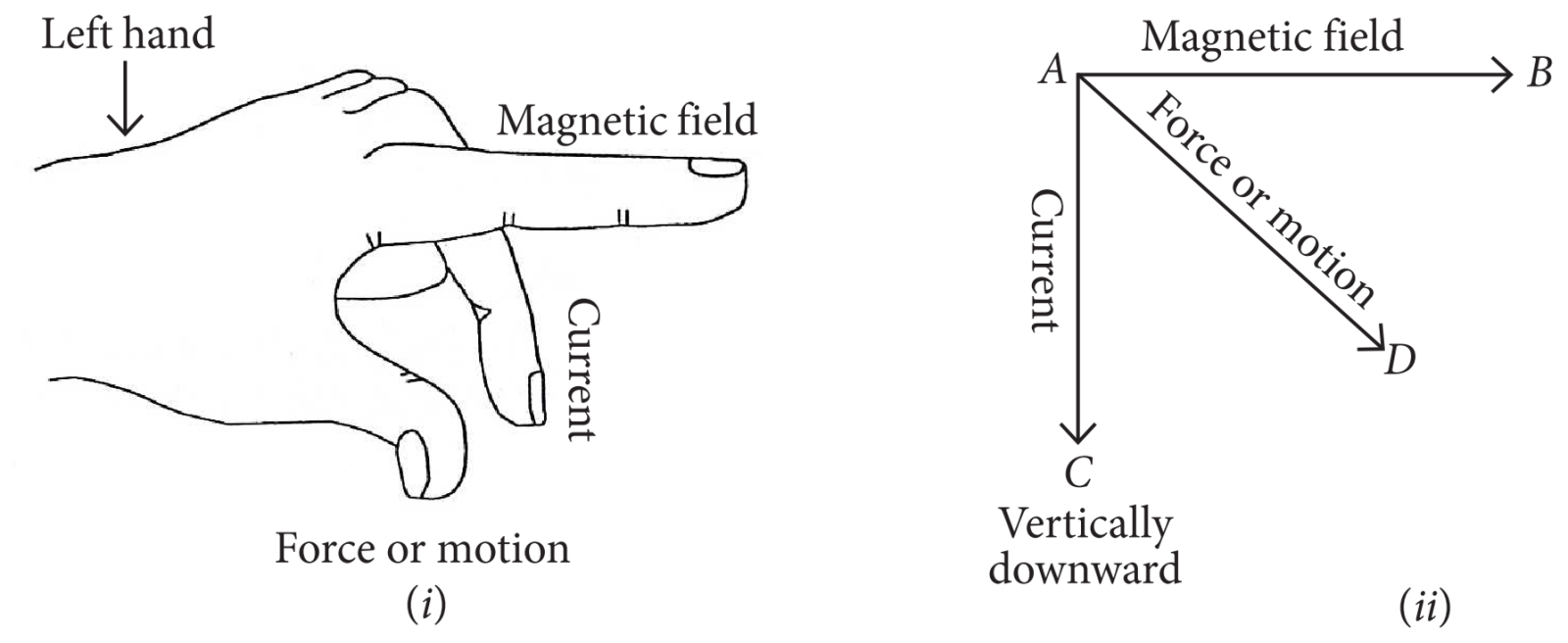
Andre Marie Ampere suggested that a magnet must exert an equal and opposite force on a current carrying conductor, which was experimentally found to be true. But we know that current is due to charges in motion. Thus, it is clear that a charge moving in a magnetic field experience a force, except when it is moving in a direction parallel to it. If the direction of motion is perpendicular to the direction of magnetic field, the magnitude of force experienced depends on the charge, velocity (v), strength of magnetic field (B), and sine of the angle between v and B. Direction of magnetic force is given by Fleming's left-hand rule.

  1. If an electron is travelling horizontally towards east. A magnetic field in vertically downward direction exerts a force on the electron along which side?

  2. If a charged particle is moving along a magnetic field line. The magnetic force on the particle will?

  3. a) A magnetic field exerts no force on?
    b) what Andre Marie Ampere suggested?

  4. What is fleming's left hand rule?

Answer
  1. (d) South.

Explanation:

Fleming's left-hand rule is used to determine the direction of force on electron i.e., in south direction.

  1. (d) Zero.

Explanation:

The angle between velocity and magnetic field is zero. Therefore, magnetic force on the particle is zero.

  1. (a) A stationary electric charge.
  2. (a) Forces both pointing into the plane of paper.

Explanation:

As the direction of current is taken opposite to the direction of motion of electrons, therefore, current from the motion of electron and proton is n the same direction, i.e., from bottom to top. Now, according to Fleming's left-hand rule, the electron and the proton experience forces both pointing into the plane of paper.

  1. (c) Into the page.
View full question & answer
Question 44 Marks
Read the following and answer any three questions from (i) to (iv).

An insulated copper wire wound on a cylindrical cardboard tube such that its length is greater than its diameter is called a solenoid. When an electric current is passed through the solenoid, it produces a magnetic field around it. The magnetic field produced by a current-carrying solenoid is similar to the magnetic field produced by a bar magnet. The field tines inside the solenoid are in the form of parallel straight tines. The strong magnetic field produced inside a current-carrying solenoid can be used to magnetise a piece of magnetic material, like soft iron, when placed inside the solenoid. The strength of magnetic field produced by a current carrying solenoid is directly proportional to the number of turns and strength of current in the solenoid.

  1. The strength of magnetic field inside a long current-carrying straight solenoid is called?

  2. The north-south polarities of an electromagnet can be found easily by using which rule?

  3. Define a solenoid?

  4. A long solenoid carrying a current produces a magnetic field B along its axis. If the current is double and the number of turns per cm is halved, then new value of magnetic field will be?
Answer
  1. (c) Same at all points.

Explanation:

Magnetic field inside infinite solenoid is uniform. Hence, it is same at all points.

  1. (c) Clock face rule.
  2. (c) The pattern of the magnetic field associated with the solenoid is different from the pattern of the magnetic field around a bar magnet.

Explanation:

The pattern of the magnetic field associated with solenoid is same as the pattem of the magnetic field around a bar magnet.

  1. (a) B

Explanation:

For a long solenoid, magnetic field $\text{B}\propto\text{in;}$ where I is the flowing current and n is a number of turns per unit length in the solenoid. Therefore, in the given case, magnetic field will remain unchanged.

  1. (a) N-pole.
View full question & answer
Question 54 Marks

 
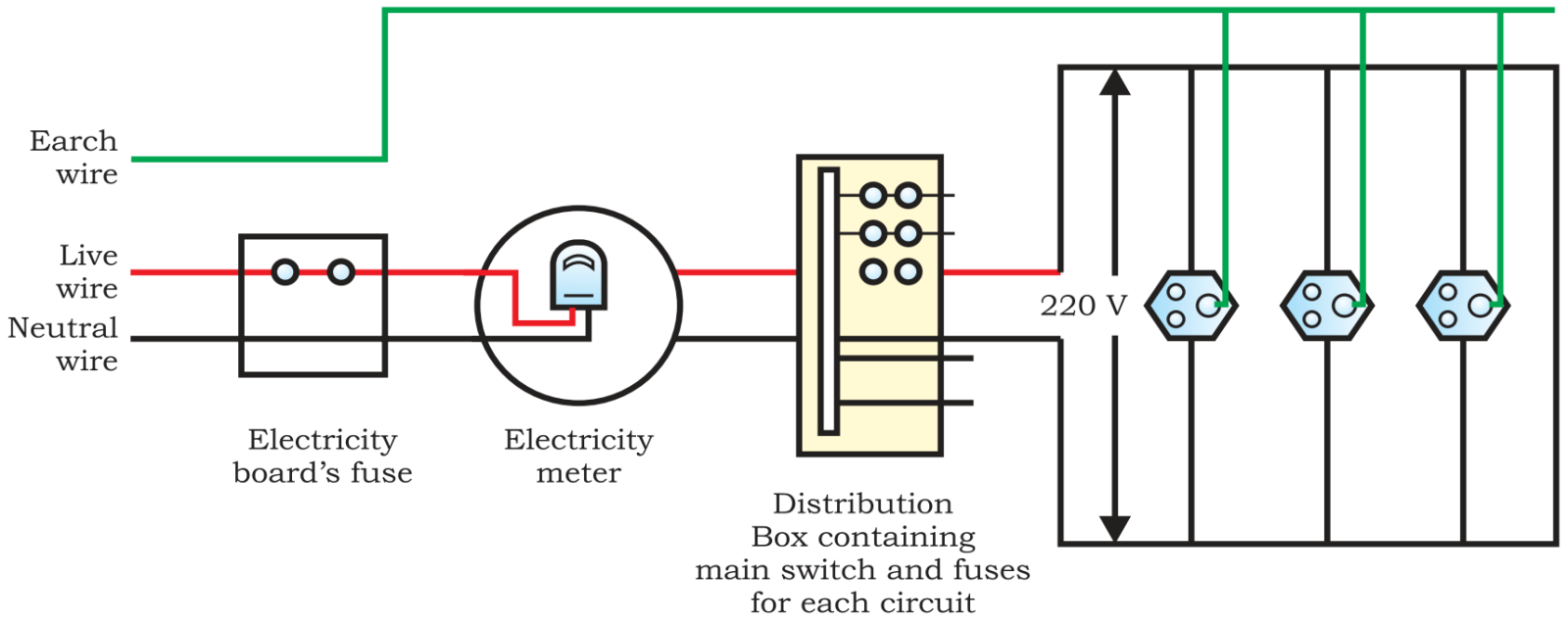
  1. The figure shows a domestic electric circuit. Study this circuit carefully and list any three errors in the circuit and justify your answer.
  2. Give one difference between the wires used in the element of an electric heater and in a fuse.
  3. List two advantages of parallel connection over series connection.1 image attached.
Answer
  1. Following are the errors in the circuit given above.
  1. Fuse is incorrectly connected to the neutral wire (N), it must be connected to the live wire(L).
  2. Bulb B2 is connected to the neutral wire.
  3. Two switches S1 and S2 in both B1 circuit and no switch in bulb B2 circuit.
  1. Element of electric heater-high melting point.

Element of fuse wire-Low melting point.

  1.  
  1. Each application has equal potential difference.
  2. Each appliance has separate switch to ON/ OFF the flow of current through it.
View full question & answer
Question 64 Marks
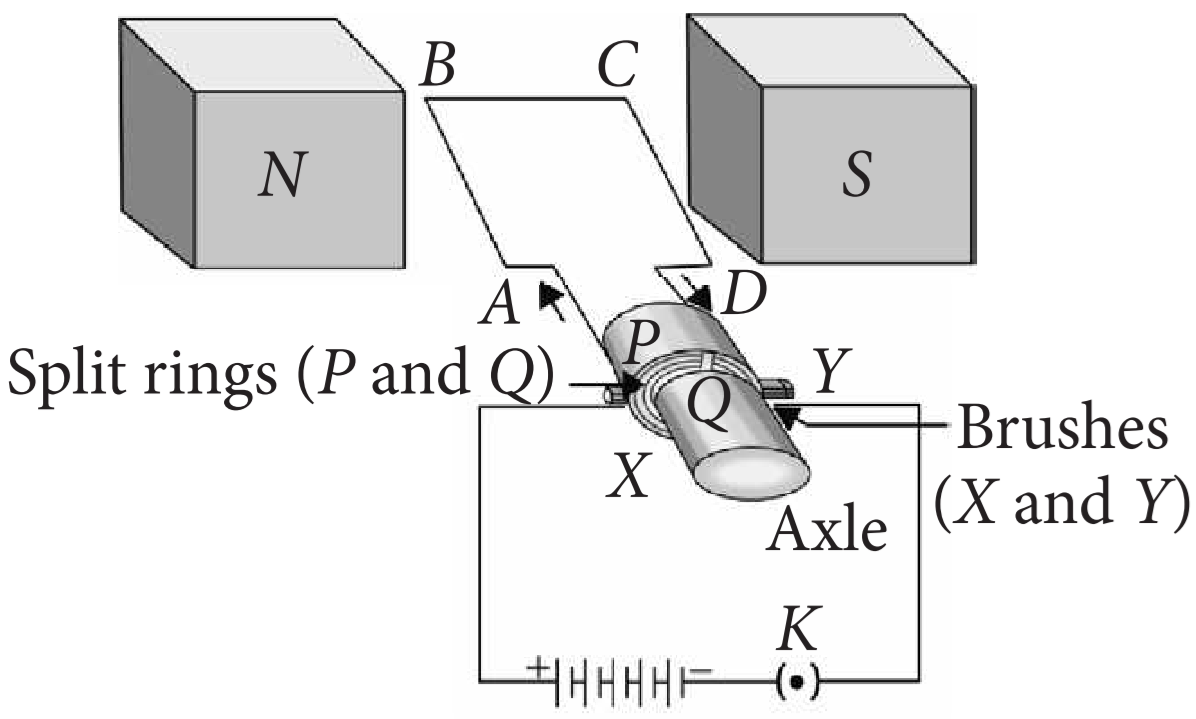
Answer
  1. (d) Both (a) and (b).
  2. (b) The direction of the current in the coil.

Explanation:

The direction of the current has no effect on the size of the turning effect on the coil.

  1. (b) Electrical energy to mechanical energy.

​​​​​​​​​​​​​​Explanation:

​​​​​​​Electric fan works on the principle of electric motor. It converts electrical energy to mechanical energy.

  1. (b) Brushes.
  2. (c) Half rotation.
View full question & answer
Question 74 Marks
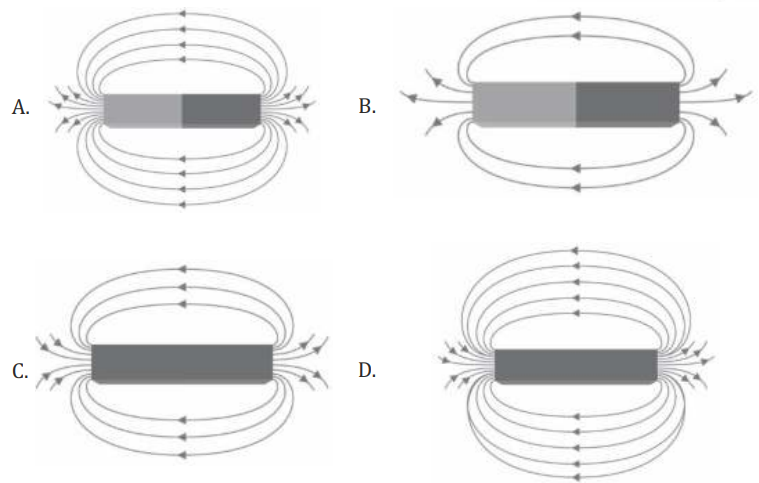
Which of these magnets has the strongest magnetic field?
Image
Answer
1. Mentions that the ammeter’s reading will be decreased by one-half.
View full question & answer
Question 84 Marks
Answer
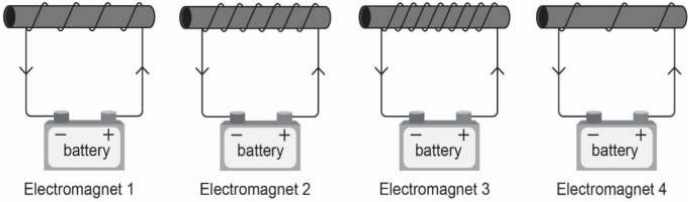
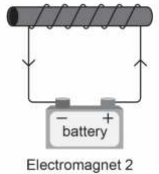
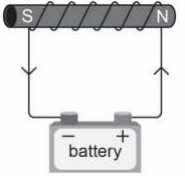
5. C. Electromagnet 3
6. Yes
    Yes
    No
7. 
Image
8. B. Electric bell
View full question & answer
Question 94 Marks
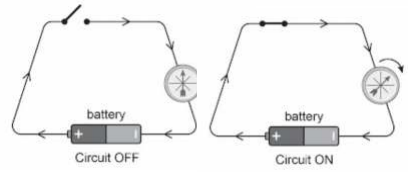
Reema placed a magnetic needle in an electric circuit.
She noticed a delection of the needle when the circuit is turned ON.
Image
3. Reema placed a second battery in the circuit and turned the circuit ON.
What change in the needle will she observe now?
  A. The needle will keep spinning.
  B. The delection of the needle will increase.
  C. The delection of the needle will decrease.
  D. There will be no change in the delection of the needle.
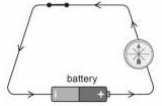
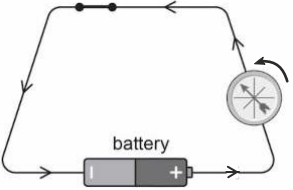
4. Reema reverses the direction of the battery in the circuit.
She turns the circuit ON.
Draw an arrow on the magnetic needle to show the correct delection.
Image
Answer
3. B. The delection of the needle will increase.
4. 
Image
View full question & answer
Question 104 Marks
Leena creates an electric circuit with three resistors R1, R2 and R3.
Image
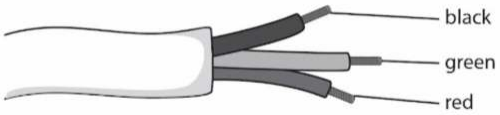
9. Which wire should be connected to the negative terminal of a socket?
Answer
9. Mentions black wire as the response.
View full question & answer
Question 114 Marks
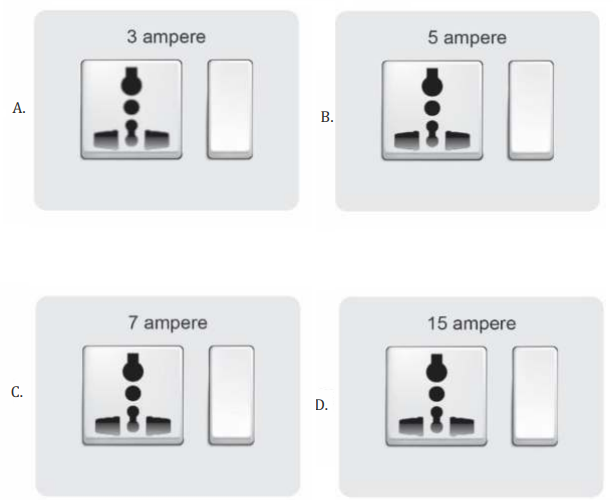
Electrical devices often have an ampere marking to indicate the strength of electric current
required for it to work.
10. Will there be any change in the ammeter reading if the length of the wire in the circuit is doubled?
Explain your answer. 
Image
Answer
10. D. 15 Ampere
View full question & answer
Question 124 Marks
2. Which of these statements is true for the lines of a magnetic ield?
Circle ‘Yes’ or ‘No’ for the correct response.

Is the statement true?

Yes or No

Lines of a magnetic ield can sometimes cross each other.

Yes/No

Lines of a magnetic ield emerge from the north pole and meet at the south pole.

Yes/No

Lines of a magnetic ield can sometimes change direction.

Yes/No

Answer
2. No
    Yes
    No
View full question & answer