Question
You are given the following current- time graphs from two different sources:
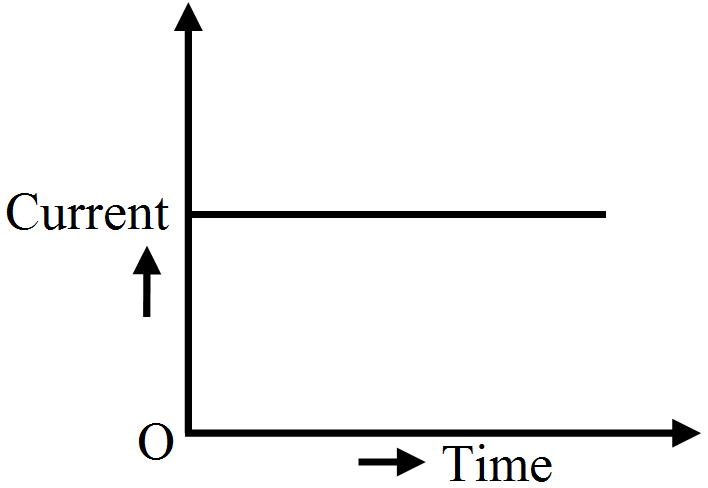
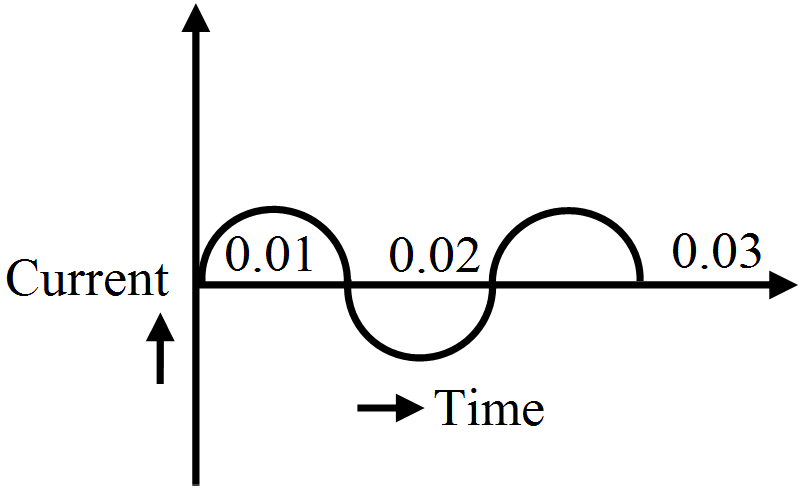
Now, answer the following questions:
  1. Name the type of current in two cases. 
  2. Identify any one source for each type of these currents. 
  3. What is the frequency of current in case (b) in India?
Use above graphs to write two differences between the current in two cases.

Answer

In graph (a) current is constant and in graph (b) current is different.
1. Source of (a) is battery and source of (b) is AC generator.
2. 50Hz frequency of current in case b.
3.
Alternating currentDirect current
1.
Both the magnitude and direction of current varies within equal intervals of time.
Direction of current does not vary with time and remains constant.
2.
The frequency of ac is 50Hz or 60Hz depending upon the country.
The frequency for direct current is zero.

Need a full question paper?

Generate a complete, print-ready paper with questions like this in minutes — across 16+ boards, with answer keys.

Start Generating Free

Similar questions

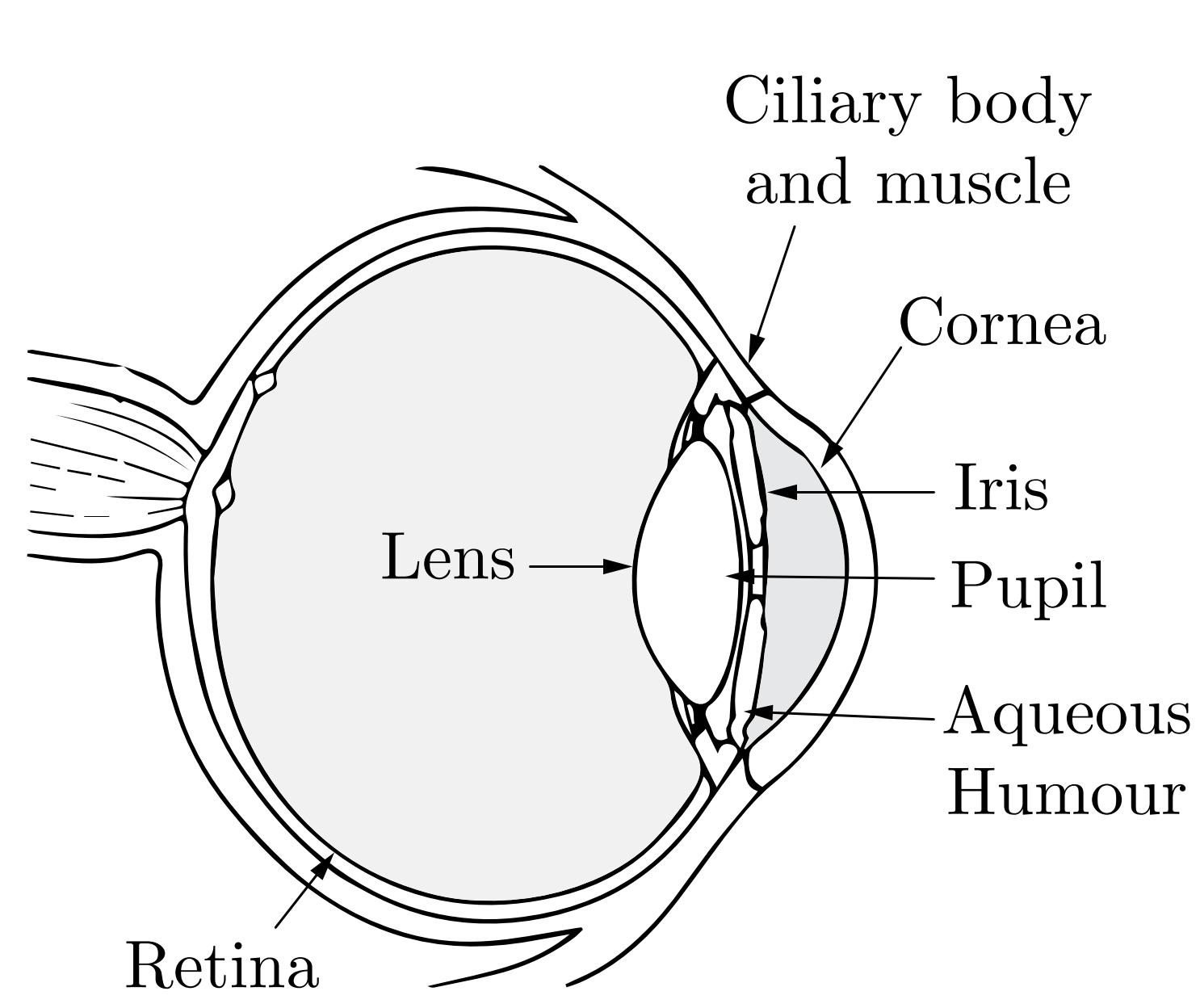
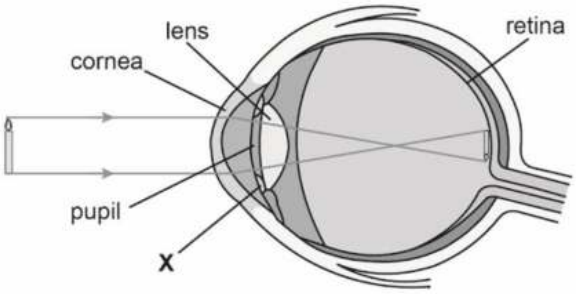
The ciliary muscle muscles of eye control the curvature of the lens in the eye and hence can alter the effective focal length of the system. When the muscles are fully relaxed, the focal length is maximum. When the muscles are strained the curvature of lens increases (that means radius of curvature decreases) and focal length decreases. For a clear vision the image must be on retina. The image distance is therefore fixed for clear vision and it equals the distance of retina from eye-lens. It is about $2.5 cm$ for a grown-up person. A person can theoretically have clear vision of objects situated at any large distance from the eye. The smallest distance at which a person can clearly see is related to minimum possible focal length, The ciliary muscles are most strained in this position. For an average grown-up person minimum distance of object should be around 25 cm. A person suffering for eye defects uses spectacles (Eye glass). The function of lens of spectacles is to form the image of the objects within the range in which person can see clearly. The image of the spectacle-lens becomes object for eye-lens and whose image is formed on retina. The number of spectacle-lens used for the remedy of eye defect is decided by the power of the lens required and the number of spectacle-lens is equal to the numerical value of the power of lens with sign. For example power of lens required is $+3 D$ (converging lens of focal length $100 / 3 cm$ ) then number of lens will be $+3$

For all the calculations required you can use the lens formula and lens maker's formula. Assume that the eye lens is equiconvex lens. Neglect the distance between eye lens and the spectacle lens.
(i) What do you mean by the ciliary muscles?
(ii) What is the minimum focal length of eye lens of a normal person ?
(iii) What is the maximum focal length of eye lens of normal person ?
or
(iv) A near-sighted man can clearly see object only up-to a distance of $100 cm$ and not beyond this. What is the number of the spectacles lens necessary for the remedy of this defect ?
Study the following table for a convex lens for different positions of object and answer the following questions:
Position of objectPosition of imageRelative size of image
At infinityAt focus F_(2)Highly diminished point sized
Beyond 2F_(1)Between F_(2) and 2F_(2)Diminished
At 2F_(1)At 2F_(2)Same size
Between F_(1) and 2F_(1)Beyond 2F_(2)Enlarged
At focus F_(1)At infinityInfinitely large or highly enlarged
Between focus F_(1) and optical centre OOn the same side of the lens as the objectEnlarged

(i) What is the nature of the image, if an object is placed at infinity ?
(ii) Identify the nature of the image for which the object is between focus and optical centre.
(iii) What is position of image, when object is place at focus $\left(f_1\right)$ ?
or
(iv) What is the focal length of a lens for an object placed $50 cm$ from the lens producing virtual image at a distance of $10 cm$ in front of the lens?

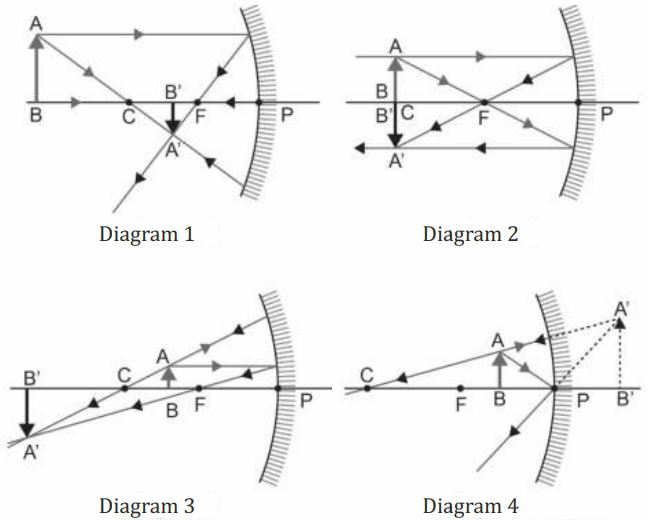
A concave mirror forms image of an object thrice in its size on a screen. Magnification of a mirror gives information about the size of the image relative to the object. It is defined as the ratio of size of image to the size of object. It is represented by $m$.
\[
m=\frac{\text { Size of image }}{\text { Size of object }}
\]
Sign of magnification by mirror gives the information about the nature of the image produce by it.
(i) Describe the nature of image formed.
(ii) If the object $x$ distance from the pole of mirror, then find image distance from the pole.
(iii) If the radius of curvature of mirror is $R$, then write the relation between object distance, image distance and focal length of the mirror.
or
(iv) Give one use of concave mirror.
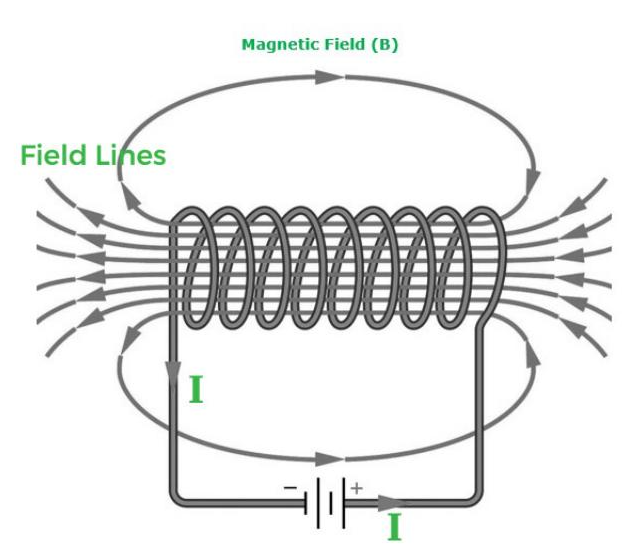
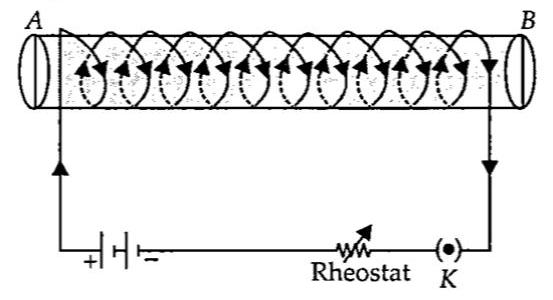
An insulated copper wire wound on a cylindrical cardboard tube such that its length is greater than its diameter is called a solenoid. When an electric current is passed through the solenoid, it produces a magnetic field around it. The magnetic field produced by a current-carrying solenoid is similar to the magnetic field produced by a bar magnet. The field lines inside the solenoid are in the form of parallel straight lines. The strong magnetic field produced inside a current-carrying solenoid can be used to magnetize a piece of a magnetic material like soft iron when placed inside the solenoid. The strength of the magnetic field produced by a current-carrying solenoid is directly proportional to the number of turns and strength of the current in the solenoid.
Image
i. What would be the strength of the magnetic field inside a long current-carrying straight solenoid?
ii. Which end is north and which end is south pole when current flows through a solenoid?
iii. A long solenoid carrying a current produces a magnetic field B along its axis. If the current is double and the number of turns per cm is halved, then what will be the new value of the magnetic field?
OR
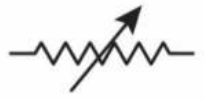
A soft iron bar is enclosed by a coil of insulated copper wire as shown in the figure. When the plug of the key is closed, then where would the face B of the iron bar be marked?
Image
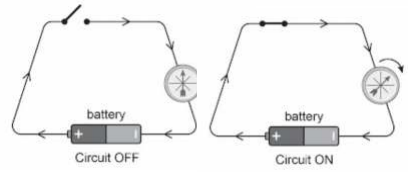
Reema placed a magnetic needle in an electric circuit.
She noticed a delection of the needle when the circuit is turned ON.
Image
3. Reema placed a second battery in the circuit and turned the circuit ON.
What change in the needle will she observe now?
  A. The needle will keep spinning.
  B. The delection of the needle will increase.
  C. The delection of the needle will decrease.
  D. There will be no change in the delection of the needle.
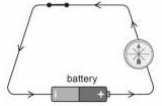
4. Reema reverses the direction of the battery in the circuit.
She turns the circuit ON.
Draw an arrow on the magnetic needle to show the correct delection.
Image