Questions · Page 1 of 2

[3 Mark Questions]

🎯

Test yourself on this topic

50 questions · timed · auto-graded

Question 13 Marks
A reddish-brown metal ' $X$ ', when heated in air, gives a black compound ' $Y$ ', which when heated in presence of $H _2$ gas gives ' $X$ ' back. ' $X$ ' is refined by the process of electrolysis; this refined form of ' $X$ ' is used in electrical wiring.
Identify ' $X$ ' and ' $Y$ '. Draw a well-labeled diagram to represent the process of refining ' $X$ '.
Answer
a) ' $X$ ' - Copper/ $Cu$ and ' $Y$ ' - $CuO$
b) Diagram to represent the process of refining of ' $X$
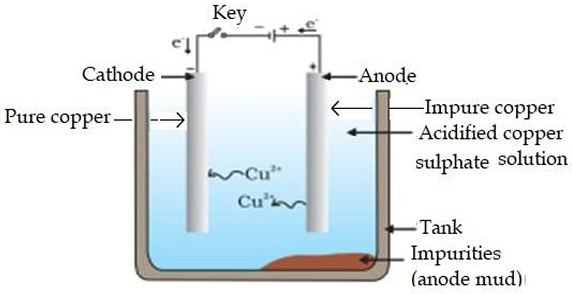
Image
View full question & answer
Question 23 Marks
An element ' $M$ ' with electronic configuration (2,8,3) combines separately with $Cl , SO ^2$ anions. Write the chemical formulae of the compounds formed. Predict with the suitable reason the nature of the bond formed by element ' $M$ ' in general. How will the electrical conductivity of the compounds formed vary with respect to 'M'?
Answer
$
MCl _3 ; M _2\left( SO _4\right)_3
$
$M$ in general forms Ionic bond. It can acquire a stable electronic configuration of neon $(2,8)$ by losing its three valence electrons to form $M ^{3+}$ cation.
Compounds formed will conduct electricity in liquid / molten state but not in solid state in contrast to ' $M$
View full question & answer
Question 33 Marks
The given reaction shows one of the processes to extract the metals like Iron and Manganese.
$
MnO _2( s )+ Al ( s ) \rightarrow Mn ( l )+ Al _2 O _3( s )+\text { Heat }
$
a) Give reason why the above reaction is known as a thermite reaction.
b) Identify the substance oxidised and reduced in the above reaction.
c) Give a reason why Aluminium is preferably used in thermite reactions.
Answer
a) The above reaction is known as a thermite reaction as the reaction is highly exothermic reaction.
b) Substance oxidised - $Al ( s )$
Substance reduced $- MnO _2$ (s)
c) Aluminium is preferably used in thermite reactions as it is placed above Fe and $Mn$ in reactivity series of metals.
View full question & answer
Question 43 Marks
  1. What are amphoteric oxides? Choose the amphoteric oxides from amongst the following oxides:
$\text{Na}_{2}\text{O, ZnO, Al}_{2}\text{O}_{3}, \text{CO}_{2}, \text{H}_{2}\text{O}$
  1. Why is it that non-metals do not displace hydrogen from dilute acids?
Answer
  1. Metal oxides that react with both acids and bases to produce salt and water are known as amphoteric oxides. For example, zinc reacts with an acid or a base to produce salt and water.
$ZnO , Al _2 O _3$ etc. are amphoteric oxides.
  1. Non-metals do not displace hydrogen from dilute acids is because unlike metals, non-metals do not have a tendency to lose electrons but to gain electrons.
View full question & answer
Question 53 Marks
The atomic number of an element is 12.
  1. Write its electronic configuration and determine its valency.
  2. Is it more reactive or less reactive than Ca (atomic number 20)? Justify your answer giving reason.
  3. Is it a metal or a non-metal?
  4. Write the formula of its oxide.
Answer
  1. X(12): 2,8,2
Valency: 2
  1. Less reactive than Ca as reactivity increases down the group.
  2. It is a metal.
  3. Formula of oxide: XO
View full question & answer
Question 63 Marks
The atomic number of an element is 19.
  1. Write the electronic configuration of this element and determine (i) the valency of this element, and (ii) whether this element is a metal or a non-metal.
  2. Write the formula of the oxide of this element.
  3. Is this element more reactive or less reactive than Na (atomic number 11)? Justify your answer giving example.
Answer
  1. X(19): 2,8,8,1
  1. Valency: 1
  2. X is a metal
  1. $x _2 O$
  2. X is more reactive than Na X and Na belong to the same group. But Na is in the third period and X is in the fourth period. Since reactivity increases down the group X is more reactive than Na.
View full question & answer
Question 73 Marks
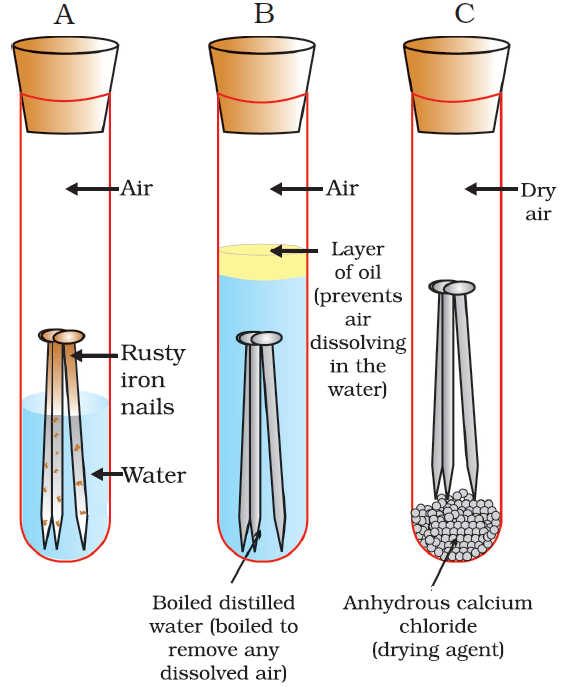
What is meant by ‘rusting’? With labelled diagrams describe an activity to find out the conditions under which iron rusts.
Answer
Iron when exposed to moist air for a long time acquires a coating of a brown flaky substance rust and this process is called rusting/ corrosion of iron in moist air/ slow oxidation of iron in moist air. Diagram
Activity description:
  • Take three test tubes and place clean iron nails in each of them.
  • Label these test tubes A, B and C. Pour some water in test tube A and cork it.
  • Pour boiled distilled water in test tube B. add about 1 ml of oil and cork it. The oil will float on water and prevent the air from dissolving in the water.
  • Put some anhydrous calcium chloride in testtubeCand cork it. Anhydrous calcium chloride will absorb the moisture, if any, from the air Leave these test tubes for a few days and then observe. It is observed that iron nails in test tube A rust where as those in Band C do not.
View full question & answer
Question 83 Marks
  1. Show the formation of NaCl from sodium and chlorine atoms by the transfer of electron(s).
  2. Why has sodium chloride a high melting point?
  3. Name the anode and the cathode used in electrolytic refining of impure copper metal.
Answer
  1.  
  1. Sodium chloride consists of sodium ion $\left( Na ^{+}\right)$and chloride ion (CT). These are strongly attracted towards each other to form ionic bond. To break this strong force of attraction between them, a large amount of energy is required ..... Hence, sodium chloride has high melting point.
  2. Cathode: Strip of pure copper.
Anode: Crude (impure) copper.
View full question & answer
Question 93 Marks
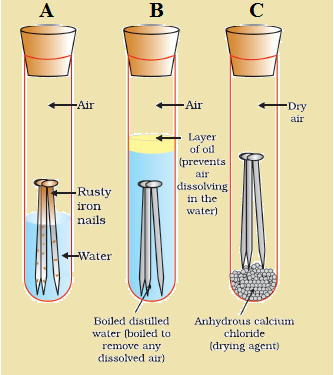
What is 'rusting'? Describe with a labelled diagram an activity to investigate the conditions under which iron rusts.What is 'rusting'? Describe with a labelled diagram an activity to investigate the conditions under which iron rusts.
Answer
  • Oxidation of iron when exposed to air and moisture and acquiring a coating of brown flaky substance. Activity-
  • Take three test tubes marked A,B and C with clean iron nails in each.
  • Pour some water in test tube ‘A’ and cork it.
  • Pour some boiled distilled water and a drop of oil in test tube B and cork it.
  • Put some anhydrous calcium chloride in test tube ‘C’ and cork it. It will absorb moisture from air leave the test tubes for a few days.
  • Rusting will take place only in test tube A, which has air and moisture present.
​​​​​​​
View full question & answer
Question 103 Marks
An ore, on heating in air, give Sulphur dioxide gas. Name the method in each metallurgical step that will be required to extract this metal from its ore.
Answer
An ore on heating gives $SO_2$ in air means the ore is sulphide ore. The process involved in the extraction of metal from sulphide ores are:
  1. The sulphide ore is concentrated by froth floatation method to remove impurities.
  2. The concentrated ore is roasted in the presence of air to convert to metal oxide with the liberation of sulphur dioxide.
  3. Reduction of metal oxide to metal using carbon
  4. The metal is purified by electrolytic reduction.
View full question & answer
Question 113 Marks
Zn is more electropositive than Fe. Therefore, it should get corroded faster than Fe. But it does not happen. Instead, it is used to galvanize iron. Explain why does it happen so?
Answer
Zinc is more electropositive than Iron but it does not get corroded faster and is used to galvanize iron.
Reasons:
  • A thin layer prevents the entering of water and oxygen underneath.
  • Zinc is more reactive than iron.
  • Oxidizes in preference to the iron.
  • Corrosion is because when oxygen in the air reacts with the surface of zinc.
  • Dense and impermeable coating of zinc oxide.
  • Acts as a physical barrier that protects the zinc surface.
View full question & answer
Question 123 Marks
What is a thermite reaction? Explain with the help of an equation. State one use of this reaction.
Answer
The reduction of a metal oxide to form metal by using aluminium powder as a reducing agent is called a thermite reaction. This property of reduction by aluminium is made use of in thermite welding for joining the broken pieces of heavy iron objects like girders etc. A mixture of Iron (III) oxide and aluminium powder is ignited with a burning magnesium ribbon. Aluminium reduces iron oxide to produce iron metal with the evolution of a lot of heat. Due to this heat, iron metal is produced in the molten state. This molten iron is then poured between the broken iron pieces to weld them (to join them).$\text{Fe}_2\text{O}_3(\text{s})+2\text{Al(s)}\rightarrow2\text{Fe(l)}+\text{Al}_2\text{O}_3\text{(s)}+\text{Heat}$
View full question & answer
Question 133 Marks
How are the properties of an alloy different from those of the constitutent elements?
Answer
  1. Alloys are stronger than the metals from which they are made.
  2. Alloys are harder than the constituent metals.
  3. Alloys are more resistant to corrosion.
  4. Alloys have lower melting points than constituent metals.
  5. Alloys have lower electrical conductivity than pure metals.
View full question & answer
Question 143 Marks
Write the equations for the reactions of:
  1. Iron with steam.
  2. Calcium with water.
  3. Potassium with water.
Answer
The balanced chemical equations for the said reactions are as follows:
  1. Iron with steam:
$3\text{Fe(s)}+4\text{H}_2\text{O(g)}\rightarrow\text{Fe}_3\text{O}_4(\text{s})+4\text{H}_2(\text{g})$
  1. Calcium and water:
$\text{Ca(s)}+2\text{H}_2\text{O(l)}\rightarrow\text{Ca(OH)}_2(\text{aq})+\text{H}_2(\text{g})$
  1. Potassium and water:
$2\text{K(s)}+2\text{H}_2\text{O(l)}\rightarrow2\text{KOH(aq)}+\text{H}_2(\text{g})$
View full question & answer
Question 153 Marks
Define the following terms.
  1. Mineral
  2. Ore
  3. Gangue
Answer
  1. Mineral: The naturally occurring compounds of elements are known as Mineral.
  2. Ore: Minerals from which metals can be extracted profitably are known as ores.
  3. Gaguen: The impurities present in the ore such as sand, rocks etc are non as gangue.
View full question & answer
Question 163 Marks
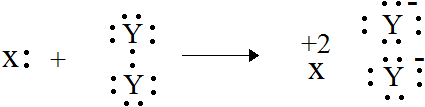
A metal ‘X’ loses two electrons and a non-metal ‘Y’ gains one electron. Show the electron dot structure of compound formed between them. Is it ionic or covalent? Does it have high melting point or low? Will it conduct electricity in solid state or in aqueous solution and why? Will it be soluble in water?
Answer
X loses 2 electrons while Y gains 1. It means X is in group 2 and Y in group 17.

It is ionic. It has high melting point as it is a crystalline salt. Yes, it is soluble in water & conducts electricity in aqueous state and molten state.
View full question & answer
Question 173 Marks
A zinc plate was kept in a glass container having $CuSO_4$ solution. On examining it was found that the blue colour of the solution is getting lighter and lighter. After a few days, when the zinc plate was taken out of the solution, a number of small holes were noticed in it. State the reason and give chemical equation of the reaction involved.
Answer
Zinc is more reactive than copper and hence zinc displaces copper from copper sulphate solution to form zinc sulphate solution, which is of green colour, and copper. It is due to formation of the green zinc sulphate solution that the blue colour of copper sulphate gets lighter and lighter.
Zinc from the rod reacts with the solution to form zinc sulphate solution. So the plate has a number of small holes in it.
$Zn ( s )+ CuSO _4( aq ) \rightarrow ZnSO _4( aq )+ Cu ( s )$
View full question & answer
Question 183 Marks
What is electroplating?
Answer
Electroplating is basically the process of plating a metal onto the other by hydrolysis mostly to prevent corrosion of metal or for decorative purposes. The process uses an electric current to reduce dissolved metal cations to develop a lean coherent metal coating on the electrode. Electroplating is often applied in the electrical oxidation of anions on a solid substrate like the formation of silver chloride on silver wire to form silver chloride electrodes.
Electroplating is majorly applied to modify the surface features of an object (e.g corrosion protection, lubricity, abrasion), but the process can also be used to build thickness or make objects by electroforming.
View full question & answer
Question 193 Marks
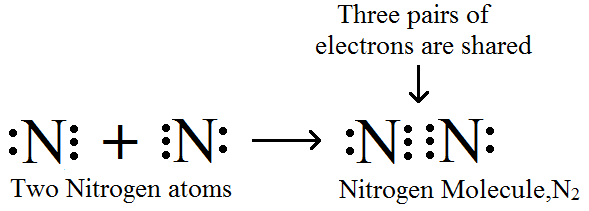
Using electron-dot diagrams which show only the outermost shell electrons, show how a molecule of nitrogen, N, is formed from two nitrogen atoms. What name is given to this type of bonding? (Atomic number of nitrogen is 7)
Answer
Since nitrogen has 5 electrons in its outermost shell so, to achieve the 8-electron structure of an inert gas, it needs 3 more electrons and hence combines with another nitrogen atom to form a molecule of nitrogen gas.

This type of bonding is called covalent bonding.
View full question & answer
Question 203 Marks
How is manganese extracted from manganese dioxide, $MnO _2$ ? Explain with the help of an equation.
Answer
Manganese metal is extracted by the reduction of its oxide with aluminium powder as the reducing agent. Thus, when manganese dioxide is heated with aluminium powder, then manganese metal is formed.$3\text{MnO}_{2}\text{(s)}\ \ \ \ +\ \ \ \ 4\text{Al}\text{(s)}\ \ \ \xrightarrow{\ \ \ \ }\ \ \ 3\text{Mn}\text{(l)}\ \ \ \ +\ \ \ \ \ \ \ 2\text{Al}_{2}\text{O}_{3}\ \ \ \ +\ \ \ \text{Heat}\ \\ \text{Manganese}\ \ \ \ \ \ \ \text{Aluminium}\ \ \ \ \ \ \ \ \ \text{manganese}\ \ \ \ \ \ \ \ \ \text{Aluminium}\ \ \ \ \ \ \ \ \ \ \ \ \ \ \ \ \ \ \ \ \ \ \ \ \ \ \ \ \ \ \ \ \ \ \ \ \ \ \ \ \ \\\ \ \ \text{dioxide}\ \ \ \ \ \ \ \ \ \ \ \ \ \ \text{powder}\ \ \ \ \ \ \ \ \ \ \ \ \ \text{metal}\ \ \ \ \ \ \ \ \ \ \ \ \ \ \ \ \ \ \ \ \ \ \ \text{oxide}$
View full question & answer
Question 213 Marks
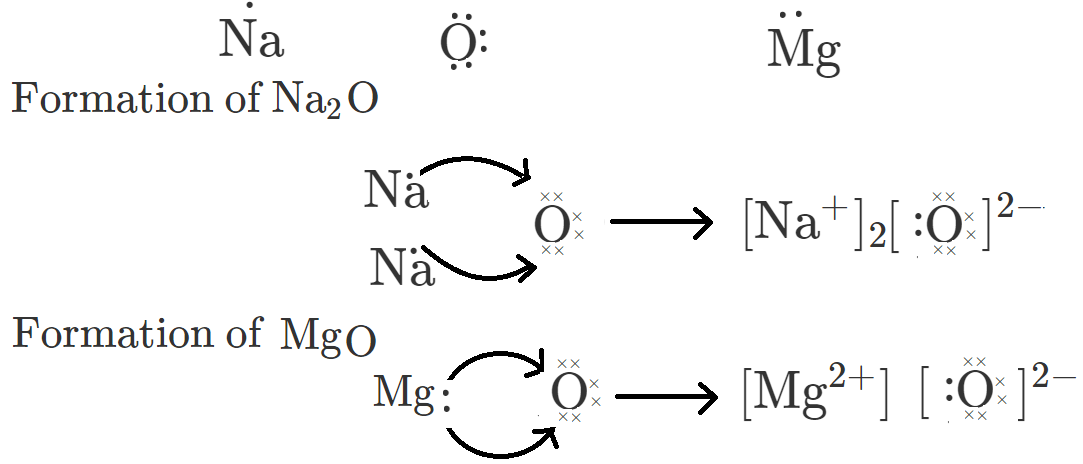
  1. Write the electron-dot structures for sodium, oxygen and magnesium.
  2. Show the formation of $Na _2 O$ and MgO by the transfer of electrons.
  3. What are the ions present in these compounds?
Answer
  1. Electron-dot structure for sodium, oxygen and magnesium are.
  2.  

iii. Ions present in $Na _2 O$ are $Na ^{+}$and $O ^{2-}$
Ions present in MgO are $Mg ^{2+}$ and $O ^{2-}$
View full question & answer
Question 223 Marks
Explain giving equation, what happens when:
a. $ZnCO _3$ is heated in the absence of air?
b. A mixture of $CU _2 O$ and $CU _2 S$ is heated?
Answer
  1. When zinc carbonate is heated strongly in the absence of air, it decomposes to form zinc oxide and carbon dioxide.
$\text{ZnCO}_3\text{(s)}\xrightarrow{\ \ \ \ \text{Calcination}\ \ \ }\text{ZnO(s)}\ \ \ \ \ \ \ \ +\ \ \ \ \ \ \ \ \ \ \text{CO}_2\text{(g)}\\\text{Zinc carbonate}\ \ \ \ \ \ \ \ \ \ \ \ \ \ \text{Zinc Oxide}\ \ \ \ \ \ \ \ \ \ \ \ \text{Carbon dioxide}\\\text{(Calamineore)}$
  1. When copper (I) oxide reacts with copper (I) sulphide, it forms copper metal and sulphur dioxide.
$2\text{Cu}_2\text{O(s)}+\text{Cu}_2\text{S(s)}\xrightarrow{\ \ \ \text{Heat}\ \ \ \ }6\text{Cu(s)}+\text{SO}_2\text{(g)}$
View full question & answer
Question 233 Marks
Define the terms:
  1. mineral.
  2. ore.
  3. gangue.
Answer
  1. Minerals: The natural materials in which the metals or their compounds are found in earth are called minerals.
  2. Ores: Those minerals from which the metals can be extracted conveniently and profitably are called ores.
  3. Gangue:The unwanted impurities like sand, rocky material, earthy particles etc. present in an ore are called gangue.
View full question & answer
Question 243 Marks
What is the nature of zinc oxide?
Answer
Zinc oxide is basically an inorganic compound. It is a white coloured powder. It occurs in the earth’s crust in natural form. For commercial purposes, zinc oxide is manufactured and is synthetic in nature.
View full question & answer
Question 253 Marks
Differentiate between metal and non-metal on the basis of their chemical properties.
Answer
Metals and non-metals can be differentiated on the basis of following chemical properties.
  Metals Non-metals
1. Metals displace hydrogen from water. Non-metal do not displace hydrogen from water.
2. Metals are basic oxide. Non-metals are acidic oxides.
3. Metals displace hydrogen from dilute acids. Non-metals displace hydrogen from dilute acids.
4. Metals form ionic chlorides with chlorides with chlorine. Non-metals form covalent chlorides with chlorine.
View full question & answer
Question 263 Marks
You must have seen tarnished copper vessels being cleaned with lemon or tamarind juice. Explain why these sour substances are effective in cleaning the vessels.
Answer
Copper reacts with moist carbon dioxide in air to fonm copper carbonate and as a result, copper vessel loses its shiny brown surface forming a green layer of copper carbonate. The citric acid present in the lemon or tamarind neutralises the basis copper carbonate and dissolves the layer. That is why, tarnished copper vessels are cleaned with lemon or tamarind juice to give the surface of the copper vessel its characteristic lustre.
View full question & answer
Question 273 Marks
Suppose you have to extract metal M from its enriched sulphide ore. If M is in the middle of the reactivity series, write various steps used in extracting this metal.
Answer
The metals in the middle of the reactivity series are moderately reactive. these are usually pesent as sulphides or carbonates in nature the metal sulphides and carbonates must be converted into metal oxides. Thus this impure metal ‘M’ undergoes purification. The process of purifying impure metal is called refining. The most widely used method for refining is electrolytic refining.
View full question & answer
Question 283 Marks
Explain the meanings of malleable and ductile.
Answer
A substance that can be beaten into thin sheets is said to be malleable. For example, iron, copper etc.
A substance that can be drawn into wires is called ductile. For example, gold, silver etc.
View full question & answer
Question 293 Marks
Two ores A and B were taken. On heating ore A gives $CO _2$ whereas, ore B gives $SO _2$. What steps will you take to convert them into metals?
Answer
Since the ore ' $A$ ' of the metal gives $CO _2$ upon heating, it is some metal carbonate $\left( MCO _3\right)$. It can be converted to the metallic form as follows:Calcination:
$\text{MCO}_3\text{(s)}\xrightarrow{\text{heat}}\text{MO(s)}+\text{CO}_2\text{(g)}$
Smelting:
$\text{MO}\text{(s)} +\text{C(s)}\xrightarrow{\text{heat}}\text{M(s)}+\text{CO}\text{(g)}\\ \ \ \ \ \ \ \ \ \ \ \ \ \ \text{(coke)}$
Since the ore ‘Y’ of the metal gives $SO_2$ upon heating, it can be some metal sulphide (MS). It can be converted to the metallic form as follows:Roasting:
$2\text{MS}\text{(s)}+3\text{O}_2\text{(g)}\rightarrow2\text{MO(s)}+2\text{SO}_2\text{(g)}$
Reduction:
$\text{MO}\text{(s)}+\text{C}\text{(s)}\rightarrow\text{M(s)}+\text{CO}\text{(g)}\\ \ \ \ \ \ \ \ \ \ \ \ \ \ \ \text{(coke)}$
View full question & answer
Question 303 Marks
Generally, when metals are treated with mineral acids, hydrogen gas is liberated but when metals (except Mn and Mg ), treated with $HNO _3$, hydrogen is not liberated, why?
Answer
It is because $HNO _3$ is an oxidising agent and it gets reduced to NO if it is dilute and $NO _2$ if HNO is concentrated, it oxidises $H _2$ to $H _2 O$.
View full question & answer
Question 313 Marks
The electronic configurations of three elements A, B and C are as follows:
A 2, 8, 1
B 2, 8, 7
C 2, 4
  1. Which of these elements is a metal?
  2. Which of these elements are non-metals?
  3. Which two elements will combine to form an ionic bond?
  4. Which two elements will combine to form a covalent bond?
  5. Which element will form an anion of valency 1?
Answer
  1. A is a metal.
  2. B and C are non-metals.
  3. A and B combines to form an ionic bond.
  4. B and C combines to form a covalent bond.
  5. B will form an anion with valency 1 since it needs only 1 electron to complete its octet.
View full question & answer
Question 323 Marks
How do metals reacts with dilute acids? Explain with the help of an example.
Answer
When a metal reacts with dilute acid, salts are formed. During this reaction hydrogen gas is evolved. In other words, when a metal is added to dilute acids, salt and hydrogen gas are formed.
Process: Sulfate salts and chloride salts are formed when metals react with dilute sulfuric acid and hydrochloric acid. Some metals reacts vigorously with dilute sulfuric acid or hydrochloric acid for example, potassium, sodium, lithium and calcium.
View full question & answer
Question 333 Marks
Of the three metals X, Y and Z. X reacts with cold water, Y with hot water and Z with steam only. Identify X, Y and Z and also arrange them in order of increasing reactivity.
Answer
X is sodium, Y is magnesium and Z is iron.
$2 Na+2 H_2 O \rightarrow 2 NaOH+H_2$
$Mg+2 H_2 O \rightarrow Mg(OH)_2+H_2$
$3 Fe+4 H_2 O \rightarrow Fe_3 O_4+4 H_2$
Their sequence in reactivity series is as follows:
$Fe<Mg<Na.$
View full question & answer
Question 343 Marks
Metals are said to be shiny. Why do metals generally appear to be dull ? How can their brightness be restored?
Answer
Metals lose their shine or brightness on keeping in air for a long time and acquire a dull appearence due to the formation of a thin layer of oxide, carbonate or sulphide on their surface by the slow action of various gases present in air.
Brightness of metals can be restored by rubbing the dull surface of the metal object with a sand paper, then the outer corroded layer is removed and the metal object becomes shiny and bright once again.
View full question & answer
Question 353 Marks
A metal A, which is used in thermite process, when heated with oxygen gives an oxide B, which is amphoteric in nature. Identify A and B. Write down the reactions of oxide B with HCl and NaOH.
Answer
Aluminium (AI) is used in thermite process so metal A is Aluminium. The reaction of Al with oxygen forms aluminium oxide $Al _2 O _3$ which is amphoteric in nature as it can exhibit acidic as well as basic nature.
$4 Al(s)+3 O_2(g) \rightarrow 2 Al_2 O_3(s)$
Hence, $A =$ Aluminium and $B =$ Aluminium oxide
Reactions of aluminium oxide with HCl and NaOH are as given below;
$Al_2 O_3(s)+6 HCl(aq) \rightarrow 2 AlCl_3(aq)+3 H_2 O(l)$
$Al_2 O_3(s)+2 NaOH(aq) \rightarrow 2 NaAlO_2(aq)+H_2 O(l)$
View full question & answer
Question 363 Marks
Explain giving one example, how highly reactive metals (which are high up in the reactivity series) are extracted.
Answer
The highly reactive metals are extracted by the electrolytic reduction of their molten chlorides
or oxides. Example: Sodium metal is extracted by the electrolytic reduction of molten sodium chloride. When electric current is passed through molten sodium chloride, it decomposes to form sodium metal and chlorine gas.$2\text{NaCl}\text{(l)}\xrightarrow[]{\text{Electrolysis}}2\text{Na}\text{(s)}+ \text{cl}_{2}\text{(g)}$
View full question & answer
Question 373 Marks
How is copper extracted from its sulphide ore (copper glance), $Cu _2 S$ ? Explain with equations of the reactions involved.
Answer
The concentrated copper (I) sulphide ore (copper glance), Cu 2 S is roasted in air when a part of copper (I) sulphide is oxidised to copper (I) oxide.$2\text{Cu}_2\text{O(s)}+3\text{O}_2\text{(g)}\xrightarrow{\text{Rosting}}2\text{Cu}_2\text{O(s)}+2\text{SO}_2\text{(g)}$
When a good amount of copper (I) sulphide has been converted to copper (I) oxide, then the supply of air for roasting is stopped. In the absence of air, copper (I) oxide formed above reacts with remaining copper (I) sulphide to form copper metal and sulphur dioxide.$2\text{Cu}_2\text{O(s)}+\text{Cu}_2\text{O(s)}\xrightarrow{\text{Heat}}6\text{Cu}\text{(s)}+\text{SO}_2\text{(g)}$
View full question & answer
Question 383 Marks
Will carbon monoxide (CO) change the colour of blue litmus?
Answer
Carbon is a nonmetal Oxides of nonmetal are acidic Oxides of nonmetal when dissolved in water acids are formed When carbon dioxide dissolves in water Carbonic acid. is formed.$\text{H}_2\text{O}+\text{CO}_2\rightarrow\text{H}_2\text{CO}_3$
$H _2 CO _3$ - is Carbonic acid Hence here blue litmus solution turns red.
View full question & answer
Question 393 Marks
How does the method used for extracting a metal from its ore depend on the metal’s position in the reactivity series? Explain with examples.
Answer
Different methods are used for extracting metals belonging to category of highly reactive metals, moderately reactive metals and less reactive metals. This is because the extraction of a metal from its concentrated ore is essentially a process of reduction of the metal compound present in the ore.
For example: Manganese metal is obtained by the reduction of its oxide with aluminium powder and not carbon. This is because carbon is less reactive than manganese. Carbon, which is a non-metal, is more reactive than zinc and it can be placed just above Zn in the reactivity series.
Hence, carbon can reduce the oxides of zinc and all other metals below zinc to form metals.
View full question & answer
Question 403 Marks
A solution of $CuSO_4$ was kept in an iron pot. After few days, the iron pot was found to have a number of holes in it. Explain the reason in terms of reactivity. Write the equation of the reaction involved.
Answer
Iron (Fe) is more reactive than copper (Cu). Hence, when a solution of copper sulphate is placed in Iron pot, iron metal from Iron pot displaces the copper from the solution and Single Displacement Reaction will take place. The reaction is as follows:$\text{CuSO}_4+\text{Fe}\rightarrow\text{FeSO}_4+\text{Cu}$
Hence, holes will appear on pot, because there is displacement reaction taking place between Iron metal and$CuSO_4$ solution.
View full question & answer
Question 413 Marks
Describe how sodium and chlorine atoms are changed into ions when they react with each other to form sodium chloride, NaCl. What is the name given to this type of bonding? (At. No of sodium = 11; At. No. of chlorine = 17)
Answer
solution The atomic number of sodium is 11 , so its electronic configuration is 2,8 , 1 . Sodium atom has only 1 electron in its outermost shell. So, the sodium atom donates one electron (to a chlorine atom) and forms a sodium ion, $Na ^{+}$. The atomic number of chlorine is 17 , so its electronic configuration is $2,8,7$. Chlorine atom has 7 electrons in its outermost shell and needs 1 more electron to achieve the stable 8 -electron inert gas configuration. So, a chlorine atom takes one electron (from the sodium atom) and forms a negatively charged chloride ion, $Cl ^{-}$This type of bonding is called ionic bonding.
View full question & answer
Question 423 Marks
State two ways to prevent the rusting of iron.
Answer
Two ways to prevent the rusting of iron are:
→ Oiling, greasing, or painting: By applying oil, grease, or paint, the surface becomes water proof and the moisture and oxygen present in the air cannot come into direct contact with iron. Hence, rusting is prevented.
→ Galvanisation: An iron article is coated with a layer of zinc metal, which prevents the iron to come in contact with oxygen and moisture. Hence, rusting is prevented.
View full question & answer
Question 433 Marks
What are noble gases? What is the characteristic of the electronic configuration of noble gases?
Answer
There are some elements in group 18 of the periodic table which do not combine with other elements. These elements are helium, neon, argon, krypton, xenon and radon . They are known as noble gases or inert gases because they are unreactive.
If we look at the electronic configuration of noble gases, we would notice that except helium, all other inert gases have 8 electrons (helium has 2) in their outermost shells. This is considered to be the most stable arrangement of electrons.
View full question & answer
Question 443 Marks
Explain why, aluminium is a highly reactive metal, still it is used to make utensils for cooking.
Answer
Aluminium begins to corrode quickly when it comes in contact with moist air. The action of moist air on aluminium metal forms a thin layer of aluminium oxide all over the metal. This aluminium oxide is very tough and prevents the metal underneath from further corrosion. Therefore, aluminium is used for making utensils irrespective of its highly reactive property as its corrosion leads to the non-corrosion of the metal in the longer run.
View full question & answer
Question 453 Marks
Explain why, an aqueous solution of sodium chloride is not used for the electrolytic extraction of sodium metal.
Answer
We cannot use an aqueous solution of sodium chloride to obtain sodium metal because if we electrolyse an aqueous solution of sodium chloride, then as soon as sodium metal is produced at cathode, it will react with water present in the aqueous solution to form sodium hydroxide. Hence, electrolysis of an aqueous solution of sodium chloride will produce sodium hydroxide and not sodium metal.
View full question & answer
Question 463 Marks
Iqbal treated a lustrous, divalent element M with sodium hydroxide. He observed the formation of bubbles in reaction mixture. He made the same observations when this element was treated with hydrochloric acid. Suggest how can he identify the produced gas. Write chemical equations for both the reactions.
Answer
The divalent element M is a metal. It reacts with both sodium hydroxide (alkali) and dilute hydrochloric acid to evolve hydrogen gas.
$M(s)+2 NaOH(aq) \rightarrow Na_2 MO_2(aq)+H_2(g)$
$M(s)+2 HCl(aq) \rightarrow MCl_2(aq)+H_2(g)$
The gas burns with a pop sound when a burning match stick is brought near it.
View full question & answer
Question 473 Marks
How is zinc extracted from its carbonate ore (calamine)? Explain with equations.
Answer
When calamine ore is heated strongly in the absence of air i.e. calcined, it decomposes to form zinc oxide and carbon dioxide.$\text{ZnCO}_{3}\text{(s)}\xrightarrow[]{\ \ \ \ \ \ \text{Calcination}\ \ \ \ \ }\text{ZnO}\text{(s)}\ \ \ +\ \ \text{CO}\text{(g)}\\\\\text{Zinc carbonate}\ \ \ \ \ \ \ \ \ \ \ \ \ \ \text{Zinc oxide}\ \ \ \ \ \text{Carbon oxide}\ \ \ \ \ \ \ \ \ \\\text{(Calmineore)}\ \ \ \ \ \ \ \ \ \ \ \ \ \ \ \ \ \ \ \ \ \ \ \ \ \ \ \ \ \ \ \ \ \ \ \ \ \ \ \ \ \ \ \ \ \ \ \ \ \ \ \ \ \ $
Then zinc oxide is heated with carbon and zinc metal is produced.$\text{ZnO}\text{(s)}\ \ \ \ +\ \ \text{C}\text{(s)}\ \ \ \xrightarrow{\ \ \ \ }\ \ \ \text{Zn}\text{(s)}\ \ \ +\ \ \ \text{CO}\text{(g)}\\ \text{Zinc oxide}\ \ \ \text{Carbon}\ \ \ \ \ \text{Zinc metal}\ \ \ \text{carbon monoxide}$
View full question & answer
Question 483 Marks
You are given a dry cell, a torch bulb with holder, wires and crocodile clips. How would you use them to distinguish between samples of metals and non-metals?
Answer
We would create an apparatus using dry cell, a torch bulb fitted in a holder and some connecting wires with crocodile clips and connect them to make an electric circuit. Then insert a piece of sulphur between the crocodile clips and the bulb does not light up at all. This means that sulphur does not allow the electric current to pass through it. Now insert a piece of copper between the crocodile clips and the bulb will light up. This observation shows that non metals (ex- sulphur) do not conduct electricity and metals (ex- copper) conduct electricity.
View full question & answer
Question 493 Marks
An element A burns with golden flame in air. It reacts with another element B, atomic number 17 to give a product C. An aqueous solution of product C on electrolysis gives a compound D and liberates hydrogen. Identify A, B, C and D. Also write down the equations for the reactions involved.
Answer
Element ' $A$ ' that burns with golden flame is sodium ( Na ). Element ' $B$ ' with atomic number 17 is chlorine (Cl).
Sodium and chlorine react to form sodium chloride ( NaCl ) which is an ionic compound. $2 Na ( s )+ Cl _2(g) \rightarrow 2 NaCl ( s )$
The aqueous solution of sodium chloride, also called as brine when goes through electrolysis, forms sodium
hydroxide $( NaOH )$, hydrogen and chlorine gas. $2 NaCl ( aq )+2 H _2 O ( l ) \xrightarrow{\text { Electrolysis }} 2 NaOH ( aq )+ Cl _2+ H _2(g)$
Hence, $A =$ Sodium $( Na ), B =$ Chlorine $( Cl ), C =$ Sodium chloride $( NaCl ), D =$ Sodium hydroxide $( NaOH )$.
View full question & answer
Question 503 Marks
During extraction of metals, electolytic refining is used to obtain pure metals.
  1. Which material will be used as anode and cathode for refining of silver metal by this process?
  2. Suggest a suitable electrolyte also.
  3. In this electrolytic cell, where do we get pure silver after passing electric current?
Answer
1. Pure silver rod will be used as cathode and impure silver rod will be used as anode.
2. $Ag NO _3( aq )$ can be used as electrolyte.
3. Pure silver will be formed at cathode.

At anode: $Ag \rightarrow Ag ^{+}+ e ^{-}$

At cathode: $Ag ^{+}+ e ^{-} \rightarrow Ag$
View full question & answer
[3 Mark Questions] - Science STD 10 Questions - Vidyadip