Question
How is copper extracted from its sulphide ore (copper glance), $Cu _2 S$ ? Explain with equations of the reactions involved.

Answer

The concentrated copper (I) sulphide ore (copper glance), Cu 2 S is roasted in air when a part of copper (I) sulphide is oxidised to copper (I) oxide.$2\text{Cu}_2\text{O(s)}+3\text{O}_2\text{(g)}\xrightarrow{\text{Rosting}}2\text{Cu}_2\text{O(s)}+2\text{SO}_2\text{(g)}$
When a good amount of copper (I) sulphide has been converted to copper (I) oxide, then the supply of air for roasting is stopped. In the absence of air, copper (I) oxide formed above reacts with remaining copper (I) sulphide to form copper metal and sulphur dioxide.$2\text{Cu}_2\text{O(s)}+\text{Cu}_2\text{O(s)}\xrightarrow{\text{Heat}}6\text{Cu}\text{(s)}+\text{SO}_2\text{(g)}$

Need a full question paper?

Generate a complete, print-ready paper with questions like this in minutes — across 16+ boards, with answer keys.
Start Generating Free

Similar questions

What are noble gases? What is the characteristic of the electronic configuration of noble gases?
Describe how sodium and chlorine atoms are changed into ions when they react with each other to form sodium chloride, NaCl. What is the name given to this type of bonding? (At. No of sodium = 11; At. No. of chlorine = 17)
What are the advantages of sexual reproduction over asexual reproduction?
A convex lens of focal length 0.10m is used to form a magnified image of an object of height 5mm placed at a distance of 0.08m from the lens. Calculate the position, nature and size of the image.
Name the functional group of organic compounds that can be hydrogenated. With the help of suitable example explain the process of hydrogenation mentioning the conditions of the reaction and any one change in physical property with the formation of the product. Name any one natural source of organic compounds that are hydrogenated.
What is, highest, and lowest, resistance which can be obtained by combining Com resistors having the following resistances?$4 Ω, 8 Ω, 12 Ω, 24 Ω$
$i.$ Distinguish between ionic and covalent compounds under the following properties:
$a.$ Strength of forces between constituent elements
$b.$ Solubility of compounds in water
$c.$ Electrical conduction in substances
$ii.$ Explain how the following metals are obtained from their compounds by the reduction process:
$a.$ Metal $M$ which is in the middle of the reactivity series.
$b.$ Metal $N$ which is high up in the reactivity series. Give one example of each type.
Explain with the help of a labelled diagram the distribution of magnetic field due to a current through a circular loop. Why is it that if a current carrying coil has n turns the field produced at any point is n times as large as that produced by a single turn?
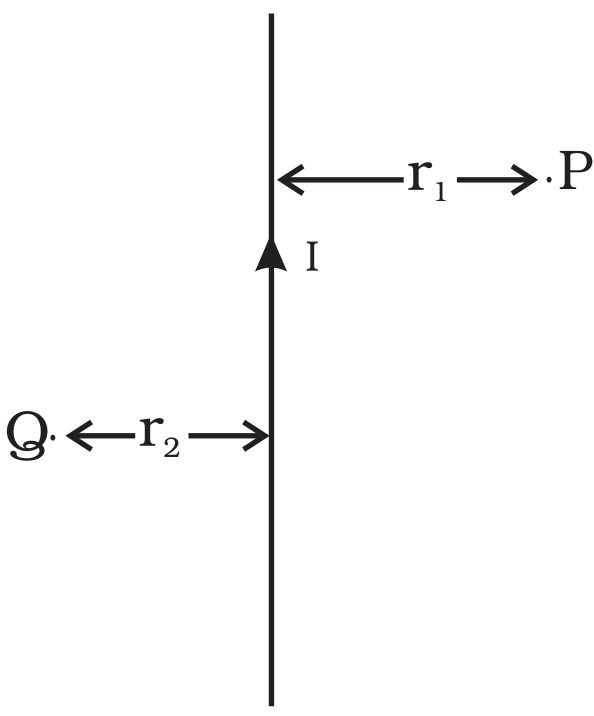
AB is a current carrying conductor in the plane of the paper as shown in Figure. What are the directions of magnetic fields produced by it at points $P$ and $Q$ ? Given $r_1>r_2$, where will the strength of the magnetic field be larger?
What is nuclear fusion? Explain with an example. Write the equation of the reaction involved.