Questions

[5 marks Questions]

🎯

Test yourself on this topic

6 questions · timed · auto-graded

Question 15 Marks
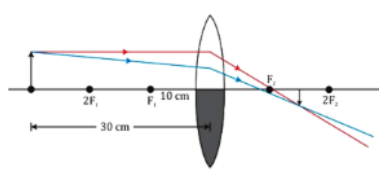
$i.$ One half of a convex lens of focal length $10 \ cm$ is covered with a black paper. Can such a lens produce an image
of a complete object placed at a distance of $30 \ cm$ from the lens? Draw a ray diagram to justify your answer.
$ii.$ A $4 \ cm$ tall object is placed perpendicular to principal axis of a convex lens of focal length $20 \ cm.$ The distance of
the object from the lens is $15 \ cm.$ Find the nature, position and the size of the image.
Answer
When a convex lens is covered half with black paper as shown in diagram, then image of full object will formed , but it will be of less intensity and brightness.
Image
As $h _0=4 \ cm, f =20 \ cm$ and $u =-15 \ cm$
By lens formula,
$\frac{1}{f}=\frac{1}{v}-\frac{1}{u}$
$\Rightarrow \frac{1}{v}=\frac{1}{f}+\frac{1}{u}$
$=\frac{1}{20}+\frac{1}{(-15)}$
$=\frac{15-20}{300}$
$=\frac{-5}{300}$
$\therefore v=-60 \ cm$
As, magnification,
$m =\frac{h_i}{h_0}=\frac{v}{u}$
$\Rightarrow h_i=h_0 \times \frac{v}{u}$
$=4 \times \frac{-60}{-15}$
$=16 \ cm$
Image formed is virtual, erect and magnified.
View full question & answer
Question 25 Marks
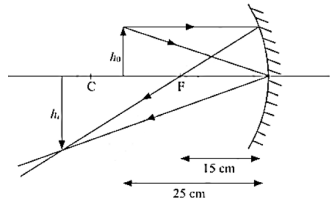
An object $4.0 \ cm$ in size, is placed $25.0 \ cm$ in front of a concave mirror of focal length $15.0 \ cm.$
$i.$ At what distance from the mirror should a screen be placed in order to obtain a sharp image?
$ii.$ Find the size of the image.
$iii.$ Draw a ray diagram to show the formation of image in this case.
Answer
Given: Height of object $\left(h_0\right)=4 \ cm$
Object distance $(u) = -25 \ cm(-ve$ as it is in front of mirror$)$
Focal length $(f) = -15 \ cm$
$i.$ Applying mirror formula and substituting the values,
$\frac{1}{v}+\frac{1}{u}=\frac{1}{f}$
$\frac{1}{v}=\frac{1}{-15}-\frac{1}{-25}$
$\frac{1}{v}=\frac{-5+3}{75}$
$v =\frac{-75}{2}$
$=-37.5 \ cm$
The negative sign indicates that the image is in front of the mirror.
Therefore, the screen must be placed in front of the mirror at a distance of $37.5 \ cm.$
$ii.$ Applying the magnification formula and substituting the values,
$ m =\frac{-v}{u}=\frac{h_i}{h_o}$
$\frac{-\left(\frac{-75}{2}\right)}{-25}=\frac{h_i}{4}$
$h_{ i }=\frac{-75}{2 \times 25} \times 4$
$h_{ i }=-6 \ cm$
The image will be $6\ cm$ high and it will be inverted.
$iii.$ The ray diagram showing the formation of image in this case is,
Image
View full question & answer
Question 35 Marks
How phototropism does occur in plants?
Answer
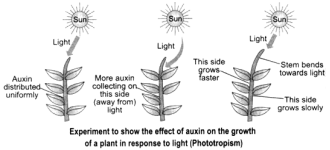
The directional movement of a plant part/plant in response to light is called phototropism. The shoot responds by bending towards light while roots respond by bending away from the light. We know that the plant stem responds to light and bends towards it due to the action of auxin hormone. When sunlight comes from above, then the auxin hormone present at the tip of the stem spreads uniformly down the stem. Due to the equal presence of auxin, both the sides of the stem grow straight and with same rapidity.This is because auxin hormone moves away from the light.
Thus, more auxin hormone is present in the left side of stem as compared to the right. The left side of stem, grows faster than its right side and therefore, the stem bends towards the right side (direction of light).

Image

The effect of auxin on the growth of a root is exactly opposite to that on a stem. Auxin hormone increases the rate of growth in stem but it decreases the rate of growth in a root. The side of root away from light will have all the auxin concentrated in it. Due to this, the side of root which is away from light will grow slower than the other side and make the root bends away from light.
View full question & answer
Question 45 Marks
Explain the term fission as used in relation to reproduction.
Answer
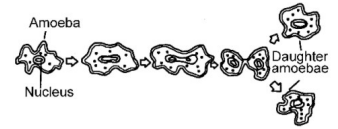
Binary fission in Amoeba. It is normal method of reproduction in Amoeba. It occurs under favourable conditions. The animal grows until it attains the maximum size and then divides by binary fission in every three or four days. The fission is completed in 15 to 20 minutes.

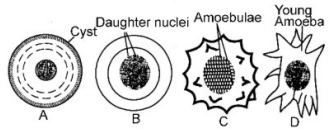
ImageMultiple fusion in Amoeba
Multiple fission inside the cyst has been described but not established. It has been suggested that sometimes inside the cyst, the nucleus divides and surrounds itself with cytoplasm to form several small amoebulae. At the return of favourable conditions or on finding a favourable substrate, the cyst absorbs water and its walls burst. The amoebulae escape and soon each one grows into new amoeba.

Image
View full question & answer
Question 55 Marks
a. Define the term isomer
b. Two compounds have same molecular formula $C _3 H _6 O$. Write the name of these compounds and their structural formula.
c. How would you bring the following conversions:
i. Ethanol to ethene
ii. Propanol to propanoic acid
Answer
a. Isomers are those compounds which have the same molecular formula but different structural formula
b. Propanal- $CH _3 CH _2 CHO$
Propanone- $CH _3 COCH _3$
Above are the name of these compounds and their structural formula.
c. i. $CH _3 CH _2 OH \xrightarrow[\text { Henc }]{\substack{\text { Conc. } H _2 SO _4 \\ \text { Alkaline } KMnO _4}} H _2 C = CH _2+ H _2 O$
ii. $CH _3 CH _2 OH \xrightarrow[\text { Heat }]{43 CH } CH _2 COOH + H _2 O$
View full question & answer
Question 65 Marks
i. What are soaps? Explain the mechanism of cleansing action of soap with the help of a labelled diagram.
ii. Detergents are better than soaps. Justify.
Answer
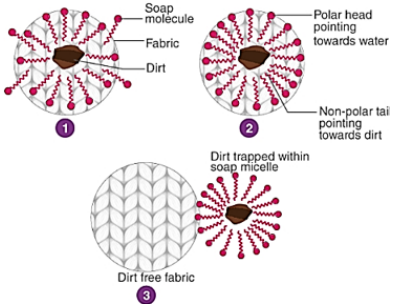
i. Soaps are molecules has two ends have differing properties, one is hydrophilic (interacts with water), while the other end is hydrophobic (interacts with hydrocarbons). When soap is at the surface of water, the hydrophobic 'tail' of soap will not be soluble in water and the soap will align along the surface of water with the ionic end in water and the hydrocarbon 'tail' protruding out of water. Inside water, these molecules keeps the hydrocarbon portion out of the water. Thus, clusters of molecules in which the hydrophobic tails are in the interior of the cluster and the ionic ends are on the surface of the cluster. This formation is called a micelle. Soap in the form of a micelle is able to clean, since the oily dirt will be collected in the centre of the micelle. The micelles stay in solution as a colloid and will not come together because of ion-ion repulsion. Thus, the dirt suspended in the micelles is also easily rinsed away. The soap micelles are large enough to scatter light.

Image

ii. Detergents are sodium salts of sulphonic acids or ammonium salts with chlorides or bromide ions etc. Detergents have long hydrocarbon chains. The charged ends of these compounds do not form insoluble precipitates with the calcium and magnesium ions in hard water but soap reacts with calcium and magnesium ions present in the hard water to form insoluble substance called scum. Thus, detergents are better cleansing agents than soaps, they remain effective even in hard water.
View full question & answer
[5 marks Questions] - Science STD 10 Questions - Vidyadip