Questions

[5 marks Questions]

🎯

Test yourself on this topic

6 questions · timed · auto-graded

Question 15 Marks
A student has three concave mirrors A, B and C of focal lengths 20 cm, 15 cm and 10 cm, respectively. For each concave mirror, he performs the experiment of image formation for three values of object distance of 30 cm, 10 cm and 20 cm.
Give reasons for the following:
i. For the three object distances, identify the mirror which will form an image equal in size to that of object. Find at least one value of object distance.
ii. Out of the three mirrors, identify the mirror which would be preferred to be used for shaving purpose.
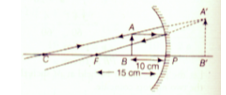
iii. For the mirror B, draw ray diagram for image formation for any two given values of object distance.
Answer
i. When an object is placed at the centre of curvature of concave mirror, the image formed is equal in size to that of object. So, for object distance 20 cm, the mirror C with focal length 10 cm is used as
$u=R=2 f=2 \times 10 cm=20 cm$
ii. For shaving purpose, mirror B (f = 15 cm) would be preferred (object distance is 10 cm) Also mirror A( f=20 cm) would be used (object distance is10 cm).
iii. a. For u = 30 cm
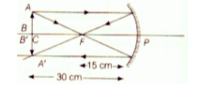
Image
b. For u = 10 cm
Image
View full question & answer
Question 25 Marks
What are Cartesian sign conventions used in spherical mirror? What is the mirror formula?
Answer
(a) All the rays are drawn from left to right.
(b) All distances are measured from the pole of the spherical mirror.
(c) The distances measured in the direction of the incident light are taken as positive and those measured in a direction opposite to
the direction of incident light are taken as negative.
(d) The heights measured upwards and perpendicular to the principal axis of the mirror are taken as positive and vice versa. Since the object is always placed on the left of the mirror, u is always negative.
If u is the distance of object and v the distance of image from pole of the mirror, then
$\frac{2}{R}=\frac{1}{v}+\frac{1}{u}$ or $\frac{1}{f}=\frac{1}{v}+\frac{1}{u}$
View full question & answer
Question 35 Marks
Name various plant hormones. Also give their physiological effects on plant growth and development.
Answer
Plants also perform chemical coordination for various activities with the help of hormones. These are the chemical compounds released by stimulated cells that diffuse to various locations in plants performing different functions. These hormones produced by plants are also called as phytohormones.<br;Different types of hormones produced by plants are: Auxin, Gibberellins, Cytokinins, Abscisic acid, Ethylene.<br;The physiological effect of each plant hormone (called phytohormone) is described in following table.
Plant HormonePhysiological Effect
Auxin- It is synthesised in the young tip of roots and shoots.
- It diffuses towards the shady side of the plant, which stimulates the cells to grow longer, resulting in bending of shoot towards the light
- It promotes cell elongation and division.
- It also plays important role in the formation of roots and seedless fruits
Gibberellins- These hormones helps in growth of stem and flower.
- These hormones also Help in germination of seed.
Cytokinins- It promotes cell division and delay ageing in leaves.
- It reduces apical dominance and also stimulates the leaf expansion.
Abscisic acid- It is a Growth inhibitor hormone that reverses the growth promoting effects of auxin and gibberellins.
- It causes the dormancy of seeds, wilting of leaves, closing of stomata and loss of proteins and chlorophyll.
Ethylene- It promotes transverse growth, also promotes senescence and abscission of leaves.
- It acts as an essential hormone for the ripening of fruits.

View full question & answer
Question 45 Marks
i. Name the mode of reproduction of the following organisms and state the important feature of each mode:
a. Planaria
b. Hydra
c. Rhizopus
ii. We can develop new plants from the leaves of Bryophyllum. Comment.
iii. List two advantages of vegetative propagation over other modes of reproduction.
Answer
i. a. Planaria: Fragmentation- occurs when an organism literally breaks off from itself. The broken fragments of the organism grow into individual separate organisms.
b. Hydra-budding: In hydra, a bud develops as an outgrowth due to repeated cell division at one specific site. These buds develop into tiny individuals and, when fully mature, detach from the parent body and become new independent individuals.
c. Rhizopus: spore formation occurs when a plant produces tiny spores and propagates through them. It burst open under favourable conditions giving rise to the new individual.
ii. Occurs asexually through vegetative propagation by leaves. These buds arise at the margins of leaves giving rise to adventitious roots, shoots and small leaves. The new plants then detach from the leaves and develop into a mature plant after coming in contact with the soil.
iii. a. offspring are clones of their parent plants.
b. The plants that cannot produce viable seeds such as banana, seedless grapes and oranges, etc, can be easily grown by vegetative propagation.
c. It is an easier, less expensive and a rapid method of propagation.
View full question & answer
Question 55 Marks
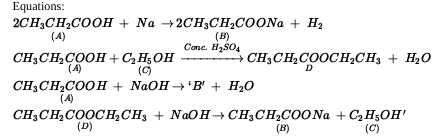
A compound$ A ($molecular formula $C_3H_6O_2)$ reacts with sodium metal to form compound B and evolves a gas which burns with a pop sound. The compound $A$ on treatment with alcohol $C,$ found in beer$,$ in presence of concentrated sulphuric acid$,$ forms a sweet smelling compound $D ($molecular formula $C_5H_{10}O_2)$. On addition of $\text{NaOH}$ to $A$ it also gives $B$ and water. $D$ on treatment with $\text{NaOH}$ gives back $B$ and $C.$ Identify $\text{A, B, C}$ and $D$ and write down the chemical equations of the reactions involved.
Answer
Chemical equations of the reactions involved are:
$\text { A - } C _2 H _5 COOH / CH _3 CH _2 COOH$  An acid
$\text { B - } CH _3 CH _2 COONa / C _2 H _5 COO$ Na  a sodium salt
$\text { C - } C _2 H _5 OH / CH _3 CH _2 OH $ an alcohol
$\text { D - } CH _3 CH _2 COOCH _2 CH _3 / C _2 H _5 COOC _2 H _5 $ an Ester
Image
View full question & answer
Question 65 Marks
What do you mean by multiple covalent bonding? Explain with the help of examples.
Answer
Multiple covalent Bonding: We know that electron pair shared between two atoms is responsible for the formation of a covalent
bond. This shared pair is also called bonding pair of electrons. The bonding atoms may share more than one pair of electrons also depending upon their requirement to complete the Octet. If the two atoms share one electron pair$,$bond is known as single covalent bond and is represented by one dash $(-).$ If the two atoms share two electron pairs$,$bond is known as double covalent bond and is represented by two dashes $(=)$. If the two atoms share three electron pairs$,$bond is known as triple covalent bond and is represented by three dashes $(=).$
In the case of $H_2$,$Cl_2$ and $\text{HCI}$ molecules $($given above$)$ there are single bonds between the atoms.
Formation of Double Bond: Two oxygen atoms combine to form an oxygen molecule by sharing two electron pairs. In the formation of oxygen molecule each oxygen atom has six electrons in the valence shell and require two electrons to complete the octet. Therefore$,$both the atoms contribute two electron pairs are shared and hence there is a double bond between the oxygen
atoms. The covalency of oxygen is two.
Image
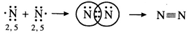
Formation of Triple Bond: In the formation of a nitrogen molecule$,$each of the bond nitrogen atoms having five electrons$,$provides three electrons to form three electrons pairs for sharing. Thus$,$a triple bond is formed between the two atoms. Here$,$covalency of nitrogen is three.
Image
View full question & answer
[5 marks Questions] - Science STD 10 Questions - Vidyadip