Question 14 Marks
Carbon is a versatile element that forms the basis of all living organisms and many of the things we use. A large variety of compounds is formed because of its tetravalency. Compounds of carbon are formed with oxygen, hydrogen, nitrogen, sulphur, chlorine and many other elements.
Answer the following questions:
a. What are hydrocarbons?
b. List two properties by virtue of which carbon can form a large number of compounds.
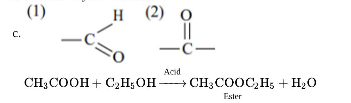
c. Write the formula of the functional group present in (1) aldehydes, and (2) ketones. Write chemical equation for the reaction that occurs between ethanoic acid and ethanol in the presence of a catalyst.
OR
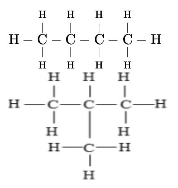
What are structural isomers? Write the structures of two isomers of butane $\left(\mathrm{C}_{4} \mathrm{H}_{10}\right)$.
Answer the following questions:
a. What are hydrocarbons?
b. List two properties by virtue of which carbon can form a large number of compounds.
c. Write the formula of the functional group present in (1) aldehydes, and (2) ketones. Write chemical equation for the reaction that occurs between ethanoic acid and ethanol in the presence of a catalyst.
OR
What are structural isomers? Write the structures of two isomers of butane $\left(\mathrm{C}_{4} \mathrm{H}_{10}\right)$.
Answer
View full question & answer→a. Compounds formed by carbon and hydrogen only.
b. Tetravalency and Catenation
OR
Compounds with identical molecular formula but different structures
Two isomers of butane $\mathrm{C}_{4} \mathrm{H}_{10}$
b. Tetravalency and Catenation
OR
Compounds with identical molecular formula but different structures
Two isomers of butane $\mathrm{C}_{4} \mathrm{H}_{10}$