Question
$i$. How do you classify elements into metals and non $-$ metals on the basis of their electronic configuration ? Choose metal and non $-$ metal out of the following : ${ }_{11}^{23} A,{ }_9^{19} B,{ }_{12}^{24} C,{ }_{15}^{31} D,{ }_{17}^{35} E$
$ii$. What type of bond will be formed if
$a.\ 'A\ '$ combines with $'B\ '$ ?
$b.\ 'A\ ' $ combines with $'E\ '$ ?
$c.\ 'C\ ' $ combines with $'E\ '$ ?
$d.\ 'D\ '$  combines with $'E\ '$ ?
Answer

$i$. Elements which contain $1$ to $3$ electrons in their outermost shell are metals.
Elements containing $4$ to $7$ electrons in their valence shell are non $-$ metals.
Electronic configurations:
${ }_{11}^{23} N a(Z=11)=2,8,1$
${ }_9^{19} B(Z=9)=2,7$
${ }_2^{24} C(Z=12)=2,8,2$
${ }_{31}^{21} D(Z=15)=2,8,5$
${ }_{35}^{15} E(Z=17)=2,8,7$
Hence $A$ and $C$ are metals whereas, $B, D$ and $E$ are non $-$ metals.
$ii.$ Type of bonds
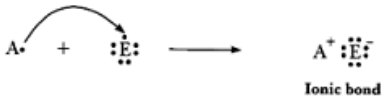
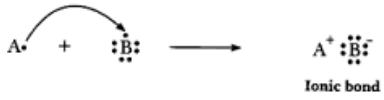
$a.\ 'A\ '$ is metal and $'B\ '$ is non $-$ metal, so the bond formed will be ionic.
$A=2, 8,1 B = 2, 7$
Image
$b.\ 'A\ '$ is metal and $'E\ '$ is non $-$ metal, so the bond formed is ionic.
$A=2, 8, 1 B=2, 7$​​​​​​​
Image
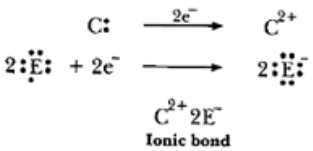
$c.\ 'C\ ' $ is metal and $'E\ '$ is non $-$ metal, so the bond formed is ionic.
$C=2, 8, 2 E= 2, 8, 7$​​​​​​​
Image
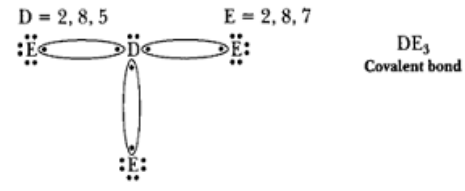
$d.\ 'D\ '$ is a non $-$ metal and $'E\ '$ is also a non $-$ metal, so the bond formed will be covalent.
$D= 2,8,5    E= 2,8,7$
Image

Need a full question paper?

Generate a complete, print-ready paper with questions like this in minutes — across 16+ boards, with answer keys.

Start Generating Free

Similar questions

What is Ohm’s law? Explain how it is used to define the unit of resistance.
What are the advantages and disadvantages of using a solar cooker?
From the internet, gather information about the chromosome numbers of five animals and five plants. Correlate the number with the size of organism and answer the following questions.
  1. Do larger organisms have more number of chromosomes/ cells?
  2. Can organism with fewer chromosomes reproduce more easily than organisms with more number of chromosomes?
  3. More the number of chromosomes/ cells greater is the DNA content. Justify.
Calculate the focal length of a convex lens which produces a virtual image at a distance of 50cm of an object placed 20cm in front of it.
Group 16
Group 17
 
_______
_______
(First Period)
_______
A
(Second Period)
_______
_______
(Third Period)
B
C
(Fourth Period)
  1. State whether element C would be a metal or a non-metal. Why?
  2. Which is the more active element, A or C? Why?
  3. Which type of ion (cation or anion) will be formed by the element C? Why?
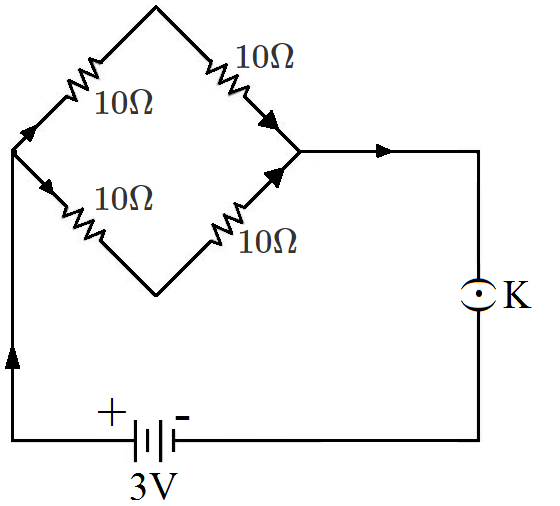
Find the current drawn from the battery by network of four resistors shown in the figure?
Describe how, the water of river Ganga has been highly polluted.
Distinguish between a convex and a concave mirror.
An object is placed at a distance of 100cm from a converging lens of focal length 40cm.
  1. What is the nature of image?
  2. What is the position of image?
A convex lens produces an inverted image magnified three times of an object placed at a distance of 15cm from it. Calculate focal length of the lens.
Why should we avoid the use of fossil fuels as sources of energy?