Questions · Page 1 of 2

[3 Mark Questions]

🎯

Test yourself on this topic

50 questions · timed · auto-graded

Question 13 Marks
State the 10% law, associated with the flow of energy in trophic levels of organisms.
Answer
10% energy law is a law used in a food chain where only the total energy of 10% is transferred through the next organism in the next trophic level. When the trophic level increase the energy will be more in the producer and least in the last trophic level.
And the example of this is
The sun gives 100 joules if energy to the producer but the producer uses the energy in respiration and other processes but only % of this energy is used in the photosynthesis that makes only 10% energy passes through the next organism. This processes happen till the last organism gets energy in the food chain.
View full question & answer
Question 33 Marks
Fertilizers and other chemicals used in agriculture are harmful to us. Give reason.
Answer
Here are some of the most direct consequences, i.e. disadvantages:
  1. Global warming via release of greenhouse gases.
  2. Mono-cultures and consequences associated with elimination of diversity.
  3. Ever increasing dependence on chemical systems.
  4. Nutrient pollution as evidenced by algae blooms, eutrophication.
  5. Water quality issues, lower oxygen levels and dangers to fish stocks Direct impacts on human health (cancers, nutrient deficiencies, etc).
View full question & answer
Question 43 Marks
  1. What is an ecosystem? List its two main components.
  2. We do not clean ponds or lakes, but an aquarium needs to be cleaned regularly. Explain.
Answer
  1. Ecosystem is a self sustaining system where the biotic and abiotic organisms of various communities interact with each other.
The two components of the ecosystem are–Biotic and Abiotic. Biotic system consists of all the living organisms of particular area like humans, animals etc and the nonliving or abiotic component consists of air, mineral soil, water and sunlight.
  1. Ponds are the example of natural ecosystem whereas the aquarium is an example of artificial ecosystem. Ponds do not need to be cleaned but aquarium needs to be cleaned. This is because aquarium does not contain soil and decomposing bacteria which helps in degrading complex organic substance into simple inorganic substance. But pond has this facility. Therefore, it does not need to be cleaned.
View full question & answer
Question 53 Marks
Which of the following are biodegradable and which non-biodegradable?
Glass bottle, Paper, Ball point pen refill, Hay, DDT, Wheat, Cake, Wood, Polythene bag, Jute bag, Cotton cloth, Grass, Vegetable peels.
Answer
Glass bottle – Non-biodegradable Paper – Biodegradable Ball point pen refill – Nonbiodegradable Hay – biodegradable DDT – Non- biodegradable Wheat – Biodegradable Cake – Biodegradable Wood – Biodegradable Polythene Bag – Non-biodegradable Jute Bag – Biodegradable Cotton Cloth – Biodegradable Grass – Biodegradable Vegetable peels – Biodegradable.
View full question & answer
Question 63 Marks
“Damage to the ozone layer is a cause for concern.” Justify this statement. Suggest any two steps to limit this damage
Answer
Damage to the ozone layer is a cause for concern because the harmful ultraviolet (LTV) radiation from the sun will reach the earth. This radiation is highly damaging to organisms, for example, is known to cause skin cancer in human beings.Steps being taken to limit this damage are:
  1. Reduce the use of ozone depleting substances Eke the chlorofluorocarbons (CFCs).
  2. Do not release untreated CFCs present in ACs, fire extinguishers and refrigerators directly into the atmosphere when repairing them.
View full question & answer
Question 73 Marks
Explain how, geothermal energy is used to generate electricity.
Answer
Extremely hot rocks present below the surface of earth heat the underground water and turn it into steam. As more and more steam is formed between the rocks, it gets compressed to high pressures. This high pressure steam is brought up through pipes and is used to run the turbine of a generator to produce electricity.
View full question & answer
Question 83 Marks
If the primary consumer has 400J of energy. What was the energy trapped by the producer and also write the energy present at the quaternary consumer level?
Answer
According to 10% law only 10% of the energy is transferred to the next trophic level. So, if primary consumer has 400J of energy then producer will have 10% more of 400J i.e. 440 . So 440J will be available to the producer. Secondary consumer will have 40 J of energy. Tertiary consumer will have 4J of energy. Quaternary consumer will have 0.4J of energy available.
View full question & answer
Question 93 Marks
State any three environmental problems caused by man.
Answer
Environmental problems caused by man are as follows:
  1. Human activity like building of industry, like sugar mill, chemical industry, emitted certain harmful effluent that pollute air and water and soil as well.
  2. Cutting of trees led to the migration of certain animals and cause extinction of the species.
  3. Primitive agricultural practice caused soil erosion.
  4. Burning of fossil fuels lead to the depletion of ozone layer and may cause several health problems.
  5. Hot water from nuclear thermal power plan affect the microorganisms living in the soil like bacteria, fungi, etc.
  6. It lead to the changing of climate and weather 0f certain areas and mostly the rise of temperature of the earth which is a major cause of rising of sea level due to the melting of polar ice.
View full question & answer
Question 103 Marks
Mention three harmful effects of using polythene bags on the environment. Suggest an effective alternative to these bags.
Answer
  1. Plastic is a non biodegradable substance. It causes land pollution and water pollution.
  2. Burning of plastic also causes air pollution.
  3. Plastic bags when consumed along with food by animals, cause harm to their life.
  4. Plastic bags can cause blocking in sewage line.
  5. Alternative to plastic bags are many such as paper bags, jute bags and other.
View full question & answer
Question 113 Marks
Name the wastes which are generated in your house daily. What measures would you take for their disposal?
Answer
Wastes which are generated in our house daily and measures for their disposal are as follows:
  • Raw vegetable and peels of fruits: Can be disposed underground in a nearby garden which on decomposition enriches the soil with nutrients.
  • Paper wastes like newspaper, books etc: Can be recycled or can also be sold.
  • Plastic waste like polybags, plastic toys etc: Can be sold in suitable shops where they can be recycled.
  • Other household waste like pieces of glass, clothes etc: Should be safely dumped in garbage bins placed to collect non-biodegradable waste.
View full question & answer
Question 123 Marks
How is ozone formed in the upper atmosphere? Why is damage to ozone layer a cause of concern to us? What causes this damage?
Answer
  1. UV rays in atmosphere split some molecular $\text{(O}_{2})$ oxygen into free oxygen (O) atoms.
  2. These atoms combine with molecular oxygen to form $\text{O}_{3}$ (Ozone).
Alternate Answer

$\text{O}_{2}\xrightarrow{\text{UV rays}}\text{O + O}$

$\text{O + O}_{2} \rightarrow\text{O}_{3}$

Damage to ozone layer is a cause of concern to us because it protects the earth from harmful UV radiations. These rediations causes Skin Cancer, Cataract and Crop damage.

Chloroflurocarbons/CFCS which are used in refrigerants and in fire extiguishers cause this damage.
View full question & answer
Question 133 Marks
How is being a vegetarian advantageous in terms of energy?
Answer
We know that, vegetarians obtain food directly from plants while non-vegetarians get the food from animals. Animals (herbivores) contain 10% of food energy as compared to plants (producers). For example; the same amount of producer which supplies say 1000 of food energy to a vegetarian will provide only 100J of food energy to a non-vegetarian. Hence, a vegetarian will be at an advantageous position.
View full question & answer
Question 143 Marks
Ozone present in the atmosphere is very important for sustenance of life on earth. Justify.
Answer
Importance of Ozone layer:
The ozone layer is majorly present in the two layers of the atmosphere. The first 10% of the ozone is present in the troposphere and the rest 90% is present in the stratosphere. The sunray that touches earth surface contains various radiations including the UV rays which are harmful to the human body. The ozone layer absorbs the harmful UV radiations and prevents it to reach the earth's surface. Apart from that the ozone layer present in the lower atmosphere also absorbs different pollutants from the air.
View full question & answer
Question 153 Marks
Depletion of ozone in the ozone layer is a cause for our worry. Why?
Answer
Ozone layer plays an important role in Earth's atmosphere as it absorbs the harmful UV radiation of the sunlight and is important for survival on Earth. Since it absorbs harmful UV radiations and protects us from Sun's harmful rays and various skin diseases including cancer. The use of chloro-Fluoro carbons (CFCs) have resulted in the depletion of Ozone layer. If Ozone layer depletion continues, it may lead to skin cancer, cataracts, damage in immune system etc. It can also lead to affect the rainfall, aquatic food chain and much more.
View full question & answer
Question 163 Marks
Explain with an example for each, how the following provides evidences in favour of evolution in organisms:
  1. Homologous organs.
  2. Analogous organs.
  3. Fossils.
Answer
  1. Homologous organs: Organs which have the same basic structure but different functions are called homologous organs.
Example: The forelimbs of a man, lizard, frog, bird and bat have the same basic design of bones, but they perform different functions.
  1. Analogous organs: Organs which have different basic structure but similar appearance and perform similar functions are called analogous organs.
Example: The wings of an insect and a bird have different structures, but they perform the same function of flying.
  1. Fossils: The remains of dead animals or plants which lived in the remote past are known as fossils.
For example, a fossil bird called Archaeopteryx looks like a bird, but it has many other features which are found in reptiles. Therefore, Archaeopteryx is a connecting link between the reptiles and birds and hence suggests that birds have evolved from reptiles.
View full question & answer
Question 173 Marks
A non-biodegradable toxic chemical has entered into the food chain. Which type of food habit will you suggest to a man, vegetarian or non-vegetarian? Explain with the help of a food chain. The food chain which you would suggest, is advantageous in an another aspect. How?
Answer
The non biodegradable toxic chemical present in various substance like fertilizers, insecticides etc which were mostly spread in crop land after raining it is wash out and go into water resources like ponds, river etc which is consume by aquatic life like fish and we consume fish as food that chemical substance entre our body and harms. I suggest to be a vegetarian because it has various advantages such as it follow 10% law and give maximum energy to us and safe health. Maximum consumption of plants and its substances lead to a good food chain.
View full question & answer
Question 183 Marks
What is meant by a primary consumer, secondary consumer and a tertiary consumer? Give one example of each.
Answer
The animals which eat only plants are called Herbivores. All herbivores are primary consumers.
Example: Goat.
The small carnivores which feed on herbivores (primary consumers) are called secondary consumers.
Example: Frog.
The Large carnivores (or top carnivores) which feed upon the small carnivores (secondary consumers) are called tertiary consumers.
Example: Lion.
View full question & answer
Question 193 Marks
Differentiate between biodegradable and non-biodegradable substances with the help of one example each. List two changes in habit that people Differentiate between biodegradable and non-biodegradable substances must adopt to dispose non-biodegradable waste, for saving the environment.
Answer
Biodegradable substances
Non biodegradable substances
Biodegradable substances are those which can be broken down by microorganisms and insects etc into substances which are taken up by soil and are not harmful to the environment.
Non biodegradable substance does not decompose naturally and are harmful to the environment and create pollution.
Biodegradable substances are made up of natural ingredients.
Non biodegradable substance are made up of natural ingredients.
For example, garden waste of non greasy food waste which is decomposed by soil organisms, make up the humus and do not persist in the environment for long.
Example: substances like plastic are not broken down by soil organisms and persist in the environment for long.
Two changes:
  1. Non biodegradable waste should be recycled and should be disposed by landfills in a way so that they do not affect the quality of soil.
  2. Also certain non biodegradable wastes should be burned by combustion.
View full question & answer
Question 203 Marks
Differentiate between biodegradable and non-biodegradable substances with the help of one example each. List two changes in habit that people must adopt to dispose non-biodegradable waste, for saving the environment.
Answer
Biodegradable substances
Non biodegradable substances
Biodegradable substances are those which can be broken down by microorganisms and insects etc into substances which are taken up by soil and are not harmful to the environment.
Non biodegradable substance does not decompose naturally and are harmful to the environment and create pollution.
Biodegradable substances are made up of natural ingredients.
Non biodegradable substance are made up of natural ingredients.
For example garden waste of non greasy food waste which is decomposed by soil organisms, make up the humus and do not persist in the environment for long.
Example: substances like plastic are not broken down by soil organisms and persist in the environment for long.
Two changes:
  1. Non biodegradable waste should be recycled and should be disposed by landfills in a way so that they do not affect the quality of soil.
  2. Also certain non biodegradable wastes should be burned by combustion.
View full question & answer
Question 213 Marks
fforts are being made for substituting the chemicals like CFCs. Why?
Answer
CFC is a potent greenhouse gas and leads to global warming. It contributes to ozone depletion in the upper atmosphere and therefore are being replaced by products like hydrofluorocarbons (HFCs). But it is to be mentioned that these HFCs are not 100% efficient as some of them might also act as greenhouse gas (example- HFC-134a or R-134a). Therefore, excess use of the substitutes is also not recommended. Thus, necessary steps are still to be taken towards this direction and modifications are still required.
View full question & answer
Question 223 Marks
The ultraviolet radiations are damaging to living components of the environment. Give a reason.
Answer
When UV (ultraviolet) radiations from the sun reach earth's atmosphere which is heavily rich in oxygen. These high energy UV rays split molecular oxygen $\left( O _2\right)$ into free oxygen $( O )$. Afterward, this free oxygen reacts with molecular oxygen; it forms ozone $\left( O _3\right)$.
These harmful UV radiations of the sun, can cause skin cancer in human and can cause many health hazards like skin cancer, cataract, destruction of plants, etc.
View full question & answer
Question 233 Marks
Give reason to justify the following:
  1. The existence of decomposers is essential in a biosphere.
  2. Flow of energy in a food chain is unidirectional.
Answer
  1. The existence of decomposers is essential in a biosphere because they breakdown complex organic substances into simple inorganic substances that can be absorbed by the plants. Thus, decomposers.
  • Replenish the soil naturally.
  • Helps in removing the biodegradable waste.
  1. In a food chain the energy moves progressively through the various trophic levels, it is no longer available to the previous level (autotrophs) and the energy captured by the autotrophs does not go back to the solar input. Hence, the flow of energy is unidirectional.
View full question & answer
Question 243 Marks
Will the impact of removing all the organisms in a trophic level be different for different trophic levels? Can the organisms of any trophic level be removed without causing any damage to the ecosystem?
Answer
Impact of removing all organisms of a trophic level is different for different trophic levels.For example, if we remove producers from a food chain, no organism will get food, if we remove herbivores from a food chain then carnivores will die and producers will also die due to competition for space and nutrients. No, we can't remove any trophic level without causing damage to the ecosystem as one is dependent on other for their survival. If we remove any one this will create imbalnce in the ecosystem.
View full question & answer
Question 253 Marks
The activities of man had adverse effects on all forms of living organisms in the biosphere. Unlimited exploitation of nature by man disturbed the delicate ecological balance between the living and non-living components of the biosphere. The unfavourable conditions created by man himself threatened the survival not only of himself but also of the entire living organisms on the mother earth. One of your classmates is an active member of ‘Eco club' of your school which is creating environmental awareness amongst the school students, spreading the same in the society and also working hard for preventing environmental degradation of the surroundings.
  1. Why is it necessary to conserve our environment?
  2. State the importance of green and blue dust-bins in the safe disposal of the household waste.
  3. List two values exhibited by your classmate who is an active member of Eco-club of your school.
Answer
  1. Conserving of environment is important because of following reasons:
  1. To save the natural resources which are essential for survival such as air, water, soil etc.
  2. To maintain stability in the ecosystem.
  3. Environment provides various things such as air, wood, paper medicines which are very important for survival. If environment is not conserved it can cause ozone depletion resulting in various harmful diseases.
  1. Green dustbins as well as Blue dustbins are very important as green dustbin is used to throw biodegradable waste and blue dustbin is for throwing non-biodegradable waste. Thus, they help in keeping separate the biodegradable and non-biodegradable waste. It helps in proper disposing of both type of waste and recycling of materials.
  2. The values which have reflected by the classmate are the cooperative nature, concern for environmental issues, civic sense and sensitive.
View full question & answer
Question 263 Marks
The number of trophic levels is limited to 3-4 in a food chain. Give reason.
Answer
The number of trophic levels in an ecosystem are limited and are not more than 3-4. Because the amount of energy flow decreases with successive trophic level, as only 10% of energy is transferred from one trophic level to the next trophic level. So, rest of the energy is lost in the form of respiration and other vital activities to maintain life. If more trophic levels are present, the residual energy will be limited and will decrease to such an extent that it cannot further support any trophic level. So, the food chain is generally limited to 3-4 trophic levels only.
View full question & answer
Question 273 Marks
What is an ecosystem? List its two main components. We do not clean natural ponds or lakes but an aquarium needs to be cleaned regularly. Why is it so? Explain.
Answer
The term ecosystem refers to the biological system consisting of all the living components in a particular area and the nonliving components with which the organisms interact, such as air, mineral, soil, water and sunlight.
Following are the components of environment:
  1. Biotic component.
  2. Abiotic component.
Aquarium is an artificial ecosystem that contains fishes as living organisms. In natural ecosystems, other organisms are also present in sufficient number to maintain a balance. In natural aquatic ecosystem, uneaten food or fish waste turns into ammonia and then bacteria convert these pollutants into non-toxic “nitrates”. Therefore, if the water of aquarium is not changed regularly, then wastes could accumulate to dangerous level, which can lead to the death of fishes.
View full question & answer
Question 283 Marks
What is ozone? How is it formed?
Answer
Ozone is a poisonous gas. It is made up of three atoms of oxygen combined together. It is formed high up in the atmosphere by the action of ultraviolet radiation on oxygen gas. The high energy ultraviolet radiation (UV radiation) coming from the sun splits oxygen gas into free oxygen atoms.
$\ \ \ \ \ \ \ \ \text{O}_{2}\ \ \ \ \ \ \xrightarrow[\text{From sun}]{\text{UV radiation}}\ \ \ \ \ \ \ \ \ \ \ \text{O}\ \ \ \ \ \ \ \ \ + \ \ \ \ \ \ \ \ \ \ \text{O}\\\ {^\text{Oxygen molecules}}\ \ \ \ \ \ \ \ \ \ \ \ \ \ \ \ \ \ \ \ \ {^\text{Oxygen atom}}\ \ \ \ \ \ \ \ \ \ \ {^\text{Oxygen atom}} $
The free oxygen atoms thus produced are very reactive. One oxygen atom reacts with an oxygen molecule to form an ozone molecule:
$\ \ \ \ \ \ \ \ \ \ \text{O}_{2}\ \ \ \ \ \ \ \ \ +\ \ \ \ \ \ \ \ \text{O}\ \ \ \ \ \ \ \ \rightarrow\ \ \ \ \ \ \ \ \text{O}_{3}\\\ {^\text{Oxygen molecules}} \ \ \ \ \ \ \ \ {^\text{Oxygen atom}}\ \ \ \ \ \ \ {^\text{Ozone molecule}}$
View full question & answer
Question 293 Marks
We often observe domestic waste decomposing in the bylanes of residential colonies. Suggest ways to make people realize that the improper disposal of waste is harmful to the environment.
Answer
It is true that domestic waste decomposing in the balance of residential areas is harmful to the environment not only the residential colonies but entire on the earth waste should be properly treated so that it does not harm environment for this we should aware the people the importance of environment, by which if they are throwing the waste here and there are burning the waste like plastic plastic bottles stems roots of the plant that it will produce harmful gases which will degrade or spread pollution that we call it air pollution as well as land pollution, hence this must to be stop, we should recycle it and stop the synthesization of new plastic bottles and production of new plastic bottles till these old bottles are used up and use this again and again.
View full question & answer
Question 303 Marks
Indicate the flow of energy in an ecosystem. Why is it unidirectional? Justify.
Answer
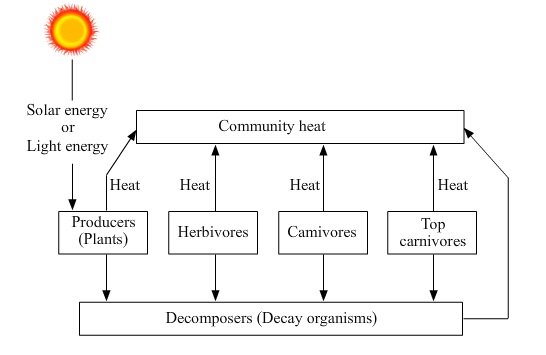
The flow of energy in the ecosystem is unidirectional. The energy enters the plants(from the sun) through photosynthesis during the making of food. This energy is then passed on from one organism to another in a food chain.Energy given out by the organisms as heat is lost to the environment, it does not return to be used by the plants again. This makes the flow of energy in ecosystem 'unidirectional'. Thus, the flow of energy in the ecosystem is said to be unidirectional because the energy lost as heat from the living organisms of a food chain cannot be reused by plants in photosynthesis.
The flow of energy is generally from
Sun --> Producer → Primary Consumer → Secondary Consumer → Tertiary Consumer.
since the flow of energy is progressiely from one trophic level to another and does not revert back, it is siad to be unidirectional. Further, the available energy decreases in the higher trophic levels making it impossible for energy to flow in the reverse direction.
View full question & answer
Question 313 Marks
With the help of a flow diagram, describe how energy from the sun flows through various trophic levels.
Answer
The energy from sun flows through various trophic levels. The food and energy are transferred from producer organisms to herbivores and from herbivores to carnivores, through the food chain. First Step – The green plants trap solar energy with the help of green pigment called chlorophyll which converts the sunlight energy into chemical energy. This gets stored as carbohydrates in the plants. About 1% of the sun’s energy falling on the leaves is used by the plants in the process of photosynthesis and stored as chemical energy of food. The plants utilize the stored energy for their metabolic activities like respiration and growth. Some of the energy is not utilised and it is released as unusable heat into the environment. Second Step – The plants are eaten up by herbivores and the chemical energy of plants is transferred to them. The herbivores utilize this energy for various metabolic activities and release unused energy as heat energy to the environment.
Third Step – The herbivores are eaten up by carnivores. The chemical energy stored in the flesh of herbivores is transferred to the carnivores and they utilise this energy for their metabolic activities like respiration and growth and some of the energy which remains unutilised, is released into the environment. This process of transfer of energy is repeated with large carnivores and so on.
View full question & answer
Question 323 Marks
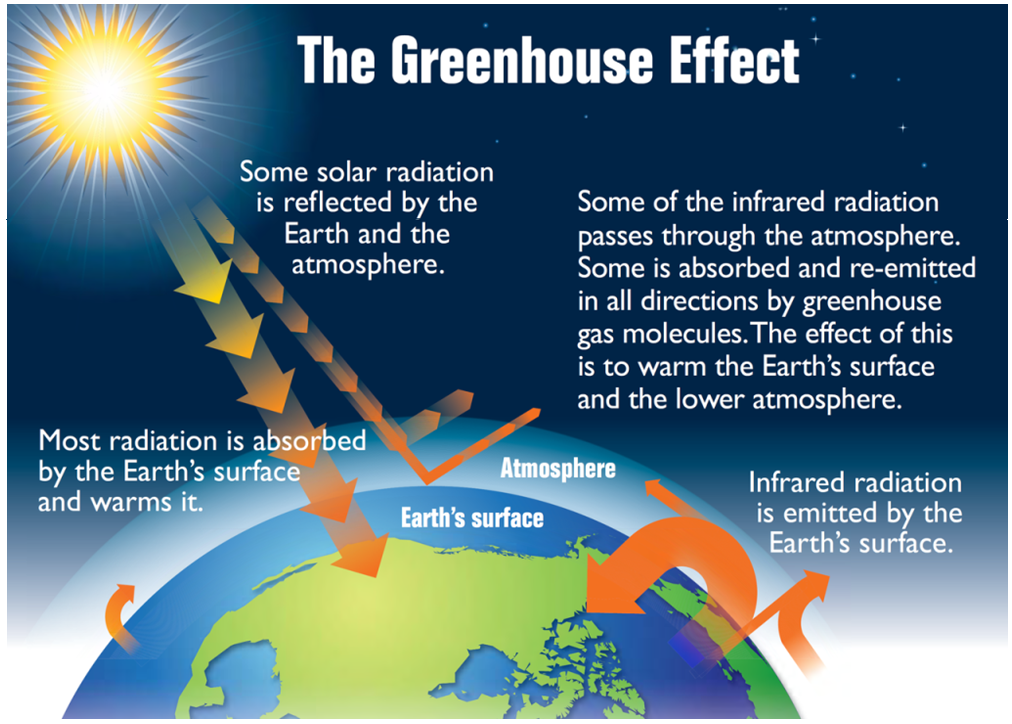
How is Earth kept warm by nature? Describe in detail.
Answer
The greenhouse effect keeps the earth warm by allowing solar energy to pass into the atmosphere and reach the surface of the planet while also providing a barrier for some energy so that it remains on earth.
Explanation:
The greenhouse effect keeps the earth warm by allowing solar energy to pass into the atmosphere and reach the surface of the planet while also providing a barrier for some energy so that it remains on earth. Without this effect, the temperature on earth would be drastically different and it would be impossible for humans to survive.
View full question & answer
Question 333 Marks
What is biological magnification? Will the levels of this magnification be different at different levels of the ecosystem?
Answer
The phenomenon of progressive increase in concentration of certain harmful non biodegradable chemicals such as DDT at different trophic levels of food chain is called biological magnifications.The concentration of harmful chemicals will be different at different trophic levels. It will be lowest in the first trophic level and highest in the last trophic level of the food chain.
View full question & answer
Question 343 Marks
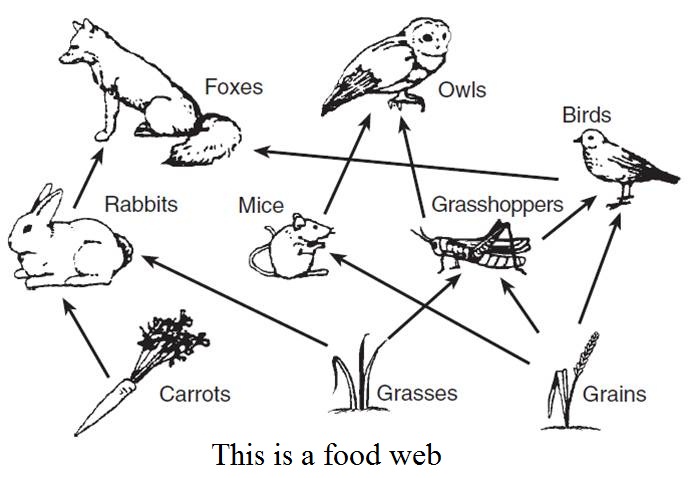
What is a ‘food web’? Show its formation.
Answer
The interconnected food chains operating in an ecosystem which establish a network of relationships between various species is called a food web. In this food web, we can see a network of numerous pathways along which the food flows within grass land community. This food web starts from the plants which is producer and end in top carnivore hawk.
View full question & answer
Question 353 Marks
Your mother always thought that fruit juices are very healthy for everyone. One day she read in the newspaper that some brands of fruit juices in the market have been found to contain certain level of pesticides in them. She got worried as pesticides are injurious to our health.
  1. How would you explain to your mother about fruit juices getting contaminated with pesticides?
  2. It is said that when these harmful pesticides enter our body as well as in the bodies of other organisms they get accumulated and beyond a limit cause harm and damage to our organs. Name the phenomenon and write about it.
Answer
  1.  
  1. During growing of fruit crops, pesticides are often used which may contaminate the fruit and hence the fruit juices.
  2. By using contaminated ground water for making fruit juices.
  1. Bio magnification/Biological magnification.
The progressive accumulation of non-biodegradable toxic substances/chemicals at each trophic level leading to their maximum concentration at the highest trophic level (human beings) is called biological magnification.
View full question & answer
Question 363 Marks
‘‘Energy flow in a food chain is unidirectional.’’ Justify this statement. Explain how the pesticides enter a food chain and subsequently get into our body.
Answer
“Energy flow in a food chain is unidirectional.’’ In the ecosystem energy flows from one trophic level to the next trophic level food chain. Energy flows producers i.e., green plants to the consumers. It does not flow from the last consumer to its previous consumer and so on. It does not flow back from consumers o the producers. So we say that flow of energy in an ecosystem is unidirectional.
Entry of pesticides in a food chain: Some harmful chemicals like pesticides, when absorbed by the plants through soil and water, get transferred from first trophic to the last trophic level of the food chain. As these chemicals are non-degradable their concentration in the concentration of harmful chemicals in the body of living organisms at each trophic level of a food chain is called biological magnification. The level of concentration of chemicals is maximum for human being as they are at the highest trophic level.
View full question & answer
Question 373 Marks
List four points of significance of reproductive health in a society. Name any two areas related to reproductive health which have improved over the past 50 years in our country.
Answer
Significance of reproductive health in a society:
  1. It prevents the spread of various sexually transmitted diseases such as AIDS, syphilis, etc.
  2. Individuals with a sound reproductive health produce better offspring's that have a better chance of survival.
  3. Better sex education and awareness helps in maintaining the population and prevent population explosion.
View full question & answer
Question 383 Marks
Explain the phenomenon of “biological magnification.” How does it affect organisms belonging to different trophic levels particularly the tertiary consumers?
Answer
Biological magnification refers to the process of increase in the concentration of a toxic chemical with increasing tropic level in a food chain.
Harmful or poisonous substance such as DDT sprinkled to kill pests on plants enters the food chain. The plants absorb these harmful chemicals from soil along with water and minerals. They enter the food chain at producer level and then transfers to the next tropic level. The tertiary consumers get higher levels of these chemicals.
View full question & answer
Question 393 Marks
In which form is the 10% energy available for transfer?
Answer
The 10% law for the transfer of energy from one trophic level to the next was introduced by Lindemann (1942). According to this law, during the transfer of energy from organic food from one trophic level to the next, only about ten percent of the energy from organic matter is stored as flesh. The remaining is lost during transfer, broken down in respiration, or lost to incomplete digestion by higher trophic levels.
View full question & answer
Question 403 Marks
Describe with a diagram how energy flows through different trophic levels. Describe how transfer and circulation of material takes place in nature, and the role of decomposers in the process. State how recycling of materials benefits living organisms.
Answer


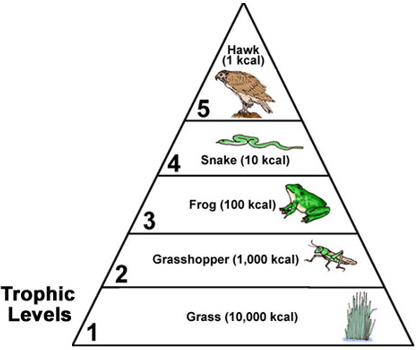
Grass: They are the producers so are placed in first trophic level. They utilize solar energy to prepare food. They transfer this energy to grasshopper, but only 10% of the energy is available to grasshopper according to Lindeman’s 10% Law. If grass has 10,000 kcal of energy only 1000kcal will be transferred to grasshopper. So energy at next trophic level is reduced.
Similarly grasshopper is placed at second trophic level; frog in third, snake in fourth and fifth trophic level is occupied by hawk. At each trophic level the energy goes on decreasing i.e. frog will receive 100kcal of energy, snake 10kcal and finally hawk only 1kcal. Thus energy at each trophic level goes on decreasing and the animal placed at apex will receive lowest energy.
Decomposers like bacteria, fungi etc. act upon dead and decay organisms to convert organic compounds into simpler forms. These simple substances get mixed up in the soil and are used as nutrients by the producers. From producers it goes to consumers and so on. Thus there is recycle of matter which is done by decomposers that maintain balance in the ecosystem. Recycling of materials helps in reuse of same materials again and again. Decomposers provide space for new life in biosphere and without them all life will ultimately cease to exist as dead remains and waste organic matter.
View full question & answer
Question 413 Marks
Define an ecosystem. Draw a block diagram to show the flow of energy in an ecosystem.
Answer

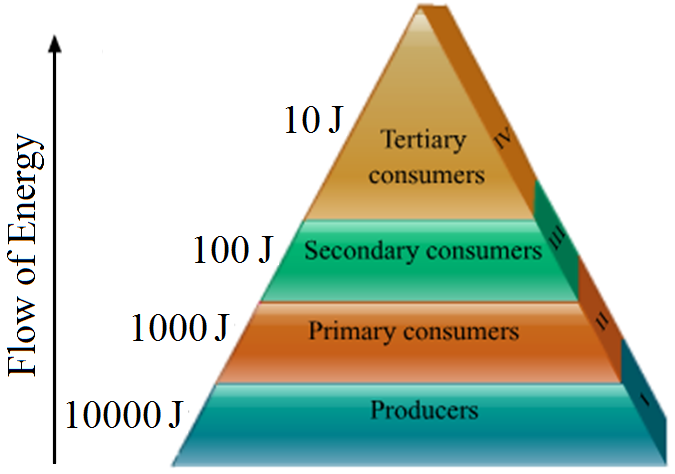
Ecosystem refers to the living and non-living components in an area and the interactions between them. Energy flows across the trophic levels as shown in the diagram below, following the ten percent law. Only ten percent of the energy available to a trophic level is passed on to the next trophic level. The remaining is dissipated away.

Assuming 10000J is the energy available to the producers, then
1000J will be available to the primary consumers,
100J will be available to secondary consumers and
10J will be available to tertiary consumers.
View full question & answer
Question 423 Marks
Human body is made up of five important components, of which water is the main component. Food as well as potable water are essential for every human being. The food is obtained from plants through agriculture. Pesticides are being used extensively for a high yield in the fields. These pesticides are absorbed by the plants from the soil along with water and minerals and from the water bodies these pesticides are taken up by the aquatic animals and plants. As these chemicals are not biodegradable, they get accumulated progressively at each trophic level. The maximum concentration of these chemicals gets accumulated in our bodies and greatly affects the health of our mind and body.
  1. Why is the maximum concentration of pesticides found in human beings?
  2. Give one method which could be applied to reduce our intake of pesticides through food to some extent.
  3. Various steps in a food chain represent:
  1. Food web.
  2. Trophic level.
  3. Ecosystem.
  4. Biomagnification.
  1. With regard to various food chains operating in an ecosystem, man is a:
  1. Consumer.
  2. Producer.
  3. Producer and consumer.
  4. Producer and decomposer.
Answer
  1. The maximum concentration of these chemicals/ pesticides get accumulated in the human body when human beings occupy the top level in any food-chain
  2. One method is to consume the food produced through organic farming.
  1.  
  1. Ecosystem.
  1.  
  1. Consumer.
View full question & answer
Question 433 Marks
Explain some harmful effects of agricultural practices on the environment.
Answer
Although agriculture is important but there are some harmful effects of agricultural practices on the environment which are as follows:
Excessive cutting down of trees for agricultural purposes causes deforesting and during rain fall it may also result in soil erosion.
Excess drainage of groundwater for irrigation purposes lowers the water table. This results in acute water shortage at many places.
Synthetic fertilizers and pesticides used in the field during rain fall washed away to rivers and other bodies which cause water pollution.
The chemical pesticides, being non-biodegradable accumulates in organisms in increasing amounts at each trophic level commonly known as bio magnification.
View full question & answer
Question 443 Marks
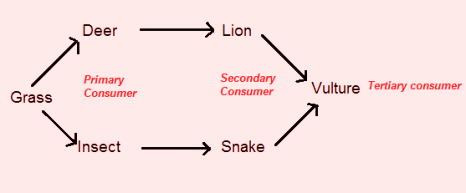
Make two food chains and a food web from the following set of living organisms: Grass, vulture, deer, insect, and snake. Identify the tertiary consumers in both the food chains.
Answer
The Food chain is as follows:
  1. Grass → →Deer → →Lion → →Vulture.
  2. Ct → → Snake → →Vulture.Grass → → Inse
The Food web is as follow:

The tertiary consumer is Vulture for both food chains.
View full question & answer
Question 453 Marks
How do human activities affect the environment?
Answer
Human impact on environment in several ways, some common effects include water quality, environmental pollution and greenhouse gas emissions, depletion of natural resources and contribution to climate change. Some of these are the direct result of human activities, whereas others are secondary effects that are part of a series of actions and reactions. Though, technology is making lives of humans easier and comfortable. It poses a great threat to the environment. The threat is due to pollution, radiation hazards, exploitation of natural resources etc. Greenhouse gases and aerosols affect climate by altering incoming solar radiation and out-going infrared (thermal) radiation that are part of Earth’s energy balance. Changing the atmospheric abundance or properties of these gases and particles can lead to a warming or cooling of the climate system.
View full question & answer
Question 463 Marks
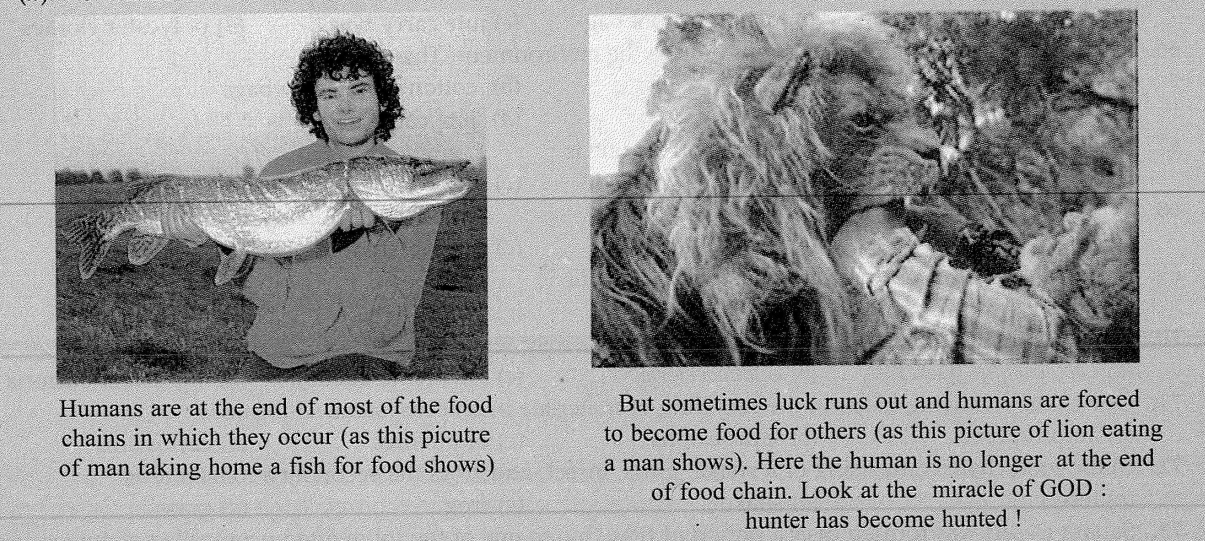
Some hunters are roaming in the plush green forest of Africa. They spot a deer and kill it. They decide to roast the deer there and then and eat it. When the hunters had just finished enjoying the feast of roasted deer, a lion attacks them. The lion kills one of the hunters and eats his flesh.
  1. Write a food chain which provides food to lion in this case.
  2. Which animal (other than deer) the lion could look for food if he did not get the hunter as prey?
  3. Which other animal in the forest could have been in place of lion?
  4. How does the above food chain differ form the food chain such as: plants → goat → man?
Answer
  1. The following is the food chain that provides food to the lion in the given case:
    Plants → Deer → Man → Lion
  2. The lion could have looked for a herbivore, such a wild buffalo or a zebra, if it he had not got the hunter as prey.
  3. Any top consumer, such as a tiger or a python, could have been in the place of the lion in the forest.
  4. In the food chain,
    Plants → Goat → Man
    man is the top consumer whereas, in the food cha
    Plants → Deer → Man → Lion,
    the top consumer is lion.in,
View full question & answer
Question 473 Marks
How does a biodegradable waste differ from a non-biodegradable waste? Give two examples of non- biodegradable wastes which pollute our environment.
Answer
Bioderghradable Wastes:
  • Those waste materials which can be broken down to non-poisonous substances in nature by the action of microorganisms (like bacteria) are called biodegradable wastes.
  • They get recycled and therefore do not require dumping sites.
  • They do not cause any pollution to the soil.
Example: Paper, Wood, etc.
Non-Biodegradable Wastes:
  • Those waste materials which cannot be broken down to non-poisonous substances in nature are called non-biodergradable wastes.
  • They cannot be recycled easily and therefore are to be dumped which requires lot of space. This cause wastage of land.
  • The harmful chemical leach out of these wastes when they are dumped in soil. This leads to soil pollution.
Example: DDT, Plastic and Polythene bags.
View full question & answer
Question 483 Marks
How much energy will be available to hawks in the food chain comprising hawk, snake, paddy and mice, if 10,000 J of energy is available to paddy from the sun?
Answer
  1. Small algae can trap only 1% of the sun’s energy falling on them. 1% of 10,000 J is 100 J, so the small algae have 100 J of energy available.
  2. Small algae are eaten up by zooplankton. According to the 10% law, 10% of 100 J is 10 J of energy which is available in zooplankton.
  3. The zooplankton will transfer 10% of its 10 J energy to the fish. Thus, the food energy available to the fish will be 10% of 10 J, which is 1 J.
  4. 10% of 1 J will be transferred to big fish which will be 0.1 J. The above result can be clearly shown as:
$\ \ \ \ \ \ \ \ \ \ \ \ \ \ \ \ \ \ \ \ \ \ \ \ \ \ \text{sun}\\^{10000\text{J}}\ ^{(1\%\text{absorbed)}}\Bigg\downarrow\\ \ \ \ \ \ \ \ \ \ \ \ \ \ \ \ \ \text{Small Algae}\ \xrightarrow{\ \ 10\%\ \text{Of}\ 100\text{J}\ \ \ }\ \text{Zooplankton}\ \xrightarrow{\ \ 10\%\ \text{Of }\ 10\text{J}\ \ }\ \text{Fish}\ \xrightarrow{\ \ 10\%\ \text{Of}\ 1\text{J}\ \ }\ \text{Big fish}\\ \ \ \ \ \ \ \ \ \ \ \ \ \ \ \ \ \ \ \ \ \ \ 100\text{J}\ \ \ \ \ \ \ \ \ \ \ \ \ \ \ \ \ \ \ \ \ \ \ \ \ \ \ \ \ \ \ \ \ \ \ \ \ \ \ 10\text{J}\ \ \ \ \ \ \ \ \ \ \ \ \ \ \ \ \ \ \ \ \ \ \ \ \ \ \ \ \ \ \ \ \ \ 1\text{J}\ \ \ \ \ \ \ \ \ \ \ \ \ \ \ \ \ \ \ \ \ \ \ \ \ \ 0.1\text{J}$
View full question & answer
Question 493 Marks
In three words, describe the relationship of organisms working in a food chain.
Answer
Food Chains and Food Webs. In ecology, a food web describes the feeding connections between organisms in a biotic community. Both energy and nutrients flow through a food web, moving through organisms as they are consumed by an organism above them in the food web.
A food chain is a series of steps in an ecosystem to which organisms transfer energy by eating and being eaten. A food web is a network of complex interactions formed by the feeding relationships among the various organisms in an ecosystems.
Examples of Food Chains
Butterfly - small birds - fox.
Carrots - rabbit - snake - eagle.
Corn - chick - snake - man.
View full question & answer
Question 503 Marks
A food chain occurring in the sea which provides food for many people can be written as:
phytoplankton → zooplankton → X → Y
  1. Name one phytoplankton.
  2. Name two zooplanktons.
  3. What could be X?
  4. Name the organism which Y could be.
  5. Which organism in the above food chain is a (i) primary consumer, and (ii) tertiary consumer?
Answer
  1. Algae are phytoplankton.
  2. Jelly fish and copepods are examples of zooplankton.
  3. X is a small fish.
  4. Y could be a big fish.
  5. (i) Zooplankton are primary consumers, and (ii) big fish are tertiary consumers.
View full question & answer
[3 Mark Questions] - Science STD 10 Questions - Vidyadip