Question
In which form is the 10% energy available for transfer?

Answer

The 10% law for the transfer of energy from one trophic level to the next was introduced by Lindemann (1942). According to this law, during the transfer of energy from organic food from one trophic level to the next, only about ten percent of the energy from organic matter is stored as flesh. The remaining is lost during transfer, broken down in respiration, or lost to incomplete digestion by higher trophic levels.
Need a full question paper?

Generate a complete, print-ready paper with questions like this in minutes — across 16+ boards, with answer keys.

Start Generating Free

Similar questions

In a household electric circuit, different appliances are connected in parallel to one another. Give two reasons. An electrician puts a fuse of rating 5A in that part of domestic electrical
circuit in which an electrical heater of rating 1.5kW, 220V is operating. What is likely to happen in this case and why? What change, if any, needs to be made?
State the rule to determine the direction of a,
  1. Magnetic field produced around a straight conductor-carrying current.
  2. Force experienced by a current-carrying straight conductor placed in a magnetic field which is perpendicular to it, and,
  3. Current induced in a coil due to its rotation in a magnetic field.
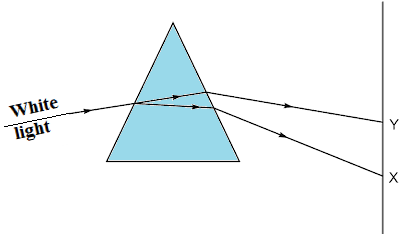
In the figure given alongside, a narrow beam of white light is shown to pass through a triangular glass prism. After passing through the prism, it produces a spectrum YX on the screen:
State the colour seen.
  1. At X, and
  2. At Y​​​​​​​​​​​​

​​​​​​​​​​​​
  1. violet.
  2. Red
  1. ​​​​​​​Why do different colours of white light bend through different angles with respect to the incident beam of light?
A bright object 50mm high stands on the axis of a concave mirror of focal length 100mm and at a distance of 300mm from the concave mirror. How big will the image be?
Differentiate between the time varying and constant currents.
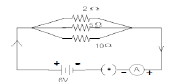
In the circuit diagram given here, calculate$-$
Image
$i.$ The total effective resistance and the total current
$ii.$ The current through each resistor
Why homologous series of carbon compounds are so called? Write chemical formula of two consecutive members of a homologous series and state the part of these compounds that determines their (i) physical properties, and (ii) chemical properties.
Define nutrition. What are the different modes of nutrition?
Define the term transpiration. Design an experiment to demonstrate this process.
Describe how deoxygenated blood from this chamber is sent to lungs for oxygenation.