Questions

4 Marks Question

🎯

Test yourself on this topic

28 questions · timed · auto-graded

Question 14 Marks
Prepare a ‘Total Creditors Account with imaginary figures.
Answer
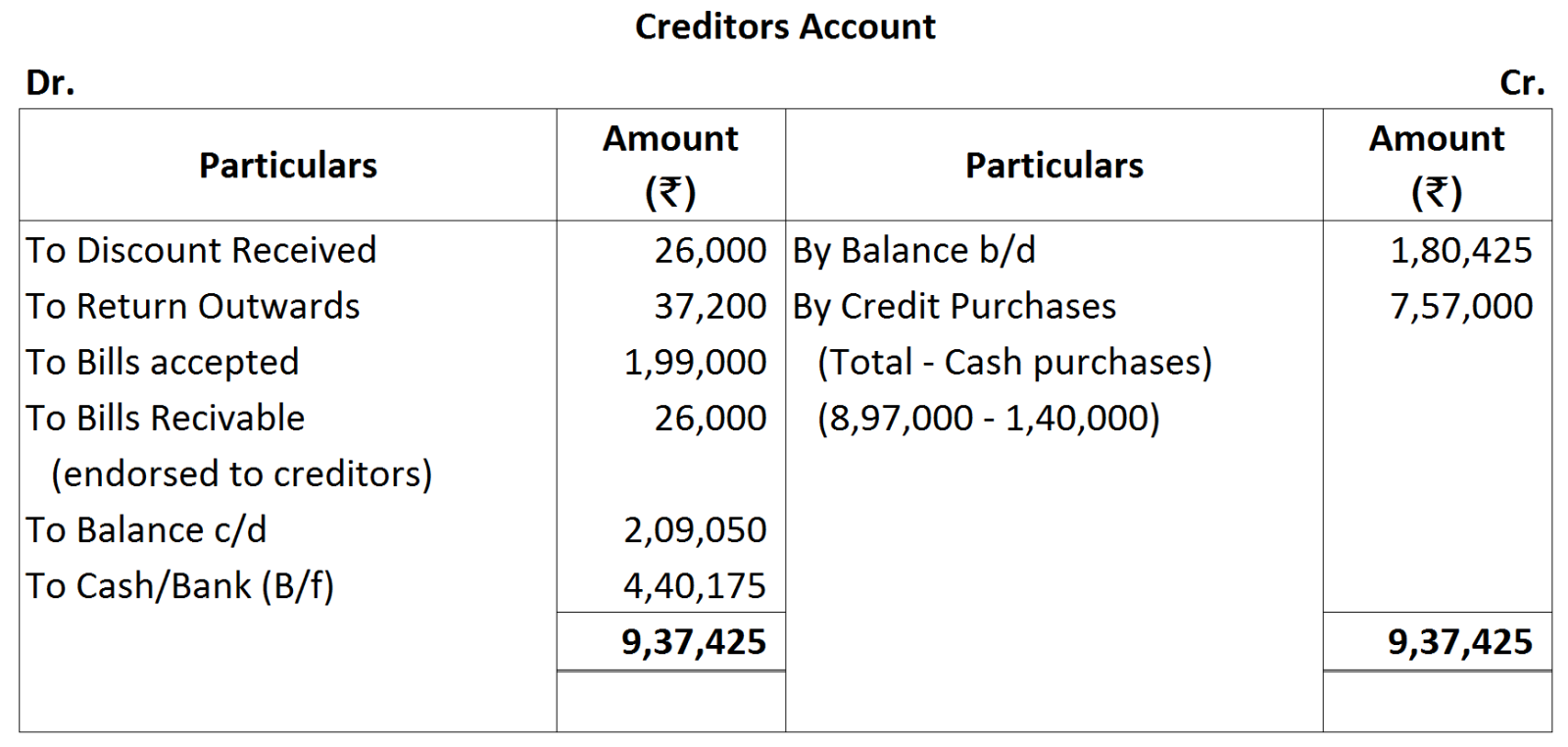
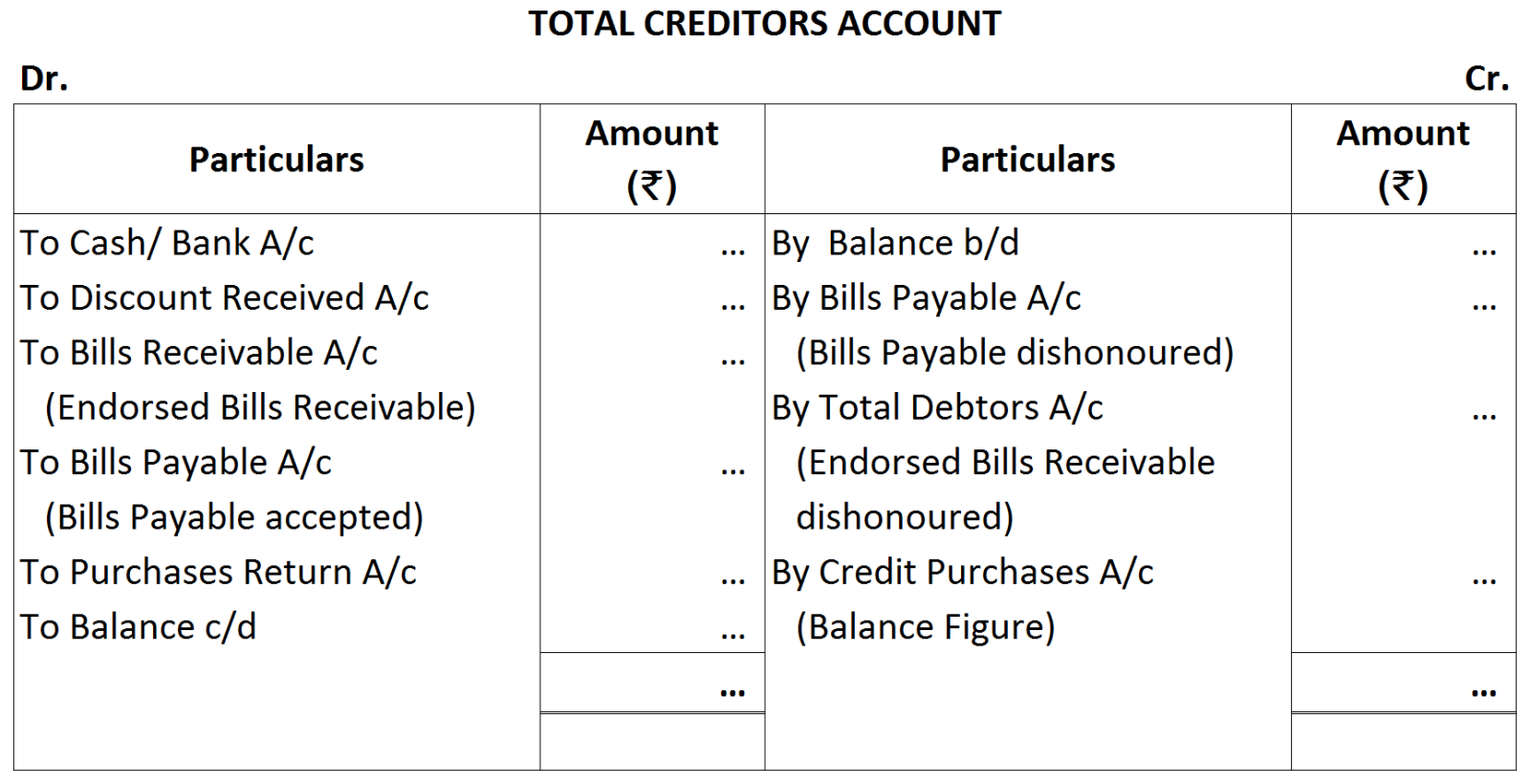
Prepare Total Creditors Account: Total Creditors Account is prepared in the same manner as Total Debtors Account to find the missing value (figure) of credit purchases or closing balance of creditors or cash paid to creditors or opening balance of creditors as given below:
View full question & answer
Question 24 Marks
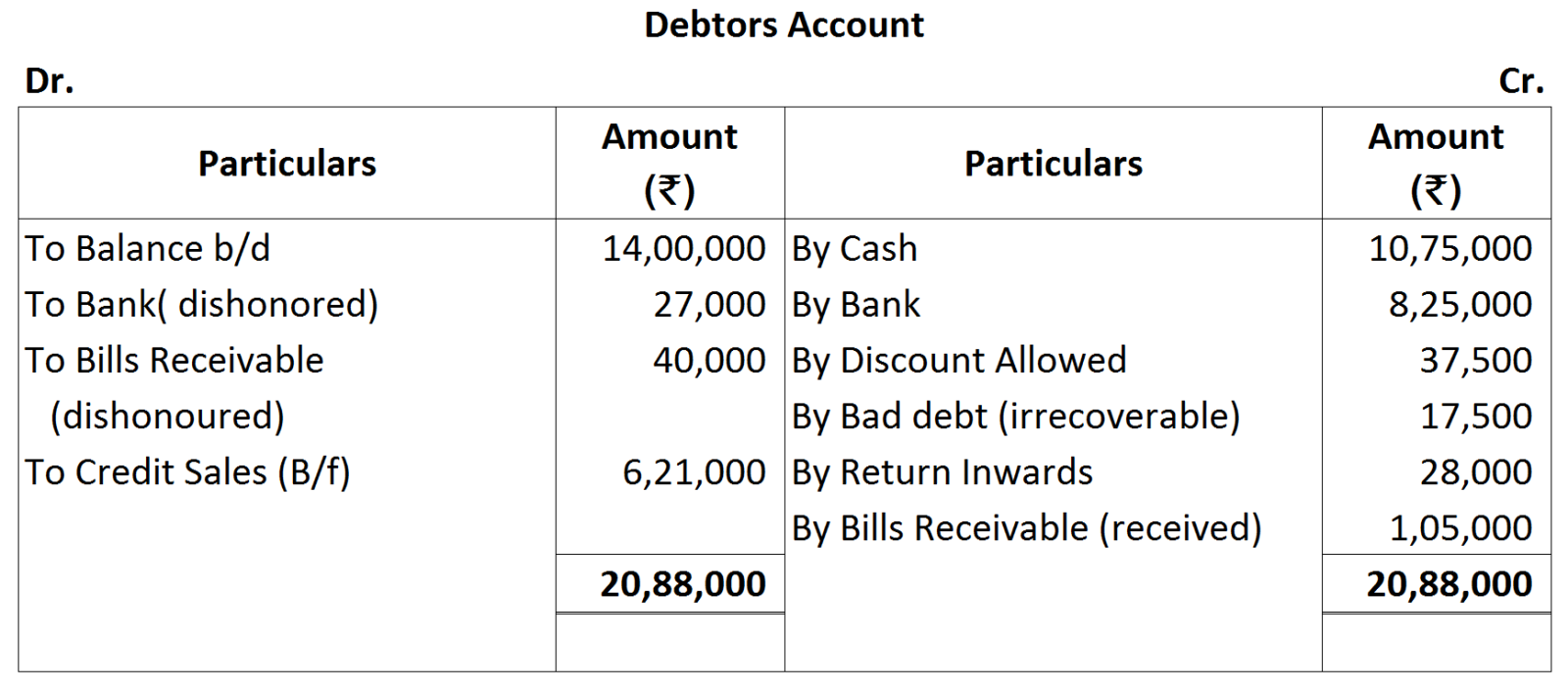
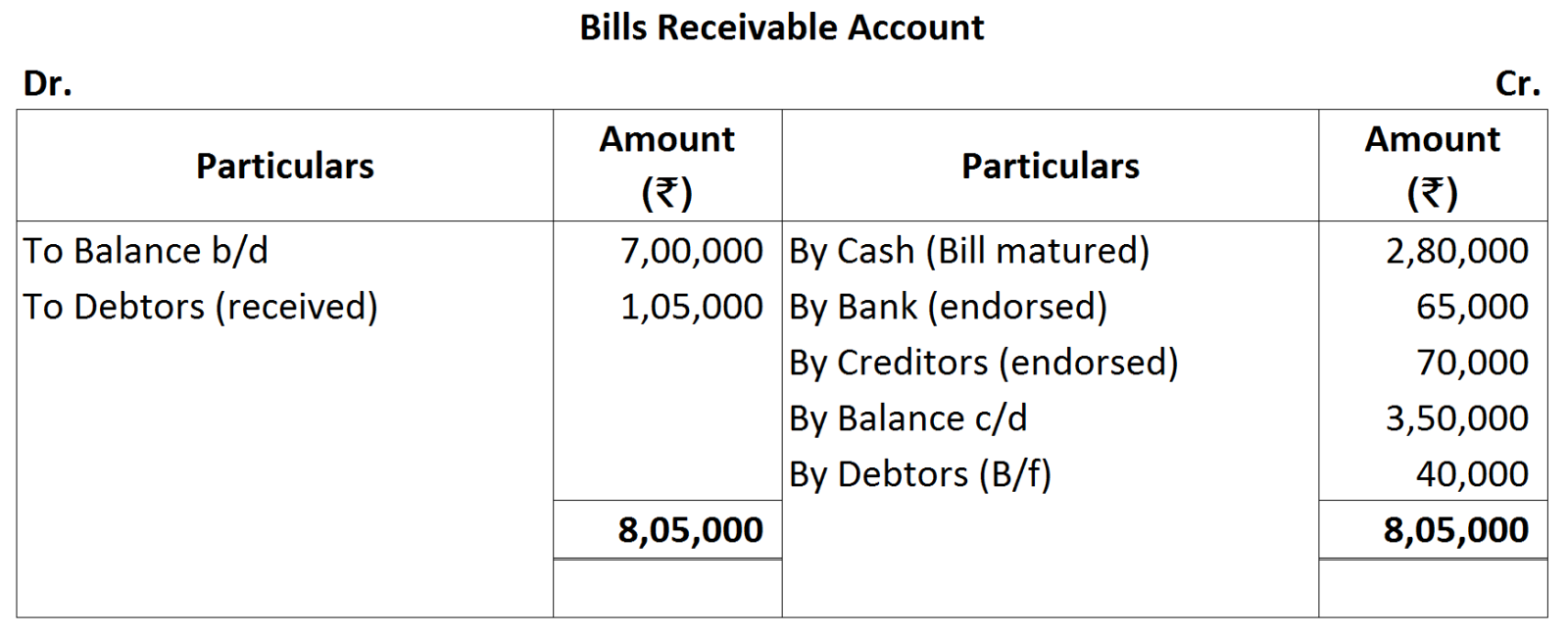
Prepare the suitable accounts and find out the missing figure if any
 
Opening balance of debtors. 14,00,000
Opening balance of bills receivable. 7,00,000
Closing balance of bills receivable. 3,50,000
Cheque dishonoured. 27,00
Cash received from debtors. 10,75,00
Cheque received and deposited in the bank. 8,25,00
Discount allowed. 37,50
Irrecoverable amount. 17,500
Returns inwards. 28000
Bills receivable received from customers. 1,05,000
Bills receivable matured. 2,80,000
Bills discounted. 65,000
Bills endorsed to creditors. 70,000
Answer


Note: As per solution, the missing figure in the bills receivable account is B/R dishonoured of 40,000. The missing figure in the debtors account is the credit sales of 6,21,000, However, the NCERT book shows a credit sales 5,16,000.
In order to match our answer with that of the book, B/R received from the customers is not shown in the debtors account.
View full question & answer
Question 34 Marks
Creditors on 1st April, 2017 were ₹ 15,000, Purchases on credit were ₹ 30,000, Cash paid to Creditors during 2017-18 was ₹ 20,000, Returns Outward (regarding credit purchases) were ₹ 1,000 and Bills Payable accepted during the year ₹ 10,000. Find the balance of Creditors on 31st March, 2018.
View full question & answer
Question 44 Marks
Write any three characteristics of Single Entry System.
Answer
Characteristics of Single Entry System:
  1. Suitability: This system is suitable for small-size businesses where the number of transactions is less.
  2. No Uniformity: This system may differ from firm to firm as it is a mere adjustment of Double Entry System according to requirements and convenience.
  3. Maintenance of Personal Accounts: Usually under this system, only personal accounts are maintained and real and nominal accounts are avoided. Therefore sometimes, it is defined as a system where only personal accounts are kept.
  4. Maintenance of Cash Book: Generally, a Cash Book is maintained in this system which mixes up business as well as personal transactions.
View full question & answer
Question 54 Marks
Give any three reasons for keeping records under Single Entry System.
Answer
Reasons:
  1. Simple Method: Single Entry System is a simple method of recording business transactions.
  2. Less Expensive: It is less expensive when it is compared to Double Entry System of book keeping.
  3. Suitable for Small Businesses: It is mainly suited to small businesses with limited number of transactions and very few assets and liabilities.
  4. No Need of Expert Knowledge of Principles of Book Keeping: Under Single Entry System, accounting records can be easily maintained as their maintenance does not require expert knowledge of the principles of book keeping.
  5. Easy to Ascertain Profit or Loss: Ascertainment of profit or loss is much easier. To ascertain the profit or loss, the proprietor has to compare the financial condition of business at the close of the accounting period with that in the beginning.
View full question & answer
Question 64 Marks
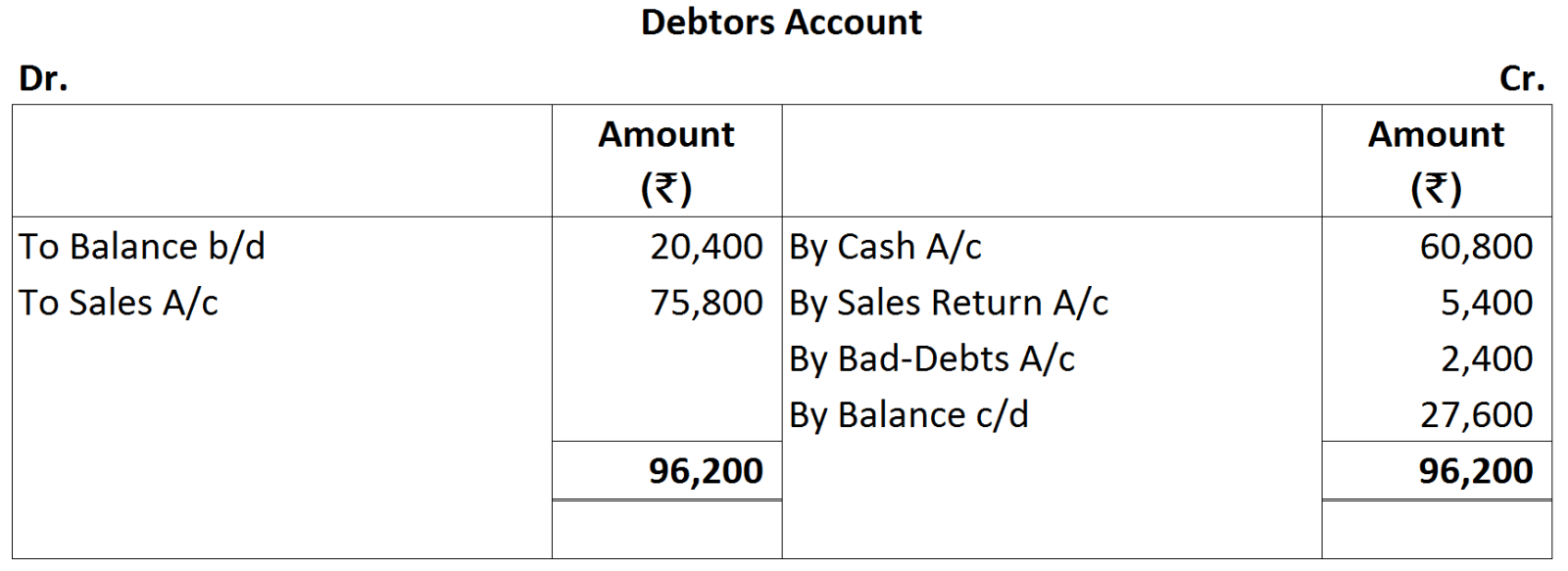
From the following information, calculate Total Sales made during the period:
 
Debtors as on 1st April, 2017 20,400
Cash received from debtors during the year (as per Cash Book) 60,800
Returns Inward 5,400
Bad Debts 2,400
Debtors as on 31st March, 2018 27,600
Cash Sales (as per Cash Book) 56,800
Answer

Total Sales = Cash Sales + Credit Sales
Total Sales = 56,800 + 75,800 = ₹ 1,32,600
View full question & answer
Question 74 Marks
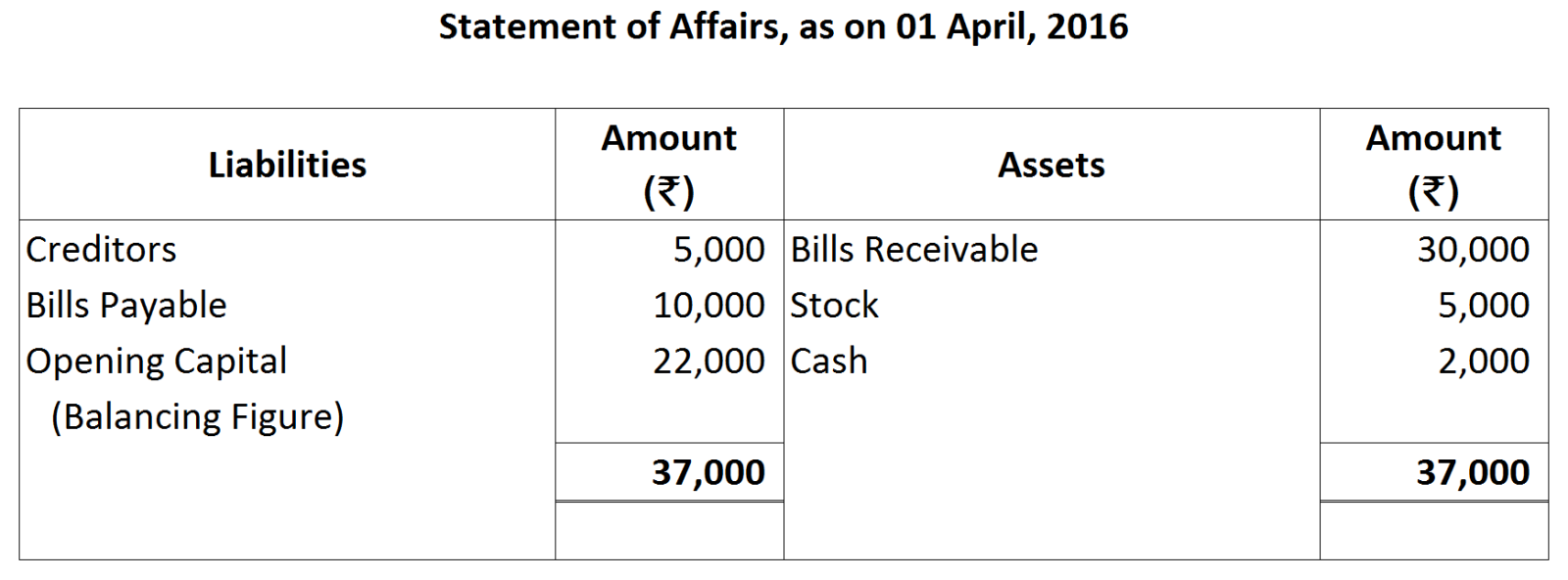
Mr. Girdhari Lal does not keep full double entry records. His balance as on April 01, 2016 is as.

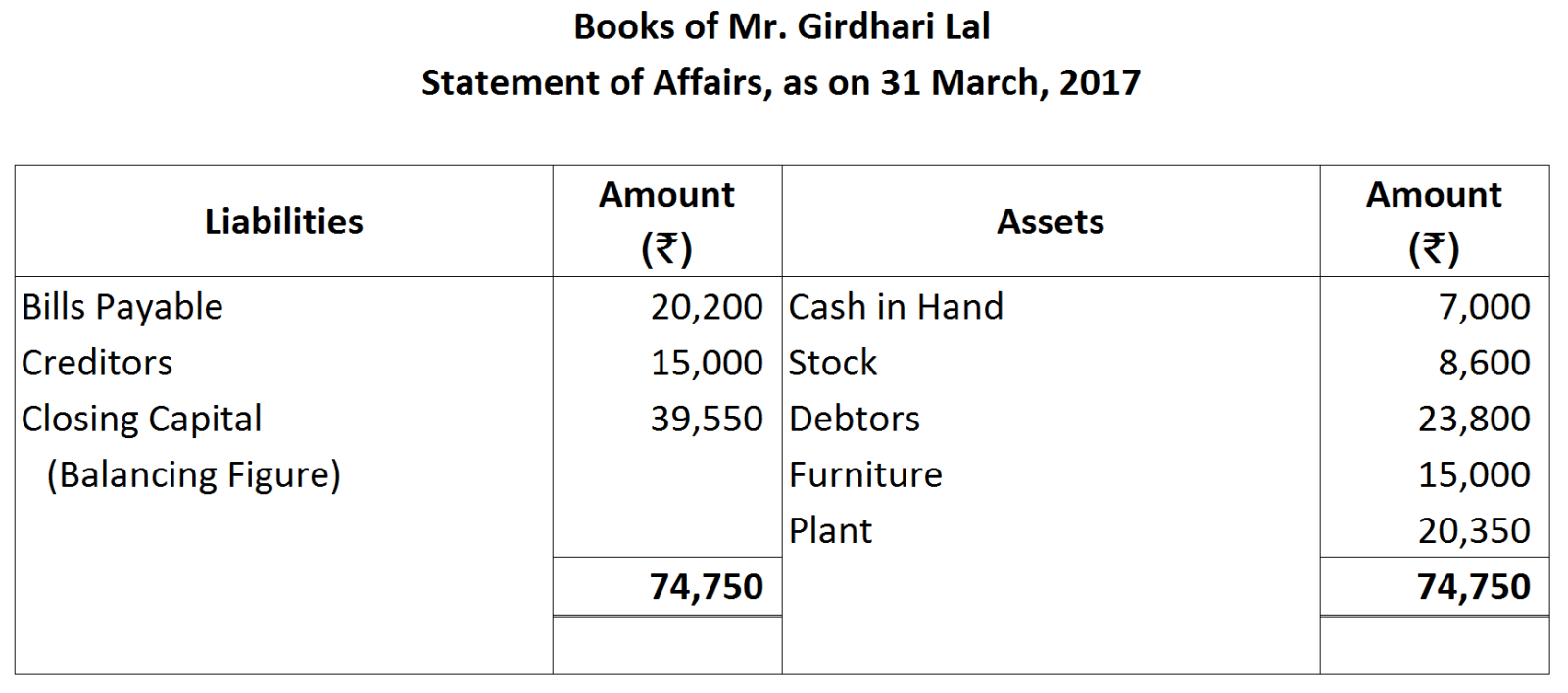
His position at the end of the year is:
 
Cash in hand 7000
Stock 8,600
Debtors 23,800
Furniture 15,000
Plant 20,350
Bills payable 20,200
Creditors 15,000
He withdrew 500 per month out of which to spent 1,500 for business purpose. Prepare the statement of profit or loss.
View full question & answer
Question 84 Marks
Following information is given below: calculate the closing capital:
  April 01, 2016 March 31, 2017
 
Creditors 5,000 30,000
Bills payable 10,000
Loan 50,000
Bills receivable 30,000 50,000
Stock 5,000 30,000
Cash 2,000 20,000
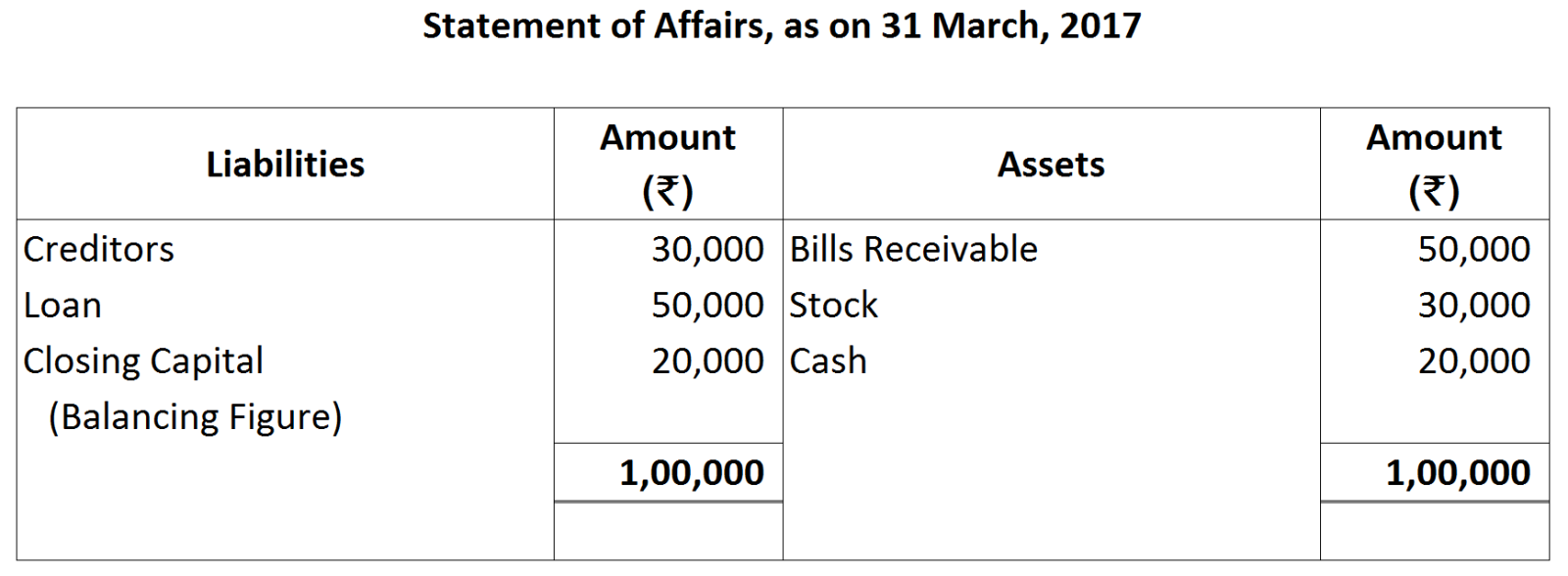
Calculation of profit or loss and ascertainment of statement of affairs at the end of the year (Opening Balance is given).
Answer


Capital on March 31, 2017 (Closing) is 20,000
View full question & answer
Question 94 Marks
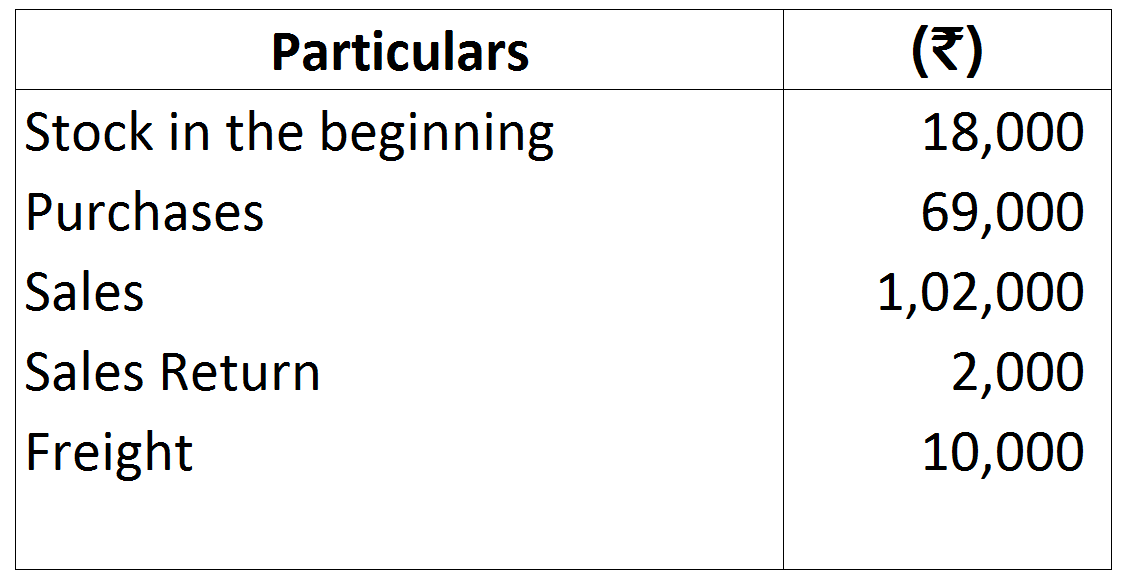
Ascertain the value of Closing Stock from the following:
Rate of G.P. on cost is 25%.
Answer
Rate of Gross Profit (on cost) = 25%
Rate of Gross Profit (on sales) = 20%
Gross Profit = 20% of 1,00,000 = 20,000
Gross Profit = Net Sales - Cost of Goods Sold
20,000 = 1,00,000 - Cost of Goods Sold
Cost of Goods Sold = 1,00,000 - 20,000 = ₹ 80,000
Cost of Goods Sold = Opening Stock + Purchases + Direct Expenses - Closing Stock
80,000 = 18,000 + 69,000 + 10,000 - Closing Stock
Closing Stock = 18,000 + 69,000 + 10,000 - 80,000 = ₹ 17,000
View full question & answer
Question 104 Marks
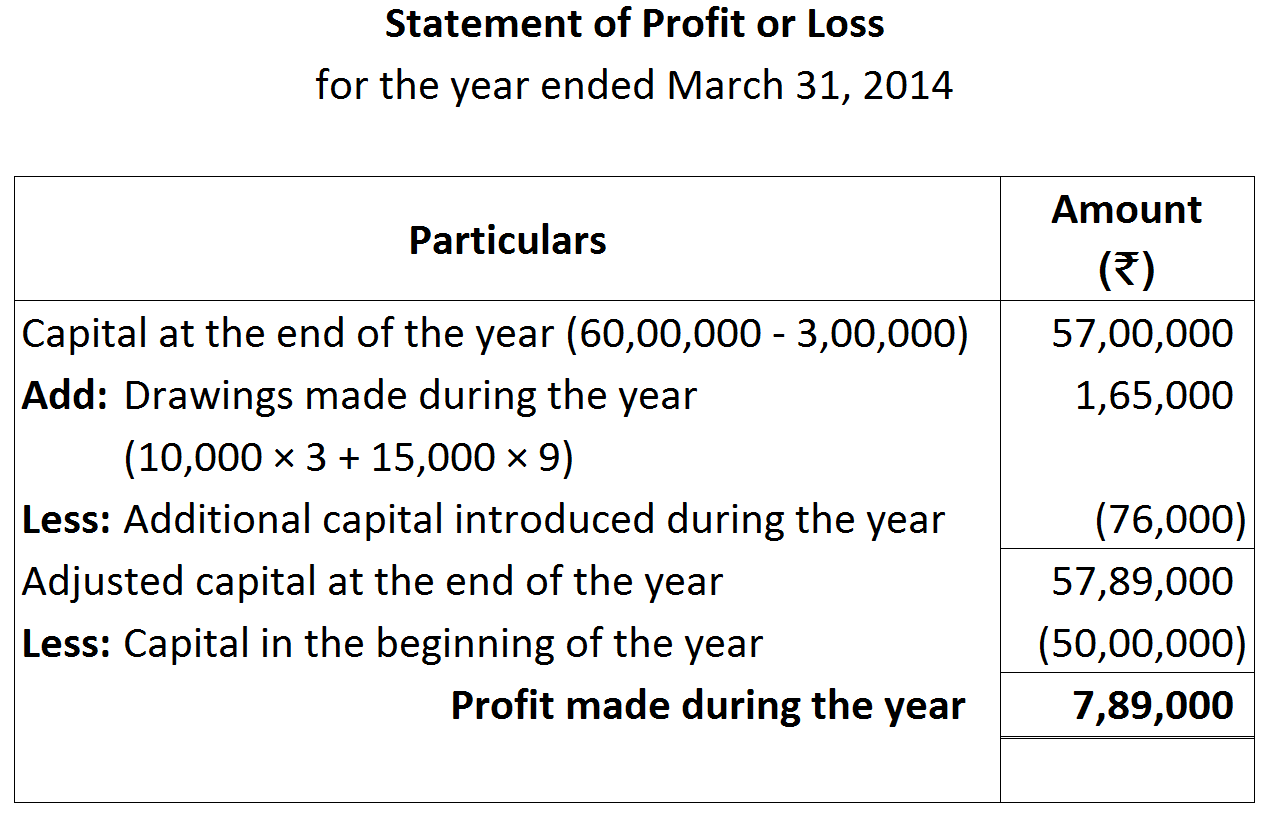
Suchitra started a business on $1^{st}$ April, $2013$ with a Capital of ₹ $50,00,000$. On $31^{st}$ March, $2014$ her total Assets were ₹ $60,00,000$ and Creditors were $3,00,000$. She withdrew during the year for her personal expenses ₹ $10,000$ per month upto $30^{th}$ June, $2013$ and thereafter ₹ $15,000$ per month upto $31^{st}$ March, $2014$. During the year she sold her personal investments of ₹ $80,000$ at $5\%$ loss and introduced that amount in the business.
You are required to prepare a Statement of Profit or Loss for the year ending $31^{st}$ March, $2014$.
Answer

Working Note:
Calculation of additional capital introduced during the year
Value of Investments = 80,000
Loss = 80,000 × 5% = 4,000
Sale Value of Investments = ₹ 76,000(Aditional Capital)
View full question & answer
Question 114 Marks
Give any three advantages of Single Entry System of Accounting.
Answer
Advantages of Single Entry System:
  1. Simple Method: Single Entry System is a simple method of recording business transactions.
  2. Less Expensive: It is less expensive when it is compared to Double Entry System of book keeping.
  3. Suitable for Small Businesses: It is mainly suited to small businesses with limited number of transactions and very few assets and liabilities.
  4. No Need of Expert Knowledge of Principles of Book Keeping: Under Single Entry System, accounting records can be easily maintained as their maintenance does not require expert knowledge of the principles of book keeping.
  5. Easy to Ascertain Profit or Loss: Ascertainment of profit or loss is much easier. To ascertain the profit or loss, the proprietor has to compare the financial condition of business at the close of the accounting period with that in the beginning.
View full question & answer
Question 124 Marks
From the following information, prepare the bills receivable account and total debtors account for the year ended March 31, 2017.
 
Opening balance of debtors. 1,80,000
Opening balance of bills receivable. 55,000
Cash sales made during the year. 95,000
Credit sales made during the year. 14,50,000
Return inwards. 78,000
Cash received from debtors. 10,25,000
Discount allowed to debtors. 55,000
Bills receivable endorsed to creditors. 60,000
Cash received (bills matured). 80,500
Irrecoverable amount. 10,000
Closing balance of bills receivable on March 31, 2017. 75,500
View full question & answer
Question 134 Marks
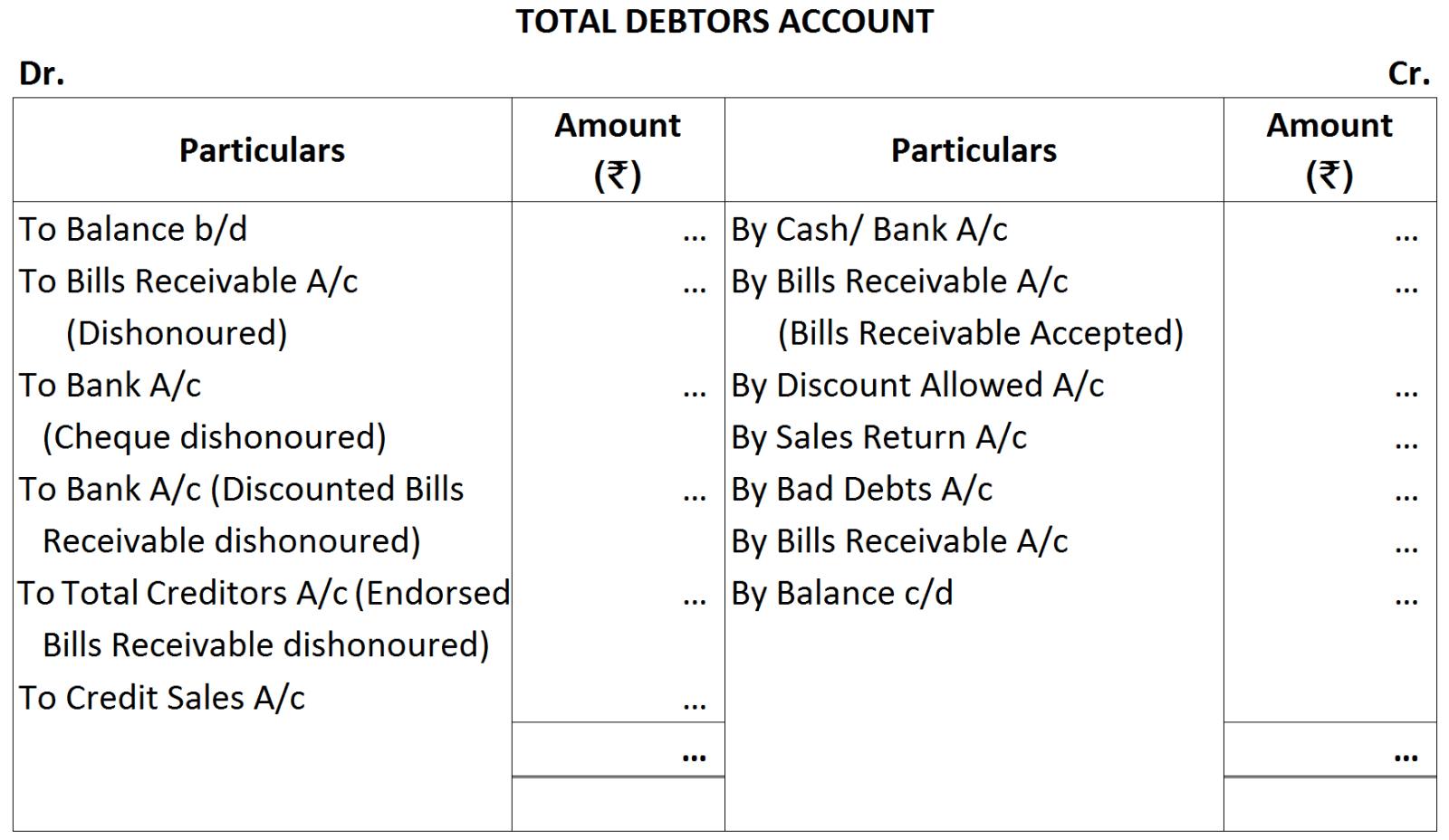
Prepare a “Total Debtors Account' with imaginary figures.
Answer
Prepare Total Debtors Account: Total Debtors Account is prepared to find the missing values (figures) of credit sales or the closing balance of debtors or cash received from the debtors or opening balance of debtors in the following manner:
View full question & answer
Question 144 Marks
What are the possible reasons for keeping incomplete records?
Answer
The possible reasons for keeping incomplete records are:
  1. Simple method: Proprietors, who do not have the proper knowledge of accounting principles, find it much convenient and easier to maintain their business records under this system.
  2. Less time consuming: Maintaining books according to the single entry system is less time consuming, as only few books are to be maintained. Further, the books are not as comprehensive as they are under double entry system.
  3. Less expensive: It is an economical mode of maintaining records, as there is no need to appoint specialised accountant.
  4. Flexible: Owner may record transactions as per his/ her own needs. It can be easily adjusted or changed whenever needed.
View full question & answer
Question 154 Marks
From the following information calculate the amount to be paid to creditors:
 
Sundry creditors as on March 31, 2017 1,80,425
Discount received 26,000
Discount allowed 24,000
Return outwards 37,200
Return inward 32,200
Bills accepted 1,99,000
Bills endorsed to creditors 26,000
Creditors as on April 01, 2016 2,09,050
Total purchases 8,97,000
Cash purchases 1,40,000
Answer

Amount paid to Creditors is 4,40,175.
View full question & answer
Question 164 Marks
Explain how the following may be ascertained from incomplete records:
Opening capital and closing capital.
Answer
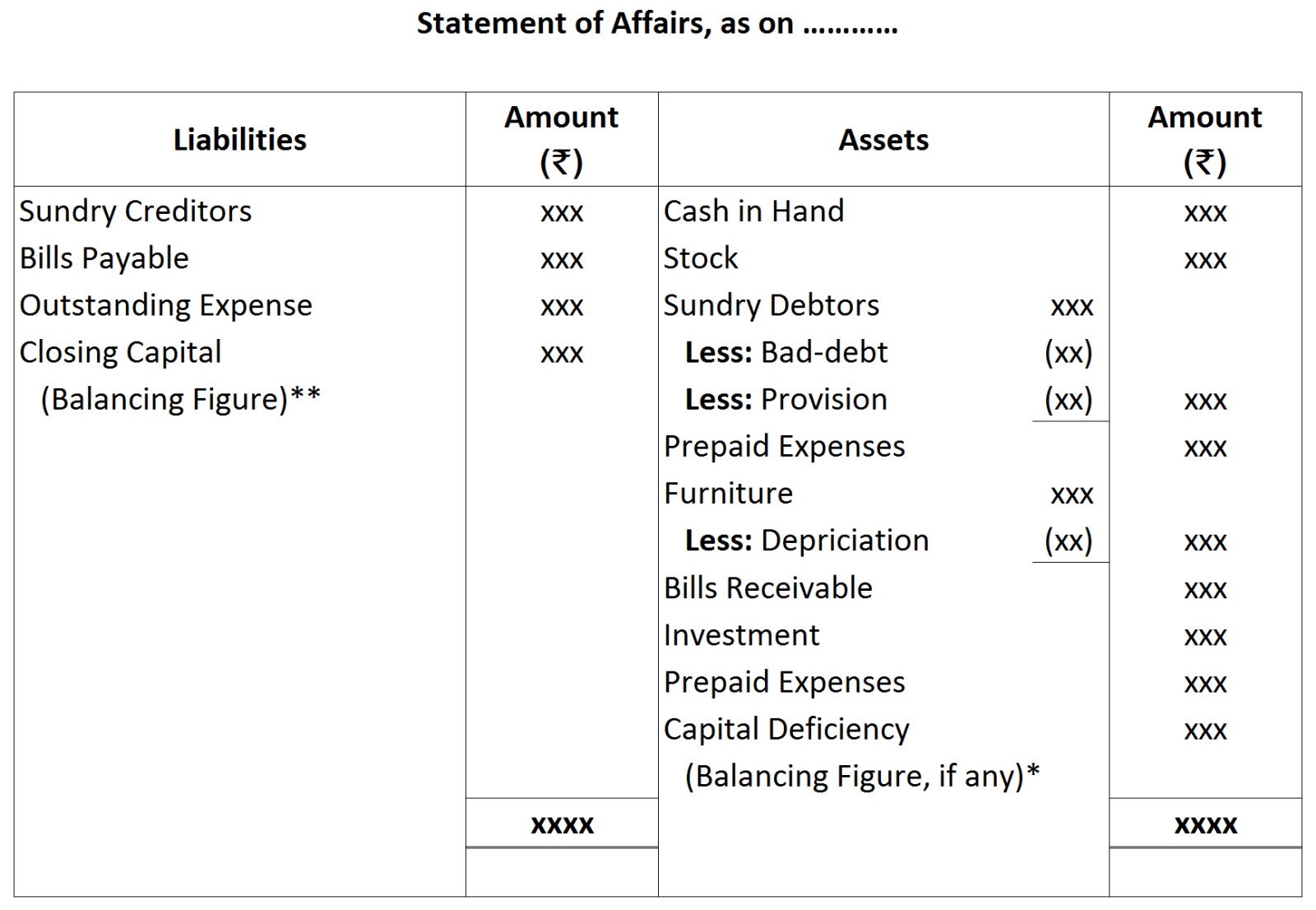
Opening capital and closing capital: Opening capital can be ascertained by preparing opening statement of affairs at the beginning of the accounting period and closing capital can be ascertained by preparing closing Statement of Affairs at the end of the accounting period.

When liabilities are more than assets, capital appears in assets side, as it is balancing figure.
When the assets’ balance exceeds liabilities’ balance, the balancing figure is denoted by capital in the Liabilities side of the Statement of Affairs.
View full question & answer
Question 174 Marks
Calculate Total Sales from the following information:
 
Bills Receivables as on 1st April, 2017 7,800
Debtors as on 1st April, 2017 30,800
Cash received on maturity of Bills Receivable during the year 20,900
Cash received from Debtors 70,000
Bad Debts written off 4,800
Returns Inward 8,700
Bills Receivable dishonoured 1,800
Bills Receivable on 31st March, 2018 6,000
Debtors as on 31st March, 2018 25,500
Cash Sales during the year 15,900
Answer

Total Sales = Cash Sales + Credit Sales
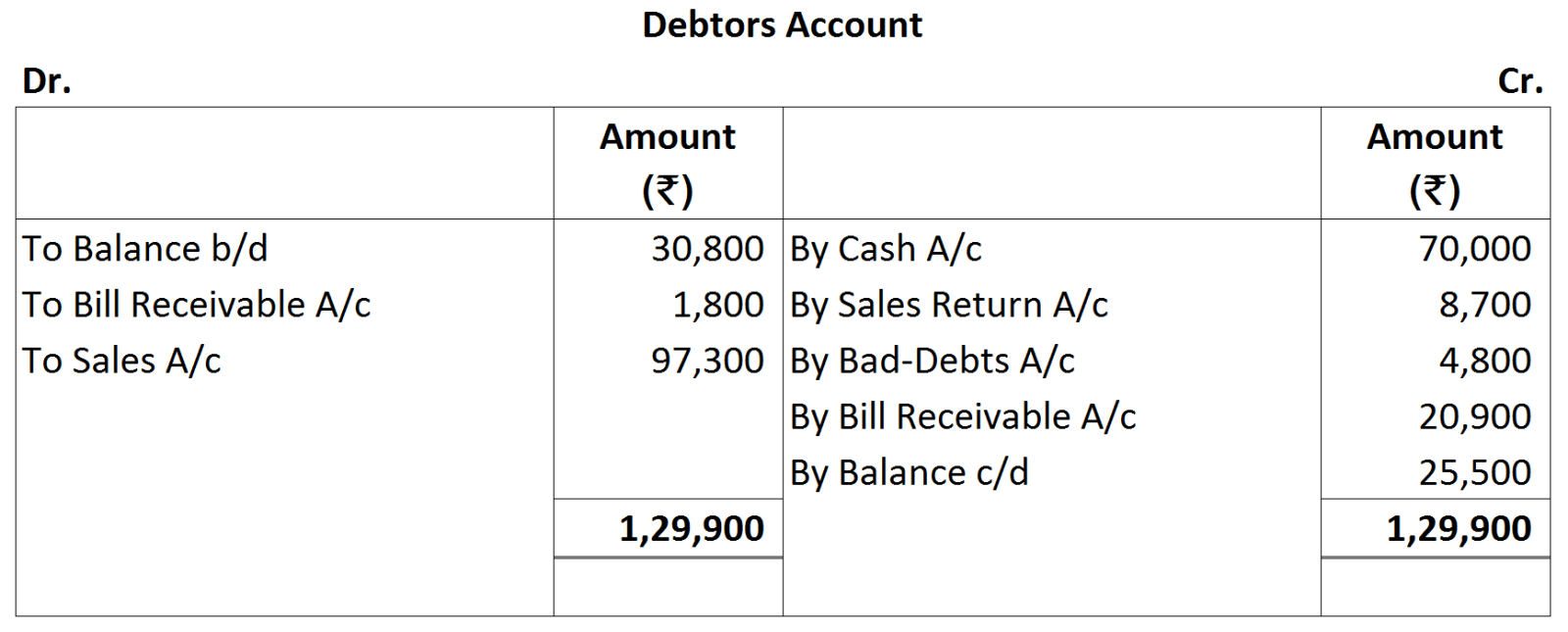
Total Sales = 15,900 + 97,300 = ₹ 1,13,200
View full question & answer
Question 184 Marks
From the following information ascertain the opening balance of sundry debtors and closing balance of sundry creditors
 
Opening stock, 30,000
Closing stock, 25,000
Opening creditors, 50,000
Closing debtors, 75,000
Discount allowed by creditors, 15,00
Discount allowed to customers, 2,500
Cash paid to creditors, 1,35,000
Bills payable accepted during the period, 30,000
Bills receivable received during the period, 75,000
Cash received from customers, 2,20,000
Bills receivable dishonoured, 3,500
Purchases, 2,95,000
The rate of gross profit is 25% on selling price and out of the total sales 85,000 was for cash sales.
Total sales $=4,00,000=3,00,000\times\frac{100}{75}$
Answer


Opening balance of debtors is 54,000 and the closing balance of creditors is 1,78,500.
Working Notes:
Total Sales = Cash Sales + Credit Sales
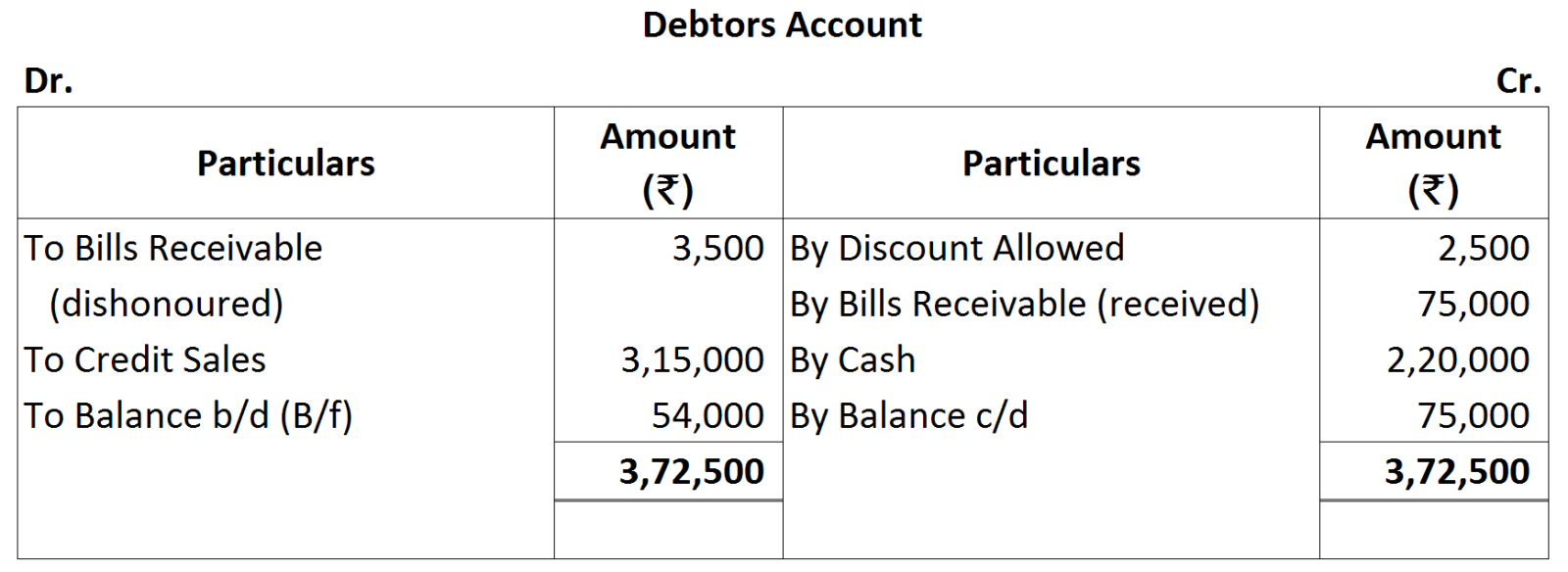
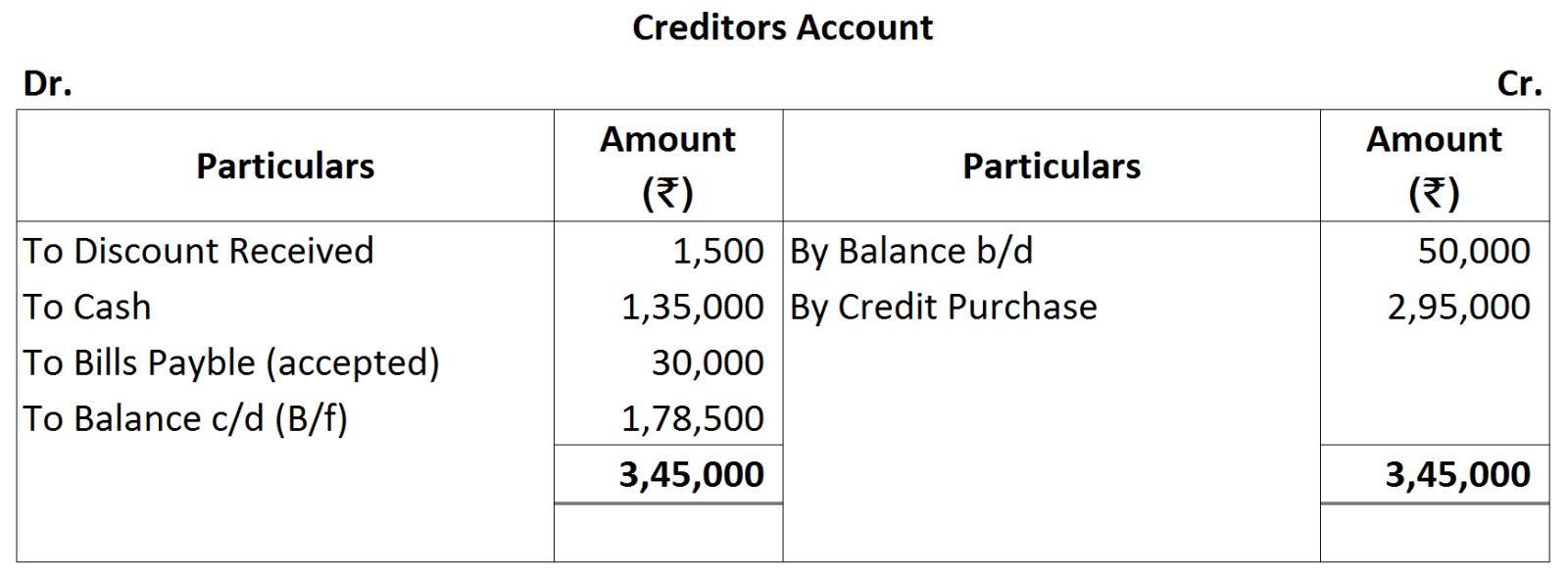
Total Sales = Cost of Goods Sold + Gross Profit.
Cost of goods sold = Opening stock + Purchase - Closing stock.
= 30,000 + 2,95,000 - 25,000
= ₹ 3,00,000
Let sales be 100%
Sales = Cost of goods sold + Gross profit
or, = Cost of goods sold + 25%
Cost of Goods Sold = 100% - 25% = 75%
Gross Profit $=\frac{\text{Cost of Goods sold}}{\% \ \text{Cost of goods Sold}}\times\%\text{ of Gross profit}$
$=\frac{3,00,000}{75}\times25$
= 1,00,000
Sales = Cost of Goods Sold + Gross Profit
= 3,00,000 + 1,00,000
= 4,00,000
Total Sales = Cash Sales + Credit Sales
Or, = 85,000 + 4,00,000
= 4,00,000 - 85,000
= 3,15,000
View full question & answer
Question 194 Marks
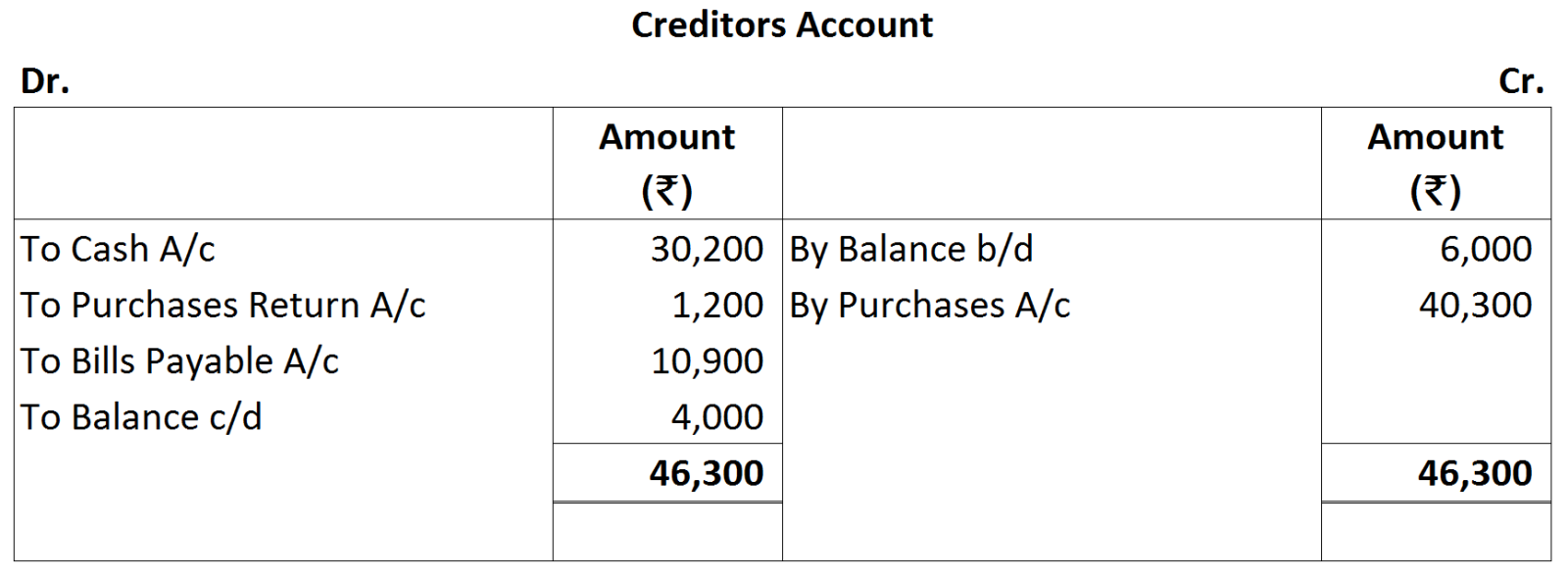
From the following information supplied by X, who keeps his books on Single Entry System, you are required to calculate Total Purchases:
 
Opening balance of Bills Payable 5,000
Opening balance of Creditors 6,000
Closing balance of Bills Payable 7,000
Closing balance of Creditors 4,000
Cash paid to Creditors during the year 30,200
Bills Payable discharged during the year 8,900
Returns Outward 1,200
Cash Purchases 25,800
Answer

Total Purchases = Cash Purchases + Credit Purchases
Total Purchases = 25,800 + 40,300 = ₹ 66,100
View full question & answer
Question 204 Marks
Debtors in the beginning of the year were ​₹ 30,000, Sales on credit during the year were ₹ 75,000, Cash received from the Debtors during the year was ₹ 35,000, Returns Inward (regarding credit sales) were ₹ 5,000 and Bills Receivable drawn during the year were ₹ 25,000. Find the balance of Debtors at th end of the year, assuming that there were Bad Debts during the year of ₹ 2,000.
View full question & answer
Question 214 Marks
Distinguish between statement of affairs and balance sheet.
Answer
Basis of Difference
Statement of Affairs
Balance Sheet
Objective
It is prepared to determine the amount of capital at a particular date.
It is prepared to ascertain the true financial position.
Reliability
It is based on estimates; hence, it is less reliable.
It is based on sophisticated and well developed principles; hence, it is more reliable.
Accounting Method
It is prepared from incomplete records of business transactions under single entry system.
It is prepared when accounts are maintained under double entry system.
Omission
Omission of assets and liabilities cannot be easily identified.
Omission of assets and liabilities can be easily identified, as omission will lead to mismatch of either sides of the balance sheet.
View full question & answer
Question 224 Marks
Find out the credit purchases from the following:
 
Balance of creditors April 01, 2016 1,80,425
Balance of creditors March 31, 2017 26,000
Cash paid to creditors 24,000
Cheque issued to creditors 37,200
Cash purchases 32,200
Discount received from creditors 1,99,000
Discount allowed 26,000
Bills payable given to creditors 2,09,050
Return outwards 8,97,000
Bills payable dishonoured 1,40,000
Bills receivable endorsed to creditors 4,500
Bills receivable endorsed to creditors dishonoured 1,800
Return inwards 3,700
View full question & answer
Question 234 Marks
Mr. Arnav does not keep proper records of his business he provided following information, you are required to prepare a statement showing the profit or loss for the year.
 
Capital at the beginning of the year, 15,00,000
Bills receivable, 60,000
Cash in hand, 80,000
Furniture, 9,00,000
Building, 10,00,000
Creditors, 6,00,000
Stock in trade, 2,00,000
Further capital introduced, 3,20,000
Drawings made during the period, 80,000
Ascertainment of statement of affairs at the beginning and at the end of the, year and calculation of profit or loss.
View full question & answer
Question 244 Marks
Following information is given of an accounting year:
Opening Creditors ₹ 15,000; Cash paid to creditors ₹ 15,000; Returns Outward ₹ 1,000 and Closing creditors ₹ 12,000.
Calculate Credit Purchases during the year.
View full question & answer
Question 254 Marks
Mrs. Anu started firm with a capital of 4,00,000 on 1st October, 2016. She borrowed from her friends a sum of 1,00,000 @ 10% per annum (interest paid) for business and brought a further amount to capital 75,000 on March 31, 2017, her position was:
 
Cash 30,000
Stock 4,70,000
Debtors 3,50,000
Creditors 3,00,000
He withdrew 8,000 per month for the year. Calculate profit or loss for the year and show your working clearly.
View full question & answer
Question 264 Marks
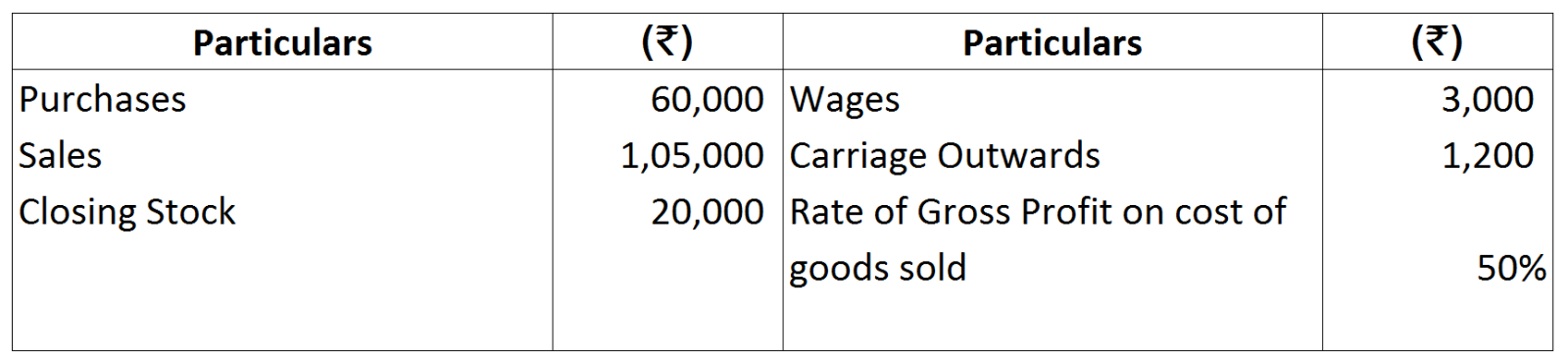
From the following particulars, ascertain the value of Opening Stock:
Answer
Rate of Gross Profit (on cost) = 50%
Rate of Gross Profit (on sales) = 33.33%
Gross Profit = 33.33% of (1,05,000) = 35,000
Gross Profit = Net Sales - Cost of Goods Sold
35,000 = 1,05,000 - Cost of Goods Sold
Cost of Goods Sold = 1,05,000 - 35,000 = ₹ 70,000
Cost of Goods Sold = Opening Stock + Purchases + Direct Expenses - Closing Stock
70,000 = Opening Stock + 60,000 + 3,000 - 20,000
Opening Stock = 70,000 - 60,000 - 3,000 + 20,000 = ₹ 27,000
View full question & answer
Question 274 Marks
Mention three characteristics of Single Entry System.
Answer
Features of Single Entry System:
  1. Suitability: This system is suitable for small-size businesses where the number of transactions is less.
  2. No Uniformity: This system may differ from firm to firm as it is a mere adjustment of Double Entry System according to requirements and convenience.
  3. Maintenance of Personal Accounts: Usually under this system, only personal accounts are maintained and real and nominal accounts are avoided. Therefore sometimes, it is defined as a system where only personal accounts are kept.
  4. Maintenance of Cash Book: Generally, a Cash Book is maintained in this system which mixes up business as well as personal transactions.
  5. Dependence on Original Vouchers: Usually under this system, original vouchers are scrutinised for collection of information. For example, in case of credit sale, the owner may keep the invoice without recording it in accounting books and at the end of a particular period the total of the invoices gives credit sales of the business. Similarly, the amount of credit purchases may be determined on the basis of original invoices received from the suppliers.
View full question & answer
Question 284 Marks
Mr. Akshat keeps his books on incomplete records following information is given below:
  April 01, 2016 March 31, 2017
 
Cash in hand 1,000 1,500
Cash at bank 15,000 10,000
Stock 1,00,000 95,000
Business premises 75,000 1,35,000
Furniture 9,000 7,500
Creditors 66,000 87,000
Bills payable 44,000 58,000
During the year he withdrew 45,000 and introduced 25,000 as further capital in the business compute the profit or loss of the business.
View full question & answer