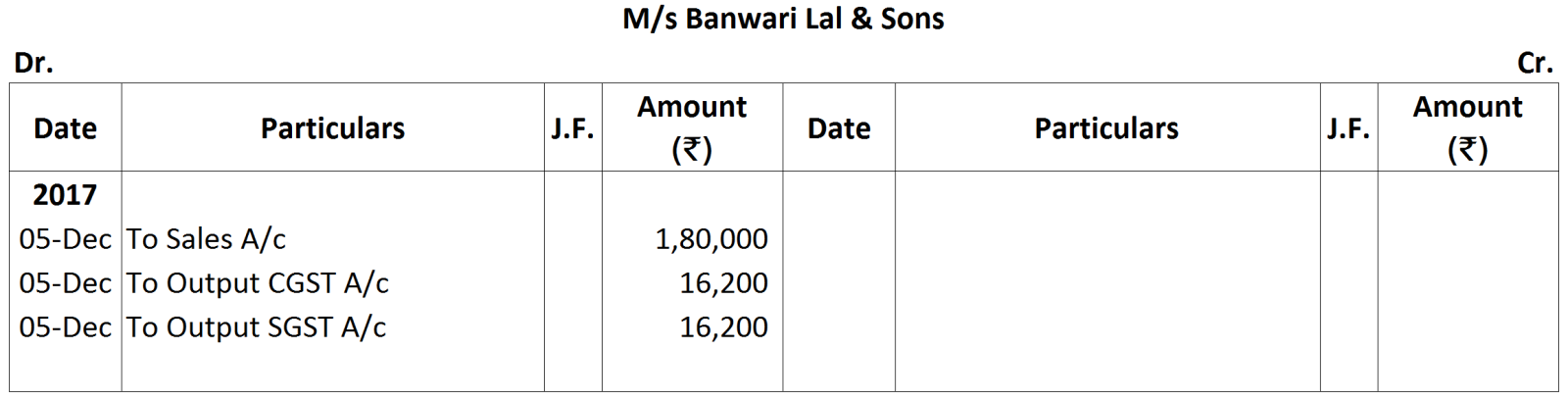
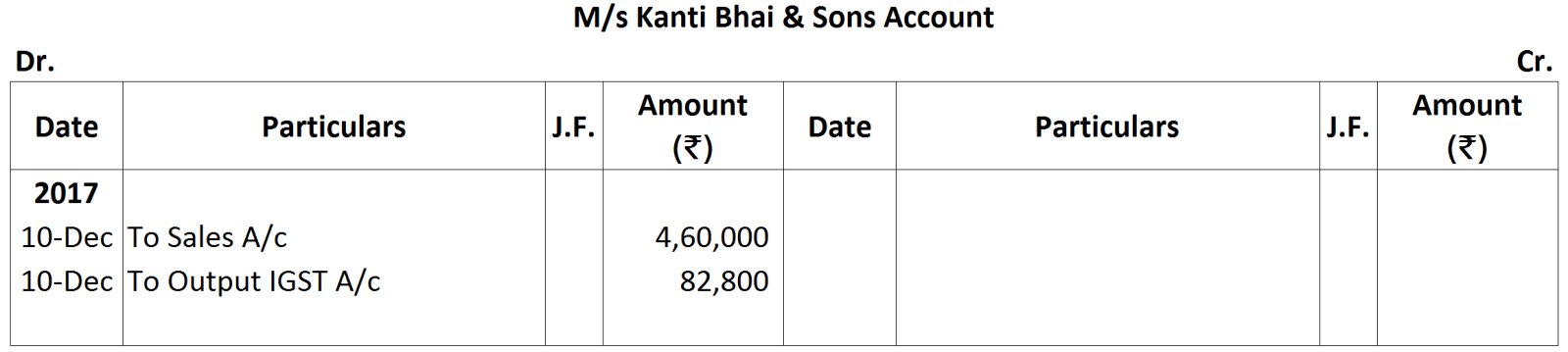
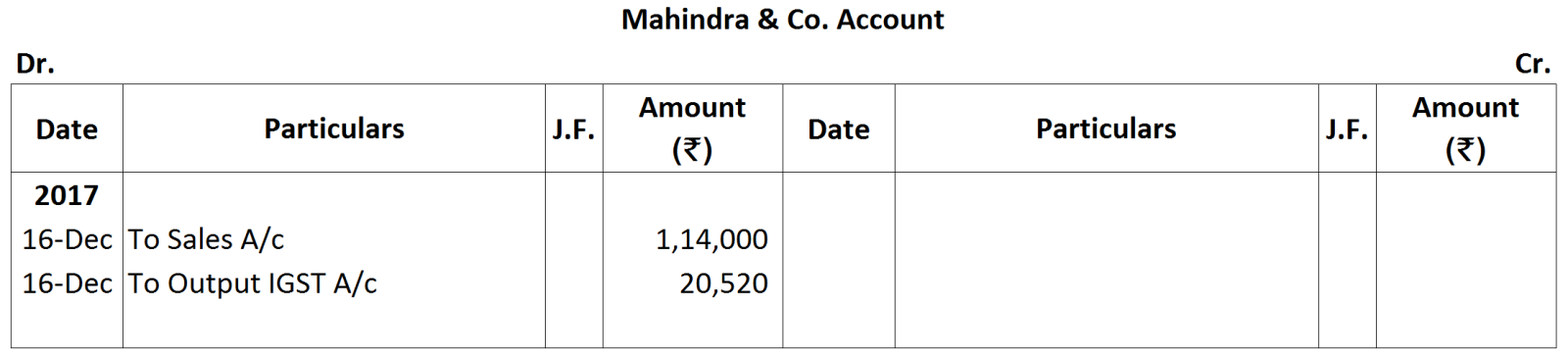
Questions · Page 1 of 3

3 Marks Question

🎯

Test yourself on this topic

50 questions · timed · auto-graded

Question 13 Marks
Journalise the following in the books of Som Nath & Sons:
2019  
May 1 Purchased a Machinery for ₹ 1,00,000 and the payment was made by issuing a cheque from Proprietor's saving bank account.
May 4 Received an order from Chakravarti for goods of ₹ 4,00,000 alongwith a cheque of 10% of the order as advance.
May 8 Paid cash ₹ 8,000 to Dushyant and discount allowed by him ₹ 800.
May 10 Goods stolen by an employee (Sale Price ₹ 20,000; Cost ₹ 15,000).
May 15 Purchased stationery worth ₹ 8,000 for office use and ₹ 2,000 for personal use.
May 20 Manoj pays us ₹ 5,400 after deducting 10% for prompt payment.
May 28 Sold goods to Kuber costing ₹ 2,00,000 at 25% above cost less trade discount of 10% and cash discount of 5%. Kuber did not avail the cash discount.
View full question & answer
Question 23 Marks
Explain the procedure of balancing the personal accounts.
Answer
From the balancing of these accounts we can ascertain as to how much amount is owing from each individual customer and how much amount is owed to each individual creditor. If a personal account shows a debit balance, it indicates the amount owing from him. On the contrary, if a personal account shows a credit balance, it indicates the amount owing to him.In case the total of the debit side is in excess of the credit side, the difference between the two is inserted on the credit side of the account in order to make their totals equal. The words ‘By Balance c/d’, i.e., balance carried down are written against the amount of the difference. In the next accounting period, the balance is brought down on the debit side by writing the words ‘To Balance b/d'.
On the contrary, if the total of the credit side is in excess of the debit side, the difference between the two is inserted on the debit side of the account in order to make their totals equal. The words ‘To Balance c/d' are written against the amount of the difference. In the next accounting period, the balance is brought down on the credit side by writing the words 'By Balance b/d’.
View full question & answer
Question 33 Marks
Journalise the following transactions:
  1. Purchased a Motor Car for 3,00,000 and paid 25,000 for its repair and renewal. Entire payment is made by cheque.
  2. Received Rent 5,000.
  3. Goods worth 20,000 were distributed as free samples.
  4. Charge depreciation on Motor Car 32,500.
  5. Rent due to Landlord 10,000 and Salary due to Clerks 80,000.
  6. Charge interest on Capital 20,000.
  7. 5,000 due from Sanjay Gupta are bad-debts.
  8. Goods worth 50,000 were destroyed by fire.
  9. ash 5,000 and goods worth 20,000 were stolen by an employee.
View full question & answer
Question 43 Marks
Pass journal entries for the following:
Jan. 5
Purchased goods for Cash ₹ 10,000 and spent ₹ 200 for their carriage.
Jan. 10
Purchased machinery for Cash ₹ 50,000 and spent ₹ 500 for its carriage.
Jan. 15
Paid ₹ 20,000 for cement, ₹ 10,000 for timber and ₹ 5,000 as wages for the construction of building.
Jan. 17
Purchased an old machinery for ₹ 20,000 and spent ₹ 2,500 on its immediate repairs.
Jan. 20
Paid ₹ 500 for repairing some other machinery.
View full question & answer
Question 53 Marks
Differentiate between source documents and vouchers.
Answer
Basis of Difference
Source Documents
Vouchers
Meaning
It refers to the documents in writing, containing the details of events or transactions.
When source document is considered as evidence of an event or transaction, then it is called voucher.
Purpose
It is used for preparing accounting vouchers.
It is used for analysing the transactions.
Recording
It acts as a basis for preparing accounting voucher that helps in recording.
It acts as a basis for recording transactions.
Preparation
It is prepared at the time when an event or a transaction occurs.
It can be prepared either when an event or a transaction occurs, or later on.
Legality/ Validity
It can be used as evidence in the court of law.
It can be used for assessing the authentication of transactions.
Prepared By
It is prepared by the persons who are directly involved in the transactions, or who are authorised to prepare or approve these documents.
It is prepared by the authorised persons or by the accountants.
Examples
Cash memo, invoice, and pay-in-slip, etc.
Cash memo, invoice, pay-in-slip (if used as evidence), debit note, credit note, cash vouchers, transfer vouchers, etc.
View full question & answer
Question 63 Marks
Prepare Accounting Equation from the following:
 
 
i.
Kunal started business with Cash
2,50,000
ii.
He purchased furniture for cash
35,000
iii.
He paid commission
2,000
iv.
He purchased goods on credit
40,000
v.
He sold goods (Costing ₹ 20,000) for cash
26,000
View full question & answer
Question 73 Marks
Classify the following accounts under personal, real or nominal accounts:
  1. Commission Paid.
  2. Commission Received.
  3. Commission Accrued.
  4. Prepaid Salaries.
  5. Leasehold Property A/c.
  6. Discount Allowed.
  7. Carriage Inwards A/c.
  8. Life Insurance Corporation of India.
  9. Drawings A/c.
  10. Rent Received in Advance.
  11. Debtors.
  12. Sales A/c.
  13. Rent Paid in Advance.
  14. Bank Overdraft.
Answer
Personal Accounts:
  1. Commission Accrued.
  1. Prepaid Salaries.
  1. Life Insurance Corporation of India.
  1. Drawings A/C.
  1. Rent Received in Advance.
  1. Debtors.
  1. Rent Paid in Advance.
  1. Bank Overdraft.
Real Accounts:
  1. Leasehold Property A/c.
Nominal Accounts:
  1. Commission Paid.
  1. Commission Received.
  1. Discount Allowed.
  1. Carriage Inwards A/c.
  1. Sales A/c.
View full question & answer
Question 83 Marks
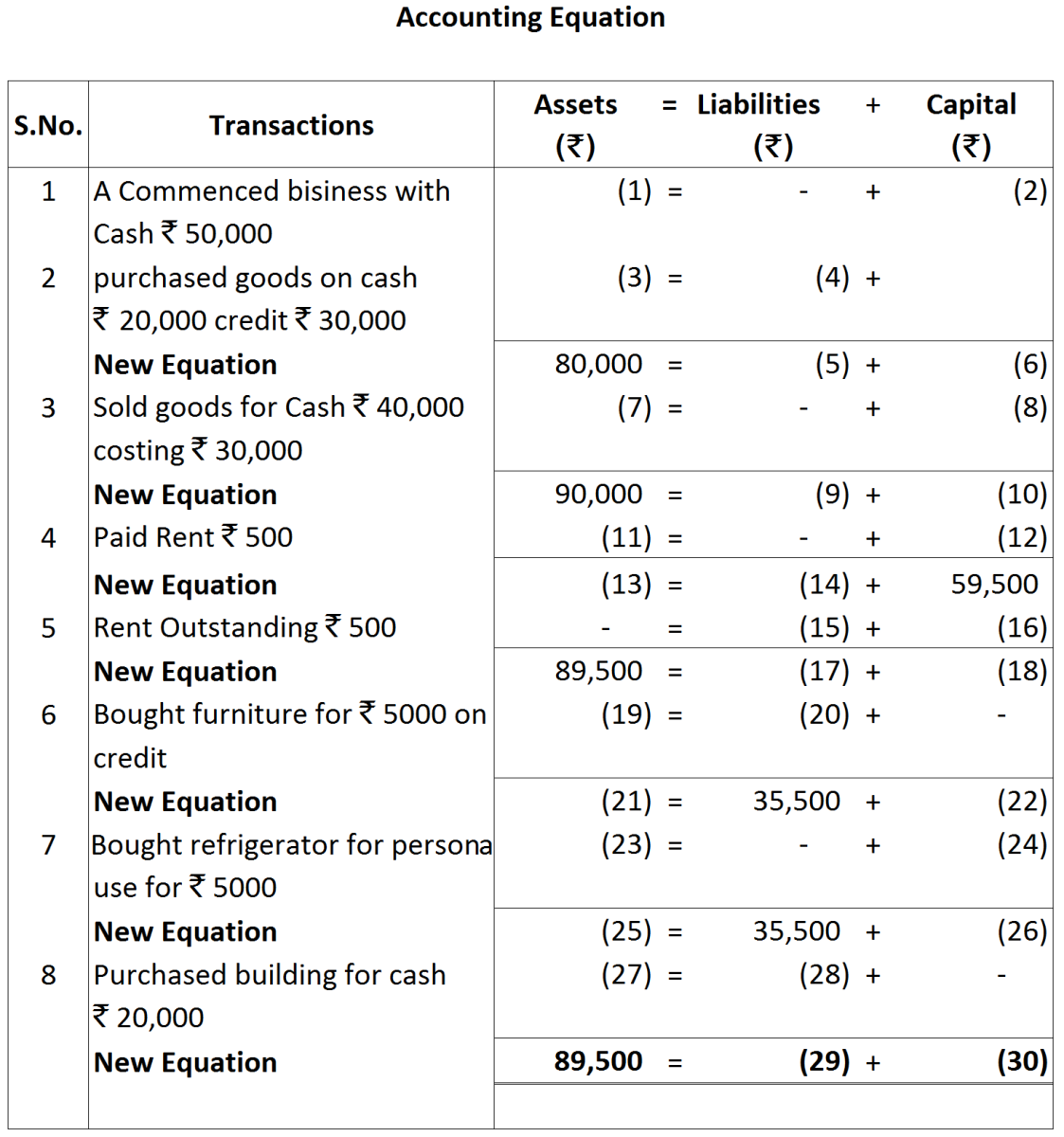
Prepare an Accounting Equation from the following:
  1. Started business with cash ₹ 50,000 and goods ₹ 30,000.
  2. Purchased goods for cash ₹ 30,000 and on credit from Karan ₹ 20,000.
  3. Goods costing ₹ 40,000 were sold for ₹ 55,000.
  4. Withdrew cash for personal use ₹ 10,000.
  5. Rent outstanding ₹ 2,000.
View full question & answer
Question 93 Marks
Explain the double entry mechanism with an illustrative example.
Answer
Double entry system is based on the dual aspect concept. It means every transaction has two-sided effects, i.e., every debit has its credit.
This system is explained by Luca Pacioli in his book Summade Arithmetica Geometria Proportioni et Proportionalita, 1494. He said if one is receiver, then the other should be the giver.
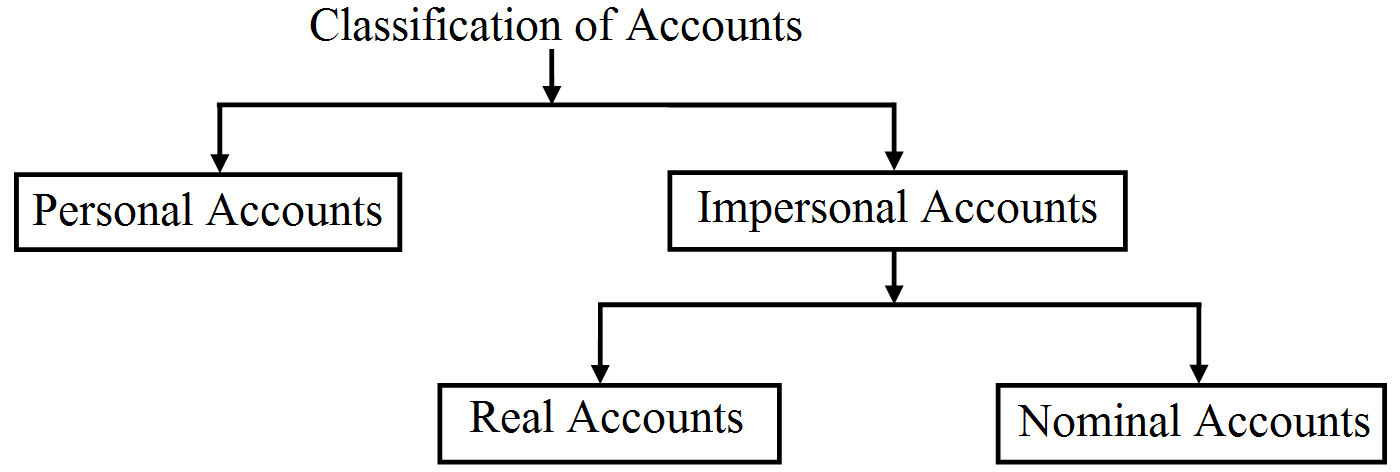
In double entry system, accounts are classified as shown below.

Personal Accounts: It includes individual persons, firms, companies, and other institutions, such as Mr. A, M/s ABC & Co. etc.
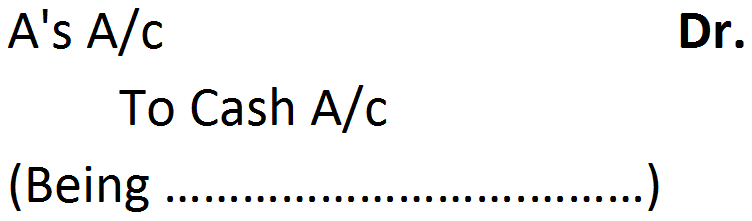
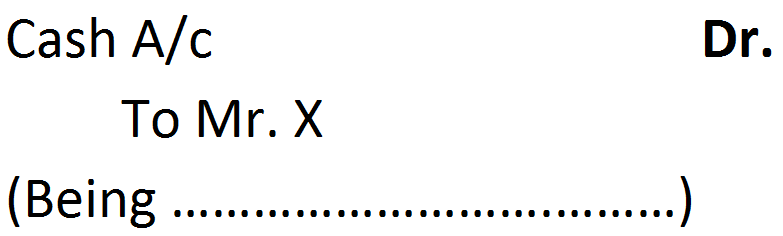
Rule of double entry system for personal accounts:
  • Debit the receiver.
  • Credit the giver.
For example:
Cash paid to Mr. A.

Cash received from Mr. X

Impersonal Accounts: It relates to non living things. Impersonal accounts are further classified as real accounts and nominal accounts.
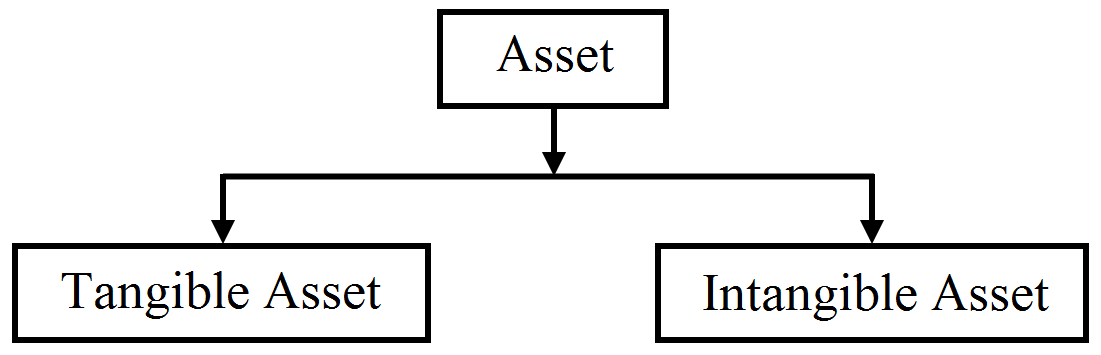
  1. Real Account: It includes all types of assets.

Tangible assets that can be seen and touched; for example, machinery, building, etc.

Intangible assets that cannot be seen and touched; for example, goodwill, patent, etc.

Rule of double entry system for real accounts:
  • Debit what comes in.
  • Credit what goes out.
For example:

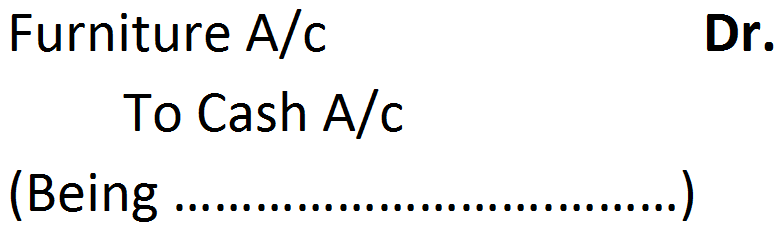
Furniture purchased for cash

  1. Nominal Account: It includes all expenses, losses, incomes and gains.
Rule of double entry system for nominal accounts:
  • Debit all losses and expenses.
  • Credit all gains and incomes.
For example:

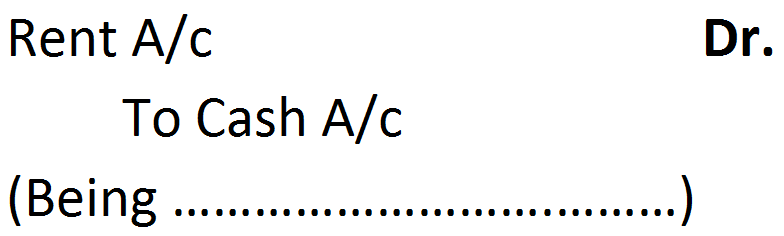
Rent paid


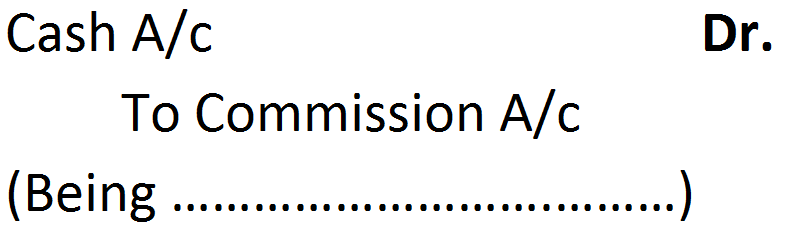
Commission received

View full question & answer
Question 103 Marks
Why are the rules of debit and credit same for both liability and capital?
Answer
Every business acquires funds from internal as well as from external sources. According to the business entity concept, the amount borrowed from the external sources together with the internal sources like, capital invested by the proprietor, is termed as liability to the business. Business entity concept treats business and business owner separately.
Capital of the owner is treated as liability to the business because the business has to repay the amount of capital to the owner, in case of closure of the business. As liability incurred is credited, in the same way, fresh capital introduced and net profit increases the owner’s capital, and so, capital is credited. On the other hand, if liability is paid, it reduces liability, and so, it is debited. Similarly, drawings from capital and net loss reduce the capital, and so, capital is debited.
Thus the rules of debit and credit are same for both liability and capital.
View full question & answer
Question 113 Marks
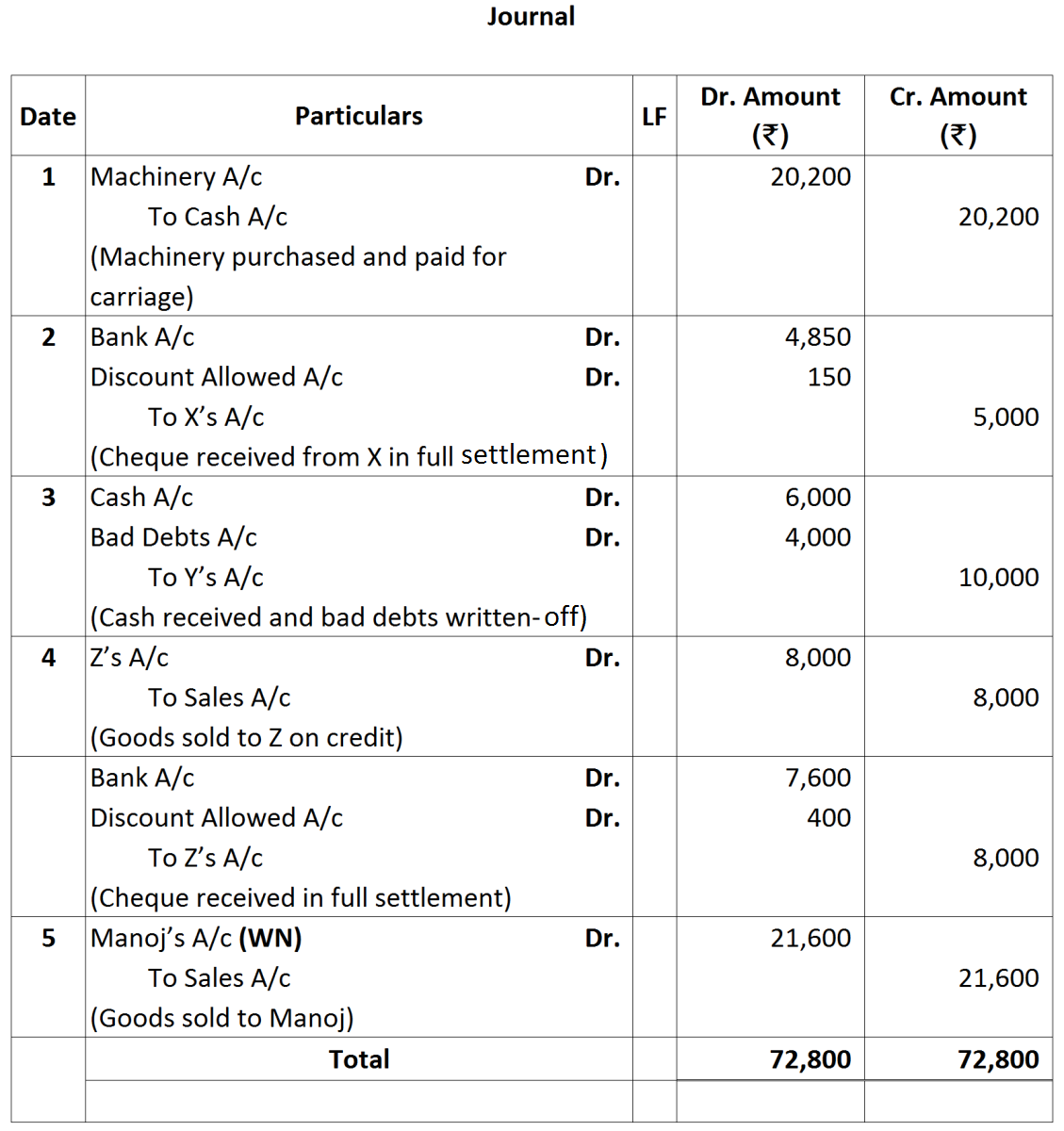
Pass Journal entries for the following transactions:
  1. Purchased Machinery for ₹ 20,000 and paid ₹ 200 for its carriage.
  2. Received a cheque fo ₹ 4,850 from X in full settlement of his account of ₹ 5,000. Cheque was immediately deposited into bank.
  3. Received by cheque a first and final payment of 60 paise in a ₹ from Y who owed us ₹ 10,000.
  4. Sold goods to Z for ₹ 10,000 at a trade discount of 20%. Next day a cheque was received from him after deducting 5% cash discount. Cheque was immediately deposited into Bank.
  5. Goods costing ₹ 20,000 sold to Manoj at a profit of 20% on cost less 10% trade discount.
Answer

Working Notes: Calculation of amount of goods sold to Manoj.
Cost Price
=
20,000
Add: Profit
=
4,000
Invoice Price
=
24,000
Less: Trade Discount
=
2,400
 
=
₹ 21,600
View full question & answer
Question 123 Marks
Prepare Journal from the transactions given below:
 
 
(a)
Cash paid for installation of machine
500
(b)
Goods given as charity
2,000
(c)
Interest charge on capital @ 7% p.a. when total capital were
70,000
(d)
Received ₹ 1,200 of a bad debts written-off last year.
 
(e)
Goods destroyed by fire
2,000
(f)
Rent outstanding
1,000
(g)
Interest on drawings
900
(h)
Sudhir Kumar who owed me ₹ 3,000 has failed to pay the amount. He pays me a compensation of 45 paise in a rupee.
 
(i)
Commission received in advance
7,000
View full question & answer
Question 133 Marks
Show the effect of the following transactions and also prepare a Balance Sheet:
  1. Started business with cash ₹ 60,000.
  2. Rent received ₹ 2,000.
  3. Accrued interest ₹ 500.
  4. Commission received in advance ₹ 1,000.
  5. Amount withdrawn ₹ 5,000.
[Hint: Capital = Opening Capital ₹ 60,000 + Rent Received ₹ 2,000 + Accrued Interest ₹ 500 - Drawings ₹ 5,000 = ₹ 57,500.]
View full question & answer
Question 143 Marks
Journalise the following transactions:
  1. Goods for ₹ 50,000 were destroyed by fire.
  2. Goods worth ₹ 18,000 were distributed as free samples and ₹ 20,000 were given away as charity in cash.
  3. Goods worth ₹ 25,000 and cash ₹ 40,000 were taken away by the proprietor for his personal use.
  4. Goods worth ₹ 20,000 and cash ₹ 5,000 were given away as charity.
  5. Cash ₹ 1,00,000 were stolen from the Iron Safe of the trader.
View full question & answer
Question 153 Marks
What is a journal? Give a specimen of journal showing at least five entries.
Answer
Journal is derived from the French word Jour, means daily records. In this book, transactions are recorded in order of their occurrence, i.e., in chronological order from the source document. It is also termed as the book of original entry and each transaction is termed as journal entry. Date: Date of transaction is recorded in the order of their occurrence. Particulars: Details of business transactions like, name of the parties involved and the name of related accounts, are recorded. L.F.: Page number of ledger account when entry is posted. Debit Amount: Amount of debit account is written. Credit Amount: Amount of credit account is written. Recording of a Journal Entry
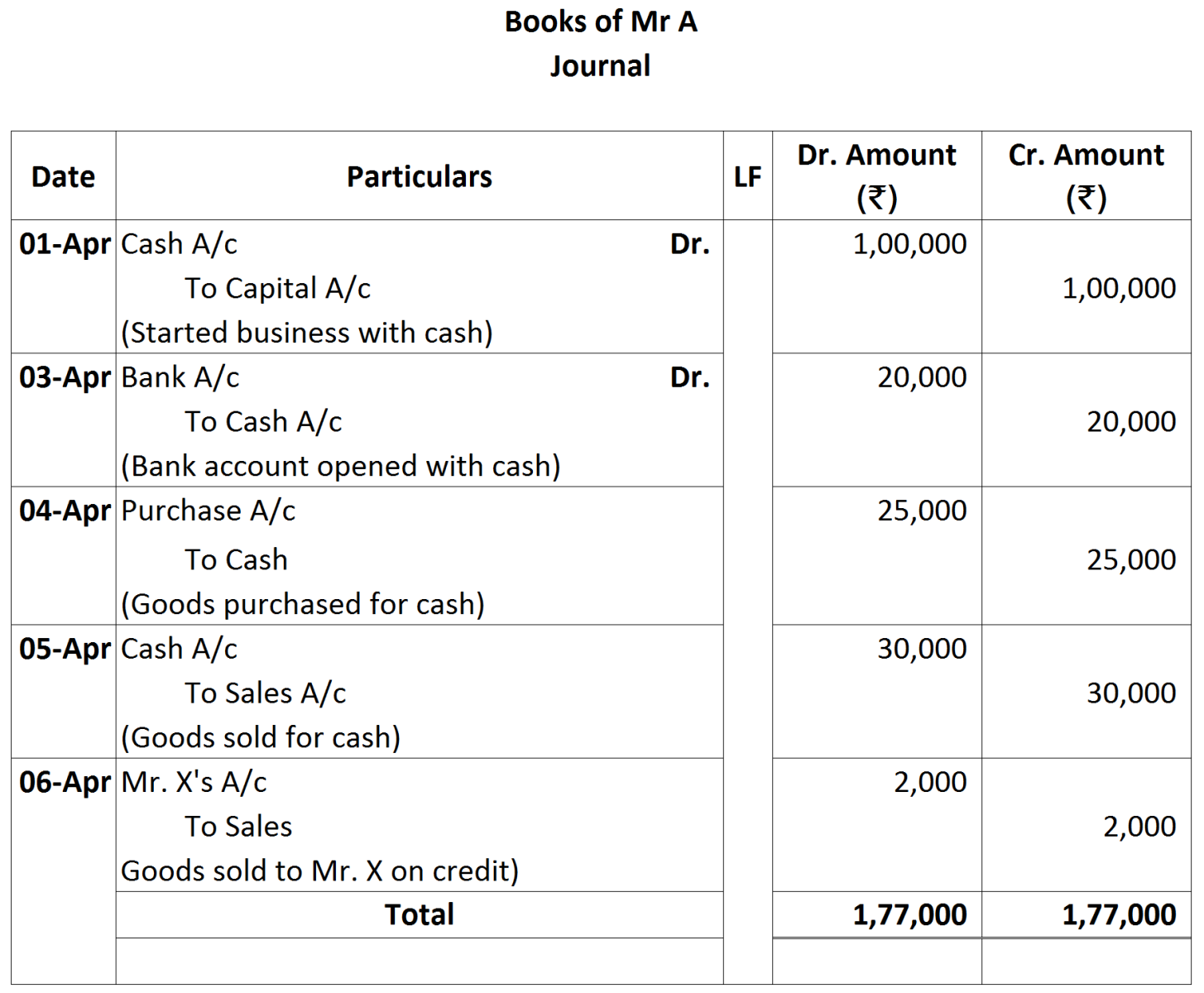
 
 
Date
1.
Started business with cash ₹ 1,00,000
April 01
2.
Open a bank account ₹ 20,000
April 03
3.
Purchase goods for cash ₹ 25,000
April 04
4.
Goods sold for cash ₹ 30,000
April 05
5.
Goods sold to Mr. X ₹ 2,000
April 06
View full question & answer
Question 163 Marks
Accounting equation remains intact under all circumstances. Justify the statement with the help of an example.
Answer
According to the dual-aspect concept, every transaction simultaneously, has two effects of equal amount, i.e. debit and credit. However, in any case, the equality of total assets with the total claims of business (sum of capital and liabilities) is not disturbed.
This equality is algebraically represented as:
Asset = Total Claims
Or,
Assets = Liabilities + Capital
Or,
Liabilities = Assets - Capital
Or,
Liabilities = Asset − Capital
Or,
Capital = Assets − Liabilities
In any circumstance the above equation cannot be changed. For example,
Business started with cash 1,00,000


Assets decrease, as cash is invested into the business and capital increases.
Thus the equality between LHS and RHS remains intact.
Goods purchased on credit 20, 000

Assets increase as well as liability increases, without disturbing the equality.
Goods purchased with cash 25000

As goods are purchased for cash, so cash balance reduces by ₹ 25,000, but on the other hand, stock balance increases by ₹ 25,000.
Thus the total balance of LHS remains equal to the total claims.
View full question & answer
Question 173 Marks
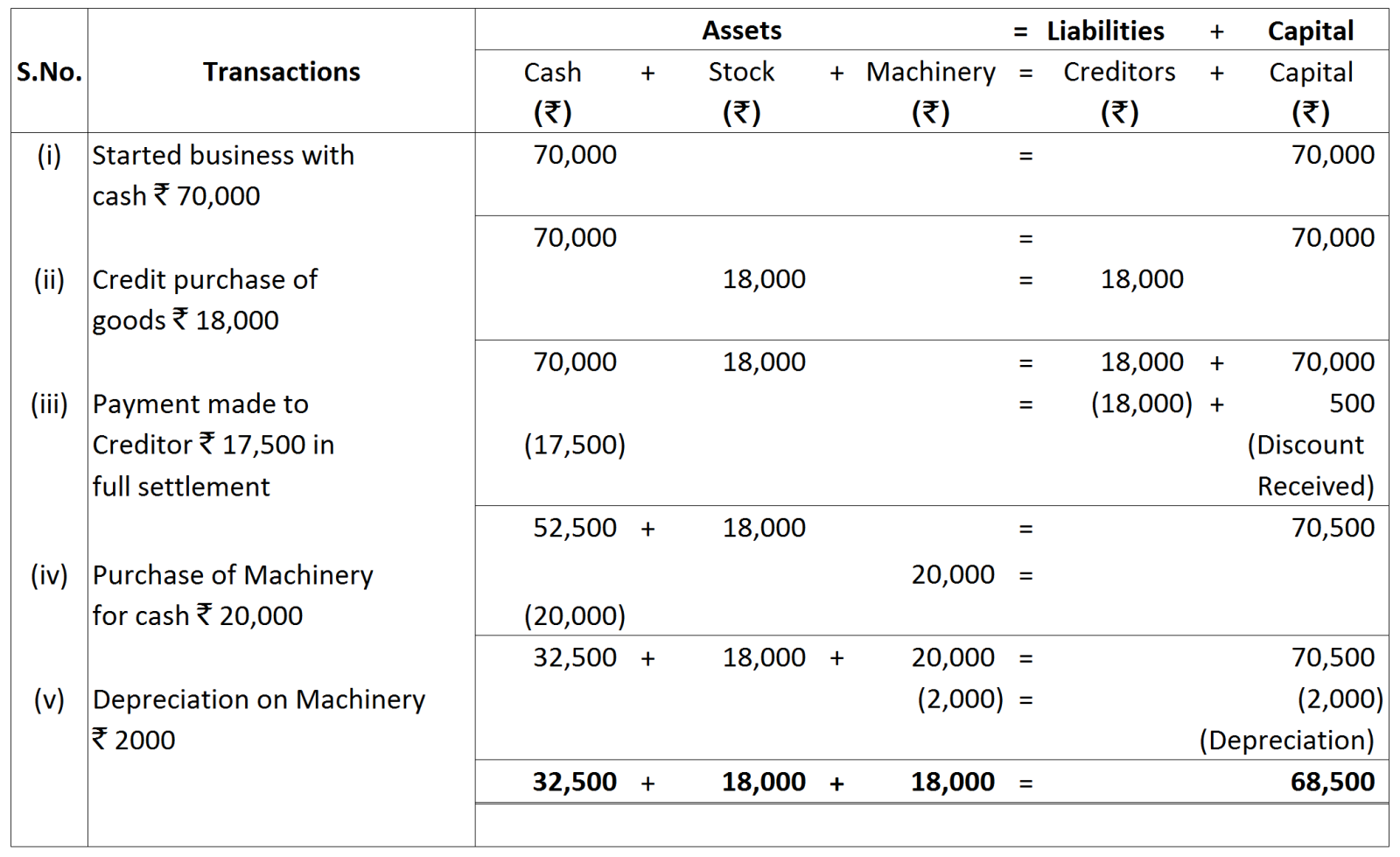
Prepare an Accounting Equation on the basis of the following transaction:
  1. Started business with cash ₹ 70,000.
  2. Credit purchase of goods ₹ 18,000.
  3. Payment made to creditors in full settlement ₹ 17,500.
  4. Purchase of machinery for cash ₹ 20,000.
  5. Depreciation on machinery ₹ 2,000.
Answer

Assets = 32,500 + 18,000 + 18,000 = ₹ 68,500
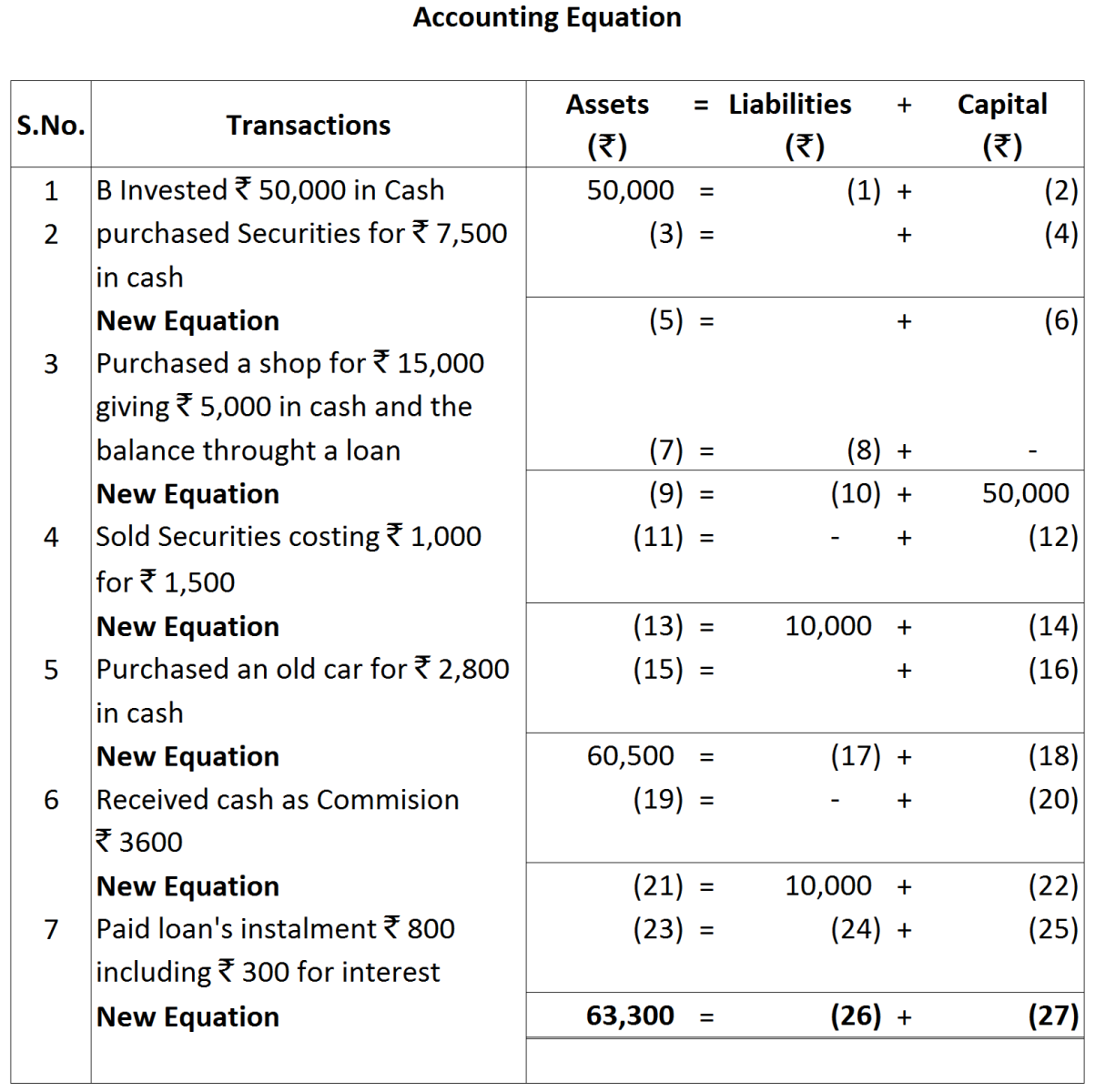
Liabilities = NIL
Capital = ₹ 68,500
View full question & answer
Question 183 Marks
Use accounting equation to show the effect of the following transactions of M/s Royal Traders:
a.
Started business with cash
₹ 1,20.000
b.
Purchased goods for cash
₹ 10,000
c.
Rent received
₹ 5,000
d.
Salary outstanding
₹ 2,000
e.
Prepaid Insurance
₹ 1,000
f.
Received interest
₹ 700
g.
Sold goods for cash (Costing ₹ 5,000)
₹ 7,000
h.
Goods destroyed by fire
₹ 500
(Ans: Assets = Cash ₹ 1,21,200 + Goods ₹ 4,500 + Prepaid insurance ₹ 1,000; Liabilities = Outstanding salary ₹ 2,000 + Capital ₹ 1,25,200)
View full question & answer
Question 193 Marks
Enter the following Transactions in the Journal of Mudit:
2017
 
Jan.01
Commenced business with cash
1,75,000
Jan.01
Building
1,00,000
Jan.02
Goods purchased for cash
75,000
Jan.03
Sold goods to Ramesh
30,000
Jan.04
Paid wages
500
Jan.06
Sold goods for cash
10,000
Jan.10
Paid for trade expenses
700
Jan.12
Cash received from Ramesh
29,500
 
Discount allowed
500
Jan.14
Goods purchased for Sudhir
27,000
Jan.18
Cartage paid
1,000
Jan.20
Drew cash for personal use
5,000
Jan.22
Goods use for house hold
2,000
Jan.25
Cash paid to Sudhir
26,700
 
Discount allowed
300
View full question & answer
Question 213 Marks
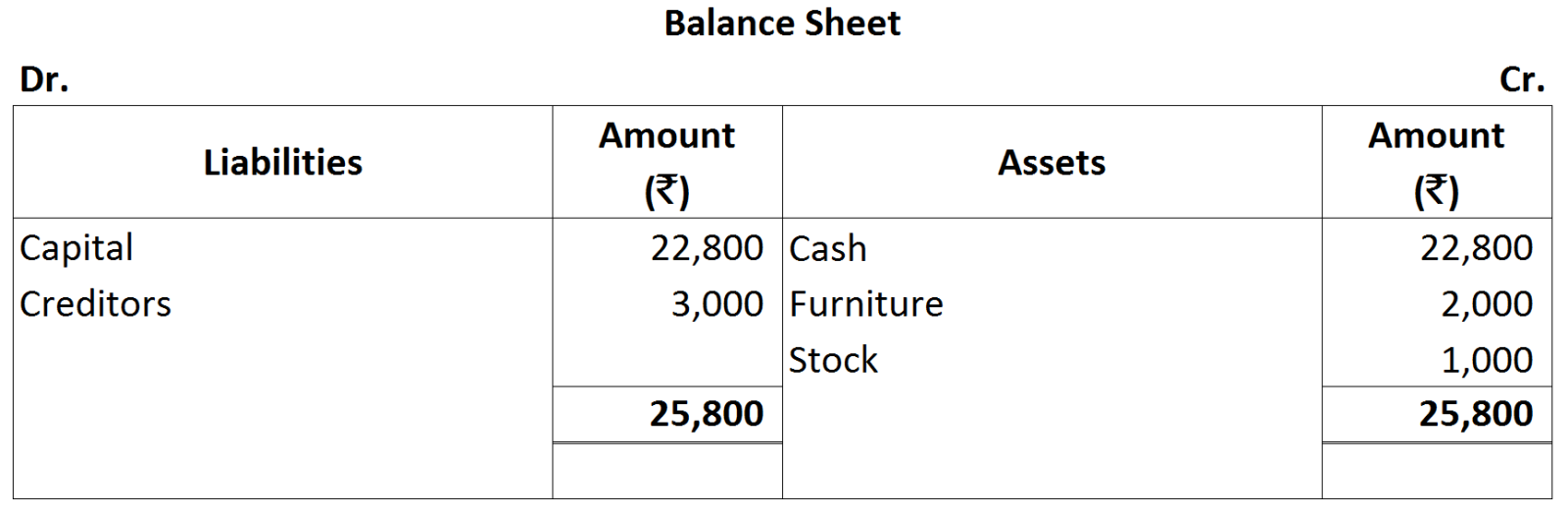
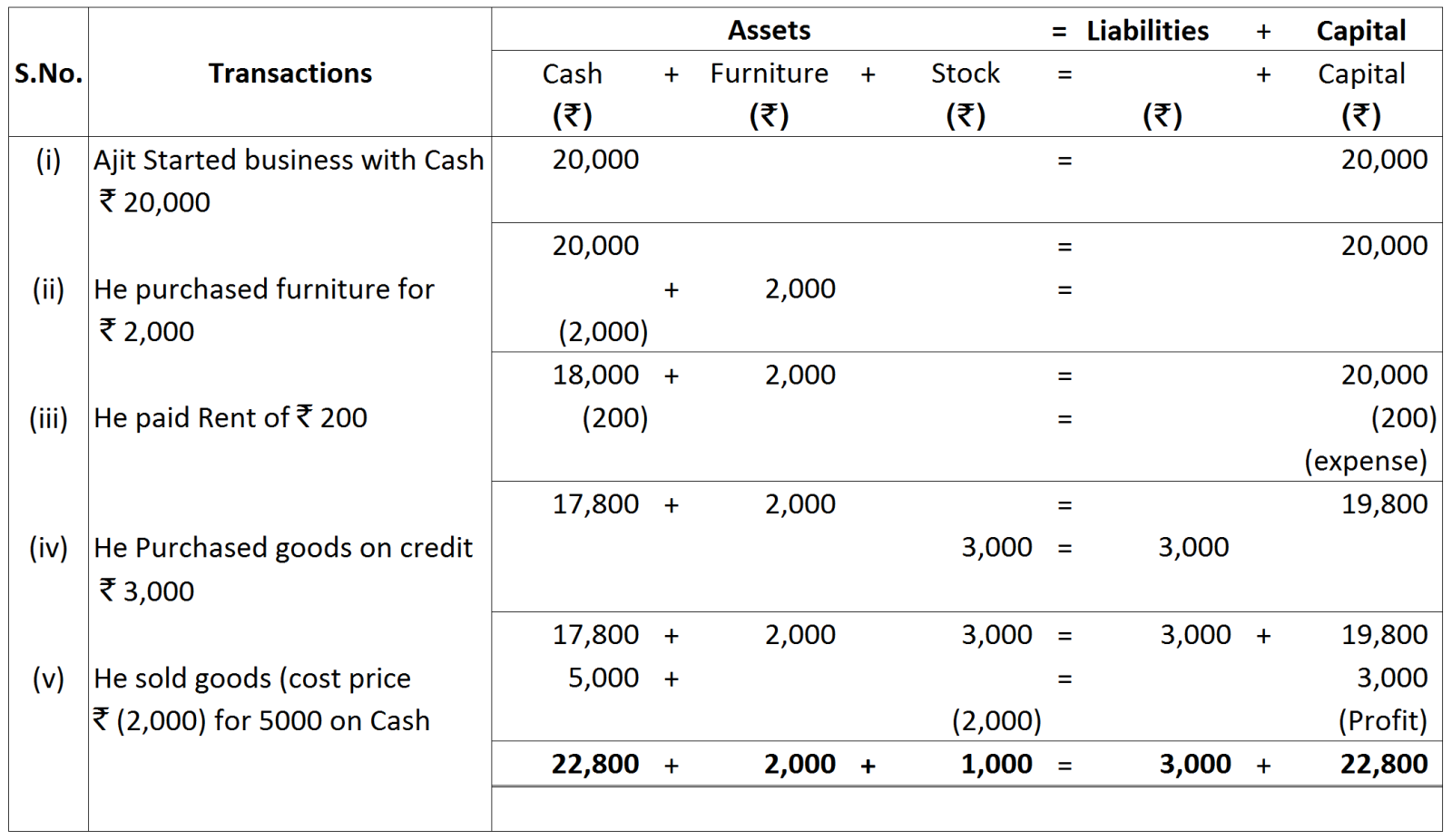
Prepare an Accounting Equation and Balance Sheet on the following basis:
  1. Ajeet started business with cash ₹ 20,000.
  2. He purchased furniture for ₹ 2,000.
  3. He paid rent of ₹ 200.
  4. He purchase goods on credit ₹ 3,000.
  5. He sold goods (cost price ₹ 2,000) for ₹ 5,000 on cash.
Answer

Assets = 22,800 + 2,00 + 1,000 = ₹ 25,800
Liabilities = ₹ 3,000
Capital = ₹ 22,800
View full question & answer
Question 223 Marks
Prepare accounting equation from the following:
  1. Started business with cash ₹ 50,000 and goods ₹ 30,000.
  2. Purchased goods for cash ₹ 30,000 and on credit from Karan ₹ 20,000.
  3. Goods costing ₹ 40,000 were sold for ₹ 55,000 for cash.
  4. Withdrew cash for personal use ₹ 10,000.
  5. Rent outstanding ₹ 2,000.
View full question & answer
Question 233 Marks
Journalise the following transactions in the books of Himanshu:
2017
 
Dec.01
Business started with cash
75,000
Dec.07
Purchased goods for cash
10,000
Dec.09
Sold goods to Swati
5,000
Dec.12
Purchased furniture
3,000
Dec.18
Cash received from Swati in full settlement
4,000
Dec.25
Paid rent
1,000
Dec.30
Paid salary
1,500
View full question & answer
Question 253 Marks
Prove that accounting equation is satisfied in all the following cases:
  1. Commenced business with cash ₹ 50,000.
  2. Paid rent ₹ 4,000 including ₹ 1,000 as advance.
  3. Bought goods for cash ₹ 30,000 and on credit ₹ 20,000.
  4. Sold the goods bought on credit for ₹ 25,000.
  5. Purchased furniture worth ₹ 10,000 for office use and for ₹ 5,000 for domestic use.
View full question & answer
Question 263 Marks
Show the effect of the following transactions on the Accounting Equation:
  1. Started business with cash ₹ 50,000.
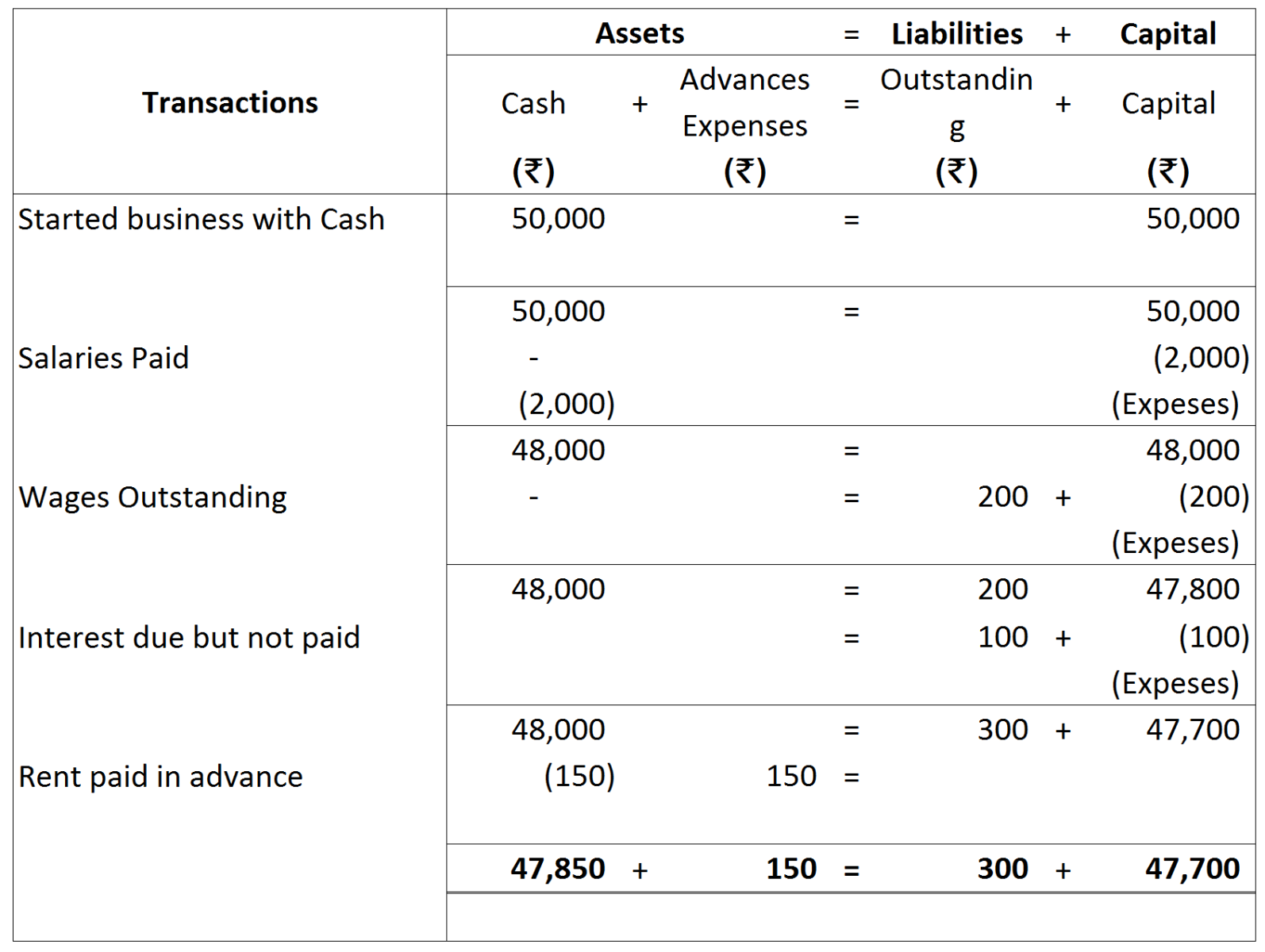
  2. Salaries paid ₹ 2,000.
  3. Wages Outstanding ₹ 200.
  4. Interest due but not paid ₹ 100.
  5. Rent paid in advance ₹ 150.
Answer

Asset = 47,850 + 150 = ₹ 48,000
Liabilities = ₹ 300
Capital = ₹ 47,700
View full question & answer
Question 273 Marks
Rohit has the following transactions:
a.
Commenced business with cash
₹ 1,50.000
b.
Purchased machinery on credit
₹ 40,000
c.
Purchased goods for cash
₹ 20,500
d.
Purchased car for personal use
₹ 80,000
e.
Paid to creditors in full settlement
₹ 38,000
f.
Sold goods for cash costing ₹ 5,000
₹ 4,500
g.
Paid rent
₹ 1,000
h.
Commission received in advance
₹ 2,000
(Ans: Assets = Cash ₹ 17,500 + Machine ₹ 40,000 + Goods ₹ 15,000 = ₹ 72,500; Liabilities = Commission ₹ 2,000 + Capital ₹ 70,500 = ₹ 72,500)
View full question & answer
Question 283 Marks
Mohit has the following transactions, prepare accounting equation:
a.
Business started with cash
₹ 1,75,000
b.
Purchased goods from Rohit
₹ 50,000
c.
Sales goods on credit to Manish (Costing ₹ 17,500)
₹ 20,000
d.
Purchased furniture for office use
₹ 10,000
e.
Cash paid to Rohit in full settlement
₹ 48,500
f.
Cash received from Manish
₹ 20,000
g.
Rent paid
₹ 1,000
h.
Cash withdrew for personal use
₹ 3,000
(Ans: Cash ₹ 1,32,500 + Goods ₹ 32,500 + Furniture ₹ 10,000 = ₹ 1,75,000; Liabilition = Capital ₹ 1,75,000)
View full question & answer
Question 293 Marks
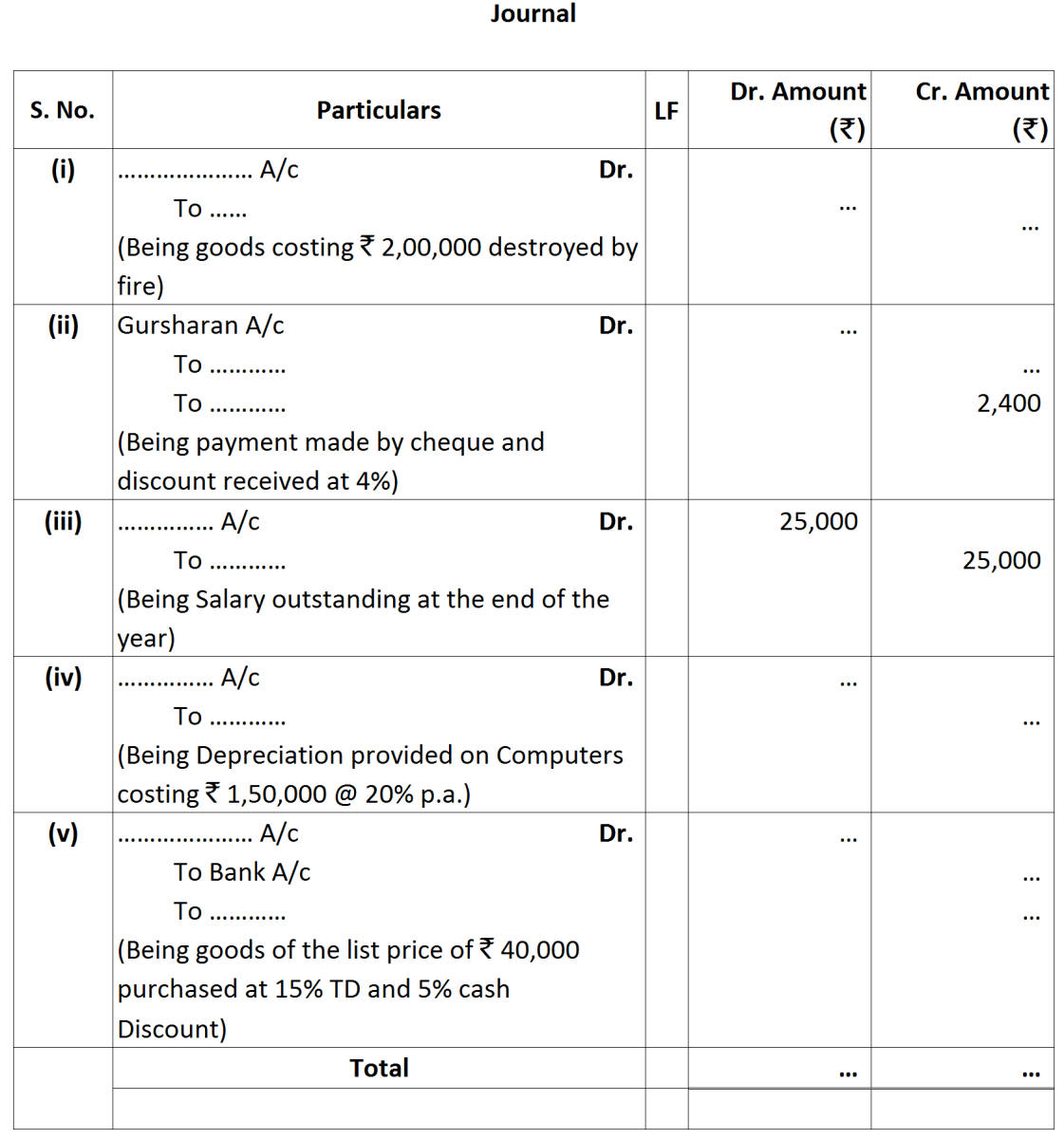
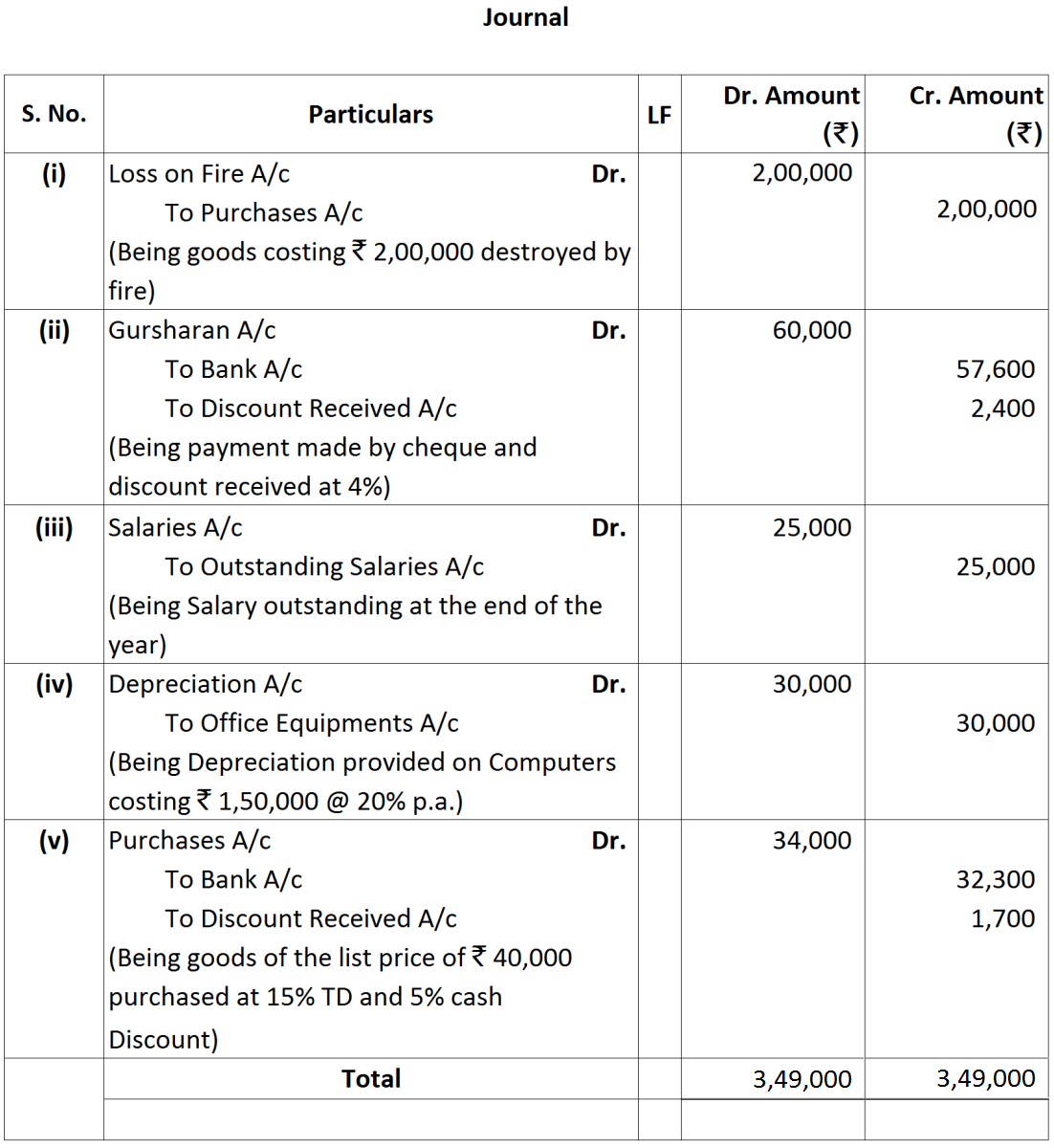
Fill in the missing information in the following journal entries:
Answer

Working Note:
  1. Total Amount $=\frac{2,400}{4}\times100=₹\ 60,000$
View full question & answer
Question 303 Marks
Journalise the following transactions of Raj Kumar Traders, timber merchants:
  1. Purchased timber from Kuldeep Kumar, for cash ₹ 2,000 and credit ₹ 10,000.
  2. Paid to Kuldeep Kumar in full settlement of his account ₹ 9,950.
  3. Paid rent in advance ₹ 10,000.
  4. Purchased machinery for ₹ 1,00,000 by cheque and carriage ₹ 2,000 and installation charges ₹ 1,000 paid in Cash.
  5. Purchased goods for ₹ 50,000 from Govind and sold it to Manohar for ₹ 65,000.
View full question & answer
Question 313 Marks
Transactions of M/s Vipin Traders are given below.
Show the effects on Assets, Liabilities and Capital with the help of accounting Equation.
a.
Business started with cash
₹ 1,25,000
b.
Purchased goods for cash
₹ 50,000
c.
Purchase furniture from R.K. Furniture
₹ 10,000
d.
Sold goods to Parul Traders (Costing ₹ 7,000 vide bill no. 5674)
₹ 9,000
e.
Paid cartage
₹ 100
f.
Cash Paid to R.K. furniture in full settlement
₹ 9,700
g.
Cash sales (costing ₹ 10,000)
₹ 12,000
h.
Rent received
₹ 4,000
i. Cash withdrew for personal use ₹ 3,000
(Ans: Asset = cash ₹ 78,200 + Goods ₹ 33,000 + Furniture ₹ 10,000 Debtors ₹ 9,000 = ₹ 1,30,200; Liabilities = Capital ₹ 1,30,200)
View full question & answer
Question 323 Marks
Show the accounting equation on the basis of the following transaction:
a.
Udit started business with:
(i) Cash
(ii) Goods
₹ 5,00,000
₹ 1,00,000
b.
Purchased building for cash
₹ 2,00,000
c.
Purchased goods from Himani
₹ 50,000
d.
Sold goods to Ashu (Cost ₹ 25,000)
₹ 36,000
e.
Paid insurance premium
₹ 3,000
f.
Rent outstanding
₹ 5,000
g.
Depreciation on building
₹ 8,000
h.
Cash withdrawn for personal use
₹ 20,000
i. Rent received in advance ₹ 5,000
j. Cash paid to himani on account ₹ 20,000
k. Cash received from Ashu ₹ 30,000
(Ans : Assets = Cash ₹ 2,92,000 + Goods ₹ 1,25,000 + Building ₹ 1,92,000 + Debtors ₹ 6,000 = 6,15,000: Laibilities = Creditors ₹ 30,000 + Outstanding Rent ₹ 5,000 + Accounts receiavable ₹ 5,000 + Capital ₹ 5,75,000 = ₹ 6,15,000)
View full question & answer
Question 333 Marks
On 1st April, 2019, the following were Ledger balances of M/s. Ram & Co., Delhi:
Cash in Hand ₹ 300; Cash at Bank ₹ 7,000; Bills Payable ₹ 1,000; Zahir (Dr.) ₹ 800; Stock ₹ 4,000; Gobind (Cr.) ₹ 2,000; Sharma (Dr.) ₹ 1,500; Rahul (Cr.) ₹ 900; Capital ₹ 9,700.
Transactions during the month of April, 2019 were:
2019
 
April 2
Bought goods from Gobind, Delhi
900
April 3
Sold goods to Sharma, Kanpur
1,000
April 5
Bought goods from Rahul, Delhi
1,200
April 8
Sold goods to Zahir, Kolkata
500
April 15
Paid Gobind by cheque on account*
1,500
April 18
Received from Sharma a cheque of
2,000
 
Allowed him discount*
50
April 20
Sold goods to Sharma, Kanpur
800
April 20
Paid rent by cheque
200
April 25
Sold goods to Zahir, Kolkata
1,000
April 30
Paid salaries in cash*
300
Inter-state transactions are subject to levy of IGST @ 12% and Intra-state transactions are subject to levy of CGST and SGST @ 6% each. GST is not levied on transactions marked with (*).
Post the above transactions to the Ledger and prepare the Trial Balance on 30th April, 2019.
View full question & answer
Question 343 Marks
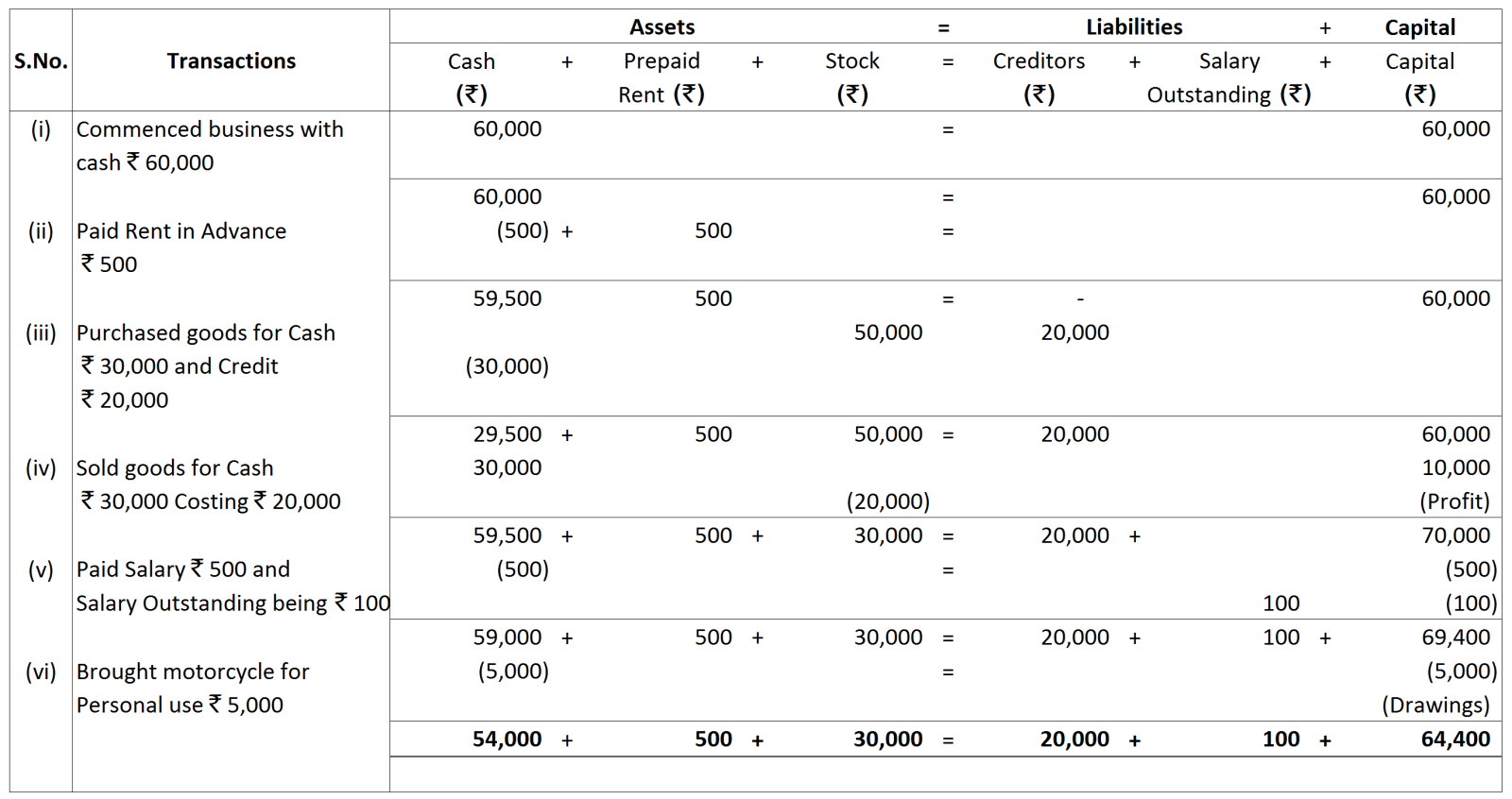
Prove that the Accounting Equation is satisfied in all the following transactions of Suresh. Also prepare a Balance Sheet.
  1. Commenced business with cash ₹ 60,000.
  2. Paid rent in advance ₹ 500.
  3. Purchased goods for cash ₹ 30,000 and credit ₹ 20,000.
  4. Sold goods for cash ₹ 30,000 costing ₹ 20,000.
  5. Paid salary ₹ 500 and salary outstanding being ₹ 100.
  6. Bought motorcycle for personal use ₹ 5,000
Answer

Assets = 54,000 + 500 + 30,000 = ₹ 84,500
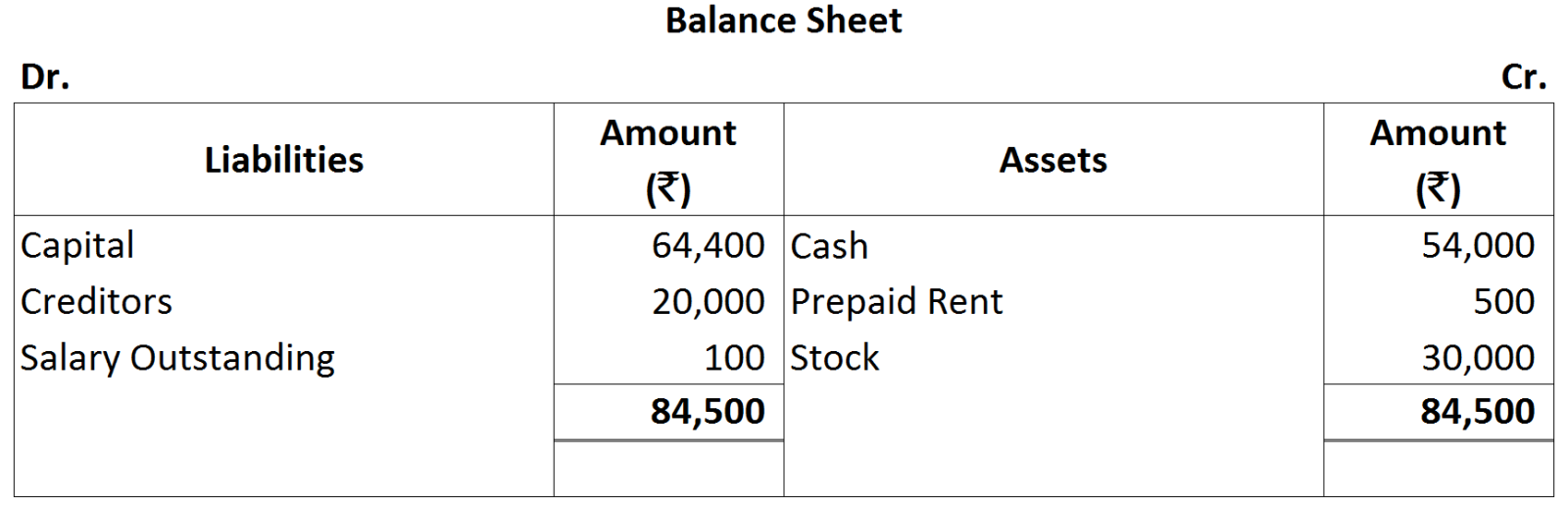
Liabilities = 20,000 + 100 = ₹ 20,100
Capital = ₹ 64,400
View full question & answer
Question 353 Marks
Prepare the Transfer Vouchers in the books of Mangla Agencies, Faridabad, Haryana from the Source Vouchers:
2019
Particular
Jan-7
Purchased goods from M/s Eufora, New Delhi vide Bill No. 912, paid IGST @ 12%
4,700
Jan-11
Sold goods to M/s Yardley, Faridabad, Haryana vide Bill No. 31596, charged CGST and SGST @ 6% each
5,000
Jan-31
Depreciation charged on building @ 10% on ₹ 2,00,000
20,000
View full question & answer
Question 363 Marks
Enter the following transaction in the Journal of Marutinandan Stores:
2017
 
Jan. 10
Purchased goods from Ghanshyam of the list price of 50,000 at 15% trade discount.
Jan. 13
Returned goods to Ghanshyam of the list price of ₹ 2,000
Jan. 15
Paid cash to Ghanshyam ₹ 40,000 in full settlement of his account.
Jan. 20
Purchased goods from Raghu of the list price of ₹ 60,000 at 10% trade discount.
Jan. 22
Returned goods to Raghu of the list price of ₹ 5,000
Jan. 25
Paid cash to Raghu ₹ 49,000 in full settlement of his Account.
View full question & answer
Question 373 Marks
Prepare the Vouchers to be recorded in the books of M/s Elegant Furnitures, New Delhi:
2019
Particular
Jan-1
Bought furniture from Modern Furniture for cash vide Cash Memo No. 241*
7,500
Jan-8
Paid cash to Mani & Sons for purchase of 2 machines vide Cash Memo No. 1230*
5,000
Jan-20
Paid for conveyance
150
Jan-27
Sold old typewriter for cash vide cash receipt No. 314*
500
Transactions marked with * are subject to levy of CGST and SGST @ 6% each.
View full question & answer
Question 383 Marks
What are the rules of posting in the Ledger?
Answer
Posting is the process of transferring entries from Journal or Subsidiary Books to the Ledger. The following rules should be observed while posting entries in the Ledger:
  1. All transactions relating to an account should be entered at one place. In other words, two separate accounts should not be opened for posting transactions relating to the same account. If there are two customers with similar names, their accounts should be distinguished by writing their address against their names, say the Account of Anil (of Karol Bagh) and the Account of Anil (of Chandni Chowk).
  2. The word 'To’is used before the accounts which appear on the debit side of an account. Similarly, the word ‘By' is used before the accounts which appear on the credit side of an account.
  3. If an account has been debited in the Journal entry, the posting in the Ledger should also be made on the debit side of such account. In the Particulars column, the name of the other account which has been credited in the Journal entry should be written for reference.
  4. If an account has been credited in the Journal entry, the posting in the Ledger should also be made on the credit side of such account. In the particulars column, the name of the other account which has been debited in the Journal entry should be written for reference.
  5. Similar amount which has been posted on the debit side of an account should also be posted on the credit side of another account.
  6. It is not necessary to write the word ‘Alc' after the personal accounts.
View full question & answer
Question 393 Marks
Journalise the following transactions in the Journal of Navin Gupta & Sons.:
  1. Out of Insurance premium paid this year, ₹ 15,000 is related to next year.
  2. Credit purchases from Ram & Co. for ₹ 50,000. Cash discount will be received at 5% on payment of bill within 10 days.
  3. Cash paid to Ram & Co. and discount availed of.
  4. Paid Income Tax ₹ 20,000 by cheque.
  5. Goods costing ₹ 2,00,000 sold for cash at a profit of 10%.
  6. Purchased iron safe for ₹ 2,00,000 filing cabinet for ₹ 50,000 and Computer for ₹ 1,00,000.
View full question & answer
Question 403 Marks
Journalise the following transactions:
2018
 
April 1
Purchased goods for ₹ 1,00,000 from Manoj and availed discount of ₹ 10,000
April 2
Paid amount due to Manoj by cheque and availed discount of ₹ 4,500
April 5
Cash ₹ 5,000 paid to Desai and discount allowed by him ₹ 200
April 10
Cash ₹ 10,000 received from Govardhan and allowed him discount ₹ 500.
April 12
Sold personal Car of the proprietor for ₹ 80,00 against cheque, which was deposited into the firm's bank account.
April 16
Sold personal Car of the proprietor for ₹ 1,50,000 against cheque, which was deposited into the proprietor's personal bank account.
April 20
Sold goods to Gaurav costing ₹ 1,00,000 at a profit of 40% and allowed him 10% trade discount and paid for cartage ₹ 3,000 not to be charged from him.
April 24
Placed an order with Rudra & Co. for supply of goods of ₹ 80,000 and a cheque for 40% amount is sent to them as an advance.
View full question & answer
Question 413 Marks
Pass Journal Entries for the following transactions:
  1. Provide depreciation on Furniture ₹ 500 and on Machinery ₹ 2,000.
  2. Received cash ₹ 1,000 for bad-debts written off last year.
  3. Ajay Singh was declared bankrupt. He owed ₹ 2,500 to us. Nothing could be recovered from his estate.
  4. ₹ 20,000 for wages and ₹ 4,000 for salaries are outstanding.
  5. Purchased furniture for ₹ 6,000 for the proprietor and paid the amount by cheque.
  6. Provide 9% interest on capital amounting to ₹ 2,00,000.
  7. Charge interest on drawings ₹ 1,000.
View full question & answer
Question 423 Marks
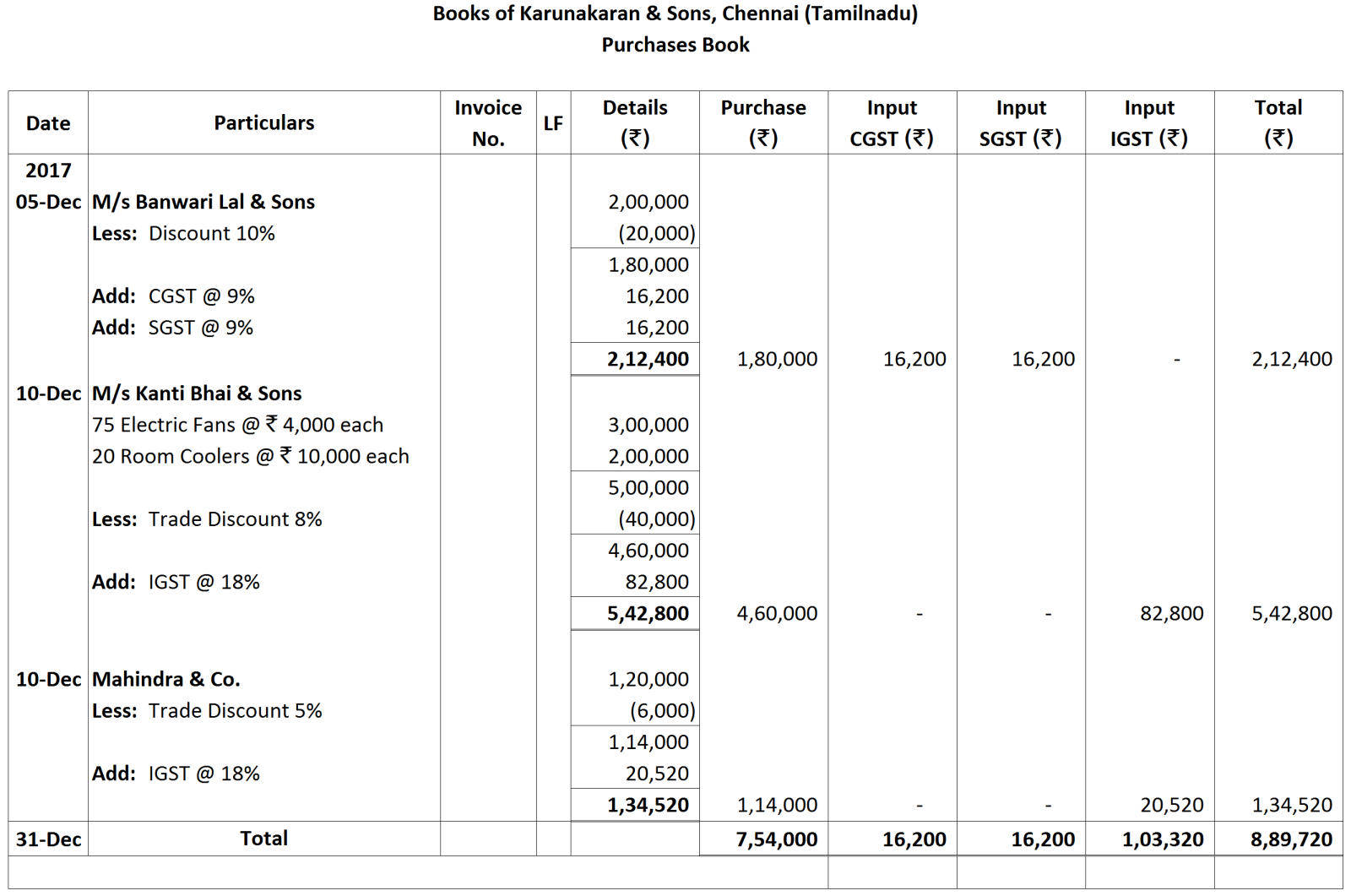
Record the following transaction in the Sales Book of Karunakaran & Sons, Chennai (Tamilnadu) assuming CGST @ 90% and SGST @ 9% and post them into Ledger:
2017
 
Dec. 5
Sold of M/s Banwari Lal & Sons, Chennai, goods valued at ₹ 2,00,000 less Trade Discount 10%
Dec. 10
Sold to M/s Kanti Bhai & Sons, Bengaluru (Karnataka):
75 Electric Fans @ ₹ 4,000 each
20 Room Coolers @ ₹ 10,000 each
Less: Trade Discount 8%
Dec. 16
Mahindra & Co., Kochi (Kerala) purchased from us goods of ₹ 1,20,000, less: 5%
Dec. 24
Sold goods for cash ₹ 60,000
Answer


Note: Transaction on Dec. 24 will not be recorded in the Sales Book as it is a cash transaction.
View full question & answer
Question 433 Marks
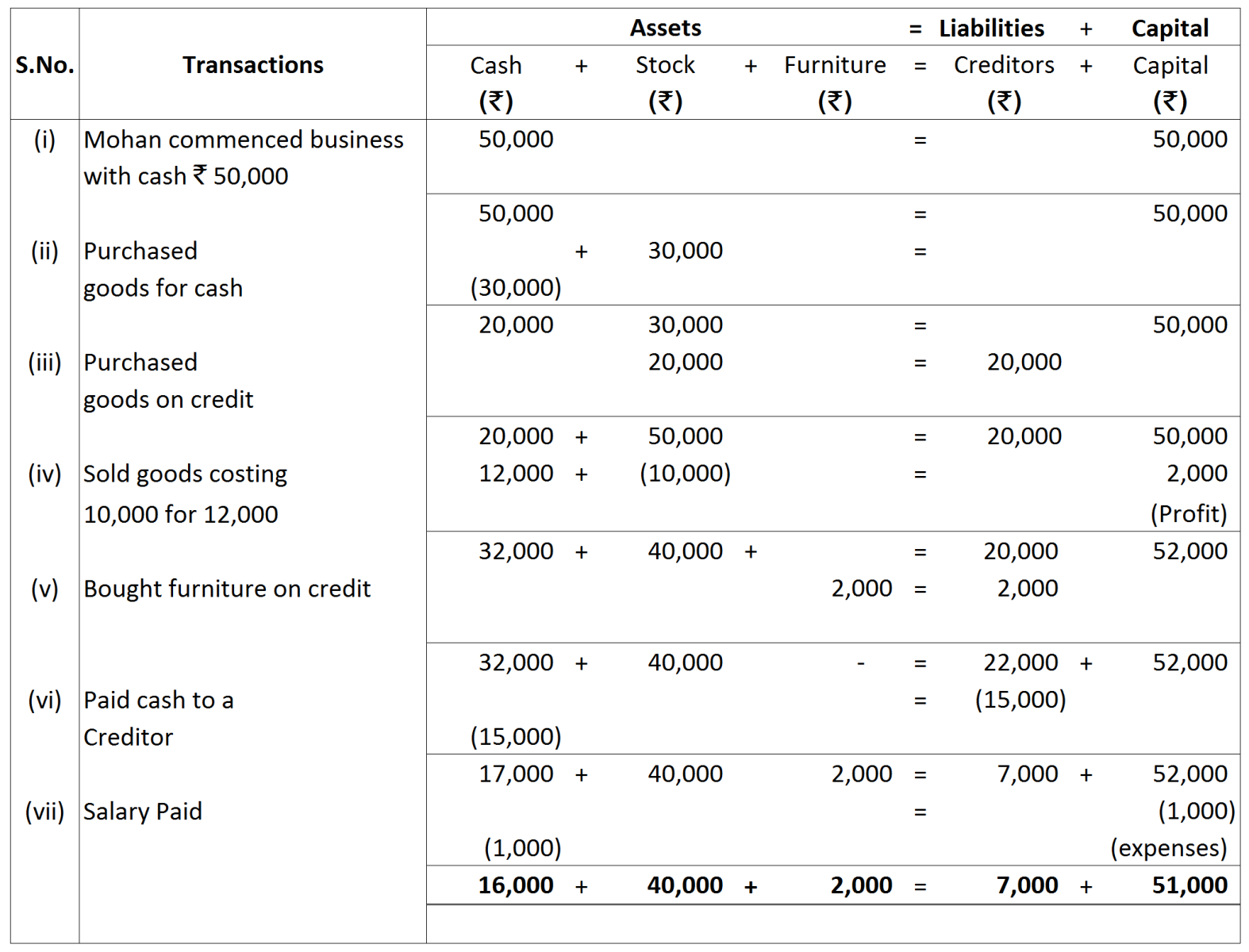
Develop an Accounting Equation from the following transactions:
S.no  
(i) Mohan commenced business with cash 50,000
(ii) Purchased goods for cash 30,000
(iii) Purchased goods on credit 20,000
(iv) Sold goods (costing ₹ 10,000) for 12,000
(v) Bought furniture on credit 2,000
(vi) Paid cash to a creditor 15,000
(vii) Salary paid 1,000
Answer

Assets = 16,000 + 40,000 + 2,000 = ₹ 58,000
Liabilities = ₹ 7,000
Capital = ₹ 51,000
View full question & answer
Question 443 Marks
On 1st April, 2019, Mohit, Delhi started business with a capital of ₹ 50,000. He made the following transactions during the month of April:
2019  
April 3 Purchased goods from Rita, Delhi on credit for 20,000
April 4 Cash paid to Rita 10,000
April 6 Goods sold to Rohit, Chandigarh 25,000
April 8 Received cash from Rohit 20,000
April 12 Goods purchased from Rita 12,000
April 18 Cash paid to Rita 20,000
April 25 Goods sold to Rohit, Chandigarh 10,000
April 30 Received cash from Rohit 6,000
You are required to journalise the above transactions and show the respective Ledger accounts.
View full question & answer
Question 453 Marks
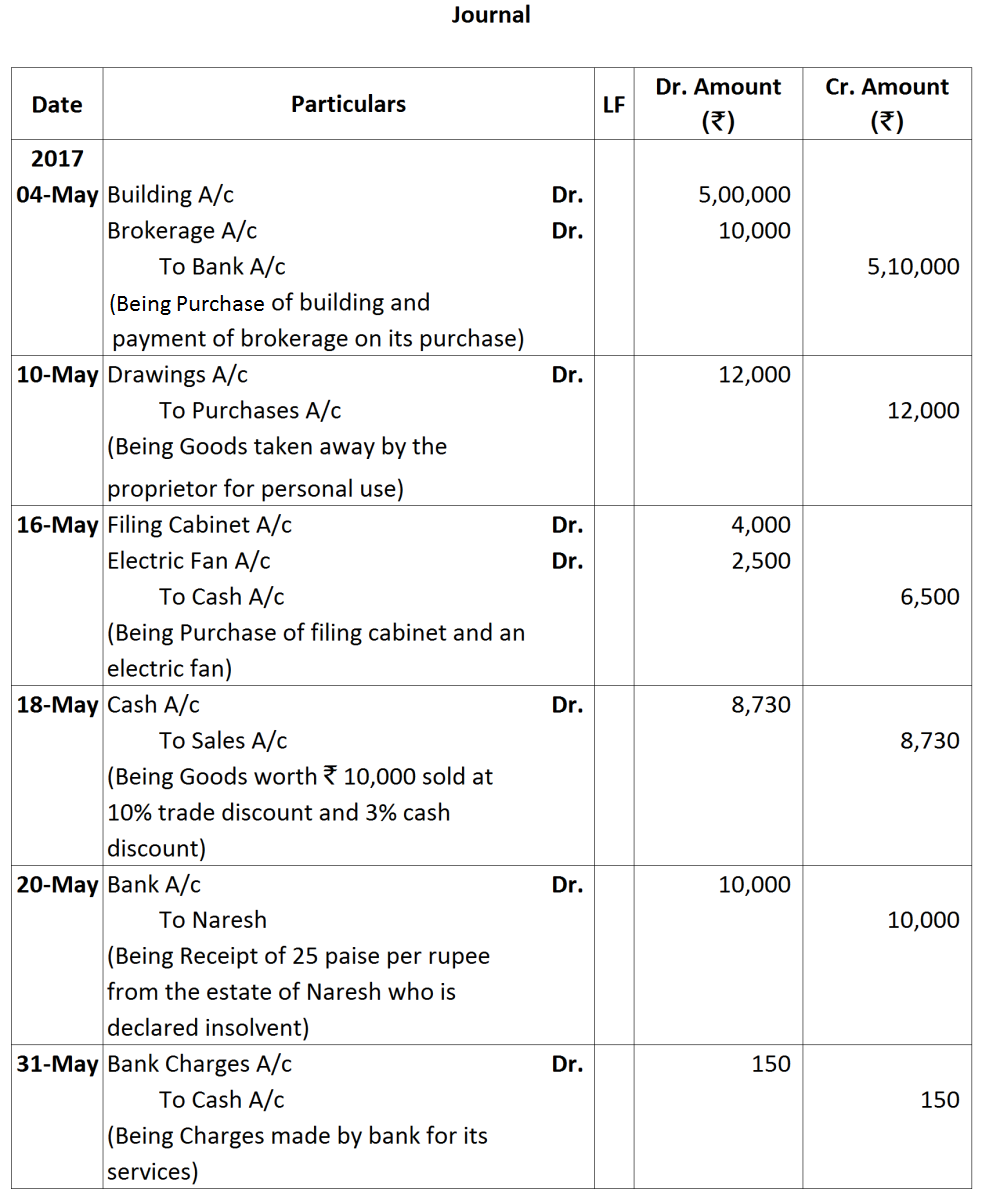
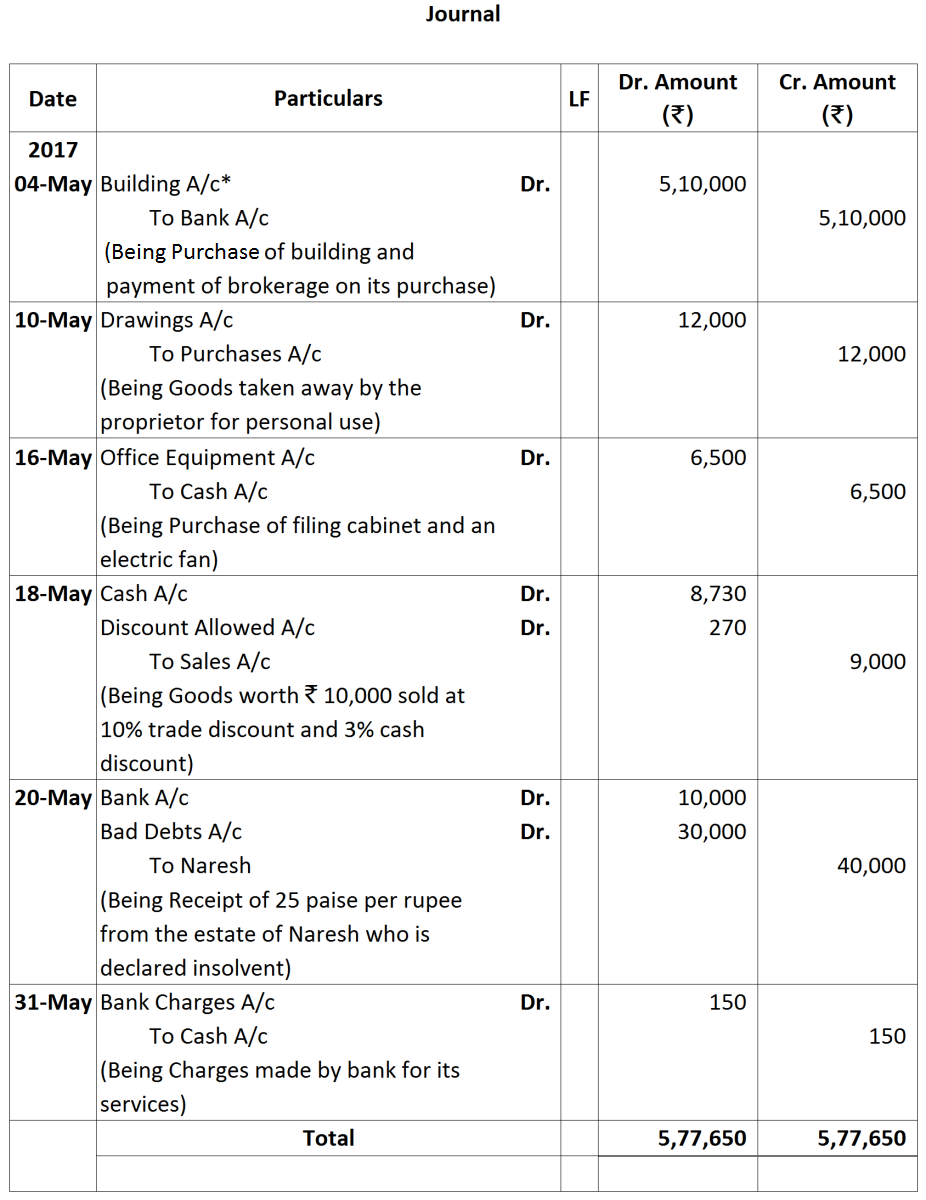
Rectify the following entries assuming that the narration in each case is correct:
Answer

*Payment of brokerage will be included in cost of the building as it is incurred at time of purchase of building.
Working Notes:
WN 1: Calculation of amount of goods sold.
Cost = 10,000
Less: Trade Discount (10% on 10,000) = 1,000
  = $\overline{9,000}$
Less: Cash Discount (3% on 9,000) = 270
Sale Price = $\overline{8,730}$
WN 2: Calculation of amount of bad debts.
25 Paise per rupee received from Naresh = 10,000
$\therefore$ 75 paise per rupee not received from Naresh $=\frac{10,000}{25}\times75=30,000$
Total amount due from Naresh = ₹ 40,000 (10,000 + 30,000)
View full question & answer
Question 463 Marks
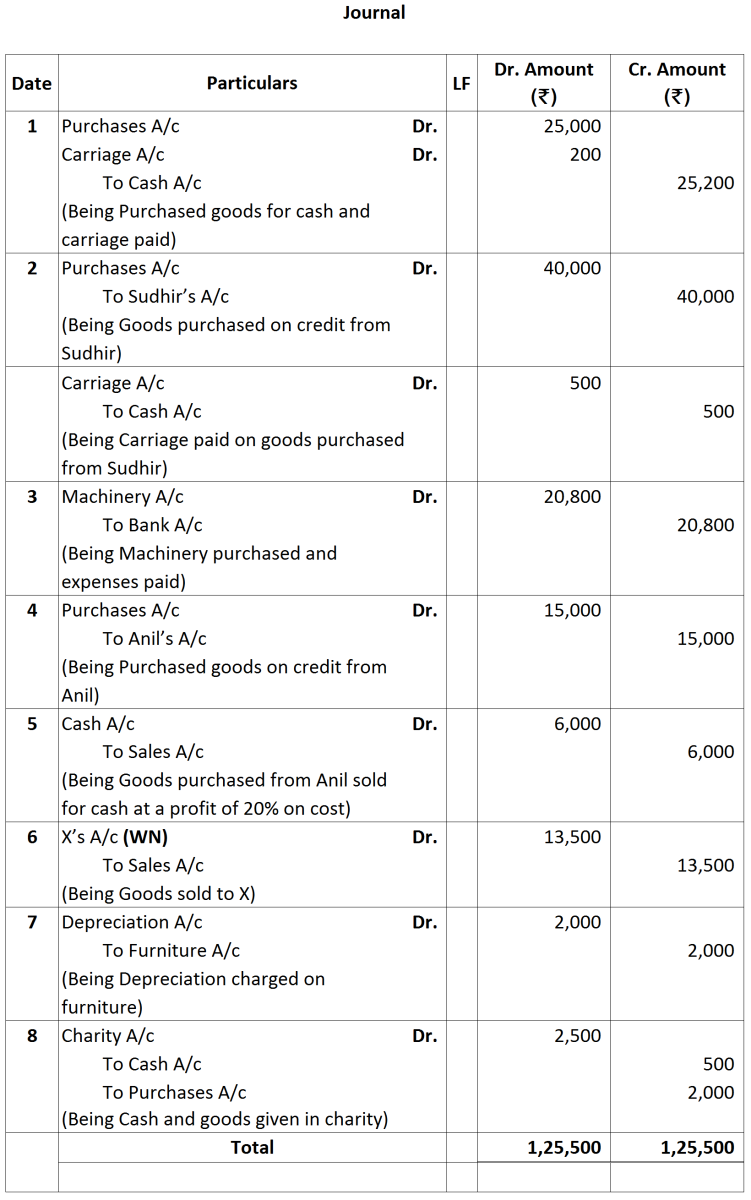
Journalise the following:
  1. Purchased goods for ₹ 25,000 for Cash and paid ₹ 200 for carriage on these goods.
  2. Purchased goods for ₹ 40,000 on Credit from Sudhir and paid ₹ 500 for carriage on these goods.
  3. Purchased machinery for ₹ 20,000 and spent ₹ 500 on its carriage and ₹ 300 on its installation.
  4. Purchased goods from Anil for ₹ 15,000.
  5. Sold $\frac{1}{3}\text{rd}$ of the above goods at a profit of 20% on cost.
  6. Goods costing ₹ 12,000 sold to Mr. X, issued invoice at 25% above cost less 10% trade discount.
  7. Provide 20% depreciation on furniture costing ₹ 10,000.
  8. Gave as charity−Cash ₹ 500 and Goods ₹ 2,000.
Answer

Working Notes: Calculation of amount of goods sold to X.
Cost
=
12,000
Add: Profit @ 25% on 12,000
=
3,000
 
=
$\overline{15,000}$
Less: Trade Discount (10% on 15,000)
=
1,500
Sale Price
=
$\overline{13,500}$
View full question & answer
Question 473 Marks
Show the Accounting Equation on the basis of the following and present a balance sheet on the last new equation balances:
 
 
i.
Manu started business with cash
50,000
ii.
Bought furniture for
500
iii.
Purchased goods on credit
4,000
iv.
Sold goods on cash (cost ₹ 500) for
700
v.
Received rent
200
vi.
Purchased goods for cash
1,000
vii. Withdrew for personal use 700
viii. Paid to creditors 400
ix. Paid for salaries 200
View full question & answer
Question 483 Marks
Prepare the Vouchers to be recorded in the books of M/s Computer Aids:
2019
Particular
Jan-1
Bought computer for resale for cash vide Cash Memo No. 512*
7,200
Jan-8
Salary paid for the month of December, 2018
10,000
Jan-10
Sold computer for cash vide Cash Memo No. 64*
12,000
Jan-15
Withdraw cash from bank for office use vide cheque No. 13456
1,700
Transactions marked with * are subject to levy of CGST and SGST @ 6% each.
View full question & answer
Question 493 Marks
Pass entries in the books of Mukerjee & Sons. assuming all transactions have taken place within the state of Uttar Pradesh. Assume CGST @ 9% and SGST @ 9%.
2018
 
March 1
Purchased goods for ₹ 5,00,000 from Mehta Bros.
March 10
Sold goods for ₹ 8,00,000 to Munjal & Co.
March 15
Paid for advertisement ₹ 40,000 by cheque.
March 18
Purchased furniture for office use ₹ 50,000 and payment made by cheque.
March 25
Paid for printing and stationery ₹ 8,000.
March 31
Payment made of balance amount of GST.
View full question & answer
Question 503 Marks
Show an Accounting Equation for the following transactions:
  1. D. Mahapatra commenced business with cash ₹ 50,000 and ₹ 1,00,000 by cheque; goods ₹ 60,000; machinery ₹ 1,00,000 and furniture ₹ 50,000.
  2. $\frac{1}{3}\text{rd}$ of above goods sold at a profit of 10% on cost and half of the payment is received in cash.
  3. Depreciation on machinery provided @ 10%.
  4. Cash withdrawn for personal use ₹ 10,000.
  5. Interest on drawings charged @ 5%.
  6. Goods Sold to Gupta for ₹ 10,000 and received a Bill Receivable for the same amount for 3 months.
  7. Received ₹ 10,000 from Gupta against the Bills Receivable on its maturity.
View full question & answer