Questions

3 Marks Question

🎯

Test yourself on this topic

42 questions · timed · auto-graded

Question 13 Marks
Write a short note on 'balancing an account'. Explain by balancing a Cash Account.
Answer
A balance of an account is the difference between the total of its debit and credit sides. If the total of debit side is more than the total of credit side, the account is said to have a debit balance. It has a credit balance when total of credit side is more than the total of debit side. Balancing a Cash Account.
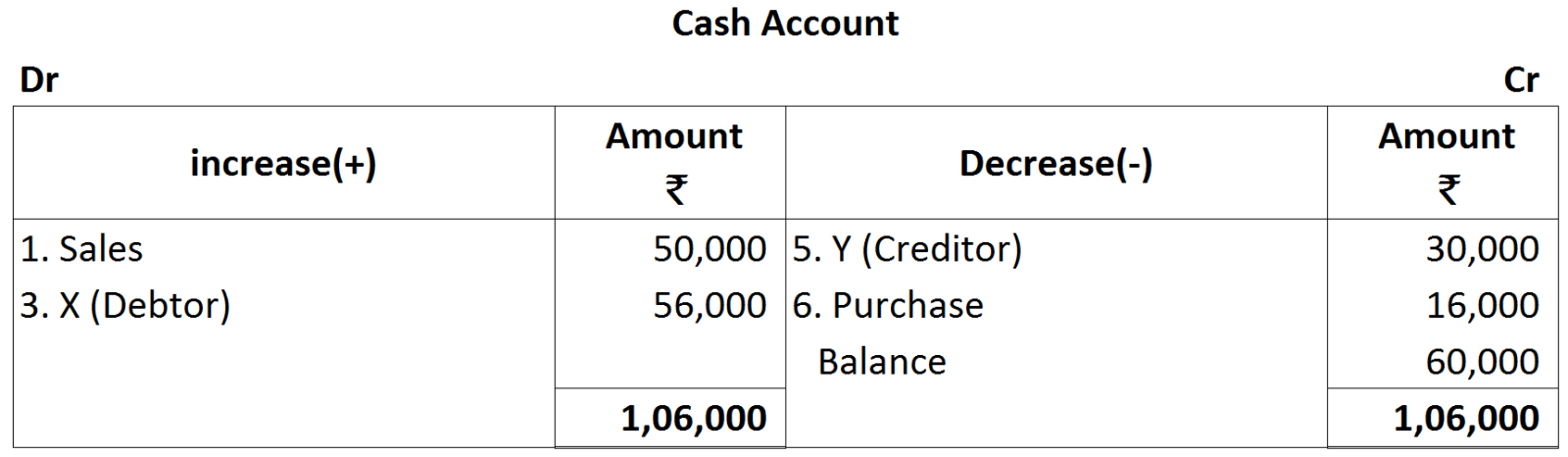
       
1. Cash sales 50,000 2. Sold goods to X on credit 80,000
3. Cash received from X 56,000 4. Purchased goods from Y on credit 44,000
5. Paid to Y 30,000 6. Cash purchases from Y 16,000
View full question & answer
Question 23 Marks
Give one example of each of the following transactions:
  1. Increase in an asset and a liability.
  2. Decrease in an asset and a liability.
  3. Increase in assets and capital.
  4. Decrease in assets and capital.
Answer
 
Effect of Transaction
Example
i.
Increase in an asset and a liability.
Goods purchased on credit.
ii.
Decrease in an asset and a liability.
Cash paid to creditors.
iii.
Increase in assets and capital.
Additional capital brought in by the proprietor.
iv.
Decrease in assets and capital.
Salary paid in Cash.
View full question & answer
Question 33 Marks
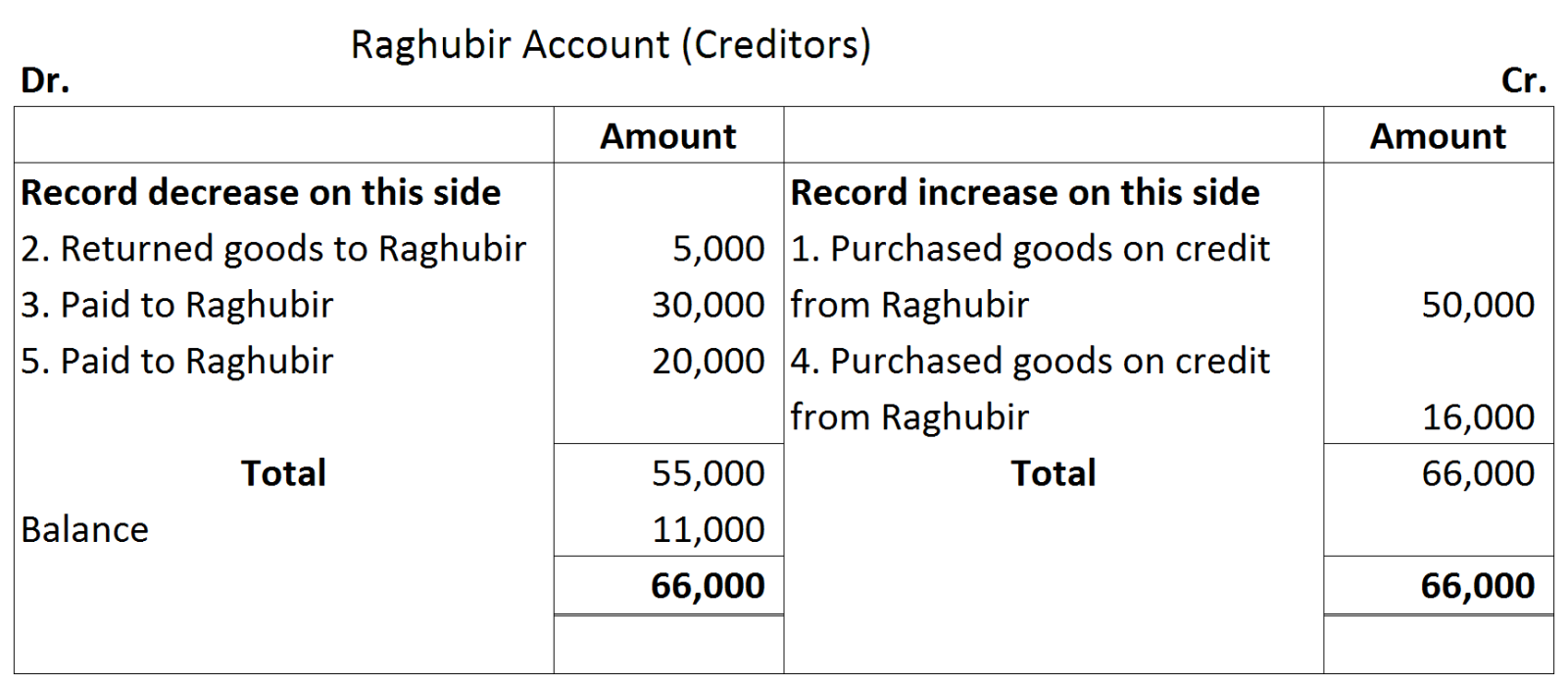
Open 'T' shape account of our creditor 'Raghubir' and write the following transactions on the proper side:
  1. Purchased goods from Raghubir on credit for ₹ 50,000.
  2. Returned goods to Raghubir for ₹ 5,000.
  3. Paid to Raghubir ₹ 30,000.
  4. Purchased goods from Raghubir on credit for ₹ 16,000.
  5. Paid to Raghubir ₹ 20,000.
Answer
Raghubir is a creditor, which means, it is a liability for the business. As we know, increase in liability is recorded on the credit side while decrease in liability will be shown on the debit side of the concerned liability account.
View full question & answer
Question 43 Marks
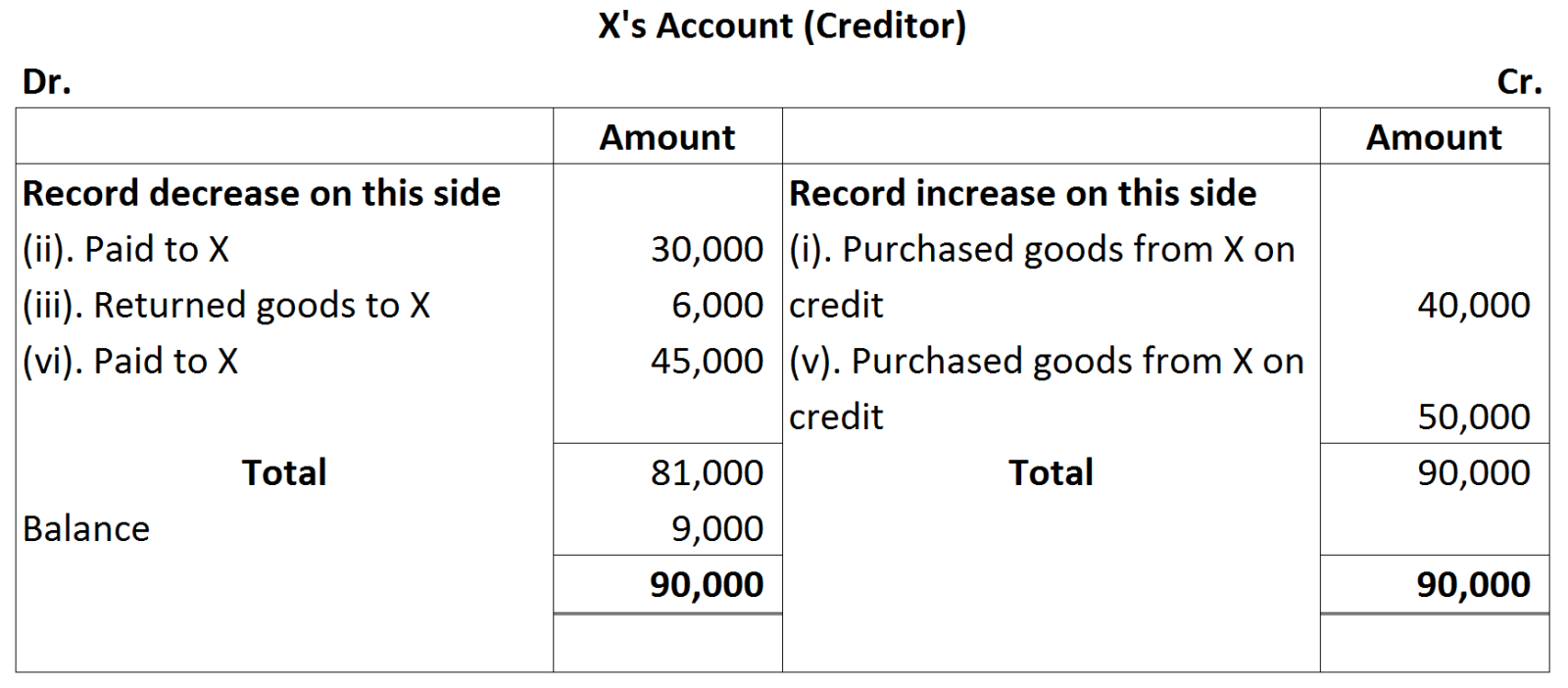
Open 'T' shape account of our Creditor 'X' and write the following transactions on the proper side:
    (₹)
1. Purchased goods from X on Credit 40,000
2. Paid to X 30,000
3. Returned goods to X 6,000
4. Purchased goods from X for Cash 20,000
5. Purchased goods from X on Credit 50,000
6. Paid to X 45,000
Answer
Increase in Creditors (being a liability) will be shown on the credit side and decrease in the creditors will be recorded on the debit side of the Creditors Account.

Note: Transaction Number (4) will not be recorded in Creditors Account as goods are purchased for cash. Thus, there will be no impact on Creditors Account.
View full question & answer
Question 53 Marks
On which side the increase in the following accounts will be recorded? Also mention the nature of account:
  1. Furniture
  2. Rent Paid
  3. Commission Received
  4. Salary Paid
  5. Proprietor's Account
  6. Debtor
  7. Creditor
Answer
 
Accounts
Increase Recorded at Side
Nature
i.
Furniture
Debit
Asset
ii.
Rent Paid
Debit
Expense
iii.
Commission Received
Credit
Income
iv.
Salary Paid
Debit
Expense
v. Proprietor’s Account Credit Capital
vi. Debtor Debit Asset
vii. Creditor Credit Liability
View full question & answer
Question 63 Marks
What are compound journal entries? Give an example.
Answer
Compound Journal Entry: Compound Journal entry is a Journal entry in which more than two accounts are affected, i.e., one or more accounts are debited and/or one or more accounts are credited or vice versa. For example, a sale of 5,000 is made to Satish. It is discharged by Satish by paying 2,000 in cash, balance to be paid later. This transaction of sale affects three accounts as follows:Images
View full question & answer
Question 73 Marks
Explain in short the meaning of an Accounting Equation.
Answer
An Accounting Equation is a mathematical expression which shows that the assets and liabilities of a firm are equal. An Accounting Equation is based on the Dual Aspect Concept of accounting meaning, every transaction has dual aspect or two aspects debit and credit. It holds that for every debit there is a credit of equal amount and vic? versa. It means, total claims (those of outsiders and of the proprietors) will always be equal to the total assets of the firm. The claims, also known as equities, are of two types:
  1. Owner's equity or capital
  2. Liabilities or amounts due to outsiders (i.e., Outsider's Equity).
We can express it mathematically as follows:
Assets = Equities (Total Claims)
OR
Assets = Liabilities + Capital

OR
Liabilities = Assets - Capital

OR
Capital = Assets - Liabilities
View full question & answer
Question 83 Marks
Ram started business on $1$st April, $2018$ with a Capital of $₹ 25,000$ and a loan of $₹ 12,500$. On $31^{\text {st }}$ March, $2019$, his assets were ₹ $50,000$ . Find his capital as on $31^{\text {st }}$ March, $2019$ and the profit earned during the year.
Answer
Closing Capital is difference between the assets and liabilities. Thus
liabilities $= 12,500$ (Loan)
and assets $= 50000$.
Therefore capital $= 50,000 - 12,500 = 37,500$
Profit = Closing Capital - Opening Capital + Drawings - Additional Capital
Profit $= 37,500 - 25,000 + 0 - 0$
Profit $= 12,500$
View full question & answer
Question 93 Marks
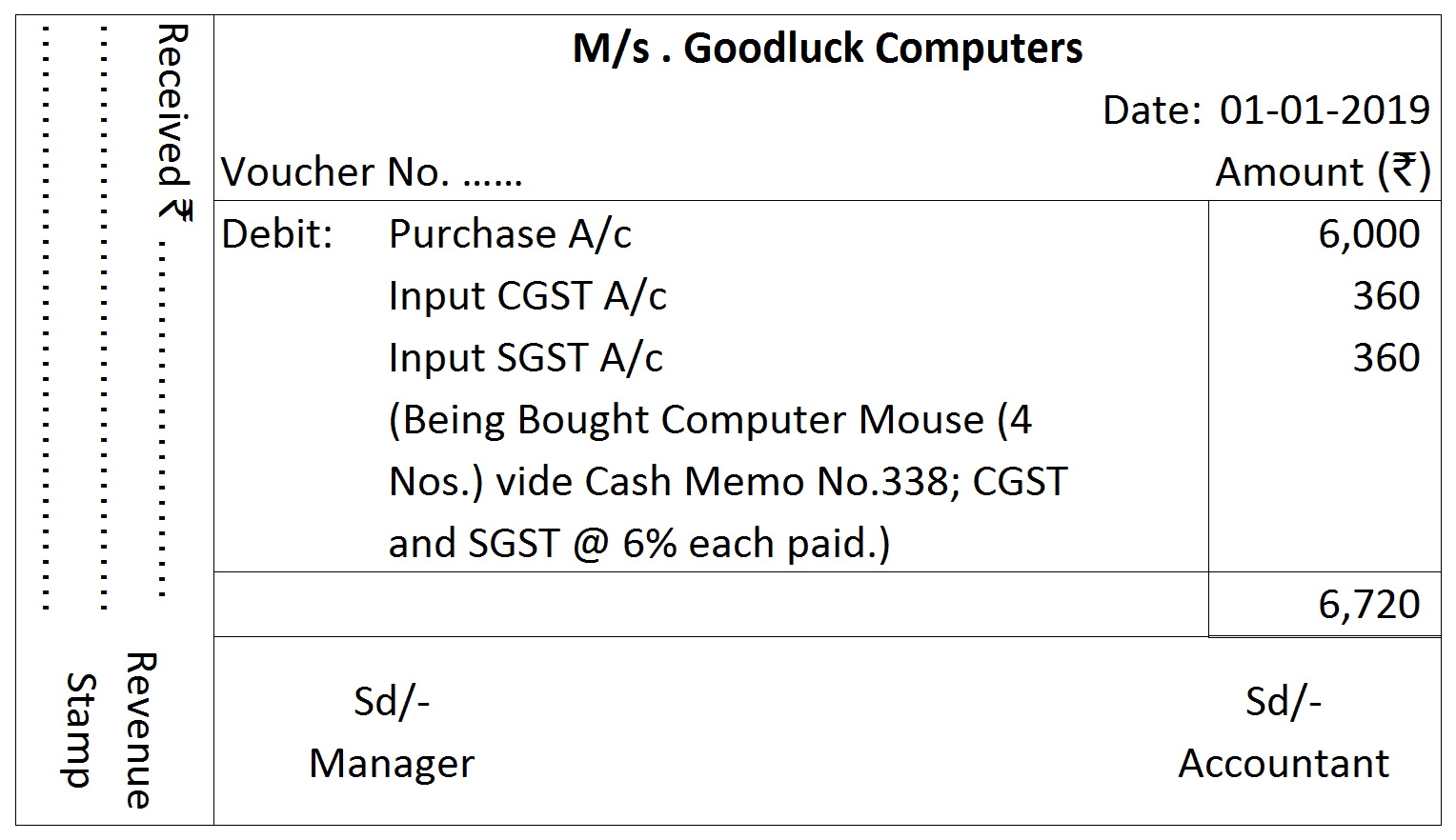
What is a Voucher? Prepare an imaginary Specimen of Voucher.
Answer
Voucher is a document evidencing a business transaction. It flows from the above definition that when a transaction is entered into, an evidence to that effect is also established. Such evidences are Source Documents. On the basis of Source Documents, a voucher detailing the accounts that are debited and credited is prepared. A specimen of a Voucher is given below:
View full question & answer
Question 103 Marks
On which side will the increase in the following accounts be recorded? Also mention the nature of account:
  1. Furniture
  2. Wages paid
  3. Rent Received
  4. Cash
  5. Proprietor's Account
  6. Debtor
  7. Prepaid Insurance
  8. Outstanding Salary.
Answer
  Accounts Increase Recorded at Side Increase Recorded at Side
i. Furniture Debit Asset
ii. Wages Paid Debit Expense
iii. Rent Received Credit Income
iv. Cash Debit Asset
v. Proprietor’s Account Credit Capital
vi. Debtor Debit Asset
vii. Prepaid Insurance Debit Asset
viii. Outstanding Salary Credit Liability
View full question & answer
Question 113 Marks
Give one distinction between books of original entry and ledger. Ledger.
Answer
Journal or Books of Original Entry
Ledger
All the transactions are first of all recorded in these books, i.e., journal or subridiary books such as purchase book sales books etc.
All the transactions entered in jouenal or subsidiary Books are later transferred to the ledger.
View full question & answer
Question 123 Marks
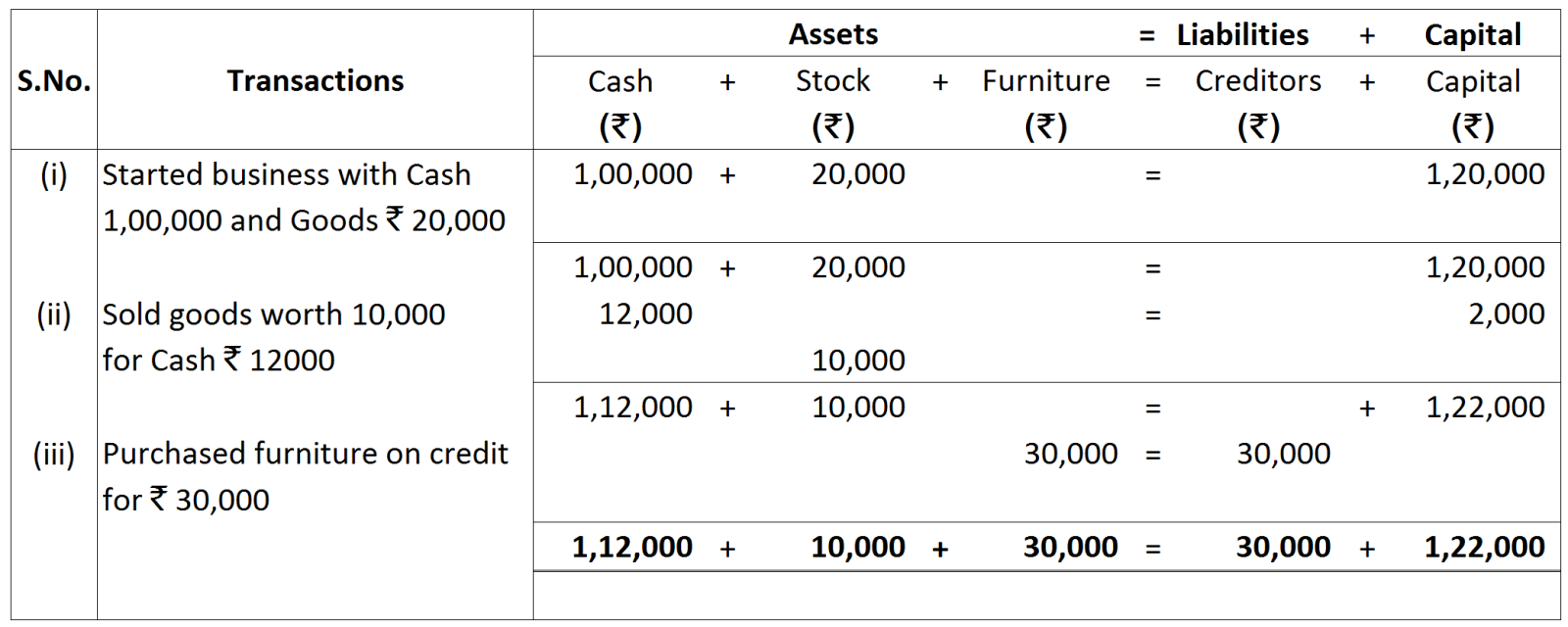
Prepare Accounting Equation from the following:
  1. Started business with cash ₹ 1,00,000 and Goods ₹
    20,000.
  2. Sold goods worth ₹ 10,000 for cash ₹ 12,000.
  3. Purchased furniture on credit for ₹ 30,000.
Answer

Assets = 1,12,000 + 10,000 + 30,000 = ₹ 1,52,000
Liabilities = ₹ 30,000
Capital = ₹ 1,22,000
View full question & answer
Question 133 Marks
Is it possible to pass a single journal entry for two or more transactions?
Answer
Sometimes, two or more transactions relating to one particular account take place on the same date. In such cases, instead of passing separate entries for all such transactions, only one entry is passed. Such a Journal entry is termed as Compound Journal Entry.
View full question & answer
Question 143 Marks
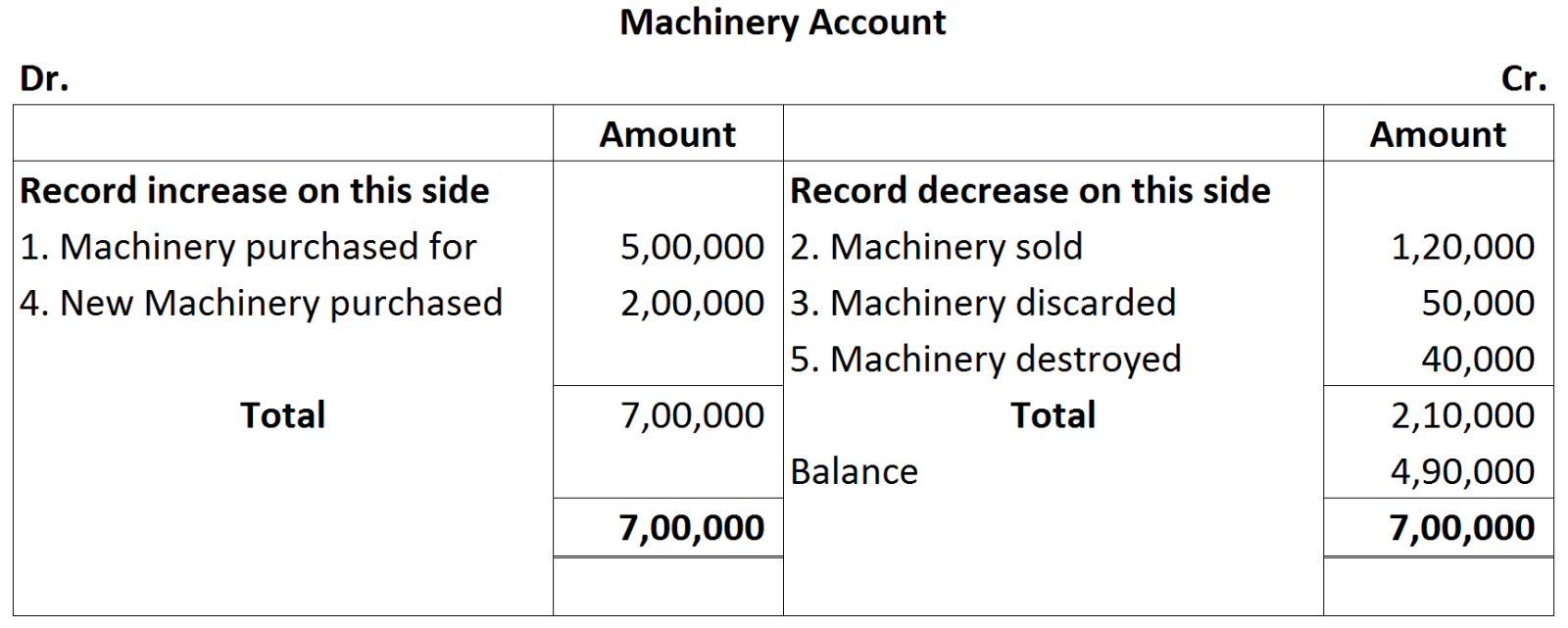
Open 'T' shape account for Machinery and write the following on the proper side:
    (₹)
i. Machinery purchased for 5,00,000
ii. Machinery sold 1,20,000
iii. Machinery discarded 50,000
iv. New Machinery purchased 2,00,000
v. Machinery destroyed 40,000
Answer
As we know, Machinery Account is an asset, so, increase in machinery will be recorded on the debit side while decrease in machinery will be recorded on the credit side of the Machinery Account.
View full question & answer
Question 153 Marks
What is the purpose of posting J.F. numbers at the time entries are posted to the accounts.
Answer
Journal Folio (J.F.) Column in the ledger records Page No. of the journal from which the posting to the Ledger has taken place. Purpose of posting J.F. numbers is that it provides a ready reference for tracing the page of journal from where the entry has been posted.
View full question & answer
Question 163 Marks
Why are some accounting systems called double accounting systems?
Answer
Some accounting systems are called double accounting systems because under this system there are two aspects of every transaction, i.e., every transaction has dual effect.
Every transaction affects two accounts simultaneously, that is represented by debiting one account and crediting the other account. It is based on the fact that if there is receiver, there should be a giver.
View full question & answer
Question 173 Marks
What are ‘Books of Original Entry'?
Answer
The books in which a transaction is recorded for the first time from a source document are called 'Books of Original Entry'. Journal is one of the basic books of original entry in which transactions are originally recorded in a chronological (day-to-day) order according to the principles of double entry system.
View full question & answer
Question 183 Marks
Describe the fundamental accounting equation. How are revenue and expenses related to it?
Answer
The elements of fundamental accounting equation are Capital, Assets and Liabilities. Assets = Things that a business owns Liabilities = Things that a business owes Capital = Amount invested by the owner in the businessThe equation is:
Capital = Assets + Liabilities Expenses and Revenue are related to capital; increase in revenue leads to increase in capital while expenses leads to decrease in capital. It is because any income/ expense belongs to the owner and thus his capital in the business gets affected with the amount of expenses incurred and revenue earned.
  • Revenue: Owner's equity (Capital) is increased by the amount of revenue.
  • Expenses: Owner's equity (Capital) is increased by the amount of revenue.
Income = Revenue - Expense Income is the profit earned during an accounting period. Profit increases the owner's equity (Capital) and loss decreases the owner's equity (Capital).
View full question & answer
Question 193 Marks
What are the types of Accounting Voucher?
OR
Name the two types of vouchers (Main Classification).
Answer
Types of Accounting Vouchers: Accounting Vouchers are of two types, i.e.,
  1. Cash Vouchers: Cash Voucher refers to the voucher prepared at the time of receipt or payment of cash and includes receipt and payment through cheques. Cash Vouchers can be of two types namely,
  1. Credit Voucher.
Credit Vouchers are prepared when cash is received. Cash may be received against
  1. sales of goods,
  2. sale of fixed assets,
  3. sale of investments,
  4. receipts from debtors,
  5. withdrawal from bank, etc.
  1. Debit Voucher.
  1. Non-Cash Vouchers or Transfer Vouchers: Non-Cash Vouchers are the vouches prepared for transactions not involving cash. Examples of these are Invoice or Bills, Debit and Credit Notes, etc. Non-Cash Vouchers are prepared for the transactions of credit sales, credit purchases, goods returned (both inwards and outwards), rectifying the mistakes, etc.
View full question & answer
Question 203 Marks
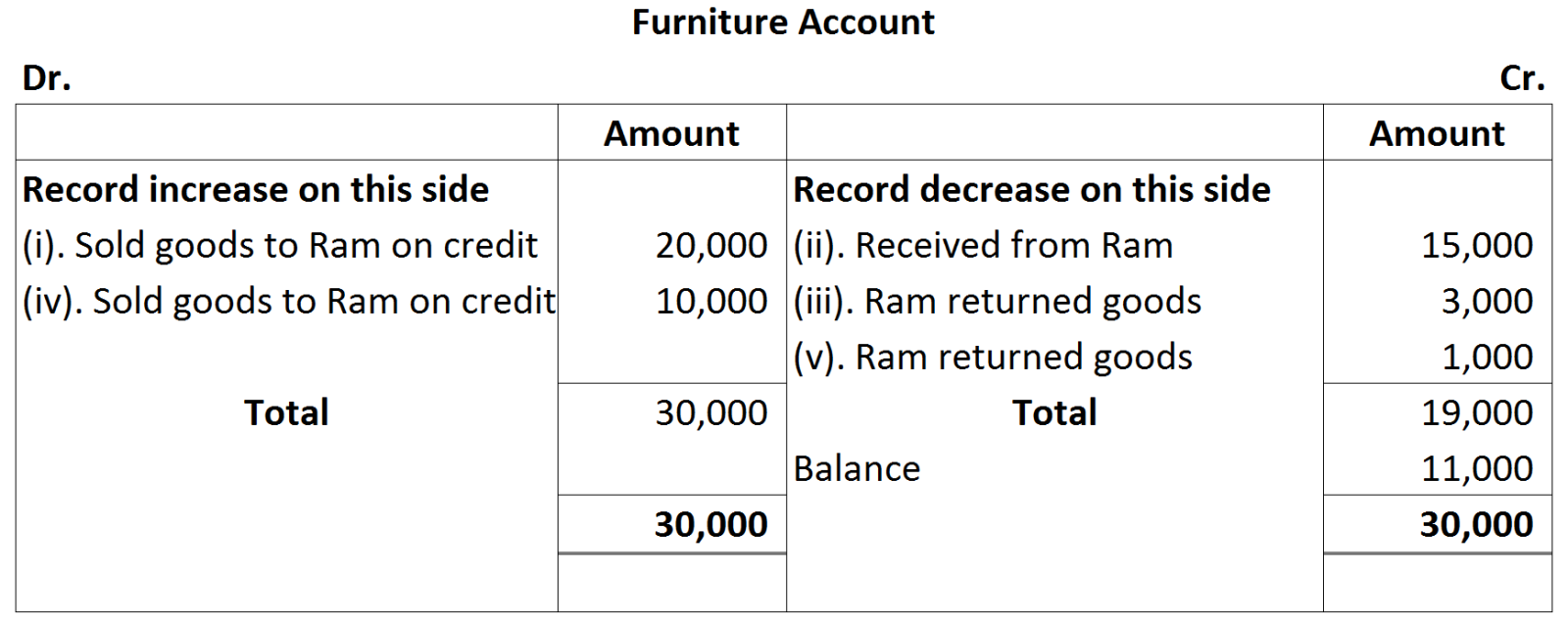
Open 'T' shape account of our Debtor 'Ram' and write the following transactions on proper side:
    (₹)
i. Sold goods to Ram on Credit 20,000
ii. Received from Ram 15,000
iii. Ram returned goods to us 3,000
iv. Again sold goods to Ram on Credit 10,000
v. Ram returned goods to us 1,000
Answer
Increase in Debtors (being an asset) will be shown on the debit side and decrease in them will be recorded on the credit side of the Debtors Account.
View full question & answer
Question 213 Marks
Why is the evidence provided by source documents important to accounting?
Answer
The evidence provided by the source document is important in the following manners:
  1. It provides evidence that a transaction has actually occurred.
  2. It provides important and relevant information about date, amount, parties involved and other details of a particular transaction.
  3. It acts as a proof in the court of law.
  4. It helps in verifying transactions during the auditing process.
View full question & answer
Question 223 Marks
What is a Trial Balance?
Answer
After posting the transactions in the accounts and balancing them, a statement is prepared to show separately the debit and credit balances. Such a statement is known as Trial Balance. The total of the debit side of Trial Balance should be equal to that of its credit side. This is based on the Dual Aspect Concept which states for every debit there is a corresponding credit of equal amount.
View full question & answer
Question 233 Marks
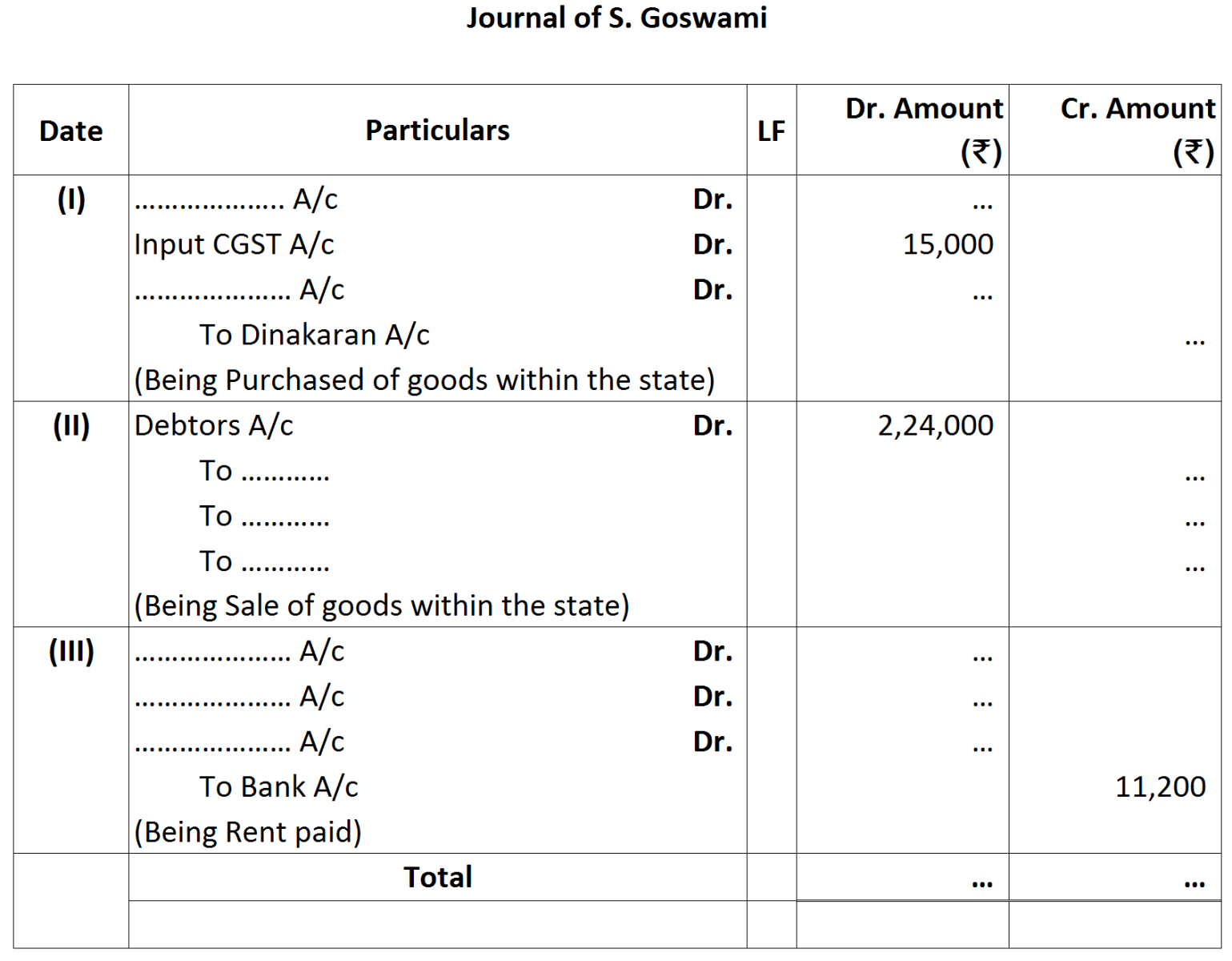
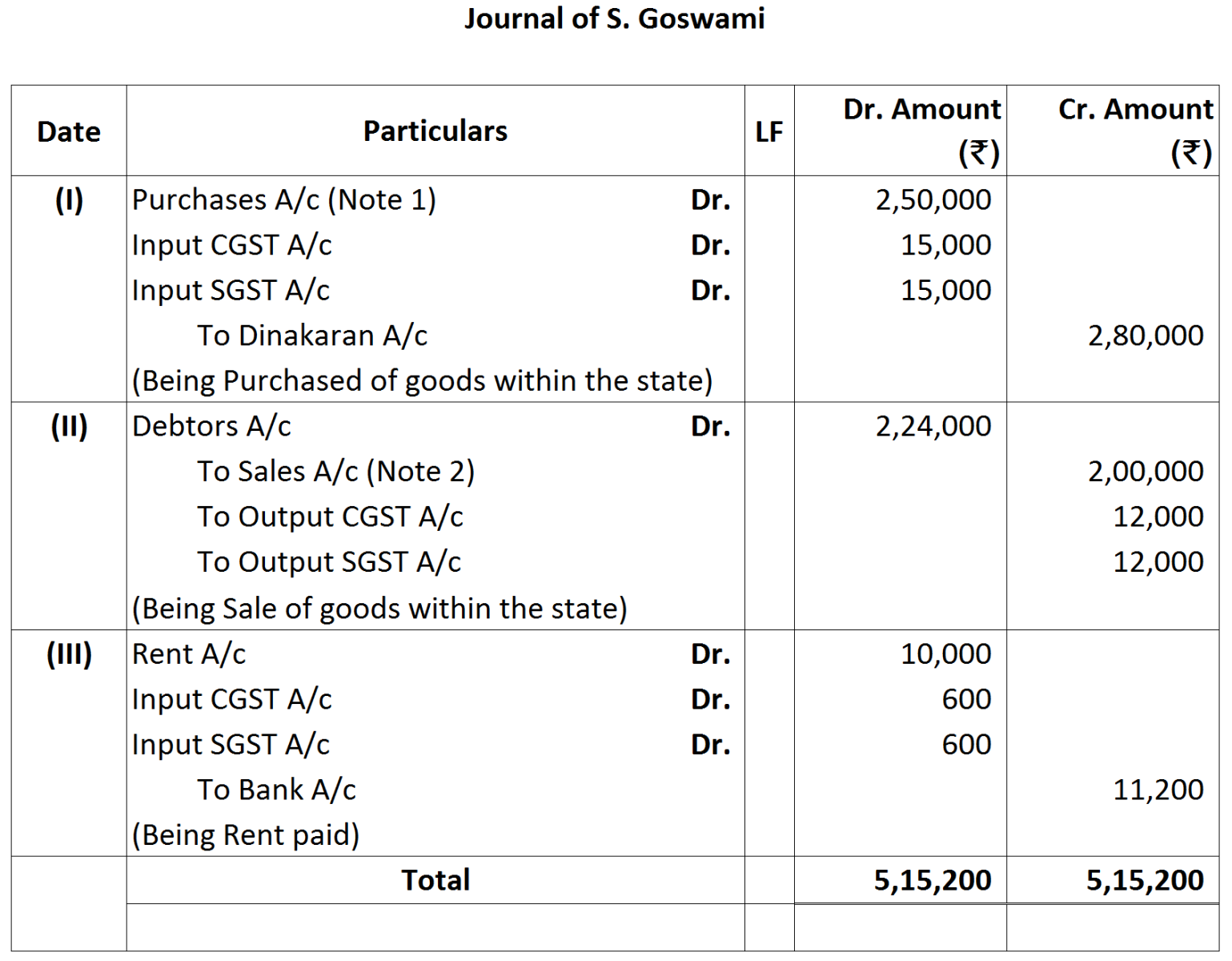
Fill in the missing figures, assuming CGST @ SGST @ 6%:
Answer

$15,000\times\frac{100}{6}=₹\ 2,50,000$

$2,24,000\times\frac{100}{112}=₹\ 2,00,000$
View full question & answer
Question 243 Marks
From the following transactions prepare the Proprietor's Account in 'T' shape:
2013   (₹)
April 1 Commenced business with Cash 5,00,000
August 1 Introduced additional Capital 1,00,000
Dec. 31 Drawings 40,000
2014    
Feb. 28 Drawings 20,000
March 31 Net Profit shown by Profit & Loss A/c 1,25,000
View full question & answer
Question 253 Marks
Prepare a Compound Entry with the help of imaginary figures and show its posting.
Answer
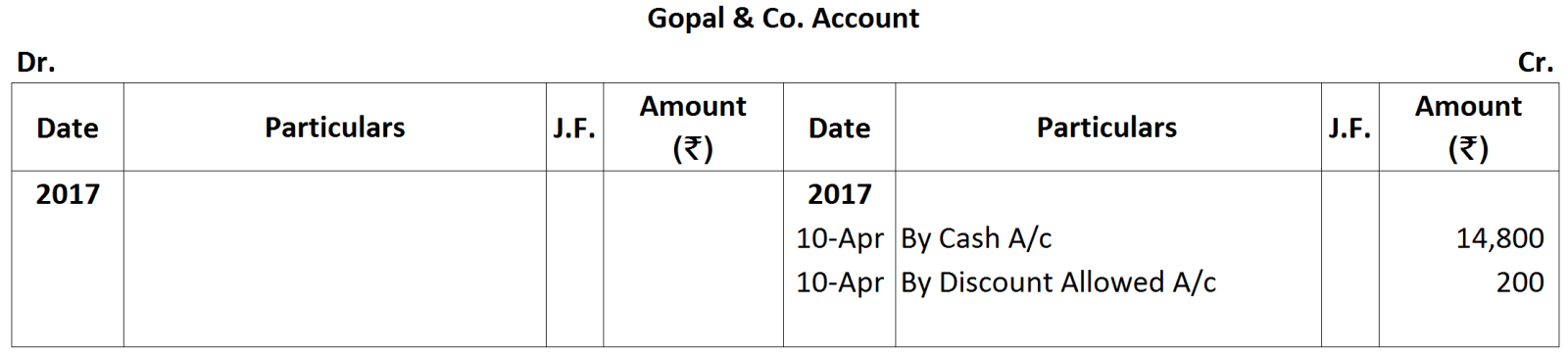
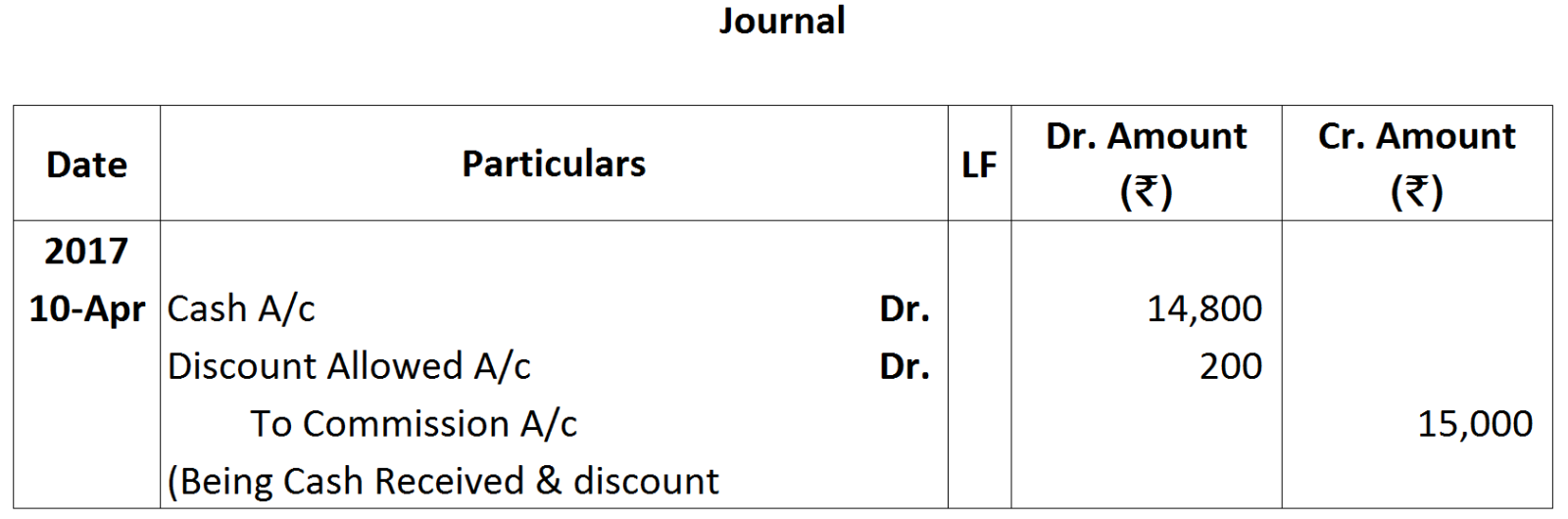
When in a Journal entry, two or more accounts are debited and only one account is credited or vice versa, the entry is termed as compound journal entry. In case of posting of a compound journal entry, posting has to be made in all the accounts whether debited or credited in the entry. For example, if on 10th April 2017, cash received from Gopal & Co. is ₹ 14,800 and discount allowed to them is ₹ 200, the compound entry and the Ledger Accounts will be as follows:


View full question & answer
Question 263 Marks
Prepare an Opening Entry with the help of imaginary figures and show its posting.Pass the Opening Entry on 1st April, 2019 on the basis of the following inform action takes form the books of Raman. Also, post the opening entry:
 
Cash in Hand. 20,000
Sundry Dedtors. 60,000
Stock of Goods. 40,000
Input IGST Account. 15,000
Input SGST Account. 5,000
Plant. 50,000
Land and Building. 1,00,000
Sundry Creditors. 1,00,000
View full question & answer
Question 273 Marks
'A' commenced his cloth business on 1st April, 2011 with a capital of ₹ 3,00,000. On 31st March, 2012 his assets were worth ₹ 5,00,000 and liabilities ₹ 1,00,000. Find out his closing capital and profits earned during the year.
Answer
Opening Capital (Capital as on March 31, 2011) = ₹ 3,00,000 Calculation of Closing Capital (Capital as on March 31, 2012)Assets = Liabilities + Capital
5,00,000 = 1,00,000 + Capital
Capital = ₹ 4,00,000
Calculation of Profit Earned during the year
Closing Capital = Opening Capital + Additional Capital + Profit - Drawings
4,00,000 = 3,00,000 + 0 + Profit - 0
Profit = 4,00,000 - 3,00,000
= ₹ 1,00,000
View full question & answer
Question 283 Marks
Pass Journal Entries for the following transactions:
2017
 
Jan. 6
Sold goods to Muskan of the list price of ₹ 2,00,000 at trade discount of 20%.
Jan. 8
Muskan returned goods of the list price of ₹ 5,000.
Jan. 15
Received from Muskan the full payment under a cash discount of 4%.
View full question & answer
Question 293 Marks
X started a business on $1^{\text {st }}$ April, 2013 with a Capital of $₹ 1,00,000$ and a loan of $₹ 50,000$ from the bank. On $31^{\text {st }}$ March, 2014, his assets were $₹ 1,75,000$. Find out his Capital as on $31^{\text {st }}$ March, $2014$ and profit earned during the year $2013-14.$
Answer
Opening Capital (Capital as on $1^{st}$​​​​​​​ April, 2013) $= ₹ 1,00,000$​​​​​​​
Calculation of Closing Capital (Capital as on March $31, 2014)$
Assets = Liabilities + Capital
$1,75,000 = 50,000 +$ Capital
Capital =$ ₹ 1,25,000$​​​​​​​
Calculation of Profit Earned during the year
Closing Capital = Opening Capital + Additional Capital + Profit - Drawings
$1,25,000 = 1,00,000 + 0 +$ Profit $- 0$
Profit $= 1,25,000 - 1,00,000$
$= ₹ 25,000$
View full question & answer
Question 303 Marks
On which side the decrease in the following accounts will be recorded? Also mention the nature of account:
  1. Cash
  2. Bank Overdraft
  3. Rent Paid
  4. Salary Paid
  5. Outstanding Rent
  6. Prepaid Insurance
  7. Manoj, Proprietor of the business.
Answer
 
Accounts
Decrease Recorded at Side
Nature
i.
Cash
Credit
Asset
ii.
Bank Overdraft
Debit
Liability
iii.
Rent Paid
Credit
Expense
iv.
Outstanding Rent
Debit
Liability
v. Prepaid Insurance Credit Asset
vi. Manoj, Proprietor of the business Debit Capital
View full question & answer
Question 313 Marks
Prepare an Accounting Equation from the following:
  1. Started business with cash ₹ 1,00,000.
  2. Purchased goods for cash ₹ 20,000 and on credit ₹ 30,000.
  3. Sold goods for cash costing ₹ 10,000 and on credit costing ₹ 15,000 both at a profit of 20%
View full question & answer
Question 323 Marks
What is GST?
Answer
Goods and Service Tax (GST) is an indirect tax levied at prescribed rate on every supply of goods and services except on petroleum and alcohol for human comsumption. Supply of goods means sale of goods and supply of services means rendering of services. It is a nation-wide tax seeking to unify several indirect taxes and is based on the principle of 'One Nation one Tax'.
View full question & answer
Question 333 Marks
Determine the missing amounts on the basis of the Accounting Equation:
S.no
Assets
=
Liabilities
+
Capital
(i)
20,000
=
15,000
+
?
(ii)
?
=
5,000
+
10,000
(iii)
10,000
=
?
+
8,000
Answer
S.no
Assets
=
Liabilities
+
Capital
(i)
20,000
=
15,000
+
₹ 2,000
(ii)
5,000
=
5,000
+
10,000
(iii)
10,000
=
₹ 15,000
+
8,000
View full question & answer
Question 343 Marks
Distinguish between Journal and Ledger.
Answer
Difference between Journal and Ledger
 
Basis
Journal
Ledger
1.
Nature of Book
It is a book of primary entry.
It is a book of final entry.
2.
Basis for preparation
Primary documents (such as vouchers, receipts, etc.) are the basis for recordng transactions in the journal.
Journal is the basis for recording transactions in the ledger.
3.
.Stage of Recording
Recording in the joumal is the first stage.
Recording in the ledger is the second stage.
4.
Object
It is pepared to record all transactions in a chronologlcal order.
It is prepared to see the net effect of various transaction affecting a particular account.
5.
Format
Joumal has five columns:
1.
Date.
2.
Particulars.
3.
Ledger Follo.
4.
Debit Amount.
Ledger has four identical columns on debit and credit sides:
1.
Date.
2.
Particulars.
3.
Journal Follio.
4.
Amount.
View full question & answer
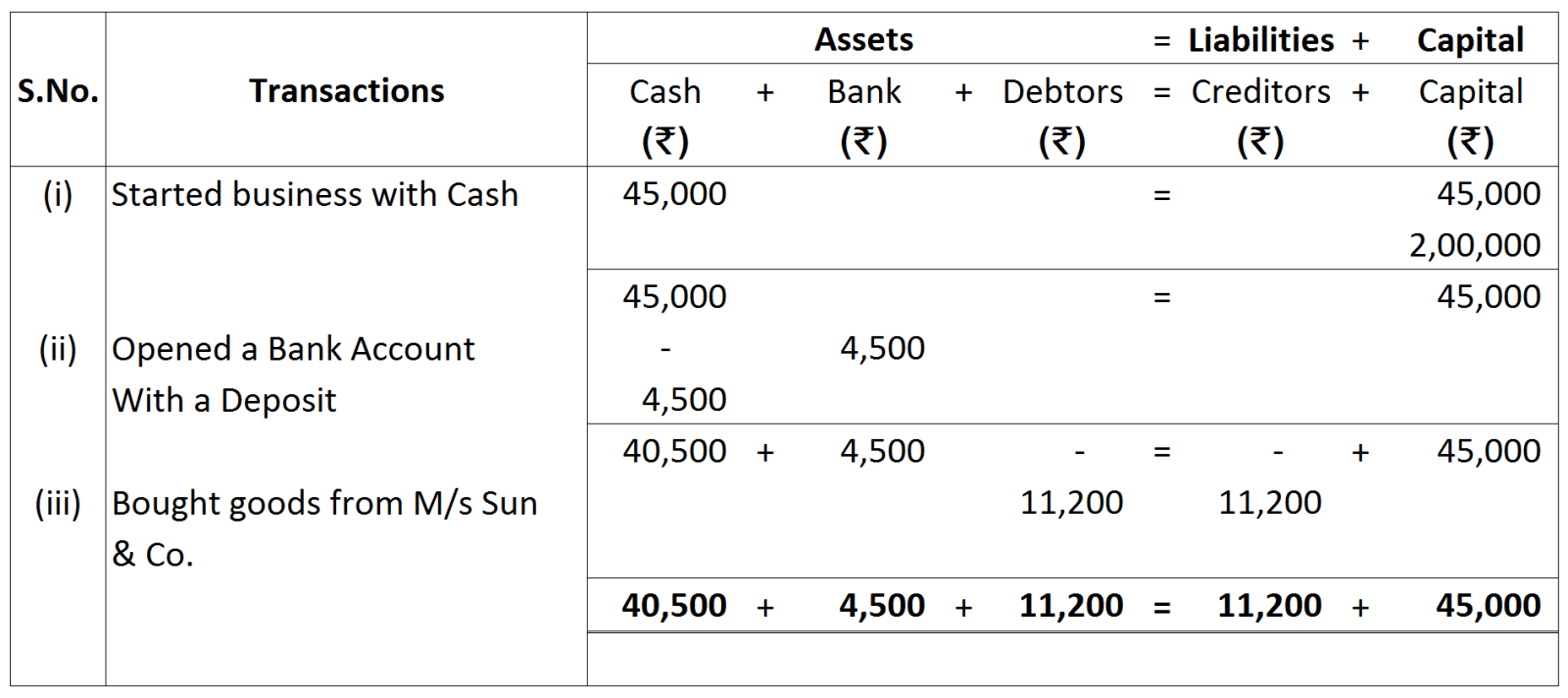
Question 353 Marks
What will be effect of the following on the Accounting Equation?
  1. Started business with cash ₹ 45,000
  2. Opened a Bank Account with a deposit of ₹ 4,500
  3. Bought goods from M\s. Sun & Co. for ₹ 11,200
Answer

Total = Cash + Bank + Stock
Assets = 40,500 + 4,500 + 11,200 = ₹ 56,200
Liabilities = ₹ 11,200
Capital = ₹ 45,000
View full question & answer
Question 363 Marks
Show the accounting equation on the basis of following transactions:
  1. Ram started business with ₹ 25,000.
  2. Purchased goods from Shyam ₹ 10,000.
  3. Sold goods to Sohan costing ₹ 1,500 for ₹ 1,800.
View full question & answer
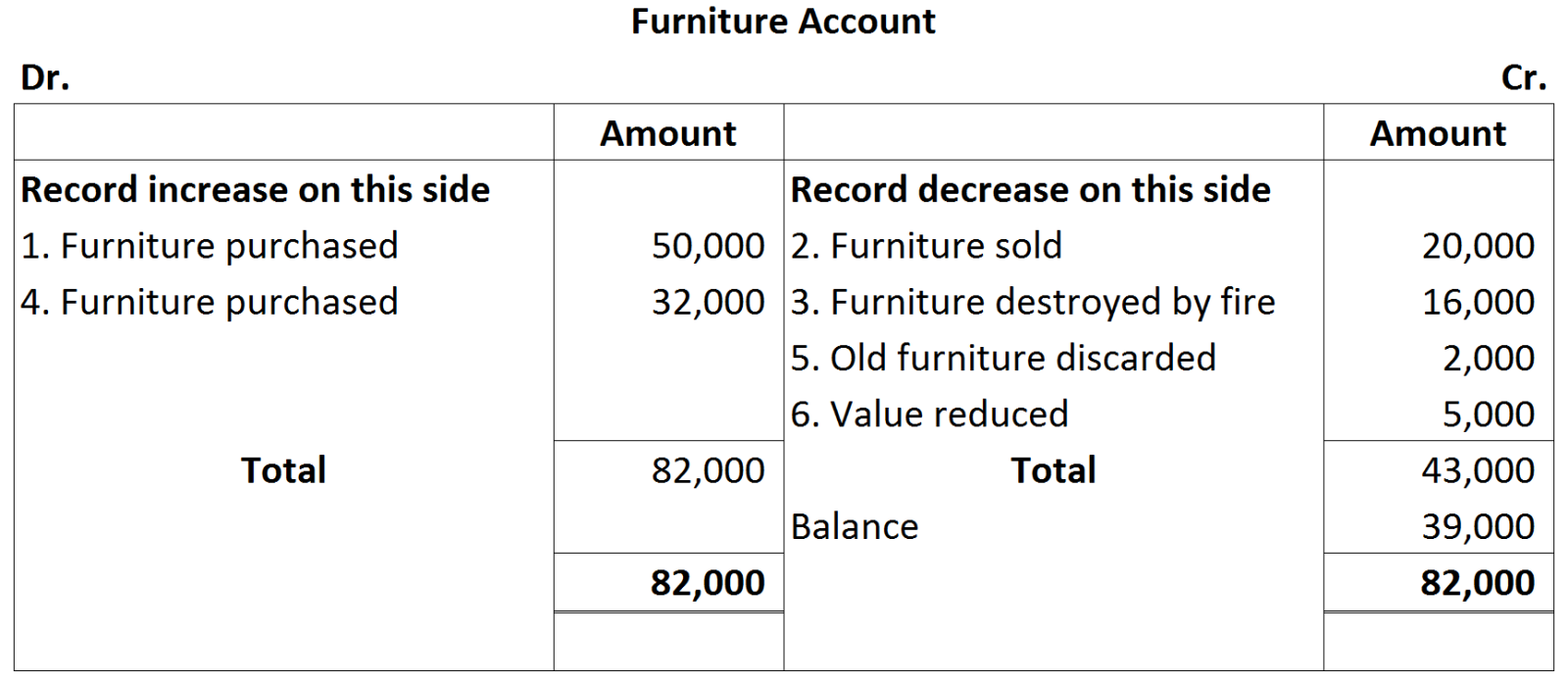
Question 373 Marks
Open 'T' shape account for Furniture and write the following on the proper side∶
  1. Furniture purchased for ₹ 50,000
  2. Furniture sold costing ₹ 20,000
  3. Furniture destroyed by fire ₹ 16,000
  4. Furniture again purchased ₹ 32,000
  5. Old furniture discarded ₹ 2,000
  6. Value of furniture was reduced by ₹ 5,000
Answer
As we know, Furniture is an asset, so, increase in furniture will be recorded on the debit side while decrease in furniture will be recorded on the credit side of the Furniture Account.
View full question & answer
Question 383 Marks
What entry (debit or credit) would you make to:
  1. Increase revenue.
  2. Decrease in expense.
  3. Record drawings.
  4. Record the fresh capital introduced by the owner.
Answer
  1. Increase in revenue: Increase in revenue is credited as it increases the capital. Capital has credit balance and if capital increases, then it is credited.
  2. Decrease in expense: Decrease in expense is credited as all expenses have debit balance. If expense decreases, then it is credited.
  3. Record drawings: Capital has credit balance; if the capital increases, then it is credited. If capital decreases, then it is debited. Drawings are debited as they decrease the capital.
  4. Record of fresh capital introduced by the owner: Capital has credit balance, if capital increases, then it is credited. The introduction of fresh capital increases the balance of capital, and so, it is credited.
View full question & answer
Question 393 Marks
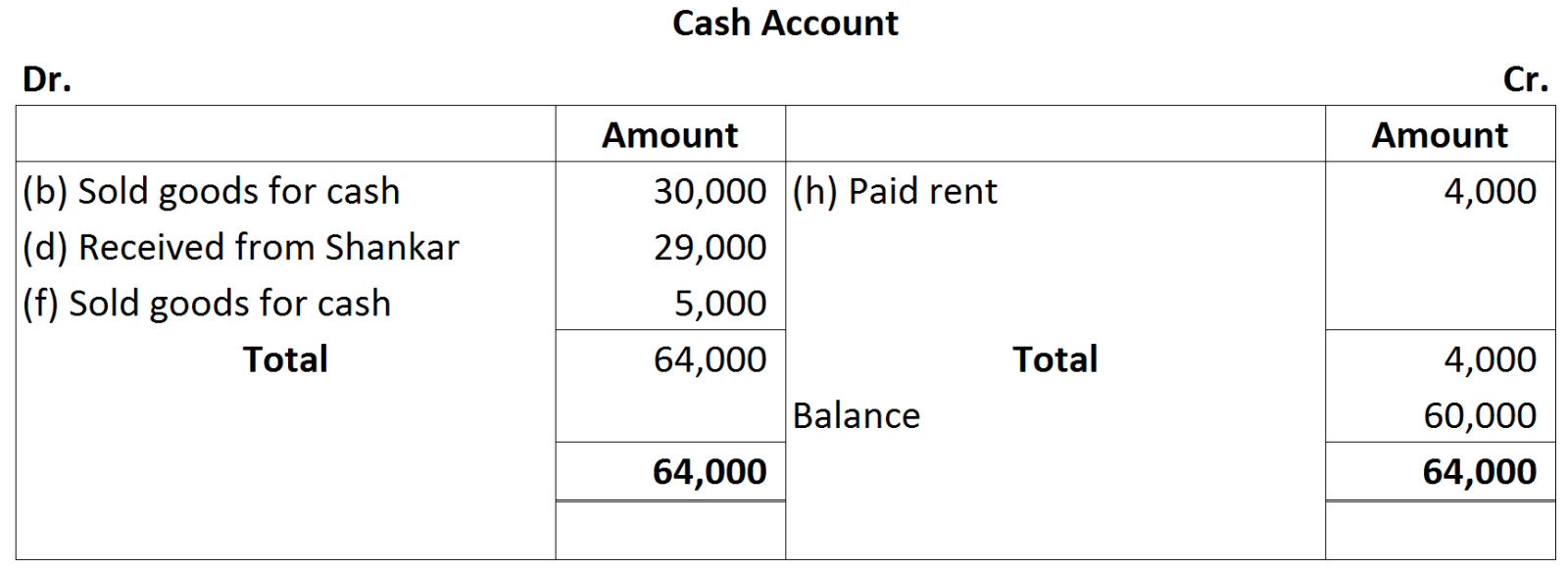
Put the following on the proper side of Cash Account, Debtors's Account and Creditor's Account:
    (₹)
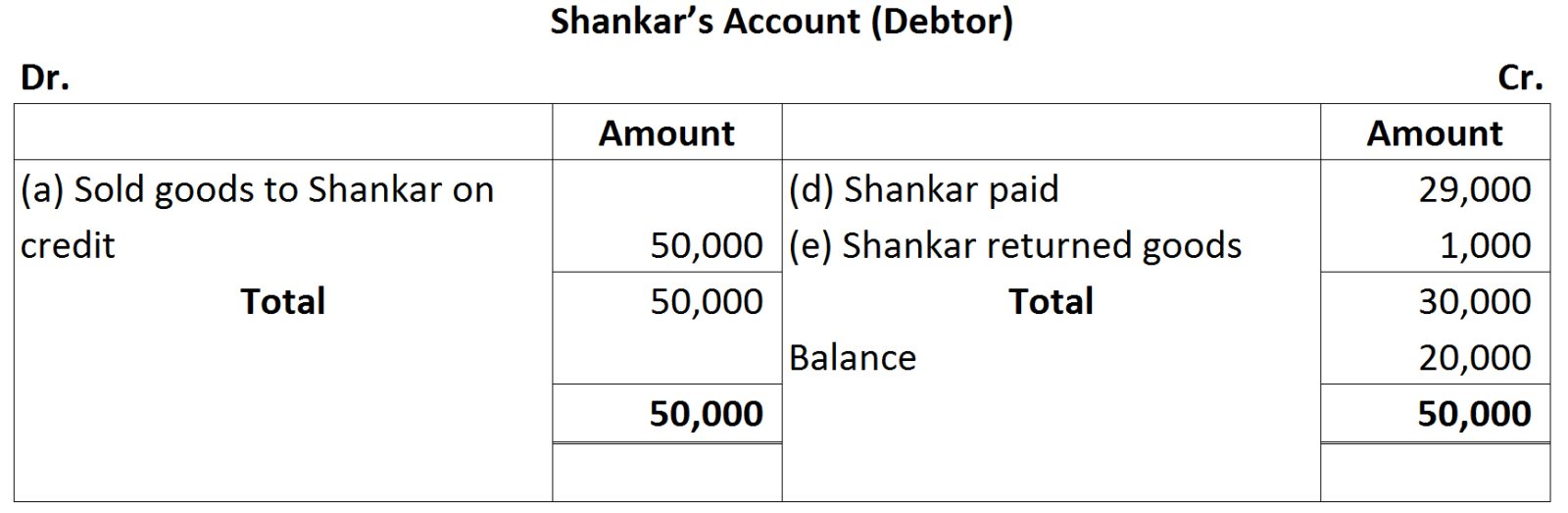
a. Sold goods to Shankar on Credit 50,000
b. Sold goods to Ghanshyam for Cash 30,000
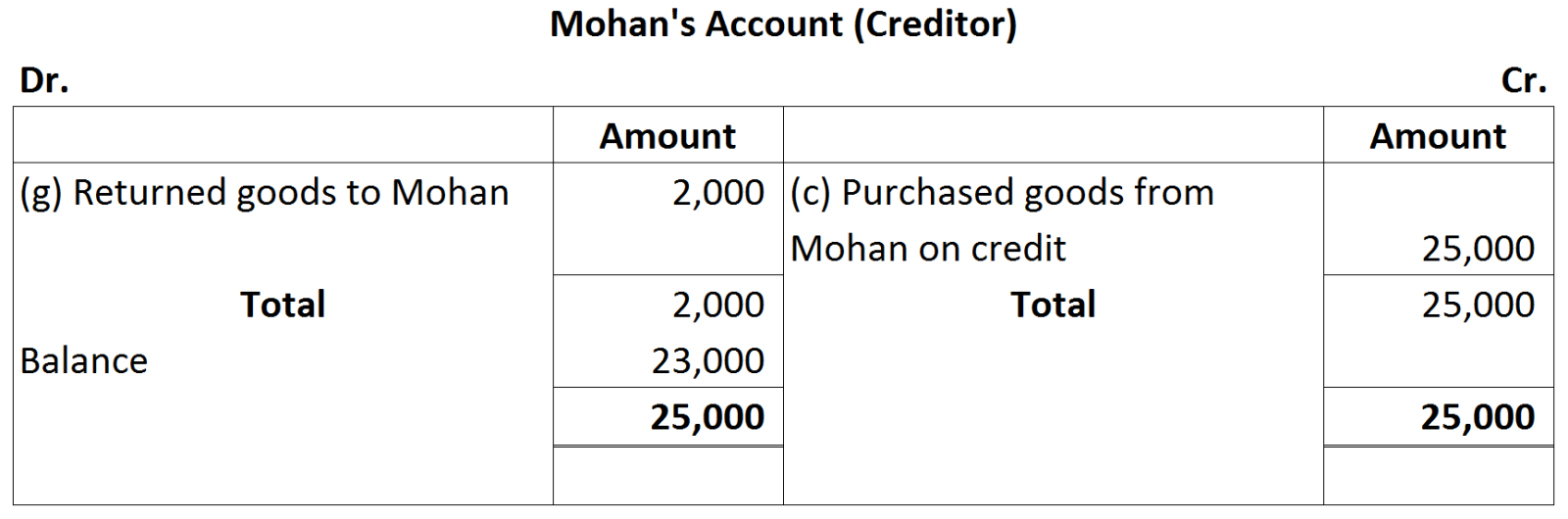
c. Purchased goods from Mohan on Credit 25,000
d. Received from Shankar 29,000
e. Shankar returned goods 1,000
f. Sold goods to Shankar for Cash 5,000
g. Returned goods to Mohan 2,000
h. Paid Rent 4,000
Answer
  1. Increase in Cash (being an asset) will be shown on the debit side and decrease in cash will be recorded on the credit side of the Cash Account.
  1. Increase in Debtors (being an asset) will be shown on the debit side and decrease in them will be recorded on the credit side of the Debtors Account.
  1. Increase in Creditors (being a liability) will be shown on the credit side and decrease in the creditors will be recorded on the debit side of the Creditors Account.
View full question & answer
Question 403 Marks
What is the object of preparing an account?
Answer
The main objective is to keep systematic records:
  • To determine profits and loss.
  • To ascertain financial position.
  • To communicate the information.
View full question & answer
Question 413 Marks
What is Trade Discount? Give an example.
Answer
Trade Discount Trade Discount is a discount allowed by the seller on purchase of goods in large quantity. It is normally allowed by the seller to the purchaser who further sells goods to the consumer. It is deducted in the invoice from sale price and is not recorded in the books of account. Sale is recorded at the net value, i.e., sale price less trade discount For example, Amit sells goods to Vikas of ₹ 10,000 allowing him trade discount of 20%. The invoice will be prepared for net amount ₹ 8,000, i.e., after trade discount. Amit will pass following Journal entry in his books of account:Images.
View full question & answer