Questions · Page 1 of 2

3 Marks Question

🎯

Test yourself on this topic

50 questions · timed · auto-graded

Question 13 Marks
Bank overdraft is a Liability while bank balance is an Asset. Do you agree?
Answer
Yes. Bank overdraft is the amount payable by the firm to the bank since the amount drawn is more than the balance held. Bank balance is the amount owned by the firm that is lying deposited in the bank, thus, it is an asset.
View full question & answer
Question 23 Marks
What is an Account?
Answer
In accounting, an account is a record in the general ledger that is used to sort and store transactions. For example, companies will have a Cash account in which to record every transaction that increases or decreases the company's cash. Another account, Sales, will collect all of the amounts from the sale of merchandise. Most accounting systems require that every transaction will affect two or more accounts. For example, a cash sale will increase the Cash account and will increase the Sales account.
View full question & answer
Question 33 Marks
What is ‘Imprest System' of Petty Cash Book?
Answer
Under this system, the petty cashier is given a definite sum, say ₹ 2,500, at the beginning of a certain period. This amount is called 'imprest amount'. The petty cashier goes on paying all petty expenses out of this imprest amount and records them in the petty cash book maintained by him. At the end of the given period, say after a month, the chief cashier reimburses the amount actually spent by the petty cashier.
View full question & answer
Question 43 Marks
What is Contra Entry? How will you recognise it from among other entries in Cash Book?
Answer
Contra Entry: Contra entries are the entries which affect both cash and bank, i.e., balance one will decrease and the other will increase due to such transactions. Such transactions are recorded on both sides of the Cash Book. Let us take an example to understand it better.
  1. Cash deposited into the Bank 20,000: In this transaction, Bank Account is to be debited and Cash Account is to be credited. Debit aspect is recorded on the debit side of the Bank Column and credit aspect is recorded on the credit side of Cash Column.
  2. Cash withdrawn from Bank for Office Use 10,000: In this transaction Cash Account is to be debited and Bank Account is credited. Debit aspect is recorded on the debit side of the Double Column Cash Book in the Cash Column and credit aspect is recorded on the credit side of the Double Column Cash Book in the Bank Column.
View full question & answer
Question 53 Marks
Do you agree that a Sales Book is used to record invoices issued to customers in respect of goods sold on credit and not cash? Give reasons.
Answer
Yes. Sales can be either in cash or on credit. Credit sales are recorded in the Sales Book and cash sales in the Cash Book. The source documents for recording entries in the Sales Book are invoices or bills issued to customers. Entries are recorded with the net amount of the invoice after deducting trade discount.
View full question & answer
Question 63 Marks
Enter the following transactions in the Purchase Journal (Book) of M/s Gupta Traders of July
01 Bought from Rahul Traders as per invoice no.20041
40 Registers @ ₹ 60 each
80 Gel Pens @ ₹ 15 each
50 note books @ ₹ 20 each
Trade discount 10%.
15 Bought from Global Stationers as per invoice no.1132
40 Ink Pads @ ₹ 8 each
50 Files @ ₹ 10 each
Trade Discount 5%
23 Purchased from Lamba Furniture as per invoice no. 3201
2 Chairs @ 600 per chair
1 Table @ 1000 per table
25 Bought from Mumbai Traders as per invoice no.1111
10 Paper Rim @ ₹ 100 per rim
400 drawing Sheets @ ₹ 3 each
20 Packets waters colour @ ₹ 40 per packet
View full question & answer
Question 73 Marks
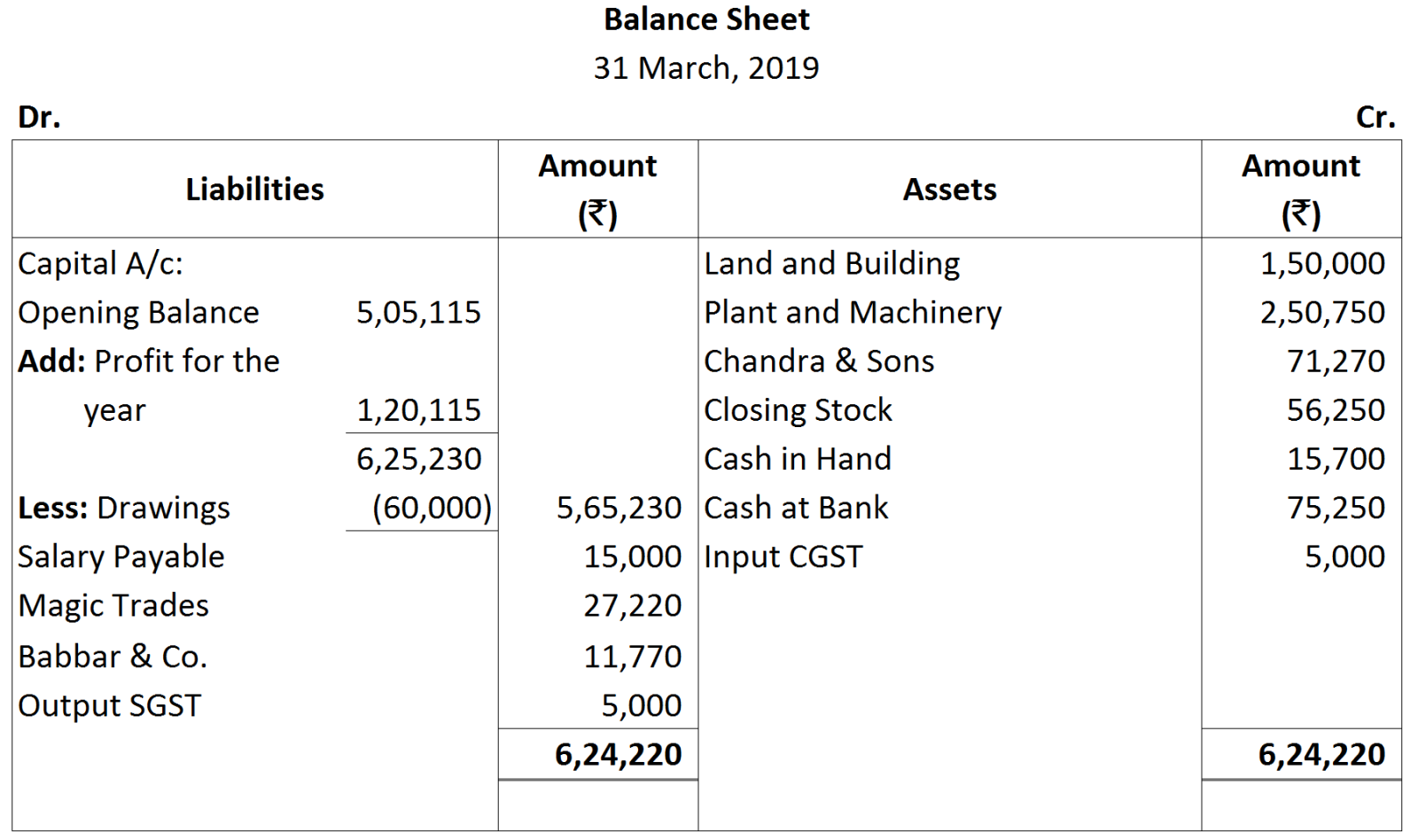
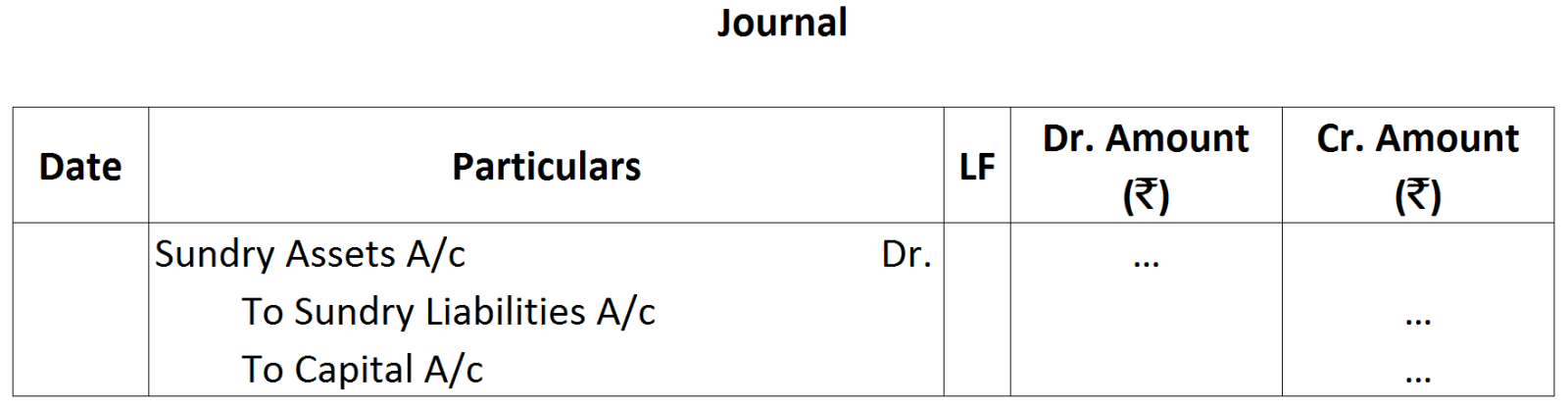
On 1st April, 2019, the position of Tendulkar was as follows: Stock-in-Hand ₹ 2,88,000; Bills Payable ₹ 48,000; Cash at Bank ₹ 2,16,000; Plant and Machinery ₹ 1,20,000; Debtors ₹ 60,000; Creditors ₹ 96,000; Investment ₹ 2,40,000, Loan from Suresh ₹ 1,80,000. What was the amount of Tendulkar's capital on the date? Pass an opening Journal entry.
View full question & answer
Question 83 Marks
Explain how the following transactions would be recorded in a Cash Book with Cash and Bank Columns?
Deposit of cheques (received from others) into Bank.
Answer
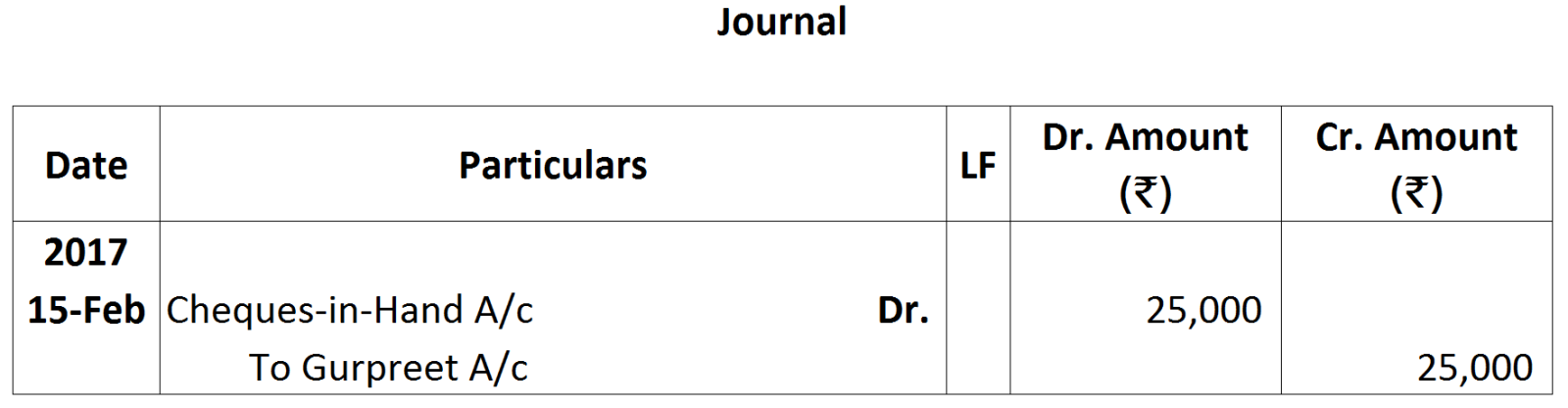
These are enteret in Bank Column on the debit side. examples: On 15th Feb. 2017 a cheque is received from guepreet for 25000 this cheque was deposited into the bank on 20th Feb. 2017 On receipt of cheque the following journal entry will be passed:
On deposit of this cheque into bank on 20th Fer. 2017 it will be recorded on the debit side of cash book as follows.
View full question & answer
Question 93 Marks
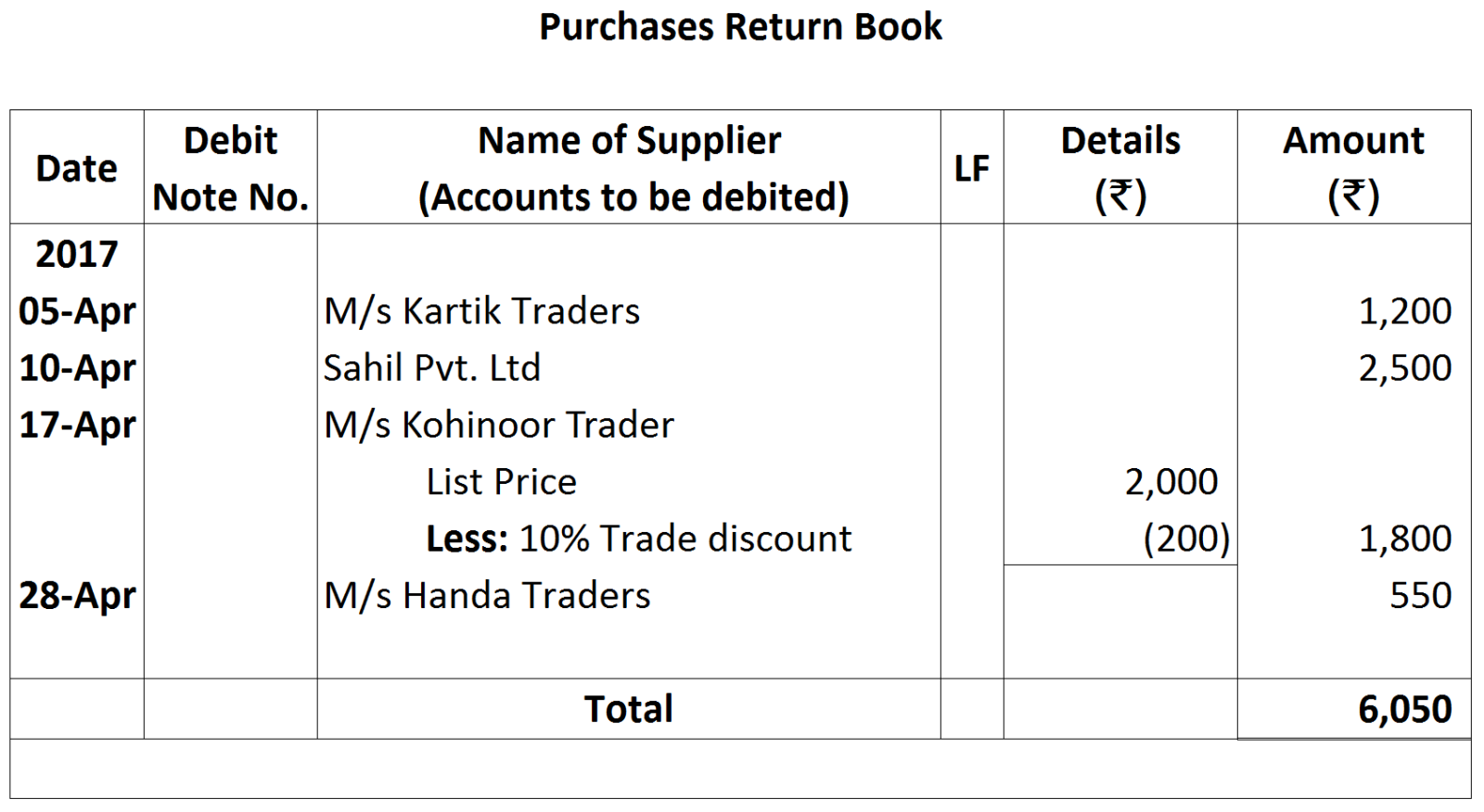
Prepare a purchases return (journal) book from the following transactions for April 2017.
 
2017 April
05
Returned goods to M/s Kartik Traders
1,200
10
Goods returned to Sahil Pvt. Ltd.
2,500
17
Goods returned to M/s Kohinoor Traders. for list price₹ 2,000 less 10% trade discount.
 
28
Return outwards to M/s Handa Traders
550
Answer
Solution is as follow:
View full question & answer
Question 103 Marks
State reasons for the following:
The balance in the cash column of the Cash Book is always a debit balance whereas that in the bank column can sometimes be credit.
Answer
Cash Column in the Cash Book cannot show credit balance because cash payments cannot exceed cash in hand. At the most it can show nil balance when cash payments are equal to cash in hand.
Bank may allow to withdraw more amount than the deposited. If the bank allows the firm to withdraw more amount than the balance in the account, it is known as Overdraft. In such a case, total of the bank column on the credit side will be bigger than the total of debit side.
View full question & answer
Question 113 Marks
What is Contra Entry?
Answer
Contra Entry means withdrawal of cash from bank for official use or cash deposited in the bank. As both the accounts are in the Cash Book it is signified by writing 'C' in the column for Ledger Folio.
View full question & answer
Question 123 Marks
State reasons for the following:
The Cash Account and the Bank Account are not posted in the Ledger.
Answer
Cash and bank transactions are recorded in the Cash Book and on the basis of such record, Ledger Accounts are prepared. Therefore, Cash Book is a Subsidiary Book. Also. Cash Book by itself is Cash Account and Bank Account. The balances are entered in the Trial Balance directly. Cash Book, therefore, is a part of the Ledger also. Hence it is also a Principal Book.
Cash Book is, thus, both a Subsidiary Book and a Principal Book.
View full question & answer
Question 133 Marks
Briefly state how the cash book is both journal and a ledger.
Answer
Transactions are recorded directly from source documents in the Cash Book, so there is no need to record transactions in the Journal book. Further, on the basis of the cash transactions recorded in the Cash Book, cash and bank balances can be determined, and so there is no need to prepare cash account (which is a part of ledger) separately. Thus, the Cash Book serves the purpose of both Journal as well as ledger.
View full question & answer
Question 143 Marks
Name and describe the various books of original entrie.
Answer
  1. Cash Book: To record receipts and payments of cash, including receipts into and payments from the bank.
  2. Purchases Book: To record credit purchases of goods.
  3. Sales Book: To record the credit sales of goods.
  4. Purchases Return Book: To record the return of goods previously purchased on credit.
  5. Sales Return Book: To record the return of credit sales made by customers.
  6. Journal Proper: To record the transactions which cannot be recorded in any of the above books.
View full question & answer
Question 153 Marks
Give two examples of entries which appear in a 'Journal Proper'.
Answer
  1. Credit purchase of plant and Machinery.
  2. Credit sales of fixed assets.
View full question & answer
Question 163 Marks
Ranjan, an employee of Jumbo Electronics, deposited in the bank ₹ 40,000 as the previous day's sale held overnight in the firm's safe. He has recorded the transaction in the Cash Book as follows:
In the bank column on Payments side; and in the cash column on Receipts side. Has he passed the entry correctly?
Answer
The entry recorded in the books of account is not correct. A deposit into the bank is recorded on the Receipts side of the Cash Book in the bank column and cash deposited is payment, it is recorded on the Payments side of the Cash Book in the cash column.
View full question & answer
Question 173 Marks
What do you understand by 'debit' and 'credit? Do you think 'debit' always stands for decrease in amount and credit for increase?
Answer
Debit refers to the left side of an account and credit refers to the right side of an account. In the abbreviated form Dr. stands for debit and Cr. stands for credit. An item recorded on the debit side of an account is said to be debited to the account. An item recorded on the credit side of an account is said to be credited to the account.
Both debit and credit may represent either increase or decrease depending upon the nature of an account. The rules of debit and credit depend on the nature of account.
View full question & answer
Question 183 Marks
What is a Credit Note?
Answer
A form or letter sent by a seller to a buyer, stating that a certain amount has been credited to the buyer's account.
A credit note is issued in various situations to correct a mistake, such as when:
  1. An invoice amount is overstated.
  2. Correct discount rate is not applied.
  3. Goods spoil within guaranty period.
  4. They do not meet the buyer's specifications and are returned. Also called credit memo.
View full question & answer
Question 193 Marks
Name the various entries which have to be passed through a Journal even though we might have kept all the subsidiary books in the business.
Answer
Following are the three entries which are required to be passed even when all subsidiary books are maintained:
  1. Purchase of Fixed Assets on Credit.
  2. Making provisions for doubtful Debts.
  3. Providing Depreciation on Assets.
View full question & answer
Question 203 Marks
What are Adjustment Entries?
Answer
In an enterprise there are number of transactions relating to incomes and expenses, which need to be adjusted so that, final accounts give true and fair view of the results. All such items which need to be adjusted when Final Accounts are prepared are called adjustments. Journal entries are passed giving effect to the adjustments. These entries are known as Adjusting Entries.
View full question & answer
Question 213 Marks
On 1st April, 2019, the position of Rahman was as follows: Cash-in Hand ₹ 11,200; Cash at bank ₹ 2,57,600; Bills Receivable ₹ 68,800; Jai Ram (Dr.) ₹ 16,000; Ram Kumar (Dr.) ₹ 48,080; Office Furniture ₹ 52,800; Stock-in-Trade ₹ 4,16,000; Doulat Ram (Cr.) ₹ 1,74,720, Hari Ram (Cr.) ₹ 2,16,960; Bills Payable ₹ 80,000. What was the amount of capital of Rahman on that date? Pass the Journal entry to Open his books.
View full question & answer
Question 223 Marks
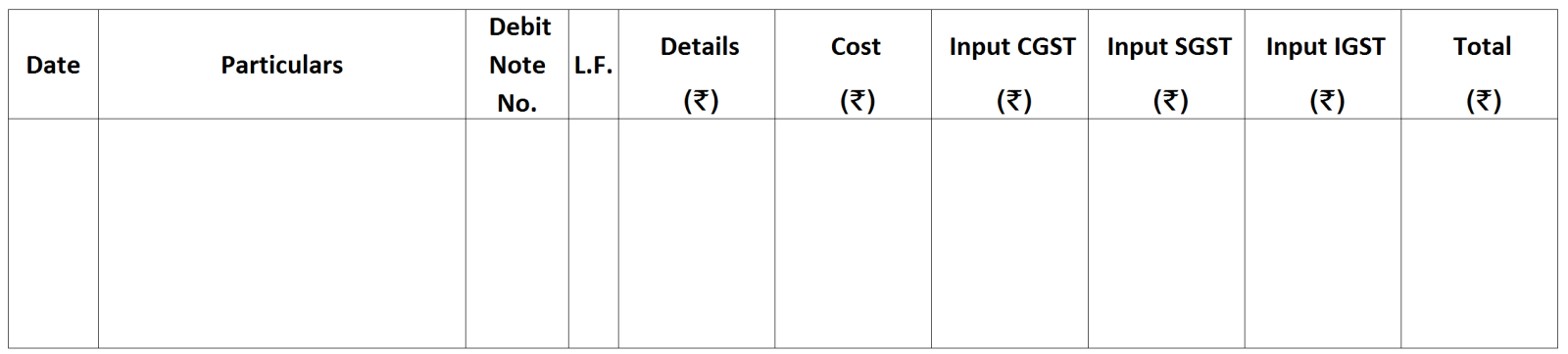
What is a Purchases Return Book? Give its specimen.
Answer
Purchases Return Book or Returns Outward Book is a subsidiary book maintained to record the goods or materials returned to the sellers of goods that were purchased on credit.Ruling of a Purchases Return Book is similar to the Purchases Book ruling except that instead of a column for 'Invoice No.' it has a column for Debit Note No.
View full question & answer
Question 233 Marks
What is meant by a Sales Return Book? When is it opened?
Answer
Sales Return Book or Returns Inward Book is a subsidiary book maintained to record the goods or materials returned by the purchaser that had been sold on credit. This book is maintained if the return of goods is frequent otherwise it can be recorded in the Journal.
View full question & answer
Question 243 Marks
Mittal Cycles purchased 100 cycles from Hero Cycles, Ludhina (Punjab) @ ₹ 1,200 per cycle plus IGST @ 12%. Hero Cycles allowed 10% Trade Discount and 3% Cash Discount if payment is made within 14 days. Mittal Cycles received 10 cycles damaged during transit, which it returned. Mittal Cycles settled the payment in 10 days time.
​Pass Journal entries for the above transactions.
View full question & answer
Question 253 Marks
Explain how the following transactions would be recorded in a Cash Book with Cash and Bank Columns?
Withdrawal of money from Bank for office use.
Answer
In this case the cash balance is increased and the bank balance is reduced On the Dr.the side 'To Bank A/c' is written and the amount is recorded in cash Column On the Cr.sid ;By Cash A/c' is written and the amount is recorded in Bank Column. Debit Cash A/c (As cash is coming in) Credit Cash A/c (As bank is the giver,i.e., credit the giver) For example, if we withdraw 2,500 form the bank it will be recorded in the cash book as follows.
View full question & answer
Question 263 Marks
How is Trade Discount recorded in the books of account?
Answer
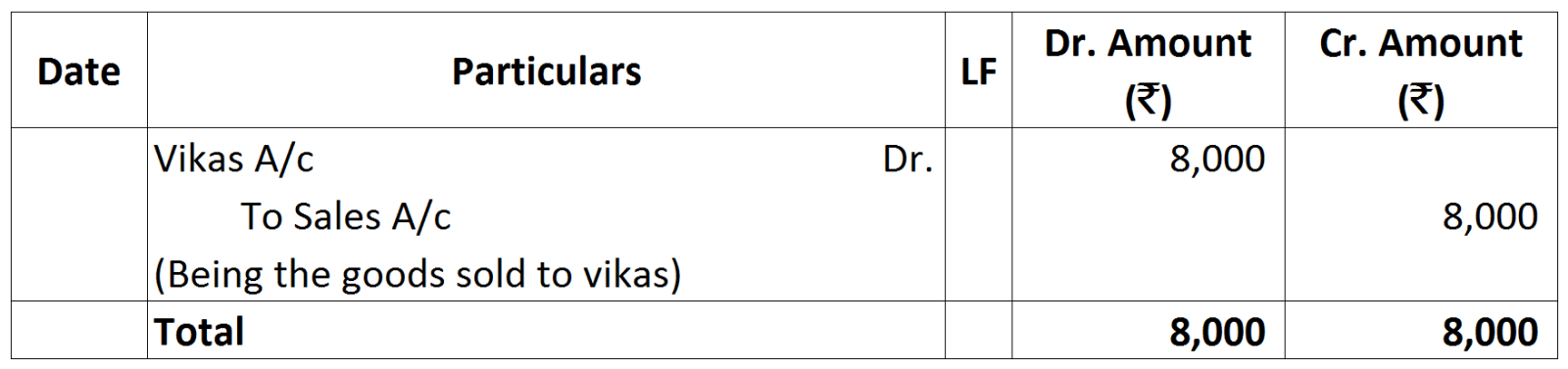
It is deducted in the invoice from sale price and is not recorded in the books of account. Sale is recorded at the net value, i.e., sale price less trade discount. For example, Amit sells goods to Vikas of ₹ 10,000 allowing him trade discount of 20%. The invoice will be prepared for net amount ₹ 8,000, i.e., after trade discount. Amit will pass following Journal entry in his books of account:
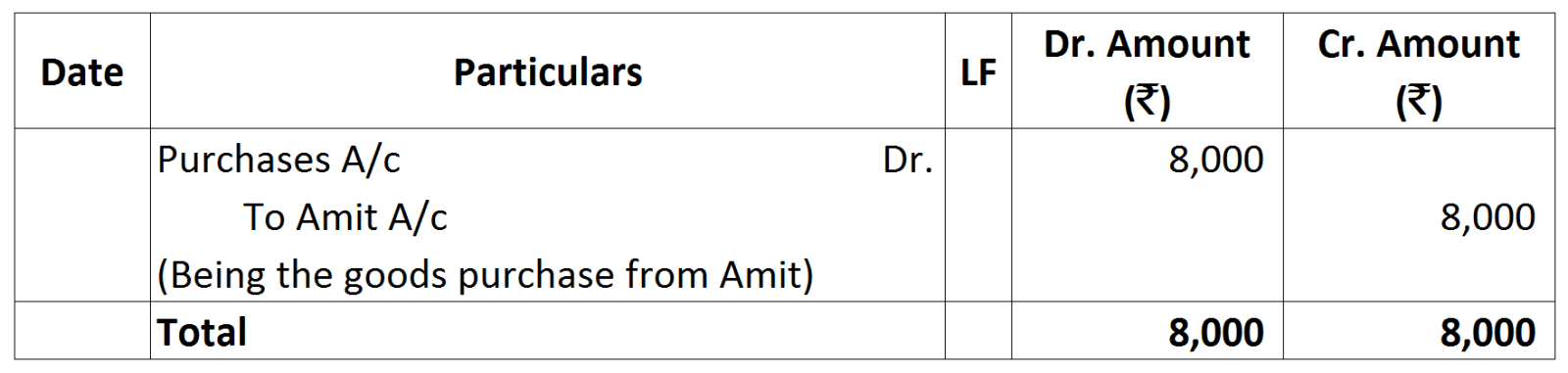
Vikas will pass following journal entry in his books of account:
View full question & answer
Question 273 Marks
Prepare Return Inward Journal (Book) from the following transactions of M/s Bansal Electronics for July 2017:
 
2017 July
04
M/s Gupta Traders returned the goods
1,500
10
Goods returned from M/s Harish Traders
800
18
M/s Rahul Traders returned the goods not as per specifications
1,200
28
Goods returned from Sushil Traders
1,000
View full question & answer
Question 283 Marks
When do you credit a liability account? What will you do to reduce the balance of any liability account? Explain with an example.
Answer
We credit a liablity ledger when the "Liability Increases". We should 'debit' the liability ledger when we want to reduce the balance in the liability account. For eg: Let us assume that, there is a Rent payable for ₹ 500. Outstanding Rent is a Liability.Then, the entry will be,
Rent A/c Dr.
₹ 500
To Outstanding Rent A/c
₹ 500
Here, when we credit O/S Rent A/c, Liability Increased. Now, the O/S Rent is paid through Cash. So, the entry will be,
Outstanding Rent A/c Dr.
₹ 500
To Cash A/c
₹ 500
Here, when O/S Rent is paid Liability has Decreased. So, it is debited.
View full question & answer
Question 303 Marks
Total of the purchase invoices recorded in the Purchases Book is posted to debit side of the Purchases Account in the Ledger and credited to the accounts of suppliers. Do you agree? Give reasons.
Answer
Yes. Purchase is an Expense Account therefore, following the rule ‘Increase in expenses is debited and decrease credited.' Purchases Account is debited. Since, the Purchases Book contains records of credit purchases, the Supplier's Account is credited following the rule applicable to Liability Accounts, i.e., 'Increase in liabilities is credited and decrease debited.'
View full question & answer
Question 313 Marks
Total of the Sales Book is posted to the credit side of the Sales Account in the General Ledger while individual account of customers is debited by the amount of their respective purchases. Is the above statement correct? Give reasons.
Answer
Yes. Sale is a revenue account and, therefore, following the rule 'Increase in revenue is credited and decrease debiteď Sales Account is credited. Since, the Sales Book contains records of credit sales, the Purchaser's Account (being debtors) is debited following the rule applicable to Asset Accounts, i.e., “Increase in assets is debited and decrease credited.
View full question & answer
Question 323 Marks
Elucidate the following statement:
Cash Book is both Journal and Ledger'.
Answer
It is a journal since the transactions are recorded in it for the first time from the source documents and from there these are posted to the respective accounts in the ledger. The Cash book is also a ledger in the sense that it serves the purpose of a Cash account also. When a Cash book is prepared, no separate Cash account is opened in the ledger. As such, the Cash book is a journal as well as a ledger and hence it may be called “journalised ledger”.
View full question & answer
Question 333 Marks
What do you understand by ledger folio?
Answer
Ledger folio is a page number of an account in ledger that is written in the L.F. column of a journal format. In journal entry, ledger folio number is written corresponding to the name of the account in the L.F. column. It helps in easy locating of the account in the ledger book. It reduces the time in recording and rechecking.
View full question & answer
Question 343 Marks
Rahul sold 100 Cricket Bats to V. Sports @ ₹ 5,000 each less 25% Trade Discount plus IGST @ 12% and 2% Cash Discount if V. Sports paid the amount in 14 days of sale. V. Sports paid the amount within 14 days. What will be the amount that Rahul should credit to Sales Account?
What will be the Journal entries for the transaction in the books of Rahul?
View full question & answer
Question 353 Marks
Why Cash Book is called a book of original entry?
Answer
Since all cash transactions are recorded for the first time in the cash book, it is therefore called a book of original entry. When a cash book is maintained, transactions of Cash and Bank are not recorded in journal.
View full question & answer
Question 363 Marks
Oswal Woollen Mills, Amritsar (Punjab) sold shawls to Gupta Shawls, Jaipur as per details:
Sold 100 shawls @ ₹ 200 per shawl on 4th January, 2019, IGST is levied @ 12%. Trade Discount 25% and Cash Discount 5% if full payment is made within 14 days. Gupta Shawls sent 50% of the payment on 14th January, 2019 and balance payment on 10th February, 2019. Pass Journal entries.
View full question & answer
Question 373 Marks
Give specimen of the following, with two entries in each:
  1. Purchase Book.
  2. Purchase Return Book.
Answer
Purchase Book:
Purchase Return Book:
View full question & answer
Question 393 Marks
Why is only one account posted to the Ledger Account from the Cash Book?
Answer
Although the Cash Book is a book of original entry, it is also a book where the Cash Account and Bank Account are maintained. In effect, it is both a book of original entry and a Ledger dedicated to those accounts. As a result, each transaction in the Cash Book is posted only once to another account.
View full question & answer
Question 403 Marks
What is a Personal Account? Is Capital Account a Personal Account? If yes, why?
Answer
Personal Accounts: Accounts which relate to persons, i.e., individuals, firms, companies, debtors or creditors, etc., are Personal Accounts. Examples of Personal Accounts are the account of Ram & Co., a customer (Debtor), or the account of Jhaveri & Co., a supplier of goods (Creditor), Capital Account and Drawings Account of the proprietor. The main purpose of preparing a Personal Account is to determine the balance due to or due from persons or organisations.
Capital account is a personal account. because capital account is related to owner personal capital and thats why this is treated in the liabilities side of balance sheet.
View full question & answer
Question 413 Marks
What is the reason for maintaining separate accounts for CGST, SGST and IGST?
Answer
CGST, SGST and IGST all these all collected from different types of transactions.
  • CGST: It is collected on intra state supplies made (i.e. within the state).
  • SGST: It is collected on intra state supplies made (i.e. within the state).
  • IGST: It is collected on inter state supplies made (i.e. outside the state).
So, in order to get a clear presentation of all the adjustments these accounts are maintained separately.
View full question & answer
Question 423 Marks
What are special purpose books?
Answer
Business transactions are large in number and difficult to record; so, journal is sub-divided for quick, efficient and accurate recording of the business transactions. Special purpose books like, sales book and purchases book are maintained for those transactions that are routine and repetitive in nature. Recording through these books is economical and enables division of work among accountants.
View full question & answer
Question 433 Marks
State reasons for the following:
Contra entries in the Two-Column Cash Book are not posted into the Ledger.
Answer
Contra Entry: Contra entries are the entries which affect both cash and bank, i.e., balance of one will decrease and the other will increase due to such transactior s. Such transactions are recorded on both sides of the Cash Book. Let us take an example to understand it better. Against such entries, the letter 'C' is written in the L.F. column to indicate thot these are contra transactions and are not posted in the Ledger Account.
View full question & answer
Question 443 Marks
What is Cash Discount?
Answer
Cash Discount is a discount allowed by the seller of goods to encourage prompt or early payment. The usual method to encourage payment within the specific time, the seller allows cash discount say @ 2% of invoice value to the buyer. Cash discount is calculated after deducting trade discount from the invoice price. In other words, cash discount is calculated always on net amount.
View full question & answer
Question 453 Marks
What are Contra Entries? Why these are not posted into the Ledger?
Answer
Contra Entry: Contra entries are the entries which affect both cash and bank, i.e., balance of one will decrease and the other will increase due to such transactior s. Such transactions are recorded on both sides of the Cash Book. Let us take an example to understand it better.
View full question & answer
Question 463 Marks
How is Cash Discount recorded in the books of account?
Answer
Cash Discount Allowed is an expense and is debited to Discount Allowed Account. It is closed by transferring it to the Profit and Loss Account. Similarly, Cash Discount Received is an income and is credited to Discount Received Account which is transferred to Profit and Loss Account.
View full question & answer
Question 473 Marks
Why opening entries are passed?
Answer
Opening Entry: Opening entry is recorded in the beginning of a financial year to open the books by debiting assets and crediting liabilities and the capital appearing in the Balance Sheet of the previous year.
View full question & answer
Question 483 Marks
What is the purpose of contra entry?
Answer
Contra entry represents deposits or withdrawals of cash from bank or vice versa. The purpose of contra entry is to indicate the transactions that effect both cash and bank balances. This entry does not affect the financial positions of a business. A contra entry is recorded in both sides of a two column Cash Book and is denoted by ‘C’ in the ledger folio column.
View full question & answer
Question 493 Marks
If a partner takes goods for personal use or goods are given as charity, why Input GST (CGST and SGST or IGST) Account is credited?
Answer
It is credited because at the time of purchase GST Paid on these goods was debited to Input GST (CGST and SGST or IGST) Account. The goods are not sold but have reached their final destination, i.e., will not be sold further. Therefore, GST (CGST and SGST or IGST) is credited.
View full question & answer
Question 503 Marks
What is difference between trade discount and cash discount?
Answer
Basis of Difference
Trade Discount
Cash Discount
Meaning
It is allowed when goods are purchase or sold.
It is allowed at the time of payment.
Recording in books
It is recorded in invoice/ bill but not in the books.
It is recorded in the discount column of the Cash Book’s debit side, if allowed, and credit side, if received.
Purpose
It is allowed to increase sale.
It is allowed for earlier payment.
Deduction
It is deducted from the price-list of the goods.
It is not deducted from the price-list of the goods.
View full question & answer
3 Marks Question - Account STD 11 Commerce Questions - Vidyadip