Questions

4 Marks Question

🎯

Test yourself on this topic

22 questions · timed · auto-graded

Question 14 Marks
When should revenue be recognised? Are there exceptions to the general rule?
Answer
Revenue is recognised only when it is realised i.e., when a legal right to receive it arises. Thus credit sales are treated as revenue on the day sales are made and not when cash is received from the buyers. Similarly, rent for the month of March even if received in April month will be treated as revenue of the financial year ending 31st March.There are two exceptions to this rule:
  • In case of sales on installment basis, only the amount collected in installments is treated as revenue.
  • In case of long-term construction contracts, proportionate amount of revenue, based on part of the contracted completed by the end of the financial year is treated as realised.
View full question & answer
Question 24 Marks
Discuss the Accounting Convention based on the premise 'Do not anticipate profits but provide for all losses.'
Answer
According to the Conservatism Principle, profits should not be anticipated; however, all losses should be accounted (irrespective whether they occurred or not). It states that profits should not be recorded until they get recognised; however, all possible losses even though they may happen rarely, should be provided. For example, stock is valued at cost or market price, whichever is lower. If the market price is lower than the cost price, loss should be accounted; whereas, if the former is more than the latter, then this profit should not be recorded until unless the stock is sold. There are numerous provisions that are maintained based on the conservatism principle like, provision for discount to debtors, provision for doubtful bad debts, etc. This principle is based on the common sense and depicts pessimism. This also helps the business to deal uncertainty and unforeseen conditions.
View full question & answer
Question 34 Marks
Why is it important to adopt a consistent basis for the preparation of financial statements? Explain.
Answer
It is important to adopt a consistent basis for the preparation of financial statements because it helps in comparability of financial statements. For Example: if a firm choose straight line method for showing depreciation but in the next accounting period switched over to written down method then the results of this year cannot be compared to that of the previous years. However, it does not mean that firm cannot changes its accounting policies. A better method, if available which will lead to better presentation and better understanding of the financial results, the firm may adopt but it must be stated clearly by way of footnotes to enable the users of the financial statements to be aware of the changes.
View full question & answer
Question 44 Marks
Vijay, a consultant, during the financial year 2018-19 earned ₹ 4,00,000. Out of which he received ₹ 3,50,000. He incurred an expense of ₹ 1,70,000, out of which ₹ 40,000 are outstanding. He also received consultancy fee relating to previous year ₹ 45,000 and also paid ₹ 20,000 expenses of last year. You are required to determine his income for the year if,
  1. He follows Cash Basis of Accounting.
  2. He follows Accrual Basis of Accounting.
Answer
  1. Cash basis: Total amount of cash received and paid for the period is taken. No adjustment needed for outstanding or advance receipt or payment to be made.
Receipt - 350000 + 45000 = 395000
Payment - 130000 + 20000 = 150000
Income - 395000 - 150000 = 245000
  1. Accrual basis: Here all the adjustments are to be made and only the actual amount for the period to be taken for calculation of receipt and payment. Prior period adjustments are not required.
Receipt - 350000 + 50000 = 400000
Payment - 130000 + 40000 = 170000
Income - 400000 - 170000 = 230000
View full question & answer
Question 54 Marks
Explain the following briefly with appropriate example:
Money Measurement Concept.
Answer
Money Measurement Concept: According to the Money Measurement Principle, transactions and events that can be measured in money terms are recorded in the books of account of the enterprise. Staning different y, money is the common denominator in recording and reporting transactions. This principle suffers from two major limitations:
  1. Transactions and events that cannot be measured in money terms are not recorded in the books of account, howsoever important they may be to the enterprise. For example, human resources with the enterprise are important to the enterprise but are not reflected in the financial statements because they cannot be measured and expressed in money terms.
  2. The value of money is considered to have static value as the transactions are recorded at the value on the transaction date.
View full question & answer
Question 64 Marks
What is Money Measurement Concept? Which one factor can make it difficult to compare the monetary value of one year with the monetary values of another years?
Answer
Money Measurement Concept states that only those events that can be expressed in monetary terms are recorded in the books of accounts. For example, 12 television sets of 10,000 each are purchased and this event is recorded in the books with a total amount of 1,20,000. Money acts a common denomination for all the transactions and helps in expressing different measurement units into a common unit, for example rupees. Thus, money measurement concept enables consistency in maintaining accounting records.
But on the other hand, the adherence to the money measurement concept makes it difficult to compare the monetary values of one period with that of another. It is because of the fact that the money measurement concept ignores the changes in the purchasing power of the money, i.e. only the nominal value of money is concerned with and not the real value. What Rs 1 could buy 10 years back cannot buy today; hence, the nominal value of money makes comparison difficult. In fact, the real value of money would be a more appropriate measure as it considers the price level (inflation), which depicts the changes in profits, expenses, incomes, assets and liabilities of the business.
View full question & answer
Question 74 Marks
Explain the following accounting concept with an example of each:
Matching Concept.
Answer
Matching Concept: An important objective of business is to determine profit periodically. It is necessary to match 'revenues of the period with the 'expenses of that period to determine correct profit (or loss) for the accounting period. Profit earned by the business during a period can be correctly measured only when the revenue earned during the perioc. is matched with the expenditure incurred to earn that revenue. It is not relevant when the payment was made or received. Therefore, as per this concept, adjustments are made for all outstanding expenses and prepaid expenses.
Example: Angle Machining, Inc. buys a new piece of equipment for 1,00,000 in 2015. This machine has a useful life of 10 years. This means that the machine will produce products for at least 10 years into the future. According to the matching principle, the machine cost should be matched with the revenues it creates. Thus, the machine is depreciated over its 10-year useful life instead of being fully expensed in 2015.
View full question & answer
Question 84 Marks
“Capital is a liability for the business." Explain this statement with the principle applied.
Answer
In the above statement it is the Principle of Business Entity which is implied. As per this principle, business is treated as distinct and a separate entity from its owners. In simple words, we can say that business and its owners are different. In fact, the business (firm) borrows money from the owners (which is regarded as capital) and in return, the business pays interest on this money so borrowed from the owner. Thus, in this manner, the capital invested is a liability for a business. Hence, in accounting sense, it means one separate entity (owner) is assumed to be giving money to another distinct entity (business unit).
View full question & answer
Question 94 Marks
“Revenue earned and cost of earning that revenue should be properly identified for a period." Explain this statement.
Answer
The above quoted statements highlights the importance of matching principle. As per the principle the revenues earned during a period should be correctly matched against the expenses incurred by a firm during an accounting period to correctly report the accounting profits earned during a year. Accordingly, there is a need to ascertain and report the corrected revenues and cost of earning revenue so as to account for corrected profits.
View full question & answer
Question 104 Marks
Mr. Gopal started business for buying and selling of readymade garments with ₹ 8,00,000 as an initial investment. Out of this he paid ₹ 4,00,000 for the purchase of garments and ₹ 50,000 for furniture and ₹ 50,000 for computers and the remaining amount was deposited into the bank. He sold some of the ladies and kids garments for ₹ 3,00,000 for cash and some garments for ₹ 1,50,000 on credit to Mr. Rajesh.
Subsequently, he bought men's garments of ₹ 2,00,000 from Mr. Satish. In the first week of the next month, a fire broke out in his office and stock of garments worth ₹ 1,00,000 was destroyed. Later on, some garments which cost ₹ 1,20,000 were sold for ₹ 1,30,000. Expenses paid during the same period were ₹ 15,000. Mr. Gopal withdrew ₹ 20,000 from business for his domestic use.
From the above, answer the following:
  1. What is the amount of capital with which Mr. Gopal started the business?
  2. What fixed assets did he buy?
  3. What is the value of the goods purchased?
  4. Who is the creditor and state the amount payable to him?
  5. Who is the debtor and what is the amount receivable from him?
  6. What is the total amount of expenses?
  7. What is the amount of drawings of Mr. Gopal?
Answer
  1. Initial Investment made by Mr. Gopal for starting the business of "Readymade Garments" is ₹ 8,00,000.
  2. He bought two Fixed Assets i.e. Furniture and Computer of ₹ 50,000 each.
Therefore,

Total Fixed Assets bought by him = Furniture + Computer

= 50,000 + 50,000

= ₹ 1,00,000
  1. Value of the goods purchased by Mr. Gopal (Proprietor) = Purchase of Garments + Purchase of Men's Garments.
= 4,00,000 + 2,00,000

= ₹ 6,00,000
  1. Mr. Satish is the creditor of business with ₹ 2,00,000.
  2. Mr. Rajesh is the debtor of the business with ₹ 1,50,000.
  3. Total amount of Expenses = ₹ 15,000.
  4. Mr. Gopal withdrew ₹ 20,000 for domestic use (Drawings).
View full question & answer
Question 114 Marks
Discuss Cash and Accrual Basis of Accounting.
Answer
Cash basis: Cash basis of accounting is a system in which transactions are recorded when cash is transacted, whether received or paid. It means, revenue is recognised on receipt of cash. Likewise, expenses are recorded as incurred when they have been paid. The difference between the total incomes and total expenses represents Profit or Loss of a business for the accounting period. Thus, when Cash Basis of Accounting is followed, outstanding and prepaid expenses and income received in advance or accrued incomes are not considered. Receipts and Payments Account prepared in case of Not-for-Profit Organisations, such as charitable institutions, clubs and schools, is an example (f accounting on cash basis).
Accrual Basis: Under Accrual Basis of Accounting, unlike under Cash Basis of Accounting, income is recorded as income when it is earned or accrued. For example, credit sale is recognised as sale irrespective of the fact whether amount has been received or not. Similarly, if an expense has been incurred but payment has not been made, it will be recorded as an expense.For example, rent for the month of March, 2019 has not been paid. It will still be recorded as an expense because it had become due.
View full question & answer
Question 124 Marks
Define Accounting Standards. Who is responsible for issuing Accounting Standards in India?
Answer
Accounting Standards: Accounting Standards are a set of guidelines, i.e., Generally Accepted Account ng Principles, that are followed for preparation and presentation of Financial Statemer ts. They are accounting rules and procedures relating to measurement, recognition, treatment, presentation and disclosure of accounting transactions in the financial statements issued by the Council of the Institute of Chartered Accountants of Ind a.
Indian Accounting Standard (abbreviated as Ind-AS) is the Accounting standard adopted by companies in India and issued under the supervision of Accounting Standards Board (ASB) which was constituted as a body in the year 1977. ASB is a committee under Institute of Chartered Accountants of India (ICAI) which consists of representatives from government department, academicians, other professional bodies viz. ICAI, representatives from ASSOCHAM, CII, FICCI, etc.
View full question & answer
Question 134 Marks
Name the steps followed in accounting process.
Answer
Accounting process begins with the origin and identification of business transaction and is followed by recording, classification and summarization of business transactions culminating in preparation of trial balance and financial statements, i.e., Profit & Loss Account and Balance Sheet. Following steps are followed in accounting process:
Identification of Transactions $\Rightarrow$ Preparation of Vouchers $\Rightarrow$ Recording in books of original entry $\Rightarrow$ Posting to Ledger $\Rightarrow$ Preparation of Trial Balance and Financial Statements
View full question & answer
Question 144 Marks
Explain the following briefly with appropriate example:
Revenue Recognition (Realisation) Concept.
Answer
Revenue Recognition (Realisation) Concept: According to the Revenue Recognition Concept, revenue is considered to have been realised when a transaction has been entered into and the obligation to receive the amount is established. It is to be noted that recognising revenue and receipt of an amount are two separate aspects.
Example: An enterprise sells goods in February, 2018 and receives the amount in April, 2018. Revenue of this sales should be recognised in February, 2018, i.e., when the goods are sold because the legal obligation to receive the amount is established (upon sales) in February, 2018. Let us take another example. Suppose, an enterprise has received an advance in February, 2018 for the sales to be made in May, 2018, revenue shall be recognised in May, 2018, upon sales having been made because the legal obligation to receive the amount is established in May, 2018.
View full question & answer
Question 154 Marks
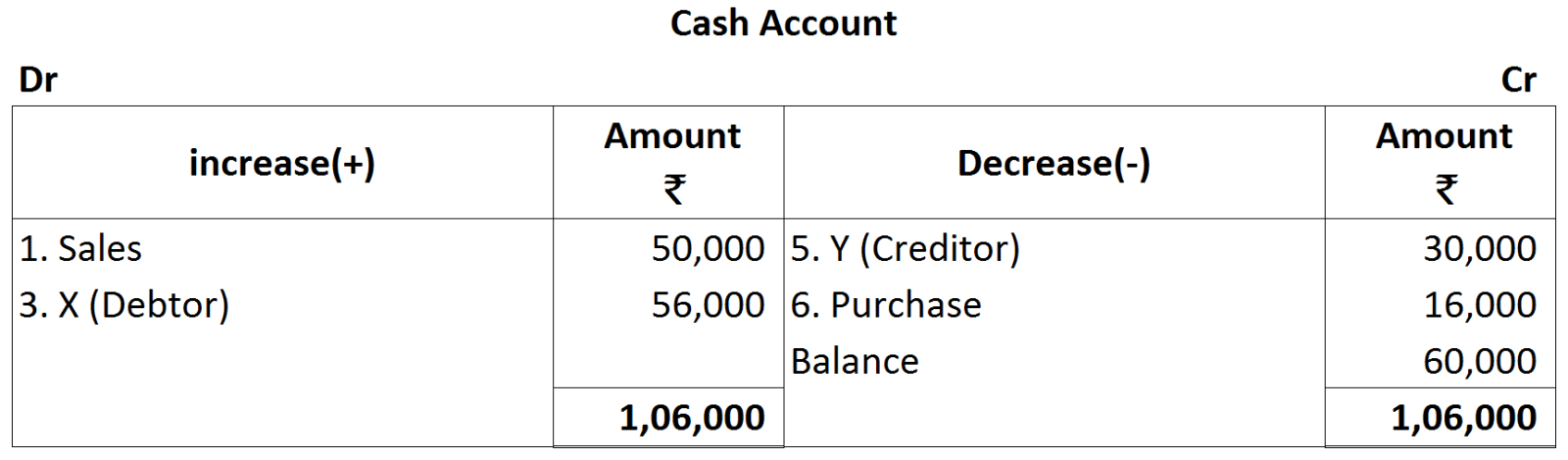
Write a short note on ‘balancing an account'. Explain by balancing a Cash Account.
Answer
A balance of an account is the difference between the total of its debit and credit sides. If the total of debit side is more than the total of credit side, the account is said to have a debit balance. It has a credit balance when total of credit side is more than the total of debit side.
View full question & answer
Question 164 Marks
What do you understand by debit' and credit'? Do you think debit always stands for decrease in amount and credit for increase?
Answer
Debit refers to the left side of an account and credit refers to the right side of an account. In the abbreviated form Dr. stands for debit and Cr. stands for credit. An item recorded on the debit side of an account is said to be debited to the account. An item recorded on the credit side of an account is said to be credited to the account.
Both debit and credit may represent either increase or decrease depending upon the nature of an account. The rules of debit and credit depend on the nature of account.
View full question & answer
Question 174 Marks
'Business units last indefinitely.' Mention and explain the concept on which the statement is based.
Answer
"Business units lasts indefinitely" implies that the business is based on the Going Concern Concept.
According to which, business is assumed to be continued for an indefinite period. As per this profit or loss of the business can only be ascertained when business is shut down. So owner of the business has to wait till the closure of his/her business to measure performance of its business. On the other hand, as per Accounting Period Concept the entire life of business is divided into smaller period of time (say one year) for measuring its performance. Therefore, accounting period principle is treated as a limitation of going concern concept. Or we can say that "Men may come and go but the business may go on and on"
Example: An oil and gas firm operating in Sudan is stopped by a Sudanese court from carrying out operations in Sudan. The firm is not a going concern in Sudan, because it has to shut down.
View full question & answer
Question 184 Marks
“Cash Basis of Accounting is not a better basis for depicting the correct financial position of an enterprise.” Do you agree? Give reasons in support of your answer.
Answer
Yes, we agree. Cash Basis of Accounting is not a better basis for depicting the correct financial position of an enterprise.
Reasons:
  1. It does not give a true and fair view of profit or loss and financial position of the enterprise because it ignores outstanding expenses, prepaid expenses, accrued incomes and incomes received in advance.
  2. It does not follow matching principle of accounting. For example, acquisition of goods will have to be treated as expenses of the period in which payment is made instead of the periods in which benefits are derived from them.
  3. There is a great possibility of manipulation of profits in cash basis of accounting because payments may either be delayed or made early and similarly incomes may be postponed or collected early.
  4. Companies Act, 2013 does not recognize it.
View full question & answer
Question 194 Marks
Explain the following accounting concept with an example of each:
Going Concern Concept.
Answer
Going Concern Concept: The going concern concept of accounting implies that the business entity will continue its operations in the future and will not liquidate or be forced to discontinue operations due to any reason. A company is a going concern if no evidence is available to believe that it will or will have to cease its operations in foreseeable future.
Example: The application of going concern concept of accounting is the computation of depreciation on the basis of expected economic life of fixed assets rather than their current market value. Companies assume that their business will continue for an indefinite period of time and the assets will be used in the business until fully depreciated. Another example of the going concern assumption is the prepayment and accrual of expenses. Companies prepay and accrue expenses because they believe that they will continue operations in future.
View full question & answer
Question 204 Marks
Briefly explain your understanding of IFRS.
Answer
IFRS are the accounting standards issued by the IASB, recommended to be used by the enterprises globally to produce financial statements following a single set of accounting standards. IFRS are principle based accounting standards in compar son to rule based Indian Accounting Standards. Also they are based on fair value concept.
View full question & answer
Question 214 Marks
“Accounting Standards ensure the consistency and comparability of Financial Statements.” Explain.
Answer
Accounting standards make the financial statements of different enterprises or of the same enterprise for different accounting periods comparable. They bring the uniformity of assumptions, rules and policies adopted in the preparation of financial statements and thus they ensure the consistency and comparability of such statements which in turn ensures better comparison of profitability, financial position and future prospects of an enterprise. In the absence of accounting standards, comparison of different financial statements may lead to wrong conclusions because each enterprise would evolve its own rules or standards to suit its purpose.
View full question & answer
Question 224 Marks
State four advantages of Accounting Standards.
Answer
Accounting Standards serve the following purposes:
  1. Accounting Standards provide the norms on the basis of which financial statements should be prepared.
  2. Accounting Standards ensure uniformity in the preparation and presentation of financial statements by removing the effect of diverse accounting practices. The application of Accounting Standards make financial statements more meaningful and comparable.
  3. Accounting Standards create confidence among the users of accounting information. Accounting information based on Accounting Standards is considered reliable by users of such information.
  4. Accounting Standards help auditors in auditing the accounts. They help accountants to follow uniform practices and policies.
View full question & answer
4 Marks Question - Account STD 11 Commerce Questions - Vidyadip