Questions

6 Marks Question

🎯

Test yourself on this topic

33 questions · timed · auto-graded

Question 16 Marks
Karl Pearson's Method is superior to Rank Correlation. Do you agree? Justify your answer.
Answer
The Pearson correlation coefficient is the most widely used. It measures the strength of the linear relationship between normally distributed variables. When the variables are not normally distributed or the relationship between the variables is not linear, it may be more appropriate to use the Spearman rank correlation method. It gives an answer for any number fo figures while rank correlation can't be used if n is more than 30.
  1. If many numbers are repeating, it becomes still more difficult to use rank correlation.
  2. But if we do not know the figures but ranks, then it is advisable to use rank correlation.
View full question & answer
Question 26 Marks
Describe how to tell whether a set of data points shows a positive correlation, a negative correlation, or approximately no correlation.
Answer
A perfect positive correlation is given the value of 1. A perfect negative correlation is given the value of -1. If there is absolutely no correlation present the value given is 0. The closer the number is to 1 or -1, the stronger the correlation, or the stronger the relationship between the variables. The closer the number is to 0, the weaker the correlation. So something that seems to kind of correlate in a positive direction might have a value of 0.67, whereas something with an extremely weak negative correlation might have the value - 21.
An example of a situation where you might find a perfect positive correlation would be when every time that "x" number of people go, "y" amount of money is spent on tickets without variation. An example of a situation where you might find a perfect negative correlation would be if with every increase in X, same amount of y decreases.
On the other hand, a situation where you might find a strong but not perfect positive correlation would be if you examined the number of hours students spent studying for an exam versus the grade received. This won't be a perfect correlation because two people could spend the same amount of time studying and get different grades. But in general the rule will hold true that as the amount of time studying increases so does the grade received.
View full question & answer
Question 36 Marks
Interpret the values of r as 1, -1 and 0.
Answer
The value of r being 1 implies that there is a perfect positive correlation between the two variables involved. A high value of r (i.e. close to 1) represents a strong positive linear relationship between the two variables.
If r = -1, then the correlation is perfectly negative. A negative value of r indicates an inverse relation. A low value of r (i.e. close to -1) represents a strong negative linear relationship between the variables. On the other hand, if the value of r = 0, then it implies that the two variables are uncorrelated to each other. But this should not be misunderstood as the variables are independent of each other. The value of r equals zero confirms only the non-existence of any linear relation but the variables may be non-linearly related to each other.
View full question & answer
Question 46 Marks
Calculate the coefficient of rank correlation from the following data:
X
75
88
95
70
60
80
81
50
Y
120
134
150
115
110
140
142
100
Answer
$X$ $R_1$ $Y$ $R_2$ $D = R_1- R_2$ $D_2$
75 5 120 5 0 0
88 2 134 4 -2 4
95 1 150 1 0 0
70 6 115 6 0 0
60 7 110 7 0 0
80 4 140 3 1 1
81 3 142 2 1 1
50 8 100 8 0 0
N = 8         $\Sigma\text{D}^2=6$
$\text{r}_\text{s}=1-\frac{6\Sigma\text{D}^2}{\text{N}^3-\text{N}}$
$=1-\frac{6\times6}{8^3-8}$
$=1-\frac{36}{504}$
$=1-0.7$
$=0.93$
View full question & answer
Question 56 Marks
Explain different types of correlation.
Answer
Through the coefficient of correlation, we can measure the degree or extent of the correlation between two variables. On the basis of the coefficient of correlation we can also determine whether the correlation is positive or negative and also its degree or extent.
Perfect correlation: If two variables changes in the same direction and in the same proportion, the correlation between the two is perfect positive. According to Karl Pearson the coefficient of correlation in this case is +1. On the other hand if the variables change in the opposite direction and in the same proportion, the correlation is perfect negative. its coefficient of correlation is -1. In practice we rarely come across these types of correlations.
Absence of correlation: If two series of two variables exhibit no relations between them or change in variable does not lead to a change in the other variable, then we can firmly say that there is no correlation or absurd correlation between the two variables. In such a case the coefficient of correlation is 0.
Limited degrees of correlation: If two variables are not perfectly correlated or is there a perfect absence of correlation, then we term the correlation as Limited correlation. It may be positive, negative or zero but lies with the limits $\pm1.$
High degree, moderate degree or low degree are the three categories of this kind of correlation. The following table reveals the effect (or degree) of coefficient or correlation.
View full question & answer
Question 66 Marks
Define the term correlation. What purpose does it solve?
Answer
Correlation is a statistical technique that can show whether and how strongly pairs of variables are related. For example, height and weight are related; taller people tend to be heavier than shorter people. The relationship isn't perfect. People of the same height vary in weight, and you can easily think of two people you know where the shorter one is heavier than the taller one. Nonetheless, the average weight of people 5'5" is less than the average weight of people 5'6", and their average weight is less than that of people 5'7", etc. Correlation can tell you just how much of the variation in peoples' weights is related to their heights.
  1. Correlation is very helpful when we want to study relationship between two or more variables.
  2. Correlation also helps in finding if one variable is dependent on other or not.
  3. When two variables are correlated then the value of one variable can be estimated given the value of other variable using regression equations.
  4. It helps in taking important decisions to a business man, government and sociologists.
View full question & answer
Question 76 Marks
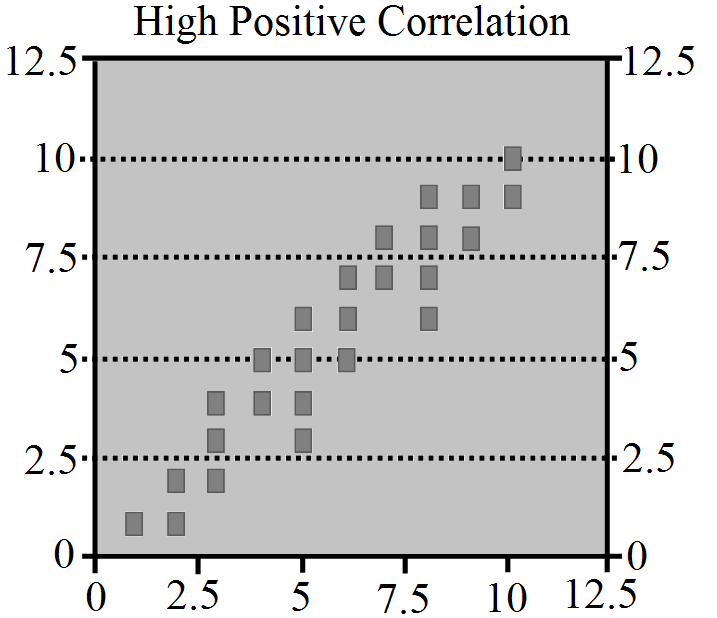
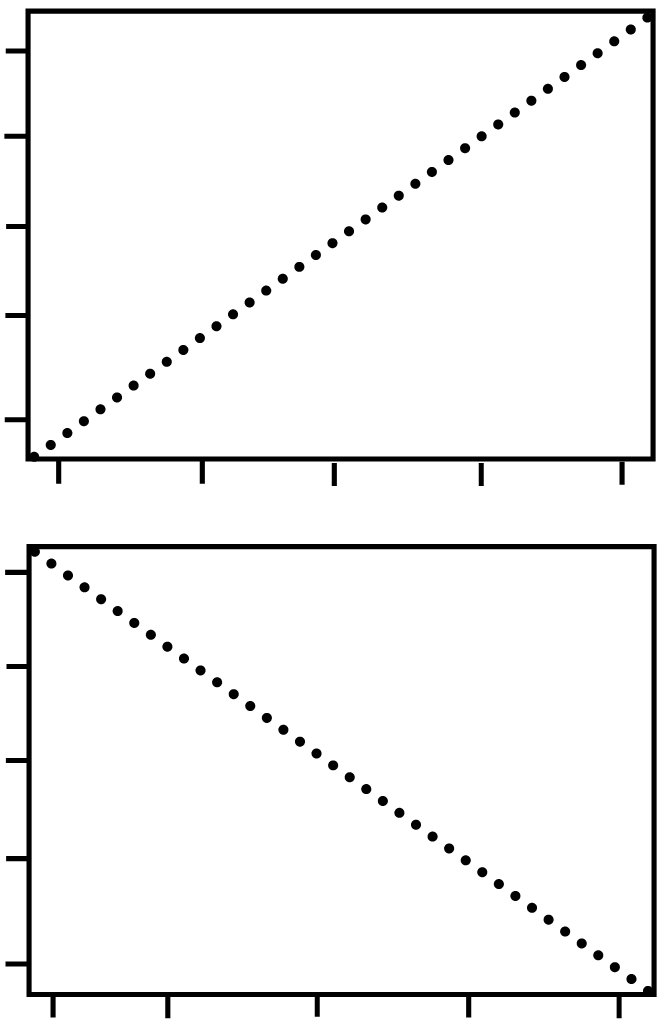
Draw a scatter diagram for:
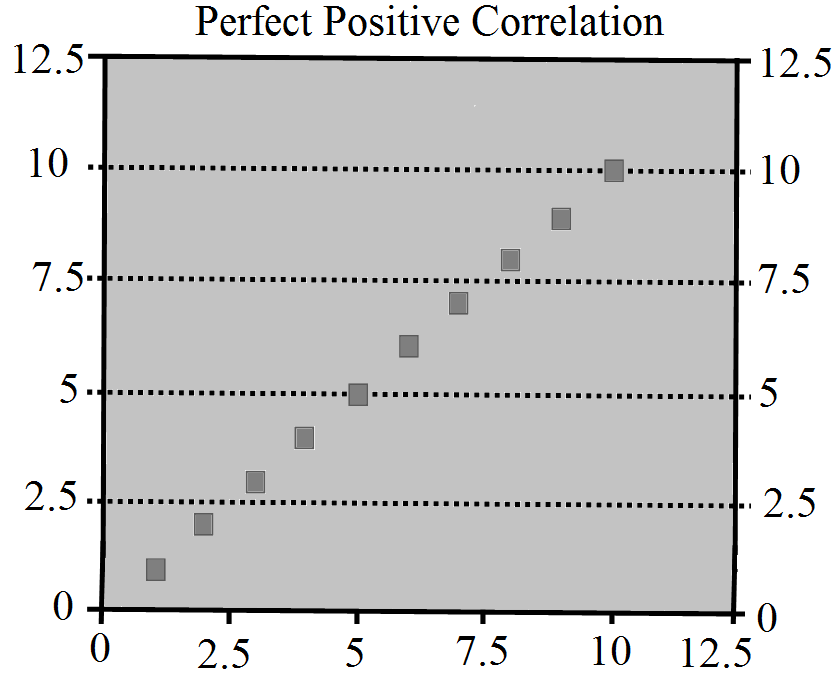
  1. Perfect positive correlation.
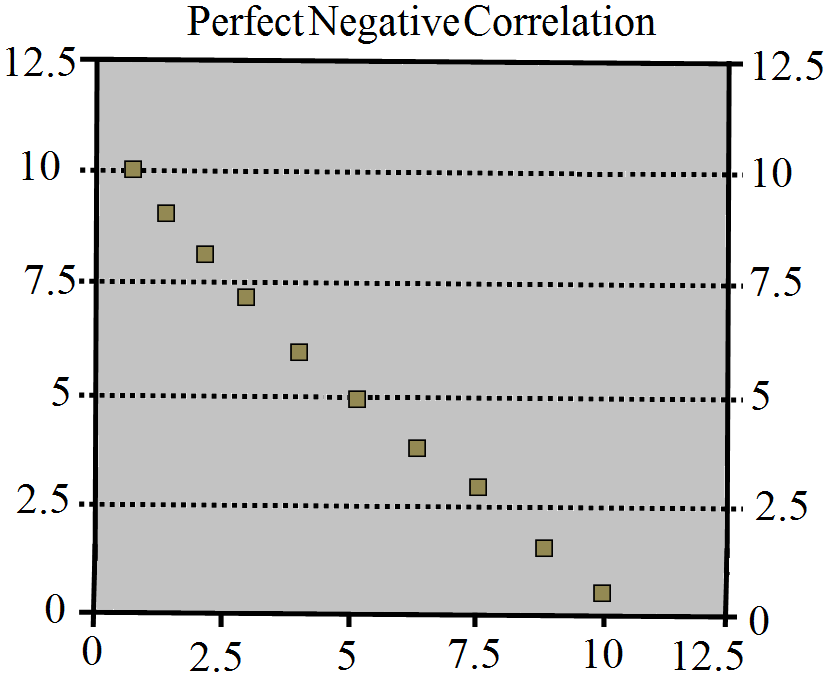
  2. Perfect negative correlation.
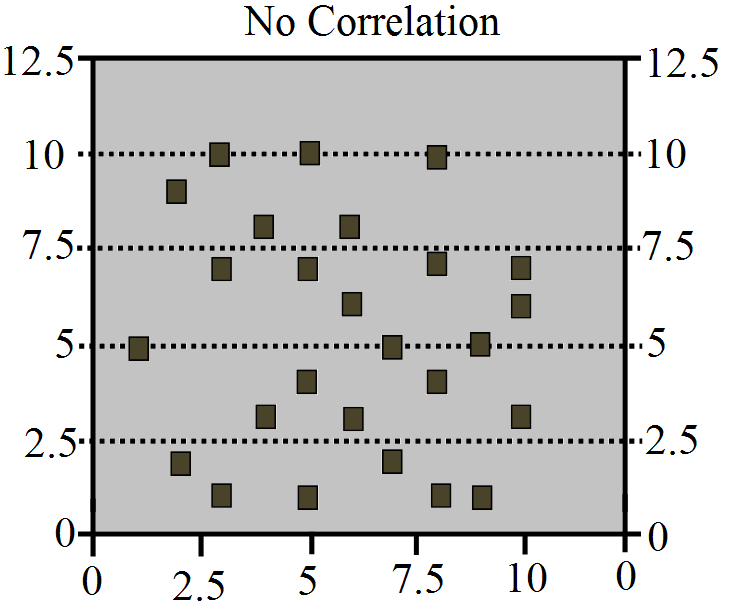
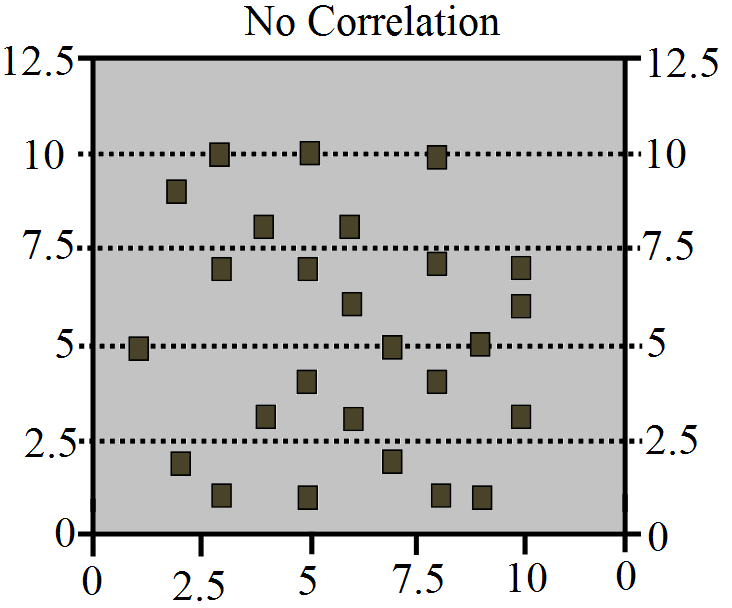
  3. Zero correlation.
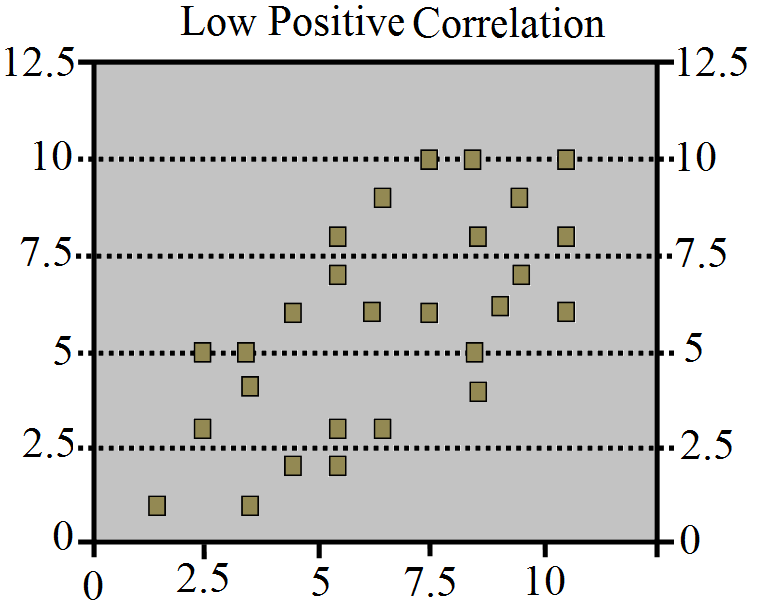
  4. Low positive correlation.
  5. low negative correlation.
  6. High positive correlation.
Answer
  1.  
  1.  
  1.  
  1.  
View full question & answer
Question 86 Marks
How is value of correlation interpreted?
Answer
S. No.
Degrees
Positive
Nagative
1.
Abesence of correlation.
Zero
0
2.
Perfact correlation.
+ 1
- 1
3.
High degree correlation.
+ 0.75 to + 1
- 0.75 to - 1
4.
Moderate degree correlation.
+ 0.25 to + 0.75
- 0.25 to - 0.75
5.
Low degree correlation.
0 to 0.25
0 to -.0.25
View full question & answer
Question 96 Marks
How is correlation different from causation?
Answer
Difference between correlation and causation is given below:
  1. Definition: "Correlation is a statistical measure (expressed as a number) that describes the size and direction of a relationship between two or more variables. A correlation between variables, however, does not automatically mean that the change in one variable is the cause of the change in the values of the other variable". "Causation indicates that one event is the result of the occurrence of the other event; i.e. there is a causal relationship between the two events. This is also referred to as cause and effect."
  2. Mutual dependence: Theoretically, the difference between the two types of relationships are easy to identify - an action or occurrence can cause another (e.g. smoking causes an increase in the risk of developing lung cancer), or it can correlate with another (e.g. smoking is correlated with alcoholism, but it does not cause alcoholism). In practice, however, it remains difficult to clearly establish cause and effect, compared with establishing correlation.
  3. Pure Chance: The correlation between the two variables may be due to pure chance or co-incidence. But in causation, it is not coincidental but logical.
View full question & answer
Question 106 Marks
“The degree of closeness of scatter points and their overall direction gives us an idea of the nature of the relationship between variables.” True or False. Justify your answer.
Answer
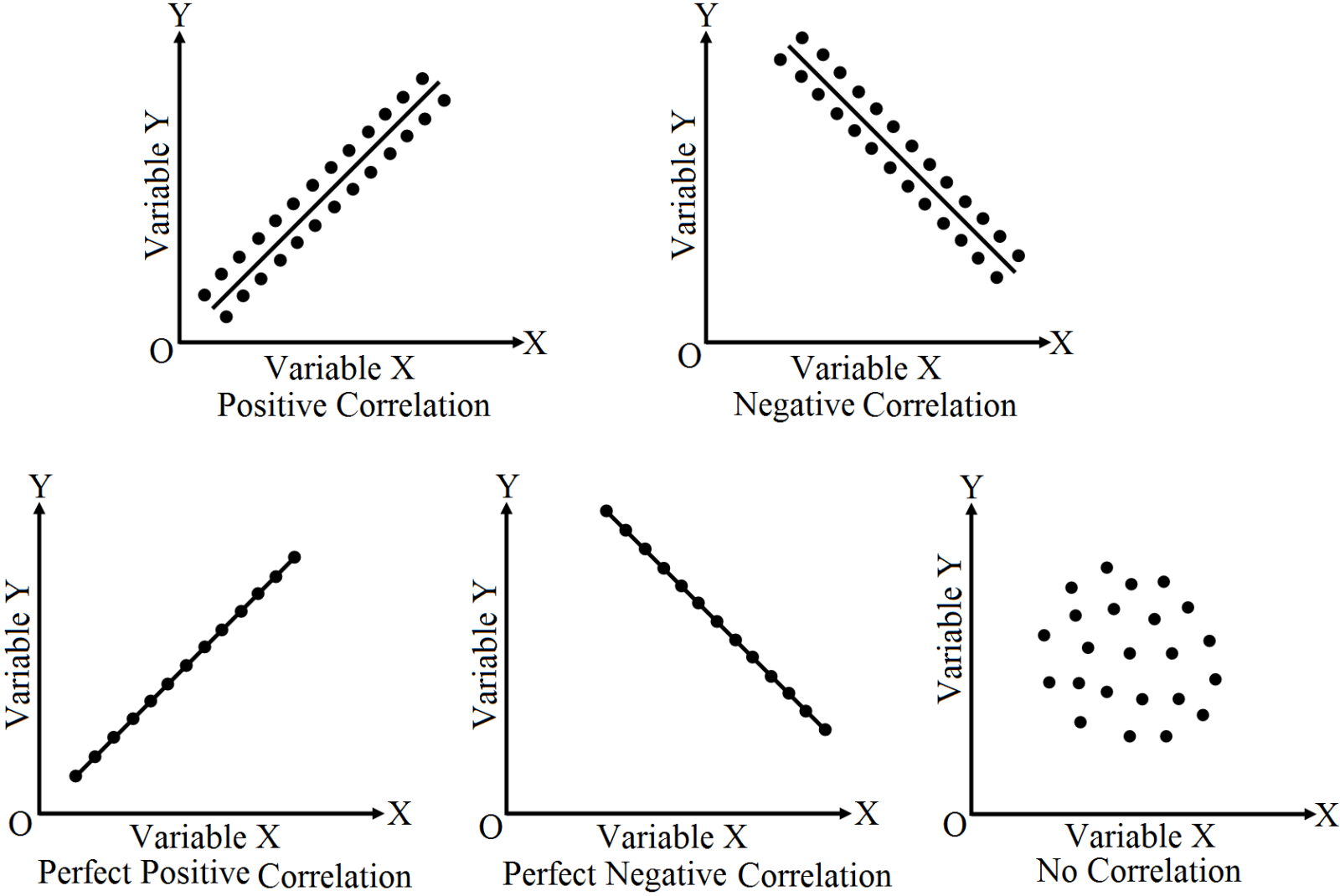
Scatter diagram is a graphic (or visual) method of studying correlation. To construct a scatter diagram, X variable is taken on x-axis and Y variable is taken on y-axis. The cluster of points, so plotted is referred to as a scatter diagram. In a scatter diagram, the degree of closeness of scatter points and their overall direction gives us an idea of the nature of the relationship:
  1. If the dots move from left to the right upwards, correlation is said to be positive whereas the movement of dots from left to right downwards indicates negative correlation.
  2. Dots in a straight line indicate perfect correlation.
  3. Dots falling close to each other in a straight line indicate high degree of correlation.
  4. Scattered dots indicate no correlation. The following diagrams illustrate the idea:

Thus we can interpret that it is true to state that the scatter points and their overall direction which gives us the idea of the nature of relationship between the two variables as proven above.
View full question & answer
Question 116 Marks
Name various methods of studying correlation. Describe any one.
Answer
Various methods of studying correlation are:
  1. Scatter diagram
  2. Karl Pearson's coefficient of correlation
  3. Spearman's Rank Correlation
Now explaining one of them:
Spearman's Rank Correlation: Prof. Charles Spearman (British psychologist), developed this method as computing coefficient of correlation in 1904. It is based on the ranking of various values in the variables.
This method is known as Spearman's Rank Difference method.
It is useful in cases when quantitative measure for certain factors such as, intelligence, beauty, honesty, etc. is not possible. The process of calculating the rank correlation is as follow:
  1. Give ranks to various items of the two series (if ranks are not given)
  2. Find differences of the ranks and denote them by D.
  3. Square that differences and denote them by D2 to obtain EDP
  4. Apply the following formula:
$\text{r}_\text{s}=1-\frac{6\Sigma\text{D}^2}{\text{N}^3-\text{N}}.$
View full question & answer
Question 126 Marks
Calculate coefficient of correlation from the following data and interpret the result:
No. of years of schooling of farmers $0$ $2$ $4$ $6$ $8$ $10$ $12$
Annual yield per acre in $‘000 (₹)$ $4$ $4$ $6$ $10$ $10$ $8$ $7$
Answer
No. of year of schooling (X)  $\text{x}=(\text{X}-\overline{\text{X}})$ $x^2$ Annual yield (Y) $\text{y}=(\text{Y}-\overline{\text{Y}})$ $y^2$ $xy$
$0$ $-6$ $36$ $4$ $-3$ $9$ $18$
$2$ $-4$ $16$ $4$ $-3$ $9$ $18$
$4$ $2$ $4$ $6$ $-1$ $1$ $12$
$6$ $0$ $0$ $10$ $3$ $9$ $0$
$8$ $2$ $4$ $10$ $3$ $9$ $6$
$10$ $4$ $16$ $8$ $1$ $1$ $4$
$12$ $6$ $36$ $7$ $0$ $0$ $0$
$\Sigma\text{X}=42$ $\Sigma\text{x}=0$ $​​\Sigma\text{x}^2=112$ $\Sigma\text{Y}=49$ $​​\Sigma\text{y}=0$ $​​\Sigma\text{y}^2=38$ $​​\Sigma\text{xy}=42$
Interpretation: Moderate degree co-relation exists between the given two variables.
$\overline{\text{X}}=\frac{\Sigma\text{X}}{\text{N}}=\frac{42}{7}=6$ $\overline{\text{Y}}=\frac{\Sigma\text{Y}}{\text{N}}=\frac{49}{7}=42$
$\text{r}=\frac{\Sigma\text{xy}}{\sqrt{\Sigma\text{x}^2\Sigma\text{y}^2}}$
$=\frac{42}{\sqrt{112}\sqrt{38}}=\frac{42}{10.58\times6.16}=\frac{42}{65.17}=0.64 $
View full question & answer
Question 136 Marks
Calculate Karl Pearson’s coefficient of correlation:
X
20
18
16
15
14
12
12
10
8
5
Y
12
16
10
14
12
10
9
8
7
2
Answer
$x$ $\text{x}=(\text{X}-\overline{\text{X}})$ $x^2$ $Y$ $\text{y}=(\text{Y}-\overline{\text{Y}})$ $y^2$ $xy$
20 7 49 12 2 4 14
18 5 25 16 6 36 30
16 3 09 10 0 0 0
15 2 4 14 4 16 8
14 1 1 12 2 2 2
12 -1 1 10 0 0 0
12 -1 1 9 -1 1 1
10 -3 09 8 -2 4 6
8 -5 09 8 -2 4 6
5 -8 64 2 -8 64 64
$\Sigma\text{X}=130$   $\Sigma\text{x}^2=188$ $\Sigma\text{Y}=100$   $\Sigma\text{y}^2=136$ $\Sigma\text{xy}=140$
$\overline{\text{X}}=13$     $\overline{\text{Y}}=10$      
$\overline{\text{X}}=\frac{\Sigma\text{X}}{\text{N}}=\frac{130}{10}=13$ $\overline{\text{Y}}=\frac{\Sigma\text{Y}}{\text{N}}=\frac{100}{10}=10$
$\text{r}=\frac{\Sigma\text{xy}}{\sqrt{\Sigma\text{x}^2\Sigma\text{y}^2}}$
$=\frac{140}{\sqrt{188}\sqrt{136}}=\frac{140}{159.85}=0.87$
in indicates a high dagree of possitive correlation between X and Y varibales.
View full question & answer
Question 146 Marks
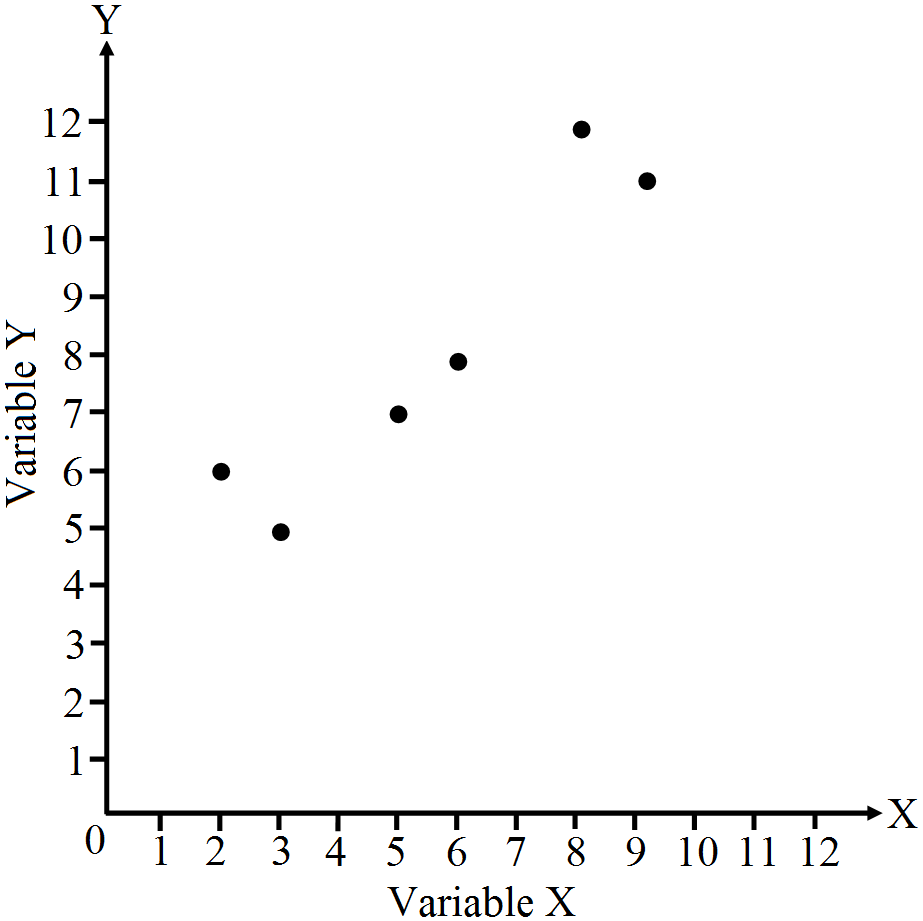
Draw a scatter diagram of the following data and interpret to find the nature of correlation.
X
2
3
5
6
8
9
Y
6
5
7
8
12
11
Answer

Interpretation: As there is no particular trend in the above case, there is "no correlation” between the given two variables X and Y.
View full question & answer
Question 156 Marks
Calculate the correlation coefficient between the heights of fathers in inches (X) and their sons (Y).
X
65
66
57
67
68
69
70
72
Y
67
56
65
68
72
72
69
71
Answer
X-Series
Y-Series
$XY$
$X$
$X^2$
$Y$
$Y^2$
65
4225
67
4489
4355
66
4356
56
3136
3696
57
3249
65
4225
3705
67
4489
68
4624
4556
68
4624
72
5184
4896
69
4761
72
5184
4968
70
4900
69
4761
4830
72
5184
71
5041
5112
$\sum\text{X} = 534$
$\sum\text{X}^2 = 35788$
$\sum\text{Y} = 540$
$\sum\text{Y}^2 = 36644$
$\sum\text{XY} = 36118$
$\text{r}=\frac{\sum\text{XY}-\frac{\big(\sum\text{X}\big)\big(\sum\text{Y}\big)}{\text{N}}}{\sqrt{\sum\text{X}^2-\frac{\big(\sum\text{X}^2\big)}{\text{N}}}\sqrt{\sum\text{Y}^2-\frac{\big(\sum\text{Y}\big)^2}{\text{N}}}}$
$=\frac{36118-\frac{534\times540}{8}}{\sqrt{35788-\frac{(534)^2}{8}}\sqrt{36644-\frac{(540)^2}{8}}}$
$=\frac{36118-\frac{288360}{8}}{\sqrt{35788-\frac{285156}{8}}\sqrt{36644-\frac{291600}{8}}}$
$=\frac{36118-36045}{\sqrt{35788-35644.5}\sqrt{36644-36450}}$
$=\frac{73}{\sqrt{143.5}\sqrt{194}}$
$=\frac{73}{11.98\times13.93}$
$=\frac{73}{166.88}$
$=0.44$
The Correlation coeffcient is 0.44
View full question & answer
Question 166 Marks
Find out rank difference correlation of X and Y.
X
$80$
$78$
$75$
$75$
$58$
$67$
$60$
$59$
Y
$12$
$13$
$14$
$14$
$14$
$16$
$15$
$17$
Answer
$X$ $R_1$ $Y$ $R2$ $D= R_1 - R_2$ $D^2$
$80$
$1$
$12$
$8$
$-7$
$49$
$78$
$2$
$13$
$7$
$-5$
$25$
$75$
$3.5$
$14$
$5$
$-1.5$
$2.25$
$75$
$3.5$
$14$
$5$
$-1.5$
$2.25$
$58$
$8$
$14$
$5$
$3$
$9$
$67$
$5$
$16$
$2$
$3$
$9$
$60$
$6$
$15$
$3$
$3$
$9$
$59$
$7$
$17$
$1$
$6$
$36$


$\Sigma\text{D}^2=141.50$
Here, $\text{n}=8,\Sigma\text{D}^2=141.5,\text{m}_1=3,\text{m}_2\ \text{and }\text{m}_3=2$
$\therefore\ \text{r}_\text{k}=1-\frac{6\bigg[\Sigma\text{D}+\frac{1}{12}(\text{m}^3-\text{m})+\frac{1}{12}(\text{m}^3-\text{m)}+\frac{1}{12}(\text{m}^3-\text{m)}\bigg]}{\text{n}^3-\text{n}}$
$=1-\frac{6\bigg[141.50+\frac{1}{12}(\text{3}^3-\text{3)}+\frac{1}{12}(\text{2}^3-\text{2)}+\frac{1}{12}(\text{2}^3-\text{2)}\bigg]}{8^3-8}$
$=\frac{1-6\bigg[141.50+\frac{6}{12}+\frac{24}{12}\bigg]}{512-8}=1-\frac{6(141.50+0.50+2)}{504}$
$=1-\frac{6\times144}{504}=1-\frac{864}{504}=1-1.714=-0.714$
It indicates that there is moderate degree of negative correlation.
View full question & answer
Question 176 Marks
Calculate Karl Pearson's coefficient of correlation by actual mean method:
Answer
Let X denotes price and Y denotes quantity.
X $\text{X}-\overline{\text{X}}$ $(\text{X}-\overline{\text{X}})^2$ Y $\text{Y}-\overline{\text{Y}}$ $(\text{Y}-\overline{\text{Y}})^2$ $(\text{X}-\overline{\text{X}})(\text{Y}-\overline{\text{Y}})$
10 -4 16 20 -4 16 16
12 -2 4 29 5 25 -10
14 0 0 21 -3 9 0
16 2 1 22 -2 4 -4
18 4 16 28 4 16 16
$\Sigma\text{X}=70\ \text{N}=5$   $\Sigma(\text{X}-\overline{\text{X}})^2=40$ $\Sigma\text{Y}=120$   $\Sigma(\text{Y}-\overline{\text{Y}})^2=70$ $\Sigma(\text{X}-\overline{\text{X}})(\text{Y}-\overline{\text{Y}})=18$
$\overline{\text{X}}=\frac{\Sigma\text{X}}{\text{N}}=\frac{70}{5}=14$ $\overline{\text{Y}}=\frac{\Sigma\text{Y}}{\text{N}}=\frac{120}{5}=24$
$\text{r}=\frac{\Sigma\text{(X}-\overline{\text{X}})(\text{Y}-\overline{\text{Y}})}{\sqrt{\Sigma\text{(X}-\overline{\text{X}}) ^2}\sqrt{\Sigma(\text{Y}-\overline{\text{Y}})^2}}$
$\frac{180}{\sqrt{40}\sqrt{70}}=\frac{18}{6.32\times8.36}=\frac{18}{52.83}=0.34$
View full question & answer
Question 186 Marks
Compute Karl Pearson's coefficient of correlation and interpret the result:
Marks in Mathematics
15
18
21
24
Marks in Accountancy
25
25
27
31
Answer
Let X and Y denote marks in Mathematics and Accountancy.
X $(\text{X}-\overline{\text{X}})$ $(\text{X}-\overline{\text{X}})^2$ Y $(\text{Y}-\overline{\text{Y}})$ $(\text{Y}-\overline{\text{Y}})^2$ $(\text{X}-\overline{\text{X}})(\text{Y}-\overline{\text{Y}})$
15 -6 36 25 -3 9 18
18 -3 9 25 -3 9 9
21 0 0 27 -1 1 0
24 3 9 31 3 9 9
27 6 36 32 4 16 24
$\Sigma\text{X}=105$   $\Sigma\text{(X}-\overline{\text{X}})^2=90$ $\Sigma\text{Y}=140$   $\Sigma\text{(Y}-\overline{\text{Y}})^2=44$ $\Sigma(\text{X}-\overline{\text{X}})(\text{Y}-\overline{\text{Y}})=60$
$\text{X}=\frac{\Sigma\text{X}}{\text{N}}=\frac{105}{5}=21$ $\overline{\text{Y}}=\frac{\Sigma\text{X}}{\text{N}}=\frac{140}{5}=28$
$\text{r}=\frac{\Sigma\text{(X}-\overline{\text{X}})(\text{Y}-\overline{\text{Y}})}{\sqrt{\Sigma\text{(X}-\overline{\text{X}}) ^2}\sqrt{\Sigma(\text{Y}-\overline{\text{Y}})^2}}$
$=\frac{60}{\sqrt{90}\sqrt{44}}=\frac{60}{9.48\times6.63}=\frac{60}{62.85}=0.95$
It indicates that there is high degree of positive correlation between the marks in Mathematics and Accountancy.
View full question & answer
Question 196 Marks
Calculate coefficient of rank correlation from the following data.
X
48
33
40
9
16
16
65
24
16
27
Y
13
13
24
6
15
4
20
9
6
19
Answer
X
R1
Y
R2
D = R1 - R2
D2
48
2
13
5.5
-3.5
12.5
33
4
13
5.5
-1.5
2.25
40
3
24
1
2.0
4.0
9
10
6
8.5
1.5
2.25
16
8
15
4
4.0
16.0
16
8
4
10
-2.0
4.0
65
1
20
2
-1.0
1.0
24
6
9
7
-1.0
1.0
16
8
6
8.5
-0.5
0.25
27
5
19
3
2.0
4.0


$\Sigma\text{D}^2=47$
Here, $\text{n}=10,\Sigma\text{D}^2=47,\text{m}_1=3,\text{m}_2\ \text{and }\text{m}_3=2$
$\therefore\ \text{r}_\text{k}=1-\frac{6\bigg[\Sigma\text{D}+\frac{1}{12}(\text{m}^3-\text{m})+\frac{1}{12}(\text{m}^3-\text{m)}+\frac{1}{12}(\text{m}^3-\text{m)}\bigg]}{\text{n}^3-\text{n}}$
$=1-\frac{6\bigg[47++\frac{1}{12}(\text{3}^3-\text{3)}+\frac{1}{12}(\text{2}^3-\text{2)}+\frac{1}{12}(\text{2}^3-\text{2)}\bigg]}{10^3-10}$
$=\frac{1-6(47+2+0.5+0.5)}{990}=1-\frac{6\times50}{990}$
$=1-\frac{300}{990}=1-0.303=0.697$
It indicates that there is moderate degree of positive correlation.
View full question & answer
Question 206 Marks
Calculate the coefficient of correlation by Karl Pearson's method.
Income ( Lac)
$23$
$27$
$28$
$29$
$30$
$31$
$33$
$35$
$36$
$39$
Expenditure
$18$
$22$
$23$
$24$
$25$
$26$
$28$
$29$
$30$
$32$
Answer
Let X and Y denote income and expenditure respectively.
$X$ $dx = X - A$ $dx^2$ $Y$ $dy = Y - A$ $dy^2$ $dxdy$
$23$ $-8$ $64$ $18$ $-8$ $64$ $64$
$27$ $-4$ $16$ $22$ $-4$ $16$ $16$
$28$ $-3$ $9$ $23$ $-3$ $9$ $9$
$29$ $-2$ $4$ $24$ $-2$ $4$ $4$
$30$ $-1$ $1$ $25$ $-1$ $1$ $1$
$31$ $0$ $0$ $26$ $0$ $0$ $0$
$33$ $2$ $4$ $28$ $2$ $4$ $4$
$35$ $4$ $16$ $29$ $3$ $9$ $12$
$36$ $5$ $25$ $30$ $4$ $16$ $20$
$39$ $8$ $64$ $32$ $6$ $36$ $48$
  $\Sigma\text{dx}=1$ $\Sigma\text{dx}^2=203$   $\Sigma\text{dy}=-3$ $\Sigma\text{dy}^2=159$ $\Sigma\text{dxdy}=178$
$\text{r}_\text{k}=\frac{\Sigma\text{dxdy}-\frac{(\Sigma\text{dx})\times(\Sigma\text{dy)})}{\text{N}}} {\sqrt{\Sigma\text{dx}^2-\frac{(\Sigma\text{dx})^2}{\text{N}}\times\sqrt{\Sigma\text{dy}^2-\frac{(\Sigma\text{dy})^2}{\text{N}}}}}$
$=\frac{178-\frac{(1)\times(-3)}{10}}{\sqrt{203-\frac{(1)^2}{10}\times\sqrt{159-\frac{(-3)^2}{10}}}}$
$=\frac{178-\frac{3}{10}}{\sqrt{202.9}\times\sqrt{158.9}}=\frac{178.1}{14.24\times12.60}=\frac{178.1}{179.42}=0.99$
Inference: Very high degree of correlation exists between income and expenditure.
View full question & answer
Question 216 Marks
Calculate Karl Pearson's coefficient of correlation from following data:
X
21
22
23
24
25
26
27
Y
16
15
17
18
19
20
21
Answer
Karl Pearson's coefficient of correlation:
$X$ $Y$ $(\overline{\text{X}}=24)\text{ X}=\text{X}-\overline{\text{X}}$ $X^2$ $(\overline{\text{Y}}=18)\text{ Y}=\text{Y}-\overline{\text{Y}}$ $Y^2$ $XY$
21 16 -3 9 -2 4 6
22 15 -2 4 -3 9 6
23 17 -1 1 -1 1 1
24 18 0 0 0 0 0
25 19 1 1 1 1 1
26 20 2 4 2 4 4
27 21 3 9 3 9 9
$\Sigma\text{X}=168$ $\Sigma\text{Y}=126$   $\Sigma\text{X}^2=28$   $\Sigma\text{Y}^2=28$ $\Sigma\text{XY}=27$
$\overline{\text{X}}=\frac{\Sigma\text{X}}{\text{N}}=\frac{168}{7}=24$ $\overline{\text{Y}}=\frac{\Sigma\text{Y}}{\text{N}}=\frac{126}{7}=18$
$\text{r}=\frac{\Sigma\text{XY}}{\sqrt{\Sigma\text{X}^2}.\sqrt{\Sigma\text{Y}^2}}$
$=\frac{27}{\sqrt{28}.\sqrt{28}}=\frac{27}{28}=0.96$
Interpretation: Very high degree of correlation prevails.
View full question & answer
Question 226 Marks
Calculate the coefficient of correlation from the following data:
X
$30$
$40$
$60$
$70$
$100$
Y
$90$
$110$
$140$
$150$
$160$
Answer
X $\text{x}=(\text{X}-\overline{\text{X}})$ $x^2$ $Y$ $\text{y}=(\text{Y}-\overline{\text{Y}})$ $y^2$ $xy$
$30$ $-30$ 900 $90$ $-40$ $1600$ $1200$
$40$ $-20$ 400 $110$ $-20$ $400$ $400$
$60$ $0$ 0 $140$ $10$ $100$ $0$
$70$ $10$ 100 $150$ $20$ $400$ $200$
$100$ $40$ 1600 $160$ $30$ $900$ $1200$
$\Sigma\text{X}=300$   $\Sigma\text{x}^2=3000$ $\Sigma\text{Y}=650$   $\Sigma\text{y}^2=3400$ $\Sigma\text{xy}=3000$
$\overline{\text{X}}=\frac{\Sigma\text{X}}{\text{N}}=\frac{300}{5}=60;$ $\overline{\text{Y}}=\frac{\Sigma\text{Y}}{\text{N}}=\frac{650}{5}=130$
$\text{r}=\frac{\Sigma\text{(X}-\overline{\text{X}})(\text{Y}-\overline{\text{Y}})}{\sqrt{\Sigma\text{(X}-\overline{\text{X}}) ^2}\sqrt{\Sigma(\text{Y}-\overline{\text{Y}})^2}}\ \text{or}\ \frac{\Sigma\text{xy}}{\sqrt{\Sigma\text{x}^2}\sqrt{\Sigma\text{y}^2}}$
$=\frac{3000}{\sqrt{3000}\sqrt{3400}}=\frac{3000}{54.7\times6.63}=\frac{3000}{3194.8}=0.94$
It indicates a very high degree of positive co-relation between X and Y variables.
View full question & answer
Question 236 Marks
Calculate Karl Pearson's coefficient of correlation for the data given below:
X
$2$
$3$
$4$
$5$
$6$
$7$
$8$
Y
$4$
$7$
$8$
$9$
$10$
$14$
$18$
Answer
$X$ $\text{x}=(\text{X}-\overline{\text{X}})$ $x^2$ $Y$ $\text{y}=(\text{Y}-\overline{\text{Y}})$ $y^2$ $xy$
$2$ $-3$ $9$ $4$ $-6$ $36$ $18$
$3$ $-2$ $4$ $7$ $-3$ $9$ $6$
$4$ $-1$ $1$ $8$ $-2$ $4$ $2$
$5$ $0$ $0$ $9$ $-1$ $1$ $0$
$6$ $1$ $1$ $10$ $0$ $0$ $0$
$7$ $2$ $4$ $14$ $4$ $16$ $8$
$8$ $3$ $9$ $18$ $8$ $64$ $24$
$\Sigma\text{X}=35$   $\Sigma\text{x}^2=28$ $\Sigma\text{Y}=70$   $\Sigma\text{y}^2=130$ $\Sigma\text{xy}=58$
$\overline{\text{X}}=\frac{\Sigma\text{X}}{\text{N}}=\frac{35}{7}=5$ $\overline{\text{Y}}=\frac{\Sigma\text{Y}}{\text{N}}=\frac{70}{7}=10$
$\text{r}=\frac{\Sigma\text{xy}}{\sqrt{\Sigma\text{x}^2\Sigma\text{y}^2}}$
$=\frac{58}{\sqrt{28}\times\sqrt{130}}=\frac{58}{\sqrt{3640}}=\frac{58}{60.33}=0.96$
Interpretation: Very high degree co-relation exists between X and Y.
View full question & answer
Question 246 Marks
Calculate coefficient of correlation between age group and rate of mortality from the following data:
Age group
0-20
20-40
40-60
60-80
80-100
Rate of mortality
350
280
540
760
900
Answer
Since class intervals are given for age, their mid values should be used for the calculation of coefficient of correlation(r).
Age group
M. V. (X)
dx
$dx'$
$dx'^2$
Rate of mortality (Y)
dy
$dy'$
$dy'^2$
$dx'dx'$
0-20
10
-40
-2
4
350
-190
-19
361
38
20-40
30
-20
-1
1
280
-260
-26
676
26
40-60
50
0
0
0
540
0
0
0
0
60-80
70
20
1
1
760
220
22
484
22
80-100
90
40
2
4
900
360
36
1296
72
N = 5
 
 
$\Sigma\text{dx}'=0$
$\Sigma\text{dx}'^2=10$
 
 
$\Sigma\text{dy}'=13$
$\Sigma\text{dy}'^2=2817$
$\Sigma\text{dx}'\text{dy}'=158$
$\text{r}=\frac{\text{N.}\Sigma\text{dx'dy}-(\Sigma\text{dx}')(\Sigma\text{dy'})}{\sqrt{\text{N.}\Sigma\text{dx}'^2(\Sigma\text{dx'})^2(\sqrt{\text{N.}\Sigma\text{dy}'^2-(\Sigma\text{dy'})^2}}}$
$=\frac{5\times158=-(0)(13)}{\sqrt{5\times10-(0)^2}\sqrt{5\times2817-(13)^2}}$
$=\frac{790}{\sqrt{50}\sqrt{13916}}=\frac{790}{707\times117.96}=\frac{790}{833.9}=0.94$
View full question & answer
Question 256 Marks
From the following data, calculate coefficient of correlation between age and playing habits.
Age Group
20-30
30-40
40-50
50-60
60-70
Number of Students
25
60
40
20
20
Number of Regular Players
10
30
12
2
1
Answer
First, we shall find the percentage of regular players in the following way: Calculat of Parcentage of Regular Players:
Number of Student Number of Regular Players Parcentage of Regular Players
25 10 $\frac{10}{25}\times100=40$
60 30 $\frac{30}{60}\times100=50$
40 12 $\frac{12}{40}\times100=30$
20 2 $\frac{2}{20}\times100=10$
20 1 $\frac{1}{20}\times100=5$
Denoting mid value of age as X and percentage of regular players as Y:
Age Group Mid value(X) dx (X - A), A = 45 $\text{dx}'\bigg(\frac{\text{dx}}{\text{c}_1}\bigg),\text{c}_1=10$ $\text{dx}^2$ Parcentage of Regular Players(Y) dy (Y - A), A = 30 $\text{dy}'\bigg(\frac{\text{dy}}{\text{c}_2}\bigg),\text{c}_2=5$ $\text{dy}^2$ dx'dy'
20-30 25 -20 -2 4 40 10 2 4 -4
30-40 35 -10 -1 1 50 20 4 16 -4
40-50 45 0 0 30 0 0 0 0 0
50-60 55 10 1 1 10 -20 -4 16 -4
60-70 65 20 2 4 5 -25 -5 25 -10
      $\Sigma\text{dx}'=0$ $\Sigma\text{dx}^2=10$     $\Sigma\text{dy}=-3$ $\Sigma\text{dy}^2=61$ $\Sigma\text{dx}'\text{dy}'=-22$
Here, $\text{n}'=5,\Sigma\text{dx}'^2=0,\Sigma\text{dy}'^2=10,\Sigma\text{dy}'=-3\Sigma\text{dy}'^2=61$ and $\Sigma\text{dx}'\text{dy}'=-22$$\therefore\ \text{r}=\frac{\Sigma\text{dx}'\text{dy}'-\frac{\Sigma\text{dx}'\times\Sigma\text{dy}'}{\text{n}}}{\sqrt{\Sigma\text{dx}'^2-\frac{(\Sigma\text{dx}')^2}{\text{n}}\times}\sqrt{\Sigma\text{dx}'^2-\frac{(\Sigma\text{dy}')^2}{\text{n}}}}$
$=\frac{22-\frac{(0\times-3)}{5}}{\sqrt{10-\frac{(0)^2}{5}\times\sqrt{61-\frac{(-3)^2}{5}}}}$
$=\frac{-22}{\sqrt{10}\times\sqrt{61-1.8}}=\frac{-22}{\sqrt{10}\times\sqrt{59.2}}=\frac{-22}{3.16\times7.69}$
$=\frac{-22}{24.3} =-0.90$
It indicates that there is a high degree of negative correlation between age and playing habits. It shows that as age increases, the tendency to play decreases.
View full question & answer
Question 266 Marks
Compute Karl Pearson's coefficient of correlation by direct method and interpret the result:
Marks in Mathematics 15 18 21 24 27
Marks in Accountancy 25 25 27 31 32
Answer
Let X and Y denote marks in Mathematics and Accountancy, respectively.
X $\text{x}(\text{X}-\overline{\text{X}}),\text{X}=21$ $\text{x}^2$ Y $\text{y}(\text{Y}-\overline{\text{Y}})\text{Y}=28$ $\text{y}^2$ xy
15 - 6 36 25 - 3 9 18
18 - 3 9 25 - 3 9 9
21 0 0 27 - 1 1 0
24 3 9 31 3 9 9
27 6 36 32 4 16 24
$\Sigma\text{X}=105$   $\Sigma\text{x}^2=90$ $\Sigma\text{Y}=140$   $\Sigma\text{y}^2=44$ $\Sigma\text{xy}=60$
Here, $\Sigma\text{X}=105,\Sigma\text{Y}=140,\Sigma\text{xy}=60,\Sigma\text{x}^2=90\text{ and }\Sigma\text{y}^2=44$
$\overline{\text{X}}=\frac{\Sigma\text{X}}{\text{n}}=\frac{105}{5}=21$
$\overline{\text{Y}}=\frac{\Sigma\text{Y}}{\text{n}}=\frac{140}{5}=28$
$\text{r}=\frac{\Sigma\text{xy}}{\sqrt{\Sigma\text{x}^2\times\Sigma\text{y}^2}}$
$=\frac{60}{\sqrt{90\times44}}=\frac{60}{\sqrt{3960}}$
$=\frac{60}{62.928}=0.95$
It indicates that there is high degree of positive correlation between marks in Mathematics and Accountancy.
View full question & answer
Question 276 Marks
What do you mean by linear and non linear correlation?
Answer
Linear Correlation: Linear correlation said to exist when the ratio of change between X and Y is stable. In other words, when X and Y change in such a way that their ratio of change remains same throughout. It can be positive linear as will as negative linear correlation. In the given table, there is linear relation because throughout the ratio of change in X and change in Y is 1:2.
X
Y
1
10
2
8
3
6
4
4
5
2
 
X
Y
1
10
2
8
3
6
4
4
5
2

Non Linear Correlation: Non linear or curvi - linear correlation said to exist when the ratio of change between X and Y is not stable. In other words, when X and Y change in such a way that their ratio of change does not remain same throughout. It can be positive non linear as will as negative non linear correlation. In the given table, there is non linear relation because t the ratio of change in X and change in Y is not constant.
X
Y
1
20
2
17
3
12
4
8
5
3
 
X
Y
1
5
2
14
3
22
4
28
5
29


View full question & answer
Question 286 Marks
Calculate Coefficient of correlation using step deviation method:
X $30$ $40$ $60$ $70$ $100$
Y $90$ $110$ $140$ $150$ $160$
Answer
$X$ $dx = X - A$ $dx'$ $dx'^2$ $Y$ $dy = Y - A$ $dy'$ $dy'^2$ $dx'.dy'$
$30$ -30 -3 9 90 -50 -5 25 15
40 $-20$ -2 4 110 -30 -3 9 6
60 0 0 0 140 0 0 0 0
70 10 1 1 150 10 1 1 1
100 40 4 16 160 20 2 4 8
$\Sigma\text{X}=300\ \text{N}=5$   $\Sigma\text{dx}'=0$ $\Sigma\text{dx}'^2=30$     $\Sigma\text{dy}'=-5$ $\Sigma\text{dy}'^2=39$ $\Sigma\text{dx}'\text{dy}'=30$
$\text{r}=\frac{\text{N.}\Sigma\text{dx}'\text{dy'}-(\Sigma\text{dx}')(\Sigma\text{dy'})}{\sqrt{\text{N.}\Sigma\text{dx}'^2-(\Sigma\text{dx}')^2(\sqrt{\text{N.}\Sigma\text{dy}'^2-(\Sigma\text{dy'})^2}}}$
$=\frac{5\times30-(0)(-5)}{\sqrt{5\times30-(0)^2}\sqrt{5\times39-(-5)^2}}$
$=\frac{150}{\sqrt{150}\sqrt{170}}=\frac{150}{12.24\times13.03}=\frac{150}{159.48}=0.94$
View full question & answer
Question 296 Marks
In a poem recitation competition, ten participants were recorded following marks by two different judges X and Y.
X
15
17
14
13
11
12
16
18
10
9
Y
15
12
4
6
7
9
3
10
2
5
Calculate the coefficient of rank correlation.
Answer
$X$ $R_1$ $Y$ $R_2$ $D = R_1 - R_2$ $D^2$
15 4 15 1 3 9
17 2 12 2 0 0
14 5 4 8 -3 9
13 6 6 6 0 0
11 8 7 5 3 0
12 7 9 4 3 9
16 3 3 9 -6 36
18 1 10 3 -2 4
10 9 2 10 -12 1
9 10 5 7 3 9
          $\Sigma\text{D}^2=86$
Here, $\text{n}=10\ \text{and }\Sigma\text{D}^2=86$
$\therefore\ \text{r}_\text{k}=1-\frac{6\Sigma\text{D}^2}{\text{n}^3-\text{n}}=1-\frac{6\times86}{10^3-10}=1-\frac{516}{990}=1-0.52=0.48$
It indicates that there is moderate degree of positive correlation between X and Y series.
View full question & answer
Question 306 Marks
Calculate Karl Pearson's coefficient of correlation from following data:
X
24
22
25
27
23
26
Y
18
14
22
20
19
24
Answer
$X$ $Y$ $\text{x}=(\text{X}-\overline{\text{X}})$ $\text{y}=(\text{Y}-\overline{\text{Y}})$ $x^2$ $y^2$ $xy$
24 18 -0.5 -1.5 0.25 2.25 0.75
22 14 -2.5 -5.5 6.25 30.25 13.75
25 22 0.5 2.5 0.25 6.25 1.25
27 20 2.5 0.5 6.25 0.25 1.25
23 19 -1.5 -0.5 2.25 0.25 0.75
26 24 1.5 4.5 2.25 20.25 6.75
$\Sigma\text{X}=147$ $\Sigma\text{Y}=117$     $\Sigma\text{x}^2=17.5$ $\Sigma\text{y}^2=59.5$ $\Sigma\text{xy}=24.5$
$\overline{\text{X}}=\frac{\Sigma\text{X}}{\text{N}}=\frac{147}{6}=24.5$ $\overline{\text{Y}}=\frac{\Sigma\text{Y}}{\text{N}}=\frac{117}{6}=19.5$
karl pearson's coeffcient of correlation $\text{r}=\frac{\Sigma\text{xy}}{\sqrt{\Sigma\text{x}^2\Sigma\text{y}^2}}$
$=\frac{24.5}{\sqrt{17.5}\sqrt{59.5}}=\frac{24.5}{4.18\times7.71}$
$=\frac{24.5}{32.22}=0.76$
It indicates a moderately high degree of co-relation between X and Y variables.
View full question & answer
Question 316 Marks
What are the merits and limitations of scatter diagram?
Answer
Merits:
  1. Simplicity: It is easy to plot even by a beginner.
  2. Easy to Understand: It is very easy and simple to understand. It can be easily understood and interpreted.
  3. Helps to detect abnormal values: Abnormal values in a sample can be easily detected.
  4. Not affected by extreme values: Values of extreme items do not affect this method. Such points are always isolated in diagram.
Demerits:
  1. Does not give exact figure: This method depicts only if relation is positive or negative or no relation. But degree of correlation can't be predicted.
  2. No mathematical or Algebraic Treatment is possible: It is not possible to do any further mathematical treatment to the result.
  3. Can't be used when variables are large: The method is useful only when number of terms is small i.e. it can't be applied to 3-4 terms.
  4. Can't be used when items are large: The method is also useless when number of 179 terms is very big i.e. in hundreds.
  5. Does not give answer in quantitative terms: It is not a quantitative measure of the relationship between the variables. It is only a quantitative expression of the quantitative change.
View full question & answer
Question 326 Marks
Calculate the correlation coefficient between X and Y and comment on their relationship.
X
1
3
4
5
7
8
Y
2
6
8
10
14
16
Answer
$X$
$Y$
$XY$
$X^2$
$Y^2$
1
2
2
1
4
3
6
18
9
36
4
8
32
16
64
5
10
50
25
100
7
14
98
49
196
8
16
128
64
256
$\sum\text{X}=8$
$\sum\text{Y}=56$
$\sum\text{XY}=328$
$\sum\text{X}^2=164$
$\sum\text{Y}^2=656$
$\text{r}=\frac{\sum\text{XY}-\frac{\big(\sum\text{X}\big)\big(\sum\text{Y}\big)}{\text{N}}}{\sqrt{\sum\text{X}^2-\frac{\big(\sum\text{X}^2\big)}{\text{N}}}\sqrt{\sum\text{Y}^2-\frac{\big(\sum\text{Y}\big)^2}{\text{N}}}}$
$=\frac{328-\frac{28\times56}{6}}{\sqrt{164-\frac{(28)^2}{6}}\sqrt{656-\frac{(56)^2}{6}}}$
$=\frac{328-\frac{1568}{6}}{\sqrt{164-\frac{784}{6}}\sqrt{656-\frac{3136}{6}}}$
$=\frac{328-261.33}{\sqrt{164-130.67}\sqrt{656-522.67}}$
$=\frac{66.67}{\sqrt{33.33}\sqrt{133.33}}$
$=\frac{66.67}{5.77\times11.55}$
$=\frac{66.6}{66.6}$
$=1.00$
$=1$
As the correlation coefficient between the two variables is +1, so the two variables are perfectly positive correlated.
View full question & answer
Question 336 Marks
What do you mean by positive and negative correlation?
Answer
Positive Correlation: When X and Y are related in such a way that with increase in X, Y also increases and vice versa, it is called positive correlation. In other words, when both variables move in same direction, then variables are said to be positively related. For example, as height increases, weight also increases, so height and weight are positively related variables.
X Y
1 2
2 4
3 6
4 8
5 10
Negative correlation: When X and Y are related in such a way that with increase in X, Y decreases and vice versa, it is called negative correlation. In other words, when both variables move in opposite direction, then variables are said to be negatively related. For example, as income increases, demand for poor quality goods decreases, so income and poor quality goods are negatively related variables.
X Y
1 10
2 8
3 6
4 4
5 2
View full question & answer
6 Marks Question - Economics STD 11 Commerce Questions - Vidyadip