Questions · Page 1 of 4

M.C.Q (1 Marks)

🎯

Test yourself on this topic

50 questions · timed · auto-graded

MCQ 11 Mark
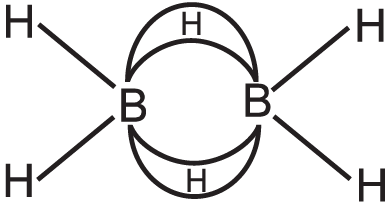
In the structure of diborane.
  • A
    All hydrogen atoms lie in one plane and boron atoms lie in a plane perpendicular to this plane.
  • $2$ boron atoms and $4$ terminal hydrogen atoms lie in the same plane and $2$ bridging hydrogen atoms lie in the perpendicular plane.
  • C
    $4$ bridging hydrogen atoms and boron atoms lie in one plane and two terminal hydrogen atoms lie in a plane perpendicular to this plane.
  • D
    All the atoms are in the same plane.
Answer
Correct option: B.
$2$ boron atoms and $4$ terminal hydrogen atoms lie in the same plane and $2$ bridging hydrogen atoms lie in the perpendicular plane.
The four terminal hydrogen atoms and the two boron atoms lie in one plane.
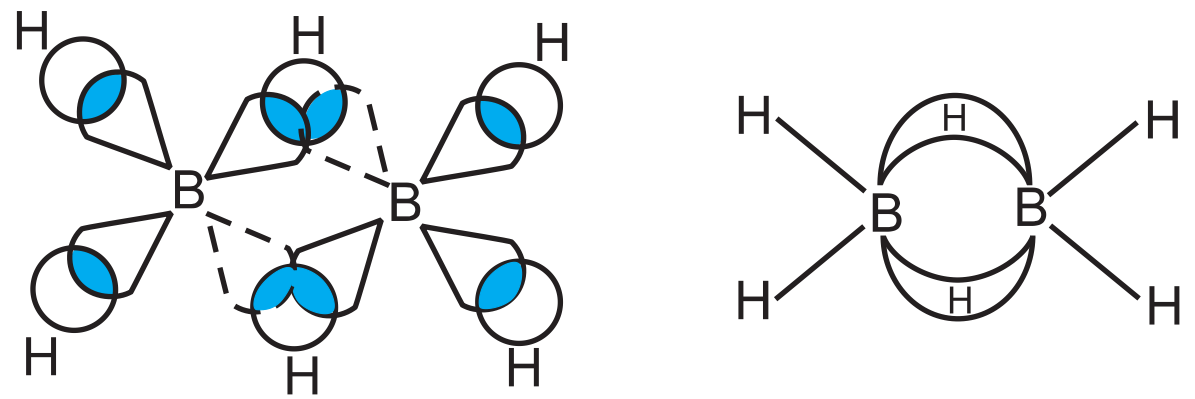
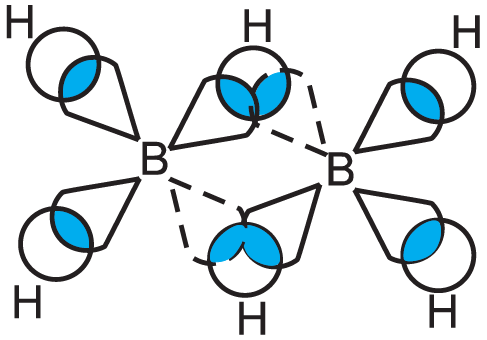
Above and below this plane, there are two bridging hydrogen atoms. The four terminal $\ce{B-H}$ bonds are regular two$-$center$-$two$-$electron bonds while the two bridge $\text{(B-H-B)}$ bonds are different and can be described in terms of three$-$centre$-$two$-$electrone bonds as shown in figure:
View full question & answer
MCQ 21 Mark
$\ce{B_2H_6}$ on heating with $\ce{NH_3}$ gases gives:
  • $ \mathrm{B}_3 \mathrm{~N}_3 \mathrm{H}_6$
  • B
    $ \mathrm{~B}_2 \mathrm{H}_6 \cdot \mathrm{NH}_3 $
  • C
    $\mathrm{H}_6 \cdot 3 \mathrm{NH}_3 $
  • D
    $\mathrm{~B}_2 \mathrm{~N}_4 \mathrm{H}_{10} $
Answer
Correct option: A.
$ \mathrm{B}_3 \mathrm{~N}_3 \mathrm{H}_6$
$3\text{B}_2\text{H}_6+6\text{NH}_3\rightarrow2\text{B}_3\text{N}_3\text{H}_6+12\text{H}_2\\\ \ \ \ \ \ \ \ \ \ \ \ \ \ \ \ \ \ \ \ \ \ \ \ \ \ \ \ \ \ \ \ \ \ ^\text{(Inorganic benzene)}$
View full question & answer
MCQ 31 Mark
Catenation i.e., linking of similar atoms depends on size and electronic configuration of atoms. The tendency of catenation in Group $14$ elements follows the order:
  • A
    $\text{C > Si > Ge > Sn.}$
  • $\text{C >> Si > Ge ≈ Sn.}$
  • C
    $\text{Si > C > Sn > Ge.}$
  • D
    $\text{Ge > Sn > Si > C.}$
Answer
Correct option: B.
$\text{C >> Si > Ge ≈ Sn.}$
The decrease in catenation property is linked with $M – M$ bond energy which decreases from carbon to tin.
$\text{C}-\text{C}\ \ \ \ \ \ \ \ \text{Si}-\text{S}\ \ \ \ \ \ \ \ \text{Ge}-\text{Ge}\ \ \ \ \ \ \ \ \text{Sn}-\text{Sn}\\^{83\text{kcal/ mol}}\ \ \ \ ^{54\text{kcal/ mol}}\ \ \ \ ^{40\text{kcal/ mol}}\ \ \ \ \ \ \ \ ^{37\text{kcal/ mol}}$
Thus, two options $(a)$ and $(b)$ are correct in this question but $(b)$ is more approprite.
$\text{C}>>\text{Si}\ \ \ \ \ \ > \ \ \ \ \ \text{Ge}\approx\text{Sn}\\ ^{\text{large difference}\\ \ \ \ \text{in energy}}\ \ \ \ \ \ \ \ \ \ ^{\text{Small difference}\\ \ \ \ \text{in energy}}$
View full question & answer
MCQ 41 Mark
Kieselguhr contains :
  • A
    Carbon
  • Silicon
  • C
    Boron
  • D
    Iodine
Answer
Correct option: B.
Silicon
Keisulguhr is a naturally occurring soft silicons sedimentary rock that is easily crumbled into fine white$-$to$-$off$-$white powder. It contains $80−90\%$ silica, with $2−4\%$ alumina. So it has silicon.
View full question & answer
MCQ 51 Mark
Which of the following figures show$(s)$ the bonding in diborane?
  • A
  • B
  • Both $(A)$ and $(b)$
  • D
    None of these.
Answer
Correct option: C.
Both $(A)$ and $(b)$
In the structure of diborane, each $B$ atom uses $sp^3$-hybridised orbital for bonding. Out of the four $sp^3 -$hybridised orbitals on each $B$ atom, one is without an electron shown by dotted lines. The terminal $B-H$ bonds are normal $2$ centre$-2$ electron bonds but the two bridge bonds are $3$ centre$-2$ electron bonds. The $3$ centre$-2$ electron bridge bonds are also refered as banana bonds.
View full question & answer
MCQ 61 Mark
In representative elements the ionization energy values generally decrease smoothly down the group. But in boron group the values show an erratic trend. This is mainly due to:
  • A
    increase in metallic nature down the group
  • B
    inert pair effect in the heavier elements of the group
  • $d-$block contraction and lanthanide contraction affecting the values of later elements due to poor shielding by $d$ and $f$ electrons
  • D
    The different type of packing in their crystalline structure
Answer
Correct option: C.
$d-$block contraction and lanthanide contraction affecting the values of later elements due to poor shielding by $d$ and $f$ electrons
Poor shielding of nuclear charge in $Ga$ by $3d$ electrons results in smaller atomic size and higher $I.P$ for the atom. Similarly, in $TI$ the poor shielding by the $4f$ electrons leads to higher $I.P$ or the atom. Hence, first $I.P$ values for the $3^{rd}$ group elements show erratic trend.
View full question & answer
MCQ 71 Mark
Which of the following statements about anhydrous aluminium chloride is correct?
  • It exists as $\ce{AlCl_3}$​ molecule in vapour.
  • B
    It is a strong Lewis base.
  • C
    It sublimes at $100^{\circ}C$ under vacuum.
  • D
    It is not readily hydrolyzed
Answer
Correct option: A.
It exists as $\ce{AlCl_3}$​ molecule in vapour.
It exists as dimer in vapour.
It is a strong Lewis acid due to incomplete octet and because of that it can be easily hydrolyzed.
View full question & answer
MCQ 81 Mark
The coloured bead produced when borax is heated with $Cu$ in an oxidizing flame is:
  • A
    Greenish
  • Green when hot $\&$ blue when cold
  • C
    Yellow
  • D
    Red
Answer
Correct option: B.
Green when hot $\&$ blue when cold
The coloured metaborate $\mathrm{Cu}\left(\mathrm{BO}_2\right)_2$​ formed when borax is heated with $Cu$ is green when hot and blue when cold.
View full question & answer
MCQ 91 Mark
The element which exists in liquid state for a wide range of temperature and can be used for measuring high temperature is :
  • A
    $B.$
  • B
    $Al.$
  • $Ga.$
  • D
    $In.$
Answer
Correct option: C.
$Ga.$
The melting point of gallium is $30^{\circ} C$ and boiling point is $2240^{\circ} C$. Thus, the element exists in liquid state for a wide range of temperature.
View full question & answer
MCQ 101 Mark
Boric acid is an acid because its molecule.
  • A
    Contains replaceable $H^+$ ion.
  • B
    Gives up a proton.
  • Accepts $OH^-$ from water releasing proton.
  • D
    Combines with proton from water molecule.
Answer
Correct option: C.
Accepts $OH^-$ from water releasing proton.
Because of the small size of boron atom and presence of only six electrons in its valence shell, $\ce{B(OH)_3}$ accepts a pair of electrons from $\ce{OH^-}$ ion of $\ce{H_2O}$, releasing a proton.
View full question & answer
MCQ 111 Mark
Which of the following has trigonal planar geometry?
  • $\ce{BF_3}$
  • B
    $\ce{NH_3}$
  • C
    $\ce{PCI_3}$
  • D
    $\ce{IF_3}$
Answer
Correct option: A.
$\ce{BF_3}$
$\ce{BF_3 , p^2}$ hybridised, trigonal planar, bond angle $120^{\circ}$
View full question & answer
MCQ 121 Mark
Element showing the phenomenon of allotropy is:
  • $Al$
  • B
    $Pb$
  • C
    $Sn$
  • D
    $Cu$
Answer
Correct option: A.
$Al$
Among the given elements tin $(Sn)$ shows the allotropy.
$\beta$-$tin ($the metallic form, or white tin$)$, which is stable at and above room temperature, is malleable. In contrast, $\alpha - tin ($nonmetallic form, or gray tin$)$, which is stable below $13.2^{\circ}C (55.8^{\circ}F),$ is brittle.
View full question & answer
MCQ 131 Mark
Which of the following is not isostructural with $\ce{SicI_4}$?
  • A
    $\text{SO}^{2-}_4$
  • B
    $\text{PO}^{3-}_4$
  • C
    $\text{NH}^{+}_4$
  • $\text{Scl}_4$
Answer
Correct option: D.
$\text{Scl}_4$
$\ce{Scl_4}$ is not isostructural, it has sea$-$saw shope, others are tetrahedral.
View full question & answer
MCQ 141 Mark
Which of the following is a Lewis acid?
  • $\ce{AlCl_3}$.
  • B
    $\ce{MgCl_2}$.
  • C
    $\ce{CaCl_2}$.
  • D
    $\ce{BaCl_2}$.
Answer
Correct option: A.
$\ce{AlCl_3}$.
Lewis acids are the species in which octate is not complete and ready to accept electrons. In $\ce{AlCl_3},Al$ is surrounded by $6$ electrons and all three $Cl$ atoms are surrounded by $8$ electrons, therefore, $\ce{AlCl_3}$ is electron accepter. It is a covalent compound.
View full question & answer
MCQ 151 Mark
Indite is a mineral for the production of $.........$
  • indium
  • B
    aluminium
  • C
    boron
  • D
    gallium
Answer
Correct option: A.
indium
Indite is an extremely rare indium$-$iron sulfide mineral, found in Siberia.
Its chemical formula is $\ce{FeIn_2​S_4}$.
View full question & answer
MCQ 161 Mark
Borax is :
  • A
    Miscible in water.
  • B
    Immiscible in oil.
  • Partially soluble in cold water $\&$ fairly soluble in hot water.
  • D
    Insoluble in water.
Answer
Correct option: C.
Partially soluble in cold water $\&$ fairly soluble in hot water.
Borax slightly soluble in cold water, very soluble in hot water and insoluble in acids.
View full question & answer
MCQ 171 Mark
How many electrons can fit in the orbital for which n = 3 and l = 1?
  • A
    10
  • B
    14
  • C
    2
  • 6
Answer
Correct option: D.
6
Explanation: d. 6
n = 3 and l = 1
⇒ 3p orbital so 3p orbital can accommodate 6 electrons.
View full question & answer
MCQ 181 Mark
Total number of sigma bonds formed by all the boron atoms in borax is:
  • $14$
  • B
    $4$
  • C
    $9$
  • D
    $7$
Answer
Correct option: A.
$14$
View full question & answer
MCQ 191 Mark
Which of the following is a white crystalline solid, with soapy touch?
  • A
    Borax.
  • Orthoboric acid.
  • C
    Diborane.
  • D
    None of these.
Answer
Correct option: B.
Orthoboric acid.
View full question & answer
MCQ 201 Mark
Vapour pressure of a solvent containing nonvolatile solute is $.........$
  • A
    more than the vapour pressure of a solvent
  • less than the vapour pressure of solvent
  • C
    equal to the vapour pressure of solvent
  • D
    none
Answer
Correct option: B.
less than the vapour pressure of solvent
At any given temperature, the vapor pressure of a solution containing a nonvolatile solute is less than that of the pure solvent. This effect is called vapor pressure lowering. The solid line in Figure is a plot of the vapor pressure of pure water versus temperature. The break in the curve at $0^{\circ} C$ is the intersection of the curve of the vapor pressure of the solid with the curve of the vapor pressure of the liquid. The dashed line in is a plot of the vapor pressure of an aqueous solution of sugar versus temperature. Notice that the vapor pressure of the solution is always less than that of the pure solvent.
The vapor pressure of pure water is shown as a solid line; the vapor pressure of an aqueous solution is shown as a dashed line. Note the differences between the solution and the pure substance in melting point and boiling point.
View full question & answer
MCQ 211 Mark
Cement, the important building material is a mixture of oxides of several elements. Besides calcium, iron and sulphur, oxides of elements of which of the group $(s)$ are present in the mixture?
  • A
    Group $2$
  • Groups $2, 13$ and $14$
  • C
    Groups $2$ and $13$
  • D
    Groups $2$ and $14$
Answer
Correct option: B.
Groups $2, 13$ and $14$
groups $2(\mathrm{MgO})$, Group $13\left(\mathrm{Al}_2 \mathrm{O}_3\right)$, Group $14\left(\mathrm{SiO}_2\right)$.
View full question & answer
MCQ 221 Mark
Borax contains the tetranuclear units. Thus, its formula can be written as:
  • A
    $[\text{Na}_2\text{B}_4\text{O}_5(\text{OH})_4].8\text{H}_2\text{O}$
  • $\text{Na}_2[\text{B}_4\text{O}_5(\text{OH)}_4].8\text{H}_2\text{O}$
  • C
    $[\text{Na}_2\text{B}_4\text{O}_5(\text{OH})_6].6\text{H}_2\text{O}$
  • D
    None of the above.
Answer
Correct option: B.
$\text{Na}_2[\text{B}_4\text{O}_5(\text{OH)}_4].8\text{H}_2\text{O}$
View full question & answer
MCQ 231 Mark
Which of the following is a water$-$borne disease:
  • A
    Malaria
  • Dysentery
  • C
    Pneumonia
  • D
    Breathlessness
Answer
Correct option: B.
Dysentery
Water borne diseases are caused by micro organisma in untreated contaminated water.
ex. Cholera,Dysentery.
View full question & answer
MCQ 251 Mark
Which of the following elements can present both in cation and anion of its salts?
  • A
    $B$
  • $Al$
  • C
    $Ga$
  • D
    $Tl$
Answer
Correct option: B.
$Al$
Boron can only form cation of its salts.
$Al$ can form both cation and anion of its salts.
Example: $\mathrm{Al}^3+ ($cation$) \mathrm{AlO}_3{ }^{3-} ($Anion$)$
$Ga$ and $Tl$ can only form cation of their salts.
View full question & answer
MCQ 261 Mark
Silicon is an important constituent of:
  • A
    Rocks.
  • Amalgams.
  • C
    Chlorophyll.
  • D
    Haemoglobin.
Answer
Correct option: B.
Amalgams.
Silicon is an important constituent of rock in form of silica $\ce{SiO_2}$​.
Amalgams contains $Hg$.
Haemoglobin contains iron.
Chlorophyll contains $Mg$.
View full question & answer
MCQ 271 Mark
Apatite is an ore of:
  • Fluorine.
  • B
    Chlorine.
  • C
    Bromine.
  • D
    Iodine.
Answer
Correct option: A.
Fluorine.
Apatite is $\mathrm{CaF}_2 \cdot 3 \mathrm{Ca}_3\left(\mathrm{PO}_4\right)_2$​
$\therefore$ It is an ore of fluorine with calcium.
View full question & answer
MCQ 281 Mark
Which of the following does not exhibit inert pair effect?
  • A
    $Bi$
  • B
    $Pb$
  • $B$
  • D
    $Tl$
Answer
Correct option: C.
$B$
Only high atomic weight elements in $p$ block show inert pair effect. Here $B$ is the first member of boron family and it does not have high atomic weight so it does not show inert pair effect.
View full question & answer
MCQ 291 Mark
The type of hybridisation of boron in diborane is:
  • A
    $sp.$
  • B
    $\ce{sp^2}$
  • $\ce{sp^3}$
  • D
    $\mathrm{dsp}{ }^2$
Answer
Correct option: C.
$\ce{sp^3}$
Boron in diborane is $\ce{sp^3}$ hybridized.
View full question & answer
MCQ 301 Mark
Silica is heated with carbon in electric furnace to form :
  • A
    Silicon carbonate
  • Silicon carbide or carborundum
  • C
    Silicon monoxide
  • D
    None
Answer
Correct option: B.
Silicon carbide or carborundum
View full question & answer
MCQ 311 Mark
Carbon has a unique ability to form pit$-$pt :
  • A
    Single bond,
  • B
    Double bond,
  • C
    Triple bond,
  • Multiple bond,
Answer
Correct option: D.
Multiple bond,
View full question & answer
MCQ 321 Mark
Which of the following has highest dipole moment?
  • $\mathrm{NH}_3$
  • B
    $\mathrm{NCI}_3$
  • C
    $\mathrm{NF}_3$
  • D
    $\mathrm{CO}_2$
Answer
Correct option: A.
$\mathrm{NH}_3$
$\mathrm{NH}_3$ has hightest dipole moment due to more polarity.
View full question & answer
MCQ 331 Mark
Rock crystal is :
  • A
    $\text{NaCl}$
  • B
    Sand
  • Quartz
  • D
    Agate
Answer
Correct option: C.
Quartz
All clear colourless quartzs are known as rock crystal and they are used as ornamental stone.
View full question & answer
MCQ 341 Mark
Carbon dioxide can be obtained as a solid in the form of:
  • Dry ice.
  • B
    Wet ice.
  • C
    Both $(a)$ and $(b)$
  • D
    None of these.
Answer
Correct option: A.
Dry ice.
View full question & answer
MCQ 351 Mark
The important mineral$(s)$ of $Al$ is$/$are:
  • A
    Bauxite.
  • B
    Cryolite.
  • Both $(a)$ and $(b)$
  • D
    None of these.
Answer
Correct option: C.
Both $(a)$ and $(b)$
View full question & answer
MCQ 361 Mark
When aluminium is heated in the atmosphere of nitrogen it forms a nitride of formula :
  • $\text{AlN}$
  • B
    $\mathrm{Al}_3 \mathrm{~N}$
  • C
    $\mathrm{AlN}_3$
  • D
    $\mathrm{Al}_2 \mathrm{~N}_3$​
Answer
Correct option: A.
$\text{AlN}$
When aluminium is heated in atmosphere of nitrogen it forms aluminum nitride and the reaction involve is.
$\text{2Al + N}_2\xrightarrow{\Delta}\text{2AlN}$
View full question & answer
MCQ 371 Mark
When Borax is heated with solid salt metal metaborate is produced. Which of the following reaction actually involve the metal metaborate formation?
  • Acid base reaction between metal oxide and $\mathrm{B}_2 \mathrm{O}_3$

  • B
    Oxidation reduction reaction between metal oxide and $\mathrm{B}_2 \mathrm{O}_3$

  • C
    Substitution reaction between $\mathrm{NaBO}_2\  \&$ metal oxide
     
  • D
    Complex formation reaction between metal oxide and $\mathrm{B}_2 \mathrm{O}_3$​
Answer
Correct option: A.
Acid base reaction between metal oxide and $\mathrm{B}_2 \mathrm{O}_3$

View full question & answer
MCQ 381 Mark
The compounds of boron are :
  • A
    Mostly ionic
  • Mostly covalent
  • C
    Both
  • D
    Crystalline
Answer
Correct option: B.
Mostly covalent
$IE$ and electron affinity values of boron are too high to form ionic compounds.
View full question & answer
MCQ 391 Mark
Which element does not show allotropy?
  • $Pb$
  • B
    $Si$
  • C
    $C$
  • D
    $Sn$
Answer
Correct option: A.
$Pb$
$Pb$ orbitals are too diffused to form strong single $Pb-Pb$ bonds.
View full question & answer
MCQ 401 Mark
The tendency of $Ge, Sn$ and $Pb$ to show $+2$ oxidation state increases in the sequence:
  • A
    $\text{Ge=Sn < Pb}$
  • $\text{Ge < Sn < Pb}$
  • C
    $\text{Ge > Sn > Pb}$
  • D
    $\text{Ge > Sn = Pb}$
Answer
Correct option: B.
$\text{Ge < Sn < Pb}$
The tendency of $\text{Ge, Sn, Pb}$ to show $+2$ oxidation state increases on moving from $Ge$ to $Pb.$ Thus, the correct sequence is $\text{Ge < Sn < Pb}.$
View full question & answer
MCQ 411 Mark
Boron possesses a high melting point among the elements of group$-13$ due to:
  • A
    Very high electronegativity of $B$.
  • B
    Very high ionisation energy of $B$.
  • C
    Small size of $B$.
  • Strong bonding between individual atoms in the solid state.
Answer
Correct option: D.
Strong bonding between individual atoms in the solid state.
View full question & answer
MCQ 421 Mark
The blue coloured mineral 'Lapis Lazuli' which is used as a semi$-$precious stone is a mineral of the following class:
  • Sodium alumino silicate
  • B
    Zinc cobaltate
  • C
    Basic copper carbonate
  • D
    Prussian blue
Answer
Correct option: A.
Sodium alumino silicate
Lapis Lazuli, a semi$-$precious stone is a "Sodium Alumino Silicate" class of mineral.
View full question & answer
MCQ 431 Mark
The strongest oxiding agent among the following is:
  • A
    $\mathrm{GeO}_2$
  • $\mathrm{PbO}_2$
  • C
    $\mathrm{SrO}_2$
  • D
    $\mathrm{SiO}_2$
Answer
Correct option: B.
$\mathrm{PbO}_2$
$\text{PbO}_2\because \text{Pb}^{4+}+2\text{e}^-\rightarrow\text{Pb}^{2+}$ Which is more stable due to inert pair effect.
View full question & answer
MCQ 441 Mark
Which of the following element does not show inert pair effect?
  • A
    $Tl$
  • B
    $Pb$
  • C
    $Bi$
  • $C$
Answer
Correct option: D.
$C$
The inert pair effect is the tendency of the electrons in the outermost atomic $s$ orbital to remain unionized or unshared in compounds of post$-$transition metals. The term inert pair effect is often used in relation to the increasing stability of oxidation states that are two less than the group valency for the heavier elements of groups $13, 14, 15$ and $16$. The inert pair effect is shown by $Tl, Pb$ and $Bi$ due to which, the lower oxidation state is more stable than the higher oxidation state. But $C$, being higher up in the periodic table, does not show inert pair effect.
View full question & answer
MCQ 451 Mark
Elements of group $14$ :
  • A
    Exhibit oxidation state of $+4$ only.
  • Exhibit oxidation state of $+2$ and $+4.$
  • C
    Form $\mathrm{M}^{2-}$ and $\mathrm{M}^{4+}$ ions.
  • D
    Form $\mathrm{M}^{2+}$ and $\mathrm{M}^{4+}$ ions.
Answer
Correct option: B.
Exhibit oxidation state of $+2$ and $+4.$
Due to inert pair effect, elements of group $14$ exhibit oxidation states of $+2$ and $+4$. Thus, option $(b)$ is correct.
View full question & answer
MCQ 461 Mark
$\mathrm{H}_3 \mathrm{PO}_2$ is:
  • A
    Tribani.
  • B
    Dibasic.
  • Monobasic.
  • D
    Tetrabasic.
Answer
Correct option: C.
Monobasic.
It is monobasic acid because it has one replacable hydrogen.
View full question & answer
MCQ 471 Mark
Super conductors are derived from compounds of:
  • $p-$block elements
  • B
    lanthanides
  • C
    actinides
  • D
    transition elements
Answer
Correct option: A.
$p-$block elements
View full question & answer
MCQ 481 Mark
The exhibition of highest co$-$ordination number depends on the availability of vacant orbitals in the central atom. Which of the following elements is not likely to act as central atom in $\text{MF}^{3-}_6$?
  • $B.$
  • B
    $Al.$
  • C
    $Ga.$
  • D
    $In.$
Answer
Correct option: A.
$B.$
Boron does not have $d-$orbittal. the element $M$ in the complex ion $\text{MF}^{3-}_6$has cordination number $6$. Boron can have maximum cordination number $4$. Thus, $B$ cannot from this complex.
View full question & answer
MCQ 491 Mark
The most abundant metal among the following is :
  • $Al$
  • B
    $Ca$
  • C
    $Fe$
  • D
    $K$
Answer
Correct option: A.
$Al$
In the Earth's crust, aluminium is the most abundant $(8.3\%$ by weight$)$ metallic element and the third most abundant of all elements $($after oxygen and silicon$)$.
View full question & answer
MCQ 501 Mark
The geometry of a complex species can be understood from the knowledge of type of hybridisation of orbitals of central atom. The hybridisation of orbitals of central atom in $\ce{[Be(OH)^4]^-}$ and the geometry of the complex are respectively.
  • $\mathrm{sp}^3$, tetrahedral.
  • B
    $\mathrm{sp}^3$, square planar.
  • C
    $\mathrm{sp}^3 \mathrm{~d}^2$, octahedral.
  • D
    $\ce{dsp^2}$, square planar.
Answer
Correct option: A.
$\mathrm{sp}^3$, tetrahedral.
Boron has die electronic configuration:
$1\text{s}^22\text{s}^22\text{p}^1_\text{x}2\text{p}^0_\text{y}2\text{p}^0_\text{z}$
In the excited state, $2s-$orbital electrons are impaired and one electron is shifted to a $p-$orbital. Now, hybridisation occurs between one $s-$and three $p-$orbitals to give $sp^3$ hybridisation and tetrahedral geometry.
$1\text{s}^2\underbrace{2\text{s}^12\text{p}^1_\text{x}2\text{p}^1_\text{y}2\text{p}^0_\text{z}}\\ \ \ \ \text{sp}^3\text{-hybridisation}$
View full question & answer
M.C.Q (1 Marks) - Chemistry STD 11 Science Questions - Vidyadip