MCQ 511 Mark
Choose the correct answer. The equation of the ellipse whose focus is $(1, -1),$ the directrix the line $x - y - 3 = 0$ and eccentricity $\frac{1}{2}$ is:
- ✓
$ 7 x^2+2 x y+7 y^2-10 x+10 y+7=0 $
- B
$ 7 x^2+2 x y+7 y^2+7=0 $
- C
$ 7 x^2+2 x y+7 y^2+10 x-10 y-7=0 $
- D
AnswerCorrect option: A. $ 7 x^2+2 x y+7 y^2-10 x+10 y+7=0 $
Given that, fouus of the ellipse is $S(1, -1)$ and the equation of directrix is $x - y - 3 = 0$
Also, $\text{e}=\frac{1}{2}$
From definition of ellipse, for any point $P(x, y)$ on the ellipse,
we have $\text{SP = ePM,}$ where $M$ is foot of the perpendicular from point $P$ to the directrix.
$\therefore\ \sqrt{(\text{x}-1)^2+(\text{y}+1)^2}=\frac{1}{2}\frac{|\text{x}-\text{y}-3|}{\sqrt{2}}$
$\Rightarrow 8x^2- 16x + 16 + 8y^2+ 16y = x^2+ y^2+ 9 - 2xy + 6y - 6x$
$\Rightarrow 7 x^2+2 x y+7 y^2-10 x+10 y+7=0 $
View full question & answer→MCQ 521 Mark
The eccentricity of the hyperbola $x^2- 4y^2= 1$
- A
$\frac{\sqrt3}{2}$
- ✓
${\frac{\sqrt5}{2}}$
- C
${\frac{2}{\sqrt3}}$
- D
$\frac{2}{\sqrt5}$
AnswerCorrect option: B. ${\frac{\sqrt5}{2}}$
The equation of the hyperbola is $x^2- 4y^2= 1$.
This can be rewritten in the following way:
$\frac{\text{x}^2}{1}-\frac{\text{y}^2}{\frac{1}{4}}=1$
This is the standard form of a hyperbola, where $a = 1$ and $\text{b}^2=\frac{1}{4}.$
The value of eccentricity is calculated in the following way:
$\text{b}^2=\text{a}^2(\text{e}^2-1)$
$\Rightarrow\frac{1}{4}=(\text{e}^2-1)$
$\Rightarrow\text{e}^2=\frac{5}{4}$
$\Rightarrow\text{e}=\frac{\sqrt5}{4}$
View full question & answer→MCQ 531 Mark
The equations of the tangents to the ellipse $9\text{x}^2+16\text{y}^2=144$ from the point $(2, 3)$ are:
- A
$y = 3, x = 5$
- B
$x = 2, y = 3$
- C
$x = 3, y = 2$
- ✓
$x + y = 5, y = 3$
AnswerCorrect option: D. $x + y = 5, y = 3$
$\Rightarrow\frac{\text{x}^2}{16}+\frac{\text{y}^2}{9}=1$
Equation of the tangent in case of an ellipse is given by
$\text{y}=\text{mx}+\sqrt{\text{a}^2\text{m}^2+\text{b}^2}$
$\Rightarrow\text{y}=\text{mx}+\sqrt{16\text{m}^2+9}\ \dots(1)$
Substituting $x = 2$ and $y = 3,$ we get:
$3=2\text{m}\pm\sqrt{16\text{m}^2+9}$
$\Rightarrow3-2\text{m}=\sqrt{16\text{m}^2+9}$
On squaring both sides, we get:
$(3-2\text{m})^2=(16\text{m}^2+9)$
$\Rightarrow9+4\text{m}^2-12\text{m}=(16\text{m}^2+9)$
$\Rightarrow12\text{m}^2+12\text{m}=0$
$\Rightarrow12\text{m}(\text{m+1})=0$
$\Rightarrow\text{m}=0,-1$
Substituting values of m in eq. $(1),$ we get:
For $\text{m}=0,\ \text{y}=3$
For $\text{m}=-1,\ \text{y}=-\text{x}+5$ or $\text{x}+\text{y}=5$
View full question & answer→MCQ 541 Mark
The circle with radius $1$ and centre being foot of the perpendicular from $(5, 4)$ on $y-$axis, is:
- A
$ x^2+y^2-8 x-15=0 $
- B
$ x^2+y^2-10 x+24=0 $
- ✓
$ x^2+y^2-8 y+15=0 $
- D
AnswerCorrect option: C. $ x^2+y^2-8 y+15=0 $
Foot of perpendicular of $(5, 4)$ on $y-$axis is $(0, 4)$
$\therefore$ The equation of circle with
radius $1\ cm$ is $(x - 0)^2+ (y - 4)^2= 1$
$\Rightarrow x^2 + y^2- 8y + 16$
$\Rightarrow x^2+y^2-8 y+15=0 $
View full question & answer→MCQ 551 Mark
Choose the correct answer. The area of the circle centred at $(1, 2)$ and passing through $(4, 6)$ is:
AnswerCorrect option: C. $25\pi$
Given that the centre of the circle is $(1, 2)$
Radius of the circle $=\sqrt{(4-1)^2+(6-2)^2}$
$=\sqrt{9+16}$
$=5$
So, the area of the circle $=\pi\text{r}^2$
$=\pi\times(5)^2$
$=25\pi$
View full question & answer→MCQ 561 Mark
Determine the area enclosed by the curve $x^2- 10x + 4y + y^2= 196:$
- A
$15\pi$
- ✓
$225\pi$
- C
$20\pi$
- D
$17\pi$
AnswerCorrect option: B. $225\pi$
View full question & answer→MCQ 571 Mark
Equation of the diameter of the circle $x^2+ y^2− 2x + 4y = 0$ which passes through the origin is:
- A
$x + 2y = 0$
- B
$x − 2y = 0$
- ✓
$2x + y = 0$
- D
$2x − y = 0$
AnswerCorrect option: C. $2x + y = 0$
Let the diameter of the circle be $y = mx.$
Since the diameter of the circle passes through its centre, $(1, -2)$ satisfies the equation of the diameter.
$\therefore m = -2$
Substituting the value of m in the equation of diameter:
$y = -2x$
$\Rightarrow 2x + y = 0$
Hence, the required equation of the diameter is $2x + y = 0.$
View full question & answer→MCQ 581 Mark
The length of the transverse axis is the distance between the:
AnswerThe length of the transverse axis is the distance between two vertices.
View full question & answer→MCQ 591 Mark
The order of the differential equation of the family of parabolas whose length of latus rectum is fixed and axis is the $x-$axis:
View full question & answer→MCQ 601 Mark
If $2\text{x}^2+\lambda\text{xy}+2\text{y}^2(\lambda-4)\text{x}+6\text{y}-5=0$ is the equation of a circle, then its radius is:
- A
$3\sqrt{2}$
- B
$2\sqrt{3}$
- C
$2\sqrt{2}$
- ✓
AnswerThe given equation is $2\text{x}^2+\lambda\text{xy}+2\text{y}^2+(\lambda-4)\text{x}+6\text{y}-5=0$ which can be rewritten as
$\text{x}^2+\frac{\lambda\text{xy}}{2}+\text{y}^2+\frac{(\lambda-4)}{2}\text{x}+3\text{y}-\frac{5}{2}=0.$
Comparing the given equation $\text{x}^2+\text{y}62+2\text{gx}+2\text{fy}+\text{c}=0$ with we get: $\lambda=0$
$\therefore\text{x}^2+\text{y}^2-2\text{x}+3\text{y}-\frac{5}{2}=0$
$\therefore$ Radius $=\sqrt{(-1)^2+\Big(\frac{3}{2}\Big)^2+\frac{5}{2}}$
$=\sqrt{1+\frac{9}{4}+\frac{5}{2}}$
$=\sqrt{\frac{23}{4}}$
$=\frac{\sqrt{23}}{2}$
View full question & answer→MCQ 611 Mark
If the circle $x^2+ y^2+ 2ax + 8y + 16 = 0$ touches $x-$axis, then the value of $a$ is:
- A
$\pm16$
- ✓
$\pm4$
- C
$\pm8$
- D
$\pm1$
AnswerCorrect option: B. $\pm4$
The equation of the circle is $x^2+ y^2+ 2ax + 8y + 16 = 0.$
Its centre is $(-a, -4)$ and its radius is a units.
Since the circle touches the $x-$axis, we have:
$\sqrt{(-\text{a}+\text{a})^2+(4-0)^2}=\text{a}$
$\Rightarrow\text{a}=\pm4$
View full question & answer→MCQ 621 Mark
The radius of the circle represented by the equation $3\text{x}^2+3\text{y}^2+(\lambda-6)\text{y}+3=0$ is:
- ✓
$\frac{3}{2}$
- B
$\frac{\sqrt{17}}{2}$
- C
$\frac{2}{3}$
- D
AnswerCorrect option: A. $\frac{3}{2}$
The equation of the circle is $3\text{x}^2+3\text{y}^2+(\lambda-6)\text{y}+3=0$
$\therefore$ Coefficient of $\text{xy}=0$
$\Rightarrow\lambda=0$
$\therefore3\text{x}^2+3\text{y}^2+9\text{x}-6\text{y}+3=0$
$\Rightarrow\text{x}^2+\text{y}^2+3\text{x}-2\text{y}+1=0$
Therefore, the radius of the circle is $\sqrt{\Big(\frac{3}{2}\Big)^2+(-1)^2-1}=\frac{3}{2}.$
View full question & answer→MCQ 631 Mark
The equation of a hyperbola with foci on the $x-$axis is:
- A
$\frac{\text{x}^2}{\text{a}^2}+\frac{\text{y}^2}{\text{b}^2} = 1$
- ✓
$\frac{\text{x}^2}{\text{a}^2}-\frac{\text{y}^2}{\text{b}^2} = 1$
- C
${x}^2 + \text{y}^2 = (\text{a}^2 + \text{b}^2)$
- D
$\text{x}^2 - \text{y}^2 = (\text{a}^2 + \text{b}^2)$
AnswerCorrect option: B. $\frac{\text{x}^2}{\text{a}^2}-\frac{\text{y}^2}{\text{b}^2} = 1$
The equation of a hyperbola with foci on the $x-$axis is defined as. $\frac{\text{x}^2}{\text{a}^2}-\frac{\text{y}^2}{\text{b}^2} = 1$
View full question & answer→MCQ 641 Mark
The equation $x^2+ y^2- 2x + 4y + 5 = 0$ represents:
- ✓
- B
- C
A circle of non zero radius
- D
Answer$ x^2+y^2-2 x+4 y+5=0 $
$ (x-1)^2+(y+2)^2-5+5=0 $
$ \Rightarrow(x-1)^2+(y+2)^2=0 $
Since, radius is $0,$ its a point
Alternative method:
Here, $a = b = 1$
$\text{r}=\sqrt{1+4-5=0}$
a circle of radius $0.$
So, its a point.
View full question & answer→MCQ 651 Mark
The equation to the circle with centre $(2, 1)$ and touches the line $3x + 4y - 5$ is:
- A
$ x^2+y^2-4 x-2 y+5=0 $
- B
$ x^2+y^2-4 x-2 y-5=0 $
- ✓
$ x^2+y^2-4 x-2 y+4=0 $
- D
AnswerCorrect option: C. $ x^2+y^2-4 x-2 y+4=0 $
distance of pt. $(2, 1)$ from line $3x + 4y - 5$ is radius$(r)$
$\Rightarrow\text{r}=\frac{\mid6+4-5\mid}{5}=\frac{5}{5}=1$
$\Rightarrow$ Equation of circle is
$\Rightarrow (x - 2)^2 + (y - 1)^2= 1$
$\Rightarrow x^2+y^2-4 x-2 y+4=0 $
View full question & answer→MCQ 661 Mark
The distance between the directrices of the hyperbola $\text{x}=8\sec\theta,\text{y}=8,$ is
- ✓
$8\sqrt2$
- B
$16\sqrt2$
- C
$4\sqrt2$
- D
$6\sqrt2$
AnswerCorrect option: A. $8\sqrt2$
We have:
$\text{x}=8\sec\theta,\text{y}=8\tan\theta$
On squaring and subtracting:
$\text{x}^2-\text{y}^2=8\sec^2\theta-8\tan^2\theta$
$\Rightarrow\text{x}^2-\text{y}^2=8$
$\Rightarrow\frac{\text{x}^2}{8}-\frac{\text{y}^2}{8}=1$
$\therefore\text{a}=\text{b}=\text{c}$
Distance between the directrices of the hyperbola $=\frac{2\text{a}^2}{\sqrt{\text{a}^2+\text{b}^2}}$
Distance between the directrices $=\frac{2\times64}{\sqrt{64+64}}$
$=\frac{128}{8\sqrt2}$
$=\frac{16}{\sqrt2}$
$=8\sqrt2$
View full question & answer→MCQ 671 Mark
The equation of the conic with focus at (1, -1) directrix along x - y + 1 = 0 and eccentricity $\sqrt2$ is
AnswerSolution: (D) 2xy - 4x + 4y + 1 = 0
Let P(x, y) be any point on the hyperbola.
Then, the distance of any point from the focus is eccentricity times the distance from the directrix.
$\therefore\sqrt{(\text{x}-1)^2+(\text{y}+1)^2}=\sqrt2\Big|\frac{\text{x}-\text{y}+1}{\sqrt2}\Big|$
Squaring both the sides, we get:
$ (x-1)^2+(y+1)^2=(x-y+1)^2 $
$ x^2-2 x+1+y^2+1+2 y=x^2+y^2+1-2 x y-2 y+2 x $
$ 2 x y-4 x+4 y+1=0 $
View full question & answer→MCQ 681 Mark
The equation of a circle with radius $5$ and touching both the coordinate axes is:
- A
$x^2+ y^2± 10x ± 10y + 5 = 0$
- B
$x^2+ y^2 ± 10x ± 10y = 0$
- ✓
$x^2+ y^2± 10x ± 10y + 25 = 0$
- D
$x^2+ y^2 ± 10x ± 10y + 51 = 0$
AnswerCorrect option: C. $x^2+ y^2± 10x ± 10y + 25 = 0$
Case $I:$ If the circle lies in the first quadrant:
The equation of a circle that touches both the coordinate axes and hasradius a is $x^2+ y^2- 2ax - 2ay + a^2 = 0.$
The given radius of the circle is $5$ units, i.e. $a = 5.$
Thus, the equation of the circle is $x^2+ y^2 - 10x - 10y + 25 = 0.$
Case $II:$ If the circle lies in the second quadrant:
The equation of a circle that touches both the coordinate axes and has radius a is $x^2+ y^2 + 2ax - 2ay + a^2= 0$.
The given radius of the circle is $5$ units, i.e. $a = 5.$
Thus, the equation of the circle is $x^2+ y^2 + 10x - 10y + 25 = 0.$
Case $III:$ If the circle lies in the third quadrant:
The equation of a circle that touches both the coordinate axes and has radius a is $x^2+ y^2 + 2ax + 2ay + a^2= 0$
The given radius of the circle is $5$ units, i.e. $a = 5.$
Thus, the equation of the circle is $x^2+ y^2+ 10x + 10y + 25 = 0.$
Case $IV:$ If the circle lies in the fourth quadrant:
The equation of a circle that touches both the coordinate axes and has radius a is $x^2+ y^2 - 2ax + 2ay + a^2= 0$.
The given radius of the circle is $5$ units, i.e. $a = 5.$
Thus, the equation of the circle is $x^2+ y^2 - 10x + 10y + 25 = 0.$
Hence, the required equation of the circle is $x^2+ y^2± 10x ± 10y + 25 = 0.$
View full question & answer→MCQ 691 Mark
The perpendicular distance from the point $(3, -4)$ to the line $3x - 4y + 10 = 0:$
View full question & answer→MCQ 701 Mark
If the point $(\lambda,\ \lambda+1)$ lies inside the region bounded by the curve $\text{x}=\sqrt{25-\text{y}^2}$ and $y-$axis, then $\lambda$ belongs to the interval:
AnswerCorrect option: A. $(-1,\ 3)$
The given equation of the curve is $x^2+ y^2= 25$
Since $(\lambda,\ \lambda+1)$ lies inside the region bounded by the curve $x^2+ y^2= 25$ and the $y-$axis, we have:
$\lambda^2+(\lambda+1)^2 < 25,$ provided $\lambda+1 > 0$
$\Rightarrow\lambda^2+\lambda^2+12\lambda < 25,\ \lambda > -1$
$\Rightarrow2\lambda^2+2\lambda-24 < 0,\ \lambda>-1$
$\Rightarrow\lambda^2+\lambda-12 < 0,\ \lambda>-1$
$\Rightarrow(\lambda-3)(\lambda+4) < 0,\ \lambda>-1$
$\Rightarrow-4 < \lambda<3,\ \lambda>-1$
$\Rightarrow\lambda\in(-1,\ 3)$
View full question & answer→MCQ 711 Mark
The center of the circle $4x^2+ 4y^2- 8x + 12y - 25 = 0$ is:
- ✓
$(2, -3)$
- B
$(-2, 3)$
- C
$(-4, 6)$
- D
$(4, -6)$
AnswerCorrect option: A. $(2, -3)$
View full question & answer→MCQ 721 Mark
The equation of circle center at $(0, 0)$ and Radius $8\ cm:$
- ✓
$x^2+ y^2 = 64$
- B
$x^2+ y^2 = 8$
- C
$x^2+ y^2= 16$
- D
AnswerCorrect option: A. $x^2+ y^2 = 64$
The equation of circle is $x^2+ y^2 = r^2$
$x^2+ y^2= 8^2$
$x^2+ y^2= 64$
View full question & answer→MCQ 731 Mark
The area of an equilateral triangle inscribed in the circle $x^2+ y^2 - 6x - 8y - 25 = 0$ is:
- ✓
$\frac{225\sqrt{3}}{6}$
- B
$25\pi$
- C
$50\pi-100$
- D
AnswerCorrect option: A. $\frac{225\sqrt{3}}{6}$
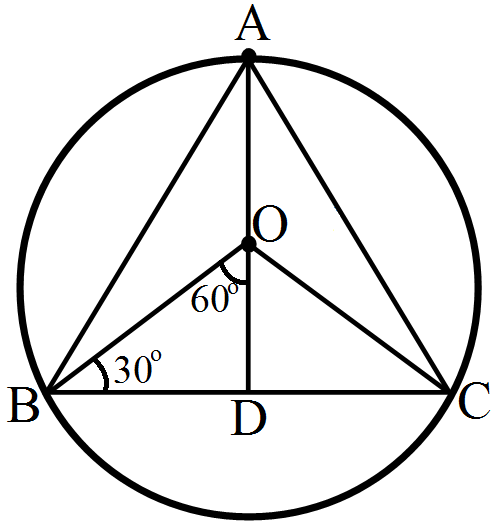
Let $\text{ABC}$ be the required equilateral triangle.
The equation of the circle is $x^2+ y^2 - 6x - 8y - 25 = 0.$
Therefore, coordinates of the centre $O$ is $(3, 4).$
Radius of the circle $=\text{OA}=\text{OB}=\text{OC}=\sqrt{9+16+25}=5\sqrt{2}$
In $\Delta\text{BOD},$ we have:
$\sin60^\circ=\frac{\text{DB}}{\text{BO}}$
$\Rightarrow\text{DB}=\frac{\sqrt{3}}{2}(5\sqrt{2})$
$\Rightarrow\text{BC}=2\text{BD}-\sqrt{3}\big(5\sqrt{2}\big)=5\sqrt{6}$
Now, area of $\triangle\text{ABC}=\frac{\sqrt{3}}{4}\text{BC}^2=\big(5\sqrt{6}\big)^2$
$=\frac{\sqrt{3}(150)}{4}$
$=\frac{\sqrt{3}(75)}{2}$
$=\frac{\sqrt{3}(225)}{6}$ square units View full question & answer→MCQ 741 Mark
The distance between the foci of a hyperbola is $16$ and its eccentricity is $\sqrt2$ , then equation of the hyperbola is
- A
$x^2+ y^2 = 32$
- B
$x^2- y^2 = 16$
- C
$x^2+ y^2 = 16$
- ✓
$x^2- y^2 = 32$
AnswerCorrect option: D. $x^2- y^2 = 32$
The distance between the foci is $2ae.$
$\therefore 2ae = 16$
$\Rightarrow ae = 8$
$\text{e}=\sqrt2$
$\therefore\text{a}\sqrt2=8$
$\Rightarrow\text{a}=4\sqrt2$
Also $ b^2=a^2\left(e^2-1\right) $
$\Rightarrow b^2=32(2-1) $
$\Rightarrow b^2=32 $
Standard form of the hyperbola is given below:
$\frac{\text{x}^2}{32}-\frac{\text{y}^2}{32}=1$
$\text{x}^2-\text{y}^2=32$
View full question & answer→MCQ 751 Mark
Which of the following points lie on the parabola $x^2 = 4ay$?
- A
$x = at^2, y = 2at$
- B
$x = 2at, y = at^2$
- C
$x = 2at^2, y = at$
- ✓
$x = 2at, y = at^2$
AnswerCorrect option: D. $x = 2at, y = at^2$
Substituting $x = 2at, y = at^2$ in the given equation:
$(2at)^2= 4a(at^2)$
$⇒ 4a^2t^2 = 4a^2t^2$
Hence, $(2at, at^2)$ lies on the parabola $x^2 = 4ay$.
View full question & answer→MCQ 761 Mark
The equation of the circle concentric with $x^2+ y^2- 3x + 4y - c = 0$ and passing through $(-1, -2)$ is:
AnswerCorrect option: B. $x^2+ y^2- 3x + 4y = 0$
The centre of the circle $x^2 + y^2- 3x + 4y - c = 0$ is $\Big(\frac{3}{2},\ -2\Big).$
Therefore, the centre of the required circle is $\Big(\frac{3}{2},\ -2\Big).$
The equation of the circle is $\Big(\text{x}-\frac{3}{2}\Big)^2+(\text{y}+2)^2=\text{a}^2. \ ......(1)$
Also, circle $(1)$ passes through $(-1, -2).$
$\therefore\Big(-1-\frac{3}{2}\Big)^2+\Big(-2+2\Big)^2=\text{a}^2$
$\Rightarrow\text{a}=\frac{5}{2}$
Substituting the value of a in equation $(1):$
$\Big(\text{x}-\frac{3}{2}\Big)^2+(\text{y}+2)^2=\Big(\frac{5}{2}\Big)^2$
$\Rightarrow\frac{(2\text{x}-3)^2}{4}+(\text{y}+2)^2=\frac{25}{4}$
$\Rightarrow(2\text{x}-3)^2+4(\text{y}+2)^2=25$
$\Rightarrow\text{x}^2+\text{y}^2-3\text{x}+4\text{y}=0$
Hence, the required equation of the circle is $x^2+ y^2- 3x + 4y = 0$
View full question & answer→MCQ 771 Mark
The equation of the circle passing through $(2, 0)$ and $(0, 4)$ and having the minimum radius is:
- A
$ x^2+y^2=20$
- ✓
$ x^2+y^2-2 x-4 y=0 $
- C
$ x^2+y^2=4 $
- D
AnswerCorrect option: B. $ x^2+y^2-2 x-4 y=0 $
Given, points are $(2, 0)$ and $(0, 4)$
$\therefore$ equation of circle is $(x - 2) (x - 0) + (y - 0) (y - 4) = 0$
By expanding, we get
$x^2 - 2x + y^2 - 4y = 0$
View full question & answer→MCQ 781 Mark
Choose the correct answer. The equation of a circle with origin as centre and passing through the vertices of an equilateral triangle whose median is of length $3a$ is:
- A
$ x^2+y^2=9 a^2 $
- B
$ x^2+y^2=16 a^2 $
- ✓
$ x^2+y^2=4 a^2 $
- D
$x 2+y 2=a 2 $
AnswerCorrect option: C. $ x^2+y^2=4 a^2 $
Let $\text{ABC}$ be an equilateral triangle in which mediam $\text{AD = 3a}$
Centre of the circle is same as the centroid of the triangle i.e., $(0, 0)$
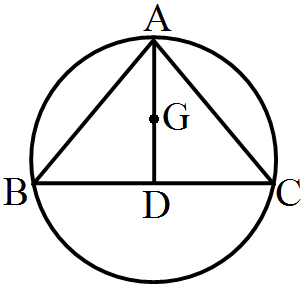
$\text{AG : GD} = 2 : 1$
So, $\text{AG}=\frac{2}{3}\text{AD}=\frac{2}{3}\times3\text{a}=2\text{a}$
$\therefore$ The equation of the circle is,
$(x - 0)^2+ (y - 0)^2= (2a)^2$
$ \Rightarrow x^2+y^2=4 a^2 $ View full question & answer→MCQ 791 Mark
The equation of the circle passing through $(3, 6)$ and whose centre is $(2, -1)$ is:
- ✓
$ x^2+y^2-4 x+2 y=45 $
- B
$ x^2+y^2-4 x-2 y+45=0 $
- C
$ x^2+y^2+4 x-2 y=45 $
- D
AnswerCorrect option: A. $ x^2+y^2-4 x+2 y=45 $
Equation of circle, $(\text{x} - 2)^2 + (\text{y} -( -1))^2= \Big(\sqrt{{(3-2)^2+(6}-(-1))^2\Big)}^2$
$\text{x}^2 - 4\text{x} + 4 + \text{y}^2 + 2\text{y} + 1=(\sqrt{1+49})^2$
$\therefore\text{x}^2+\text{y}^2-4\text{x}+2\text{y}=45$ Equation of circle.
View full question & answer→MCQ 801 Mark
The eccentricity of the ellipse $\frac{\text{x}^2}{\text{b}^2}+\frac{\text{y}^2}{\text{y}^2}=1$ if its latus rectum is equal to one half of its minor axis, is:
- A
$\frac{1}{\sqrt{2}}$
- ✓
$\frac{\sqrt{3}}{2}$
- C
$\frac{1}{2}$
- D
$\text{none of these}$
AnswerCorrect option: B. $\frac{\sqrt{3}}{2}$
According to the question, the latus rectum is half its minor axis.
i.e. $\frac{2\text{b}^2}{\text{a}}=\frac{1}{2}\times2\text{b}$
$\Rightarrow2\text{b}^2=\text{ab}$
$\Rightarrow\text{a}=2\text{b}$
Now, $\text{e}\sqrt{1-\frac{\text{b}^2}{\text{a}^2}}$
$\Rightarrow\text{e}=\sqrt{1-\frac{\text{b}^2}{4\text{b}^2}}$
$\Rightarrow\text{e}=\sqrt{1-\frac{1}{4}}$
$\Rightarrow\text{e}=\frac{\sqrt{3}}{2}$
View full question & answer→MCQ 811 Mark
Assertion: If the equation of a circle is $(x + 1)^2+ (y - 1)^2= 4$, then its radius is $4.$ Reason: Equation of a circle with radius $r$ is given by, $(x -a)^2+ (y - b)^2 = r2$.
- A
Both Assertion and Reason are correct and Reason is the correct explanation for Assertion
- B
Both Assertion and Reason are correct but Reason is not the correct explanation for Assertion
- C
Assertion is correct but Reason is incorrect
- ✓
Assertion is incorrect but Reason is correct
AnswerCorrect option: D. Assertion is incorrect but Reason is correct
$(x + 1)^2+ (y - 1)^2 = 2^2$ Radius $= 2$ Centre $(-1, 1)$ Assertion is incorrect but reason is correct.
View full question & answer→MCQ 821 Mark
The equation of the circle which touches $x-$axis at $(0, 0)$ and touches the line $3x + 4y - 5 = 0$ is:
- A
$x^2+ y^2 - 4y = 0$
- B
$x^2+ y^2 - 10y = 0$
- C
$x^2+ y^2+ 10x = 0$
- ✓
AnswerEquation of circle touching $x-$axis at $(0, 0),$ means centre of circle lie on $Y-$axis i.e. $(0, k).$
$(x - 0)^2+ (y - k)^2= k^2$
$S: x^2+ y^2 - 2ky = 0 .... (1)$
Circle $S$ touches $3x + 4y - 5 = 0$
$\therefore\text{k}=\frac{4\text{k}-5}{5}$
$5k = 4k - 5$
$k = -5$
$\therefore$ Equation of circle is
$\Rightarrow x^2+ y^2+ 10y = 0$
View full question & answer→MCQ 831 Mark
Choose the correct answer. Equation of a circle which passes through $(3, 6)$ and touches the axes is:
- A
$x^2+ y^2 + 6x + 6y + 3 = 0$
- B
$x^2+ y^2 - 6x - 6y - 9 = 0$
- ✓
$x^2+ y^2 - 6x - 6y + 9 = 0$
- D
AnswerCorrect option: C. $x^2+ y^2 - 6x - 6y + 9 = 0$
Given that the circle touches both axes.
Therefore, equation of the circle is, $(x-a)^2+(y-a)^2=a^2$
Circle passes through the point $(3,6)$
$ \therefore(3-a)^2+(6-a)^2=a^2 $
$ \Rightarrow a^2-18 a+45=0 $
$ \Rightarrow(a-3)(a-15)=0$
$ \therefore a=3, a=15$
For $a=3$, the equation of circle is,
$ (x-3)^2+(y-3)^2=9 $
$ \Rightarrow x^2+y^2-6 x-6 y+9=0$
View full question & answer→MCQ 841 Mark
If $(-3, 2)$ lies on the circle $x^2+ y^2+ 2gx + 2fy + c = 0$ which is concentric with the circle $x^2+ y^2+ 6x + 8y - 5 = 0$, then $c =$
AnswerThe centre of the circle $x^2+y^2+6 x+8 y-5=0$ is $(-3,-4)$.
The circle $x^2+y^2+2 g x+2 f y+c=0$ is concentric with the circle $x^2+y^2+6 x+8 y-5=0$
Thus, the centre of $x^2+y^2+2 g x+2 f y+c=0$ is $(-3,-4)$.
$\therefore g=3, f=4$
Also, it is given that $(-3,2)$ lies on the circle $x^2+y^2+2 g x+2 f y+c=0$.
$ \therefore(-3)^2+2^2+2(3)(-3)+2(4)(2)+c=0 $
$ \Rightarrow 9+4-18+16+c=0 $
$ \Rightarrow c=-11$
View full question & answer→MCQ 851 Mark
Choose the correct answer. If the focus of a parabola is $(0, -3)$ and its directrix is $y = 3,$ then its equation is:
- ✓
$x^2= -12y$
- B
$x^2= 12y$
- C
$y^2= -12x$
- D
$y^2= 12x$
AnswerCorrect option: A. $x^2= -12y$
According to the definition of parabola,
$\sqrt{(\text{x}-0)^2+(\text{y}+3)^2}=\Bigg|\frac{\text{y}-3}{\sqrt{(0)^2+(1)^2}}\Bigg|$
$\Rightarrow\sqrt{\text{x}^2+\text{y}^2+9+6\text{y}}=|\text{y}-3|$
Squaring both sides, we get
$ x^2+y^2+9+6 y=y^2+9-6 y $
$\Rightarrow x^2+9+6 y=9-6 y $
$\Rightarrow x^2=-12 y $
View full question & answer→MCQ 861 Mark
Choose the correct answer. If the vertex of the parabola is the point $(-3, 0)$ and the directrix is the line $x + 5 = 0,$ then its equation is:
- ✓
$ y^2=8(x+3) $
- B
$ x^2=8(y+3) $
- C
$ y^2=-8(x+3) $
- D
$ y^2=8(x+5) $
AnswerCorrect option: A. $ y^2=8(x+3) $
Given that vertex $\equiv(-3,0)$ and directrix, $x + 5 = 0$
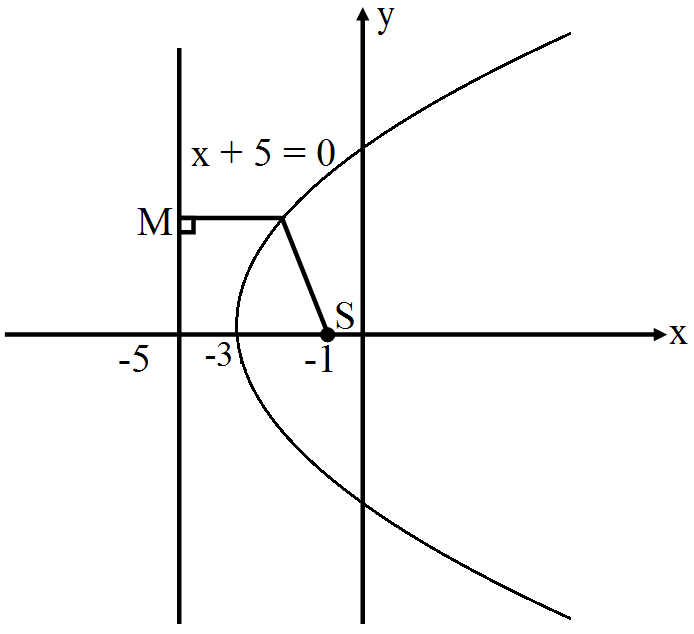
So, focus $\equiv\text{S}(-1,0)$
For any point of parabola $P(x, y)$ we have,
$\text{SP}=\text{PM}$
$\Rightarrow\sqrt{(\text{x}+1)+\text{y}^2}=|\text{x}+5|$
$\Rightarrow\text{x}^2+2\text{x}+1+\text{y}^2=\text{x}^2+10\text{x}+25$
$\Rightarrow\text{y}^2=8\text{x}+24$
$\Rightarrow\text{y}^2=8(\text{x}+3)$ View full question & answer→MCQ 871 Mark
What is the equation of a circle with center $(-3, 1)$ and radius $7:$
- A
$ (x-3)^2+(y+1)^2=7 $
- B
$ (x-3)^2+(y+1)^2=49 $
- C
$ (x+3)^2+(y-1)^2=7 $
- ✓
AnswerThe general equation of a circle with center at $(a, b)$ and radius $r$ is $(x-a)^2+(y-b)^2=r^2$
So substituting the values we get the equation of the circle is $(x+3)^2+(y-1)^2=7^2=49$
View full question & answer→MCQ 881 Mark
The eccentricity of the hyperbola whose latus$-$rectum is half of its transverse axis, is
- A
$\frac{1}{\sqrt2}$
- B
$\sqrt{\frac{2}{3}}$
- ✓
$\sqrt{\frac{3}{2}}$
- D
AnswerCorrect option: C. $\sqrt{\frac{3}{2}}$
The lengths of the latus rectum and the transverse axis are $\frac{2\text{b}^2}{\text{a}}$ and $2\text{a},$ respectively.
According to the given statement, length of the latus rectum is half of its transverse axis.
$\therefore\frac{2\text{b}^2}{\text{a}}=\frac{1}{2}\times2\text{a}$
$\Rightarrow\frac{2\text{b}^2}{\text{a}}=\text{a}$
$\Rightarrow2\text{b}^2=\text{a}$
Eccentricity, $\text{e}=\frac{\sqrt{\text{a}^2+\text{b}^2}}{\text{a}}$
Substituting the value $\text{b}^2=\frac{\text{a}^2}{2},$ we get:
$\text{e}=\frac{\sqrt{\text{a}^+\frac{\text{a}}{2}}}{\text{a}}$
$=\frac{\text{a}\sqrt{\frac{3}{2}}}{\text{a}}$
$=\sqrt{\frac{3}{2}}$
$\therefore$ Eccentricity is $\sqrt{\frac{3}{2}}$
View full question & answer→MCQ 891 Mark
If $e_1$ is the eccentricity of the conic $9x^2+ 4y^2 = 36$ and $e_2$ is the eccentricity of the conic $9x^2- 4y^2 = 36$, then
- A
$\text{e}_1^2-\text{e}_2^2=2$
- ✓
$2<\text{e}_2^2-\text{e}_1^2<3$
- C
$\text{e}_2^2-\text{e}_1^2=2$
- D
$\text{e}_2^2-\text{e}_1^2>3$
AnswerCorrect option: B. $2<\text{e}_2^2-\text{e}_1^2<3$
The conic $9x^2+ 4y^2 = 36$ can rewritten in the following way:
$\frac{9\text{x}^2}{36}+\frac{4\text{y}^2}{36}=1$
$\Rightarrow\frac{\text{x}^2}{4}+\frac{\text{y}^2}{9}=1$
This is the standard equation of an ellipse.
$\therefore$ $b^2 = a^2(1−e_1)^2$
$\Rightarrow9=4(1-\text{e}_1)^2$
$\Rightarrow(\text{e}_1)^2=\frac{-5}{4}$
The conic $9x^2- 4y^2 = 36$ can rewritten in the following way:
$\frac{9\text{x}^2}{36}-\frac{4\text{y}^2}{36}=1$
$\Rightarrow\frac{\text{x}^2}{4}-\frac{\text{y}^2}{9}=1$
This is the standard equation of a hyperbola.
$\therefore$ $b^2= a^2(e{_2}^2− 1)$
$\Rightarrow9=4(\text{e}_2^2-1)$
$\Rightarrow(\text{e}_2)^2=\frac{13}{4}$
$\therefore\text{e}_2^2-\text{e}_1^2=\frac{13}{4}+\frac{5}{4}=2.5$
View full question & answer→MCQ 901 Mark
If the circles $x^2+ y^2+ 2ax + c = 0$ and $x^2+ y^2 + 2by + c = 0$ touch each other, then:
- ✓
$\frac{1}{\text{a}^2}+\frac{1}{\text{b}^2}=\frac{1}{\text{c}}$
- B
$\frac{1}{\text{a}^2}+\frac{1}{\text{b}^2}=\frac{1}{\text{c}}$
- C
$\text{a}+\text{b}=2\text{c}$
- D
$\frac{1}{\text{a}}+\frac{1}{\text{b}}=\frac{2}{\text{c}}$
AnswerCorrect option: A. $\frac{1}{\text{a}^2}+\frac{1}{\text{b}^2}=\frac{1}{\text{c}}$
Given:
$x^2+ y^2 + 2ax + c = 0 ....... (1)$
And, $x^2+ y^2+ 2by + c = 0 ........ (2)$
For circle $(1),$ we have:
Centre $= (-a, 0) = C_1$
For circle $(2),$ we have:
Centre $= (0,-b) = C_2$
Let the circles intersect at point $P.$
$\therefore$ Coordinates of $P =$ Mid point of $C_1C_2$
$\Rightarrow$ Coordinates of $P =\Big(\frac{-\text{a}+0}{2},\ \frac{0-\text{b}}{2}\Big)=\Big(\frac{-\text{a}}{2},\ \frac{-\text{b}}{2}\Big)$
Now, we have:
$PC_1$= radius of $(1)$
$\Rightarrow\sqrt{(-\text{a}+\frac{\text{a}}{2})^2}+\Big(0-\frac{\text{b}}{2}\Big)^2=\sqrt{\text{a}^2-\text{c}}$
$\Rightarrow\frac{\text{a}^2}{4}+\frac{\text{b}}{4}^2=\text{a}^2-\text{c}\ .....(3)$
Also, radius of circle $(1) =$ radius of circle $(2)$
$\Rightarrow\sqrt{\text{a}^2-\text{c}}=\sqrt{\text{b}^2-\text{c}}$
$\Rightarrow\text{a}^2=\text{b}^2\ .....(4)$
From $(3)$ and $(4),$ we have:
$\frac{\text{a}^2}{2}=\text{a}^2-\text{c}$
$\Rightarrow\frac{\text{a}^2}{2}=\text{c}$
$\Rightarrow\frac{2}{\text{a}^2}=\frac{1}{\text{c}}$
$\Rightarrow\frac{1}{\text{a}^2}+\frac{1}{\text{a}^2}=\frac{1}{\text{c}}$
View full question & answer→MCQ 911 Mark
For the ellipse $12\text{x}^2+4\text{y}^2+24\text{x}-16\text{y}+25=0$
Answer$12\text{x}^2+4\text{y}^2+24\text{x}-16\text{y}+24=0$
$\Rightarrow12\big(\text{x}^2+2\text{x}\big)+4\big(\text{y}^2-4\text{y}\big)=-24$
$\Rightarrow12\big(\text{x}^2+2\text{x}+1\big)+4\big(\text{y}^2-4\text{y}+4\big)=-24+12+16$
$\Rightarrow12\big(\text{x}+1\big)^2+4\big(\text{y}-2\big)^2=4$
$\Rightarrow\frac{(\text{x}+1)^2}{3}+\frac{(\text{y}-2)^2}{1}=1$
So, the centre is a $(-1,\ 2).$
Here, $\text{a}=\sqrt{3}$ and $\text{b}=1$
The lengths of the axes are $\sqrt{3}$ and $1.$
Now, $\text{e}=\sqrt{1-\frac{\text{b}62}{\text{a}^2}}$
$\text{e}=\sqrt{1-\frac{1}{3}}$
$\Rightarrow\text{e}=\sqrt{\frac{2}{3}}$
View full question & answer→MCQ 921 Mark
The parametric equations of a parabola are $x = t^2 + 1, y = 2t + 1$. The cartesian equation of its directrix is
- ✓
$x = 0$
- B
$x + 1 = 0$
- C
$y = 0$
- D
AnswerCorrect option: A. $x = 0$
Given:
$x = t^2+ 1 ...(1)$
$y = 2t + 1 ...(2)$
From $(1)$ and $(2)$:
$\text{x}=\Big(\frac{\text{y}-1}{2}\Big)^2+1$
On simplifying:
$(y - 1)^2= 4(x - 1)$
Let $Y = y - 1$ and $X = x - 1$
$\therefore$ $Y^2= 4X$
Comparing it with $y^2= 4ax:$
$a = 1$
Therefore, the equation of the directrix is $X = -a ,$
i.e. $x - 1= -1$
$\Rightarrow x = 0$
View full question & answer→MCQ 931 Mark
Choose the correct answer. If the parabola $y^2= 4ax$ passes through the point $(3, 2),$ then the length of its latus rectum is:
- A
$\frac{2}{3}$
- ✓
$\frac{4}{3}$
- C
$\frac{1}{3}$
- D
$4$
AnswerCorrect option: B. $\frac{4}{3}$
Given parabola is $y^2= 4ax$
If the parabola is passing through $(3, 2)$
Then $(2)^2= 4a \times 3$
$\Rightarrow 4 = 12a$
$\Rightarrow\text{a}=\frac{1}{3}$
Nowm length of the latus rectum $=4\text{a}=4\times\frac{1}{3}=\frac{4}{3}$
View full question & answer→MCQ 941 Mark
The focus of the parabola $y^2= 8x$ is:
- A
$(0, 2)$
- ✓
$(2, 0)$
- C
$(0, -2)$
- D
$(-2, 0)$
AnswerCorrect option: B. $(2, 0)$
Given parabola equation $y^2= 8x …(1)$
Here, the coefficient of $x$ is positive and the standard form of parabola is $y^2= 4ax … (2)$
Comparing $(1)$ and $(2),$ we get
$4a = 8$
$\text{a} = \frac{8}{4} = 2$
We know that the focus of parabolic equation $y^2= 4ax$ is $(a, 0).$
$\therefore$ The focus of the parabola $y^2= 8x$ is $(2, 0).$
View full question & answer→MCQ 951 Mark
The equation of the directrix of the parabola whose vertex and focus are $(1, 4)$ and $(2, 6)$ respectively is
- ✓
$x + 2y = 4$
- B
$x - y = 3$
- C
$2x + y = 5$
- D
$x + 3y = 8$
AnswerCorrect option: A. $x + 2y = 4$
Given:
The vertex and the focus of a parabola are $(1, 4)$ and $(2, 6),$ respectively.
$\therefore$ Slope of the axis of the parabola $= \frac{6-4}{2-1}=2$
Slope of the directrix $=\ \frac{-1}{2}$
Let the directrix intersect the axis at $K (r, s).$
$\therefore\ \frac{\text{r}+2}{2}=1,\ \frac{\text{s}+6}{2}=4$
$\Rightarrow\ \text{r}=0,\ \text{s}=2$
Equation of the directrix:
$(\text{y}-2)=\frac{-1}{2}(\text{x}-0)$
$\Rightarrow x + 2y = 4$
View full question & answer→MCQ 961 Mark
Equation of the parabola having focus $(3, 2)$ and Vertex $(-1, 2)$ is:
- A
$(x+1)^2=16(y-2)$
- B
$(x-1)^2=16(y+2)$
- ✓
$(y-2)^2=16(x+1)$
- D
AnswerCorrect option: C. $(y-2)^2=16(x+1)$
View full question & answer→MCQ 971 Mark
If the eccentricity of the hyperbola $x^2 − y^2\ \sec^2 \alpha = 5$ is $\sqrt3$ times the eccentricity of the ellipse $x^2\ \sec^2$ $\alpha + y^2= 25,$ then $\alpha =$
- A
$\frac{\pi}{6}$
- ✓
$\frac{\pi}{4}$
- C
$\frac{\pi}{3}$
- D
$\frac{\pi}{2}$
AnswerCorrect option: B. $\frac{\pi}{4}$
The hyperbola $\text{x}^2 − \text{y}^2 \sec^2\alpha = 5$ can be rewritten in the following way:
$\frac{\text{x}^2}{5}-\frac{\text{y}^2}{5\cos^2\text{a}}=1$
This is the standard form of a hyperbola, where $ \text{a}^2 = 5$ and $\text{b}^2 = 5\cos^2\alpha.$
$\Rightarrow\text{b}^2 = \text{a}^2(\text{e}_1^2 − 1)$
$\Rightarrow 5\cos^2\alpha=5(\text{e}_1^2−1)$
$\Rightarrow\text{e}_1^2=\cos^2\alpha+1...(1)$
The ellipse $\text{x}^2\sec^2\alpha+\text{y}^2=25$ can be rewritten in the following way:
$\frac{\text{x}^2}{25\cos^2\alpha}+\frac{\text{y}^2}{25}=1$
This is the standard form of an ellipse, where $\text{a}^2=25$ and $\text{b}^2=25\cos^2\alpha$
$\text{b}^2=\text{a}^2(1-\text{e}_2^2)$
$\Rightarrow\text{e}_2^2=1-\cos^2\alpha$
$\Rightarrow\text{e}_2^2=\sin^2\alpha...(2)$
According to the question,
$\cos^2\alpha+1=3(\sin^2\alpha)$
$\Rightarrow2=4\sin^2\alpha$
$\Rightarrow\sin\alpha=\frac{1}{\sqrt2}$
$\Rightarrow\alpha=\frac{\pi}{4}$
View full question & answer→MCQ 981 Mark
Find the equation to the circle which touches the axis of $y$ at the origin and passes through the point $(b, c):$
- A
$b x^2+b y^2-\left(b^2+c^2\right) y=0 $
- ✓
$ b x^2+b y^2-\left(b^2+c^2\right) x=0 $
- C
$ b x^2+b y^2+\left(b^2+c^2\right) y=-1 $
- D
$ b x^2+c y^2-\left(b^2+c^2\right) x=1 $
AnswerCorrect option: B. $ b x^2+b y^2-\left(b^2+c^2\right) x=0 $
Equation of circle which touches the $y-$axis at origin is $x^2+ y^2 + 2gx + d = 0$
Since the circle passes through origin,
$d = 0$ Thus the equation becomes, $x^2+ y^2 + 2gx = 0 ...... (1)$
The equation passes through $(b, c)$
so, $b^2+ c^2+ 2gb = 0$
$\therefore\text{g}=\frac{-\text{b}^2-\text{c}^2}{\text{2b}}$
So, putting the value of $g$ in $(1)$ we get $bx^2+ by^2- (b^2+ c^2) x = 0$
View full question & answer→MCQ 991 Mark
The equation of parabola with vertex at origin and directrix $x - 2 = 0$ is:
- A
$y^2= -4x$
- B
$y^2= 4x$
- ✓
$y^2= -8x$
- D
$y^2= 8x$
AnswerCorrect option: C. $y^2= -8x$
View full question & answer→MCQ 1001 Mark
The number of tangents that can be drawn from $(1, 2)$ to $x^2+ y^2 = 5$ is:
- A
$0$
- ✓
$1$
- C
$2$
- D
more than $2$
AnswerGiven circle equation: $x^2+ y^2= 5$
$x^2+ y^2- 5 = 0 … (1)$
Now, substitute $(1, 2)$ in equation $(1),$ we get
Circle Equation: $(1)^2+ (2)^2- 5 = 0$
Equation of circle $= 1 + 5 - 5 = 0$
This represents that the point lies on the circumference of a circle,
and hence only one tangent can be drawn from $(1, 2).$
View full question & answer→