Questions

6 Marks Question

🎯

Test yourself on this topic

25 questions · timed · auto-graded

Question 16 Marks
‘RO Youth Club’ organised a visit of its members to an Old Age Home to inculcate the habit of social work among them. The visit revealed that the living conditions of the inmates of the Old Age Home were not hygienic. So, the RO Youth Club members decided to clean the premises. During their cleanliness drive, they realised that the Old Age Home also required pest control. But some of the inmates of the Old Age Home were reluctantfor it because they believed that the pest control may create health problems for them. RO Youth Club, therefore, decided to provide ethical, safe and odourless pest control. They showed to the inmates of the Old Age Home a pamphlet of the proposed pest control product which promised easy, inexpensive and long-lasting pest control. The inmates happily agreed and the pest control was carried out. The effect of the pest control started wearing off after a fortnight. RO Youth Club contacted the pest control company which kept on postponing their visit. After waiting for a month, RO Youth Club filed a case in the consumer court. The consumer court was satisfied about the genuineness of the complaint and issued necessary directions to the pest control company.
  1. State any six directions that might have been issued by the court.
  2. Identify any two values that are being communicated by RO Youth Club to the society.
Answer
  1. Directions that might have been issued by the court:
  1. To remove the deficiency in service.
  2. To refund the price paid for the service provided.
  3. To pay a reasonable amount of compensation for any loss suffered by the inmates of old age home.
  4. To pay punitive damages.
  5. To discontinue the unfair/ restrictive trade practice and not to repeat the same in future.
  6. To pay any amount (not less than 5% of the value of the service provided) to be credited to the Consumer Welfare Fund or any other organisation/person, to be utilised in the prescribed manner.
  7. To issue corrective advertisement to neutralize the effect of misleading pamphlet.
  8. To pay adequate costs to RO Youth Club.
  1. Values that are being communicated by RO Youth Club to the society are:
  1. Sensitivity towards the environment.
  2. Respect for the elderly.
  3. Cleanliness and hygiene.
  4. Concern for health of people.
View full question & answer
Question 26 Marks
Reena purchased one litre of pure Desi Ghee from a shopkeeper. After using it she had a doubt that it is adulterated. She sent it for a laboratory test which confirmed that the Ghee is adulterated. State any six reliefs available to Reena, if she complains and the Consumer Court is satisfied about the genuineness of the complaint.
Answer
Reliefs available to Reena:
  1. To replace adulterated ghee.
  2. To refund the price paid for the product.
  3. To pay a reasonable amount of compensation for any loss or injury/sickness suffered by her due to negligence of the manufacturer.
  4. To pay adequate costs to Reena.
  5. To discontinue this unfair/restrictive trade practice and not to repeat it in future.
  6. Not to offer adulterated ghee for sale.
  7. To withdraw adulterated ghee from sale.
  8. To cease manufacture of adulterated ghee.
  9. To pay any amount (not less than 5% of the value) of the adulterated ghee to be credited to the Consumer Welfare Fund or any other organisation/person, to be utilised in the prescribed manner.
  10. To pay punitive damages in appropriate circumstances.
View full question & answer
Question 36 Marks
Briefly, explain any three rights of a consumer available under the Consumer Protection Act, 1986.
Answer
Rights of a consumer available under the Consumer Protection Act 1986:
  1. Safety: The right to safety means the right to be protected against products, production processes and services, which are hazardous to health or life.
  2. Information: Consumers should have the right to be informed about the quality, quantity, potency, purity, standard and price of goods or services, so as to make the right decision and protect themselves against abusive practices.
  3. Choice: The right to choice can be defined as an assurance, whenever possible, of availability, ability and access to a variety of products and services at competitive prices.
  4. Representation: This right includes the right to representation (to be heard) in the government and in other policy making bodies as well as the right to be heard in the development of product and services before they are produced or set up.
  5. Redressal: This right includes the right to receive compensation for supply of shoddy goods or unsatisfactory services and availability of acceptable forms of legal aid or redress for small claims wherever necessary.
  6. Consumer education: The right to consumer education means the right to acquire the knowledge and skills to be an informed consumer.
View full question & answer
Question 46 Marks
What is the meaning of ‘training’? Explain any four needs of training.
Answer
Training is any process by which the aptitudes, skills and abilities of employees to perform specific jobs are increased. It is a process of learning new skills and application of knowledge. It attempts to improve their performance on the current job or prepare them for any intended job.Importance of training:
  1. Improves morale of employees: Training helps the employee to get job security and job satisfaction. The more satisfied the employee is and the greater is his morale, the more he will contribute to organizational success and the lesser will be employee absenteeism and turnover.
  2. Less supervision: A well trained employee will be well acquainted with the job and will need less of supervision. Thus, there will be less wastage of time and efforts.
  3. Fewer accidents: Errors are likely to occur if the employees lack knowledge and skills required for doing a particular job. The more trained an employee is, the less are the chances of committing accidents in job and the more proficient the employee becomes.
  4. Chances of promotion: Employees acquire skills and efficiency during training. They become more eligible for promotion. They become an asset for the organization.
  5. Increased productivity: Training improves efficiency and productivity of employees. Well trained employees show both quantity and quality performance. There is less wastage of time, money and resources if employees are properly trained.
View full question & answer
Question 56 Marks
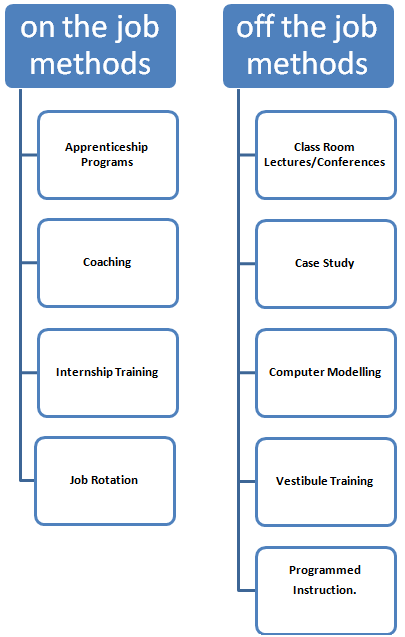
Briefly, explain the different methods of training.
Answer
Methods of training:
On the Job Methods:
  1. Apprenticeship Programmes: Apprenticeship programmes put the trainee under the guidance of a master worker. These are designed to acquire a higher level of skill. People seeking to enter skilled jobs, to becomefor example, plumbers, electricians or iron-workers, are often required to undergo apprenticeship training
  2. Coaching: In this method, the superior guides and instructs the trainee as a coach. The coach or counselor sets mutually agreed upon goals, suggests how to achieve these goals, periodically reviews the trainees progress and suggests changes required in behavior and performance.
  3. Internship Training: It is a joint programme of training in which educational institutions and business firms cooperate. Selected candidates carry on regular studies for the prescribed period.
Off the job methods:
  1. Case Study: Taken from actual experiences of organisations, cases represent attempts to describe, as accurately as possible real problems that managers have faced. Trainees study the cases to determine problems, analyse causes, develop alternative solutions, select what they believe to be the best solution, and implement it.
  2. Computer Modelling: It simulates the work environment by programming a computer to imitate some of the realities of the job and allows learning to take place without the risk or high costs that would be incurred if a mistake were made in real life situation
  3. Vestibule Training: Employees learn their jobs on the equipment they will be using, but the training is conducted away from the actual work floor. Actual work environments are created in a class room and employees use the same materials, files and equipment. This is usually done when employees are required to handle sophisticated machinery and equipment.
View full question & answer
Question 66 Marks
Explain any six ways and means of Consumer Protection in India.
Answer
Ways and means of consumer protection: There are various ways in which the objective of consumer protection can be achieved.
  1. Self Regulation by Business: Enlightened business firms realize that it is in their long-term interest to serve the customers well. Socially responsible firms follow ethical standards and practices in dealing with their customers. Many firms have set up their customer service and grievance cells to redress the problems and grievances of their consumers.
  2. Business Associations: The associations of trade, commerce and business like Federation of Indian Chambers of Commerce of India (FICCI) and Confederation of Indian Industries (CII) have laid down their code of conduct which lay down for their members the guidelines in their dealings with the customers.
  3. Consumer Awareness: A consumer, who is well informed about his rights and the reliefs available to him, would be in a position to raise his voice against any unfair trade practices or unscrupulous exploitation. In addition to this, an understanding of his responsibilities would also enable a consumer to safeguard his interests.
  4. Consumer Organisations: Consumer organisations play an important role in educating consumers about their rights and providing protection to them. These organizations can force business firms to avoid malpractices and exploitation of consumers.
  5. Government: The government can protect the interests of the consumers by enacting various legislations. The legal framework in India encompasses various legislations which provide protection to consumers. The most important of these regulations is the Consumer Protection Act, 1986.
View full question & answer
Question 76 Marks
Prakhar purchased an ISI mark electric iron from 'Bharat Electricals'. While using he found that it was not working properly. He approached the seller and complains for the same. The seller satisfies Prakhar by saying that he will ask the manufacturer to replace this iron. The manufacturer refused to replace and 'Bharat Electricals' decided to file a complaint in the Consumer Court.
Can 'Bharat Electricals' do this? Why? Also explain 'who is a consumer' as per Consumer Protection Act, 1986.
Answer
Bharat Electricals cannot file a complaint.
This is because Bharat Electricals in not a consumer as per consumer Protection Act 1986 because they bought the goods for re-sale/commercial purpose.
Under the Consumer Protection Act, a consumer is defined as:
  1. Any person who buys any goods for a consideration, which has been paid or promised, or partly paid and partly promised, or under any scheme of deferred payment. It includes any user of such goods, when such use is made with the approval of the buyer, but does not include a person who obtains goods for re-sale or any commercial purpose.
  2. Any person who hires or avails of any service, for a consideration which has been paid or promised, or partly paid and partly promised, or under any system of deferred payment. It includes any beneficiary of services when such services are availed of with the approval of the person concerned, but does not include a person who avails of such services for any commercial purpose.
View full question & answer
Question 86 Marks
Some products have certain unique features. They attract a significant group of buyers. Identify the kind of product and list its features.
Answer
Speciality Products: Speciality products are those consumer goods which have certain special features because of which people make special efforts in their purchase. For example, if there is a rare collection of artwork or of antiques, some people may be willing to spend a lot of shopping effort and travel long distance to buy such products.
  1. The demand for these goods is relatively inelastic, i.e., even if the price is increased, the demand does not come down. The demand for speciality products is limited as relatively small number of people buy these products;
  2. These products are generally costly and their unit price is very high;
  3. These products are available for sale at few places as the number of customers is small and are willing to take extra efforts in the purchase of these products;
  4. An aggressive promotion is required for the sale of speciality products, in order to inform people about their availability, features, etc.; and
  5. After sales services are very important for many of the speciality products.
View full question & answer
Question 96 Marks
Explain any three responsibilities of the consumer to safeguard his interest.
Answer
CONSUMER RESPONSIBILITIES:A consumer should keep in mind the following responsibilities while purchasing, using and consuming goods and services.
  1. Be aware about various goods and services available in the market so that an intelligent and wise choice can be made.
  2. Buy only standardised goods as they provide quality assurance. Thus, look for ISI mark on electrical goods, FPO mark on food products, Hallmark on jewelry etc.
  3. Learn about the risks associated with products and services, follow manufacturer’s instructions and use the products safely.
  4. Read labels carefully so as to have information about prices, net weight, manufacturing and expiry dates, etc.
  5. Assert yourself to ensure that you get a fair deal.
  6. Be honest in your dealings. Choose only from legal goods and services and discourage unscrupulous practices like black-marketing, hoarding etc.
  7. Ask for a cash memo on purchase of goods or services. This would serve as a proof of the purchase made.
View full question & answer
Question 106 Marks
Explain any three ways and means of consumer protection available in India.
Answer
WAYS AND MEANS OF CONSUMER PROTECTION:There are various ways in which the objective of consumer protection can be achieved.
  1. Self Regulation by Business: Enlightened business firms realize that it is in their long-term interest to serve the customers well. Socially responsible firms follow ethical standards and practices in dealing with their customers. Many firms have set up their customer service and grievance cells to redress the problems and grievances of their consumers.
  2. Business Associations: The associations of trade, commerce and business like Federation of Indian Chambers of Commerce of India (FICCI) and Confederation of Indian Industries (CII) have laid down their code of conduct which lay down for their members the guidelines in their dealings with the customers.
  3. Consumer Awareness: A consumer, who is well informed about his rights and the reliefs available to him, would be in a position to raise his voice against any unfair trade practices or unscrupulous exploitation. In addition to this, an understanding of his responsibilities would also enable a consumer to safeguard his interests.
  4. Consumer Organisations: Consumer organisations play an important role in educating consumers about their rights and providing protection to them. These organizations can force business firms to avoid malpractices and exploitation of consumers.
  5. Government: The government can protect the interests of the consumers by enacting various legislations. The legal framework in India encompasses various legislations which provide protection to consumers. The most important of these regulations is the Consumer Protection Act, 1986.
View full question & answer
Question 116 Marks
Explain any six rights of a consumer under the Consumer Protection Act, 1986.
Answer
Rights of a Consumer:
  1. Right to Safety: The consumer has a right to be protected against goods and services which are hazardous to life and health. For instance, electrical appliances which are manufactured with substandard products or do not conform to the safety norms might cause serious injury. Thus, consumers are educated that they should use electrical appliances which are ISI marked as this would be an assurance of such products meeting quality specifications.
  2. Right to be Informed: The consumer has a right to have complete information about the product he intends to buy including its ingredients, date of manufacture, price, quantity, directions for use, etc. It is because of this reason that the legal framework in India requires the manufactures to provide such information on the package and label of the product.
  3. Right to Choose: The consumer has the freedom to choose from a variety of products at competitive prices. This implies that the marketers should offer a wide variety of products in terms of quality, brand, prices, size, etc. and allow the consumer to make a choice from amongst these.
  4. Right to be Heard: The consumer has a right to file a complaint and to be heard in case of dissatisfaction with a good or a service. It is because of this reason that many enlightened business firms have set up their own consumer service and grievance cells. Many consumer organisations are also working towards this direction and helping consumers in redressal of their grievances.
  5. Right to seek Redressal: The consumer has a right to get relief in case the product or service falls short of his expectations. The Consumer Protection Act provides a number of reliefs to the consumers including replacement of the product, removal of defect in the product, compensation paid for any loss or injury suffered by the consumer, etc.
  6. Right to Consumer Education: The consumer has a right to acquire knowledge and to be a well informed consumer throughout life. He should be aware about his rights and the reliefs available to him in case of a product or service falling short of his expectations.
View full question & answer
Question 126 Marks
‘VOICE’ is an important consumer organization. It organized workshops in the months of December in Delhi/ NCR for consumers. The theme was ‘Organic Food - From Farm to Plate’, to spread awareness on the importance of organic farming and to encourage consumers to switch from conventional food, that contains chemicals and pesticides to organic food. Expert speakers from farmers’ community explained the harmful effects of usage of pesticides in farming and the importance of organic food. People were informed that the organization regularly tests samples to detect adulteration like presence of heavy metals or pesticides. The results of the tests are published in their monthly magazine ‘Consumer Voice’ to make people aware of quality of different products. It also provides aid and legal advice to the consumers in seeking a remedy.
State the functions performed by the Consumer Voice for the protection and promotion of consumer interest by quoting lines from the above para.
Answer
The following functions are being performed by consumer organization:
  1. Consumer Education: NGOs and consumer organisations conduct various training programmes and workshops to educate the consumers about their rights and responsibilities.
Line: 'The theme was 'Organic Food - From Farm to Plate', to spread awareness on the importance of organic farming'.
  1. Publish Journals: They regularly publish journals and periodicals to spread knowledge and awareness about various consumer problems, legal remedies available and other such matters.
Line: 'The results of the tests are published in their monthly magazine 'Consumer Voice'.
  1. Legal Assistance: They also provide legal assistance to the consumers and help them in seeking suitable redressal.
Line: 'It also provides aid and legal advice to the consumers in seeking a remedy. '
  1. Encourage Protests Against Exploitation: They encourage consumers to protest against any form of exploitation and unfair trade practices.
Line: 'encourage consumers to switch from conventional food, that contains.
  1. Test the Quality of Products: They conduct quality tests for various products in laboratories and publish the results.
Line: 'People were informed that the organization regularly tests samples to detect adulteration like presence of heavy metals or pesticides.'
View full question & answer
Question 136 Marks
Government of India took the congnizance and understood the necessity of protecting the public in its purchases of gold jewellery, especially with regard to standards of fineness and the prevention of adulteration, be it deliberate or accidental. The principle objectives of the Hallmarking Scheme are to protect the public against the fraud of adulteration and to oblige manufacturers to maintain legal standards of fineness.
  1. What is hallmarking?
  2. Why is it necessary to check the hallmarks on jewellery?
  3. Give a brief description for the following certification marks.
  1.  
  1.  
  1.  
  1.  
Answer
  1. ISI: mark It is certification mark for industrial products in India. The mark certifies that a product conforms to a set of standards laid by the Bureau of Indian Standards, the National Standard Organisation in India.
  2. AGMARK: It is a certification mark employed on agricultural products in India, assuring that the product is of standard quality approved by the directorate of marketing and inspection, an agency of Government of India.
  3. BIS: mark It is a certified hallmark sign on gold as well as on silver jewellery. This sign certifies the purity of metal.
  4. NSF: mark It can be found on millions of consumer, commercial and industrial products. Products, certified by NSF international, include bottled water, food equipment, home appliances, etc.
  5. Energy saving mark: It is certified that the product consumes less energy and leads to reduced power bills.
View full question & answer
Question 146 Marks
Discuss the scope of Consumer Protection Act, 1986.
Answer
The Consumer Protection Act, 1986 was enacted to provide a simpler and quicker access to redressal of consumer grievances. The Act introduced the concept of 'consumer and conferred express additional rights on him. The protection is meant for the person who fits in the definition of 'consumer' given by the Act.Section 2(d) of the Consumer Protection Act says that consumer means any person who:
  1. Buys any goods for a consideration which has been paid or promised or partly paid and partly promised, or under any system of deferred payment, and includes any user of such goods other than the person who buys such goods for consideration paid or promised or partly paid or partly promised, or under any system of deferred payment when such use is made with the approval of such person, but does not include a person who obtains such goods for resale or for any commercial purpose; or
  2. Hires or avails of any services for a consideration which has been paid or promised or partly paid and partly promised, or under any system of deferred payment, and includes any beneficiary of such services other than the person who hires or avails of the services for consideration paid or promised, or partly paid and partly promised, or under any system of deferred payment, when such services are availed of with the approval of the first mentioned person.
For the purposes of the sub-clause (i), "commercial purpose" does not include use by a consumer of goods bought and used by him and services availed by him exclusively for the purpose of earning his livelihood, by means of self-employment. This is an exception to the rule that a buyer of commercial goods is not a consumer under the Act. When goods are bought for commercial purposes and such purchase satisfy the following conditions then such use would not be termed as for commercial purposes under the act, and the user is recognized as a consumer.
  • The goods are used by the buyer himself.
  • Exclusively for the purpose of earning his livelihood.
  • By means of self-employment.
For example:
  1. X buys a truck for plying it as a public carrier by himself, then X is a consumer.
  2. Y buys a truck and hires a driver to ply it, then Y is not recognized as a consumer.
  3. Z has a grocery shop. He starts another business of a photocopier and buys a photocopy machine. Here, Z has not bought this machine exclusively for the purpose of earning livelihood. He is not a consumer under the Act.
The intention of the legislature is to exclude big business houses carrying on business with profit motive from the purview of the Act. At the same time, it is pertinent to save the interests of small consumers who buy goods for self employment to earn their livelihood such as a farmer purchasing fertilizer for his crops, a taxi driver buying a car to run it as a taxi. It is worthwhile to note that in case of goods, buyer of goods for commercial purpose ceases to be a consumer under the Act. On the other hand, a consumer of service for commercial purpose remains a consumer under the Act.
View full question & answer
Question 156 Marks
Explain any six rights of a consumer under the Consumer Protection Act, 1986.
Answer
Under section-6 of Consumer Protection Act, consumer has the following rights:
  1. Right to Safety: It is the right to safety against such goods and services as are hazardous to health, life and property of the consumer. For example, spurious and sub-standard drugs.
  2. Right to be Informed: Consumer has also the right that he should be provided all the information on the basis of which he decides to buy goods or services. Such information relate to quality, purity, potency, standard, date of manufacture, method of use, etc. of the commodity.
  3. Right to Choose: Consumer has the full right to buy any good or service of his choice from among the different goods or services available in the market. In other words, no seller can influence his choice in an unfair manner.
  4. Right to be Heard: Consumer has the right that his complaint be heard. Under this right, the consumer can file a complaint against all those things which are prejudicial to his interest.
  5. Right to Consumer Education: Consumer education refers to educate the consumer constantly with regard to their rights. In other words, consumers must be aware of the rights they enjoy against the loss they suffer on account of goods and services purchased by them.
  6. Right to Healthy Environment: This right provides consumers, the protection against environmental pollution so that the quality of life is enhanced.
View full question & answer
Question 166 Marks
Explain the rights and responsibilities of a consumer.
Answer
The Consumer Protection Act provides six rights to consumers.They are as follows:
  1. Right to Safety: The consumer has a right to be protected against goods and services which are hazardous to life. e.g., sometimes we purchased the food items of low quality which causes several problems. Thus, in this case, we should purchased good quality and FPO labelled products.
  2. Right to be informed: The consumer has a right to have complete information about the product. Which he intends to buy including its ingredients, date of manufacture, price, quantity, directions for use etc. Under the legal framework of India manufactures have to provide such information on the package and label of the product.
  3. Right to Choose: The consumer has the freedom to choose from a variety of products. The marketers should offer a wide variety of products and allow the consumer to make a choice and choose the product which is most suitable.
  4. Right to be heard: The consumer has a right to file a complaint and to be heard in case of dissatisfaction with a good or a service. It is because of this reason that many enlightened business firms have set up their own consumer service and grievance cells.
  5. Right to Seek Redressal: The Consumer Protection Act provides a number product, of reliefs to the removal of defect consumer including replacement of the in the product, compensation paid for any loss or injury suffered by the consumer etc.
  6. Right to Consumer Education: The consumer has a right to acquire knowledge about products. He should be aware about his rights and the reliefs available to him in case of a produce service falling short of his expectations many consumer organisations and some enlightened businesses are taking an active part in educating consumers in this respect.
Consumer Responsibilities:
A consumer must be aware about these responsibilities while purchasing, using and consuming goods and services:
  1. Consumer must be aware of all their rights.
  2. Consumer must be careful while purchasing a product.
  3. He should file complaint for the redressal of genuine grievances.
  4. Consumer must buy a standardised good.
  5. He should ask for a cash-memo on purchase of goods and services.
View full question & answer
Question 176 Marks
What are various ways in which the objective of consumer protection can be achieved? Explain the role of consumer organisations and NGOs in this regard.
Answer
There are various ways in which the objective of consumer protection can be achieved:
  1. Self Regulation by Business: Socially responsible firms follows ethical standards and practices in dealing with their customers. Many firms have set up their customer service and grievance cells to redress the problems and grievances of their consumers.
  2. Business Associations: The associations of trade, commerce and business like Federation of Indian Chambers of Commerce of India (FICCI) and Conference of Indian Industries (CII) have laid down their code of conduct which lays down for their members the guidelines in their dealings with the customers.
  3. Consumer Awareness: A consumer, who is well informed about his rights and the reliefs, would be in a position to raise his voice against any unfair trade practices or exploitation.
  4. Consumer Organisations: Consumer organisations plays an important protecting role in educating consumers about their rights and them. These organisations can force business firms to avoid malpractices and exploitation of consumers.
  5. Government: The Government can protect the interests of the consumers by enacting various legislations. The legal framework in India encompasses various legislations which provide protection to consumer, the most important of these regulations is the Consumer Protection Act, 1986. The Act provides for a three-tier machinery at the District, State and National levels for redressal of consumer grievance.
Role of Consumer Organisations and NGOs:
Consumer organisation and NGOs perform several functions for the protection and promotion of interest of consumers.
In India, these associations are performing lots of functions some of them are:
  1. Educating the general public about consumer rights by organising training programmes, seminars and workshops.
  2. Publishing periodicals and other publications to impart knowledge about consumer problems, legal reporting, reliefs available and other matters of interest.
  3. Carrying out comparative testing of consumer products in accredited laboratories to test relative qualities of competing brands and publishing the test results for the benefit of consumers.
  4. Encouraging consumers to strongly protest and take an action against unscrupulous, exploitation and unfair trade practices of sellers.
  5. Providing legal assistance to consumers by providing aid, legal advice etc in seeking legal remedy.
  6. Filing complaints in appropriate consumer courts on behalf of the consumers.
  7. Taking an Initiative in filing cases in consumer court in the interest of the general public, not for any individual.
View full question & answer
Question 186 Marks
Explain the various ways and Means available to the consumers for redressing their grievances under Three-tier Judicial Machinery.
Answer
The Consumer Protection: Act has provided three tier judicial machinery for redressing the grievances of consumers:
  1. District Forum: According to Consumer Protection Act, state government can set up one or more district forum in each district.
Main features of district forum are as under:
  1. There are three members including one presiding officer. Of these one must be a lady member. They are appointed by the state government. The presiding officer must have the qualifications of a District Judge.
  2. District Forum hears disputes involving a sum upto ₹ 20 lakhs.
  3. If neither party is satisfied with the judgement of the District Forum, it can file appeal against it with the state commission within 30 days, subjected to jurisdiction, i.e., complaints involving a sum exceeding ₹ 1 crore.
  1. State Commission: One state commission is appointed by the state government in each state.
Its main characteristics are as follows:
  1. It also is composed of three members including one presiding officer. Of these, one must be a lady member. They are appointed by the state government. The person appointed as presiding officer must have the qualifications of an Honourable Justice of the High Court.
  2. State commission redresses grievances involving a sum exceeds ₹ 20 lakhs and upto ₹ 1 crore.
  3. If either of the party is not satisfied with the decision of the state commission, it can file an appeal before the National Commission within 30 days.
  1. National Commission: It is appointed by the central government.
Its main characteristics are as under:
  1. It has five members including the Presiding Officer. One lady member is a must. They are appointed by the central government. Only that person is eligible to become the presiding officer who possesses qualifications equivalent to Supreme Court Judge.
  2. It has the jurisdiction to hear complaints involving a sum exceeding ₹ 1 crore.
  3. If any party is not satisfied with the decision of the National Commission, it can file an appeal with the Supreme Court within 30 days, subjected to jurisdiction, i.e., complaints involving a sum exceeding ₹ 1 crore.
View full question & answer
Question 196 Marks
State any six functions performed by consumer organization working in the field of consumer protection.
Answer
The non-government consumer organisations perform the following functions:
  1. Accelerating Consumer Awareness/ Educating Consumers: The first priority of consumer organisation is to accelerate consumer awareness towards their rights. To accomplish this task following efforts are made: a. To publish brochures, journals and monographs. b. To arrange conferences, seminars and workshops.
  2. Collecting Data on Different Products and Testing them: These organisations collect samples of different products from time to time and test them. After that the results of tests are declared to public. In this way, these organisations provide prior information to consumers about the authenticity of product and protects them.
  3. Filing Suit on behalf of Consumers: Whenever a consumer fails to raise his voice of protection regarding his complaints, these consumers’ organisations come to his rescue and file a case in the court. They also run voluntary complaint centres for the guidance of consumers.
  4. Helping Educational Institutions: These organisations tell the educational institutions the way to prepare courses of study keeping in view the interests of the consumers. They stress the fact that a special chapter on consumers’ interest should always be added to the courses on general study.
  5. Promoting network of Consumer Associations: Consumer organisations are trying to grow their numbers. They want to cover all regions so that consumers of all regions are benefited by their services.
  6. Extending Support to Government: Consumer organisations by informing government agencies about adulteration, artificiality, inferior quality products and other such evils helps government. This helps government to conduct proceedings on time.
View full question & answer
Question 206 Marks
Explain any four ways and means of consumer protection followed in India.
Answer
Main means of consumer protection are as under:
  1. Self Regulation by Business: Every firm insists to have a strong consumer base which means that more and still more people should buy their products. This is possible only when the consumers are fully satisfied with the products of the firm. With this purpose in view the firms ban all types of undesirable activities that can be harmful to the consumers. In addition to this, consumer service and a grievance cell is also established to handle consumers’ problems. In this way, business regulates itself and acts to protect consumers’interests.
  2. Business Associations: Business associations prepare a code of conduct for businessmen. It is laid down in the code of conduct as to how businessmen are expected to behave with the consumers. For example, the Federation of Indian Chambers of Commerce and Industries (FICCI) and the Confederation of Indian Industries (CII) have proposed their code of conduct which govern the attitude of their members towards consumers.
  3. Consumer Awareness: As an important means of consumer protection, consumer should protect himself. He should be alert in the matter of his rights. Alert consumer alone can demand his rights from the sellers. Thus, the consumer himself must know his rights and raise voice against unfair practices of the sellers.
  4. Government: Interests of the Consumers are protected by the government by enacting various legislations. Consumer Protection Act, 1986 is an important legislation by the government to provide protection to the affected consumers. Under the provisions of the Act, Consumer Protection Councils have been set up by the Central and State Governments for the protection of the rights of consumers. On the recommendation of the amendment of the Consumer Protection Act, 2000 these councils are also to be constituted at district level by the State Governments. Under the Act, there is a provision of Three-tier Judicial Machinery to redress the grievances of the consumers in a simple, speedy and inexpensive way; namely,
    1. District Forum at district level.
    2. State Commission at state level.
    3. National Commission at national level.
View full question & answer
Question 216 Marks
Aman a degree holder in Entrepreneurship came to know about Piplantri Village located in Rajasthan, where in 2006 an initiative was started, in which 111 trees are planted every time a girl child is born.
To keep termites away from the trees the villagers have planted 2.5 million Aloe Vera plants around the trees. This has turned the village into an oasis, as the planting of trees led to higher water levels.
Aman decided to visit the village to start a business unit, for the processing and marketing of Aloe Vera into juices, gels and other products.
However, on visiting the village Aman found that the villagers were suffering exploitation at the hands of local merchants who were engaged in unscrupulous, exploitative trade practices like hoarding and black marketing of food products and also selling unsafe, adulterated products to the villagers.
After looking at their plight instead of a business organisation he decided to set up an organisation for the protection and promotion of the consumer interest of the villagers.
State the functions that the organisation established by Aman will be performing. (Any six points.)
Answer
Functions of an NGO (Consumer Organisation):
  1. Educating the villagers/ general public about consumer rights by organising training programmes, seminars and workshops.
  2. Publishing periodicals and other publications to impart knowledge about consumer problems, reliefs available and other matters of interest.
  3. Carrying out comparative testing of consumer products in accredited laboratories to test relative qualities of competing brands and publishing the test results for the benefit of consumers.
  4. Encouraging consumers to strongly protest and take an action against exploitative and unfair trade practices of sellers.
  5. Providing legal assistance to consumers by way of providing aid, legal advice etc, in seeking legal remedy.
  6. Filing complaints in consumer courts on behalf of consumers.
View full question & answer
Question 226 Marks
Explain, in brief, any six responsibilities of consumer to safeguard their interest.
Answer
They are as follows:
  1. Consumer must exercise his Rights: Consumers have many rights with regard to the goods and services. They must be aware of their rights while buying. These rights are: right of safety, right to be informed, right to representation, right to seek redressal, right to consumer education, etc.
  2. Cautious Consumer/ do not buy Blindly: The consumers should make full use of their reason while buying things. They should not take the seller’s words as the final truth. In other words, while buying consumer must get information regarding the quality, quantity, price, utility, etc. of goods and services.
  3. Filing complaint for the redressal of genuine grievances: It is the responsibility of the consumers to approach the officer concerned in case there is some complaint about the goods purchased. A late complaint may find that the period of guarantee/ warranty has lapsed. Sometimes, consumers ignore the deception of businessmen. This tendency encourages corrupt business practices.
  4. Consumer must be Quality Conscious/ should not compromise on Quality: The consumers should never compromise on the quality of the goods. Therefore, they should not buy inferior stuff out of greed for cheaper prices. If the consumers behave like this, there cannot be any protection for them from any quarter. It is also the responsibility of the consumers only to buy goods with the ISI, Agmark, Woolmark, FPO, etc. printed on them. All these symbols are indicative of the good quality of the goods.
  5. Advertisements Often Exaggerate/ Beware of False Advertisement: The sellers inform the consumers about their things through the medium of advertisement. The sellers exaggerate the quality of their goods through advertisement. Therefore, it is the responsibility of the consumers to recognise the truth of the advertisement.
  6. Do not forget to Get Receipt and Guarantee/ Warranty Card: One should always get a receipt or bill for the things purchased. In case a guarantee/warranty card is also offered by the seller, it should also be taken. In case, the goods purchased turn out to be of inferior quality or some defect appears and bothers the customers, these documents will be of great help in settling all kinds of disputes with the seller.
View full question & answer
Question 236 Marks
Explain the redressal mechanism available to consumers under the Consumer Protection Act, 1986.
Answer
For the redressal of consumer grievances, the Consumer Protection Act provides for setting up of three-tier enforcement machinery at the District, State and the National levels.
  1. District Forum: A complaint can be made to the appropriate District Forum when the value of goods or services, along with the compensation claimed, does not exceed Rs 20 lakhs. In case the aggrieved party is not satisfied with the order of the District Forum, he can appeal before the State Commission within 30 days.
  2. State Commission: A complaint can be made to the appropriate State Commission when the value of the goods or services, along with the compensation claimed exceeds Rs 20 lakhs but does not exceed Rs 1 crore. The appeals against the orders of District Forum can also be filed before the State Commission. In case the party is not satisfied with the order of the State Commission, he can appeal before the National Commission within 30 days of the passing of the order by State Commission.
  3. National Commission: A complaint can be made to the National Commission when the value of the goods or services, along with the compensation claimed exceeds Rs 1 crore. The appeals against the orders of a State Commission can also be filed before the National Commission. An order passed by the National Commission in a matter of its original justification is appealable before the Supreme Court. This means that only those appeals, where the value of goods + services in question, along with the compensation claimed, exceeded Rs 1 crore and where the aggrieved party was not satisfied with the order of the National Commission, can be taken to the Supreme Court of India.
View full question & answer
Question 246 Marks
Reena purchased one litre of pure Deshi Ghee from a shopkeeper. After using it she had a doubt that it is adulterated. She sent it for a laboratory test which confirmed that the Ghee is adulterated.
State any six reliefs available to Reena, if she complaints and the consumer court is satisfied about the genuineness of the complaint.
Answer
  1. Removal of Defects: If after proper testing the product proves to be defective then the ‘remove its defects’ order can be passed by concerned authority.
  2. Replacement of Goods: Orders can be passed to replace the defective product by new nondefective product of the same type.
  3. Refund of Price: Orders can be passed to refund the price paid by the complaint for the product.
  4. Award of Compensation: If because of the negligence of the seller a consumer suffers physical or any other loss, then compensation for that loss can be demanded for.
  5. Removal of Deficiency in Service: If there is any deficiency in delivery of service then orders can be passed to remove that deficiency. For instance, if an insurance company makes unnecessary delay in giving final touch to the claim, then under this Act orders can be passed to immediately finalise the claim.
  6. Discontinuance of Unfair/ Restrictive Trade Practice: If complaint is filed against unfair/ restrictive trade practice then under the Act that practice can be banned with immediate effect. For instance, if any gas company makes it compulsory for a consumer to buy gas stove with the gas connection then this type of restrictive trade practice can be checked with immediate effect.
View full question & answer
Question 256 Marks
State any six reliefs available to consumers on the complaint made by them under Consumer Protection Act.
Answer
Under this Act, remedies available to consumers are as follows:
  1. Removal of Defects: If after proper testing the product proves to be defective then the ‘remove its defects’ order can be passed by concerned authority.
  2. Replacement of Goods: Orders can be passed to replace the defective product by new nondefective product of the same type.
  3. Refund of Price: Orders can be passed to refund the price paid by the complaint for the product.
  4. Award of Compensation: If because of the negligence of the seller a consumer suffers physical or any other loss, then compensation for that loss can be demanded for.
  5. Removal of Deficiency in Service: If there is any deficiency in delivery of service then orders can be passed to remove that deficiency. For instance, if an insurance company makes unnecessary delay in giving final touch to the claim, then under this Act orders can be passed to immediately finalise the claim.
  6. Discontinuance of Unfair/ Restrictive Trade Practice: If complaint is filed against unfair/ restrictive trade practice then under the Act that practice can be banned with immediate effect. For instance, if any gas company makes it compulsory for a consumer to buy gas stove with the gas connection then this type of restrictive trade practice can be checked with immediate effect.
View full question & answer
6 Marks Question - Business Studies STD 12 Commerce Questions - Vidyadip