Questions · Page 1 of 2

3 Marks Question

🎯

Test yourself on this topic

50 questions · timed · auto-graded

Question 13 Marks
Rajeev, the owner of Pathways Constructions, decided to start a campaign to create awareness among people for developing clean surroundings in their area. He formed a team of 10 members to list the different ways for cleaning the surroundings. One suggested to take the help of local residents, another suggested that they may involve school-going children in their venture. One more suggestion was to take the help of the unemployed youth. On evaluation of different ways, it was decided to take the help of local residents. To achieve the desired goal, various activities are identified like

  • Purchase of necessary items like dustbins, garbage bags, brooms, etc.
  • Collection of garbage;
  • Disposal of garbage, etc.

After identification of different activities, the work was allocated to different members.

  1. Identify the concepts of management involved in the above situation and quote the lines which help in their identification.
  2. Also identify the values which the company wants to communicate to society.
Answer
  1. The concepts of management involved in the above situation are outlined below :
    • Planning: ” One suggested to take help of local residents, another suggested that they may involve school going children in their venture. One more suggestion was to take the help of the unemployed youth. On evaluation of different ways, it was decided to take help of the local residents.”
    • Organising: ” To achieve the desired goal, various activities are identified like
      • Purchase of necessary items like dustbins, garbage bags, brooms etc.
      • Collection of garbage
      • Disposal of garbage, etc.
        After identification of different activities, the work was allocated to different members.”
  2. The values which the company wants to communicate to society are:
    • Cleanliness
    • Responsibility
View full question & answer
Question 23 Marks
“Shan Spices Ltd.” are the manufacturer of different food specific spices like Rajmaa Masala, Cholley Masala, Aaloo Parantha Masala etc. Mr. Raghav, the owner of the company has created different departments for purchase, production, marketing, finance and human resource. There are thirty employees working in the organisation. Planning is of paramount importance to the company as Mr. Raghav believes that effective planning leads to achievement of organisational objectives. So in order to make employees focus on objectives, he issued instructions that during working hours only official matters will be discussed. He made certain rules and code of conduct for the employees to follow, according to which employees are not allowed to visit and talk to the employees of other departments except for official work. He emphasised on work performance which resulted in smooth functioning of the organisation.
  1. Identify and state the type of organisation mentioned in the above para.
  2. State one feature of the concept identified in part (a) as mentioned in the above para.
  3. What was the purpose behind the formulation of rules for the employees that restricted their personal communication with the employees of other departments ?
  4. State two values violated by Mr. Raghav.
Answer
  1. Formal organisation is the type of organisation mentioned in the above paragraph. Formal organisation refers to the organisation structure which is deliberately created by the management to accomplish a particular task. It clearly defines the boundaries of authority and responsibility and facilitates systematic coordination among the various activities to achieve organisational goals.
  2. One feature of formal organisation is that it clarifies who has to report to whom by specifying the relationships among various job positions and the nature of their interrelationship.
  3. The purpose behind the formulation of rules for the employees that restricted their personal communication with the employees of other departments is to ensure discipline at workplace and avoid wastage of time. This is help to curb the emergence of informal organisation to a certain extend and increase work efficiency.
  4. The two values violated by Mr. Raghav are :
    • Liberty to employees
    • Fulfilment of emotional needs
View full question & answer
Question 33 Marks
Ramdas, aged 49 is working in an aviation company. He is the senior most employee in his division. He is even senior to the division manager, Kanaputti. Ramdas is considered one of the most committed, capable and hard-working employees. As a result of his abilities and seniority, he generally received the work assignments of his choice. Although there was no formal designation of various „special’ projects assigned to Ramdas, he handled them as a matter of routine. A problem developed when an able and intelligent person Nagarjuna, aged 33, was appointed by Kanaputti. Nagarjun’s previous three years’ experience in the closely related work, made it possible for him to catch on to the routine work of his new job more rapidly than was customary for a new employee. On several occasions, Kanaputti noticed the tension developing between the two employees. However, he didn’t want to get involved in their personal issues as long as the work was completed effectively and efficiently by them. One day, the tension between them reached the boiling point and Ramdas complained to
Kanaputti stating that his duties were being largely taken over by Nagarjun. Kanaputti issued the order stating the clear allocation of the jobs and related duties between the two. He further clarified the working relationship between them by specifying who was to report to whom. This helped in reducing the workload, enhancing productivity and removing ambiguity.
  1. Identify and state the step of organizing process which has not been carried out properly and contributed to this problem.
  2. State the two steps of the organizing process which have been taken by Kanaputti to respond to the complaint of Ramdas.
  3. Also state two points of importance of organizing as reflected in the above case.
Answer
  1. The step of organizing process which has not been carried out properly and contributed to this problem is Assignment of duties.
    Assignment of Duties: Once departments have been created each of them is placed under the charge of an individual and then jobs are allocated to the members as per their job positions.
  2. The two steps of the organizing process which have been taken by Kanaputti to respond to the complaint of Ramdas are listed below:
    • Assigning the duties
    • Establishing reporting relationship.
  3. The two points of importance of organizing as reflected in the above case are described below:
    • Optimum utilization of resources: Organising ensures best possible use of all forms of resources i.e. physical, financial and human resource. It ensures systematic assignment of jobs thereby curbing overlapping of work and avoiding possibilities of duplication of work. This helps in preventing confusion and minimising the wastage of resources and efforts.
    • Adaptation to change: The process of organising provides stability to the enterprise as it can then continue to survive and grow inspite of changes in the business environment. It enables the organisation structure to be suitably modified and the revision of inter-relationships amongst managerial levels to pave the way for a smooth transition.
View full question & answer
Question 43 Marks
Kiran Industries is a company dealing in office furniture. The company chose to diversify its operations to improve its growth potential and increase market share. As the project was important, many alternatives were generated for the purpose and were thoroughly discussed amongst the members of the organisation. After evaluating the various alternatives, Sukhvinder, the Managing Director of the company, decided that they should add ‘Home Interiors and Furnishings’ as a new line of business activity.
  1. Name the framework, which the diversified organisation should adopt, to enable it to cope with the emerging complexity? Give one reason in support of your answer.
  2. State any two limitations of this framework
Answer
  1. Divisional structure should be adopted by the diversified organisation to enable it to cope with the emerging complexity.
    Reason: It leads to faster decision making, promotes flexibility and initiative because each division functions as an autonomous unit.
  2. The two limitations of divisional structure are as follows :
    • There may be conflicts among the different divisions heads as in pursuit of higher profits, each of them may seek maximum allocation of resources at the cost of other divisions.
    • The cost is high as each division is provided with separate set of similar functions.
View full question & answer
Question 53 Marks
A company is manufacturing washing machines. There is a well-defined system of jobs with a clear and definite authority, responsibility and accountability in the company. But people are not allowed to interact beyond their officially defined roles. As a result, the company is not able to adapt to the changing business environment. The workforce is also not motivated due to lack of social interaction. The company is facing problems of procedural delays and inadequate recognition of creative talents.
  1. Suggest how the organisation can overcome the problems faced by it.
  2. Give any two benefits it will derive from your suggestions.
Answer
  1. The organisation can overcome the problem faced by it by adopting informal organisation. Informal organisation emerges from within the formal organisation when people interact beyond their officially defined roles.
  2. The two benefits of informal organisation are as follows:
    • It helps to fulfill the social needs of the members by giving them a sense of belongingness in the organisation and enhances their job satisfaction .
    • It contributes towards the fulfillment of organisational objectives by compensating for inadequacies in the formal organisation.
View full question & answer
Question 63 Marks
State any three features of ‘Informal Organisation.’
Answer
  1. An informal organisation originates from within the formal organization as a result of personal interaction among employees.
  2. Independent channels of communication without specified direction of flow of information are developed by group members.
  3. The standards of behaviour evolve from group norms rather than officially laid down rules and regulations.
View full question & answer
Question 73 Marks
What is meant by ‘Informal Organisation’? State its any two advantages.
Answer
Informal organisation is a network of personal and social relations within the formal organisation arising spontaneously as people associate with one another.
Advantages of informal organisation:
  1. It leads to faster spread of information as well as a quick feedback.
  2. It fulfills the social needs of the members.
  3. It contributes towards fulfillment of organisational objectives by compensating for inadequacies in the formal organisation.
View full question & answer
Question 83 Marks
What is meant by 'Formal Organisation'? State its any two advantages.
Answer
Formal organisation refers to the organisation structure which is designed by the management to accomplish its objectives.Advantages:
  1. It is easier to fix responsibility since mutual relationships are clearly defined.
  2. It avoids duplication of effort since there is no ambiguity in the role that each member has to play.
  3. It maintains unity of command through an established chain of command.
  4. It leads to accomplishment of goals by providing a framework for the operations to be performed.
  5. It provides stability to the organisation because there are specific rules to guide behaviour of employees.
View full question & answer
Question 93 Marks
Explain by giving any three reasons why decentralisation is important in an organisation.
Answer
Decentralisation is delegation of authority throughout the organization.Importance of decentralization:
  1. Develops initiative among subordinates: Decentralisation helps to promote self-reliance and confidence amongst the subordinates. A decentralisation policy helps to identify those executives who have the necessary potential to become dynamic leaders.
  2. Develops managerial talent for the future: Formal training plays an important part in equipping subordinates with skills that help them rise in the organisation but equally important is the experience gained by handling assignments independently.
  3. Facilitates growth: Decentralisation awards greater autonomy to the lower levels of management as well as divisional or departmental heads. This allows them to function in a manner best suited to their department and fosters a sense of competition amongst the departments.
View full question & answer
Question 103 Marks
What is meant by 'informal organisation'? List any two limitations of informal organisation.
Answer
Limitations:
  1. When an informal organization spreads rumours, it becomes a destructive force and goes against the interest of the formal organisation.
  2. The management may not be successful in implementing changes if the informal organization opposes them. Such resistance to change may delay or restrict growth.
  3. It pressurises members to conform to group expectations. This can be harmful to the organisation if the norms set by the group are against organisational interests.
View full question & answer
Question 113 Marks
Mr Car Ltd. decided to set-up its new car manufacturing factory in the backward area of West Bengal where very less job opportunities were available. People of that area welcomed this effort of Mr Car Ltd. The company also decided to provide facilities like a school, hospital, market, etc. in the factory premises so that the people are attracted to join the factory as workers.
Mr Car Ltd. started earning huge profits. Another competing company asked its production manager Arvind to investigate the reasons of earning huge profits by My Car Ltd.
Arvind found that in both the companies, there was systematic coordination among the various activities to achieve the organisational goals. Every employee knew who was responsible and accountable to whom. The only difference was that in his organisation, communication took place only through the scalar chain whereas My Car Ltd. was allowing the flow of communication in all the directions as per the requirement which led to faster spread of information as well as quick feedback.
  1. Identify the type of organisation which permits the flow of communication in all the directions in My Car Ltd.
  2. Also state an advantage of the type of organisation identified in part (1) above.
  3. State any two values which My Car Ltd. wants to communicate to the society.
Answer
  1. An informal organisation permits the flow of communication in all the directions in My Car Ltd.
  2. Another advantage of informal organisation is that it helps to fulfill the social needs of the members by giving them a sense of belongingness in the organisation and enhances their job satisfaction.
  3. The two values that My Car Ltd. wants to communicate to the society are :
    • Trust
    • Social Responsibility
View full question & answer
Question 123 Marks
State any three limitations of ‘ divisional structure’ of an organisation.
Answer
Limitations of divisional structure of an organisation:
  1. Conflicts may arise among different divisions with respect to allocationof funds.
  2. It may increase the cost since there may be a duplication of activities.
  3. Divisional heads may misuse the authority ignoring organisational interests.
View full question & answer
Question 133 Marks
What is meant by 'divisonal structure' of an organisation? State its any two advantages.
Answer
Divisional structure is an organisation structure comprising of separate business units or divisions created on the basis of different products, geographical area, customer groups etc.Advantages of divisional structure:
  1. Product specialisation helps in the development of varied skills.
  2. It helps in the fixation of responsibility as divisional heads are accountable for profits, revenues and costs related to their departments.
  3. It promotes flexibility, initiative and faster decision making as each division is an autonomous unit.
  4. It facilitates expansion and growth as new divisions can be added without interrupting the existing operations.
View full question & answer
Question 143 Marks
What is meant by 'functional structure' of an organisation? State its any two advantages.
Answer
Functional structure groups activities on the basis of functions. Grouping of jobs of similar nature under functional and organizing these major functions as separate departments creates a functional structure. All departments report to a coordinating head.Advantage of functional structure:
  1. A functional structure leads to occupational specialisation since emphasis is placed on specific functions. This promotes efficiency in utilisation of manpower as employees perform similar tasks within a department and are able to improve performance.
  2. It helps in increasing managerial and operational efficiency and this results in increased profit.
View full question & answer
Question 153 Marks
Explain by giving three reasons why delegation is important in an organisation.
Answer
Delegation is important in an organisation because it leads to:
  1. Effective management: By empowering the employees, the managers are able to function more efficiently as they get more time to concentrate on important matters.
  2. Employee development: As a result of delegation, employees get more opportunities to utilize their talent and this may give rise to latent abilities in them. It allows them to develop those skills which will enable them to perform complex tasks and assume those responsibilities which will improve their career prospects.
  3. Facilitation of growth: Delegation helps in the expansion of an organisation by providing a ready workforce to take up leading positions in new ventures. Trained and experienced employees are able to play significant roles in the launch of new projects by replicating the work ethos they have absorbed from existing units, in the newly set up branches.
View full question & answer
Question 163 Marks
Explain when and why the need is felt for having a framework, within which managerial and operating tasks are performed to accomplish desired goals. Name this ‘framework’ also.
Answer
  1. The framework' is called organisational structure.
  2. It is required:
  1. When an organisation grows in size or complexity.
  2. When an organisation is new, the structure is required after planning but before staffing.
  1. Organisation structure is required because it helps in:
  1. Clarity in working relationships.
  2. Adaptation to change.
  3. Effective administration.
  4. Expansion and growth.
  5. Optimum utilisation of resources.
  6. Better co-ordination.
  7. Smooth flow of communication.
  8. Better control over the operations of the business.
View full question & answer
Question 173 Marks
What is meant by 'formal organisation'? List any two advantages of formal organisation.
Answer
Formal organisation refers to the organisation structure which is designed by the management o accomplish a particular task. It specifies clearly the boundaries of authority and responsibility and there is a systematic coordination among the various activities to achieve organisational goals.Advantages of formal organization.
  1. It is easier to fix responsibility since mutual relationships are clearly defined.
  2. There is no ambiguity in the role that each member has to play as duties are specified. This also helps in avoiding duplication of effort.
  3. Unity of command is maintained through an established chain of command.
View full question & answer
Question 183 Marks
Differentiate between formal and informal organisations on the basis of:
  1. Origin.
  2. Authority.
  3. Flow of communication.
Answer
Basis
Formal organisation
Informal organisation
Origin
It is a result of rules and policies of a company.
It is a result of social interactions among employees.
Authority
It is based on hierarchical structure.
It is based on personal qualities of members.
Flow of communication
It takes place through the scalar chain.
It can take place in any direction.
View full question & answer
Question 193 Marks
Aman Chadha started ‘Bulls Eye’ a company for providing cyber security solutions to businesses. Its objective is to prevent, detect and respond to cyber attacks and protect critical data. He was a hardworking software engineer and an expert in cyber security. His reputation grew by leaps and bounds as he was not only a person of integrity but also did his work with utmost honesty and sincerity. The business started growing day by day.
He was delighted when he was offered a big project by the Ministry of Defence. While working on the project, he found that the volume of work made it impractical for him to handle all the work by himself. He decided to expand the team. The company maintained a close liaison with a local engineering college. During a campus placement, Ishan and Vrinda were appointed to work for the new project.
He found the new employees capable, enthusiastic and trustworthy. Aman Chadha was thus, able to focus on objectives and with the help of Ishan and Vrinda, the project was completed on time. Not only this Aman Chadha was also able to extend his area of operations. On the other hand Ishan and Vrinda also got opportunities to develop and exercise initiative.
  1. Identify and briefly explain the concept used by Aman Chadha in the above case which helped him in focusing on objectives.
  2. Also, state any four points of importance of the concept identified in (i) above.
Answer
  1. Delegation of authority is the concept used by Aman Chadha in the above case which helped him in focusing on objectives.
    Delegation of authority is the process of granting of authority to the subordinates to operate within prescribed limits.
  2. The four points of importance of delegation of authority are described below:
    • Effective management: It helps the managers to function more efficiently as they get more time to concentrate on important matters. Freedom from doing routine work provides them with opportunities to excel in new areas.
    • Employee development: By empowering the employees, they are given more opportunities to utilise their talent and this may help them to become better leaders and decision makers in future.
    • Motivation of employees: Delegation also has psychological benefits as helps in building the self-esteem of an employee and improves his confidence and work performance. When a superior entrusts a subordinate with a task, it is not merely
      the sharing of work but involves trust on the superior’s part and commitment on the part of the subordinate. Thus, delegation may give rise to latent abilities in the subordinates.
    • Facilitation of growth: With the increase in the competence of the employees, an organisation tends to gain in many ways. The growth and expansion of the firm becomes easy as the capable workforce is ready to take greater responsibilities.
View full question & answer
Question 203 Marks
Samir Gupta started a telecommunications company, ‘Donira Ltd.’, to manufacture economical mobile phones for the Indian rural market with 15 employees. The company did very well in its initial years. As the product was good and marketed well, the demand of the products went up. To increase production, the company decided to recruit additional employees. Samir Gupta, who was earlier taking all the decisions for the company, had to selectively disperse the authority. He believed that subordinates are competent, capable and resourceful and can assume responsibility for the effective implementation of their decisions. This paid off and the company was not only able to increase its production but also expanded its product range.
  1. Identify the concept used by Samir Gupta through which he was able to steer his company to greater heights.
  2. Also explain any three points of importance of this concept.
Answer
  1. The concept used by Sameer Gupta/ Neeraj Gupta through which he is able to steer his company to greater heights is Decentralisation.
  2. The three advantages of using decentralisation are as follows:
    • Decentralisation helps to promote self-reliance and confidence amongst the subordinates: When the subordinates are given freedom to take their own decisions they learn to depend on their own judgment and develop solutions for the various problems they encounter. Moreover, a decentralisation policy helps to identify those executives who have the necessary potential to become dynamic leaders.
    • Relief to top management: Decentralisation reduces the need of direct supervision and helps to save the time of top management for persuing other important work.
    • Quick decision-making: In a decentralised organisation, managers at all levels are allowed to take such decisions independently which lie within their area of jurisdiction. This makes the process of decision making much faster.
View full question & answer
Question 213 Marks
Kabir opens a retail mart in a local market. As he knows it will be impossible for him to handle all work alone, he appoints Jasraj to perform tasks on his behalf thereby reducing his workload. This decision provided Kabir with more time to concentrate on important matters. Besides, he recruits eight other persons as support staff. Over the years his business earns a good name for itself. So he opens another outlet in the city. Considering Jasraj’s competence, he gives the independent charge of running the new outlet to him, thereby empowering him by giving him autonomy in functioning of the outlet.
In the context of the above case:
  1. Identify the two concepts which reflect the transition in the role of Jasraj in the above paragraph.
  2. What are the factors that Karan must keep while giving the independent charge of the new outlet to Jasraj ?
Answer
  1. Delegation of authority: In the initial years of business, Jasraj’s role is restricted. He is granted limited authority to perform tasks on behalf of Kabir to reduce his workload and provide him with more time to concentrate on important matters.
    Decentralisation of authority: When Jasraj is given an independent charge of the new outlet, he is empowered to take decisions autonomously to ensure successful running of the outlet.
  2. Karan needs to be careful while selecting those decisions related to the outlet which will be taken by Jasraj independently and those that will be retained with him. It is important to define the decision making powers as complete decentralisation would imply the delegation of all decision making functions to Jasraj and this would obviate Karan’s role as the owner of the business.
View full question & answer
Question 223 Marks
‘Home Creations Ltd.’ is a well known chain of large department store offering various types of products under one roof. The company owns fifty stores in various parts of the country. Each store is placed under the charge of a manager who is allowed to run their stores autonomously by deciding about the products which may be promoted, appointment of staff, ways to handle customer complaints etc. As these managers have a deeper knowledge of the local situations, it enables them to take these decisions effectively keeping in view the local circumstances and consumers’ needs. This approach helps to improve customer service and at the same time serves to boost morale and increase the job satisfaction of the store managers as it empowers them to innovate and use their initiatives.
In the context of above case :
  1. Identify and explain the policy followed by ‘Home Creations Ltd.’ to run their stores successfully.
  2. Also, give any three points highlighting the importance of the approach followed as identified in part (1) of the question.
  3. List any two values that ‘Home Creations Ltd.’ wants to communicate to its employees.
Answer
  1. The approach followed by ‘Home Creations Ltd.’ to run their stores successfully is Decentralisation. Decentralisation refers to systematic effort to delegate to the lowest level all authority except that which can be exercised at central points.
  2. The importance of decentralisation is highlighted through the following points:
    • Develops initiative among subordinates: Decentralisation helps to promote self reliance and confidence amongst the subordinates. The lower managerial levels are empowered to take their own decisions and they learn to depend on their own judgment. This helps to identify those executives who have the necessary potential to become dynamic leaders.
    • Develops managerial talent for the future: Decentralisation is an effective means for training employees to use their talent in real life situations as it provides them many opportunities to prove their abilities. Thus, it helps to create a pool of qualified employees who may be considered to fill up challenging job positions internally through promotions. At the same alsoit so helps to identify those employees who may not be successful in assuming greater responsibility.
    • Quick decision making: Decentralisation facilitates quick decision making as the employees are allowed to act independently within their area of jurisdiction.
  3. The two values that ‘Home Creations Ltd.’ wants to communicate to its employees are:
    • Initiative
    • Trust
View full question & answer
Question 233 Marks
Rakesh joins as a Head Librarian of a newly constructed medical college in Pune. A team of four librarians is placed under him for the smooth functioning of the library. Besides, he has been assigned eight people as support service staff. On the second day of his joining, he is told get a shipment of new books unloaded, stock the bookshelves, and then get all waste (packaging, paper etc.) disposed off within a weeks time. In order to ensure orderliness and speed in the process of setting up of the library, he makes each of the four librarians in charge of five different subjects. Keeping in mind their competence and experience he decides to give them more authority so that they can make autonomous plans and assume the responsibility for the effective implementation of their decisions.
In context of the above case :
  1. Identify and explain the concept used by Rakesh keeping in mind the competence and experience of the other librarians.
  2. Describe briefly any three advantages of using the concept as identified in part (a) of the question.
Answer
  1. Rakesh has used the concept of decentralisation keeping in mind the competence and experience of the other librarians.
  2. The three advantages of using decentralisation are as follows:
    • Decentralisation helps to promote self-reliance and confidence amongst the subordinates: When the subordinates are given freedom to take their own decisions, they learn to depend on their own judgment and develop solutions for the various problems they encounter. Moreover, a decentralisation policy helps to identify those executives who have the necessary potential to become dynamic leaders.
    • Relief to top management: Decentralisation reduces the need of direct supervision and helps to save the time of top management for persuing other important work.
    • Quick decision making: In a decentralised organisation managers at all levels are allowed to take such decisions independently which lie within their area of jurisdiction. This makes the process of decision making much faster.
View full question & answer
Question 243 Marks
Sudhir is working as a purchase manager in a power sector compahy. All his subordinates hold him in high regard for his exceptional managerial skills. On one hand, as a manager, he is a tough task master and expects strict compliance to the organisational rules and procedures from his subordinates. On the other hand, he makes conscious efforts to develop rapport with his subordinates by interacting freely with them during the lunch breaks in the cafeteria. Many a times these chit chats helps him to get an insight into the views and opinions of his team members about the policies of the organisation.
In the context of the case :
  1. Identify and explain the two types of organisations have been discussed.
  2. State any three differences between the types of organisations as identified in part (a) of the question.
Answer
  1. Formal organisation and Informal organisation are the two types of organisations which have been discussed.
    Formal organisation is the structure of authority relationships created deliberately by the management to achieve its objectives.
    Informal organisation is a network of social relationships arising out of the interaction among employees within an organisation.
  2. The difference between Formal organisation and Informal organisation is as follows:
S.No.BasisFormal OrganisationInformal Organisation
1.OriginIt arises as a result of company rules and policies.It arises as a result of social interaction.
2.AuthorityIt arises by the virtue of position in the organisation.It arises out of personal qualities of the members.
3.BehaviourIt is directed by rules of the organisation.There is no set behaviour pattern for the members.
View full question & answer
Question 253 Marks
Atul joins as a Regional Sales Head in the export division of a FMCG (fast moving consumer goods) company. In a departmental meeting, he asks one of this subordinates, Manik, to take charge of the company’s new office in Dubai. He allocates the work to him and grants the necessary authority. However, within a month by seeking regular feedback on the extent of work accomplished from Manik, Atul realises that Manik is not doing the work as per his expectations. So he takes away the authority delegated to him and re delegates the work to Prakrit. Due to the time wasted in this switch over, the work at the Dubai office suffers tremendously and the company is not able to meet its desired goals.
In context of the above case :
  1. Why is Manik supposed to give regular feedback about work to Atul ?
  2. Can the authority granted to a subordinate be taken back and re-delegated to another person ?
  3. Can Manik be held responsible for not meeting the work related expectations of Atul? Give a suitable reason in support of your answer.
  4. Differentiate between authority, responsibility and accountability on the basis of origin and flow.
Answer
  1. Manik is supposed to give regular feedback about work to Atul as he has been granted authority and entrusted responsibility, so he remains answerable for the outcome.
  2. Yes, the authority granted to a subordinate can be taken back and re-delegated to another person.
  3. Yes, Manik can be held responsible for not meeting the work related expectations of Atul as it is the obligation of a subordinate to perform the assigned duty to the best of his ability and skill.
    S.No.BasisAuthorityResponsibilityAccountability
    1.OriginArises from formal position in the organisation.Arises from delegated authority.Arises from responsibility.
    2.FlowFlows downward from superior to subordinate.Flows upward from subordinate to superior.Flows upward from subordinate to superior.
View full question & answer
Question 263 Marks
Rahunath works as a human resource manager in ‘Vanshika Housing Ltd.’ a company engaged in the real estate business. He suggests to the Managing Director of the company to start a sports club in the office where friendly indoor matches can be organised amongst the employees on every Saturday.
In context of the above case :
  1. Identify the type of organisation that Rahunath is desirous of promoting in the company.
  2. State any three advantages of the type of organisation as identified in part (a) of the question.
Answer
  1. Informal organisation is the type of organisation that Rahunath is desirous of promoting in the company.
  2. The three advantages of informal organisation are stated below:
    • It leads to faster spread of information as well as facilitates quick feedback.
    • It helps to fulfill the social needs of the members by giving them a sense of belongingness in the organisation and enhances their job satisfaction.
    • It contributes towards the fulfillment of organisational objectives by compensating for inadequacies in the formal organisation.
View full question & answer
Question 273 Marks
The activities and employees in ‘Elegance Pvt. Ltd.’, a footwear manufacturing company, can be broadly grouped into five departments namely; production, purchase, marketing, accounts and personnel. Over the years the company has grown and expanded its operations manifolds. The company now intends to diversify into leather bags segment. So its management has decided to restructure its operations. They plan to create separate product divisions for each product line wherein the functioning of each division will be further divided into five departments namely; production, purchase, marketing, accounts and personnel.
In context of the above case :
How is the company’s future organisational structures likely to be different from the existing one? State any three points of differences between the two types of organisational structures.
Answer
At present, the company is following functional structure and it intends to adopt a divisional structure in future.
The difference between Functional organisational structure and Divisional organisational structure is as follows :
S.No.BasisFunctional StructureDivisional Structure
1.FormationIt is based on functions.It is based on product lines and is supported by functions.
2.ResponsibilityIt is difficult to fix responsibility on a department.It is easy to fix responsibility for performance.
3.SpecialisationFunctional specialisationProduct specialisation.
View full question & answer
Question 283 Marks
After completing a course in travel and tourism, Karan started his own travel agency. In order to ensure smooth functioning of his business, he decided to create fourteen job positions divided into four departments on the basis of functions namely, front office department including online queries, reservations department for airways, railways and roadways, accommodation booking department, and securing payments department. In order to avoid any interdepartmental conflicts he decides to specify clearly the lines of authority and areas of responsibility for each job position.
In the context of the above case:
  1. Which function of management is being described in the above lines ?
  2. Identify the framework created by Karan within which all managerial and operating tasks are to be performed in his organisation.
  3. Name the type of the framework as identified in part (1) of the question. Also, give any two of its advantages.
Answer
  1. The Organising function of management is being described in the above lines.
  2. Organisational structure is the framework created by Karan within which all managerial and operating tasks are to be performed in his organisation.
  3. Karan has created a functional structure as job positions are divided into four departments on the basis of functions namely, front office department including online queries, reservations department for airways, railways and roadways, accommodation booking department, and securing payments department.
    The two advantages of functional structure are as follows :
    • A functional structure promotes work-related specialisation since it places emphasis on specific functions. This helps to increase efficiency in utilisation of manpower as employees perform similar tasks within a department and are able to improve performance.
    • It facilitates control and coordination within a department because of similarity in the tasks being performed.
View full question & answer
Question 293 Marks
Ishita works as a corporate event coordinator in an event management company. She has been made an overall official incharge for organizing a painting exhibition for one of the clients of the company. For ensuring that the exhibition takes place successfully, she identifies the various activities involved and divides the whole work into various task groups like marketing committee, decoration committee and reception committee. In order to facilitate coordination within and among committees, she appoints a supervisor of each group. Each member in the group is asked to report to their respective supervisors and all the supervisors are expected to work as per Ishita’s orders.
In context of the above case:
  1. Identify the function of management being performed by Ishita.
  2. Describe briefly the various steps involved in the performance of the function of management as identified in part (1) of the question.
Answer
  1. The Organising function of management is being performed by Ishita.
  2. The steps involved in the process of organizing are as follows:
    • Identification and Division of Work: The first step in the process of organising relates to identification and division of the work that has to be performed in accordance with predetermined plans. This helps to avoid duplication of activities and makes the work manageable. It also ensures that the burden of work is being shared among the employees.
    • Departmentalisation: The next step in the process involves grouping of similar activities into departments, units, sections etc. using several criteria as a basis. This facilitates specialization.
    • Assignment of Duties: Once departments have been created each of them is placed under the charge of an individual and then jobs are allocated to the members as per their job positions.
    • Establishing Reporting Relationship: While assigning jobs each member is told that from whom he /she has to take orders and to whom he/she will be accountable. The establishment of such clear reporting relationships help to create a well defined hierarchical structure. It also facilitates coordination amongst various departments.
View full question & answer
Question 303 Marks
A company has its registered office in Delhi, manufacturing unit at Gurgaon and marketing and sales department at Faridabad. The company manufactures the consumer products. Which type of organisational structure should it adopt to achieve its target ?
Answer
The company should adopt ‘Functional Organisational structure’ due to the following reasons :
    1. Specialization : As the Organization is divided into various departments on the basis of the functions to be performed like Production, Finance, Personnel, and Marketing, the employees working under these departments attain specialization in terms of the nature of the job performed.
    2. It Promotes Control and Coordination : Functional structure plays important role in promoting control and coordination within a department because workers perform similar jobs.
    3. Increasing managerial efficiency : Functional structure increases managerial and operational efficiency and thus leads to increase in profits.
    4. Reduction in cost : Functional structure helps in reducing the cost because it ensures that there is no overlapping of activities and minimal duplication of effort.
View full question & answer
Question 313 Marks
Home Creations Ltd is a well-known chain of large department store offering various types of products under one roof. The company owns fifty stores in various parts of the country. Each store is placed under the charge of a manager who is allowed to rim their stores autonomously by deciding about the products which may be promoted, the appointment of staff, ways to handle customer complaints etc. As these managers have a deeper knowledge of the local situations, it enables them to take these decisions effectively keeping in view the local circumstances and consumers’ needs. This approach helps to improve customer service and at the same time serves to boost morale and increase the job satisfaction of the store managers as it empowers them to innovate and use their initiatives.

(1) Identify and explain the policy followed by ‘Home Creations Ltd.’ to run their stores successfully.

(2) Also, give any three points highlighting the importance of the approach followed as identified in part (a) of the question.

Answer
(1) The approach followed by ‘Home Creations Ltd.’ to run their stores successfully is Decentralisation. Decentralized decision-making is any process where the decision-making authority is distributed throughout a larger group. It also connotes a higher authority given to lower level functionaries, executives, and workers. This can be in any organization of any size, from a governmental authority to a corporation.

(2) The importance of decentralisation is highlighted through the following points :

      1. Develops initiative among subordinates : Decentralisation helps the managers at the lower levels to take all those decisions, which are for the betterment of organisation, on their own and to develop solutions for solving the various problems they face. This helps in enhancing confidence and self-reliance among the employees.
      2. Develops managerial talent for the future : Decentralisation provides a chance to the employees to prove their abilities by handling various assignments independently. Such opportunities to take decisions increase their knowledge & experience at all levels. It also provides qualified manpower for fulfilling the top positions through promotions.
      3. Quick decision making : Decentralization promotes independent and quick decision making by subordinates as they are close to the operations and are in constant touch with all activities of their departments. Approval from various levels being not required, decisions can be taken much faster on their own.
View full question & answer
Question 323 Marks
How does organising help in coordination and adaptation?
Answer
Organising helps in coordination: It serves as a mechanism for unifying and integrating individual efforts. It helps in putting balanced emphasis on different activities and in establishing effective relationships between the different departments or divisions of the enterprise.
Organising helps in adaptation: Sound organisation structure ensures the ability to adopt and adjust the activities in response to the changes taking place in the external environment with respect to technology, market, product, process, etc. The system of jobs, departments and authority enables the work to be done irrespective of people moving in and out of the jobs in the organisation.
View full question & answer
Question 333 Marks
Difference between authority, responsibility and accountability.
Answer
S.No.
Basis
Authority
Responsibility
Accountability
1.
Meaning
It means the right to take decisions and command subordinates.
It means the obligation to perform the assigned task.
It means being answerable for the final outcome.
2.
Origin
It originates from job position in the scalar chain.
It arises from delegated authority.
It arises from responsibility.
3.
Flow
It flows downward from superior to subordinate.
It flows upward i.e. from subordinate to superior.
4.
Delegation
It can be delegated.
It cannot be delegated entirely.
It cannot be delegated at all.
View full question & answer
Question 343 Marks
What are the steps in the process of organising?
Answer
Organising involves following steps that need to be taken in series:
  1. Identification and Division of Work: Organising process begins with identifying and division of total work into small units.
  2. Departmentalisation: After dividing the work, related and similar jobs are grouped together and put under one department.
  3. Assignment of Duties: After departmentalisation, the work is assigned according to the ability of individuals.
  4. Establishing Reporting Relationship: Assigning duties is not enough. Each individual should also know, who he has to take orders and to whom he is accountable. Thus, reporting relationship helps in co-ordination among various departments.
View full question & answer
Question 353 Marks
“If we delegate the authority, we multiply it by two, if we decentralise it, we multiply it by many”. How? Give an example.
Answer
Let us assume that a Chief Manager of a company assigns a job/ responsibility to the Production Manager for appointing employees needed for his Division on salary less than ₹ 10,000 then this will be turned as delegation of authority. On the contrary, if this authority for appointing employees is delegated to every departmental head then it will be termed as decentralisation. If, departmental heads further delegate this authority to their deputy managers, it will lead to the expansion of decentralisation. In this context, it can be said that if we delegate the authority, we multiply it by two; if we decentralise it, we multiply it by many.
View full question & answer
Question 363 Marks
In what kind of organisation is functional structure more suitable and why?
Answer
Functional structure is suitable for organisations engaged in production and distribution of a single product or a small number of products. It is suitable where it is desired to introduce specialisation in the performance of various functions like production, finance, marketing, etc.

In functional organisational structure, each major function of business is organised as a separate department. In other words, activities are grouped and departments are created on the basis of specified functions to be preformed. It facilitates specialised performance of various functions.
View full question & answer
Question 373 Marks
Neha runs a factory wherein she manufactures shoes. The business has been doing well and she intends to expand by diversifying into leather bags as well as western formal wear thereby making her company a complete provider of corporate wear. This will enable her to market her business unit as the one stop for working women. Which type of structure would you recommend for her expanded organisation and why?
Answer
Neha should decide for divisional structure because:
  1. She will diversify her unit now into varied product lines.
  2. Such a structure would enable her to know the profit margins from each product line and accordingly, she can plan and select the specific product for future diversification.
  3. It will facilitate further expansion without disturbing the existing units.
View full question & answer
Question 383 Marks
The production manager asked the foreman to achieve a target production of 200 units per day, but he doesn’t give him the authority to requisition tools and materials from the stores department. Can the production manager blame the foreman if he is not able to achieve the desired target? Give reasons.
Answer
No, the production manager cannot hold the foreman responsible for the incomplete work as the foreman was not given authority by the manager. The principle of authority responsibility says that there should be a balance between the authority and responsibility. If the authority given is more, then it leads to misuse of authority and if responsibility is more, then the work will not be completed.
View full question & answer
Question 393 Marks
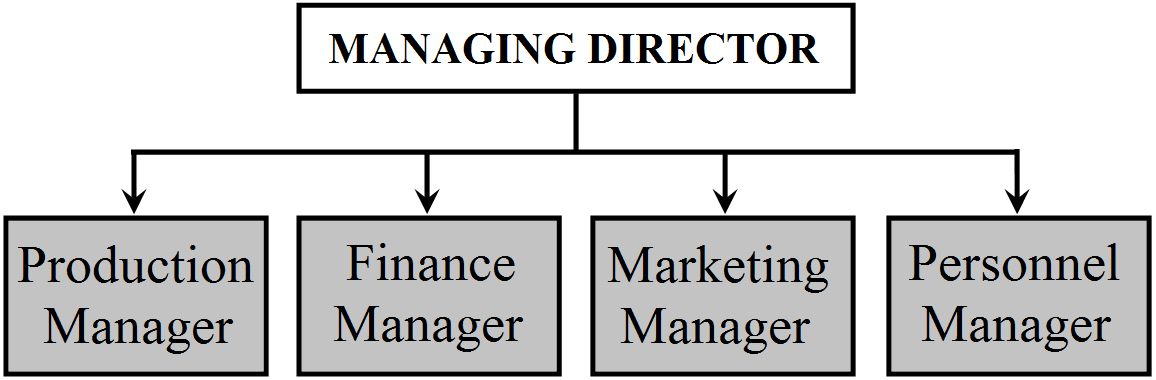
Bhuvan, Rishabh and Piyush have decided to start a business of manufacturing toys. They identified the following main activities which they have to perform. • Purchase of raw material
  • Purchase of machinery.
  • Production of toys.
  • Arrangement of finance.
  • Sale of toys.
  • Selection of employees.
In order to facilitate the work, they thought that four managers should be appointed to look after production, finance, marketing and personnel.
  1. Identify the function of management involved in the above para.
  2. Quote the lines from the above para which helps you to identify this function.
  3. State the steps followed in this process.
Answer
  1. Organising.
  2.  
  1. They identified the following main activities which they have to perform'.
  2. 'In order to facilitate the work, they thought that four managers should be appointed to look after production, finance, marketing and personnel'. These lines depict the 'Identification and division of work' step of organising process.
  1. The steps involved in organising are:
  1. Identification and division of work.
  2. Departmentalisation.
  3. Assignment of duties.
  4. Establishing reporting relationships.
View full question & answer
Question 403 Marks
State any three advantages of informal organisation.
Answer
Advantages of Informal Organisation:Following are the advantages of Informal Organisation:
  1. Effective Communication: In the absence of any definite course, it is an effective system of communication. Messages can be quickly conveyed from one place to another with the help of this system.
  2. Fulfills Social Needs: In the informal organisation, people having similarity of thoughts and ideas form a group of their own. All the people in the group stand by one another in all the organisational or personal matters.
  3. Fulfills Organisational Objectives: In the informal organisation, the subordinates put their ideas before the superiors without any fear or hesitation. It helps the superiors to understand their difficulties and immediate solution of the problem is sought out. Since the problems are easily solved it becomes easier to achieve the objectives of the organisation.
View full question & answer
Question 413 Marks
Write three characteristics of decentralisation.
Answer
Following are the salient characteristics of decentralisation:
  1. It is an expanded version of delegation of authority.
  2. It increases the significance of the role of subordinates.
  3. It is a process which is applicable to the organisation as a whole.
View full question & answer
Question 423 Marks
Discuss three disadvantages of divisional organisation structure.
Answer
Following are the disadvantages of divisional organisation structure:
  1. Conflicts between Divisional Heads: Every divisional head wants to become a divisional empire. To satisfy their ego, each demands maximum resources for their division. This situation leads to conflicts among the various divisional heads.
  2. Duplicity of Functions: The entire set of functions (e.g., production, marketing, finance, personnel, etc.) is required for all divisions. It gives rise to duplicity of efforts among divisions. Hence, resources are misused and cost of operations is unnecessarily increased.
  3. Selfish Attitude: Every division tries to display better performance sometimes even at the cost of other divisions. This shows their selfish attitude. Consequently, it hits the interest of the concern as a whole.
View full question & answer
Question 443 Marks
In functional structure, all functions are separated, resulting employees have little understanding or concern outside their functional area. In the light of above statement, state the disadvantages of functional structure.
Answer
The functional structure suffers from the following disadvantages:
  1. It is difficult to hold a single department responsible for any problem.
  2. As departments grow in number, coordination become difficult.
  3. Conflicts may arise between departments.
View full question & answer
Question 453 Marks
Explain the concept of informal organisation.
Answer
An informal organisation originates from within the formal organisation to meet the cultural and social needs of members of the organisation. When several individuals work together for achieving certain organisational goals, they come to know each other's cultural interests and needs. They associate informally to fulfil such interests and needs. The network of these social groups based on friendship is called an informal organisation. The informal organisation is, thus, a system of social relationships among the members. It emerges on its own in a natural manner within the formal organisation.
View full question & answer
Question 463 Marks
What is formal organisation structure? How is it different from informal organisation on the basis of flow of authority?
Answer
The organisational structure designed and established by management is called formal organisation. It is an official set up to achieve certain goals. It is a system of clearly defined activities and relationships which are intended to divide and integrate the activities of the organisation.
Flow of authority: Authority flows from top to bottom in formal organisations. Its direction is downward. In informal organisation, flow of authority is vertical, horizontal as well as diagonal, i.e., it can flow in all directions.
View full question & answer
Question 473 Marks
Distinguish between Formal and Informal organisations (give any three points).
Answer
S. No.
Basis of Difference
Formal Organisation
Informal Organisation
1.
Meaning
An organisation created by themanagement in the form ofstructure of authority is calledformal organisation.
An organisation born out of mutual relations is called informal organisation and it emerges automatically.
2.
Origin
It is established because of the rules and policies of the organisation.
It is established because of social relationship.
3.
Authority
Authority is born out of the postsestablished in the organisation and moves downwards.
Authority comes into existence because of individual virtues. Authority moves downwards or it can be horizontal.
View full question & answer
Question 483 Marks
State any three points which highlight the importance of delegation for an organisation.
Answer
Importance of Delegation:The following are the main points of the importance of delegation:
  1. Effective Management: Delegation leads to effective management through empowerment of employees.
  2. Employee Development: Delegation helps in employee development by providing them with the chance to use their skills and experience.
  3. Motivation of Employees: Delegation motivates employees by giving them responsibility which builds their self-esteem.
View full question & answer
Question 493 Marks
Describe the importance of an informal organisation.
Answer
Importance of informal organisation is as follows:
  1. It brings a feeling of belonging, status, self-respect and satisfaction.
  2. It satisfies social and cultural needs of the members.
  3. It provides useful channels of communication.
  4. It helps in maintaining the personality of the individual against certain effects of formal organisation which tends to disintegrate personality.
  5. It makes the organisational structure flexible and workable.
View full question & answer
Question 503 Marks
Under what circumstances would functional structure prove to be an appropriate choice?
Answer
The functional organisation structure is suitable in the situations given below:
  1. Where the size of the business unit is large.
  2. Where specialisation is required.
  3. Where there is only one product that is sold.
View full question & answer
3 Marks Question - Business Studies STD 12 Commerce Questions - Vidyadip