Question types

Model Paper 3 question types

40 questions across 8 question groups — pick any mix to generate a Economics paper with step-by-step answer keys.

40
Questions
8
Question groups
5
Question types
Sample Questions

Model Paper 3 questions

One sample from each question group in this chapter. Select any group above to see the full set with answer keys.

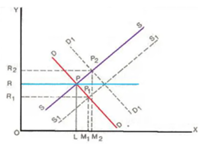
The equilibrium exchange rate is determined at the point where the
Image
  • A
    Demand for and Supply of foreign exchange has maximum gap
  • B
    Demand for and Supply of foreign exchange has normal gap
  • C
    Demand for and Supply of foreign exchange has minimum gap
  • D
    Demand for and Supply of foreign exchange is equal
View full solution
Which of the following is an example of intermediate goods?
  • A
    All of these
  • B
    Carpurchased by a dealer of second hand car
  • C
    Fertilizers purchased by a farmer
  • D
    Steel and cement used to construct a flyover
View full solution
Calculate National income or NNP at FC.
Particulars₹ in crores
(i) GDP at MP4,800
(ii) Indirect Taxes300
(iii) Net Factor income from abroad80
(iv) Consumption of Fixed Capital200
(v) Subsidies60
National Income = ₹ 4,440 Crores
View full solution
Q 104 Marks Question4 Marks
With reference to Consumption Function answer the following questions:
i. What is consumption function?
ii. What is break even point?
iii. Consumption curve starts from Y-axis. What does this implies?
View full solution
Q 124 Marks Question4 Marks
What is Fiscal Policy? What possible fiscal policy measures can be taken with respect to expenditure and income to correct (i) Excess demand and (ii) Deficient demand in the economy.
View full solution
Q 136 Marks Question6 Marks
(i) A large fiscal deficit leads to a higher revenue deficit in future. Do you agree with the statement? Give reasons in support of your answer.
(ii) Giving reasons, classify the following as direct and indirect taxes:
i. Income Tax
ii. Goods and Services Tax
iii. Corporate Tax
iv. Capital Gains Tax
View full solution
Q 146 Marks Question6 Marks
i.Mention the situations in which following equations will hold true:
i. Value of Output is equal to Value Added.
ii. National income at Current Price = National income at Constant Price
iii. Gross domestic capital formation = Gross domestic fixed capital formation
iv. Operating Surplus = Rent + Royalty + Profit
ii.Giving valid reasons explain, which of the following will not be included in the estimation of National Income of India?
a. Purchase of shares of Sethi Ltd. by an investor in the Bombay Stock Exchange.
b. Salaries paid by Indian Embassy situated at Japan, to the local workers.
c. Depreciation on capital assets charged by firms.
View full solution
Q 156 Marks Question6 Marks

i. Calculate national income:

Items(₹ In crore)
(i) Compensation of employees2000
(ii) Interest paid by production units500
(iii) Rent700
(iv) Profits800
(v) Employers' contribution to social security schemes200
(vi) Dividends300
(vii) Consumption of fixed capital100
(viii) Net indirect taxes250
(ix) Net exports70
(x) Net factor income to abroad150
(xi) Mixed income of self-employed1500

ii.Calculate Gross National Product at Market Price and Net National Disposal Income from the following:

Items(Rs.in Arab)
Net factor income to abroad(-)10
Net current transfers from rest of the world20
Wages and salaries400
Corporation tax50
Profit after corporation tax150
Social Security contributions by employees50
Rent100
Interest70
Mixed income of self-employed300
Net indirect tax140
Consumption of fixed capital80
View full solution
Q 16M.C.Q (1 Marks)1 Mark
Agriculture is a dominant sector of our economy and credit plays an important role in increasing agriculture production. The following are the institutional sources of agricultural credit except:
Image
  • A
    Commercial banks
  • B
    NABARD
  • C
    Regional banks
  • D
    Money lenders
View full solution
Q 18M.C.Q (1 Marks)1 Mark
Statement I: During the British colonial period, India's agriculture was starved of investment in terracing, flood-control, drainage and desalinisation of soil.
Statement II: While a small section of farmers changed their cropping pattern from food crops to commercial crops, a large section of tenants, small farmers and sharecroppers neither had resources and technology nor had incentive to invest in agriculture.
  • A
    Statement II is true, but statement I is false.
  • B
    Statement I is true, but statement II is false.
  • C
    Both the statements are true.
  • D
    Both the statements are false.
View full solution
Q 19M.C.Q (1 Marks)1 Mark
We are now faced with increased demand for environmental resources and services but their supply is limited due to ________.
  • A
    Overuse of environmental resources
  • B
    Misuse of environmental resources
  • C
    Overuse and Misuse of environmental resources
  • D
    Affluent consumption standards
View full solution
Q 20M.C.Q (1 Marks)1 Mark
___________ announce its five year plan in 1951. While___________announced its five year plan in 1956.___________ announced its five year plan in 1953.
  • A
    Pakistan, India, China
  • B
    Pakistan, China, India
  • C
    India, China, Pakistan
  • D
    India, Pakistan, China
View full solution
Q 233 Marks Question3 Marks
Government allocates forest lands to industries to use forest materials as industrial raw materials. Twelve years after setting up a paper mill in Uttar Kanara area, bamboo has been wiped out from that area. Even if a paper mill employs thousands of workers, but if they deprive the daily needs of million people, is it acceptable? What do you think?
View full solution
Q 286 Marks Question6 Marks
The Impact of COVID-19 on South Asian Economies - Pakistan
EARLY IMPACT OF THE PANDEMIC
On February 26, 2020, Pakistan confirmed its first two cases of COVID-19. The pandemic could not have come at a worse time: the economy was growing at a tepid rate, jobs were hard to come by, and high inflation continued to erode the purchasing power of millions of households. As the case count grew, fear that the virus would spread rapidly across the country led to a vociferous “lockdown versus livelihoods” debate. Khan made a public case for protecting livelihoods and argued against a countrywide lockdown. Nevertheless, provincial governments began to issue their own lockdown orders, shutting down all nonessential businesses. The enforcement of these orders brought Pakistan’s economy to a standstill by the end of March.
Early estimates predicted that the economy would lose between 12 and 18 million jobs during the lockdown. The World Bank predicted that the country would enter its first recession in decades. Consequently, on March 24, 2020, Khan announced a stimulus package to prop up the economy and pave the way for a quick recovery. Totaling Rs.1.2 trillion (about 3 percent of GDP), the stimulus included an Rs.200 billion fund to protect laborers, Rs.150 billion to expand the country’s existing cash transfer program to poor families, and another Rs. 100 billion for pandemic-related emergencies.
The biggest success of the stimulus was the rapid expansion of the country’s cash transfer mechanism. More than 15 million families received funds through the program, ensuring that millions of citizens did not fall into extreme poverty. The State Bank also played a key role in supporting the economy, extending credit to small- and medium-sized businesses and protecting millions of jobs in the formal economy. The cumulative support provided by the central bank reached Rs. 1.3 trillion by October 2020. It also sharply cut interest rates from 13.25 percent to 9 percent in April 2020 and pushed them down to 7 percent by the end of June. As its domestic economy struggled, Pakistan had to pause its USD 6 billion fiscal stabilization program (which had started in 2019) and seek emergency relief from the IMF. By mid-April, the IMF also approved a USD 1.39 billion loans to alleviate the economic pain from the pandemic. In the following months, the World Bank provided USD 505 million in low-interest, soft loans; the Asian Development Bank approved a USD 500 million emergency loan; and the Asian Infrastructure Investment Bank approved a USD 250 million loans. Nevertheless, by December 2020, debt relief program talks with the IMF stalled as the Khan government resisted the demands and restrictions posed by the IMF. These included demands to increase energy tariffs and to sustainably reduce debt in the power sector, among others.
Questions:
i. Discuss the projected impact of the countrywide lockdown on Pakistan’s economy.
ii. Analyse the implications of the pandemic on the domestic economy of Pakistan.
View full solution
Q 296 Marks Question6 Marks
i. Discuss briefly, how institutional reforms (land reforms) have played a significant role in transforming Indian agriculture.
ii. Write a note on National Bank for Agricultural and Rural Development (NABARD).
View full solution
Q 306 Marks Question6 Marks
i. What is organic farming and how does it promote sustainable development?
ii. Classify rural credit in different categories on the basis of time period.
View full solution

Generate a Model Paper 3 paper free

Pick question groups from the list above, set marks and difficulty, and export a branded PDF with step-by-step answer keys. First 3 chapters free — no signup.

Download App