Questions · Page 1 of 4

3 Marks Question

🎯

Test yourself on this topic

50 questions · timed · auto-graded

Question 13 Marks
'Ayush Generic Medicines,' a chemist shop sells generic medicines. On 15.2.2016 medicines as per the details given below were sold:
No. of customers Per customer billed amount
15 370
20 430
45 500
25 1,000
95 1,200
Calculate the average amount of medicines sold per customer.
Answer
No. of Customers Per customer billed amount (in Rs.) Total Billed Amount (in Rs.)
15 370 5550
20 430 8600
45 500 22500
25 1000 25000
95 1200 114000
Total- 200   175650
$\text{Average total billed amount}=\frac{\text{Total Billed Amount}}{\text{Total number of Customers}}$
$=\frac{175650}{200}$
= Rs. 878.25
View full question & answer
Question 23 Marks
'Janata Foods Ltd.' is a restaurant situated on a national highway near Hyderabad. The following figures have been extracted from the books of Janata Foods Ltd.:
 
Stock of Raw Material
1,50,000
Short-Term Loans
1,83,000
Trade Creditors
96,000
Trade Debtors
2,25,000
Dividend Payable
1,50,000
Tax Payable
1,32,000
Short-Term Investments
2,28,000
From the above information, calculate the following:
  1. Gross Working Capital.
  2. Net Working Capital.
Answer
  1.  
Gross Working Capital = Sum of Current Assets
Current assets = Trade Debtors + Stock of raw materials + Short term investments
= Rs. 2,25,000 + Rs. 1,50,000+ Rs. 2,28,000
Gross Working Capital = Rs. 6,03,000.
  1.  
Net Working Capital = Current Assets - Current Liabilities

Current assets = Trade Debtors + Stock of raw materials + Short term investments
= Rs. 2,25,000 + Rs. 1,50,000 + Rs. 2,28,000
Current Assets = Rs. 6,03,000
Current liabilities = Short Term Loans +Trade Creditors+ Dividend Payable + Tax payable
Rs. 1,83,000 + Rs. 96,000 + Rs.1,50,000 + Rs. 1,32,000
Current Liabilities = Rs. 5,61,000
Net working capital = Current Assets- Current Liabilities
=Rs. 6,03,000 - Rs. 5,61,000
= Rs. 42,000
View full question & answer
Question 33 Marks
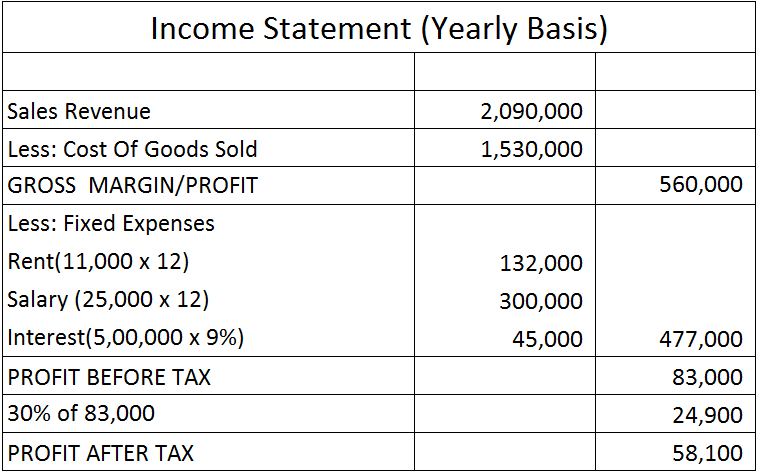
Harsha started her herbal beauty products shop in Chandigarh with a capital of ₹ 9,00,000. She took a loan of ₹ 5,00,000 from the State Bank of India at 9% p.a. interest. During the year ended 31st March 2016, her sales were ₹ 20,90,000 and the cost of goods sold was ₹ 15,30,000. She paid a monthly rent of the shop ₹ 11,000 and a monthly salary of ₹ 25,000 to the employees. The tax rate is 30%. Calculate the Return on Equity.
Answer

$\text{ROE}= \frac{\text{Profit after tax}}{\text{Equity}}\times100$
$=\frac{58,100}{9,00,000}\times100$
$=6.45 \text{%}$
OR
$ =\frac{58100}{4,00,000}\times{100} $
$=14.52 \text{%}$
View full question & answer
Question 43 Marks
Pankaj an entrepreneur started a new website 'Save Electricity' to sell LED bulbs. In the first year, he sold 2400 bulbs at the rate of 100 each. His cost of placing an order and receiving the bulbs is 500 per order. If the Economic Order Quantity is 200 buIbs, find out the inventory holding cost per year.
Answer
$\text{EOQ}=\sqrt\frac{2pd}{C}\text{D-annual demand; P-ordering cost; C-holding cost.}$$\text{EOQ}=\sqrt\frac{2\times2400\times500}{C}$
$200=\frac{2400000}{C}$
$(200)^{2}=\frac{2400000}{C}$
$\text{C}=\frac{2400000}{40000}=60.$
View full question & answer
Question 53 Marks
Following information is related to sales - mix of Pen. Sketch Pen and Geometry box.
Product Pen Sketch Pen Geometry box
Sales Price Per Unit(in Rs.) 40 45 75
Variable Cost Per Unit (in Rs.) 22 30 40
Sales - Mix Percentage 20% 20% 60%
Total Fixed cost is - Rs.90,000.
Calculate the weighted-average-contribution per unit for the sales mix.
Answer
STEP 1 Pen Sketch pen Geometry box
S.P per unit 40 45 75
(-) V.C. per unit 22 30 40
Gross Margin 18 15 35
STEP 2      
WACM ${18}\times\frac{20}{100}=3.6$ $15\times\frac{20}{100}=3$ $35\times\frac{60}{100}=21$
STEP 3 SUMMATION 27.6    
View full question & answer
Question 63 Marks
Bigul Chaturvedi started a School bag business with his brother. Both were very excited about the new venture. With meticulous planning and a lot of hard work, they were able to sell 1,000 bags in the first year. But they did not earn any profit. Both were happy because-because they were not at loss and revenue generated was equal to the cost. Now they were moving towards earning profit in the second year.
  1. Identify the component of financial plan discussed above.
  2. By giving any four points state how this component is useful for the entrepreneur.
Answer
  1. Break even point: Breakeven point is the level of sales (or revenue generated) that equals all the expenses required for generating that revenue. It is not more than the expenses (i.e. no profit) nor is it less than the expenses (i.e. no loss).
  2. Benefits of Break even point to entrepreneur:
  • It helps in setting profit goal and sales target.
  • it helps in determining the products that are not contributing to meet the fixed expenses and thus brings up the item for discussion in management meeting about its continuity.
  • Break even point analysis helps in such decision making.
  • Break-even analysis will help an entrepreneur schedule product inventory levels. Entrepreneurs must stock enough inventory to have products available for sale over a given period of time.
View full question & answer
Question 73 Marks
''All business planned for sales volumes and revenues, resources quantities, cost and expenses, etc."Identify the concept involved in the above planning and state any two benefits of this concept.
Answer
Budgeting: One of the important tools for good financial management (i.e. planning and controlling) is the budgeting process. For any business, a budget is a quantitative expression of a plan for a defined period of time.
Benefits of budgeting:
  • For startup entrepreneurs, a budget is like a roadmap that can help them set goals and assess the validity of their business concept.
  • For established small businesses, a budget can be used to take the pulse of the business, determining how the business is performing through the years, and helping identify possible future investments.
View full question & answer
Question 83 Marks
'The Shop', a readymade garments retail shop, sold 5,000 shirts at Rs. 200 per shirt during the year ended 31st March 2014. Cost of placing an order and receiving goods is Rs. 1,000 per order. Inventory holding cost is Rs. 250 per year. Calculate the 'Economic Order Quantity' for 'The Shop'.
Answer
Economic Ordering Quantity Formula$\text{q}=\sqrt\frac{2PD}{C}$
$= \sqrt\frac{2 \times 1000\times5000}{250}$
$=\sqrt{40000}.$
$=200$ units.
View full question & answer
Question 93 Marks
An entrepreneur proposes to produce 500 pants per week for which he needs ₹ 30,000 for purchasing raw materials, ₹ 10,000 for payment of labour charges and ₹ 5,000 for purchase of a button machinery. His operating cycle is 3 weeks.
Calculate the working capital requirements of this entrepreneur and also give the meaning of 'operating cycle'.
Answer
Working capital requirement = cost of Raw material + payment to labour charges
= 30,000 + 10,000

= 40,000 x 3(operating cycle)

= ₹ 1,20,000
Operating cycle - is the time between the raw material purchased to sales realisation.
View full question & answer
Question 103 Marks
Distinguish between ‘fixed capital’ and ‘working capital’.
Answer
Sr. No. Fixed Capital Working Capital
1. It is invested in fixed assets. Invested in current assets.
2. Used for the purpose of meeting the permanent long term needs of the business. Is needed for meeting the short term needs of the business.
View full question & answer
Question 113 Marks
Why is Return on Investment deemed as a yardstick for the performance of an enterprise? Explain with suitable example.
Answer
Return on investment=
Net profit before interest & taxes/Total Investment. It is deemed as a yardstick of performance of an enterprise because it measures the overall profitability and efficiency of the enterprise in relationship to investment made by the entrepreneur in business.
View full question & answer
Question 123 Marks
State the advantages of ‘Inventory Control’.
Answer
Advantages of Inventory Control.
  1. It helps in knowing whether materials are readily available for production or use.
  2. It helps in examining quantity discount for large orders.
  3. It helps in ensuring prompt delivery of materials to consumers.
  4. It helps in stabilising the fluctuations of demand.
View full question & answer
Question 133 Marks
Explain the concept of ‘circulating capital’ with the help of an example.
Answer
Working Capital is called the changing or “Circulating Capital”, since the money circulates in various forms of current assets in a continued manner. For example, funds once tied up in the form of raw material are later converted into the form of finished goods which are not ultimately sold.
View full question & answer
Question 143 Marks
'H.L. Chemist' sells medicines at a discount of 5% on list price. On 1.3.2017 medicines as per details given below were sold by 'H.L.Chemist'.
No. of Customers Per customer billed amount
 
50 340
45 370
35 650
30 800
25 975
Calculate the average amount of medicines sold per customer.
Answer
No. of customers
Per customer billed amount
Total Billed amount
50
340
17,000
45
370
16,650
35
650
22,750
30 800 24,000
25
975
24,375
 
1,04,775
 
$\text{Average Total Billed Amount}=\frac{\text{Total Billed Amount}}{\text{Total Number of customers}}$
$=\frac{1,04,775}{185}$
$=566.35$
View full question & answer
Question 153 Marks
From the following information, calculate 'Return on Equity':$\text{Captital}\text{ }\text{ }\text{ }\text{ }\text{ }\text{ }\text{ }\text{ }{\text{₹}}\text{ }\text{6,00,000}\\10{\text{%}}{\text{Loan}}\text{ }\text{ }\text{ }\text{ }\text{ }\text{ }\text{ }{\text{₹}}\text{ }20,000$
Net profit before interest ₹ 1,40,000. Also, state what is this return on rupees per lakh of equity.
Answer
$\text{Return On Equity}=\frac{\text{Net Profit after Tax}}{\text{Equity}}\times100$$\text{Interest}=2,00,000\times {\frac{10}{100}}= \text{Rs.}20,000$
$\text{Profit after interest = 1,40,000 - 20,000= 1, 20, 000}$
$\text{ROE} \text{ }\text{ }=\frac{1,20,000}{6,00,000}\times100= {\text{20%}}$
$\text{Return on rupees per lakh = 1,00,000 x 0.2 = Rs.20,000}$
Alternate Answer
$\text{Return On Equity}=\frac{\text{Net Profit after Tax}}{\text{Equity}}\times100$
$\text{Interest}=2,00,000\times{\frac{10}{100}}=\text{Rs.}20, 000$
$\text{Profit after interest}=1,40,000-20,000= 1,20,000$
$\text{ROE}=\frac{1,20,000}{4,00,000}\times100=30\text{%}$
$\text{Working note: Equity}=\text{Total capital - loan}$
$=6,00,000 - 2,00,000$
$= 4,00,000/-$
$\text{Return on rupees per lakh}=1,00,000\text{ } \times\text{ }0.3 =\text{Rs.}30,000$
View full question & answer
Question 163 Marks
Jalaji, an entrepreneur, started a new website 'Fashionate Shirts' to sell readymade shirts. In the first year, he sold 1200 shirts at the rate of Rs. 500 each. His cost of placing an order and receiving the shirts is Rs. 1,000 per order. If the Economic Order Quantity is 200 shirts, find out the inventory holding cost per year.
Answer
$\text{EOQ}=\sqrt\frac{2pd}{C}$ D = Annual demand; p = Ordering cost; C = holding cost$200=\sqrt\frac{2\times1200\times100}{C}$
$(200)^{2}= \frac{2\times1200000}{c}$
$\text{C}=\frac{2400000}{40000}$
Rs. 60.
View full question & answer
Question 173 Marks
Rohit Shetty started leather shoe business with his brother. Both were very excited about the new venture. With meticulous planning and a lot of hard work, they were able to sell 700 pairs of shoes in the first year. But they did not earn any profit. Both were happy because they were not at loss and revenue generated was equal to the cost.
Now they were moving towards earning profit in the second year.
  1. Identify the component of financial plan discussed above.
  2. By giving any four points state how this component is useful for the entrepreneur?
Answer
  1. B.E.P- Break Even Point Advantages.
  2.  
  1. Minimum level of output to be produced.
  2. Effect of change in quantity of output upon the profits.
  3. Selling price of the product Profitable options in line of production.
  4. Profitable options in line of production.
View full question & answer
Question 183 Marks
'All business plan for sales volumes and revenues, resource quantities, costs and expenses, etc'.
Identify the concept involved in the above planning and state any two benefits of this type of plan.
Answer
Budgeting: One of the important tools for good financial management (i.e. planning and controlling) is the budgeting process. For any business, a budget is a quantitative expression of a plan for a defined period of time.
Benefits:
  1. It is like a road map that can help drive-entrepreneurs in setting goals and addressing the validity of their business concept.
  2. Determining how the business is performing through the years and helping identifying possible future investments.
  3. Business leaders can compare actual figures and catch potential business pitfalls early.
  4. It can also be instrumental in winning over investors, convincing banks or bringing new Partners.
View full question & answer
Question 193 Marks
Following information is related to sales - mix of registers having 100 pages, 200 pages and 300 pages:
Register 100 pages 200 pages 300 pages
Sales Price per unit 30 42 72
Variable Cost per unit 18 28 38
Sales-Mix Percentage 20% 20% 60%
Total Fixed Cost is - 80,000.
Calculate the weighted-average-contribution per unit for the sales mix.
Answer
Step 1:
  100 pages 200 pages 300 pages
Sales price @ unit 30 42 72
Less: Variable cost @ unit 18 28 38
Gross profit/margin 12 14 34
$\text{Step 2: } {12}\times\frac{20}{100}=\text{2.4}$
${14}\times\frac{20}{100}=2.8$
${34}\times\frac{60}{100}=20.4$
$\text{Step 3: Weighted Average}=2.4+2.8+20.4=25.6.$
View full question & answer
Question 203 Marks
'The Fancy Store' a readymade garments retail shop sold 8,000 shirts at Rs. 400 per shirt during the year ended 31st March 2014. Cost of placing an order and receiving goods is Rs. 2,000 per order. Inventory holding cost is Rs.500 per year. Calculate the 'Economic Order Quantity' for 'The Fancy Store'.
Answer
Economic Ordering Quantity Formula:$=\sqrt{\frac{2PD}{C}}$
$= \sqrt{\frac{2 \times 2000 \times 8000}{500}}$
$= \sqrt{64000}$
Ans. = 252.98 units (253).
View full question & answer
Question 213 Marks
An entrepreneur proposes to produce 1000 shirts per week for which he needs Rs. 50,000 for purchasing raw materials, Rs. 20,000 towards the payment of labour charges and Rs.10,000 for purchase of a machinery. His operating cycle is 2 weeks.
Calculate the working capital requirements of this entrepreneur and also give the meaning of 'Operating Cycle'.
Answer
Working capital requirement = Raw material + Payment of Labour

= 50,000 + 20,000

= 70,000 x 2 (operating cycle)

= 1,40,000

An operating cycle is termed as cash to cash flow as it starts with the outflow of cash towards the purchase of raw material and ends with cash inflow in terms of payments received from customers towards the sale of product.
View full question & answer
Question 223 Marks
Explain any two inputs required for designing a 'Sales Budget'.
Answer
Two inputs required for designing a sales budget:
  • Previous sales budget: The basic input required for preparing sales budget is previous years sales record to find out the trend of sales in the market and from previous sales budget a new budget will be prepared.
  • Obtain department budgets: Obtain the budgets from all departments, check for errors, and compare to the bottleneck, funding, and step costing constraints. Adjust the budgets as necessary.
View full question & answer
Question 233 Marks
Why is Return on Investment deemed as a yard stick for the performance of an enterprise? Explain with suitable example.
Answer
Return on investment
Net profit before interest & taxes/Total Investment. It is deemed as a yardstick of performance of an enterprise because it measures the overall profitability and efficiency of the enterprise in relationship to investment made by the entrepreneur in business.
View full question & answer
Question 243 Marks
Paramveer Singh runs an online business for gym equipments. The annual demand for the Waist Flexors sold by him is 16,000 units. The annual holding cost of Waist Flexors per unit is ₹ 48 and the cost of placing an order is ₹ 1,500. Calculate the Economic Order Quantity of Waist Flexors.
Answer
Economic Ordering Quantity, $=\sqrt{\frac{2\times\text{annual usage}\times\text{ordering cost per unit}}{\text{Carrying cost per unit}}}$ Thus as: annual demand = 16000 Order cost = ₹ 1,500 Annual carrying cost of 1 unit = ₹ 48$\text{EOQ}=\sqrt{\frac{2\times16,000\times1,500}{48}}$
$=\sqrt{10,00,000}$
$= 1000\ \text{Units.}$
View full question & answer
Question 253 Marks
Give the meaning of ‘Cash Conversion Cycle’. How is Cash Conversion Cycle of a trading concern different from a manufacturing concern?
Answer
Operating cycle or cash conversion cycle is the time required for a business to convert raw material into cash. It represents the time period between buying the raw material and receiving cash from the customer. In a trading concern, operating cycle will be time period between buying of goods and money realised from sales. In a manufacturing concern, it will be the time required to convert:
  • Cash into raw materials.
  • Raw materials into work-in-progress.
  • Work-in-progress into finished goods.
  • Finished goods into accounts receivable.
  • Finally, accounts receivable into cash.
View full question & answer
Question 263 Marks
Aditya Bearings Ltd. are the manufacturers and suppliers of ball bearings to fan manufacturing companies. The company requires 900kg. of wrought iron for its production process. The cost of placing each order is ₹ 50 and carrying cost is ₹ 100. Calculate Economic Order Quantity.
Answer
Economic Ordering Quantity = $\text{EOQ}=\sqrt{\frac{2\times\text{P}\text{XD}}{\text{C}}}$ Annual demand(D) = 900kgs, Order cost(P) = ₹ 50 Annual carrying cost of 1 unit(C) = ₹ 100$\text{EOQ}=\sqrt{\frac{2\times900\times50}{100}}$
$=30\text{kgs}.$
View full question & answer
Question 273 Marks
What is meant by operational budget?
Answer
Operational budget is the most common type of budget used to forecast yearly revenues and expenses for a business.
View full question & answer
Question 283 Marks
What does inventory mean in general sense?
Answer
Inventory in general sense means the stock of raw materials, semi-finished goods, consumables, spare parts and finished goods.
View full question & answer
Question 293 Marks
“The Budget period for all the business are same”. Do you agree? Comment.
Answer
No, I don't agree with the statement. The budget period will depend upon the type and size of business enterprise and control aspect.
  1. For seasonal enterprise (food and clothing) short period generally should cover one season.
  2. For heavy industries with heavy capital expenditure (heavy engineering works/ automobile industries) the budget period is generally long.
View full question & answer
Question 303 Marks
“Saraswati Stationery House” sold in one day the following items:
Items
Unit prise (in ₹)
Quantity
Total Billed Amount (in ₹)
Ball Point Pen;
  1. Black colour
  2. Multi Colour
  3. Blue Colour
6
10
20
20
20
13
120
200
260
Gel Pen;
  1. Simple box
  2. Geometric box
 
10
70
 
6
1
 
60
70
Note book (Copies)
  1. 100 pages
  2. 225 pages
  3. practical File
  4. Graph copy
20
40
50
20
20
10
7
5
400
400
350
100
Eraser
10
10
100
Whitner pen
25
2
50
Pencil per dozen
50
6
300
scale
20
10
200
sketch pens
25
3 doz..
75
  1. sharpner
  2. Fancy
4
20
5
5
20
100
Total
 
265
5000
The shopkeeper also found out, based on the number of bills issued by him, that there were 50 customers.
Calculate:
  1. Unit of Sale
  2. Unit Price
  3. Unit Cost (70 % of its Selling Price/Unit Price)
  4. Gross Margin per unit of sale.
Answer
. Unit of Sale: Customers$\text{Unit Price}=\frac{\text{Total bill amount}}{\text{No. of customers}} =\frac{5000}{50}=₹ 100\ \text{per customer}$
View full question & answer
Question 313 Marks
Mohit is the sales manager of his company. The company is planning its annual operations and has asked Mohit to prepare the relevant budget for his department. Which budget is Mohit required to prepare?
Answer
Mohit is required to prepare sales budget. Sales budget gives an estimate of future sales, both in terms of units and rupees.
View full question & answer
Question 323 Marks
At zero level of output, total expenses are also zero. Do you agree? Why or why not?
Answer
At zero level of output, total cost is not zero as the business has to bear certain fixed cost even at this level, such as salary of the administrative staff, rent of premises, etc.
View full question & answer
Question 333 Marks
Explain Cash Conversion Cycle in short.
Answer
The duration between buying the raw material and receiving cash from the customer is known as Cash Conversion Cycle.
View full question & answer
Question 343 Marks
The computation of EOQ is based on certain assumptions. What are they?
Answer
The assumptions are as follows:
  1. Prior knowledge of annual usage of inventory.
  2. Constant rate of usage.
  3. Constant ordering and carrying costs.
  4. Zero lead time.
View full question & answer
Question 353 Marks
Explain any three factors that influence the decisions with regard to orders of inventory.
Answer
The factors that influence the decisions with regard to orders of inventory are as follows:
  1. Lead time It refers to the time between placing an order and receiving an order.
  2. Rate of usage It is the rate of consumption of raw materials.
  3. Re-order point It refers to the level of inventory at which new order should be placed to replenish the stock.
View full question & answer
Question 363 Marks
Divij has opened a restaurant which serves Chinese food. His fixed expenses per month are ₹ 20,000. During the month of August, his total sales revenue was also ₹ 20,000. Divij thinks that he has achieved the break-even level. Is he correct in his approach?
Answer
No, Divij is not correct in his approach because at break-even level, profits should be equal to fixed expenses and not sales.
View full question & answer
Question 373 Marks
Which assets are expected to get converted into cash or cash equivalents within a period of one year?
Answer
Current assets refer to those assets which are expected to get converted into cash or cash equivalents within a period of one year.
View full question & answer
Question 383 Marks
Write a short note on 'Return on Investment'.
Answer
Return on Investment (Rol) indicates the percentage of return on total capital invested in the business.$\text{Return on Investment(ROI)}=\frac{\text{Net Profit}}{\text{Total Capital Investment}}\times100$
where, Total Capital Invested = Equity + Debt.
View full question & answer
Question 393 Marks
Carrying costs are those costs which are incurred to maintain a given level of inventory. Give examples of two such costs.
Answer
Examples of two such costs are:
  1. Cost of storage space.
  2. Cost of insurance.
View full question & answer
Question 403 Marks
Which budgets are generally prepared by a small business?
Answer
A small business generally prepares operational, cash and capital budgets.
View full question & answer
Question 413 Marks
Net working capital can be negative or positive, but gross working capital is always positive. Why?
Answer
Net working capital is basically the difference between current assets and current liabilities. If current assets are more than current liabilities, Net working capital will be positive. If on the other hand, current liabilities are more than current assets, working capital will be negative.
But, gross working capital is the sum of current assets only, therefore it is always positive.
View full question & answer
Question 423 Marks
What do you understand by 'Return on Equity?
Answer
Return on Equity (ROE) is a measure of profitability calculated as a percentage of equity only.$\text{Return on Equity (RoE)}=\frac{\text{Net Income}}{\text{Equity}}\times100$
where, Equity = Money invested by the owner himself.
View full question & answer
Question 433 Marks
A book shop sells pens 30,000 quantity per year. Demand is uniform. Purchase cost is 6 per pen. Holding cost per annum is 20% of purchase cost. Ordering cost is 500 per order. What should be the EOQ for the shopkeeper?
Answer
Here, D = 30,000 ₛ ; P = 500 ₛ and C = 1.2 (20% of 6)
So, 2 × P × D = 3,00,00,000
This divided by 1.2 = 2,50,00,000
Square root of which is 5,000
So, the EOQ is 5,000 pens pital.
View full question & answer
Question 443 Marks
How does pilferage of material affect the enterprise and entrepreneur?
Answer
Pilferage of material means - theft. In any enterprises or a business theft raises your costs, lowers your profits, makes you less competitive and affects morale.
View full question & answer
Question 453 Marks
Explain the meaning of cash flow projection.
Answer
Cash flow projection shows how cash is expected to flow in and out of a business.
View full question & answer
Question 463 Marks
What do you mean by Cash Inflow and Cash Outflow?
Answer
All receipts of money is known as cash inflow like rent received and loan received, and payments made in money is known as cash outflow. Ex: Insurance premium and Transprtation charges.
View full question & answer
Question 473 Marks
Answers to these questions should not exceed 15 words:
Pareto's Law formed the basis for a technique. Name it.
Answer
The principle is named for Vilfredo Pareto, an Italian economist who studied land ownership in Italy in the early 1900’s and found that roughly 20 per cent of the population held title to about 80 per cent of the land. Pareto’s law has applications throughout science as well as business, including inventory control, where it forms the basis for a technique called ABC analysis.
View full question & answer
Question 483 Marks
Which amongst the two cash flow projections would be more accurate-a cash flow projection for 30 days or a cash flow projection for 6 months?
Answer
A cash flow projection for 30 days would be more accurate.
View full question & answer
Question 493 Marks
What is Pareto's Principle?
Answer
Pareto's Principle basically states that a relatively handful of things will generate the bulk of the results. It is also referred to as "80/20' rule.
View full question & answer
Question 503 Marks
A company uses 300 units of an item per day and the order lead time in 5 days. What should be the level of inventory when a new order is being placed?
Answer
Re-order Level = Maximum Rate of Consumption × Maximum Re-order Period
Accordingly, Re-order Level = 300 × 5 = 1,500 units
So, the level of inventory should be 1,500 units when a new order is being placed.
View full question & answer
3 Marks Question - Entrepreneurship STD 12 Commerce Questions - Vidyadip