MCQ 11 Mark
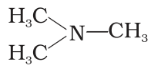
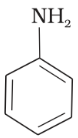
Out of the following, the strongest base in aqueous solution is:
AnswerWhen we compare the basicity of the aliphatic amines, we would expect the basicity of tertiary amines to be the greatest, followed by secondary amine and then primary amine.
But this is not so. The order of basicity is
$NH_3 <$ primary amine $\sim$ tertiary amine $<$ secondary amine
This is because:
- Steric hindrance: The size of an alkyl group is more than that of a hydrogen atom. So, an alkyl group would hinder the attack of a hydrogen atom, thus decreasing the basicity of the molecule. So, the more the number of alkyl groups attached, lesser will be its basicity.
- Solvation of ions: When amines are dissolved in water, they form protonated amines. Also, the number of possibilities for hydrogen bonding also increases. More the number of hydrogen bonding more is the hydration that is released in the process of the formation of hydrogen bonds.
The combined effect of the pushing effect of the alkyl group $(+I$ effect$),$ steric hindrance and the salvation of amines causes the basicity order to be $($basicity of tertiary is almost the same as that of primary$).$
$NH_3 $< primary amine $\sim$ tertiary amine $<$ secondary amine
So, here Dimethylamine is the strongest base. View full question & answer→MCQ 21 Mark
Which one of the amine have highest boiling point?
AnswerPrimary amines have higest boiling point because of $2$ hydrogen atom, more hydrogen bonding occur.
View full question & answer→MCQ 31 Mark
Decreasing order of basicity of the three isomers of nitro aniline is:
- A
$P −$ nitroaniline $> o −$ nitroaniline $> m −$ nitroaniline.
- B
$P −$ nitroaniline $> m −$ nitroaniline $> o −$ nitroaniline.
- ✓
$M −$ nitroaniline $> p − $nitroaniline $> o −$ nitroaniline.
- D
$M −$ nitroaniline $> o −$ nitroaniline $> p −$ nitroaniline.
AnswerCorrect option: C. $M −$ nitroaniline $> p − $nitroaniline $> o −$ nitroaniline.
Nitro group is an electron$-$withdrawing group. It mainly withdraws electrons from the ortho and para positions.
Therefore para isomer is less basic than meta isomer.
Ortho substituted anilines are generally weaker bases than aniline irrespective of the electron releasing or electron$-$withdrawing nature of the substituent.
Hence decreasing order of basicity of the isomers of nitroaniline:
$M −$ nitroaniline $> p −$ nitroaniline $> o −$ nitroaniline
View full question & answer→MCQ 41 Mark
How many lone pairs of electrons does the nitrogen atom of amines have?
AnswerThe nitrogen of $\mathrm{NH}_3$ forms $\mathrm{sp}^3$ hybridised orbitals and also a valency of three $($as it is attached to three hydrogen atoms$).$
This results is one the orbitals having a lone pair of electrons, resulting in one unshared electron pair on nitrogen.
View full question & answer→MCQ 51 Mark
Reduction of alkyl nitriles in presence of $\mathrm{LiAlH}_4$ Gives:
AnswerReduction of alkyl nitriles in presence of $\mathrm{LiAlH}_4$ Gives Alkyl Amines.
Alkyl and aryl cyanides $($nitriles$)$ can be reduce by $(\mathrm{LiAlH}_4)$ or catalytic hydrogenation.
View full question & answer→MCQ 61 Mark
Arrange the following compounds in increasing order of basicity$:\ \mathrm{CH}_3 \mathrm{NH}_2,\left(\mathrm{CH}_3\right)_2 \mathrm{NH}, \mathrm{NH}_3, \mathrm{C}_6 \mathrm{H}_5 \mathrm{NH}_2$
- A
$\mathrm{C}_6 \mathrm{H}_5 \mathrm{NH}_2<\mathrm{NH}_3<\left(\mathrm{CH}_3\right)_2 \mathrm{NH}<\mathrm{CH}_3 \mathrm{NH}_2$
- B
$\mathrm{CH}_3 \mathrm{NH}_2<\left(\mathrm{CH}_3\right)_2 \mathrm{NH}<\mathrm{NH}_3<\mathrm{C}_6 \mathrm{H}_5 \mathrm{NH}_2$
- ✓
$\mathrm{C}_6 \mathrm{H}_5 \mathrm{NH}_2<\mathrm{NH}_3<\mathrm{CH}_3 \mathrm{NH}_2<\left(\mathrm{CH}_3\right)_2 \mathrm{NH}$
- D
$\left(\mathrm{CH}_3\right)_2 \mathrm{NH}<\mathrm{CH}_3 \mathrm{NH}_2<\mathrm{NH}_3<\mathrm{C}_6 \mathrm{H}_5 \mathrm{NH}_2$
AnswerCorrect option: C. $\mathrm{C}_6 \mathrm{H}_5 \mathrm{NH}_2<\mathrm{NH}_3<\mathrm{CH}_3 \mathrm{NH}_2<\left(\mathrm{CH}_3\right)_2 \mathrm{NH}$
View full question & answer→MCQ 71 Mark
Which of the following is more appropriate reason for aniline being less basic than aliphatic amines?
- A
- B
- ✓
Positive mesomeric effect
- D
Negative mesomeric effect
AnswerCorrect option: C. Positive mesomeric effect
$\mathrm{NH}_2$ gives $e^-$ away from the group.
So $e^-$ density of $N$ decrease and hence less available for Protonation. So less Basicity.
In aliphatic amines, no mesomerism $($resonance$)$ takes place. Thus it has more electrons available for donation thus shows more basic property.
View full question & answer→MCQ 81 Mark
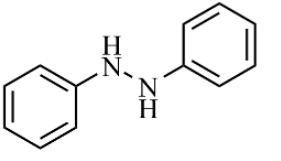
Diphenyl hydrazine is same as:
AnswerDiphenyl hydrazine is same as hydrazobenzene.
Two phenyl groups are attached to two nitrogen atoms of hydrazine.
View full question & answer→MCQ 91 Mark
Which of the following is a primary arylalkyl amine?
- A
$ \mathrm{CH}_3 \mathrm{NH}_2 $
- ✓
$ \mathrm{C}_6 \mathrm{H}_5 \mathrm{CH}_2 \mathrm{NH}_2 $
- C
$ \mathrm{C}_6 \mathrm{H}_5 \mathrm{NH}_2 $
- D
$ \left(\mathrm{C}_6 \mathrm{H}_5\right)_2 \mathrm{NH} $
AnswerCorrect option: B. $ \mathrm{C}_6 \mathrm{H}_5 \mathrm{CH}_2 \mathrm{NH}_2 $
Since it should be primary, it should have an alkyl/aryl group attached to the $NH_2$ molecule, and because it is arylalkyl, the nitrogen should be linked to an $sp^3$ hybridised benzyl carbon rather than to an aryl carbon.
View full question & answer→MCQ 101 Mark
The strongest base among the following is:
AnswerLesser the stability of the species ion, more basic be the given species.
As $\mathrm{NH}_2{ }^{-}\ ($amide ion$)$ is the least stable species ion. Thus, it is the most basic species.
View full question & answer→MCQ 111 Mark
Which of the following would not react with benzene sulphonyl chloride in $\text{aq. NaOH}\ ?$
AnswerCorrect option: C. $N, N -$ dimethyl aniline
$N, N -$ dimethyl aniline does not contain $H$ attached to nitrogen.
Hence, it would not react with benzene sulphonyl chloride in aqueous $\text{NaOH}.$
View full question & answer→MCQ 121 Mark
Which of the following reactions are correct?
$i.$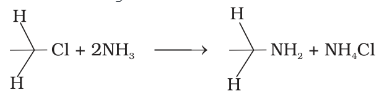
$ii.$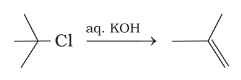
$iii.$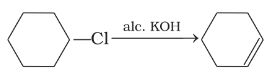
$iv.$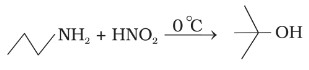
- A
$i$ and $ii$
- ✓
$i$ and $iii$
- C
$i$ and $v$
- D
$ii$ and $iii$
AnswerCorrect option: B. $i$ and $iii$
$(i)$ Is a nucleophilic substitution reaction.
$(iii)$ Is an elimination reaction. View full question & answer→MCQ 131 Mark
The reagents that can be used to convert benzenediazonium chloride to benzene are $.......$
$a. \mathrm{SnCl}_2 / \mathrm{HCl} $
$b. \mathrm{CH}_3 \mathrm{CH}_2 \mathrm{OH} $
$c. \mathrm{H}_3 \mathrm{PO}_2 $
$d. \mathrm{LiAlH}_4 $
- A
$a$ and $b$
- B
$a$ and $c$
- ✓
$b$ and $c$
- D
$a$ and $d$
AnswerCorrect option: C. $b$ and $c$
Certain mild reducing agents like hypophosphorous acid $($phosphinic acid$)$ or ethanol reduce diazonium salts to arenes and themselves get oxidised to phosphorous acid and ethanol, respectively.
$\text{Ar}\stackrel{+}{\hbox{N}}_2\text{C}\stackrel{-}{\hbox{l}}+\text{H}_3\text{PO}_2+\text{H}_2\text{O}\xrightarrow{\ \ \ \ \ }\text{ArH}+\text{N}_2+\text{H}_3\text{PO}_3+\text{HCl}$
$\text{Ar}\stackrel{+}{\hbox{N}}_2\text{C}\stackrel{-}{\hbox{l}}+\text{CH}_3\text{CH}_2\text{OH}\xrightarrow{\ \ \ \ \ \ \ \ }\text{ArH}+\text{N}_2+\text{CH}_3\text{CHO}+\text{HCl}$
View full question & answer→MCQ 141 Mark
Which of the following represents the decreasing order of basic strength of amines in the gas phase?
- ✓
Tertiary amine $>$ Secondary amine $>$ Primary amine.
- B
Tertiary amine $>$ Primary amine $>$ Secondary amine.
- C
Primary amine $>$ Secondary amine $>$ Tertiary amine.
- D
Secondary amine $>$ Tertiary amine $>$ Primary amine.
AnswerCorrect option: A. Tertiary amine $>$ Secondary amine $>$ Primary amine.
The following represents the decreasing order of basic strength of amines in the gas phase.
Tertiary amine $>$ secondary amine $>$ primary amine
This is due $+I\ ($electron releasing$)$ effect of alkyl groups.
With an increase in the number of alkyl groups, the electron density on $N$ increases and the lone pair of electrons can be easily donated.
View full question & answer→MCQ 151 Mark
Which one of the following is the strongest base in aqueous solution?
MCQ 161 Mark
Among the following which is not correct?
AnswerCorrect option: B. Aniline is more basic than pyridine.
View full question & answer→MCQ 171 Mark
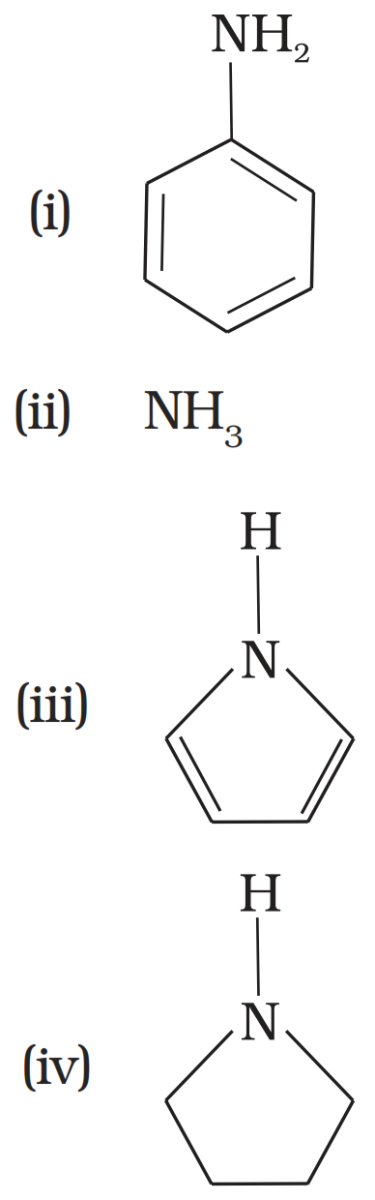
Among the following amines, the strongest Bronsted base is __________.
Answer
Aniline is weaker base than $NH_3$ due to delocalization of lone pair of electrons on the N-atom into the benzene ring. Pyrrole (c) is not at all basic because the lone pair of electrons on N-atom is donated towards aromatic sextet formation. Therefore, pyrrolidine (d) has a strong tendency to accept a proton and is hence, the strongest base. View full question & answer→MCQ 181 Mark
Which of the folllowing catalysts are used in the preparation amines by the reduction of isonitriles:
AnswerThe carbon $-$ nitrogen triple bond in a nitrile can also be reduced by reaction with hydrogen gas in the presence of a variety of metal catalysts like palladium, platinum or nickel.
View full question & answer→MCQ 191 Mark
Which of the following is not a classification of amines?
AnswerAmines may be classified as primary, secondary or tertiary depending on whether $1, 2$ or $3$ hydrogen atoms of $\mathrm{NH}_3$ are replaced by alkyl/aryl groups respectively.
Quaternary ammonium compounds are a different class of compounds where all four hydrogen atoms of ammonium salts are replaced by alkyl/aryl groups.
View full question & answer→MCQ 201 Mark
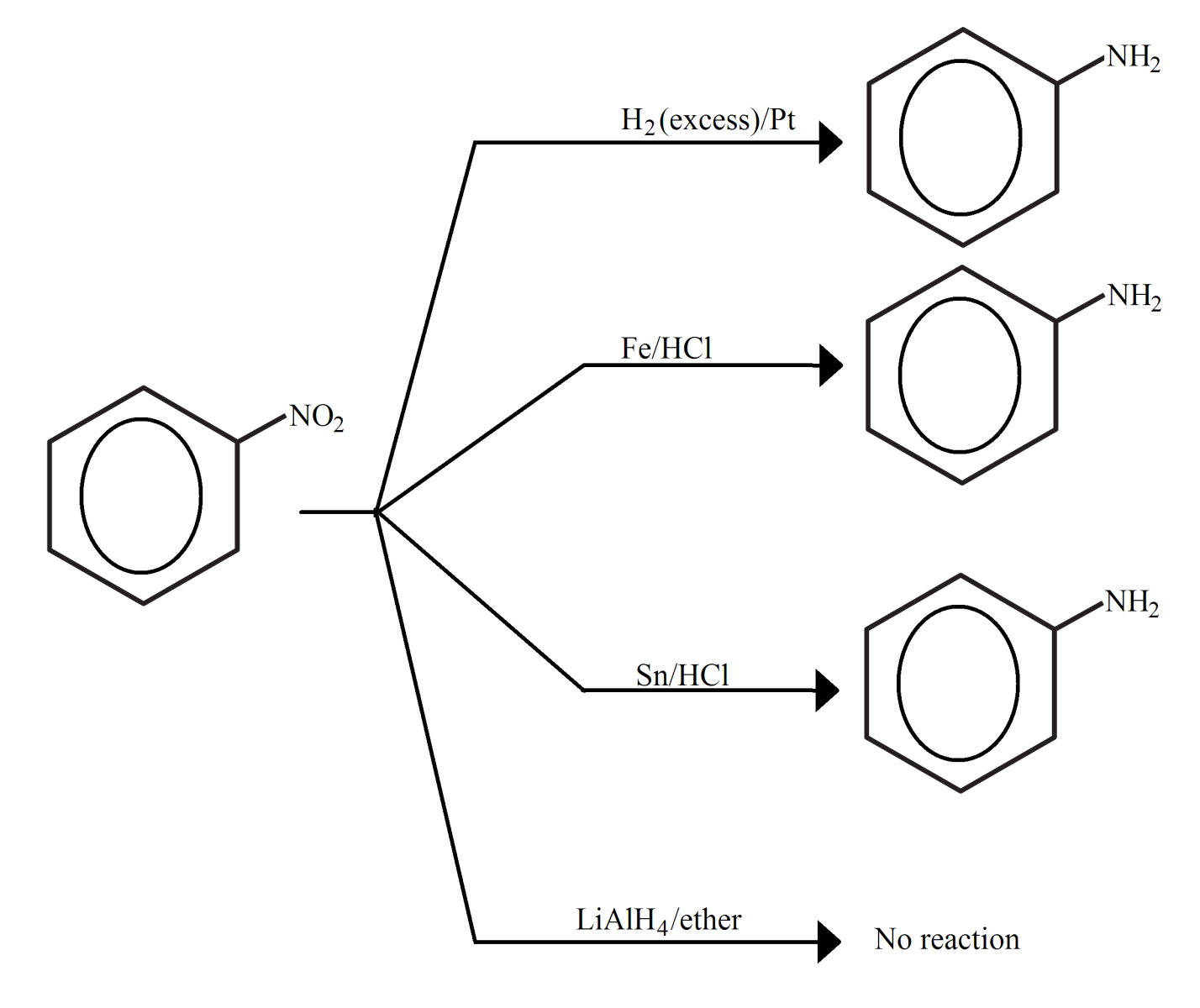
Which of the following reagents would not be a good choice for reducing an aryl nitro compound to an amine?
- A
$H_2($excess$)/$ Pt.
- ✓
$\ce{LiAlH_4}$ in ether.
- C
$Fe$ and $\text{HCl}$
- D
$Sn$ and $\text{HCl}.$
AnswerCorrect option: B. $\ce{LiAlH_4}$ in ether.
Aryl nitro compound cannot be converted into amine using $\ce{LiAlH_4}$ in ether.
View full question & answer→MCQ 211 Mark
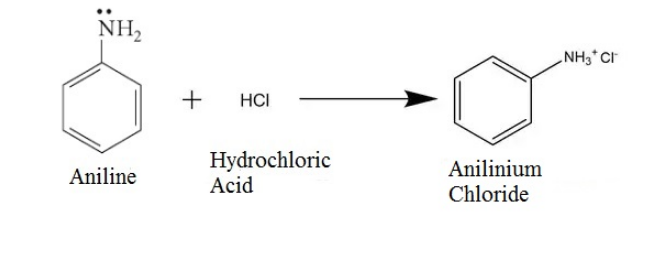
Aniline dissolves in $\text{HCl}$ due to the formation of:
AnswerAniline is basic in nature and $\text{HCl}$ is an acid. So, acid - base reaction will take place.
In aniline, the lone pair of electrons is partially delocalized into the benzene ring and is thus, available for protonation by an acid.
Hence, aniline dissolves in acid like $\text{HCl}$ forming anilinium chloride salt.
View full question & answer→MCQ 221 Mark
The correct order of boiling points of the following amines $\mathrm{C}_4 \mathrm{H}_9 \mathrm{NH}_2,\left(\mathrm{C}_2 \mathrm{H}_5\right)_2 \mathrm{NH}, \mathrm{C}_2 \mathrm{H}_5 \mathrm{\sim N}\left(\mathrm{CH}_3\right)_2$ is:
- A
$ \mathrm{C}_2 \mathrm{H}_5 \mathrm{N}\left(\mathrm{CH}_3\right)_2>\left(\mathrm{C}_2 \mathrm{H}_5\right)_2 \mathrm{NH}>\mathrm{C}_4 \mathrm{H}_9 \mathrm{NH}_2 $
- B
$ \left(\mathrm{C}_2 \mathrm{H}_5\right)_2 \mathrm{NH}>\mathrm{C}_2 \mathrm{H}_5 \mathrm{N}\left(\mathrm{CH}_3\right)_2>\mathrm{C}_4 \mathrm{H}_9 \mathrm{NH}_2 $
- ✓
$ \mathrm{C}_4 \mathrm{H}_9 \mathrm{NH}_2>\left(\mathrm{C}_2 \mathrm{H}_5\right)_2 \mathrm{NH}>\mathrm{C}_2 \mathrm{H}_5 \mathrm{N}\left(\mathrm{CH}_3\right)_2 $
- D
$ \left(\mathrm{C}_2 \mathrm{H}_5\right)_2 \mathrm{NH}>\mathrm{C}_4 \mathrm{H}_9 \mathrm{NH}_2>\mathrm{C}_2 \mathrm{H}_5 \mathrm{N}\left(\mathrm{CH}_3\right)_2 $
AnswerCorrect option: C. $ \mathrm{C}_4 \mathrm{H}_9 \mathrm{NH}_2>\left(\mathrm{C}_2 \mathrm{H}_5\right)_2 \mathrm{NH}>\mathrm{C}_2 \mathrm{H}_5 \mathrm{N}\left(\mathrm{CH}_3\right)_2 $
Because $\mathrm{C}_4 \mathrm{H}_9 \mathrm{NH}_2$ is primary amine and can form hydrogen bonding more than secondary amine $\left(\mathrm{C}_2 \mathrm{H}_5\right)_2 \mathrm{NH}$ and tertiary amine $\mathrm{C}_2 \mathrm{H}_5 \mathrm{N}\left(\mathrm{CH}_3\right)_2$. More hydrogen bonding leads to strong bonding between the molecules, hence increases the boiling point.
View full question & answer→MCQ 231 Mark
The correct order of increasing basic nature for the bases $\mathrm{NH}_3, \mathrm{CH}_3 \mathrm{NH}_2$ and $\left(\mathrm{CH}_3\right)_2 \mathrm{NH}$ is?
- A
$ \left(\mathrm{CH}_3\right)_2 \mathrm{NH}<\mathrm{NH}_3<\mathrm{CH}_3 \mathrm{NH}_2 $
- ✓
$ \mathrm{NH}_3<\mathrm{CH}_3 \mathrm{NH}_2<\left(\mathrm{CH}_3\right)_2 \mathrm{NH} $
- C
$ \mathrm{CH}_3 \mathrm{NH}_2<\left(\mathrm{CH}_3\right)_2 \mathrm{NH}<\mathrm{NH}_3 $
- D
$ \mathrm{CH}_3 \mathrm{NH}_2<\mathrm{NH}_3<\left(\mathrm{CH}_3\right)_2 \mathrm{NH} $
AnswerCorrect option: B. $ \mathrm{NH}_3<\mathrm{CH}_3 \mathrm{NH}_2<\left(\mathrm{CH}_3\right)_2 \mathrm{NH} $
$\left(\mathrm{H}_3 \mathrm{C}\right)_2 \mathrm{NH}, \mathrm{CH}_3 \mathrm{NH}_2, \mathrm{NH}_3$
Among the above molecules $\ce{(CH_3)_2NH}$ is most basic as two electron donating group are attached to it which increase its basicity is $ \mathrm{NH}_3<\mathrm{CH}_3 \mathrm{NH}_2<\left(\mathrm{CH}_3\right)_2 \mathrm{NH} $
View full question & answer→MCQ 241 Mark
By the presence of a halogen atom in the ring, basic properties of aniline is:
AnswerBy the presence of a halogen atom in the ring, basic properties of aniline is increased because it is more electronegative so donation of electron will be easy, so basicity increases.
View full question & answer→MCQ 251 Mark
The test used to distinguish primary, secondary and tertiary amines is:
AnswerCorrect option: D. $\mathrm{C}_6 \mathrm{H}_5 \mathrm{SO}_2 \mathrm{Cl}$
View full question & answer→MCQ 261 Mark
When only two hydrogen atoms are attached to the nitrogen of an amine, it is classified as a $........$ amine.
AnswerWhen an amine has two hydrogen atoms individually bonded to the nitrogen, it means that the third group is an alkyl or aryl substituent. This is called as a primary or $1^\circ $ amine as only one $H$ atom is replaced.
View full question & answer→MCQ 271 Mark
Benzyl amine is $........$ basis than aniline while ethyl amine is $.......$ basis than diethyl amine
AnswerBenzyl amine is more basic than anniline.
while ethyl amine is less basic than diethyl amine.
View full question & answer→MCQ 281 Mark
For the successful diazotization of arylamines, how many mole of mineral acid $\left(\mathrm{HCl}\right.$ or $\left.\mathrm{H}_2 \mathrm{SO}_4\right)$ are required for each mole of the amine?
View full question & answer→MCQ 291 Mark
The best reagent for converting$, 2-$phenylpropanamide into $1-$phenylethanamine is $.........$
- A
excess $H_2/ Pt.$
- ✓
$\ce{NaOH/ Br_2}.$
- C
$\ce{NaBH_4}/$ methanol.
- D
$\ce{LiAlH_4}/$ ether.
AnswerCorrect option: B. $\ce{NaOH/ Br_2}.$
$\text{CH}_3-\text{CH}-\text{CONH}_2\xrightarrow[\text{(Hofmann's bromamide reaction)}]{\text{Br}_2/\text{N}_\text{a}\text{OH}}\text{CH}_3-\text{CH}-\text{NH}_2\\\ \ \ \ \ \ \ \ \ \ \ \ \ |\ \ \ \ \ \ \ \ \ \ \ \ \ \ \ \ \ \ \ \ \ \ \ \ \ \ \ \ \ \ \ \ \ \ \ \ \ \ \ \ \ \ \ \ \ \ \ \ \ \ \ \ \ \ \ \ \ \ \ \ \ \ \ \ \ \ \ \ \ \ \ \ \ \ \ \ \ \ \ \ \ \ |\\\ \ \ \ \ \ \ \ \ \ \ \ \text{C}_6\text{H}_5\ \ \ \ \ \ \ \ \ \ \ \ \ \ \ \ \ \ \ \ \ \ \ \ \ \ \ \ \ \ \ \ \ \ \ \ \ \ \ \ \ \ \ \ \ \ \ \ \ \ \ \ \ \ \ \ \ \ \ \ \ \ \ \ \ \ \ \ \ \ \ \ \ \ \text{C}_6\text{H}_5\\2-\text{Phenylpropanamide}\ \ \ \ \ \ \ \ \ \ \ \ \ \ \ \ \ \ \ \ \ \ \ \ \ \ \ \ \ \ \ \ \ \ \ \ \ \ \ \ 1-\text{Phenyletanamine}$
View full question & answer→MCQ 301 Mark
The most reactive amine towards dilute hydrochloric acid is __________.
Answer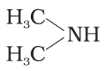
The greater will be the strength of base, the greater will be its reactivity towards dilute HCl. Hence, $(CH_3)_2NH$ has the highest basic strength as it has the highest reactivity. View full question & answer→MCQ 311 Mark
What is the expected geometry of $\ce{CH_3- NH - CH_3}\ ?$
Answer$\ce{CH_3 - NH - CH_3}$ is an amine in which two hydrogen atoms are replaced by methyl groups.
The hybridisation of $N$ atom of amines is same as that of ammonia, and is also expected to have a pyramidal geometry, with $N$ at the apex and the groups $\ce{CH_3, H}$ and $\ce{CH_3}$ occupying the corners of a trigonal base.
View full question & answer→MCQ 321 Mark
The lower aliphatic amines are gases with $........$ odour.
View full question & answer→MCQ 331 Mark
Which of the following is the correct order of the boiling points?
- ✓
Propane $<$ Ethylamine $<$ Ethyl alcohol.
- B
Ethylamine $<$ Propane $<$ Ethyl alcohol.
- C
Ethylamine $<$ Ethyl alcohol $<$ Propane.
- D
Propane $<$ Ethyl alcohol $<$ Ethylamine.
AnswerCorrect option: A. Propane $<$ Ethylamine $<$ Ethyl alcohol.
The following is the correct order of the boiling points.
propane $<$ ethylamine $<$ ethyl alcohol
In general, amines have higher boiling points than alkanes but lower boiling points than alcohols.
View full question & answer→MCQ 341 Mark
Which of the following is the $\text{IUPAC}$ name of the compound in which one hydrogen of ammonia is replaced by an ethyl group?
AnswerEthylamine and aminoethane are the names of $\mathrm{CH}_3 \mathrm{CH}_2 \mathrm{NH}_2$ according to the common system and second system respectively.
In the $\text{IUPAC}$ system, the naming is done by replacing the $'e\ ’$ of the alkane by amine.
View full question & answer→MCQ 351 Mark
When methyl iodide treated with ammonia, the product obtained is:
MCQ 361 Mark
Among the following compounds nitrobenzene, benzene, aniline and phenol, the strongest basic behaviuor in acid medium is exhibited by:
AnswerBecause the $N$ atom in aniline has a lone pair to donate and also due to $+I$ effect of $-\mathrm{NH}_2$ group
View full question & answer→MCQ 371 Mark
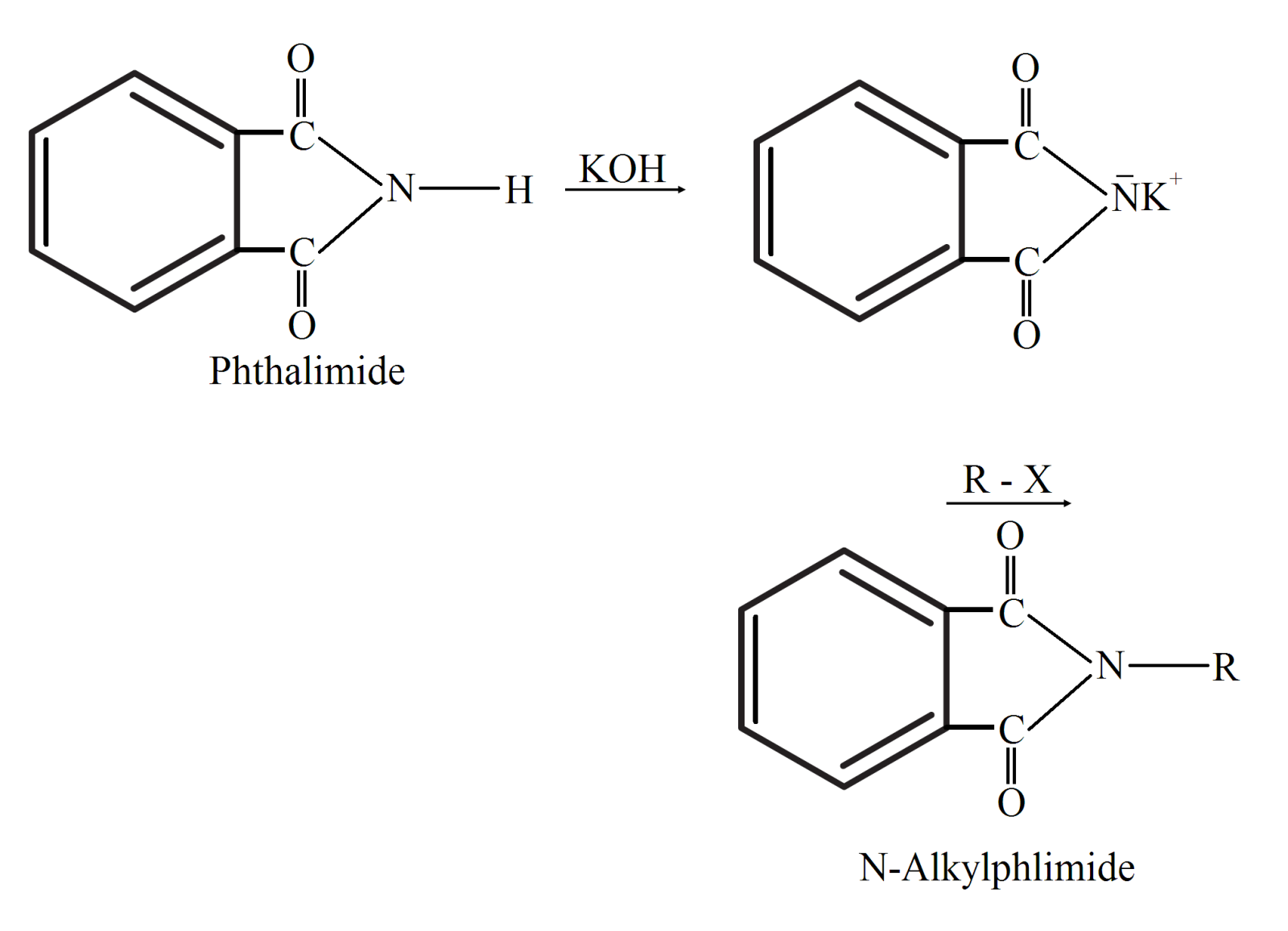
The source of nitrogen in Gabriel synthesis of amines is $.........$
- A
Sodium azide$, \ce{NaN_3}.$
- B
Sodium nitrite$, \ce{NaNO_2}.$
- C
Potassium cyanide$, \text{KCN}.$
- ✓
Potassium phthalimide$, \mathrm{C}_6 \mathrm{H}_4(\mathrm{CO})_2 \mathrm{\sim N}^{-} \mathrm{K}^{+}$
AnswerCorrect option: D. Potassium phthalimide$, \mathrm{C}_6 \mathrm{H}_4(\mathrm{CO})_2 \mathrm{\sim N}^{-} \mathrm{K}^{+}$
Gabriel synthesis is used for the preparation of primary amines. Phthalimide on treatment with ethanolic potassium hydroxide forms potassium salt of phthalimide which on heating with alkyl halide followed by alkaline hydrolysis produces the corresponding primary amine. Aromatic primary amines cannot be prepared by this method because aryl halides do not undergo nucleophilic substitution with the anion formed by phthalimide.
View full question & answer→MCQ 381 Mark
Which of the following cannot be prepared by Sandmeyer’s reaction?
$a.$ Chlorobenzene.
$b.$ Bromobenzene.
$c.$ Iodobenzene.
$d.$ Fluorobenzene.
- A
$a$ and $b$
- B
$a$ and $c$
- C
$b$ and $c$
- ✓
$c$ and $d$
AnswerCorrect option: D. $c$ and $d$
Chloro and bromo arenes are easily prepared by Sandmeyer’s reaction. Iodoarenes are prepared by simply warming the diazonium salt solution with aqueous $KI$ solution.
Fluoroarenes are prepared by Balz$-$Schiemann reaction.
All other reagents give aniline.
View full question & answer→MCQ 391 Mark
The correct order of the basic strength of methyl substitited amines in aqueous solution is:
- ✓
$ \left(\mathrm{CH}_3\right)_2 \mathrm{NH}>\mathrm{CH}_3 \mathrm{NH}_2>\left(\mathrm{CH}_3\right)_3 \mathrm{N} $
- B
$ \left(\mathrm{CH}_3\right)_3 \mathrm{N}>\mathrm{CH}_3 \mathrm{NH}_2>\left(\mathrm{CH}_3\right)_2 \mathrm{NH} $
- C
$ \left(\mathrm{CH}_3\right)_3 \mathrm{N}>\left(\mathrm{CH}_3\right)_2 \mathrm{NH}>\mathrm{CH}_3 \mathrm{NH}_2 $
- D
$ \mathrm{CH}_3 \mathrm{NH}_2>\left(\mathrm{CH}_3\right)_2 \mathrm{NH}>\left(\mathrm{CH}_3\right)_3 \mathrm{N} $
AnswerCorrect option: A. $ \left(\mathrm{CH}_3\right)_2 \mathrm{NH}>\mathrm{CH}_3 \mathrm{NH}_2>\left(\mathrm{CH}_3\right)_3 \mathrm{N} $
In aqueous solution, electron donating inductive effect, solvation effect $(H-$bonding$)$ and steric hindrance all together affect basic strength of substituted amines.
Basic character:
$(\text{CH}_3)_2\text{NH}>\text{CH}_3\text{NH}_2>(\text{CH}_3)_3\text{N}\\ \ \ \ \ \ \ \ \ \ 2^\circ\ \ \ \ \ \ \ \ \ \ \ \ \ \ \ \ \ \ 1^\circ\ \ \ \ \ \ \ \ \ \ \ \ \ \ \ \ 3^\circ$
View full question & answer→MCQ 401 Mark
$\mathrm{C}_4 \mathrm{H}_{11} \mathrm{\sim N}(\mathrm{X})+\mathrm{HNO}_2 \rightarrow \mathrm{C}_4 \mathrm{H}_{10} \mathrm{O}\left(3^{\circ}\right.$ alcohol$)$ Hence$, X$ will not give:
Answer$X$ does not undergo carbylamine reaction because this reaction requires only primary amine. In the above question the amine is secondary amine because $X$ is attached to the amine.
View full question & answer→MCQ 411 Mark
Which is the strongest base?
AnswerCorrect option: C. Propan $- 2 -$ amine
View full question & answer→MCQ 421 Mark
Amongest the following the most basic compound is:
MCQ 431 Mark
Which of the following is a $3^\circ $ amine?
AnswerThe structure of given amines are as follows:
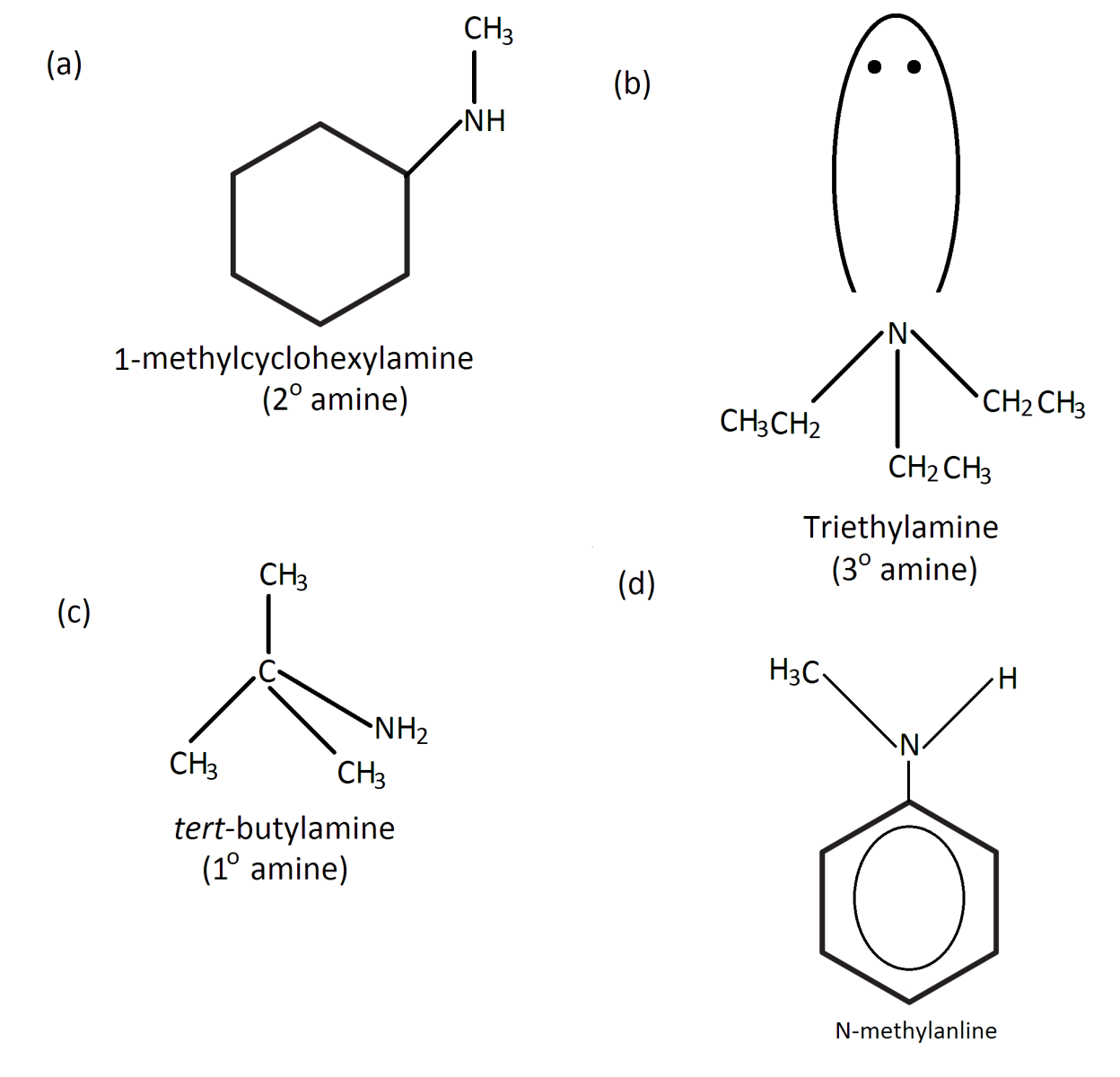
View full question & answer→MCQ 441 Mark
Alkyl and aryl amines are prepared using which of the following reducing agent.
- ✓
$\ce{LiAlH_4}$
- B
$H_2$
- C
$\ce{NaBH_4}$
- D
Both $A$ and $B$
AnswerCorrect option: A. $\ce{LiAlH_4}$
Alkyl and aryl cyanides $($nitriles$)$ can be reduced to their corresponding primary amines using lithium aluminium hydride $\ce{(LiAlH_4)}$ or catalytic hydrogenation.
View full question & answer→MCQ 451 Mark
The molecule which does not exhibit strong hydrogen bonding is:
AnswerThe molecule which does not exhibit strong hydrogen bonding is diethylether $\mathrm{CH}_3-\mathrm{O}-\mathrm{CH}_3$.
Hydrogen bonding is possible when $H$ atom is attached to an electronegative $N,O$ or $F$ atom.
View full question & answer→MCQ 461 Mark
What is the geometry of ammonia molecule?
AnswerThe nitrogen atom of ammonia undergoes hybridisation to form $4\ sp^3$ orbitals. Three of these overlap with $s$ orbital of $H$ forming three $N-H$ bonds.
This results in a pyramidal geometry with $N$ atom at the apex and three $H$ atoms at the corners of a triangle base.
View full question & answer→MCQ 471 Mark
Hoffmann Bromamide Degradation reaction is shown by $........$
- A
$\ce{ArNH_2}$
- ✓
$\ce{ArCONH_2}$
- C
$\ce{ArNO_2}$
- D
$\ce{ArCH_2NH_2}$
AnswerCorrect option: B. $\ce{ArCONH_2}$
Hoffmann developed a method for preparation of primary amines by treating an amide with bromine in an aqueous or ethanolic solution of sodium hydroxide. In this degradation reaction, migration of an alkyl or aryl group takes place from carbonyl carbon of the amide to the nitrogen atom.
View full question & answer→MCQ 481 Mark
In coupling reactions, diazonium ion acts as:
AnswerIn coupling reaction, diazonium ion acts as electrophile because in diazonium salt $+ve$ charge is there on nitrogen and thus nitrogen is electron deficient.
View full question & answer→MCQ 491 Mark
The product of the following reaction is $.........$
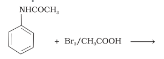
$i.$ $ ii. $
  $iii.$
  $ iv.$
- ✓
$i$ and $ii$
- B
$i$ and $iii$
- C
$ii$ and $iii$
- D
$i$ and $iv$
AnswerCorrect option: A. $i$ and $ii$
View full question & answer→MCQ 501 Mark
Which of the following is obtained by reducing methyl cyanide with $\ce{Na + C_2H_5OH}\ ?$
AnswerSodium in alcohol is a strong reducing agent and reduces nitriles to amines.
$\mathrm{CH}_3-\mathrm{CN}+\mathrm{Na}+\mathrm{C}_2 \mathrm{H}_5 \mathrm{OH} \rightarrow \mathrm{C}_2 \mathrm{H}_5-\mathrm{NH}_2$
This reaction is also known as Mendius Reduction.
View full question & answer→