Questions

2 Marks Questions

Take a timed test

11 questions · self-marked practice — reveal the answer and mark yourself.

Question 12 Marks
State the limitations of Valence bond theory
Answer
(i) It involves a number of assumptions.
(i) It does not give quantitative interpretation of magnetic data.
(iii) It does not explain the colour exhibited by coordination compounds.
(iv) It does not give a quantitative interpretation of the thermodynamic or kinetic stabilities of coordination compounds.
(v)It does not make exact predictions regarding the tetrahedral and square planar structures of 4-coordinate complexes.
(vi) It does not distinguish between weak and strong ligands.
View full question & answer
Question 22 Marks
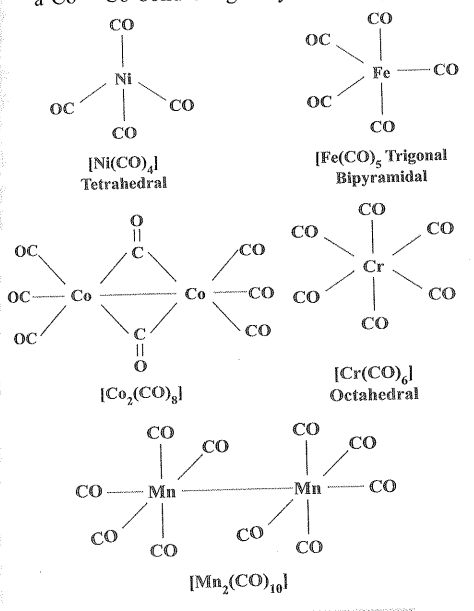
What are metal carbonyls? Explain with examples.
View full question & answer
Question 32 Marks
Write down limitation of Crystal field.
Answer
→ The Crystal field model is successful in explaining the formation, structures, colour and magnetic properties of coordination compounds to a large extent.
→ However, from the assumptions that the ligands are point charges, it follows that anionic ligands should exert the greatest splitting effect. The anionic ligands actually are found at the low end of the spectrochemical series.
→ Further, it does not take into account the covalent character of bonding between the ligand and the central atom. These are some of the weaknesses of CFT.
View full question & answer
Question 42 Marks
Explain Crystal field splitting theory
Answer
$\rightarrow$ The Crystal Field Theory $ \text{(CFT)}$ is an electrostatic model which considers the metal$-$ligand bond to be ionic arising purely from electrostatic interactions between the metal ion and the ligand.
$\rightarrow$ Ligands are treated as point charges in case of anions or point dipoles in case of neutral molecules.
$\rightarrow$ The five d orbitals in an isolated gaseous metal atom/ion have same energy, i.e., they are degenerate.
$\rightarrow$ This degeneracy is maintained if a spherically symmetrical field of negative charges surrounds the metal atom/ion.
$\rightarrow$ However, when this negative field is due to ligands $($either anions or the negative ends of dipolar molecules like $NH_3$ and $H_2O)$ in a complex, it becomes asymmetrical and the degeneracy of the d orbitals is lifted.
$\rightarrow$ It results in splitting of the d orbitals.
$\rightarrow$ The pattern of splitting depends upon the nature of the crystal field.
View full question & answer
Question 52 Marks
Explain Valence Bond theory in Coordination compound.
Answer
→ According to this theory, the metal atom or ion under the influence of ligands can use its (n-1)d, ns, np or ns, np, nd orbitals for hybridization to yield a set of equivalent orbitals of definite geometry such as octahedral, tetrahedral, square planar
→ These hybridised orbitals are allowed to overlap with ligand orbitals that can donate electron pairs for bonding.
Number of Orbitals and Types of Hybridizations
Coordination
number
Type of
Hybridisation
Distribution of
hybrid orbitals
in space
4$sp ^3$Tetrahedral
4$dsp ^2$Square planar
5$sp ^3 d$Trigonal
bipyramidal
6$sp ^3 d^2$Octahedral
6$d ^2 sp ^3$Octahedral
→ It is usually possible to predict the geometry of a complex from the knowledge of its magnetic behaviour on the basis of the valence bond theory.
View full question & answer
Question 62 Marks
Write limitations of Werner's Coordination Theory
Answer
→ Werner's theory could not explain
(1) Directional properties of bonds in a coordination compound.
(2) Ability of certain elements to form co-ordination compound.
(3) The magnetic and optical properties of coordination compound.
View full question & answer
Question 72 Marks
What are isomers? Explain the types of isomerism.
Answer
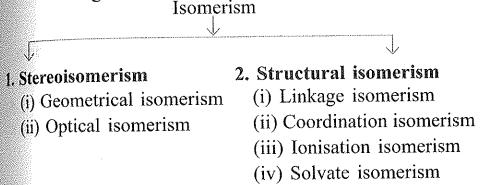
→ "Isomers are two or more compounds that have the same chemical formula but a different arrangement of atoms."
→ The different arrangement of atoms, they differ in one or more physical or chemical properties.
→ Two principal types of isomerism are known among coordination compounds.
Image
→ Stereoisomers have the same chemical formula and chemical bonds but they have different spatial arrangement.
→ Structural isomers have different bonds.
View full question & answer
Question 82 Marks
Define the following term (1) Coordination sphere (2) Oxidation number of central atom
Answer
(1) Coordination sphere
→ "The central atom/ion and the ligands attached to it are enclosed in square bracket is collectively termed as the coordination sphere."
→ The ionizable groups are written outside the bracket and are called counter ions.
→ For example, in the complex $K _4\left[ Fe ( CN )_6\right]$, the coordination sphere is $\left[ Fe ( CN )_6\right]^{4-}$ and the counter ion is $K ^{+}$.
(2) Oxidation number of central atom:
→ "The oxidation number of the central atom in a complex is defined as the charge it would carry if all the ligands are removed along with the electron pairs that are shared with the central atom."
→ The oxidation number is represented by a Roman numeral in parenthesis following the name of the coordination entity.
→ For example, oxidation number of copper in $\left[ Cu ( CN )_4\right]^{3-}$ is +1 and it is written as $Cu ( I )$.
View full question & answer
Question 92 Marks
What is Chelate ligand? Explain Chelate Complex.
Answer
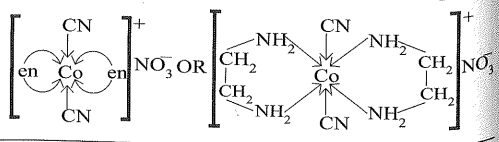
$\rightarrow$ When multidentate ligands like en, $OX^{2-}, pn, ptn, (EDTA)^{4-}$ form coordinate covalent bond with metal ion, it results into cyclic structure involving central metal ion. Thus, the complex compound formed by ligand and metal ion having cyclic structure is called chelate complex and the ligand is known as chelate ligand.
$\rightarrow$ The stability of such chelate compounds is more than the stability of simple complex compounds
Image
View full question & answer
Question 102 Marks
What is the difference between a double salt and a complex?
Answer
→ Both double salts as well as complexes are formed by the combination of two or more stable compounds in stoichiometric ratio.
→ They differ in the fact that double salts such as carnallite, $KCl . \quad MgCl _2 .\ \ 6 H _2 O$, Mohr's salt, $FeSO _4 \cdot\left( NH _4\right)_2 SO _4 \cdot 6 H _2 O$, potash alum, $KAl \left( SO _4\right)_2 \cdot 12 H _2 O$, etc. Dissociate into simple ions completely when dissolved in water.
→ However complex ions such as $\left[ Fe ( CN )_6\right]^{4-}$ of $K _4$ $\left[ Fe ( CN )_6\right]$ do not dissociate into $Fe ^{2+}$ and $CN ^{-}$ ions.
View full question & answer
Question 112 Marks
Explain Werner's Theory for Co$-$ordination Compound.
Answer
$\rightarrow$ Alfred Werner a Swiss chemist was the first to formulate his ideas about the structures of coordination compounds.
$\rightarrow$ Werner proposed the concept of a primary valence and a secondary valence for a metal ion.
$\rightarrow$ Binary compounds such as $CrCl_3,CoCl_2 \ or \ PdCl_2$ have primary valence of $3, 2$ and $2$ respectively.
$\rightarrow$ Werner develop number of compound of cobalt $(III)$ chloride with ammonia, it was found that some of the chloride ions could be precipitated as $AgCl$ on adding excess silver nitrate solution in cold but some remained in solution.
$1 \ mol \ CoCl_3.6NH_3 \ ($Yellow$)$ gave $3 \ mol \ AgCl$
$1 \ mol \ CoCl_3.5NH_3 \ ($Purple$)$ gave $2 \ mol \ AgCl$
$1 \ mol \ CoCl_3.4NH_3 \ ($Green$)$ gave $1 \ mol \ AgCl$
$1 \ mol \ CoCl_3.4NH_3 \ ($Violet$)$ gave $1 \ mol \ AgCl$
$\rightarrow$ These observations, together with the results of conductivity measurements in solution can be explained as follows:
$\rightarrow$ $(i)$ Six groups in all, either chloride ions or ammonia molecules or both, remain bonded to the cobalt ion during the reaction and $(ii)$ The compounds are formulated as where the atoms within the square brackets form a single entity which does not dissociate under the reaction conditions.
$\rightarrow$ Werner proposed the term secondary valence for the number of groups bound directly to the metal ion. In each of these examples the secondary valences are six.
Colour Formula Solution
conductivity
corresponds to
Yellow $\left[ Co \left( NH _3\right)_6\right]^{3+} 3 Cl ^{-}$ $1:3$ electrolyte
Purple $\left[ CoCl \left( NH _3\right)_5\right]^{2+} 2 Cl ^{-}$ $1:2$ electrolyte
Green $\left[ CoCl _2\left( NH _3\right)_4\right]^{+} 3 Cl ^{-}$ $1:1$ electrolyte
Violet $\left[ CoCl _2\left( NH _3\right)_4\right]^{+} 3 Cl$ $1:1$ electrolyte
$\rightarrow$ Last two compounds in Table have identical empirical formula, $CoCl_3.4NH_3$ but differem $3$ properties. Such compounds are termed as isomers.
$\rightarrow$ The main postulates of Werner's theory are:
$(1)$ In coordination compounds metals show two types of linkages $($valences$)-$primary and secondary.
$(2)$ The primary valences are normally ionizable and are satisfied by negative ions.
$(3)$ The secondary valences are non ionizable. These are satisfied by neutral molecules or negative ions. The secondary valence is equal to the coordination number and is fixed for a metal.
$(4)$ The ions / groups bound by the secondary linkages to the metal have characteristic spatial arrangements corresponding to different coordination numbers.
View full question & answer