Questions

M.C.Q (1 Marks)

Take a timed test

12 questions · 11 auto-graded MCQ + 1 self-marked written.

MCQ 11 Mark
When Benzene diazonium chloride reacts with phenol, it forms a dye. This reaction is called
  • Coupling reaction
  • B
    Diazotisation reaction
  • C
    Acetylation reaction
  • D
    Condensation reaction
Answer
Correct option: A.
Coupling reaction
(a) Coupling reaction
Explanation: The reaction is known as Coupling reaction.
View full question & answer
MCQ 21 Mark
Which of the following alcohols will not undergo oxidation?
  • A
    Butan-2-ol
  • 2-Methylbutan-2-ol
  • C
    Butanol
  • D
    3-Methylbutan-2-ol
Answer
Correct option: B.
2-Methylbutan-2-ol
(b) 2-Methylbutan-2-ol
Explanation: 2-Methylbutan-2-ol will not undergo oxidation.
View full question & answer
MCQ 31 Mark
Which of the following compounds will give butanone on oxidation with alkaline $KMnO_4$ solution?
  • A
    Butan$-2-ol$
  • B
    Both Butan$-2-ol$ and Butan$-1-ol$
  • C
    Butan$-1-ol$
  • D
    Butan$-3-ol$
View full question & answer
MCQ 41 Mark
When $10 g$ of radioactive isotope is reduced to $1.25 g$ in $12$ years, the half life period of the isotope is
  • $4$ years
  • B
    $24$ years
  • C
    $16$ years
  • D
    $8$ years
Answer
Correct option: A.
$4$ years
Radioactivity follow $1^{st}$ order kinetics.
$k=\frac{2.303}{t} \log \frac{a}{a-x}$
$k=\frac{2.303}{12} \log \frac{10}{1.25}$
$k=0.1919 \log 8$
$k=0.1919 \times \log 2^3$
$k=0.1919 \times 3 \times \log 2$
$=0.575 \times 0.3010$
$=0.173 yr^{-1}$
now, $t_{1 / 2}=\frac{0.693}{0.173}=4.005 yrs \simeq 4\ yrs$
View full question & answer
MCQ 51 Mark
The product of oxidation of $I^-$ with $\ce{MnO}_4^{-}$ in acidic medium is:
  • $I_2$
  • B
    $lo_3^-$
  • C
    $lo^-$
  • D
    $lo_4^-$
Answer
Correct option: A.
$I_2$
Iodine is liberated from potassium iodide.
$\ce{10 I^{-} + 2 MnO_4^{-} + 16 H^{+}} \rightarrow \ce{2 Mn^{2+} + 8 H_2O + 5 I_2}$
View full question & answer
MCQ 61 Mark
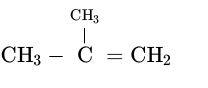
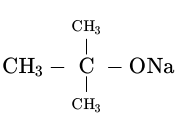
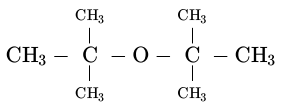
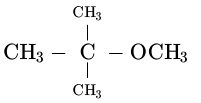
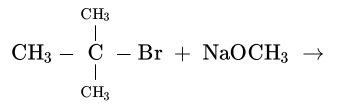
Major product formed in the following reaction
Image

  • Image
  • B

    Image
  • C

    Image
  • D

    Image
Answer
Correct option: A.

Image
(a).
Image
Explanation:Image


Tert-halide with strong base favours elimination reaction not the substitution reaction.
View full question & answer
MCQ 71 Mark
Match the items given in column I with that in column II:
Column IColumn II
(a) Osmotic Pressure.(i) Cottrell's method.
(b) Relative lowering of vapour pressure.(ii) Rast's method.
(c) Elevation in boiling point.(iii) Ostwald and Walker's method.
(d) Depression in freezing point.(iv) Berkeley and Hartley's method.
  • (a) (iv), (b) - (iii), (c) - (i), (d) - (ii).
  • B
    (a) (iv), (b) - (iii), (c) - (ii), (d) - (i).
  • C
    (a) (i), (b) - (ii), (c) - (iii), (d) - (iv).
  • D
    (a) (i), (b) - (iv), (c) - (ii), (d) - (iii).
Answer
Correct option: A.
(a) (iv), (b) - (iii), (c) - (i), (d) - (ii).
(a) (a) (iv), (b) - (iii), (c) - (i), (d) - (ii).
Explanation: (a) (iv), (b) (iii), (c) - (i), (d) - (ii).
View full question & answer
MCQ 81 Mark
The slope in the plot of log $\frac{[ R ]_0}{[ R ]}$ vs. time for a first order reaction is
  • A
    $-k$
  • B
    $\frac{- k }{2.303}$
  • $\frac{+ k }{2.303}$
  • D
    $+ k$
Answer
Correct option: C.
$\frac{+ k }{2.303}$
(c) $\frac{+ k }{2.303}$
Explanation:First order of reaction is $\frac{+ k }{2.303}$
View full question & answer
MCQ 91 Mark
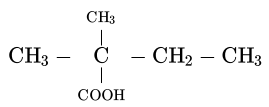
What is the correct IUPAC name of the given compound?
Image
  • A
    2-Carboxyl-2-methylbutane
  • B
    2-Ethyl-2-methylpropanoic acid
  • C
    3-Methylbutane carboxylic acid
  • 2,2-Dimethylbutanoic acid
Answer
Correct option: D.
2,2-Dimethylbutanoic acid
(d) 2,2-Dimethylbutanoic acid
Explanation: 2,2-Dimethylbutanoic acid
View full question & answer
MCQ 101 Mark
An organic compound $X$ is oxidized by using acidified $\ce{K_2Cr_2O_7}.$ The product obtained reacts with Phenyl hydrazine but does not answer the silver mirror test. The possible structure of $X$ is:
  • $\ce{(CH_3)_2CHOH}$
  • B
    $\ce{(CH_4)_2CH_3OH}$
  • C
    $\ce{CH_3CHO}$
  • D
    $\ce{CH_3CH_2OH}$
Answer
Correct option: A.
$\ce{(CH_3)_2CHOH}$
 Secondary alcohol on oxidation forms ketone which reacts with hydrazine bus doesn't gives a silver mirror test.
View full question & answer
MCQ 111 Mark
The major component of starch is:
  • amylopectin
  • B
    water
  • C
    amylose
  • D
    glucose
Answer
Correct option: A.
amylopectin
(a) amylopectin
Explanation: Starch is a polymer of a-glucose and consists of two components - Amylose and Amylopectin. Amylose is water-soluble component which constitutes about 15-20% of starch. Amylopectin is insoluble in water and constitutes about 80-85% of starch. Thus, Amylopectin is the major component of starch.
View full question & answer
MCQ 121 Mark
Which of the following reactions is a halogenated exchange reaction:
  • A

    Image
  • B

    Image
  • C

    Image

  • Image
Answer
Correct option: D.

Image
(d)
Image
Explanation: Image
View full question & answer
M.C.Q (1 Marks) - Chemistry STD 12 Science Questions - Vidyadip