Questions

3 Marks Question

Take a timed test

8 questions · self-marked practice — reveal the answer and mark yourself.

Question 13 Marks
Explain with examples the terms weak and strong electrolytes.
Answer
Weak electrolytes$:$ Weak electrolytes are those which do not dissociate into ions completely in aqueous solution $e.g.$ $CH_3COOH$
Strong electrolytes$:$ Strong electrolytes are those which dissociate into ions completely in aqueous solution $e.g. NaCl$
View full question & answer
Question 23 Marks
What are ambident nucleophiles? Explain with an example.
Answer
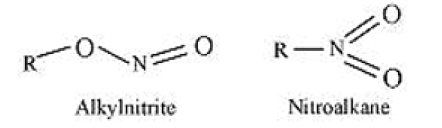
Ambident nucleophiles are nucleophiles having two nucleophilic sites. Thus, ambident nucleophiles have two sites through which they can attack.
For example, nitrite ion is an ambident nucleophile.
$[-O-\ddot{N}=O]$
Nitrite ion can attack through oxygen resulting in the formation of alkyl nitrites. Also, it can attack through nitrogen resulting in the formation of nitroalkanes.
Image
View full question & answer
Question 33 Marks
Calculate the emf of the following cell at $25^{\circ} C$.$Fe \left| Fe ^{2+}(0.001 M )\right|\left| H ^{+}(0.01 M )\right| H _2(g)(1 bar ) \mid Pt ( s )$
Given that, $E_{ Fe ^{2+} / Fe }^o=-0.44 V ; E_{H^{+} / H_2}^o=0.00 V$
Answer
At anode, $Fe ( s ) \rightarrow Fe ^{2+}( aq )+2 e ^{-}$
At cathode, $\left[ H ^{+}( aq )+ e ^{-} \rightarrow \frac{1}{2} H _2(g)\right] \times 2$
Overall reaction:
$Fe(s)+2 H^{+}(aq) \rightarrow Fe^{2+}(aq)+H_2(g)$
Given, $E_{ Fe ^{2+} / Fe }^o=-0.44 V$ and $E_{H^{+} / H_2}^o=0.00 V$
$\left.E^0(\text { cell })=E^0 \text { (cathode) }-E^0 \text { (anode }\right)=[0.00-(-0.44)]=0.44 V$
Now, Applying Nernst equation:
$E_{\text {cell }}=E_{\text {cell }}^o-\frac{0.00591}{2} \log \frac{\left[Fe^{2+}\right]}{\left[H^{+}\right]^2}=0.44-\frac{0.00591}{2} \log \frac{10^{-3}}{\left(10^{-2}\right)^2}$
$=0.44-\frac{0.00591}{2}=0.4104 V$
View full question & answer
Question 53 Marks
Give the structures and IUPAC names of the products expected from the following reactions:
a. Catalytic reduction of butanol.
b. Hydration of propene in the presence of dilute sulphuric acid.
c. Reaction of propanone with methyl magnesium bromide followed by hydrolysis.
View full question & answer
Question 63 Marks
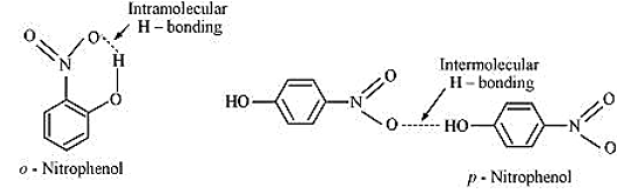
While separating a mixture of ortho and para nitrophenols by steam distillation, name the isomer which will be steam volatile. Give reason.
Answer
Intramolecular H-bonding is present in o-nitrophenol. In p-nitrophenol, the molecules are strongly associated due to the presence of intermolecular bonding. Hence, o-nitrophenol is steam volatile.
Image
View full question & answer
Question 73 Marks
$i.$ Define rate constant of reaction.
$ii.$ A first order reaction takes $40$ mins for $30\%$ decomposition. Calculate $t_\frac{1}{2}.$
Answer
$i.$ Rate constant $:$ It is the rate of chemical reaction when the concentration of reactant taken as unity at a given temperature.
$ii.$ Let initial
conc. $=$ a conc. after $40 \ min$. $=a-\frac{a \times 30}{100}$
$=0.70 \ a$
$K=\frac{2.303}{t} \ \log \frac{[A]_0}{[A]}$
$=\frac{2.303}{40} \ \log \frac{a}{0.70 a}$
$=\frac{2.303}{40} \ \log \frac{1}{0.70}$
$=\frac{2.303}{40} \times 0.1549$
$=8.92 \times 10^{-3} min^{-1}$
$t_{1 / 2}=\frac{0.693}{K}$
$=\frac{0.693}{8.92 \times 10^{-3}}$
$=77.7 \ min$
View full question & answer
Question 83 Marks
What is the difference between Galvanic cell (Electrochemical cell) and Electrolytic cell.
Answer
Electrochemical cellElectrolytic cell
(1) It is a device to convert chemical energy into electrical energy.(1) It is a device to convert electrical energy into chemical energy.
(2) It is based upon the redox reaction which is spontaneous.(2) The redox reaction is non-spontaneous and takes place only when electric energy is supplied.
(3) To set up this cell, a salt bridge or porous pot is used.(3) No salt bridge is used in this case.
 
View full question & answer
3 Marks Question - Chemistry STD 12 Science Questions - Vidyadip