MCQ 11 Mark
The adsorption of hydrogen by platinum black is called:
AnswerWhen adsorption happens on metals, it is called occlusion. Occlusion happens on a variety of metals, including iron, platinum and palladium, but hydrogen gas is the only adsorbate.
View full question & answer→MCQ 21 Mark
Gallium is in $.......$ state at room temperature.
AnswerGallium is in liquid state at room temperature. The melting point of gallium is $303K.$
View full question & answer→MCQ 31 Mark
Which one of the following statements about lanthanides is false ?
AnswerCorrect option: B. The ionic radii of trivalent lanthanides steadily increases with increase in atomic number.
The ionic radii of trivalent lanthanides steadily decreases with increase in atomic number due to lanhanide contraction.
View full question & answer→MCQ 41 Mark
Lanthanides and actinides resemble in:
- ✓
Electronic configuration.
- B
- C
- D
AnswerCorrect option: A. Electronic configuration.
Lanthanides and actinides resemble in electronic configuration:
$(n-2) f^{1-14}(n-1) d^{1-10} n s^{1-2}$
View full question & answer→MCQ 51 Mark
Transition metals make the most efficient catalysts because of their ability to:
- ✓
Adopt multiple oxidation states and to form complexes.
- B
- C
Show paramagnetism due to unpaired electrons.
- D
Form a large number of oxides.
AnswerCorrect option: A. Adopt multiple oxidation states and to form complexes.
Transition metals have partially filled $d-$ orbitals so they can easily withdraw the electrons from the reagents or give electrons to them depending on the nature of the reaction. They also have a tendency to show large no. of oxidation states and the ability to form complexes which makes them a good catalyst.
View full question & answer→MCQ 61 Mark
Which ine of the following statement about lanthanides is false?
AnswerCorrect option: B. The ionic radii of trivalent lanthanides steadily increases with increase in atomic number.
View full question & answer→MCQ 71 Mark
The color of $\mathrm{Cu}^{+}$ compounds is?
Answer$\mathrm{Cu}^{+}$ compounds are generally colourless $($white$).$ The electronic configuration is $3 \mathrm{d}^{10} 4 \mathrm{~s}^0.$ So there is no unpaired electron present in the ion. So the electronic transition between two energy levels $\mathrm{t}_{2 \mathrm{~g}}$ and $\mathrm{e}_{\mathrm{g}} ($responsible for the colour of transition metals$)$ is not possible.
View full question & answer→MCQ 81 Mark
Which element among the Lanthanides has the smallest atomic radius?
AnswerLutetium is the last element of the Lanthanides, so it will have the smallest ionic radius due to Lanthanide contraction.
View full question & answer→MCQ 91 Mark
Cholrine gas is produced from $\text{HCI}$ by the addition of:
AnswerCorrect option: D. $ \mathrm{KMnO}_4 $
$ \mathrm{KMnO}_4 $ being strong oxidising agent will oxidise $CI^-$ ion present in $\text{HCl}$ to form chlorine gas.
$2 \mathrm{KMnO}_4+16 \mathrm{HCl} \rightarrow 2 \mathrm{KCl}+2 \mathrm{MnCl}_2+8 \mathrm{H}_2 \mathrm{O}+5 \mathrm{Cl}_2$
View full question & answer→MCQ 101 Mark
Which of the following has highest value of magnetic moment?
- ✓
$ \mathrm{Fe}^{2+} $
- B
$ \mathrm{Co}^{3+} $
- C
$ \mathrm{V}^{3+} $
- D
$ \mathrm{Ti}^{3+} $
AnswerCorrect option: A. $ \mathrm{Fe}^{2+} $
Magnetic moment $=\sqrt{\text{n(n+2)}}$
$n=$ no. of unpaired electrons, $ \mathrm{Fe}^{+2} $ has $4$ unpaired electrons.
Other compound have less unpaired electrons.
More the number of electron, more the magnetic moment.
Thus $ \mathrm{Fe}^{2+} $ has the highest value of the magnetic moment among the given elements.
View full question & answer→MCQ 111 Mark
Generally transition elements form coloured salts due to the presence of unpaired electrons. Which of the following compounds will be coloured in solid state?
AnswerCorrect option: D. $ \mathrm{Cu}_2 \mathrm{Cl} $
$\mathrm{Cu}^{2+}$ has $1$ unpaired electron in $ \mathrm{Cu}_2 \mathrm{Cl} $ hence, it is coloured in solid state.
View full question & answer→MCQ 121 Mark
Colour in transition metal compounds is attributed to:
- A
Small size of metal ions.
- B
Absorption of light in $UV$ region.
- C
Complete $(ns)$ subshell.
- ✓
Incomplete $(n−1)d$ subshell.
AnswerCorrect option: D. Incomplete $(n−1)d$ subshell.
Any compound or ion showing colour is due to presence of unpaired electron. Transition metal compounds have incomplete $(n-1)d$ sub shell and because of that they have unpaired electron and thus they show colour.
View full question & answer→MCQ 131 Mark
Which of the following is amphoteric oxide$?\ \mathrm{Mn}_2 \mathrm{O}_7, \mathrm{CrO}_3, \mathrm{Cr}_2 \mathrm{O}_3, \mathrm{CrO}, \mathrm{V}_2 \mathrm{O}_5, \mathrm{V}_2 \mathrm{O}_4$
- ✓
$\text{V}_5\text{O}_5, \text{Cr}_2\text{O}_3$
- B
$\text{Mn}_2\text{O}_7, \text{Cr}\text{O}_3$
- C
$\text{Cr}\text{O}, \text{V}_2\text{O}_5$
- D
$\text{V}_2\text{O}_5, \text{V}_2\text{O}_4$
AnswerCorrect option: A. $\text{V}_5\text{O}_5, \text{Cr}_2\text{O}_3$
Since they react with acid as well as base.
View full question & answer→MCQ 141 Mark
Transition metals are good electrical conductor because $.......$
- A
- B
- ✓
They have free electrons in outer energy levels.
- D
AnswerCorrect option: C. They have free electrons in outer energy levels.
Transition metals have free electrons in outer energy levels because $d-$orbitals shields poorly and due to this they acts as good conductor of electricity.
View full question & answer→MCQ 151 Mark
Generally transition elements and their salts are coloured due to the presence of unpaired electrons in metal ions. Which of the following compounds are coloured?
$a. \mathrm{KMnO}_4$
$b. \mathrm{Ce}\left(\mathrm{SO}_4\right)_2$
$c. \mathrm{TiCl}_4$
$d. \mathrm{Cu}_2 \mathrm{Cl}_2$
- ✓
$a$ and $b$
- B
$a$ and $c$
- C
$b$ and $c$
- D
$a$ and $d$
AnswerCorrect option: A. $a$ and $b$
It is due to charge transfer. In $\ce{MnO{_4}{^-}}$ an electron is momentarily transferred from $O$ to the metal, thus momentarily $O^{2-}$ is changed to $O-$ and reducing the oxidation state of the metal from $\text{Mn (VII)}$ to $\text{Mn (VI)}.$
View full question & answer→MCQ 161 Mark
Which one of the following paramagnetic in nature?
- ✓
$\ce{CuCl_2}$
- B
$\ce{CaCl_2}$
- C
$\ce{CdCl_2}$
- D
AnswerCorrect option: A. $\ce{CuCl_2}$
In $\ce{CuCl_2}, Cu$ is in $+2$ oxidation state. Electronic configuration of $\ce{Cu^{2+}}$ is $\ce{[Ar],3d^9},$ and is coloured and paramagnetic due to presence of an unpaired electron in the $3d$ sub$-$orbital.
View full question & answer→MCQ 171 Mark
The magnetic nature of elements depends on the presence of unpaired electrons. Identify the configuration of transition element, which shows highest magnetic moment.
- A
$3 d^7$
- ✓
$3 d^5$
- C
$3 d^8$
- D
$3 d^2$
AnswerCorrect option: B. $3 d^5$
The greater the number of unpaired electron, the higher will be its value of magnetic moment. Since$, 3 d^5$ has $5$ unpaired electrons hence highest magnetic moment.
$\mu=\sqrt{5(5+2)}$
$=\sqrt{35}$
$=5.95\text{ BM}$
View full question & answer→MCQ 181 Mark
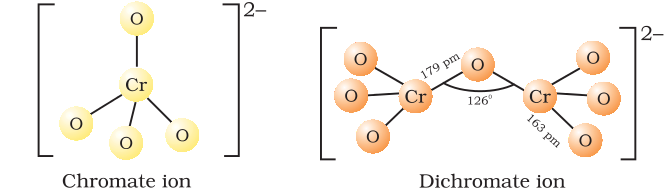
The ionic charges on chromate ion and dichromate ion respectively is:
- ✓
$-2, -2$
- B
$-3, -2$
- C
$-2, -4$
- D
$-4, -2$
AnswerCorrect option: A. $-2, -2$
Chromate salts contain the chromate anion$, \text{CrO}^{2-}_4$ with $-2$ ionic charge.
Dichromate salts contain the dichromate anion$, \text{CrO}^{2-}_7$ with $-2$ ionic charge.
They are oxoanions of chromium in the $+6$ oxidation state.
View full question & answer→MCQ 191 Mark
Which of the following oxidation state is common for all lanthanoids?
AnswerIn the lanthanoids$, \text{La(II)}$ and $\text{Ln(III)}$ compounds are predominant species. However, occasionally $+2$ and $+4$ ions in solution or in solid compounds are also obtained. This irregularity $($as in ionisation enthalpies$)$ arises mainly from the extra stability of empty, half$-$filled or filled $f$ subshell.
View full question & answer→MCQ 201 Mark
Which forms coloured salts?
- A
- B
Non$-$metals
- C
$p-$block elements
- ✓
AnswerTransitional elements form coloured salts due to the presence of unpaired electrons of $d-$orbital.
View full question & answer→MCQ 211 Mark
Maximum ferromagnetism is found in?
AnswerAs Iron have highest value of saturation, Magnetization $M_s$ which is defined as the magnetic moment density when the material is subjected to a field strong enough to align all its moments.
$\ce{Fe 1707 M_s}$
$\ce{Co 1400 M_s}$
$\ce{Ni 485 M_s}$
View full question & answer→MCQ 221 Mark
Many Lanthanoid elements are used to prepare:
- A
- B
- ✓
Superconducting materials.
- D
AnswerCorrect option: C. Superconducting materials.
Many Lanthanoid elements are used to prepare superconducting materials.
Examples include Lanthanum sesquicarbide superconductor $\mathrm{La}_2 \mathrm{C}_3.$ Gadolinium at very low temperatures becomes highly magnetic and may function as a superconductor.
View full question & answer→MCQ 231 Mark
Which of the following will not act as oxidising agents?
$a. \text{CrO}_3$
$b. \text{MoO}_3$
$c. \text{MoO}_3$
$d. \text{CrO}_4^{2-}$
- A
$a$ and $b$
- B
$a$ and $c$
- ✓
$b$ and $c$
- D
$a$ and $d$
AnswerCorrect option: C. $b$ and $c$
Higher oxidation states of $W$ and $Mo$ are more stable that is why they will not act as oxidizing agent.
View full question & answer→MCQ 241 Mark
Which of the following compounds will not give +ve chromyl chloride test?
- A
$\ce{CuCl_2}$
- ✓
$\ce{HgCl_2}$
- C
$\ce{ZnCl_2}$
- D
$\ce{C_6H_5NH_2HCl}$
AnswerCorrect option: B. $\ce{HgCl_2}$
View full question & answer→MCQ 251 Mark
Which of the following has smallest ionic radius ?
- A
$Nd^{3+}$
- B
$Dy^{3+}$
- ✓
$Lu^{3+}$
- D
$Pm^{3+}$
AnswerCorrect option: C. $Lu^{3+}$
As we move from left to right in a raw, radii decreases.
So radii of $Lu^{+3}$ is smallest among all.
View full question & answer→MCQ 261 Mark
In which pair highest oxidation states of transition metals are found?
AnswerThe highest oxidation states of transition metals are found in fluorides and oxides since fluorine and oxygen are the most electronegative elements and small in size.
View full question & answer→MCQ 271 Mark
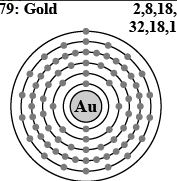
The metal capable of gaining as well as losing an electron is:
AnswerAs shown in image, Gold has $2$ electrons in level $1, 8$ electrons in level $2, 18$ in level $3, 32$ in level $4, 18$ in level $5$ and $1$ electron in level $6.$ Gold is having $1$ eletcron in last level, so it can lost $1$ electron to complete their valency or it can also gain $1$ electron thus $2$ electron will come in outer cell and will complete the last level.
View full question & answer→MCQ 281 Mark
Catalytic activity of transition elements and their compounds is due to their $.......$
AnswerCorrect option: B. Vacant $d-$orbitals.
The catalytic activity of transition elements is ascribed to their ability to adopt multiple oxidation states and to form complexes.
View full question & answer→MCQ 291 Mark
Metallic radii of some transition elements are given below. Which of these elements will have highest density?
| Element |
$Fe$ |
$Co$ |
$Ni$ |
$Cu$ |
| Metallic radii/pm |
$126$ |
$125$ |
$125$ |
$128$ |
AnswerOn moving across the period in the periodic table the atomic radii of the element decreases towards right that is why density increases towards right in a period.
View full question & answer→MCQ 301 Mark
On addition of small amount of $\mathrm{KMnO}_4$ to concentrated $\mathrm{H}_2 \mathrm{SO}_4,$ a green oily compound is obtained which is highly explosive in nature. Identify the compound from the following.
AnswerCorrect option: A. $\mathrm{Mn}_2 \mathrm{O}_7$
$\mathrm{KMnO}_4$ reacts with conc. $\mathrm{H}_2 \mathrm{SO}_4$ as:
$2 \mathrm{KMnO}_4+2 \mathrm{H}_2 \mathrm{SO}_4 \rightarrow \mathrm{Mn}_2 \mathrm{O}_7+2 \mathrm{KHSO}_4+\mathrm{H}_2 \mathrm{O}$
$\mathrm{Mn}_2 \mathrm{O}_7$ is highly explosive in nature.
View full question & answer→MCQ 311 Mark
There are $14$ elements in actinoid series. Which of the following elements does not belong to this series?
Answer$Tm\ ($thulium$)$ atomic no$. = 69$ belongs to Lanthanoids $(4f)$ series.
View full question & answer→MCQ 321 Mark
Which of the following group belongs to actinide series ?
- ✓
$\text{Th, Pa, U}$
- B
$\text{Ce Pr, Nd}$
- C
$\text{Ba, La, Hf}$
- D
$\text{Pt, Au, Ag}$
AnswerCorrect option: A. $\text{Th, Pa, U}$
$Th\ ($thorium$), Pa\ ($proactinium$)$ and $U\ ($uranium$)$ belongs to actinoid series.
$\text{CePr, Nd}$ are lanthanoids.
$\text{Ba, La, Hf}$ belongs to the sixth period.
$\text{Pt, Au, Ag}$ are transition elements.
View full question & answer→MCQ 331 Mark
The magnetic moment of $\left[\mathrm{Cu}\left(\mathrm{NH}_3\right)_4\right]^{2+}$ was found to be $1.73\ B.M.$ The number of unpaired electrons in the complex is:
AnswerMagnetic moment of a complex having $n-$unpaired electrons is given by$:\ \sqrt{\text{n(n+2)}}$ where $n$ is the number of unpaired electrons.
$\sqrt{\text{n(n+2)}}=1.73$
$\therefore \text{n}=1.$
View full question & answer→MCQ 341 Mark
Transition elements form binary compounds with halogens. Which of the following elements will form $\mathrm{MF}_3$ type compounds?
$a. Cr$
$b. Co$
$c. Cu$
$d. Ni$
- ✓
$a$ and $b$
- B
$a$ and $c$
- C
$b$ and $c$
- D
$a$ and $d$
AnswerCorrect option: A. $a$ and $b$
$Cr$ and $Co$ form $\mathrm{MF}_3$ type of compounds. The ability of fluorine to stabilize the highest oxidation state is due to higher lattice energy in $\mathrm{CoF}_3$ and higher bopnd enthalpy for the higher covalent compound like $\mathrm{CrF}_6$.
View full question & answer→MCQ 351 Mark
Which of the following lanthanoids show $+2$ oxidation state besides the characteristic oxidation state $+3$ of lanthanoids?
$a. Ce$
$b. Eu$
$c. Yb$
$d. Ho$
- A
$a$ and $b$
- B
$a$ and $c$
- ✓
$b$ and $c$
- D
$a$ and $d$
AnswerCorrect option: C. $b$ and $c$
- Cerium $(Z = 57) \Rightarrow $ Electronic configuration $=[\text{Xe}]4\text{f}^55\text{d}^06\text{s}^2$
Oxidation state of $Ce +3, +4.$
- Europium $(Z = 63) \Rightarrow $ Electronic configuration $=[\text{Xe}]4\text{f}^75\text{d}^06\text{s}^2$
Oxidation state of $Eu = +2, +3.$
- Ytterbium $(Z = 70) \Rightarrow $ Electronic configuration $=[\text{Xe}]4\text{f}^{14}5\text{d}^06\text{s}^2$
Oxidation state of $Yb = +2, +3.$
- Holmium $(Z = 67) \Rightarrow $ Electronic configuration $=[\text{Xe}]4\text{f}^{11}5\text{d}^06\text{s}^2$
Oxidation state of $Ho = +3.$ View full question & answer→MCQ 361 Mark
Experimental value of magnetic momentum of $\mathrm{Mn}^{2+}$ complex is $5.96\ B.M.$ This indicates:
- ✓
Axial and orbital motion of electron in same direction.
- B
Axial and orbital motion of electron in opposite direction.
- C
Electron does not exhibit orbital motion, it only exhibits axial motion.
- D
Electron does not exhibit axial motion, it only exhibits orbital motion.
AnswerCorrect option: A. Axial and orbital motion of electron in same direction.
$\sqrt{\text{n(n+2)}}=5.96$
$n = 5$
The axial motion of electron is clockwise because $\text{S}=\frac{+1}{2}$ and the orbital motion will also be in clockwise direction.
View full question & answer→MCQ 371 Mark
Chromium $-$ plated steel is a material of popular use. During its process of manufacture, the effluent contains chromate and cyanide ions as impurities. After these are chemically removed, carbon dioxide and salt $($sodium chloride$)$ still remain as impurities. This salt solution is purified electrolytically by adding carbonaceous matter which acts as:
AnswerThe above$-$given salt$-$solution is purified electrolytically by adding carbonaceous matter which acts as a microcell.
View full question & answer→MCQ 381 Mark
The only radioactive element among the lanthanoids is:
AnswerPromethium is a lanthanoid element with the symbol $Pm$ and atomic number $61.$ All of its isotopes are radioactive. Gadolinium, holmium and neodynium are lanthanoids but are not radio active.
View full question & answer→MCQ 391 Mark
AnswerMonazite is a prosphate material containing rare earth metals. It is reddish in colour. It is an important ore for throium, lanthanum, cerium.
View full question & answer→MCQ 401 Mark
Which sub shell is filled up progressively in actinoids?
Answer$5f$ sub shell is filled up progressively in actinoids.
View full question & answer→MCQ 411 Mark
Which of the following reactions are disproportionation reactions?
- $ \mathrm{Cu}^{+} \rightarrow \mathrm{Cu}^{2+}+\mathrm{Cu} $
- $ 3 \mathrm{MnO}_4{^-}+4 \mathrm{H}^{+} \rightarrow 2 \mathrm{MnO}_4{^-}+\mathrm{MnO}_2+2 \mathrm{H}_2 \mathrm{O} $
- $ 2 \mathrm{KMnO}_4 \rightarrow \mathrm{K}_2 \mathrm{MnO}_4+\mathrm{MnO}_2+\mathrm{O}_2 $
- $2 \mathrm{MnO}_4{^-}+3 \mathrm{Mn}^{2+}+2 \mathrm{H}_2 \mathrm{O} \rightarrow 5 \mathrm{MnO}_2+4 \mathrm{H}^{+} $
- ✓
$a, b$
- B
$a, b, c$
- C
$b, c, d$
- D
$a, d$
AnswerCorrect option: A. $a, b$
Copper $(I)$ compounds are unstable in aqueous solution and undergo disproportionation:
$2 \mathrm{Cu}^{+} \rightarrow \mathrm{Cu}^{2+}+\mathrm{Cu}$
In a disproportionation reaction, an element is simultaneously oxidized and reduced.
View full question & answer→MCQ 421 Mark
Transuranic elements begin with:
AnswerThe transuranic elements are the chemical elemnts with atomic numbers greater than $92\ ($the atomic number of Uranium$).$ Neptunium is the first element of transuranic series with atomic number $93..$
View full question & answer→MCQ 431 Mark
$\ce{KMnO_4}$ acts as an oxidising agent in acidic medium. The number of moles of $\ce{KMnO_4}$ that will be needed to react with one mole of sulphide ions in acidic solution is
- ✓
$\frac{2}{5}$
- B
$\frac{3}{5}$
- C
$\frac{4}{5}$
- D
$\frac{1}{5}$
AnswerCorrect option: A. $\frac{2}{5}$
$2\text{MnO}_4^-+5\text{S}^{2-}+16\text{H}^+\rightarrow2\text{Mn}^{2+}+5\text{s}+8\text{H}_2\text{O}$
For $5$ moles of $S$ the number of moles of $\text{KMnO}_4=2$
For $1$ moles of $S$ the number of moles of $\text{KMnO}_4=\frac{2}{5}$
View full question & answer→MCQ 441 Mark
$5f$ series elements are known as $.......?$
AnswerActinides are also called the $5f$ series.
Filling up of the $5f$ orbitals after actinium $(Z = 89)$ gives the $5f-$inner transition series known as the actinoid series.
View full question & answer→MCQ 451 Mark
The radius of $\mathrm{La}^{3+} ($atomic number of $La = 57)$ is $1.06A.$ Which one of the following given values will be closest to the radius of $\mathrm{Lu}^{3+}?\ ($atomic number of $Lu = 71)$
- A
$1.40A$
- B
$1.06A$
- ✓
$0.85A$
- D
$1.60A$
AnswerCorrect option: C. $0.85A$
As we move from left to right in a raw, radii decreases.
So radii of $\mathrm{Lu}^{+3}$ should be lesser than $1.06A.$
View full question & answer→MCQ 461 Mark
The first ionisation potential of $N, P, O$ and $S$ are in the order of:
- A
$\ce{S > P < O > N}$
- ✓
$\ce{N > O > P > S}$
- C
$\ce{N > O < P > S}$
- D
$\ce{N < O < P < S}$
AnswerCorrect option: B. $\ce{N > O > P > S}$
Moving left to right within a period or upward within a group, the first ionization energy generally increases with a few discrepancies $($aluminum and nitrogen group$).$
Nitrogen group to oxygen group$, I.P.$ decreases instead of increasing because of the stable half$-$filled configuration of nitrogen family.
$\ce{N(1400) > O(1313) > P(1011) > S(999)}$
View full question & answer→MCQ 471 Mark
Which of the following is true regarding derivation of the name of californium?
- ✓
The name of californium was derived from the name of the place.
- B
The name of californium was derived from its color.
- C
The name of californium was derived from the name of the scientist who discovered it.
- D
The name of californium was derived from mythological character name.
AnswerCorrect option: A. The name of californium was derived from the name of the place.
The name of californium was derived from the name of the state and University of California.
View full question & answer→MCQ 481 Mark
Which of the following transition metal ions has highest magnetic moment?
- A
$\mathrm{Cu}^{2+}$
- B
$\mathrm{Ni}^{2+}$
- C
$\mathrm{Co}^{2+}$
- ✓
$\mathrm{Fe}^{2+}$
AnswerCorrect option: D. $\mathrm{Fe}^{2+}$
Magnetic moment depends on number of unpaired electrons, in $\mathrm{Fe}^{2+}$ has $4$ unpaired electrons while $\mathrm{Co}^{+2}, \mathrm{Ni}^{+2}, \mathrm{Cu}^{+2}$ has $3, 2, 1$ unpaired electrons respectively.
View full question & answer→MCQ 491 Mark
Most copper $(I)$ compounds are found to be colourless. This is due to:
AnswerCorrect option: B. Completely filled $d-$level in $Cu(I).$
In copper $(I)$ ion there are no vacant $d$ orbitals as it is diamagnetic. Copper$(I)$ ion being less charged has small ligand field effect and the transition is in the infrared region in which no color is perceived by human eye.
View full question & answer→MCQ 501 Mark
Atomic number of three elements $A, B,$ and $C$ are respectively$,\ce{Pm (Z = 61), Sm (Z = 62), Eu (Z = 63)}.$Which one has a maximum atomic radius?
- ✓
$A$
- B
$B$
- C
$C$
- D
All have the same radius.
View full question & answer→