Questions · Page 1 of 4

M.C.Q (1 Marks)

🎯

Test yourself on this topic

50 questions · timed · auto-graded

MCQ 11 Mark
Electronegativity of inert gases is :
  • A
    low
  • B
    high
  • zero
  • D
    abnormally high
Answer
Correct option: C.
zero
Electronegativity of inert gases is zero as they have no tendency to attract the shared e$^-$.
Since the noble gases already have eight electrons in their outer shells, they don't want to attract any more.
Since electronegativity measures the amount of attraction between an atom and an electron, noble gases do not have electronegativity.
View full question & answer
MCQ 21 Mark
The anomalous behaviour of nitrogen is due to:
  • A
    Small size and high electronegativity.
  • B
    Non availability of $d-$orbitals in valency shell.
  • C
    Ease of multiple bond formation.
  • All are correct.
Answer
Correct option: D.
All are correct.
Nitrogen differs from other members of the group due to its smaller size, high electronegativity, high $IE$ and non availability of $d-$orbitals. Nitrogen has unique ability to form $\text{p}\pi-\text{p}\pi$ multiple bonds with itself and with other elements having small size and high electronegativity.
View full question & answer
MCQ 31 Mark
Compounds formed when the noble gases get entrapped in the cavities of crystal lattices of certain organic and inorganic compounds are known as:
  • A
    Interstitial compounds.
  • Clathrates.
  • C
    Hydrates.
  • D
    Picrates.
Answer
Correct option: B.
Clathrates.
Clathrates $($also known as cage compounds$)$ are compounds of noble gases in which they are trapped within cavities of crystal lattices of certain organic and inorganic substances.
View full question & answer
MCQ 41 Mark
In the preparation of $\mathrm{HNO}_3,$ we get $NO$ gas by catalytic oxidation of ammonia. The moles of $NO$ produced by the oxidation of two moles of $\mathrm{NH}_3$ will be $......$
  • $2$
  • B
    $3$
  • C
    $4$
  • D
    $6$
Answer
Correct option: A.
$2$
Two moles of $\mathrm{NH}_3$ will produce $2$ moles of $NO$ on catalytic oxidation of ammonia in preparation of nitric acid.
$4\text{NH}_3+5\text{O}_2\xrightarrow[\text{Pt(Rh gauge catalyst)}]{\Delta} 4\text{NO}(\text{g})+6\text{H}_2\text{O}(\text{l})$
Hence$, 2$ moles of ammonia will produce $2$ moles of $NO.$
View full question & answer
MCQ 51 Mark
The inert gas present in the second long period is:
  • A
    $Kr$
  • $Xe$
  • C
    $Ar$
  • D
    $Rn$
Answer
Correct option: B.
$Xe$
Periods $4$ and $5$ are called long periods as they contain $18$ elements each.
$4^{th}$ period is called the first long period and the inert gas in this period is $Kr.$
$5^{th}$ period is the second long period where $Xe$ is the inert gas element.
View full question & answer
MCQ 61 Mark
Bond dissociation enthalpy of $E-H (E =$ element$)$ bonds is given below. Which of the compounds will act as strongest reducing agent?
Compound $\ce{NH_3}$ $\ce{PH_3}$ $\ce{AsH_3}$ $\ce{SbH_3}$
$\Delta_{\text{diss}}(\text{E}-\text{H})/\text{kJ mol}^{-1}$ $389$ $322$ $297$ $255$
  • A
    $\ce{NH_3}$
  • B
    $\ce{PH_3}$
  • C
    $\ce{AsH_3}$
  • $\ce{SbH_3}$
Answer
Correct option: D.
$\ce{SbH_3}$
On moving down the group size of the central atom increases i.e. bond length increases and bond dissociation enthalpy decreases.
View full question & answer
MCQ 71 Mark
$\text{VA}$ group elements are known as:
  • A
    Halogens.
  • B
    Normal elements.
  • C
    Chalcogens.
  • Pnicogens.
Answer
Correct option: D.
Pnicogens.
Halogens$:\ \text{VIIA}$
Chalcogens$:\ \text{VIA}$
Pnicogens$:\ \text{VA}$
View full question & answer
MCQ 81 Mark
Hydrates of helium and neon have not been prepared because of:
  • A
    Low polarisability.
  • B
    Small size.
  • C
    Low boiling point.
  • All of the above.
Answer
Correct option: D.
All of the above.
When water is allowed to freeze in the presence of $\text{Ar, Kr}$ or $Xe$ under pressure, atoms of noble gas get trapped in the crystal lattice of ice giving clathrates corresponding to the composition, $8 \mathrm{G} .46 \mathrm{H}_2 \mathrm{O} (G =$ noble gas$).$ These clathrates are also known as the noble gas hydrates. But due to small size, low boiling point and low polarisability, He and Ne are unable to trap so they do not form.
View full question & answer
MCQ 91 Mark
Fluorine shows anomalous behavior in $\text{VIIA}$ group due to:
  • A
    Its small size.
  • B
    High electronegativity.
  • C
    Absence of $d-$orbitals.
  • All the above.
Answer
Correct option: D.
All the above.
Second period elements show anomalous behavior due to small size, high electronegativity and absence of $d-$orbitals and fluorine is a second period element
View full question & answer
MCQ 101 Mark
What is found in silver deposits?
  • A
    Phosphorous
  • B
    Bismuth
  • C
    Copper
  • Antimony
Answer
Correct option: D.
Antimony
Silver is found in a native form very rarely as nuggets, but more usually combined with sulfur, arsenic, antimony, or chlorine and in various ores such as argentite $\mathrm{Ag}_2 \mathrm{S},$ chlorargyrite $''$horn silver$,'' \text{AgCl}),$ and galena $($a lead ore often containing significant amounts of silver$).$
View full question & answer
MCQ 111 Mark
Which of the following statements are true?
$a.$ Only type of interactions between particles of noble gases are due to weak dispersion forces.
$b.$ Ionisation enthalpy of molecular oxygen is very close to that of xenon.
$c.$ Hydrolysis of $\ce{XeF_6}$ is a redox reaction.
$d.$ Xenon fluorides are not reactive.
  • $a$ and $b$
  • B
    $a$ and $c$
  • C
    $b$ and $c$
  • D
    $a$ and $d$
Answer
Correct option: A.
$a$ and $b$
Weak dispersion forces are present between particles of noble gases. Ionization enthalpy of molecular oxygen is very close to that of xenon.
View full question & answer
MCQ 121 Mark
Calcium cyanamide on treatment with steam under pressure gives ammonia and:
  • Calcium carbonate.
  • B
    Calcium hydroxide.
  • C
    Calcium oxide.
  • D
    Calcium bicarbonate.
Answer
Correct option: A.
Calcium carbonate.
$\mathrm{CaCN}_2+3 \mathrm{H}_2 \mathrm{O} \rightarrow \mathrm{CaCO}_3+2 \mathrm{NH}_3$​
View full question & answer
MCQ 131 Mark
On heating with concentrated $\text{NaOH}$ solution in an inert atmosphere of $\ce{CO_2}$, white phosphorus gives a gas. Which of the following statement is incorrect about the gas?
  • A
    It is highly poisonous and has smell like rotten fish.
  • B
    It’s solution in water decomposes in the presence of light.
  • It is more basic than $\ce{NH_3}$
  • D
    It is less basic than $\ce{NH_3}$.
Answer
Correct option: C.
It is more basic than $\ce{NH_3}$
White phosphorous is poisonous, insoluble in water but soluble in carbon disulphide and glows in dark $($chemiluminescence$).$ It dissolves in boiling $\text{NaOH}$ solution in an inert atmosphere giving $\ce{PH_3}$.
$\text{P}_4+3\text{NaOH}+3\text{H}_2\text{O}\xrightarrow{\ \ \ \ \ \ \ \ }\text{PH}_3+3\text{NaH}_2\text{PO}_2$
View full question & answer
MCQ 141 Mark
Which one of these group off elements is also called the halogen family?
  • A
    Group $16$
  • B
    Group $18$
  • C
    Group $10$
  • Group $17$
Answer
Correct option: D.
Group $17$
Group $17$ is also called halogen family.
View full question & answer
MCQ 151 Mark
Which is the most thermodynamically stable allotropic form of phosphorus?
  • A
    Red
  • B
    White
  • Black
  • D
    Yellow
Answer
Correct option: C.
Black
Black phosphorus is the most thermodynamically stable allotropic form of phosphorus.
View full question & answer
MCQ 161 Mark
With reference to Haber's process, the required catalyst used is:
  • A
    Iron oxide.
  • B
    Aluminium oxide.
  • C
    Magnesium oxide.
  • All of the above.
Answer
Correct option: D.
All of the above.
$\mathrm{N}_2+3 \mathrm{H}_2 \rightarrow 2 \mathrm{NH}_3$
Haber$-$Bosch process involves the direct reaction of hydrogen and nitrogen. This reaction requires the use of a catalyst high pressure$(100−1000\ atm)$ and elevated temperature$(400−550^\circ C).$ The catalyst can be iron oxide, magnesium oxide, aluminium oxide.
View full question & answer
MCQ 171 Mark
Anomalous behaviour of oxygen, compared to other $\text{VI A}$ group elements is due to:
  • A
    Its high electronegativity.
  • B
    Its small atomic size.
  • C
    Non availability of $d-$orbitals.
  • All.
Answer
Correct option: D.
All.
Oxygen is the first element of $\text{VI A}$ group and shows Anaomalous behaviour than other group elements because
  1. High Electronegativity
  2. small atomic size
  3. Non$-$avalability of $d-$orbits results in different compounds than their other group elements.
View full question & answer
MCQ 181 Mark
Which of the following elements does not show allotropy?
  • Nitrogen.
  • B
    Bismuth.
  • C
    Antimony.
  • D
    Arsenic.
Answer
Correct option: A.
Nitrogen.
The single $N-N$ bond is weak because of high inter$-$electronic repulsion of the non$-$bonding electrons, owing to the small bond length. As a result the catenation tendency is weaker in nitrogen that is why it does not show allotropy.
View full question & answer
MCQ 191 Mark
The percentage of $p-$character in the orbitals forming $P−PP−P$ is:
  • A
    $25$
  • B
    $33$
  • C
    $50$
  • $75$
Answer
Correct option: D.
$75$
In $P_4​,$ all $P$ atoms are in $sp^3$ hybridization so $p-$character in the orbitals forming $PP$ bonds $100\times\frac{3}{4}=75\%$
View full question & answer
MCQ 201 Mark
Viscosity is very low for?
  • A
    $Ar$
  • B
    $Xe$
  • $He$
  • D
    $Kr$
Answer
Correct option: C.
$He$
Noble gases have low melting and boiling point and lowest boiling point among them is of $He\ (4.2K).$ This is because they have only type of inter$-$atomic interaction that is weak dispersion forces.
View full question & answer
MCQ 211 Mark
he colour and state of phosphorus pentoxide is:
  • White crystalline solid.
  • B
    White amorphous liquid.
  • C
    Blue crystalline.
  • D
    Blue colour liquid.
Answer
Correct option: A.
White crystalline solid.
The colour and state of phosphorus pentoxide is white crystalline solid.
View full question & answer
MCQ 221 Mark
Magnesium on heating to redness in an atmosphere of $N_2$ and then on treating with $H_2​O$ gives?
  • $NH_3$
  • B
    $H_2$
  • C
    $N_2$​
  • D
    $O_2$
Answer
Correct option: A.
$NH_3$
Megnesium when heated with $N_2$ in atmosphere it forms magnesium nitride$(\left(\mathrm{Mg}_3 \mathrm{N}_2)\right.$ which on hydrolysis$($reaction with water$)$ gives ammonia.
$3 \mathrm{Mg}+\mathrm{N}_2 \rightarrow \mathrm{Mg}_3 \mathrm{\sim N}_2$
$\mathrm{Mg}_3 \mathrm{\sim N}_2+6 \mathrm{H}_2 \mathrm{O} \rightarrow 3 \mathrm{Mg}(\mathrm{OH})_2+2 \mathrm{NH}_3$
View full question & answer
MCQ 231 Mark
Rhombic, monoclinic and plastic sulphur are?
  • A
    Isomers.
  • B
    Isotopes.
  • Allotropes.
  • D
    Hydrides of sulphur.
Answer
Correct option: C.
Allotropes.
Sulfur is heated to just above the melting point,which is allowed to cool and crystallise slowly as monoclinic sulfur. Remaining sulfur is heated to boiling point, and the liquid is rapidly cooled in cold water to form plastic sulfur.Another sample of sulfur is dissolved in a hot solvent, and the solution allowed to cool and evaporate, leaving crystals of rhombic sulfur.All the observed changes in properties can be related to the different structural forms of the three solid sulfur samples $($allotropes$).$
View full question & answer
MCQ 241 Mark
Among these ores the highest phosphorus content is in:
  • A
    Chlorapatite.
  • Phosphorite.
  • C
    Fluorspar.
  • D
    All have equal content.
Answer
Correct option: B.
Phosphorite.
Phosphorite ore is the ore that has the highest phosphorus content.
Percentage of $P$ in phosphorite
$=\frac{69}{279}\times100=22.22\%$
In flourapatite and chlorapatite the percentage content of phosphorus is $20.32\%$ and $19.62\%$ respectively.
View full question & answer
MCQ 251 Mark
The oxidation state of central atom in the anion of compound $\mathrm{NaH}_2 \mathrm{PO}_2$ will be $......$
  • A
    $+3$
  • B
    $+5$
  • $+1$
  • D
    $-3$
Answer
Correct option: C.
$+1$
Oxidation state of $\mathrm{NaH}_2 \mathrm{PO}_2$
$\stackrel{{+1}}{\hbox{Na}}\stackrel{{+1}}{\hbox{ H}_2}\stackrel{{\text{n}}}{\hbox{ P}}\stackrel{{-2}}{\hbox{O}_2}$
$+1+2\times+1+\text{x}+2\times-2=0$
$+3+\text{x}-4=0$
$\text{x}-1=0$
$\text{x}=+1$
View full question & answer
MCQ 261 Mark
The word Argon represents the term $.......?$
  • A
    Sun
  • B
    Hidden
  • Lazy
  • D
    Stranger
Answer
Correct option: C.
Lazy
The word Argon represents the term Lazy.
View full question & answer
MCQ 271 Mark
Which of the following are formed by xenon?
  • A
    $\ce{XeF_7}$
  • $\ce{XeF_4}$
  • C
    $\ce{XeF_5}$​
  • D
    $\ce{XeF_3}$
Answer
Correct option: B.
$\ce{XeF_4}$
$\ce{XeF_{4^-}}$ This compound is formed by xenon.
$Xe$ compounds can contain only even no. of fluorine atoms.
$Xe$ has a complete filled $5p$ configuration.
As a result when it undergoes bonding with an odd number $(3$ or $5)$ of $F$ atoms it leaves behind one unpaired electron.
This causes the molecule to become unstable.
View full question & answer
MCQ 281 Mark
The outer most electronic configuration of the most electronegative element is:
  • A
    $\ce{ns^2 np^3}$
  • B
    $\ce{ns^2 np^4}$
  • $\ce{ns^2 np^5}$
  • D
    $\ce{ns^2 np^6}$
Answer
Correct option: C.
$\ce{ns^2 np^5}$
Halogens are most electronegative.
Therefore outer electronic configuration is $\ce{ns^2 np^5}.$
View full question & answer
MCQ 291 Mark
Inter $-$ halogen compounds can be:
  • A
    $\mathrm{ICl}_3$
  • B
    $\mathrm{BrF}_5$
  • C
    $\mathrm{IF}_7$
  • All of these
Answer
Correct option: D.
All of these
Halogens can combine and to form inter$-$halogen compounds which are highly reactive in nature.
Interhalogen Compounds as the subordinates of halogens. These are the compounds having two unique sorts of halogens. For example, the common interhalogen compounds include Chlorine monofluoride, bromine trifluoride, iodine pentafluoride, iodine heptafluoride, etc.
View full question & answer
MCQ 301 Mark
Which of the following noble gas is the least polarizable?
  • A
    Radon
  • B
    Krypton
  • C
    Xenon
  • Helium
Answer
Correct option: D.
Helium
Helium is the least polarizable noble gas due to presence of weakest Van der Waal's forces.
View full question & answer
MCQ 311 Mark
In the third excited state, the number of unpaired electrons in chlorine atom is:
  • A
    $5$
  • $7$
  • C
    $3$
  • D
    $1$
Answer
Correct option: B.
$7$
The general electronic configuration of chlorine is $[\mathrm{Ne}] 3 \mathrm{s}^2 3 \mathrm{p}^5$.
When electrons are excited in chlorine, the electrons enter into $3d$ subshell then the electronic configuration of chlorine is given as $[\mathrm{Ne}] 3s^1 3 p^3 3 d^3$
View full question & answer
MCQ 321 Mark
If a new noble gas is discovered then, what will be its atomic number?
  • A
    $87$
  • B
    $104$
  • $118$
  • D
    $132$
Answer
Correct option: C.
$118$
$Rn + 32 = 86 + 32 = 118$
The atomic number of next inert gas to be discovered will be $118.$
View full question & answer
MCQ 331 Mark
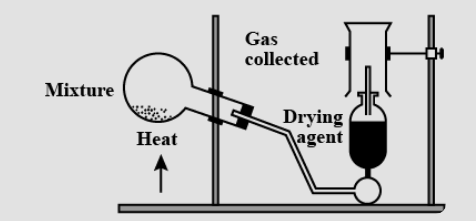
The set up shown in the diagram is for the laboratory preparation of a pungent alkaline gas. What is the name of drying agent used in the process?
  • Quick lime.
  • B
    Magnesium oxide.
  • C
    Calcium carbonate.
  • D
    None of these.
Answer
Correct option: A.
Quick lime.
Drying Agent is $\text{CaO}\ ($Quick lime$).$ It is used to dry ammonia gas.
View full question & answer
MCQ 341 Mark
Inversion temperature of helium is very low. So when helium is allowed to expand into vacuum it gets:
  • A
    Cooled.
  • Heated.
  • C
    Neither cooled, nor heated $X.$
  • D
    Liquified.
Answer
Correct option: B.
Heated.
He gets heated at their inversion temperature on expansion into vacuum.
View full question & answer
MCQ 351 Mark
In clathrate atoms or molecules the bond formed is:
  • A
    Metallic
  • B
    Covalent
  • C
    Ionic
  • They do not form bond
Answer
Correct option: D.
They do not form bond
In clathrate bond is not formed. There is only dipole- induced dipole interaction which is not a bond.
View full question & answer
MCQ 361 Mark
In the manufacture of ammonia, the catalyst used is:
  • Magnesium oxide.
  • B
    Silver.
  • C
    Gold.
  • D
    Nickel.
Answer
Correct option: A.
Magnesium oxide.
Several catalysts are being utilized. The catalyst is iron containing iron oxide, magnesium oxide, aluminium oxide and ruthenium on carbon.
View full question & answer
MCQ 371 Mark
Which is the strongest oxidising agent out of the following?
  • A
    $\mathrm{I}_2$
  • B
    $\mathrm{Cl}_2$
  • C
    $\mathrm{Br}_2$
  • $\mathrm F_2$
Answer
Correct option: D.
$\mathrm F_2$
Fluorine is such a powerful oxidising agent that you can't reasonably do solution reactions with it.
Standard Reduction Potential for fluorine is $2.87 V.$
View full question & answer
MCQ 381 Mark
The element which can displace three other halogens from their compound is:
  • A
    $Cl$
  • B
    $Br$
  • C
    $I$
  • $F$
Answer
Correct option: D.
$F$
$F$ can displace other halogens from their compounds due to its oxidising nature $($Reaction will be feasible$).$
Reactivity decreases from $F$ to $I.$
View full question & answer
MCQ 391 Mark
Nitrogen is liberated by the thermal decomposition of only:
  • A
    $\mathrm{NH}_4 \mathrm{NO}_2$
  • B
    $\mathrm{NaN}_3$
  • C
    $\left(\mathrm{NH}_4\right)_2 \mathrm{Cr}_2 \mathrm{O}_7$
  • All of these
Answer
Correct option: D.
All of these
Nitrogen is liberated by the thermal decomposition of ammonium nitrite.
$\left(\mathrm{NH}_4 \mathrm{NO}_2\right), \mathrm{NaN}_3,\left(\mathrm{NH}_4\right)_2 \mathrm{Cr}_2 \mathrm{O}_7$
View full question & answer
MCQ 401 Mark
Which of the following statements are correct?
$a.$ All the three $N—O$ bond lengths in $\mathrm{HNO}_3$ are equal.
$b.$ All $P—Cl$ bond lengths in $\ce{PCl_5}$ molecule in gaseous state are equal.
$c. P_4$ molecule in white phohsphorus have angular strain therefore white phosphorus is very reactive.
$d. \text{PCl}$ is ionic in solid state in which cation is tetrahedral and anion is octahedral.
  • A
    $a$ and $b$
  • B
    $b$ and $c$
  • C
    $a$ and $c$
  • $c$ and $d$
Answer
Correct option: D.
$c$ and $d$
  1. All the three $N – O$ bond lengths in $\mathrm{HNO}_3$ are not equal.
  2. All $\text{P – Cl}$ bond lengths in $\mathrm{PCl}_5$ molecule in gaseous state are not equal. Axial bond is longer than equatorial bond.
  3. $P_4$ molecule in white phosphorus have angular strain therefore white phosphorus is very reactive.
  4. $\mathrm{PCl}_5$ is ionic in solid state in which cation is tetrahedral and anion is octahedral.
Cation $- \left[\mathrm{PCl}_4\right]^{+}$
Anion $- \left[\mathrm{PCl}_6\right]^{-}$
View full question & answer
MCQ 411 Mark
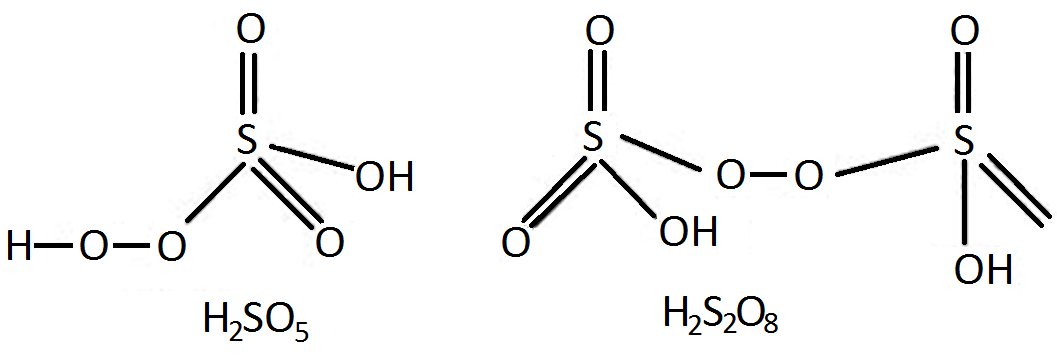
Which of the following are peroxoacids of sulphur?
  • $\mathrm{H}_2 \mathrm{SO}_5$ and $\mathrm{H}_2 \mathrm{\sim S}_2 \mathrm{O}_8$
  • B
    $\mathrm{H}_2 \mathrm{SO}_5$ and $\mathrm{H}_2 \mathrm{S}_2 \mathrm{O}_7$
  • C
    $\mathrm{H}_2 \mathrm{S}_2 \mathrm{O}_7$ and $\mathrm{H}_2 \mathrm{S}_2 \mathrm{O}_8$
  • D
    $\mathrm{H}_2 \mathrm{S}_2 \mathrm{O}_6$ and $\mathrm{H}_2 \mathrm{S}_2 \mathrm{O}_7$
Answer
Correct option: A.
$\mathrm{H}_2 \mathrm{SO}_5$ and $\mathrm{H}_2 \mathrm{\sim S}_2 \mathrm{O}_8$
Peroxoacids of sulphur must contain one $-O – O –$ bond as shown below.
View full question & answer
MCQ 421 Mark
The most abundant element in the earth's crust among the following is $.......$
  • $P$
  • B
    $As$
  • C
    $Sb$
  • D
    $Bi$
Answer
Correct option: A.
$P$
The most abundant element among the given elements in the earth's crust is phosphorus.
It occurs in the minerals of the apatite family. An example is a fluorapatite $\mathrm{Ca}_9\left[\mathrm{PO}_4\right]_6 \cdot \mathrm{CaF}_2$
Phosphorus is the most abundant element of $15^{th}$ group, accounting for $0.10\%$ of the mass of the earth's crust.
View full question & answer
MCQ 431 Mark
A black compound of manganese reacts with a halogen acid to give greenish yellow gas. When excess of this gas reacts with $\mathrm{NH}_3$ an unstable trihalide is formed. In this process the oxidation state of nitrogen changes from $........$
  • A
    $-3$ to $+3$
  • B
    $-3$ to $0$
  • $-3$ to $+5$
  • D
    $0$ to $-3$
Answer
Correct option: C.
$-3$ to $+5$
$\text{Mn0}_2+4\text{HCl}\xrightarrow{\ \ \ \ \ \ \ \ \ \ }\text{MnCl}_2+2\text{H}_2\text{O}+\text{Cl}$
$($greenish yellow gas$)$
When excess of $\mathrm{Cl}_2$ reacts with $\mathrm{NH}_3$ the products are $\mathrm{NCl}_3$ and $\text{HCl}.$
$\text{NH}_3+3\text{Cl}_2\xrightarrow{\ \ \ \ \ \ \ \ \ }\text{NCl}_3+3\text{HCl}\\\text{O.S.}(-3)\text{O.S.}(+3)$
View full question & answer
MCQ 441 Mark
Which of the following is a tetratomic element?
  • Phosphorus.
  • B
    Iron.
  • C
    Calcium.
  • D
    None of the above.
Answer
Correct option: A.
Phosphorus.
Tetra atomic elements are those which are made up of four atoms.
A common and biologically important element that consists as molecules of four atoms chemically bonded together is the element phosphorus.
View full question & answer
MCQ 451 Mark
On heating ammonium dichromate and barium azide separately we get
  • $\mathrm{N}_2$ in both cases.
  • B
    $\mathrm{N}_2$ with ammonium dichromate and $NO$ with barium azide.
  • C
    $\mathrm{N}_2 \mathrm{O}$ with ammonium dichromate and $\mathrm{N}_2$ with barium azide.
  • D
    $\mathrm{N}_2 \mathrm{O}$ with ammonium dichromate and $\mathrm{NO}_2$ with barium azide.
Answer
Correct option: A.
$\mathrm{N}_2$ in both cases.
$(\text{NH}_4)_2\text{Cr}_2\text{O}_7\xrightarrow{\ \ \ \ \ \ \ \ \ }\text{N}_2+\text{Cr}_2\text{O}_3+4\text{H}_2\text{O}$
$\text{Ba}(\text{N}_3)_2\xrightarrow{\ \ \ \ \ \ \ \ \ }3\text{N}_2+\text{Ba}$
View full question & answer
MCQ 461 Mark
The molecular formula of phosphorous is:
  • A
    $P_1$
  • $P_4$
  • C
    $P_2$
  • D
    $P_5$
Answer
Correct option: B.
$P_4$
The molecular formula of phosphorous is $P_4$.
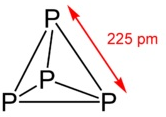
White phosphorus, in gaseous state and as waxy solid consists of $P_4$​ tetrahedra.
View full question & answer
MCQ 471 Mark
At low temperatures, nitrogen:
  • A
    Is poisonous.
  • B
    Is highly soluble in water.
  • Can be liquefied on compression.
  • D
    Dissociates to form nascent nitrogen.
Answer
Correct option: C.
Can be liquefied on compression.
At low temperatures nitrogen can be liquefied on compression.
View full question & answer
MCQ 481 Mark
In the manufacture of ammonia, what is the ratio of the reactants taken, i.e. $N_2: H_2​?$
  • A
    $1 : 1$
  • B
    $1 : 3$
  • $3 : 1$
  • D
    $2 : 3$
Answer
Correct option: C.
$3 : 1$
Reactants taken for commercial production of ammonia is nitrogen and hydrogen in the presence of catalyst, high temperature and high pressure.
$\mathrm{N}_2+3 \mathrm{H}_2 \rightarrow 2 \mathrm{NH}_3$​
View full question & answer
MCQ 491 Mark
In the preparation of ammonia gas from ammonium chloride and calcium hydroxide, the reactants are ground thoroughly $......?$
  • To provide maximum surface area.
  • B
    To provide maximum surface area.
  • C
    To increase the number of particle.
  • D
    None of these.
Answer
Correct option: A.
To provide maximum surface area.
In the preparation of ammonia gas from ammonium chloride and calcium hydroxide, the reactants are ground thoroughly to provide a maximum surface area of the reactants which helps in speeding up the reaction.
View full question & answer
MCQ 501 Mark
Argon was discovered by:
  • A
    Rayleigh
  • B
    Ramsay
  • Both $(A)$ and $(B)$
  • D
    Frankland and Lockeyer
Answer
Correct option: C.
Both $(A)$ and $(B)$
Argon was discovered by Lord Rayleigh and Sir William Ramsay in $1894.$
It was isolated by examination of the residue obtained by removing nitrogen, oxygen, carbon dioxide, and water from clean air.
View full question & answer
M.C.Q (1 Marks) - Chemistry STD 12 Science Questions - Vidyadip