Questions · Page 2 of 2

3 Marks Question

Question 513 Marks
Write the coordination number of each ion in the following crystals:
  1. $ZnS$
  2. $CaF_2$
  3. $Na_2O$
Answer
  1. $Zn^{2+} = 4,\ S^{2-} = 4$
  2. $Ca^{2+} = 8,\ F^- = 4$
  3. $Na^+ = 4,\ O^{2-} = 8$
View full question & answer
Question 523 Marks
The radius of an atom of an element is 75pm. If it crystallizes as a body-centred cubic lattice, what is the length of the side of the unit cell?
Answer
For bcc, $\text{a}=\frac{4}{\sqrt{3}}\text{r}=\frac{4}{\sqrt{3}}\times75$
$=\frac{4}{\sqrt{3}}\times75\times\frac{\sqrt{3}}{\sqrt{3}}=100\times1.732=173.2\text{pm}$
View full question & answer
Question 533 Marks
A solid is made up of two elements $P$ and $Q.$ Atoms of $Q$ are in ccp arrangement while atoms of $P$ occupy all the tetrahedral sites. What is the formula of the compound?
Answer
Suppose number of atoms of $Q$ in ccp arrangement $= N,$
So, number of tetrahedral sites $= 2N,$
$\therefore$ Number of $P$ atoms $= 2N,$
$\therefore P : Q = 2N : N = 2 : 1$
Hence, formula of compound is $P_2Q.$
View full question & answer
Question 543 Marks
A compound is formed by two elements X and Y. Atoms of the element Y(as anions) make ccp and those of the element X(as cations) occupy all the octahedral voids. What is the formula of the compound?
Answer
Suppose the number of atoms Y in ccp = N
$\therefore$ Number of octahedral voids = N × 1 = N
$\therefore$ Number of atoms of X = N
Ratio of X : Y = N : N = 1 : 1
Hence, formula of the compound = XY
View full question & answer
Question 553 Marks
If three elements $A,\ B$ and $C$ crystallise in a cubic solid lattice with $A$ atoms at the corners, $B$ atoms at the cube centres and $C$ atoms at the centre of the faces of the cube, then write the formula of the compound.
Answer
Atoms of $A$ per unit cell $=8\times\frac{1}{8}=1$
Atoms of $B$ per unit cell $= 1$
Atoms of $C$ per unit cell $=6\times\frac{1}{2}=3$
Hence, the formula is $ABC_3.$
View full question & answer
Question 563 Marks
A cubic solid is made up of two elements A and B. Atoms A are present at the corners of the cube and B are at the alternate face centres. What is the formula of the solid?
Answer
Number of A atoms per unit cell $=8\times\frac{1}{8}=1$
Number of B atoms per unit cell $=2\times\frac{1}{2}=1$
$\therefore$ Formula of the compound = AB.
View full question & answer
Question 573 Marks
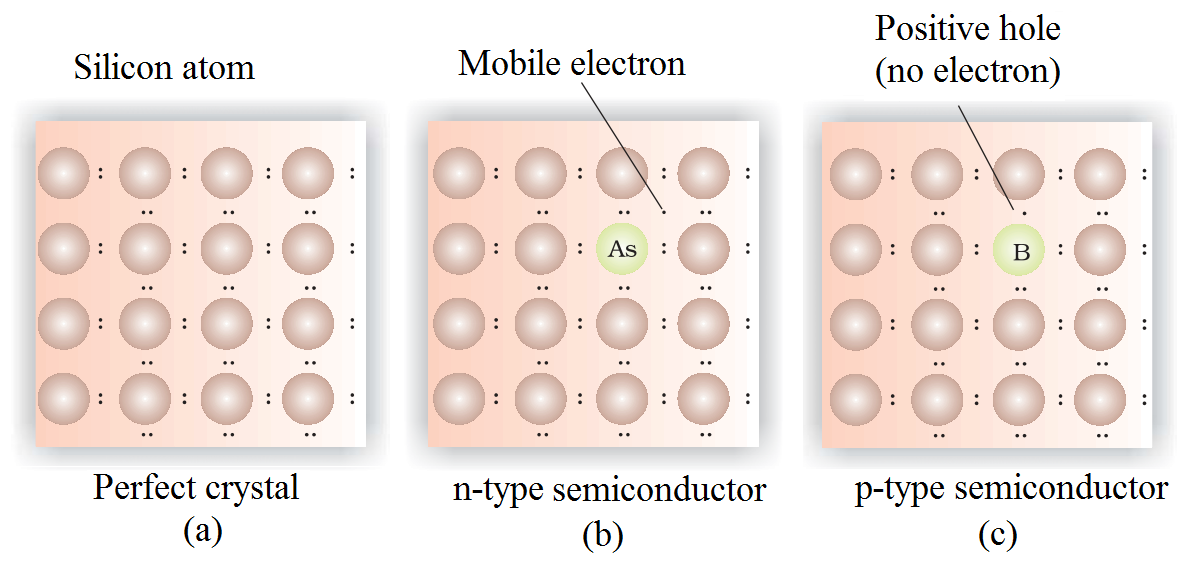
Explain why does conductivity of germanium crystals increase on doping with galium.
Answer
On doping tetravalent germanium with trivalent galium some of the positions of lattice of germanium are occupied by galium. Galium atom has only three valence electrons. Therefore, fourth valency of nearby germanium atom is not satisfied. The place remains vacant. This place is deficient of electrons and is therefore called electron hole or electron vacancy. Electron from neighbouring atom comes and fills the gap, thereby creating a hole in its original position. Under the influence of electric field electrons move towards positively charged plates through these holes and conduct electricity. The holes appear to move towards negatively charged plates.
View full question & answer
Question 583 Marks
. Match the type of packing given in Column I with the items given in Column II.
 
Column I
 
Column II
(i)
Square close packing in two dimensions
(a)
Triangular voids.
(ii)
Hexagonal close packing in two dimensions
(b)
Pattern of spheres is repeated in every fourth layer.
(iii)
Hexagonal close packing in three dimensions
(c)
Coordination number 4.
(iv)
Cubic close packing in three dimensions
(d)
Pattern of sphere is repeated in alternate layers.
Answer
 
Column I
 
Column II
(i)
Square close packing in two dimensions
(c)
Coordination number 4.
(ii)
Hexagonal close packing in two dimensions
(a)
Triangular voids.
(iii)
Hexagonal close packing in three dimensions
(d)
Pattern of sphere is repeated in alternate layers.
(iv)
Cubic close packing in three dimensions
(b)
Pattern of spheres is repeated in every fourth layer.
View full question & answer
Question 593 Marks
Match the items given in Column I with the items given in Column II.
 
Column I
 
Column II
$(i)$
$Mg$ in solid state
$(a)$
$p-$Type semiconductor.
$(ii)$
$MgCl_2$ in molten state
$(b)$
$n-$Type semiconductor.
$(iii)$
Silicon with phosphorus
$(c)$
Electrolytic conductors.
$(iv)$
Germanium with boron
$(d)$
Electronic conductors.
Answer
 
Column I
 
Column II
$(i)$
$Mg$ in solid state
$(d)$
Electronic conductors.
$(ii)$
$MgCl_2$ in molten state
$(c)$
Electrolytic conductors.
$(iii)$
Silicon with phosphorus
$(b)$
$n-$Type semiconductor.
$(iv)$
Germanium with boron
$(a)$
$p-$Type semiconductor.
  1. $Mg$ in solid state show electronic conductivity due to presence of free electrons hence, they are known as electronic conductors.
  2. $MgCl_2$ in molten state show electrolytic conductivity due to presence of electrolytes in molten state.
  3. Silicon doped with phosphorus contain one extra electron due to which it shows conductivity under the influence of electric field and known as $p-$type semiconductor.
  4. Germanium doped with boron contains one hole due to which it shows conductivity under the influence of electric field and known as $n-$type semiconductor.
View full question & answer
Question 603 Marks
Match the defects given in Column I with the statements in given Column II.
  Column I   Column II
(i)
Simple vacancy defect
(a)
Shown by non-ionic solids and increases density of the solid.
(ii)
Simple interstitial defect
(b)
Shown by ionic solids and decreases density of the solid.
(iii)
Frenkel defect
(c)
Shown by non ionic solids and density of the solid decreases.
(iv)
Schottky defect
(d)
Shown by ionic solids and density of the solid remains the same.
 
Answer
  Column I   Column II
(i)
Simple vacancy defect
(c)
Shown by non ionic solids and density of the solid decreases.
(ii)
Simple interstitial defect
(a)
Shown by non-ionic solids and increases density of the solid.
(iii)
Frenkel defect
(d)
Shown by ionic solids and density of the solid remains the same.
(iv)
Schottky defect
(b)
Shown by ionic solids and decreases density of the solid.
View full question & answer
Question 613 Marks
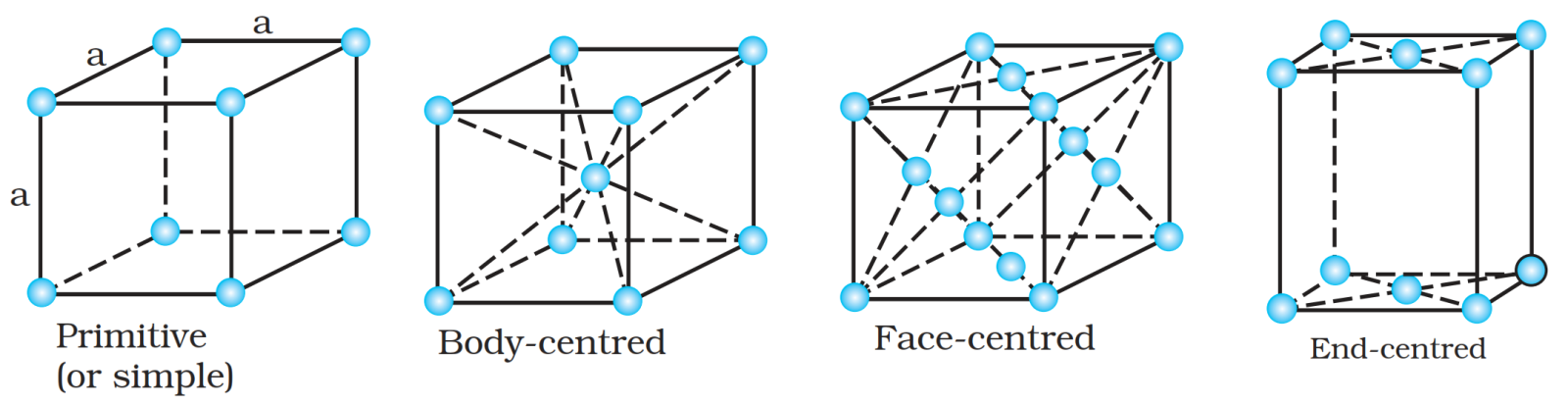
Match the type of unit cell given in Column I with the features given in Column II.
  Column I   Column I
(i)
Primitive cubic unit cell
(a)
Each of the three perpendicular edges compulsorily have the different edge length i.e; a ≠ b ≠ c.
(ii)
Body centred cubic unit cell
(b)
Number of atoms per unit cell is one.
(iii)
Face centred cubic unit cell
(c)
Each of the three perpendicular edges compulsorily have the same edge length i.e.; a = b = c
(iv)
End centred orthorhombic unit cell
(d)
In addition to the contribution from the corner atoms the number of atoms present in a unit cell is one.
 
 
(e)
In addition to the contribution from the corner atoms the number of atoms present in a unit cell is three.
Answer
  Column I   Column I
(i)
Primitive cubic unit cell
(b)
(c)
Number of atoms per unit cell is one.
Each of the three perpendicular edges compulsorily have the same edge length i.e.; a = b = c
(ii)
Body centred cubic unit cell
(C)
(d)
Each of the three perpendicular edges compulsorily have the same edge length i.e.; a = b = c
In addition to the contribution from the corner atoms the number of atoms present in a unit cell is one.
(iii)
Face centred cubic unit cell
(c)
(e)
Each of the three perpendicular edges compulsorily have the same edge length i.e.; a = b = c
In addition to the contribution from the corner atoms the number of atoms present in a unit cell is three.
(iv)
End centred orthorhombic unit cell
(a)
(d)
Each of the three perpendicular edges compulsorily have the different edge length i.e; a ≠ b ≠ c.
In addition to the contribution from the corner atoms the number of atoms present in a unit cell is one.
Explaination:
  1. For primitive unit cell, a = b = c
    Total number of atoms per unit cell $= \frac{1}{8}\times 8 = 1$
    Here, $\frac{1}{8}$ is due to contribution of each atom present at corner.
  2. For body centred cubic unit cell, a = b = c
    This lattice contain atoms at corner as well as body centre. Contribution due to atoms at corner $= \frac{1}{8}\times 8 = 1$
    contribution due to atoms at body centre = 8
  3. For face centred unit cell, a = b = c
    Total constituent ions per unit cell present at corners $= \frac{1}{8}\times 8 = 1$
    Total constituent ions per unit cell present at face centre $= \frac{1}{2}\times 6 = 3$
  4. For end centered orthorhombic unit cell, $\text{a}\neq\text{b}\neq\text{c}$ Total contribution of atoms present at corner $= \frac{1}{8}\times 8 = 1$
    Total contribution of atoms present at end centre $=\frac{1}{2}\times2=1$
    Hence, other than corner it contain total one atom per unit cell.
View full question & answer
3 Marks Question - Page 2 - Chemistry STD 12 Science Questions - Vidyadip