MCQ 1011 Mark
In Bohr model of hydrogen atom, the ratio of periods of revolution of an electron in $n=2$ and $n=1$ orbits is
- A
$2: 1$
- B
$4: 1$
- ✓
$8: 1$
- D
$16: 1$
AnswerCorrect option: C. $8: 1$
$8: 1$
View full question & answer→MCQ 1021 Mark
The minimum energy required to excite a hydrogen atom from its ground state is
- A
$13.6\ eV$
- B
$-13.6\ eV$
- C
$3.4\ eV$
- ✓
$10.2\ eV$
AnswerCorrect option: D. $10.2\ eV$
Minimum energy required to excite from ground state $=13.6\left[\frac{1}{1^2}-\frac{1}{2^2}\right]=10.2\ \mathrm{eV}$
View full question & answer→MCQ 1031 Mark
The radius of electron's second stationary orbit in Bohr's atom is $R$. The radius of the third orbit will be
- A
$3\ R$
- ✓
$2.25\ R$
- C
$9\ R$
- D
$\frac{R}{3}$
AnswerCorrect option: B. $2.25\ R$
$r \propto n^2 \Rightarrow \frac{r_{(n=2)}}{r_{(n=3)}}=\frac{4}{9} \Rightarrow r_{(n=3)}=\frac{9}{4} R=2.25\ R$
View full question & answer→MCQ 1041 Mark
Which one of the relation is correct between time period and number of orbits while an electron is revolving in a orbit
- A
$n^2$
- B
$\frac{1}{n^2}$
- ✓
$n^3$
- D
$\frac{1}{n}$
View full question & answer→MCQ 1051 Mark
The ionisation energy of $10$ times ionised sodium atom is
- A
$13.6 eV$
- B
$13.6 \times 11 eV$
- C
$\frac{13.6}{11} eV$
- ✓
$13.6 \times(11)^2 eV$
AnswerCorrect option: D. $13.6 \times(11)^2 eV$
$(E)_w=Z^2\left(E_{\text {ion }}\right)_H=(11)^2 13.6 \mathrm{eV}$
View full question & answer→MCQ 1061 Mark
The energy required to knock out the electron in the third orbit of a hydrogen atom is equal to
- A
$13.6\ eV$
- ✓
$+\frac{13.6}{9}\ eV$
- C
$-\frac{13.6}{3}\ eV$
- D
$-\frac{3}{13.6}\ eV$
AnswerCorrect option: B. $+\frac{13.6}{9}\ eV$
Energy required to knock out the electron in the $r$ orbit $=+\frac{13.6}{n^2} \mathrm{eV} $
$\Rightarrow E_3=+\frac{13.6}{9} \mathrm{eV}$.
View full question & answer→MCQ 1071 Mark
In hydrogen atom which quantity is integral multiple of $\frac{h}{2 \pi}$
View full question & answer→MCQ 1081 Mark
The frequency of $1^{-}$line of Balmer series in $H _2$ atom is $v_0$. The frequency of line emitted by singly ionised $He$ atom is
- A
$2 v_0$
- ✓
$4 v_0$
- C
$v_0 / 2$
- D
$v_0 / 4$
AnswerCorrect option: B. $4 v_0$
$ v \propto Z^2 \Rightarrow \frac{v_{H_2}}{v_{H e}}=\left(\frac{1}{2}\right)^2=\frac{1}{4} \Rightarrow v_{H e}=4 v_{H_2}=4 v$
View full question & answer→MCQ 1091 Mark
Minimum energy required to takeout the only one electron from ground state of $He^{+}$ is
- A
$13.6 eV$
- ✓
$54.4 eV$
- C
$27.2 eV$
- D
$6.8 eV$
AnswerCorrect option: B. $54.4 eV$
$E_n=-\frac{13.6 z^2}{n^2} e V $
$\Rightarrow E_1=-\frac{13.6 \times(2)^2}{(1)^2}=-54.4 \mathrm{eV}$
View full question & answer→MCQ 1101 Mark
Number of spectral lines in hydrogen atom is
AnswerInfinitely large transitions are possible (in principle) for the hydrogen atom.
View full question & answer→MCQ 1111 Mark
Hydrogen atom excites energy level from fundamental state to $n=3$. Number of spectrum lines according to Bohr, is
AnswerNo. of lines $N_E=\frac{n(n-1)}{2}=\frac{3(3-1)}{2}=3$
View full question & answer→MCQ 1121 Mark
The size of an atom is of the order of
- A
$10^{-8} m$
- ✓
$10^{-10} m$
- C
$10^{-12} m$
- D
$10^{-14} m$
AnswerCorrect option: B. $10^{-10} m$
The size of the atom is of the order of $1 \mathring A=10^{-10} m$.
View full question & answer→MCQ 1131 Mark
The spectral series of the hydrogen spectrum that lies in the ultraviolet region is the
AnswerLyman series lies in the UV region.
View full question & answer→MCQ 1141 Mark
lonization potential of hydrogen atom is $13.6\ V$. Hydrogen atoms in the ground state are excited by monochromatic radiation of photon energy $12.1\ eV$. The spectral lines emitted by hydrogen atoms according to Bohr's theory will be
AnswerFinal energy of electron $=-13.6+12.1=-1.51 \mathrm{eV}$.
which is corresponds to third level i.e. $n=3$.
Hence number of spectral lines emitted $=\frac{n(n-1)}{2}=\frac{3(3-1)}{2}=3$
View full question & answer→MCQ 1151 Mark
The following diagram indicates the energy levels of a certain atom when the system moves from $2 E$ level to $E$, a photon of wavelength $\lambda$ is emitted. The wavelength of photon produced during its transition from $\frac{4 E}{3}$ level to $E$ is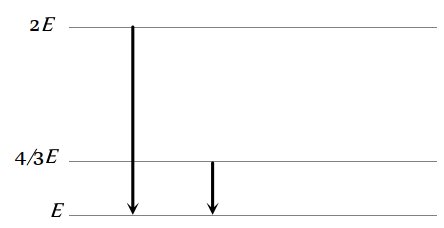
- A
$\lambda / 3$
- B
$3 \lambda / 4$
- C
$4 \lambda / 3$
- ✓
$3 \lambda$
AnswerCorrect option: D. $3 \lambda$
$ 2 E-E=\frac{h c}{\lambda} \Rightarrow E=\frac{h c}{\lambda}$
$ \frac{4 E}{3}-E=\frac{h c}{\lambda^{\prime}} \Rightarrow \frac{E}{3}=\frac{h c}{\lambda^{\prime}}$
$ \therefore \frac{\lambda^{\prime}}{\lambda}=3 \Rightarrow \lambda^{\prime}=3 \lambda$
View full question & answer→MCQ 1161 Mark
According to Bohr's theory the radius of electron in an orbit described by principal quantum number $n$ and atomic number $Z$ is proportional to
- A
$Z^2 n^2$
- B
$\frac{Z^2}{n^2}$
- C
$\frac{Z^2}{n}$
- ✓
$\frac{n^2}{Z}$
AnswerCorrect option: D. $\frac{n^2}{Z}$
$r=\frac{\varepsilon_0 n^2 h^2}{\pi Z m e^2} ; \therefore r \propto \frac{n^2}{Z}$
View full question & answer→MCQ 1171 Mark
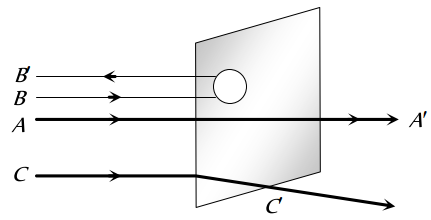
A beam of fast moving alpha particles were directed towards a thin film of gold. The parts $A^{\prime}, B^{\prime}$ and $C^{\prime}$ of the transmitted and reflected beams corresponding to the incident parts $A, B$ and $C$ of the beam, are shown in the adjoining diagram. The number of alpha particles in
- A
$B^{\prime}$ will be minimum and in $C^{\prime}$ maximum
- ✓
$A^{\prime}$ will be maximum and in $B^{\prime}$ minimum
- C
$A^{\prime}$ will be minimum and in $B^{\prime}$ maximum
- D
$C^{\prime}$ will be minimum and in $B^{\prime}$ maximum
AnswerCorrect option: B. $A^{\prime}$ will be maximum and in $B^{\prime}$ minimum
Because atom is hollow and whole mass of atom is concentrated in a small centre called nucleus.
View full question & answer→MCQ 1181 Mark
In the above figure $D$ and $E$ respectively represent
- ✓
Absorption line of Balmer series and the ion ization potential of hydrogen
- B
Absorption line of Balmer series and the wavelength lesser than lowest of the Lyman series
- C
Spectral line of Balmer series and the maximum wavelength of Lyman series
- D
Spectral line of Lyman series and the absorption of greater wavelength of limiting value of Paschen series
AnswerCorrect option: A. Absorption line of Balmer series and the ion ization potential of hydrogen
$D$ is excitation of electron from $2$ orbit corresponding to absorption line in Balmer series and $E$ is the energy released to bring the electron from $\infty$ to ground state i.e. ionisation potential.
View full question & answer→MCQ 1191 Mark
The energy levels of the hydrogen spectrum is shown in figure. There are some transitions $A, B, C, D$ and $E$. Transition $A, B$ and $C$ respectively represent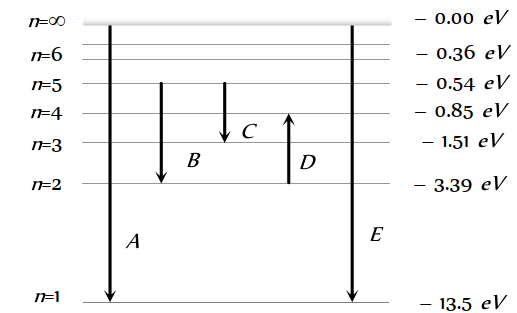
- A
(a) First member of Lyman series, third spectral line of Balmer series and the second spectral line of Paschen series
- B
(b) lonization potential of hydrogen, second spectral line of Balmer series and third spectral line of Paschen series
- ✓
(c) Series limit of Lyman series, third spectral line of Balmer series and second spectral line of Paschen series
- D
(d) Series limit of Lyman series, second spectral line of Balmer series and third spectral line of Paschen series
AnswerCorrect option: C. (c) Series limit of Lyman series, third spectral line of Balmer series and second spectral line of Paschen series
(c) Transition A ( $n=\infty$ to 1$)$ : Series limit of Lyman seriesTransition B $(n=5$ to $n=2)$ : Third spectral line of Balmer seriesTransition C $(n=5$ to $n=3)$ : Second spectral line of Paschen series
View full question & answer→MCQ 1201 Mark
If the wavelength of the first line of the Balmer series of hydrogen is $6561 \mathring A$, the wavelength of the second line of the series should be
- A
$13122 \mathring A$
- B
$3280 \mathring A$
- ✓
$4860 \mathring A$
- D
$2187 \mathring A$
AnswerCorrect option: C. $4860 \mathring A$
The wavelength of spectral line in Balmer series is given by $\frac{1}{\lambda}=R\left[\frac{1}{2^2}-\frac{1}{n^2}\right]$
For first line of Balmer series, $n=3$
$\Rightarrow \frac{1}{\lambda_1}=R\left[\frac{1}{2^2}-\frac{1}{3^2}\right]=\frac{5 R}{36} ;$
For second line
$n= \Rightarrow \frac{1}{\lambda_2}=R\left[\frac{1}{2^2}-\frac{1}{4^2}\right]=\frac{3 R}{16} $
$\therefore\frac{\lambda_2}{\lambda_1}=\frac{20}{27} \Rightarrow \lambda_1=\frac{20}{27} \times 6561=4860 \mathring A$
View full question & answer→MCQ 1211 Mark
The ratio of the energies of the hydrogen atom in its first to second excited state is
- A
$1 / 4$
- B
$4 / 9$
- ✓
$9 / 4$
- D
$4$
AnswerCorrect option: C. $9 / 4$
First excited state i.e. second orbit $(n=2)$
Second excited state i.e. third orbit $(n=3)$
$\because E=-\frac{13.6}{n^2} \Rightarrow \frac{E_2}{E_3}=\left(\frac{3}{2}\right)^2=\frac{9}{4}$
View full question & answer→MCQ 1221 Mark
- ✓
Assumes that the angular momentum of electrons is quantized
- B
Uses Einstein's photo-electric equation
- C
Predicts continuous emission spectra for atoms
- D
Predicts the same emission spectra for all types of atoms
AnswerCorrect option: A. Assumes that the angular momentum of electrons is quantized
View full question & answer→MCQ 1231 Mark
Energy $E$ of a hydrogen atom with principal quantum number $n$ is given by $E=\frac{-13.6}{n^2} eV$. The energy of a photon ejected when the electron jumps from $n=3$ state to $n=2$ state of hydrogen is approximately
- A
$1.5 eV$
- B
$0.85 eV$
- C
$3.4 eV$
- ✓
$1.9 eV$
AnswerCorrect option: D. $1.9 eV$
View full question & answer→MCQ 1241 Mark
In Bohr's model, if the atomic radius of the first orbit is $r_0$, then the radius of the fourth orbit is
- A
$r_0$
- B
$4 r_0$
- C
$r_0 / 16$
- ✓
$16 r_0$
AnswerCorrect option: D. $16 r_0$
$r_n \propto n^2 \Rightarrow \frac{r_4}{r_1}=\left(\frac{4}{1}\right)^2=\frac{16}{1} $
$\Rightarrow r_4=16 r_1 \Rightarrow r_4=16 r_0$
View full question & answer→MCQ 1251 Mark
In the Bohr model of a hydrogen atom, the centripetal force is furnished by the coulomb attraction between the proton and the electron. If $a_0$ is the radius of the ground state orbit, $m$ is the mass, $e$ is the charge on the electron and $\varepsilon_0$ is the vacuum permittivity, the speed of the electron is
- A
$0$
- ✓
$\frac{e}{\sqrt{4 \pi \varepsilon_0 a_0 m}}$
- C
$\frac{e}{\sqrt{\varepsilon_0 a_0 m}}$
- D
$\frac{\sqrt{4 \pi \varepsilon_0 a_0 m}}{e}$
AnswerCorrect option: B. $\frac{e}{\sqrt{4 \pi \varepsilon_0 a_0 m}}$
$\frac{m v^2}{a_0}=\frac{1}{4 \pi \varepsilon_0} \frac{e^2}{a_0^2}$
$ \Rightarrow v=\frac{e}{\sqrt{4 \pi \varepsilon_0 a_0 m}}$
View full question & answer→MCQ 1261 Mark
When hydrogen atom is in its first excited level, its radius is .... its ground state radius
Answer$r \propto n^2$. For ground state $n=1$ and for first excited state $n=2$.
View full question & answer→MCQ 1271 Mark
The energy of a hydrogen atom in its ground state is $-13.6 eV$. The energy of the level corresponding to the quantum number $n=2$ (first excited state) in the hydrogen atom is
- A
$-2.72 eV$
- B
$-0.85 eV$
- C
$-0.54 eV$
- ✓
$-3.4 eV$
AnswerCorrect option: D. $-3.4 eV$
$E_n=\frac{-13.6}{n^2}=\frac{-13.6}{4}=-3.4 \mathrm{eV}$
View full question & answer→MCQ 1281 Mark
An electron makes a transition from orbit $n=4$ to the orbit $n=2$ of a hydrogen atom. The wave number of the emitted radiations $(R=$ Rydberg's constant) will be
- A
$\frac{16}{3 R}$
- B
$\frac{2 R}{16}$
- ✓
$\frac{3 R}{16}$
- D
$\frac{4 R}{16}$
AnswerCorrect option: C. $\frac{3 R}{16}$
Wave number $\frac{1}{\lambda}=R\left[\frac{1}{n_1^2}-\frac{1}{n_2^2}\right]=R\left[\frac{1}{4}-\frac{1}{16}\right]=\frac{3 R}{16}$
View full question & answer→MCQ 1291 Mark
The figure indicates the energy level diagram of an atom and the origin of six spectral lines in emission (e.g. line no. 5 arises from the transition from level $B$ to $A$ ). The following spectral lines will also occur in the absorption spectrum 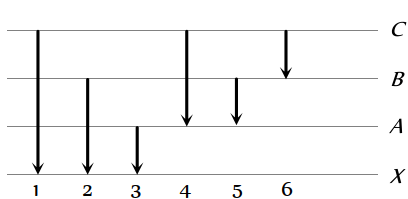
- A
(a) $1,4,6$
- B
(b) $4,5,6$
- ✓
(c) $1,2,3$
- D
(d) $1,2,3,4,5,6$
AnswerCorrect option: C. (c) $1,2,3$
(c) The absorption lines are obtained when the electron jumps from ground state $(n=1)$ to the higher energy states. Thus only 1,2 and 3 lines will be obtained.
View full question & answer→MCQ 1301 Mark
In Rutherford scattering experiment, what will be the correct angle for $\alpha$ scattering for an impact parameter $b=0$
- A
$90^{\circ}$
- B
$270^{\circ}$
- C
$0^{\circ}$
- ✓
$180^{\circ}$
AnswerCorrect option: D. $180^{\circ}$
Impact parameter $b \propto \cot \frac{\theta}{2}$
Here $b=0$, hence $\theta=180^{\circ}$
View full question & answer→MCQ 1311 Mark
Hydrogen atom emits blue light when it changes from $n=4$ energy level to the $n=2$ level. Which colour of light would the atom emit when it changes from the $n=5$ level to the $n=2$ level $21.2 \times 10^{-11} m$. What is the principal quantum number $n$ of the final state of the atom
AnswerIn the transition from orbit $5 \rightarrow 2$, more energy is liberated as compared to transition from $4 \rightarrow 2$.
View full question & answer→MCQ 1321 Mark
To explain his theory, Bohr used
- A
Conservation of linear momentum
- ✓
Conservation of angular momentum
- C
Conservation of quantum frequency
- D
AnswerCorrect option: B. Conservation of angular momentum
Bohr postulated that the angular momentum of the electron is conserved.
View full question & answer→MCQ 1331 Mark
Hydrogen atoms are excited from ground state of the principal quantum number $4.$ Then the number of spectral lines observed will be
AnswerNumber of spectral lines $\quad N_E=\frac{n(n-1)}{2}=\frac{4(4-1)}{2}=6$
View full question & answer→MCQ 1341 Mark
In a beryllium atom, if $a$ be the radius of the first orbit, then the radius of the second orbit will be in general
- A
$n a_0$
- B
$a_0$
- ✓
$n^2 a_0$
- D
$\frac{a_0}{n^2}$
AnswerCorrect option: C. $n^2 a_0$
$r \propto n^2 \Rightarrow r_n=n^2 a_0 \quad\left(\because r_1=a_0\right)$
View full question & answer→MCQ 1351 Mark
The ionisation energy of hydrogen atom is $13.6\ eV$. Following Bohr's theory, the energy corresponding to a transition between the 3 rd and the $4$ th orbit is
- A
$3.40\ eV$
- B
$1.51\ eV$
- C
$0.8\ eV$
- ✓
$0.66\ eV$
AnswerCorrect option: D. $0.66\ eV$
$ E_3=-\frac{13.6}{9}=-1.51 \mathrm{eV} ; \quad E_4=-\frac{13.6}{16}=-0.85 \mathrm{eV} $
$ \therefore E_4-E_3=0.66 \mathrm{eV}$
View full question & answer→MCQ 1361 Mark
According to Bohr's model, the radius of the second orbit of helium atom is
- A
$0.53 \mathring A$
- ✓
$1.06 \mathring A$
- C
$2.12 \mathring A$
- D
$0.265 \mathring A$
AnswerCorrect option: B. $1.06 \mathring A$
$r=\frac{n^2}{Z}\left(r_0\right) ; \Rightarrow r_{(n=2)}=\frac{(2)^2}{2} \times 0.53=1.06 \mathring A$
View full question & answer→MCQ 1371 Mark
Radius of first Bohr orbit is $r$. What is the radius of $2$ Bohr orbit?
- A
$8 r$
- B
$2 r$
- ✓
$4 r$
- D
$2 \sqrt{2 r}$
View full question & answer→MCQ 1381 Mark
An electron changes its position from orbit $n=4$ to the orbit $n=2$ of an atom. The wavelength of the emitted radiation's is ( $R=$ Rydberg's constant)
- A
$\frac{16}{R}$
- ✓
$\frac{16}{3 R}$
- C
$\frac{16}{5 R}$
- D
$\frac{16}{7 R}$
AnswerCorrect option: B. $\frac{16}{3 R}$
$\frac{1}{\lambda}=R\left[\frac{1}{n_1^2}-\frac{1}{n_2^2}\right]=R\left[\frac{1}{(2)^2}-\frac{1}{(4)^2}\right] $
$\Rightarrow \lambda=\frac{16}{3 R}$
View full question & answer→MCQ 1391 Mark
Which of the following transition will have highest emission wavelength
- A
(a) $n=2$ to $n=1$
- B
(b) $n=1$ to $n=2$
- C
(c) $n=2$ to $n=5$
- D
(d) $n=5$ to $n=2$
View full question & answer→MCQ 1401 Mark
According to classical theory, the circular path of an electron in Rutherford atom is
MCQ 1411 Mark
Which of the transitions in hydrogen atom emits a photon of lowest frequency ( $n=$ quantum number)
- A
$n=2$ to $n=1$
- ✓
$n=4$ to $n=3$
- C
$n=3$ to $n=1$
- D
$n=4$ to $n=2$
AnswerCorrect option: B. $n=4$ to $n=3$
View full question & answer→MCQ 1421 Mark
Minimum excitation potential of Bohr's first orbit in hydrogen atom is
- A
$13.6 V$
- B
$3.4 V$
- ✓
$10.2 V$
- D
$3.6 V$
AnswerCorrect option: C. $10.2 V$
$\text { Excitation potential }=\frac{\text { Excitationenergy }}{\mathrm{e}}$
Minimum excitation energy corresponds to excitation from $n=1$ to $n=2$
$\therefore$ Minimum excitation energy in hydrogen atom $=-3.4-(-13.6)=+10.2 \mathrm{eV}$
so minimum excitation potential $=10.2 \mathrm{eV}$.
View full question & answer→MCQ 1431 Mark
The wavelength of Lyman series is
- ✓
$\frac{4}{3 \times 10967} cm$
- B
$\frac{3}{4 \times 10967} cm$
- C
$\frac{4 \times 10967}{3} cm$
- D
$\frac{3}{4} \times 10967 cm$
AnswerCorrect option: A. $\frac{4}{3 \times 10967} cm$
$\frac{1}{\lambda}=R_H\left[\frac{1}{n_1^2}-\frac{1}{n_2^2}\right]$.
For Lyman series $n=1$ and $n=2,3,4$, When $n=2$, we get $\lambda=\frac{4}{3 R_H}=\frac{4}{3 \times 10967} \mathrm{~cm}$
View full question & answer→MCQ 1441 Mark
The kinetic energy of an electron revolving around a nucleus will be
MCQ 1451 Mark
The ratio of areas within the electron orbits for the first excited state to the ground state for hydrogen atom is
- ✓
$16: 1$
- B
$18: 1$
- C
$4: 1$
- D
$2: 1$
AnswerCorrect option: A. $16: 1$
$r_n \propto n^4 \Rightarrow A_n \propto n^4$
$\Rightarrow \frac{A_1}{A_0}=\left(\frac{2}{1}\right)^4=\frac{16}{1}$
View full question & answer→MCQ 1461 Mark
The diagram shows the path of four $\alpha$-particles of the same energy being scattered by the nucleus of an atom simultaneously. Which of these are/is not physically possible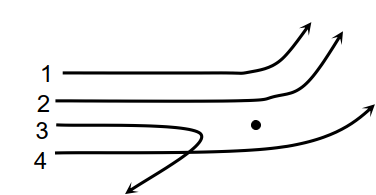
Answer(d) $\alpha$-particles cannot be attracted by the nucleus.
View full question & answer→MCQ 1471 Mark
The magnetic moment $(\mu)$ of a revolving electron around the nucleus varies with principal quantum number $n$ as
- ✓
$\mu \propto n$
- B
$\mu \propto 1 / n$
- C
$\mu \propto n^2$
- D
$\mu \propto 1 / n^2$
AnswerCorrect option: A. $\mu \propto n$
View full question & answer→MCQ 1481 Mark
The ground state energy of hydrogen atom is $-13.6 eV$. What is the potential energy of the electron in this state
- A
$0\ eV$
- ✓
$-27.2\ eV$
- C
$1\ eV$
- D
$2\ eV$
AnswerCorrect option: B. $-27.2\ eV$
P.E. $=2 \times$ Total energy $=2 \times(-13.6)=-27.2 \mathrm{eV}$
View full question & answer→MCQ 1491 Mark
In Bohr's model, the atomic radius of the first orbit is $r_0$, then the radius of the third orbit is
- A
$\frac{r_0}{9}$
- B
$r_0$
- ✓
$9 r_0$
- D
$3 r_0$
AnswerCorrect option: C. $9 r_0$
$9 r_0$
View full question & answer→MCQ 1501 Mark
The wavelength of the energy emitted when electron come from fourth orbit to second orbit in hydrogen is $20.397 cm$. The wavelength of energy for the same transition in $He ^{+}$is
- ✓
$5.099 cm ^{-1}$
- B
$20.497 cm ^{-1}$
- C
$40.994 cm ^{-1}$
- D
$81.988 cm ^{-1}$
AnswerCorrect option: A. $5.099 cm ^{-1}$
$E\left(=\frac{h c}{\lambda}\right) \propto \frac{Z^2}{n^2} \Rightarrow \lambda \propto \frac{1}{Z^2}$
Hence $\lambda_{\mathrm{He}^{+}}=\frac{20.397}{4}=5.099 \mathrm{~cm}$
View full question & answer→