Questions · Page 4 of 4

MCQ

MCQ 1511 Mark
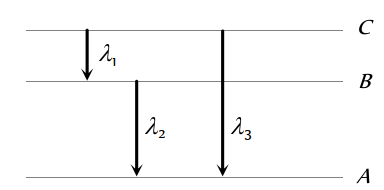
Energy levels $A, B, C$ of a certain atom corresponding to increasing values of energy i.e. $E_A<E_B<E_C$. If $\lambda_1, \lambda_2, \lambda_3$ are the wavelengths of radiations corresponding to the transitions $C$ to $B, B$ to $A$ and $C$ to $A$ respectively, which of the following statements is correct
Image
  • A
    $\lambda_3=\lambda_1+\lambda_2$
  • $\lambda_3=\frac{\lambda_1 \lambda_2}{\lambda_1+\lambda_2}$
  • C
    $\lambda_1+\lambda_2+\lambda_3=0$
  • D
    $\lambda_3^2=\lambda_1^2+\lambda_2^2$
Answer
Correct option: B.
$\lambda_3=\frac{\lambda_1 \lambda_2}{\lambda_1+\lambda_2}$
View full question & answer
MCQ 1521 Mark
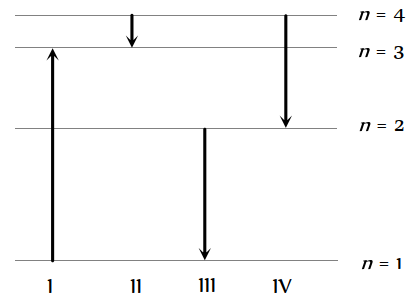
The diagram shows-the energy levels for an electron in a certain atom. Which transition shown represents the emission of a photon with the most energy

Image

  • A
    (a) 1
  • B
    (b) 11
  • (c) 111
  • D
    (d) IV
Answer
Correct option: C.
(c) 111
(c) Emitted energy $\Delta E=\frac{h c}{\lambda}\left(\frac{1}{n_1^2}-\frac{1}{n_2^2}\right)$.
View full question & answer
MCQ 1531 Mark
If the binding energy of the electron in a hydrogen atom is $13.6\ eV$, the energy required to remove the electron from the first excited state of $L i^{++}$is
  • A
    $122.4 eV$
  • $30.6 eV$
  • C
    $13.6 eV$
  • D
    $3.4 eV$
Answer
Correct option: B.
$30.6 eV$
$E_n=\frac{13.6}{n^2} \times Z^2$. For first excited state $n=2$ and for $L i^{++}, z=3 \Rightarrow E=\frac{13.6}{4} \times 9=30.6 \mathrm{eV}$
View full question & answer
MCQ 1541 Mark
In hydrogen atom, when electron jumps from second to first orbit, then energy emitted is
  • A
    $-13.6 eV$
  • B
    $-27.2 eV$
  • C
    $-6.8 eV$
  • None of these
Answer
Correct option: D.
None of these
$ E_{n_1 \rightarrow n_2}=-13.6\left[\frac{1}{n_2^2}-\frac{1}{n_1^2}\right] ; n_1=2 n_2=1$
$ \Rightarrow E_{I I} \rightarrow E_I=-13.6 \times \frac{3}{4}=-10.2 \mathrm{eV}$
View full question & answer
MCQ 1551 Mark
Rutherford's $\alpha$-particle experiment showed that the atoms have
  • A
    Proton
  • Nucleus
  • C
    Neutron
  • D
    Electrons
Answer
Correct option: B.
Nucleus
View full question & answer
MCQ 1561 Mark
When an electron in hydrogen atom is excited, from its $4^{\text {t to }} 5^*$ stationary orbit, the change in angular momentum of electron is (Planck's constant: $h=6.6 \times 10^{-34} J - s$ )
  • A
    $4.16 \times 10^{-34} J-S$
  • B
    $3.32 \times 10^{-34} J_{-S}$
  • $1.05 \times 10^{-34} J_{-S}$
  • D
    $2.08 \times 10^{-34} J_{-S}$
Answer
Correct option: C.
$1.05 \times 10^{-34} J_{-S}$
Change in the angular momentum
$ \Delta L=L_2-L_1=\frac{n_2 h}{2 \pi}-\frac{n_1 h}{2 \pi} \Rightarrow \Delta L=\frac{h}{2 \pi}\left(n_2-n_1\right)$
$ =\frac{6.6 \times 10^{-34}}{2 \times 3.14}(5-4)=1.05 \times 10^{-34} J-S$
View full question & answer
MCQ 1571 Mark
The Rutherford $\alpha$-particle experiment shows that most of the $\alpha$ particles pass through almost unscattered while some are scattered through large angles. What information does it give about the structure of the atom
  • A
    Atom is hollow
  • B
    The whole mass of the atom is concentrated in a small centre called nucleus
  • C
    Nucleus is positively charged
  • All the above
Answer
Correct option: D.
All the above
View full question & answer
MCQ 1581 Mark
Ratio of the wavelengths of first line of Lyman series and first line of Balmer series is
  • A
    $1: 3$
  • B
    $27: 5$
  • $5: 27$
  • D
    $4: 9$
Answer
Correct option: C.
$5: 27$
$\frac{1}{\lambda}=R\left(\frac{1}{n_1^2}-\frac{1}{n_2^2}\right)$
For first line of Lymen series $n=1$ and $n=2$
For first line of Balmer series $n=2$ and $n=3$
So, $\frac{\lambda_{\text {Lymen }}}{\lambda_{\text {Balmer }}}=\frac{5}{27}$
View full question & answer
MCQ 1591 Mark
The splitting of line into groups under the effect of electric or magnetic field is called
  • Zeeman's effect
  • B
    Bohr's effect
  • C
    Heisenberg's effect
  • D
    Magnetic effect
Answer
Correct option: A.
Zeeman's effect
Zeeman's effect
View full question & answer
MCQ 1601 Mark
If the energy of a hydrogen atom in $n$th orbit is $E_n$, then energy in the $n$th orbit of a singley ionized helium atom will be
  • $4 E_n$
  • B
    $E_n / 4$
  • C
    $2 E_n$
  • D
    $E_n / 2$
Answer
Correct option: A.
$4 E_n$
$E_n \propto Z^2 \Rightarrow \frac{\left(E_n\right)_{H e}}{\left(E_n\right)_H}=\frac{Z_{H e}^2}{Z_H^2}=4$
$ \Rightarrow\left(E_n\right)_{H e}=4 \times\left(E_n\right)_H$
View full question & answer
MCQ 1611 Mark
Energy of an electron in $\pi$ orbit of hydrogen atom is $\left(k=\frac{1}{4 \pi \varepsilon_0}\right)$
  • $-\frac{2 \pi^2 k^2 m e^4}{n^2 h^2}$
  • B
    $-\frac{4 \pi^2 m k e^2}{n^2 h^2}$
  • C
    $-\frac{n^2 h^2}{2 \pi k m e^4}$
  • D
    $-\frac{n^2 h^2}{4 \pi^2 k m e^2}$
Answer
Correct option: A.
$-\frac{2 \pi^2 k^2 m e^4}{n^2 h^2}$
View full question & answer
MCQ 1621 Mark
In Bohr's model of hydrogen atom, which of the following pairs of quantities are quantized [UPSEAT 2004]
  • A
    Energy and linear momentum
  • B
    Linear and angular momentum
  • Energy and angular momentum
  • D
    None of the above
Answer
Correct option: C.
Energy and angular momentum
View full question & answer
MCQ 1631 Mark
The electron in a hydrogen atom makes a transition from an excited state to the ground state. Which of the following statements is true
  • A
    Its kinetic energy increases and its potential and total energies decrease
  • B
    Its kinetic energy decreases, potential energy increases and its total energy remains the same
  • lts kinetic and total energies decrease and its potential energy increases
  • D
    Its kinetic, potential and total energies decreases
Answer
Correct option: C.
lts kinetic and total energies decrease and its potential energy increases
View full question & answer
MCQ 1641 Mark
The wavelength of radiation emitted is $\lambda_0$ when an electron jumps from the third to the second orbit of hydrogen atom. For the electron jump from the fourth to the second orbit of the hydrogen atom, the wavelength of radiation emitted will be
  • A
    $\frac{16}{25} \lambda_0$
  • $\frac{20}{27} \lambda_0$
  • C
    $\frac{27}{20} \lambda_0$
  • D
    $\frac{25}{16} \lambda_0$
Answer
Correct option: B.
$\frac{20}{27} \lambda_0$
$ \frac{1}{\lambda}=R\left[\frac{1}{n_1^2}-\frac{1}{n_2^2}\right] \Rightarrow \frac{1}{\lambda_{3 \rightarrow 2}}=R\left[\frac{1}{(2)^2}-\frac{1}{(3)^2}\right]=\frac{5 R}{36} $
$ \text { and } \frac{1}{\lambda_{4 \rightarrow 2}}=R\left[\frac{1}{(2)^2}-\frac{1}{(4)^2}\right]=\frac{3 R}{16} $
$ \therefore \frac{\lambda_{4 \rightarrow 2}}{\lambda_{3 \rightarrow 2}}=\frac{20}{27} \Rightarrow \lambda_{4 \rightarrow 2}=\frac{20}{27} \lambda_0$
View full question & answer
MCQ 1651 Mark
The radius of hydrogen atom in its ground state is $5.3 \times 10^{-11}\ m$. After collision with an electron it is found to have a radius of
  • A
    $n=4$
  • $n=2$
  • C
    $n=16$
  • D
    $n=3$
Answer
Correct option: B.
$n=2$
$ r \propto n^2 \text { i.e. } \frac{r_f}{r_i}=\left(\frac{n_f}{n_i}\right)^2 $
$ \Rightarrow \frac{21.2 \times 10^{-11}}{5.3 \times 10^{-11}}=\left(\frac{n}{1}\right)^2 \Rightarrow n^2=4 \Rightarrow n=2$
View full question & answer
MCQ 1661 Mark
According to Bohr's theory, the expressions for the kinetic and potential energy of an electron revolving in an orbit is given respectively by
  • $+\frac{e^2}{8 \pi \varepsilon_0 r}$ and $-\frac{e^2}{4 \pi \varepsilon_0 r}$
  • B
    $+\frac{8 \pi \varepsilon_0 e^2}{r}$ and $-\frac{4 \pi \varepsilon_0 e^2}{r}$
  • C
    $-\frac{e^2}{8 \pi \varepsilon_0 r}$ and $-\frac{e^2}{4 \pi \varepsilon_0 r}$
  • D
    $+\frac{e^2}{8 \pi \varepsilon_0 r}$ and $+\frac{e^2}{4 \pi \varepsilon_0 r}$
Answer
Correct option: A.
$+\frac{e^2}{8 \pi \varepsilon_0 r}$ and $-\frac{e^2}{4 \pi \varepsilon_0 r}$
P.E. $=-\frac{k e^2}{r}=-\frac{e^2}{4 \pi \varepsilon_0 r} ; \quad$ K.E. $=-\frac{1}{2}$ (P.E. $)=\frac{e^2}{8 \pi \varepsilon_0 r}$
View full question & answer
MCQ 1671 Mark
If an electron jumps from $1$st orbital to $3$ rd orbital, then it will
  • Absorb energy
  • B
    Release energy
  • C
    No gain of energy
  • D
    None of these
Answer
Correct option: A.
Absorb energy
When an electron jumps from the orbit of lower energy $(n=1)$ to the orbit of higher energy ( $n=3)$, energy is absorbed.
View full question & answer
MCQ 1681 Mark
When a hydrogen atom is raised from the ground state to an excited state [CBSE PMT 1995; AMU (Med.) 1999]
  • (a) P.E. increases and K.E. decreases
  • B
    (b) P.E. decreases and K.E. increases
  • C
    (c) Both kinetic energy and potential energy increase
  • D
    (d) Both K.E. and P.E. decrease
Answer
Correct option: A.
(a) P.E. increases and K.E. decreases
(a) P.E. $\propto-\frac{1}{r}$ and K.E. $\propto \frac{1}{r}$As $r$ increases so K.E. decreases but P.E. increases.
View full question & answer
MCQ 1691 Mark
A hydrogen atom (ionisation potential $13.6 eV$ ) makes a transition from third excited state to first excited state. The energy of the photon emitted in the process is [MNR 1995]
  • A
    $1.89 eV$
  • $2.55 eV$
  • C
    $12.09 eV$
  • D
    $12.75 eV$
Answer
Correct option: B.
$2.55 eV$
Energy released $=13.6\left[\frac{1}{(2)^2}-\frac{1}{(4)^2}\right]=2.55 \mathrm{eV}$
View full question & answer
MCQ 1701 Mark
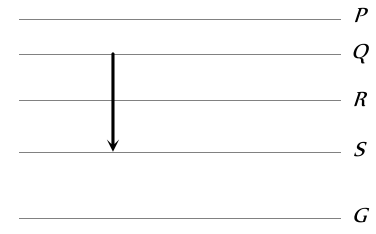
Figure shows the energy levels $P, Q, R, S$ and $G$ of an atom where $G$ is the ground state. $A$ red line in the emission spectrum of the atom can be obtained by an energy level change from $Q$ to $S$. A blue line can be obtained by following energy level change
Image
  • A
    $P$ to $Q$
  • B
    $Q$ to $R$
  • C
    $R$ to $S$
  • $R$ to $G$
Answer
Correct option: D.
$R$ to $G$
If $E$ is the energy radiated in transition then $E_{R \rightarrow G}>E_{Q \rightarrow S}>E_{R \rightarrow S}>E_{Q \rightarrow R}>E_{P \rightarrow Q}$
For getting blue line energy radiated should be maximum $\left(E \propto \frac{1}{\lambda}\right)$.
Hence (d) is the correct option.
View full question & answer
MCQ 1711 Mark
Consider an electron in the $\pi$ orbit of a hydrogen atom in the Bohr model. The circumference of the orbit can be expressed in terms of the de Broglie wavelength $\lambda$ of that electron as
  • A
    $(0.259) n \lambda$
  • B
    $\sqrt{n} \lambda$
  • C
    $(13.6) \lambda$
  • $n \lambda$
Answer
Correct option: D.
$n \lambda$
According to Bohr's theory $m v r=n \frac{h}{2 \pi}$$\Rightarrow$ Circumference $2 \pi r=n\left(\frac{h}{m v}\right)=n \lambda$
View full question & answer
MCQ 1721 Mark
An electron jumps from the $4$ orbit to the $2$ orbit of hydrogen atom. Given the Rydberg's constant $R=10^5 \ cm ^{-1}$. The frequency in $Hz$ of the emitted radiation will be
  • A
    $\frac{3}{16} \times 10^5$
  • B
    $\frac{3}{16} \times 10^{15}$
  • $\frac{9}{16} \times 10^{15}$
  • D
    $\frac{3}{4} \times 10^{15}$
Answer
Correct option: C.
$\frac{9}{16} \times 10^{15}$
$\frac{1}{\lambda}=R\left(\frac{1}{2^2}-\frac{1}{4^2}\right)=\frac{3 R}{16} $
$\Rightarrow \lambda=\frac{16}{3 R}=\frac{16}{3} \times 10^{-5} \mathrm{~cm}$
Frequency $n=\frac{c}{\lambda}=\frac{3 \times 10^{10}}{\frac{16}{3} \times 10^{-5}}=\frac{9}{16} \times 10^{15} \mathrm{~Hz}$
View full question & answer
MCQ 1731 Mark
The ionization potential for second He electron is
  • A
    $13.6 eV$
  • B
    $27.2 eV$
  • $54.4 eV$
  • D
    $100 eV$
Answer
Correct option: C.
$54.4 eV$
For the ionization of second $\mathrm{He}$ electron. $\mathrm{He}^{+}$will act as hydrogen like atom.
Hence ionization potential$=Z^2 \times 13.6 \text { volt }=(2)^2 \times 13.6=54.4 \mathrm{~V}$
View full question & answer
MCQ 1741 Mark
An electron has a mass of $9.1 \times 10^{-31} kg$. It revolves round the nucleus in a circular orbit of radius $0.529 \times 10^{-10}$ metre at a speed of $2.2 \times 10^6 m / s$. The magnitude of its linear momentum in this motion is
  • A
    $1.1 \times 10^{-34} kg - m / s$
  • $2.0 \times 10^{-24} kg - m / s$
  • C
    $4.0 \times 10^{-24} kg - m / s$
  • D
    $4.0 \times 10^{-31} kg - m / s$
Answer
Correct option: B.
$2.0 \times 10^{-24} kg - m / s$
Linear momentum $=m v=9.1 \times 10^{-31} \times 2.2 \times 10^6$
$=2.0 \times 10^{-24} \mathrm{~kg}-\mathrm{m} / \mathrm{s}$
View full question & answer
MCQ - Page 4 - JEE physics STD 12 Science Questions - Vidyadip