MCQ 2511 Mark
The resistivity of iron is $1 \times 10^{-7} \mathrm{ohm}-\mathrm{m}$. The resistance of a iron wire of particular length and thickness is $1 \ \mathrm{ohm}$. If the length and the diameter of wire both are doubled, then the resistivity in ohm $-m$ will be
- ✓
$1 \times 10^{-7}$
- B
$2 \times 10^{-7}$
- C
$4 \times 10^{-7}$
- D
$8 \times 10^{-7}$
AnswerCorrect option: A. $1 \times 10^{-7}$
$1 \times 10^{-7}$
View full question & answer→MCQ 2521 Mark
A cell of internal resistance $r$ is connected to an external resistance $R$. The current will be maximum in $R$, if
- ✓
$R=r$
- B
$R$
- C
$R>r$
- D
$R=r / 2$
View full question & answer→MCQ 2531 Mark
On increasing the temperature of a conductor, its resistance increases because
- ✓
Relaxation time decreases
- B
Mass of the electrons increases
- C
Electron density decreases
- D
AnswerCorrect option: A. Relaxation time decreases
(a) Resistance of conductor depends upon relation as $R \propto \frac{1}{\tau}$. With rise in temperature $r m s$ speed of free electron inside the conductor increase, so relaxation time decrease and hence resistance increases
View full question & answer→MCQ 2541 Mark
The figure below shows currents in a part of electric circuit. The current $i$ is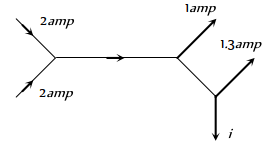
- A
$1.7 \mathrm{amp}$
- ✓
$3.7 \mathrm{amp}$
- C
$1.3 \mathrm{amp}$
- D
$1 \mathrm{amp}$
AnswerCorrect option: B. $3.7 \mathrm{amp}$
(b) In parallel, $x=\frac{R}{n} \quad R=n x$ In series, $R+R+R \ldots . n$ times $=n R=n(n x)=n x$
View full question & answer→MCQ 2551 Mark
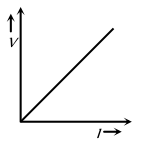
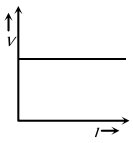
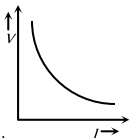
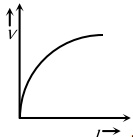
Which of the adjoining graphs represents ohmic resistance
Answer(a) For ohmic resistance $V \propto i \Rightarrow V=R i$ (here $R$ is constant)
View full question & answer→MCQ 2561 Mark
Drift velocity $v_d$ varies with the intensity of electric field as per the relation
AnswerCorrect option: A. $v_d \propto E$
$\left.v_d=\frac{e}{m} \times \frac{V}{l} \tau \text { or } v_d=\frac{e}{m} \cdot \frac{E l}{l} \tau \text { (Since } V=E l\right) $
$ \therefore v_d \propto E$
View full question & answer→MCQ 2571 Mark
A primary cell has an e.m.f. of 1.5 volts, when short-circuited it gives a current of 3 amperes. The internal resistance of the cell is
- A
$4.5 \mathrm{ohm}$
- B
$2 \mathrm{ohm}$
- ✓
$0.5 \mathrm{ohm}$
- D
$1 / 4.5 \mathrm{ohm}$
AnswerCorrect option: C. $0.5 \mathrm{ohm}$
(c) If resistances are $R_1$ and $R_2$ then $\frac{R_1 R_2}{R_1+R_2}=\frac{6}{8}$Suppose $R_2$ is broken then $R_1=2 \Omega$On solving equations (i) and (ii) we get $R_2=6 / 5 \Omega$
View full question & answer→MCQ 2581 Mark
A piece of wire of resistance $4 \mathrm{ohms}$ is bent through $180^{\circ}$ at its mid point and the two halves are twisted together, then the resistance is
- A
$8 \mathrm{ohms}$
- ✓
$1 \mathrm{ohm}$
- C
$2$ ohms
- D
$5$ ohms
AnswerCorrect option: B. $1 \mathrm{ohm}$
(b) In twisted wire, two halves each of resistance $2 \Omega$ are in parallel, so equivalent resistance will be $\frac{2}{2}=1 \Omega$.
View full question & answer→MCQ 2591 Mark
The electric resistance of a certain wire of iron is $R$. If its length and radius are both doubled, then
- A
The resistance will be doubled and the specific resistance will be halved
- ✓
The resistance will be halved and the specific resistance will remain unchanged
- C
The resistance will be halved and the specific resistance will be doubled
- D
The resistance and the specific resistance, will both remain unchanged
AnswerCorrect option: B. The resistance will be halved and the specific resistance will remain unchanged
The resistance will be halved and the specific resistance will remain unchanged
View full question & answer→MCQ 2601 Mark
A galvanometer of $50 \mathrm{ohm}$ resistance has 25 divisions. A current of $4 \times 10$ ampere gives a deflection of one division. To convert this galvanometer into a voltmeter having a range of 25 volts, it should be connected with a resistance of
- A
$2500 \Omega$ as a shunt
- B
$2450 \Omega$ as a shunt
- C
$2550 \Omega$ in series
- ✓
$2450 \Omega$ in series
AnswerCorrect option: D. $2450 \Omega$ in series
(d) Full deflection current $i_g=25 \times 4 \times 10^{-4}=100 \times 10^{-4} \mathrm{~A}$ Using $R=\frac{V}{I_g}-G=\frac{25}{100 \times 10^{-4}}-50=2450 \Omega$ in series.
View full question & answer→MCQ 2611 Mark
The resistance of a conductor increases with
- A
- B
- C
Decrease in cross-sectional area
- ✓
View full question & answer→MCQ 2621 Mark
To convert a $800 \mathrm{mV}$ range milli voltmeter of resistance $40 \Omega$ into a galvanometer of $100 \mathrm{~mA}$ range, the resistance to be connected as shunt is
- ✓
$10 \Omega$
- B
$20 \Omega$
- C
$30 \Omega$
- D
$40 \Omega$
AnswerCorrect option: A. $10 \Omega$
(a) $\frac{i}{i_g} 1 \frac{G}{S} \quad \frac{i . G}{V_g} \quad 1 \frac{G}{S} \quad \frac{10010^3 40}{80010^3} 1 \frac{40}{S}$ $S \ 10\Omega$.
View full question & answer→MCQ 2631 Mark
To convert a galvanometer into a voltmeter, one should connect a
- ✓
High resistance in series with galvanometer
- B
Low resistance in series with galvanometer
- C
High resistance in parallel with galvanometer
- D
Low resistance in parallel with galvanometer
AnswerCorrect option: A. High resistance in series with galvanometer
View full question & answer→MCQ 2641 Mark
What length of the wire of specific resistance $48 \times 10^{-8} \Omega \mathrm{m}$ is needed to make a resistance of $4.2 \Omega$ (diameter of wire $=0.4$ $\mathrm{mm})$
- A
$4.1 \mathrm{~m}$
- B
$3.1 \mathrm{~m}$
- C
$2.1 \mathrm{~m}$
- ✓
$1.1 \mathrm{~m}$
AnswerCorrect option: D. $1.1 \mathrm{~m}$
(d) $l=\frac{R \pi r^2}{\rho}=\frac{4.2 \times 3.14 \times\left(0.2 \times 10^{-3}\right)^2}{48 \times 10^{-8}}=1.1 \mathrm{~m}$
View full question & answer→MCQ 2651 Mark
The internal resistance of a cell of e.m.f. $12 V$ is $5 \times 10^{-2} \Omega$. It is connected across an unknown resistance. Voltage across the cell, when a current of $60 \mathrm{~A}$ is drawn from it, is
- A
$15 \mathrm{~V}$
- B
$12 \mathrm{~V}$
- C
$9 \mathrm{~V}$
- D
$6 \mathrm{~V}$
View full question & answer→MCQ 2661 Mark
In a meter bridge, the balancing length from the left end (standard resistance of one ohm is in the right gap) is found to be $20 \mathrm{~cm}$. The value of the unknown resistance is
- A
$0.8 \Omega$
- B
$0.5 \Omega$
- C
$0.4 \Omega$
- ✓
$0.25 \Omega$
AnswerCorrect option: D. $0.25 \Omega$
(d) $\frac{X}{1}=\frac{20}{80} \Rightarrow X=\frac{1}{4} \Omega=0.25 \Omega$.
View full question & answer→MCQ 2671 Mark
A potentiometer consists of a wire of length $4 \mathrm{~m}$ and resistance $10 \Omega$. It is connected to a cell of e.m.f. $2 \mathrm{~V}$. The potential difference per unit length of the wire will be
- ✓
$0.5 \mathrm{~V} / \mathrm{m}$
- B
$2 \mathrm{~V} / \mathrm{m}$
- C
$5 \mathrm{~V} / \mathrm{m}$
- D
$10 \mathrm{~V} / \mathrm{m}$
AnswerCorrect option: A. $0.5 \mathrm{~V} / \mathrm{m}$
(a) Since potential difference for full length of wire $=2 \mathrm{~V}$$\therefore$ P.D. per unit length of wire $=\frac{2}{4}=0.5 \frac{\mathrm{V}}{\mathrm{m}}$
View full question & answer→MCQ 2681 Mark
A galvanometer having a resistance of $8 \mathrm{ohm}$ is shunted by a wire of resistance $2 \mathrm{ohm}$. If the total current is $1 \mathrm{amp}$, the part of it passing through the shunt will be
- A
$0.25 \mathrm{amp}$
- ✓
$0.8 \mathrm{amp}$
- C
$0.2 \mathrm{amp}$
- D
$0.5 \mathrm{amp}$
AnswerCorrect option: B. $0.8 \mathrm{amp}$
$ i_g S=\left(i-i_g\right) G \Rightarrow i_g(S+G)=i G $
$ \Rightarrow \frac{i_g}{i}=\frac{G}{S+G}=\frac{8}{2+8}=0.8$
View full question & answer→MCQ 2691 Mark
Kirchhoffs first law i.e. $\sum i=0$ at a junction is based on the law of conservation of
View full question & answer→MCQ 2701 Mark
From the graph between current $I$ and voltage $V$ shown below, identify the portion corresponding to negative resistance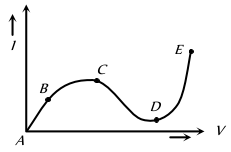
- A
$A B$
- B
$B C$
- ✓
$C D$
- D
$D E$
Answer(c) For portion $C D$ slope of the curve is negative i.e. resistance be negative.
View full question & answer→MCQ 2711 Mark
When the key $K$ is pressed at time $t=0$, which of the following statements about the current $l$ in the resistor $A B$ of the given circuit is true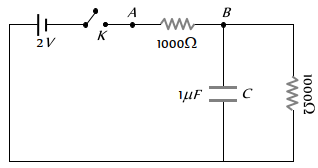
- A
$I=2 \mathrm{~mA}$ at all $t$
- B
I oscillates between $1 \mathrm{~mA}$ and $2 \mathrm{~mA}$
- C
$I=1 \mathrm{~mA}$ at all $t$
- ✓
At $t=0, l=2 \mathrm{~mA}$ and with time it goes to $1 \mathrm{~mA}$
AnswerCorrect option: D. At $t=0, l=2 \mathrm{~mA}$ and with time it goes to $1 \mathrm{~mA}$
(d) At time $t=0$ i.e. when capacitor is charging, current$i=\frac{2}{1000}=2 m A$When capacitor is full charged, no current will pass through it, hence current through the circuit $i=\frac{2}{2000}=1 \mathrm{~mA}$
View full question & answer→MCQ 2721 Mark
Kirchoff's 1 law and Il law of current, proves the
- A
Conservation of charge and energy
- B
Conservation of current and energy
- ✓
Conservation of mass and charge
- D
AnswerCorrect option: C. Conservation of mass and charge
(c) The voltmeter is assumed to have infinite resistance. Hence $(1+$ $2+1)+4=8 \Omega$.
View full question & answer→MCQ 2731 Mark
An ionization chamber with parallel conducting plates as anode and cathode has $5 \times 10^7$ electrons and the same number of singlycharged positive ions per $\mathrm{cm}^3$. The electrons are moving at $0.4 \mathrm{~m} / \mathrm{s}$. The current density from anode to cathode is $4 \mu \mathrm{A} / \mathrm{m}^2$. The velocity of positive ions moving towards cathode is
- A
$0.4 \mathrm{~m} / \mathrm{s}$
- B
$16 \mathrm{~m} / \mathrm{s}$
- C
- ✓
$0.1 \mathrm{~m} / \mathrm{s}$
AnswerCorrect option: D. $0.1 \mathrm{~m} / \mathrm{s}$
Current density of drifting electrons $j=n e v$
$ n=5 \times 10^7 \mathrm{~cm}^{-3}=5 \times 10^7 \times 10^6 \mathrm{~m}^{-3} .$
$ v=0.4 \mathrm{~ms}^{-1}, e=1.6 \times 10^{-19} \mathrm{C} \Rightarrow j=3.2 \times 10^{-6} \mathrm{Am}^{-2}$
Current density of ions $=(4-3.2) \times 10^{\circ}=0.8 \times 10^{-6} \frac{A}{\mathrm{~m}^2}$
This gives $v$ for ions $=0.1 m s$.
View full question & answer→MCQ 2741 Mark
You are given several identical resistances each of value $R=10 \Omega$ and each capable of carrying maximum current of $1$ ampere. lt is required to make a suitable combination of these resistances to produce a resistance of $5 \Omega$ which can carry a current of $4$ amperes. The minimum number of resistances of the type $R$ that will be required for this job
AnswerSuppose $n$ resistors are used for the required job. Suppose equivalent resistance of the combination is $R$ and according to energy conservation it's current rating is $i$.
Energy consumed by the combination $=n \times($ Energy consumed by each resistance)$\Rightarrow i^2 R^{\prime}=n \times i^2 R$
$ \Rightarrow n=\left(\frac{i^{\prime}}{i}\right)^2 \times\left(\frac{R^{\prime}}{R}\right)=\left(\frac{4}{1}\right)^2 \times\left(\frac{5}{10}\right)=8$
View full question & answer→MCQ 2751 Mark
A cell of e.m.f. $1.5 \mathrm{~V}$ having a finite internal resistance is connected to a load resistance of $2 \Omega$. For maximum power transfer the internal resistance of the cell should be
- A
$4 \mathrm{ohm}$
- B
$0.5 \mathrm{ohm}$
- C
$2 \mathrm{ohm}$
- D
AnswerEach part will have a resistance $r=R / 10$Let equivalent resistance be $r_R$, then
$ \frac{1}{r_R}=\frac{1}{r}+\frac{1}{r}+\frac{1}{r} \ldots \ldots \ldots . .10 \text { times }$
$ \therefore \frac{1}{r_R}=\frac{10}{r}=\frac{10}{R / 10}=\frac{100}{R} \Rightarrow r_R=\frac{R}{100}=0.01 R$
View full question & answer→MCQ 2761 Mark
A galvanometer whose resistance is $120 \Omega$ gives full scale deflection with a current of $0.05 A$ so that it can read a maximum current of $10 \mathrm{~A}$. A shunt resistance is added in parallel with it. The resistance of the ammeter so formed is
- A
$0.06 \Omega$
- B
$0.006 \Omega$
- ✓
$0.6 \Omega$
- D
$6 \Omega \mathrm{s}$
AnswerCorrect option: C. $0.6 \Omega$
(c) Resistance of shunted ammeter $=\frac{G S}{G+S}$Also $\frac{i}{i_g}=1+\frac{G}{S} \Rightarrow \frac{G S}{G+S}=\frac{i_g \cdot G}{i}$$\Rightarrow \frac{G S}{G+S}=\frac{0.05 \times 120}{10}=0.6 \Omega$
View full question & answer→MCQ 2771 Mark
A wire of radius $r$ has resistance $R$. If it is stretched to a radius of $\frac{3 r}{4}$, its resistance becomes
- A
$\frac{9 R}{16}$
- B
$\frac{16 R}{9}$
- C
$\frac{81 R}{256}$
- ✓
$\frac{256 R}{81}$
AnswerCorrect option: D. $\frac{256 R}{81}$
(d) $\frac{R_1}{R_2}=\left(\frac{r_2}{r_1}\right)^4 \Rightarrow \frac{R}{R_2}=\left(\frac{3 r / 4}{r}\right)^4=\frac{81}{256}=R_2=\frac{256}{81} R$
View full question & answer→MCQ 2781 Mark
The drift velocity of free electrons in a conductor is ' $v$ ' when a current $" i$ is flowing in it. If both the radius and current are doubled, then drift velocity will be
- A
$v$
- ✓
$\frac{v}{2}$
- C
$\frac{v}{4}$
- D
$\frac{v}{8}$
AnswerCorrect option: B. $\frac{v}{2}$
(b) $v_d=\frac{i}{n e \pi r^2} \Rightarrow v_d \propto \frac{i}{r^2} \Rightarrow \frac{v}{v^{\prime}}=\frac{i_1}{i_2} \times\left(\frac{r_2}{r_1}\right)^2 \Rightarrow v^{\prime}=\frac{v}{2}$.
View full question & answer→MCQ 2791 Mark
The drift velocity does not depend upon
- A
Cross-section of the wire
- ✓
- C
- D
View full question & answer→MCQ 2801 Mark
If an ammeter is connected in parallel to a circuit, it is likely to be damaged due to excess
Answer(a) When ammeter is connected in parallel to the circuit, net resistance of the circuit decreases. Hence more current is drawn from the battery, which damages the ammeter.
View full question & answer→MCQ 2811 Mark
The internal resistance of a cell is the resistance of
- A
- B
- ✓
Electrolyte used in the cell
- D
Material used in the cell
AnswerCorrect option: C. Electrolyte used in the cell
(c) Resistances at $C$ and $B$ are not in the circuit. Use laws of resistances in series and parallel excluding the two resistance.
View full question & answer→MCQ 2821 Mark
Which of the following is correct
- ✓
Ammeter has low resistance and is connected in series
- B
Ammeter has low resistance and is connected in parallel
- C
Voltmeter has low resistance and is connected in parallel
- D
AnswerCorrect option: A. Ammeter has low resistance and is connected in series
View full question & answer→MCQ 2831 Mark
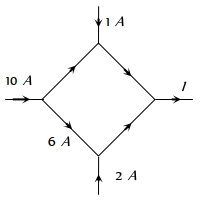
The figure shows a network of currents. The magnitude of currents is shown here. The current / will be
- A
$3 A$
- B
$9 \mathrm{~A}$
- ✓
$13 \mathrm{~A}$
- D
$19 \mathrm{~A}$
AnswerCorrect option: C. $13 \mathrm{~A}$
(c) On applying Kirchoff's current law $i=13 \mathrm{~A}$.
View full question & answer→MCQ 2841 Mark
If resistance of voltmeter is $10000 \Omega$ and resistance of ammeter is $2 \Omega$ then find $R$ when voltmeter reads $12 V$ and ammeter reads $0.1 \mathrm{~A}$
- ✓
$118 \Omega$
- B
$120 \Omega$
- C
$124 \Omega$
- D
$114 \Omega$
AnswerCorrect option: A. $118 \Omega$
View full question & answer→MCQ 2851 Mark
A galvanometer of resistance $36 \Omega$ is changed into an ammeter by using a shunt of $4 \Omega$. The fraction $f$ of total current passing through the galvanometer is
- A
$\frac{1}{40}$
- B
$\frac{1}{4}$
- C
$\frac{1}{140}$
- ✓
$\frac{1}{10}$
AnswerCorrect option: D. $\frac{1}{10}$
(d) $\frac{i_g}{i}=\frac{S}{G+S}=\frac{4}{36+4}=\frac{4}{40}=\frac{1}{10}$
View full question & answer→MCQ 2861 Mark
The emf of a battery is $2 V$ and its internal resistance is $0.5 \Omega$. The maximum power which it can deliver to any external circuit will be
Answer(d) Resistance across the battery is$\frac{1}{R_p}=\frac{1}{3}+\frac{1}{6}=\frac{2+1}{6}=\frac{3}{6} \Rightarrow R_p=2 \Omega \Rightarrow I=\frac{2}{2}=1 \mathrm{~A}$
View full question & answer→MCQ 2871 Mark
A copper wire has a square cross-section, $2.0 \mathrm{~mm}$ on a side. It carries a current of $8 A$ and the density of free electrons is $8 \times 10^{28} \mathrm{~m}^{-3}$. The drift speed of electrons is equal to
- ✓
$0.156 \times 10^{-3} \mathrm{m/s}$
- B
$0.156 \times 10^{-2} \mathrm{~m} /\mathrm{s}$
- C
$3.12 \times 10^{-3} \mathrm{m/s}$
- D
$3.12 \times 10^{-2} \mathrm{~m} / \mathrm{s}$
AnswerCorrect option: A. $0.156 \times 10^{-3} \mathrm{m/s}$
$ v_d=\frac{i}{n A e}=\frac{8}{8 \times 10^{28} \times\left(2 \times 10^{-3}\right)^2 \times 1.6 \times 10^{-19}} $
$ =0.156 \times 10^{-3} \mathrm{~m} / \mathrm{sec} .$
View full question & answer→MCQ 2881 Mark
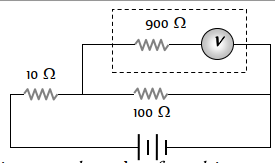
The potential difference across the $100 \Omega$ resistance in the following circuit is measured by a voltmeter of $900 \Omega$ resistance. The percentage error made in reading the potential difference is
- A
$\frac{10}{9}$
- B
$0.1$
- ✓
$1$
- D
$10$
View full question & answer→MCQ 2891 Mark
The equivalent resistance between the points $P$ and $Q$ in the network given here is equal to (given $r=\frac{3}{2} \Omega$ )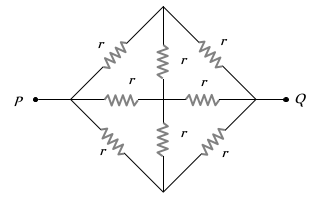
- A
$\frac{1}{2} \Omega$
- ✓
$1 \Omega$
- C
$\frac{3}{2} \Omega$
- D
$2 \Omega$
AnswerCorrect option: B. $1 \Omega$
View full question & answer→MCQ 2901 Mark
In the circuit element given here, if the potential at point $B, V=0$, then the potentials of $A$ and $D$ are given as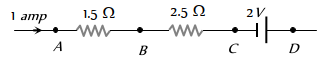
- A
$V_A=-1.5 V, V_D=+2 V$
- B
$V_A=+1.5 \mathrm{~V}, V_D=+2 \mathrm{~V}$
- C
$V_A=+1.5 \mathrm{~V}, V_D=+0.5 \mathrm{~V}$
- ✓
$V_A=+1.5 \mathrm{~V}, V_D=-0.5 \mathrm{~V}$
AnswerCorrect option: D. $V_A=+1.5 \mathrm{~V}, V_D=-0.5 \mathrm{~V}$
(d) Potential difference between $A$ and $B$
$ V_A-V_B=1 \times 1.5 $
$ \Rightarrow V_A-0=1.5 \mathrm{~V} \Rightarrow V_A=1.5 \mathrm{~V}$
Potential difference between $B$ and $C$
$ V_B-V_C=1 \times 2.5=2.5 \mathrm{~V} $
$ \Rightarrow 0-V_C=2.5 \mathrm{~V} \Rightarrow V_C=-2.5 \mathrm{~V}$
Potential difference between $C$ and $D$
$V_C-V_D=-2 V$
$ \Rightarrow-2.5-V_D=-2 \Rightarrow V_D=-0.5 V$
View full question & answer→MCQ 2911 Mark
The charge of an electron is $1.6 \times 10^{-3}C$. How many electrons strike the screen of a cathode ray tube each second when the beam current is $16 \mathrm{~mA}$
- ✓
$10^{17}$
- B
$10^{-16}$
- C
$10^{5}$
- D
$10^{-9}$
AnswerCorrect option: A. $10^{17}$
$i=\frac{n e}{t} \Rightarrow 16 \times 10^{-3}=\frac{n \times 1.6 \times 10^{-19}}{1} \Rightarrow n=10^{17}$
View full question & answer→MCQ 2921 Mark
A potentiometer having the potential gradient of $2\ \mathrm{mV} / \mathrm{cm}$ is used to measure the difference of potential across a resistance of $10\ \mathrm{ohm}$. If a length of $50 \mathrm{~cm}$ of the potentiometer wire is required to get the null point, the current passing through the $10\ \mathrm{ohm}$ resistor is (in $m A)$
Answer$ V=x l \Rightarrow i R=x l $
$ \Rightarrow i \times 10=\left(\frac{2 \times 10^{-3}}{10^{-2}}\right) \times 50 \times10^{-2}=0.1$
$ \Rightarrow i=10 \times 10^{-3} \mathrm{~A}=10 \mathrm{~mA} .$
View full question & answer→MCQ 2931 Mark
What is the equivalent resistance between the points $A$ and $B$ of the network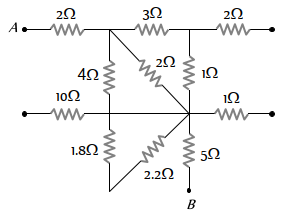
- A
$\frac{57}{7} \Omega$
- ✓
$8 \Omega$
- C
$6 \Omega$
- D
$\frac{57}{5} \Omega$
AnswerCorrect option: B. $8 \Omega$
View full question & answer→MCQ 2941 Mark
In the circuit shown, a meter bridge is in its balanced state. The meter bridge wire has a resistance $0.1 \mathrm{ohm} / \mathrm{cm}$. The value of unknown resistance $X$ and the current drawn from the battery of negligible resistance is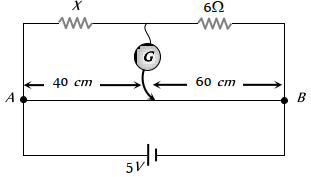
- A
$6 \Omega, 5 \mathrm{amp}$
- B
$10 \Omega, 0.1 \mathrm{amp}$
- ✓
$4 \Omega, 1.0 \mathrm{amp}$
- D
$12 \Omega, 0.5 \mathrm{amp}$
AnswerCorrect option: C. $4 \Omega, 1.0 \mathrm{amp}$
View full question & answer→MCQ 2951 Mark
Eels are able to generate current with biological cells called electroplaques. The electroplaques in an eel are arranged in 100 rows, each row stretching horizontally along the body of the fish containing 5000 electroplaques. The arrangement is suggestively shown below. Each electroplaques has an emf of $0.15 \mathrm{~V}$ and internal resistance of $0.25 \Omega$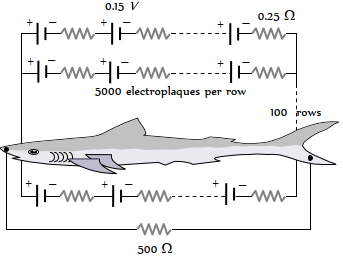
The water surrounding the eel completes a circuit between the head and its tail. If the water surrounding it has a resistance of $500 \Omega$ the current an eel can produce in water is about
- A
$1.5 \mathrm{~A}$
- ✓
$3.0 \mathrm{~A}$
- C
$15 \mathrm{~A}$
- D
$30 \mathrm{~A}$
AnswerCorrect option: B. $3.0 \mathrm{~A}$
(b) $\quad R_{A B}=R_1+\frac{R_2 R_3}{R_2+R_3}+R_4=2+\frac{4 \times 4}{4+4}+2=6 \Omega$.
View full question & answer→MCQ 2961 Mark
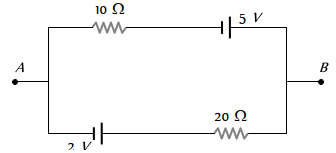
The current in the given circuit is
- A
$0.1 \mathrm{~A}$
- B
$0.2 \mathrm{~A}$
- ✓
$0.3 \mathrm{~A}$
- D
$0.4 \mathrm{~A}$
AnswerCorrect option: C. $0.3 \mathrm{~A}$
View full question & answer→MCQ 2971 Mark
In the shown circuit, what is the potential difference across $A$ and $B$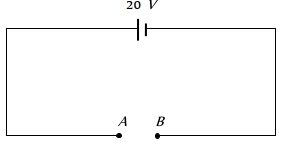
- A
$50 \mathrm{~V}$
- ✓
$45 \mathrm{~V}$
- C
$30 \mathrm{~V}$
- D
$20 \mathrm{~V}$
AnswerCorrect option: B. $45 \mathrm{~V}$
(b) If all are in series then $R_{e q}=12 \Omega$If all are in parallel then $R_{e q}=\frac{4}{3} \Omega=1.33 \Omega$If two are in series then parallel with third, $R_{e q}=\frac{8}{3}=2.6 \Omega$If two are in parallel then series with third, $R_{e q}=6 \Omega$
View full question & answer→MCQ 2981 Mark
A 2 volt battery, a $15 \Omega$ resistor and a potentiometer of $100 \mathrm{~cm}$ length, all are connected in series. If the resistance of potentiometer wire is $5 \Omega$, then the potential gradient of the potentiometer wire is
AnswerCorrect option: A. $0.005 V / \mathrm{cm}$
$ \text { Potential gradient }=\frac{e}{\left(R+R_h+r\right)} \cdot \frac{R}{L} $
$=\frac{2}{(15+5+0)} \times \frac{5}{1}=0.5 \frac{\mathrm{V}}{\mathrm{m}}=0.005 \frac{\mathrm{V}}{\mathrm{cm}}$
View full question & answer→MCQ 2991 Mark
An energy source will supply a constant current into the load if its internal resistance is
- A
- B
Non-zero but less than the resistance of the load
- C
Equal to the resistance of the load
- ✓
Very large as compared to the load resistance
AnswerCorrect option: D. Very large as compared to the load resistance
View full question & answer→MCQ 3001 Mark
Two sources of equal $\mathrm{emf}$ are connected to an external resistance $R$ The internal resistances of the two sources are $R_1$ and $R_2\left(R_2>R_1\right)$. If the potential difference across the source having internal resistance $R_2$ is zero, then
- A
$\quad R=R_1 R_2 /\left(R_1+R_2\right)$
- B
$\quad R=R_1 R_2 /\left(R_2-R_1\right)$
- C
$\quad R=R_2 \times\left(R_1+R_2\right) /\left(R_2-R_1\right)$
- ✓
$\quad R=R_2-R_1$
AnswerCorrect option: D. $\quad R=R_2-R_1$
View full question & answer→