MCQ 2011 Mark
An ammeter whose resistance is $180 \Omega$ gives full scale deflection when current is $2 \mathrm{~mA}$. The shunt required to convert it into an ammeter reading $20 \mathrm{~mA}$ (in ohms) is
AnswerGiven $i_g=2 \mathrm{~mA}, i=20 \mathrm{~mA}, G=180 \Omega$
$\frac{i_g}{i}=\frac{S}{G+S} \Rightarrow 180+S=10 S \Rightarrow S=\frac{180}{9}=20 \Omega$
View full question & answer→MCQ 2021 Mark
A galvanometer, having a resistance of $50 \Omega$ gives a full scale deflection for a current of $0.05 A$. The length in meter of a resistance wire of area of cross-section $2.97 \times 10 \mathrm{~cm}$ that can be used to convert the galvanometer into an ammeter which can read a maximum of $5 \mathrm{~A}$ current is (Specific resistance of the wire $=5 \times 10^{-7} \Omega \mathrm{m}$ )
Answer$ \frac{i}{i_g}=1+\frac{G}{S} \Rightarrow \frac{5}{0.05}=1+\frac{50}{S} $
$ \Rightarrow S=\frac{50}{99}=\frac{\rho \times l}{A} \Rightarrow l=\frac{50}{99} \times \frac{2.97 \times 10^{-2} \times 10^{-4}}{5 \times 10^{-7}}=3 \mathrm{~m}$
View full question & answer→MCQ 2031 Mark
A nichrome wire $50 \mathrm{~cm}$ long and one square millimetre crosssection carries a current of $4 \mathrm{~A}$ when connected to a $2 \mathrm{~V}$ battery. The resistivity of nichrome wire in ohm metre is
- ✓
$1 \times 10^{-6}$
- B
$4 \times 10^{-7}$
- C
$3 \times 10^{-7}$
- D
$2 \times 10^{-7}$
AnswerCorrect option: A. $1 \times 10^{-6}$
(a) $R=\frac{V}{i}=\rho \frac{l}{A} \Rightarrow \frac{2}{4}=\rho \frac{50 \times 10^{-2}}{\left(1 \times 10^{-3}\right)^2} \Rightarrow \rho=1 \times 10^{-6} \Omega m$.
View full question & answer→MCQ 2041 Mark
An ammeter and a voltmeter of resistance $R$ are connected in series to an electric cell of negligible internal resistance. Their readings are $A$ and $V$ respectively. If another resistance $R$ is connected in parallel with the voltmeter
- A
Both $A$ and $V$ will increase
- B
Both $A$ and $V$ will decrease
- C
$A$ will decrease and $V$ will increase
- ✓
$A$ will increase and $V$ will decrease
AnswerCorrect option: D. $A$ will increase and $V$ will decrease
(d) After connecting a resistance $R$ in parallel with voltmeter its effective resistance decreases. Hence less voltage appears across it i.e. $V$ will decreases. Since overall resistance decreases so more current will flow i.e. $A$ will increase.
View full question & answer→MCQ 2051 Mark
If an electron revolves in the path of a circle of radius of $0.5 \times 10$ $\mathrm{m}$ at frequency of $5 \times 10^{-} \mathrm{cycles} / \mathrm{s}$ the electric current in the circle is (Charge of an electron $=1.6 \times 10^{-19} C$ )
- A
$0.4 \mathrm{~mA}$
- ✓
$0.8 \mathrm{~mA}$
- C
$1.2 \mathrm{~mA}$
- D
$1.6 \mathrm{~mA}$
AnswerCorrect option: B. $0.8 \mathrm{~mA}$
(b) $i=\frac{Q}{T}=Q v=1.6 \times 10^{-19} \times 5 \times 10^{15}=0.8 \mathrm{~mA}$.
View full question & answer→MCQ 2061 Mark
Resistance of tungsten wire at $150^{\circ} \mathrm{C}$ is $133 \Omega$. Its resistance temperature coefficient is $0.0045 /{ }^{\circ} \mathrm{C}$. The resistance of this wire at $500^{\circ} \mathrm{C}$ will be
- A
$180 \Omega$
- B
$225 \Omega$
- ✓
$258 \Omega$
- D
$317 \Omega$
AnswerCorrect option: C. $258 \Omega$
(c) $\frac{R_{150}}{R_{500}}=\frac{[1+\alpha(150)]}{[1+\alpha(500)]}$. Putting $R_{150}=133 \Omega$ and $\alpha=0.0045 /{ }^{\circ} C$, we get $R_{500}=258 \Omega$
View full question & answer→MCQ 2071 Mark
When the resistance of $9 \Omega$ is connected at the ends of a battery, its potential difference decreases from $40 \mathrm{volt}$ to $30 \mathrm{volt}$. The internal resistance of the battery is
- A
$6 \Omega$
- ✓
$3 \Omega$
- C
$9 \Omega$
- D
$15 \Omega$
AnswerCorrect option: B. $3 \Omega$
(b) The internal resistance of battery is given by$r=\left(\frac{E}{V}-1\right) R=\left(\frac{40}{30}-1\right) \times 9=\frac{9 \times 10}{30}=3 \Omega$
View full question & answer→MCQ 2081 Mark
The relaxation time in conductors
AnswerCorrect option: B. Decreases with the increase of temperature
(b) Because as temperature increases, the resistivity increases and hence the relaxation time decreases for conductors $\left(\tau \propto \frac{1}{\rho}\right)$.
View full question & answer→MCQ 2091 Mark
$n$ identical cells each of e.m.f. $E$ and internal resistance $r$ are connected in series. An external resistance $R$ is connected in series to this combination. The current through $R$ is
- A
$\frac{n E}{R+n r}$
- B
$\frac{n E}{n R+r}$
- ✓
$\frac{E}{R+n r}$
- D
$\frac{n E}{R+r}$
AnswerCorrect option: C. $\frac{E}{R+n r}$
$\frac{E}{R+n r}$
View full question & answer→MCQ 2101 Mark
The electric intensity $E$, current density $j$ and specific resistance $k$ are related to each other by the relation
- A
$E=j / k$
- ✓
$E=j k$
- C
$E=k / j$
- D
$k=j E$
AnswerCorrect option: B. $E=j k$
(b) Specific resistance $k=\frac{E}{j}$
View full question & answer→MCQ 2111 Mark
To get the maximum current from a parallel combination of $n$ identical cells each of internal resistance $r$ in an external resistance $R$, when
View full question & answer→MCQ 2121 Mark
In Wheatstone's bridge $P=9 \mathrm{ohm}, Q=11 \mathrm{ohm}, R=4 \mathrm{ohm}$ and $S=6 \mathrm{ohm}$. How much resistance must be put in parallel to the resistance $S$ to balance the bridge
AnswerCorrect option: C. $26.4 \mathrm{ohm}$
View full question & answer→MCQ 2131 Mark
Potentiometer wire of length $1 \mathrm{~m}$ is connected in series with $490 \Omega$ resistance and $2 \mathrm{~V}$ battery. If $0.2 \mathrm{mV} / \mathrm{cm}$ is the potential gradient, then resistance of the potentiometer wire is
- ✓
$4.9 \Omega$
- B
$7.9 \Omega$
- C
$5.9 \Omega$
- D
$6.9 \Omega$
AnswerCorrect option: A. $4.9 \Omega$
(a) Potential gradient $x=\frac{e}{\left(R+R_h+r\right)} \cdot \frac{R}{L}$$\Rightarrow \frac{0.2 \times 10^{-3}}{10^{-2}}=\frac{2}{(R+490+0)} \times \frac{R}{1}\Rightarrow R=4.9 \Omega .$
View full question & answer→MCQ 2141 Mark
The colour sequence in a carbon resistor is red, brown, orange and silver. The resistance of the resistor is
- ✓
$21 \times 10^3 \pm 10 \%$
- B
$23 \times 10^4 \pm 10$
- C
$21 \times 10^5 \pm 5 \%$
- D
$12 \times 10^6 \pm 5 \%$
AnswerCorrect option: A. $21 \times 10^3 \pm 10 \%$
View full question & answer→MCQ 2151 Mark
In a potentiometer experiment the balancing with a cell is at length $240 \mathrm{~cm}$. On shunting the cell with a resistance of $2 \Omega$, the balancing length becomes $120 \mathrm{~cm}$. The internal resistance of the cell is
- A
$4 \Omega$
- ✓
$2 \Omega$
- C
$1 \Omega$
- D
$0.5 \Omega$
AnswerCorrect option: B. $2 \Omega$
(b) $r=R\left(\frac{l_1}{l_2}-1\right)=2\left(\frac{240}{120}-1\right)=2 \Omega$
View full question & answer→MCQ 2161 Mark
The maximum power drawn out of the cell from a source is given by (where $r$ is internal resistance)
- A
$E^2 / 2 r$
- ✓
$E^2 / 4 r$
- C
$E^2 / r$
- D
$E^2 / 3 r$
AnswerCorrect option: B. $E^2 / 4 r$
$i=\frac{E}{r+R} \Rightarrow P=i^2 R \Rightarrow P=\frac{E^2 R}{(r+R)^2}$
Power is maximum when $r=R \Rightarrow P_{\max }=E^2 / 4 r$
View full question & answer→MCQ 2171 Mark
With a potentiometer null point were obtained at $140 \mathrm{~cm}$ and 180 cm with cells of emf $1.1 \mathrm{~V}$ and one unknown $X$ volts. Unknown emf is
- A
$1.1 \mathrm{~V}$
- B
$1.8 \mathrm{~V}$
- C
$2.4 \mathrm{~V}$
- ✓
$1.41 \mathrm{~V}$
AnswerCorrect option: D. $1.41 \mathrm{~V}$
$ E=\frac{V}{l} ; E \text { is constant (volt. gradient). } $
$ \Rightarrow \frac{V_1}{l_1}=\frac{V_2}{l_2}$
$ \Rightarrow \frac{1.1}{140}=\frac{V}{180}$
$ \Rightarrow V=\frac{180 \times 1.1}{140}=1.41 \mathrm{~V}$
View full question & answer→MCQ 2181 Mark
If an observer is moving with respect to a stationary electron, then he observes
MCQ 2191 Mark
In the given circuit the current $l$ is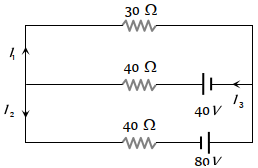
- A
$0.4 \mathrm{~A}$
- B
$-0.4 \mathrm{~A}$
- ✓
$0.8 \mathrm{~A}$
- D
$-0.8 \mathrm{~A}$
AnswerCorrect option: C. $0.8 \mathrm{~A}$
(c) $\quad R_{\max }=n R$ and $R_{\min }=R / n \Rightarrow \frac{R_{\max }}{R_{\min }}=n^2$
View full question & answer→MCQ 2201 Mark
Emf is most closely related to
MCQ 2211 Mark
What is the resistance of a carbon resistance which has bands of colours brown, black and brown
- ✓
$100 \Omega$
- B
$1000 \Omega$
- C
$10 \Omega$
- D
$1 \Omega$
AnswerCorrect option: A. $100 \Omega$
View full question & answer→MCQ 2221 Mark
A capacitor is connected to a cell of emf $E$ having some internal resistance $r$. The potential difference across the
- A
Cell is $
- ✓
Cell is $E$
- C
Capacitor is $>E$
- D
Capacitor is $
AnswerCorrect option: B. Cell is $E$
(b) In the given case cell is in open circuit $(i=0)$ so voltage across the cell is equal to its e.m.f.
View full question & answer→MCQ 2231 Mark
When a $12 \Omega$ resistor is connected with a moving coil galvanometer then its deflection reduces from 50 divisions to 10 divisions. The resistance of the galvanometer is
- A
$24 \Omega$
- B
$36 \Omega$
- ✓
$48 \Omega$
- D
$60 \Omega$
AnswerCorrect option: C. $48 \Omega$
(c) $i_g=\frac{i S}{S+G} \Rightarrow 10=\frac{50 \times 12}{12+G} \Rightarrow 12+G=60 \Rightarrow G=48 \Omega$
View full question & answer→MCQ 2241 Mark
Masses of 3 wires of same metal are in the ratio $1: 2: 3$ and their lengths are in the ratio $3: 2: 1$. The electrical resistances are in ratio
- A
$1: 4: 9$
- B
$9: 4: 1$
- C
$1: 2: 3$
- ✓
$27: 6: 1$
AnswerCorrect option: D. $27: 6: 1$
$ R \propto \frac{l^2}{m} \Rightarrow R_1: R_2: R_3=\frac{l_1^2}{m_1}: \frac{l_2^2}{m_2}: \frac{l_3^2}{m_3} $
$ \Rightarrow \quad R_1: R_2: R_3=\frac{9}{1}: \frac{4}{2}: \frac{1}{3}=27: 6: 1$
View full question & answer→MCQ 2251 Mark
A voltmeter has a range $0-V$ with a series resistance $R$. With a series resistance $2 R$, the range is $0-V$. The correct relation between $V$ and $V$ is
- A
$V^{\prime}=2 V$
- B
$V^{\prime}>2 V$
- C
$V^{\prime} \gg 2 V$
- ✓
$V^{\prime}<2 V$
AnswerCorrect option: D. $V^{\prime}<2 V$
(d) For conversion of galvanometer (of resistances) into voltmeter, a resistance $R$ is connected in series.$\begin{aligned}& \therefore i_g=\frac{V_1}{R+G} \text { and } i_g=\frac{V_2}{2 R+G} \\& \Rightarrow \frac{V_1}{R+G}=\frac{V_2}{2 R+G} \Rightarrow \frac{V_2}{V_1}=\frac{2 R+G}{R+G}=\frac{2(R+G)-G}{(R+G)} \\& =2-\frac{G}{(R+G)} \Rightarrow V_2=2 V_1-\frac{V_1 G}{(R+G)} \Rightarrow V_2<2 V_1\end{aligned}$
View full question & answer→MCQ 2261 Mark
The resistance of a wire is $10 \Omega$. Its length is increased by $10 \%$ by stretching. The new resistance will now be
- ✓
$12 \Omega$
- B
$1.2 \Omega$
- C
$13 \Omega$
- D
$11 \Omega$
AnswerCorrect option: A. $12 \Omega$
Since $R \propto l^2 \Rightarrow$ If length is increased by $10 \%$, resistance is increases by almost $20 \%$
Hence new resistance $R^{\prime}=10+20 \%$ of 10$=10+\frac{20}{100} \times 10=12 \Omega \text {. }$
View full question & answer→MCQ 2271 Mark
Four identical cells each having an electromotive force (e.m.f.) of $12 \mathrm{~V}$, are connected in parallel. The resistance electromotive force (e.m.f.) of the combination is
- A
$48 \mathrm{~V}$
- B
$12 \mathrm{~V}$
- C
$4 \mathrm{~V}$
- ✓
$3 V$
Answer(d) Equivalent external resistance of the given circuit $R_{e q}=4 \Omega$Current given by the cell $i=\frac{E}{R_{e q}+r}=\frac{10}{(4+1)}=2 \mathrm{~A}$Hence, $\left(V_A-V_B\right)=\frac{i}{2} \times\left(R_2-R_1\right)=\frac{2}{2}(2-4)=-2 V$.
View full question & answer→MCQ 2281 Mark
For driving a current of $2 \mathrm{~A}$ for 6 minutes in a circuit, $1000 \mathrm{~J}$ of work is to be done. The e.m.f. of the source in the circuit is
- A
$1.38 \mathrm{~V}$
- B
$1.68 \mathrm{~V}$
- C
$2.04 \mathrm{~V}$
- D
$3.10 \mathrm{~V}$
View full question & answer→MCQ 2291 Mark
The arrangement as shown in figure is called as
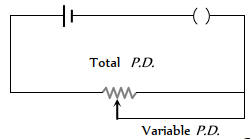
MCQ 2301 Mark
In the following Wheatstone bridge $P / Q=R / S$. If key $K$ is closed, then the galvanometer will show deflection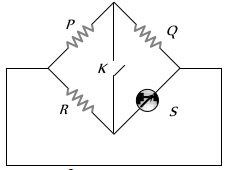
Answer(d) Pressing the key does not disturb current in all resistances as the bridge is balanced. Therefore, deflection in the galvanometer in whatever direction it was, will stay.
View full question & answer→MCQ 2311 Mark
A voltmeter has resistance of $2000 \mathrm{ohms}$ and it can measure upto $2 \mathrm{~V}$. If we want to increase its range to $10 \mathrm{~V}$, then the required resistance in series will be
- A
$2000 \Omega$
- B
$4000 \Omega$
- C
$6000 \Omega$
- ✓
$8000 \Omega$
AnswerCorrect option: D. $8000 \Omega$
(d) Here $n=\frac{10}{2}=5$$\therefore R=(n-1) G=(5-1) 2000=8000 \Omega$
View full question & answer→MCQ 2321 Mark
Resistance as shown in figure is negative at
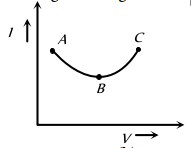
Answer(a) At point $A$ the slope of the graph will be negative. Hence resistance is negative.
View full question & answer→MCQ 2331 Mark
If $n, e, \tau$ and $m$ respectively represent the density, charge relaxation time and mass of the electron, then the resistance of a wire of length $l$ and area of cross-section $A$ will be
- ✓
$\frac{m l}{n e^2 \tau A}$
- B
$\frac{m \tau^2 A}{n e^2 l}$
- C
$\frac{n e^2 \tau A}{2 m l}$
- D
$\frac{n e^2 A}{2 m \tau l}$
AnswerCorrect option: A. $\frac{m l}{n e^2 \tau A}$
(a) $R=\rho \frac{l}{A}=\frac{n}{n e^2 \tau} \cdot \frac{l}{A}$
View full question & answer→MCQ 2341 Mark
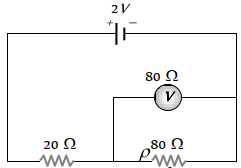
In the adjoining circuit, the e.m.f. of the cell is $2$ volt and the internal resistance is negligible. The resistance of the voltmeter is $80$ ohm. The reading of the voltmeter will be
- A
$0.80 \mathrm{volt}$
- B
$1.60$ volt
- ✓
$1.33$ volt
- D
$2.00 \mathrm{volt}$
AnswerCorrect option: C. $1.33$ volt
Total resistance of the circuit $=\frac{80}{2}+20=60 \Omega$
$\Rightarrow$ Main current $i=\frac{2}{60}=\frac{1}{30} A$
Combination of voltmeter and $80 \Omega$ resistance is connected in series with $20 \Omega$,
so current through $20 \Omega$ and this combination will be same $=\frac{1}{30} A$.
Since the resistance of voltmeter is also $80 \Omega$,
so this current is equally distributed in $80 \Omega$ resistance and voltmeter
(i.e. $\frac{1}{60} A$ through each)P.D. across $80 \Omega$ resistance $=\frac{1}{60} \times 80=1.33 \mathrm{~V}$
View full question & answer→MCQ 2351 Mark
A cell whose e.m.f. is $2 V$ and internal resistance is $0.1 \Omega$, is connected with a resistance of $3.9 \Omega$. The voltage across the cell terminal will be
- ✓
$0.50 \mathrm{~V}$
- B
$1.90 \mathrm{~V}$
- C
$1.95 \mathrm{~V}$
- D
$2.00 \mathrm{~V}$
AnswerCorrect option: A. $0.50 \mathrm{~V}$
View full question & answer→MCQ 2361 Mark
There is a current of $1.344 \mathrm{amp}$ in a copper wire whose area of cross-section normal to the length of the wire is $1 \mathrm{~mm}^2$. If the number of free electrons per $\mathrm{cm}^3$ is $8.4 \times 10^{22}$, then the drift velocity would be
- A
$1.0 \mathrm{~mm} / \mathrm{sec}$
- B
$1.0 \mathrm{~m} / \mathrm{sec}$
- ✓
$0.1 \mathrm{~mm} / \mathrm{sec}$
- D
$0.01 \mathrm{~mm} / \mathrm{sec}$
AnswerCorrect option: C. $0.1 \mathrm{~mm} / \mathrm{sec}$
$v_d=\frac{i}{n A e}=\frac{1.344}{10^{-6} \times 1.6 \times 10^{-19} \times 8.4 \times 10^{22}} $
$ =\frac{1.344}{10 \times 1.6 \times 8.4}=0.01 \mathrm{~cm} / \mathrm{s}=0.1 \mathrm{~mm} / \mathrm{s}\$
View full question & answer→MCQ 2371 Mark
Every atom makes one free electron in copper. If 1.1 ampere current is flowing in the wire of copper having 1 $\mathrm{mm}$ diameter, then the drift velocity (approx.) will be (Density of copper $=9 \times 10^3 \mathrm{~kg} \mathrm{~m}^{-3}$ and atomic weight $(=63)$
- A
$0.3 \mathrm{~mm} / \mathrm{sec}$
- ✓
$0.1 \mathrm{~mm} / \mathrm{sec}$
- C
$0.2 \mathrm{~mm} / \mathrm{sec}$
- D
$0.2 \mathrm{~cm} / \mathrm{sec}$
AnswerCorrect option: B. $0.1 \mathrm{~mm} / \mathrm{sec}$
Density of $\mathrm{Cu}=9 \times 10^3 \mathrm{~kg} / \mathrm{m}^3$ (mass of $1 \mathrm{~m}$ of $\mathrm{Cu}$ )
$\because 6.0 \times 10^{\text {a }} \text { atoms has a mass }=63 \times 10 \mathrm{~kg}$
$\therefore$ Number of electrons per $m$ are$=\frac{6.0 \times 10^{23}}{63 \times 10^{-3}} \times 9 \times 10^3=8.5 \times 10^{28}$
$ \text { Now drift velocity }=v_d=\frac{i}{n e A} $
$ =\frac{1.1}{8.5 \times 10^{28} \times 1.6 \times 10^{-19} \times \pi \times\left(0.5\times 10^{-3}\right)^2} $
$ =0.1 \times 10^{-3} \mathrm{~m} / \mathrm{sec}$
View full question & answer→MCQ 2381 Mark
The resistance $R_t$ of a conductor varies with temperauce $t$ as shown in the figure. If the variation is represented by $R_t=R_0\left[1+\alpha t+\beta t^2\right]$, then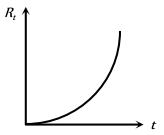
- A
$\alpha$ and $\beta$ are both negative
- ✓
$\alpha$ and $\beta$ are both positive
- C
$\alpha$ is positive and $\beta$ is negative
- D
$\alpha$ is negative and $\beta$ are positive
AnswerCorrect option: B. $\alpha$ and $\beta$ are both positive
(b) When we move in the direction of the current in a uniform conductor, the potential difference decreases linearly. When we pass through the cell, from it's negative to it's positive terminal, the potential increases by an amount equal to it's potential difference. This is less than it's emf, as there is some potential drop across it's internal resistance when the cell is driving current.
View full question & answer→MCQ 2391 Mark
Variation of current passing through a conductor ${ }^l \overrightarrow{a s}$ the voltage applied across its ends as varied is shown in the adjoining diagram. If the resistance $(R)$ is determined at the points $A, B, C$ and $D$, we will find that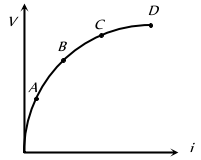
Answer(d) From the curve it is clear that slopes at points $A, B, C, D$ have following order $A>B>C>D$.and also resistance at any point equals to slope of the $V-i$ curve.So order of resistance at three points will be $R_A>R_B>R_C>R_D$
View full question & answer→MCQ 2401 Mark
In an electrical cable there is a single wire of radius $9 \mathrm{~mm}$ of copper. Its resistance is $5 \Omega$. The cable is replaced by 6 different insulated copper wires, the radius of each wire is $3 \mathrm{~mm}$. Now the total resistance of the cable will be
- ✓
$7.5 \Omega$
- B
$45 \Omega$
- C
$90 \Omega$
- D
$270 \Omega$
AnswerCorrect option: A. $7.5 \Omega$
View full question & answer→MCQ 2411 Mark
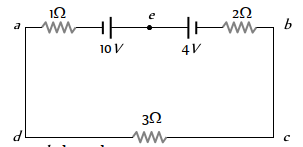
The magnitude and direction of the current in the circuit shown will be
- A
$\frac{7}{3} A$ from $a$ to $b$ through $e$
- B
$\frac{7}{3} A$ from $b$ to $a$ through $e$
- C
$1 A$ from $b$ to $a$ through $e$
- ✓
$1 A$ from $a$ to $b$ through $e$
AnswerCorrect option: D. $1 A$ from $a$ to $b$ through $e$
(d) Equivalent resistance of parallel resistors is always less than any of the member of the resistance system.
View full question & answer→MCQ 2421 Mark
When current flows through a conductor, then the order of drift velocity of electrons will be
- A
$10^{10} \mathrm{~m} / \mathrm{sec}$
- ✓
$10^{-2} \mathrm{~cm} / \mathrm{sec}$
- C
$10^4 \mathrm{~cm} / \mathrm{sec}$
- D
$10^{-1} \mathrm{~cm} / \mathrm{sec}$
AnswerCorrect option: B. $10^{-2} \mathrm{~cm} / \mathrm{sec}$
(b) Order of drift velocity $=10^{-4} \mathrm{~m} / \mathrm{sec}=10^{-2} \mathrm{~cm} / \mathrm{sec}$
View full question & answer→MCQ 2431 Mark
Current of 4.8 amperes is flowing through a conductor. The number of electrons per second will be
- ✓
$3 \times 10^{19}$
- B
$7.68 \times 10^{21}$
- C
$7.68 \times 10^{20}$
- D
$3 \times 10^{20}$
AnswerCorrect option: A. $3 \times 10^{19}$
(a) Number of electrons flowing per second$\frac{n}{t}=\frac{i}{e}=4.8 / 1.6 \times 10^{-19}=3 \times 10^{19}$
View full question & answer→MCQ 2441 Mark
The potential gradient along the length of a uniform wire is 10 volt/metre. $B$ and $C$ are the two points at $30 \mathrm{~cm}$ and $60 \mathrm{~cm}$ point on a meter scale fitted along the wire. The potential difference between $B$ and $C$ will be
- ✓
$3\ volt$
- B
$0.4 \ volt$
- C
$7 \ volt$
- D
$4 \ volt$
AnswerCorrect option: A. $3\ volt$
(a) Potential gradient $=$ Change in voltage per unit length$\therefore 10=\frac{V_2-V_1}{30 / 100} \Rightarrow V_2-V_1=3 \text { volt }$
View full question & answer→MCQ 2451 Mark
The e.m.f. of a cell is $\mathrm{E}$ volts and internal resistance is $r$ ohm. The resistance in external circuit is also $r$ ohm. The p.d. across the cell will be
- A
$E / 2$
- ✓
$2 E$
- C
$4 E$
- D
$E / 4$
Answer$ \text { Resistance of parallel group }=\frac{R}{2} $
$ \therefore \text { Total equivalent resistance }=4 \times \frac{R}{2}=2 R$
View full question & answer→MCQ 2461 Mark
A $50 \mathrm{~V}$ battery is connected across a $10 \mathrm{ohm}$ resistor. The current is $4.5$ amperes. The internal resistance of the battery is
- A
- B
$0.5 \mathrm{ohm}$
- ✓
$1.1 \mathrm{ohm}$
- D
$5.0 \mathrm{ohm}$
AnswerCorrect option: C. $1.1 \mathrm{ohm}$
View full question & answer→MCQ 2471 Mark
The resistance of a wire of uniform diameter $d$ and length $L$ is $R$. The resistance of another wire of the same material but diameter $2 d$ and length $4 L$ will be
- A
$2 R$
- ✓
$R$
- C
$R / 2$
- D
$R / 4$
Answer$ R \propto \frac{l}{A} \propto \frac{l}{d^2} \Rightarrow \frac{R_1}{R_2}=\frac{l_1}{l_2} \times\left(\frac{d_2}{d_1}\right)^2=\frac{L}{4 L}\left(\frac{2 d}{d}\right)^2=1$
$\Rightarrow R=R=R .\$
View full question & answer→MCQ 2481 Mark
A battery of 6 volts is connected to the terminals of a three metre long wire of uniform thickness and resistance of the order of $100 \Omega$. The difference of potential between two points separated by $50 \mathrm{~cm}$ on the wire will be
- ✓
$1 \mathrm{~V}$
- B
$1.5 \mathrm{~V}$
- C
$2 \mathrm{~V}$
- D
$3 \mathrm{~V}$
AnswerCorrect option: A. $1 \mathrm{~V}$
(a) Here same current is passing throughout the length of the wire, hence $V \propto R \propto l$$\Rightarrow \frac{V_1}{V_2}=\frac{l_1}{l_2} \Rightarrow \frac{6}{V_2}=\frac{300}{50} \Rightarrow V=1 \mathrm{~V} \text {. }$
View full question & answer→MCQ 2491 Mark
The specific resistance of a wire is $\rho$, its volume is $3 \mathrm{~m}^3$ and its resistance is 3 ohms, then its length will be
AnswerCorrect option: B. $\frac{3}{\sqrt{\rho}}$
(b) Volume $=A l=3 \Rightarrow A=\frac{3}{l}$Now $R=\rho \frac{l}{A} \Rightarrow 3=\frac{\rho \times l}{3 / l}=\frac{\rho l^2}{3}\Rightarrow l^2=\frac{9}{\rho}=\frac{3}{\sqrt{\rho}}$
View full question & answer→MCQ 2501 Mark
In a conductor $4$ coulombs of charge flows for $2$ seconds. The value of electric current will be
- A
$4$ volts
- B
$4$ amperes
- ✓
$2$ amperes
- D
$2$ volts
AnswerCorrect option: C. $2$ amperes
(c) $i=\frac{q}{t}=\frac{4}{2}=2$ ampere
View full question & answer→