MCQ 511 Mark
The ratio of the lengths of two wires $A$ and $B$ of same material is 1 : 2 and the ratio of their diameter is $2: 1$. They are stretched by the same force, then the ratio of increase in length will be
- A
$2: 1$
- B
$1: 4$
- ✓
$1: 8$
- D
$8: 1$
AnswerCorrect option: C. $1: 8$
(c) $l=\frac{F L}{A Y} \Rightarrow l \propto \frac{L}{d^2} \Rightarrow \frac{l_1}{l_2}=\frac{L_1}{L_2} \times\left(\frac{d_2}{d_1}\right)^2=\frac{1}{2} \times\left(\frac{1}{2}\right)^2=\frac{1}{8}$
View full question & answer→MCQ 521 Mark
The Young's modulus of a wire of length $L$ and radius $r$ is $Y N / m$. If the length and radius are reduced to $L / 2$ and $r / 2$, then its Young's modulus will be
- A
$Y / 2$
- ✓
$Y$
- C
$2 Y$
- D
$4 Y$
Answer(b) Young's modulus of wire does not varies with dimension of wire. It is the property of given material.
View full question & answer→MCQ 531 Mark
On increasing the length by $0.5 mm$ in a steel wire of length $2 m$ and area of cross-section $2 mm ^2$, the force required is [ $Y$ for steel $\left.\left.=2.2 \times 10^{11} N / m ^2\right]\right]$
- A
$1.1 \times 10^5 N$
- B
$1.1 \times 10^4 N$
- C
$1.1 \times 10^3 N$
- ✓
$1.1 \times 10^2 N$
AnswerCorrect option: D. $1.1 \times 10^2 N$
(d) $F=\frac{Y A l}{L}=\frac{2.2 \times 10^{11} \times 2 \times 10^{-6} \times 5 \times 10^{-4}}{2}=1.1 \times 10^2 \mathrm{~N}$
View full question & answer→MCQ 541 Mark
A wire of length $2 m$ is made from $10 cm ^3$ of copper. A force $F$ is applied so that its length increases by $2 mm$. Another wire of length $8 m$ is made from the same volume of copper. If the force $F$ is applied to it, its length will increase bv
- A
$0.8 \ cm$
- B
$1.6 \ cm$
- C
$2.4 \ cm$
- ✓
$3.2 \ cm$
AnswerCorrect option: D. $3.2 \ cm$
(d) $\quad l=\frac{F L}{A Y}=\frac{F L^2}{(A L) Y}=\frac{F L^2}{V Y}$$\therefore l \propto L^2$ if volume of the wire remains constant
$ \frac{l_2}{l_1}=\left(\frac{L_2}{L_1}\right)^2=\left(\frac{8}{2}\right)^2=16 $
$\therefore l_2=16 \times l_1=16 \times 2=32 \mathrm{~mm}=3.2 \mathrm{~cm}$
View full question & answer→MCQ 551 Mark
The area of cross section of a steel wire $\left(Y=2.0 \times 10^{11}\ N / m ^2\right)$ is $0.1\ cm ^2$. The force required to double its length will be
- A
$2 \times 10^{12}\ N$
- B
$2 \times 10^{11} \ N$
- C
$2 \times 10^{10}\ N$
- ✓
$2 \times 10^6\ N$
AnswerCorrect option: D. $2 \times 10^6\ N$
(d) When the length of wire is doubled then $l=L$ and strain $=1$
$ \therefore Y=\text { strain }=\frac{F}{A} $
$ \therefore \text { Force }=Y \times A=2 \times 10^{11} \times 0.1 \times 10^{-4}=2 \times 10^6 \mathrm{~N}$
View full question & answer→MCQ 561 Mark
A copper wire of length $4.0 \ m$ and area of cross-section $1.2\ cm ^2$ is stretched with a force of $4.8 \times 10^3 \ N$. If Young's modulus for copper is $1.2 \times 10^{11}\ N / m ^2$, the increase in the length of the wire will be
- ✓
$1.33\ mm$
- B
$1.33\ cm$
- C
$2.66 \ mm$
- D
$2.66\ cm$
AnswerCorrect option: A. $1.33\ mm$
(a) $l=\frac{F L}{A Y}=\frac{4.8 \times 10^3 \times 4}{1.2 \times 10^{-4} \times 1.2 \times 10^{11}}=1.33 \mathrm{~mm}$
View full question & answer→MCQ 571 Mark
On applying a stress of $20 \times 10^8 N / m ^2$ the length of a perfectly elastic wire is doubled. Its Young's modulus will be
- A
$40 \times 10^8 N / m ^2$
- ✓
$20 \times 10^8 N / m ^2$
- C
$10 \times 10^8 N / m ^2$
- D
$5 \times 10^8 N / m ^2$
AnswerCorrect option: B. $20 \times 10^8 N / m ^2$
(b) Young's modules $=\frac{\text { stress }}{\text { strain }}$ As the length of wire get doubled therefore strain $=1$
$\therefore Y=\text { strain }=20 \times 10^8 \times \mathrm{N} / \mathrm{m}^2$
View full question & answer→MCQ 581 Mark
Coefficient of isothermal elasticity $E_\theta$ and coefficient of adiabatic elasticity $E_\phi$ are related by $\left(\gamma=C_p / C_v\right)$
AnswerCorrect option: B. $E_\phi=\gamma E_\theta$
View full question & answer→MCQ 591 Mark
A wire of length $L$ and cross-sectional area $A$ is made of a material of Young's modulus $Y$. It is stretched by an amount $x$. The work done is
- A
$\frac{Y x A}{2 L}$
- B
$\frac{Y x^2 A}{2 L}$
- ✓
$\frac{Y x^2 A}{L}$
- D
$\frac{2 Y x^2 A}{L}$
AnswerCorrect option: C. $\frac{Y x^2 A}{L}$
View full question & answer→MCQ 601 Mark
When a force is applied on a wire of uniform cross-sectional area $3 \times 10^{-6} m ^2$ and length $4 m$, the increase in length is $1 mm$. Energy stored in it will be $\left(Y=2 \times 10^{11} N / m ^2\right)$
- A
$6250 \ J$
- B
$0.177\ J$
- ✓
$0.075\ J$
- D
$0.150 \ J$
AnswerCorrect option: C. $0.075\ J$
$ U=\frac{1}{2} \times \frac{Y A l^2}{L}=\frac{1}{2} \times \frac{2 \times 10^{11} \times 3 \times 10^{-6} \times\left(1 \times 10^{-3}\right)^2}{4}$
$ =0.075 \mathrm{~J}$
View full question & answer→MCQ 611 Mark
$K$ is the force constant of a spring. The work done in increasing its extension from $l_1$ to $l_2$ will be
- A
$K\left(l_2-l_1\right)$
- B
$\frac{K}{2}\left(l_2+l_1\right)$
- C
$K\left(l_2^2-l_1^2\right)$
- ✓
$\frac{K}{2}\left(l_2^2-l_1^2\right)$
AnswerCorrect option: D. $\frac{K}{2}\left(l_2^2-l_1^2\right)$
(d) At extension $l_1$, the stored energy $=\frac{1}{2} K l_1^2$At extension $l_2$, the stored energy $=\frac{1}{2} K l_2^2$Work done in increasing its extension from $l_1$ to $l_2$$=\frac{1}{2} K\left(l_2^2-l_1^2\right)$
View full question & answer→MCQ 621 Mark
Two wires of the same material have lengths in the ratio $1: 2$ and their radii are in the ratio $1: \sqrt{2}$. If they are stretched by applying equal forces, the increase in their lengths will be in the ratio
- A
$2: \sqrt{2}$
- B
$\sqrt{2}: 2$
- ✓
$1: 1$
- D
$1: 2$
AnswerCorrect option: C. $1: 1$
$ l=\frac{F L}{\pi r^2 Y} \Rightarrow l \propto \frac{L}{r^2} \quad(F \text { and } Y \text { are constant }) \\ \frac{l_1}{l_2}=\frac{L_1}{L_2}\left(\frac{r_2}{r_1}\right)^2=\frac{1}{2}(\sqrt{2})^2 \therefore \frac{l_1}{l_2}=1: 1$( $F$ and $Y$ are constant)
View full question & answer→MCQ 631 Mark
The force required to stretch a steel wire of $1 cm ^2$ cross-section to1.1 times its length would be $\left(Y=2 \times 10^{11} Nm ^{-2}\right)$
- ✓
$2 \times 10^6 N$
- B
$2 \times 10^3 N$
- C
$2 \times 10^{-6} N$
- D
$2 \times 10^{-7} N$
AnswerCorrect option: A. $2 \times 10^6 N$
(a) $F=A \times Y \times$ strain $=1 \times 10^{-4} \times 2 \times 10^{11} \times 0.1=2 \times 10^6 \mathrm{~N}$
View full question & answer→MCQ 641 Mark
Which of the following statements is correct
- ✓
Hooke's law is applicable only within elastic limit
- B
The adiabatic and isothermal elastic constants of a gas are equal
- C
Young's modulus is dimensionless
- D
Stress multiplied by strain is equal to the stored energy
AnswerCorrect option: A. Hooke's law is applicable only within elastic limit
(a) In accordance with Hooke's law.
View full question & answer→MCQ 651 Mark
The relationship between Young's modulus $Y$, Bulk modulus $K$ and modulus of rigidity $\eta$ is
- ✓
$Y=\frac{9 \eta K}{\eta+3 K}$
- B
$\frac{9 Y K}{Y+3 K}$
- C
$\quad Y=\frac{9 \eta K}{3+K}$
- D
$Y=\frac{3 \eta K}{9 \eta+K}$
AnswerCorrect option: A. $Y=\frac{9 \eta K}{\eta+3 K}$
(a) $\quad Y=3 K(1-2 \sigma)$ and $Y=2 \eta(1+\sigma)$Eliminating $\sigma$ we get $Y=\frac{9 \eta K}{\eta+3 K}$
View full question & answer→MCQ 661 Mark
An elastic material of Young's modulus $Y$ is subjected to a stress $S$. The elastic energy stored per unit volume of the material is
- A
$\frac{2 Y}{S^2}$
- ✓
$\frac{S^2}{2 Y}$
- C
$\frac{S}{2 Y}$
- D
$\frac{S^2}{Y}$
AnswerCorrect option: B. $\frac{S^2}{2 Y}$
View full question & answer→MCQ 671 Mark
The diameter of a brass rod is $4 mm$ and Young's modulus of brass is $9 \times 10^{10} N / m ^2$. The force required to stretch by $0.1 \%$ of its length is
- ✓
$360 \pi N$
- B
$36 N$
- C
$144 \pi \times 10^3 N$
- D
$36 \pi \times 10^5 N$
AnswerCorrect option: A. $360 \pi N$
(a) $F=\frac{Y A l}{L}=\frac{9 \times 10^{10} \times \pi \times 4 \times 10^{-6} \times 0.1}{100}=360 \pi \mathrm{N}$
View full question & answer→MCQ 681 Mark
The ratio of the adiabatic to isothermal elasticities of a triatomic gas is
- A
$3 / 4$
- ✓
$4 / 3$
- C
$1$
- D
$5 / 3$
AnswerCorrect option: B. $4 / 3$
(b) For triatomic gas $\gamma=\frac{4}{3}$
View full question & answer→MCQ 691 Mark
In steel, the Young's modulus and the strain at the breaking point are $2 \times 10^{11}\ Nm ^{-2}$ and $0.15$ respectively. The stress at the breaking point for steel is therefore
- A
$1.33 \times 10^{11}\ Nm ^{-2}$
- B
$1.33 \times 10^{12} \ Nm ^{-2}$
- C
$7.5 \times 10^{-13} \ Nm ^{-2}$
- ✓
$3 \times 10^{10} \ Nm ^{-2}$
AnswerCorrect option: D. $3 \times 10^{10} \ Nm ^{-2}$
(d) Breaking stress $=$ strain $\times$ Young's modulus$=0.15 \times 2 \times{ }^{11}=3 \times 10^{10}\ \mathrm{Nm}^{-2}$
View full question & answer→MCQ 701 Mark
A force $F$ is needed to break a copper wire having radius $R$. The force needed to break a copper wire of radius $2 R$ will be
- A
$F / 2$
- B
$2 F$
- ✓
$4 F$
- D
$F / 4$
Answer(c) Breaking Force $\propto$ Area of cross section of wire $(\pi r)$If radius of wire is double then breaking force will become four times.
View full question & answer→MCQ 711 Mark
The area of cross-section of a wire of length 1.1 metre is $1 mm$. It is loaded with $1 kg$. If Young's modulus of copper is $1.1 \times 10^{11} N / m ^2$, then the increase in length will be (If $\left.g=10 m / s ^2\right)$
- A
$0.01 mm$
- B
$0.075 mm$
- ✓
$0.1 mm$
- D
$0.15 mm$
AnswerCorrect option: C. $0.1 mm$
(c) $\quad l=\frac{m g L}{A Y}=\frac{1 \times 10 \times 1.1}{1.1 \times 10^{11} \times 10^{-6}} \mathrm{~m}=0.1 \mathrm{~mm}$
View full question & answer→MCQ 721 Mark
A $5$ metre long wire is fixed to the ceiling. A weight of $10\ kg$ is hung at the lower end and is $1$ metre above the floor. The wire was elongated by $1 \ mm$. The energy stored in the wire due to stretching is
- A
- ✓
$0.05$ joule
- C
$100$ joule
- D
$500$ joule
AnswerCorrect option: B. $0.05$ joule
$W =\frac{1}{2} \times F \times l=\frac{1}{2} \mathrm{mgl}$
$ =\frac{1}{2} \times 10 \times 10 \times 1 \times 10^{-1}=0.05 \mathrm{~J}$
View full question & answer→MCQ 731 Mark
Two wires of same diameter of the same material having the length $I$ and $2 l$. If the force $F$ is applied on each, the ratio of the work done in the two wires will be
- ✓
$1: 2$
- B
$1: 4$
- C
$2: 1$
- D
$1: 1$
AnswerCorrect option: A. $1: 2$
$ W=\frac{1}{2} F l \therefore W \propto l $ ( $F$ is constant)
$ \therefore \frac{W_1}{W_2}=\frac{l_1}{l_2}=\frac{l}{2 l}=\frac{1}{2}$
View full question & answer→MCQ 741 Mark
The increase in length is $l$ of a wire of length $L$ by the longitudinal stress. Then the stress is proportional to
- A
$L / I$
- ✓
$1 / L$
- C
$l \times L$
- D
$l^2 \times L$
AnswerCorrect option: B. $1 / L$
(b) Stress $\propto$ Strain $\Rightarrow$ Stress $\propto \frac{l}{L}$
View full question & answer→MCQ 751 Mark
When a pressure of 100 atmosphere is applied on a spherical ball, then its volume reduces to $0.01 \%$. The bulk modulus of the material of the rubber in dyne $/ cm ^2$ is
- A
$10 \times 10^{12}$
- B
$100 \times 10^{12}$
- ✓
$1 \times 10^{12}$
- D
$20 \times 10^{12}$
AnswerCorrect option: C. $1 \times 10^{12}$
(c) $K=\frac{100}{0.01 / 100}=10^6 \mathrm{~atm}=10^{11} \mathrm{~N} / \mathrm{m}^2=10^{12} \mathrm{dyne} / \mathrm{cm}^2$
View full question & answer→MCQ 761 Mark
Longitudinal stress of $1 kg / mm ^2$ is applied on a wire. The percentage increase in length is $\left(Y=10^{11} N / m ^2\right)$
- A
$0.002$
- ✓
$0.001$
- C
$0.003$
- D
$0.01$
AnswerCorrect option: B. $0.001$
(b) Longitudinal strain $\frac{l}{L}=\frac{\text { stress }}{Y}=\frac{10^6}{10^{11}}=10^{-5}$
Percentage increase in length $=10^{-5} \times 100=0.001 \%$
View full question & answer→MCQ 771 Mark
Steel and copper wires of same length are stretched by the same weight one after the other. Young's modulus of steel and copper are $2 \times 10^{11} \ N / m ^2$ and $1.2 \times 10^{11}\ N / m ^2$. The ratio of increase in length
- A
$\frac{2}{5}$
- ✓
$\frac{3}{5}$
- C
$\frac{5}{4}$
- D
$\frac{5}{2}$
AnswerCorrect option: B. $\frac{3}{5}$
$ l=\frac{F L}{A Y} \Rightarrow \frac{l_S}{l_{c u}}=\frac{Y_{c u}}{Y_S}(F, L \text { and } Y \text { are constant }) $
$ \therefore \frac{l_s}{l_{c u}}=\frac{1.2 \times 10^{11}}{2 \times 10^{11}}=\frac{3}{5}$
View full question & answer→MCQ 781 Mark
The modulus of elasticity is dimensionally equivalent to
MCQ 791 Mark
There is no change in the volume of a wire due to change in its length on stretching. The Poisson's ratio of the material of the wire is
- A
$0.5$
- ✓
$-0.5$
- C
$0.25$
- D
$-0.25$
AnswerCorrect option: B. $-0.5$
We know that $\frac{d V}{V}=(1+2 \sigma) \frac{d L}{L}$
If $\sigma=-\frac{1}{2}$ then $\frac{d V}{V}=0$
i.e. there is no change in volume.
View full question & answer→MCQ 801 Mark
Under elastic limit the stress is
- A
Inversely, proportional to strain
- ✓
Directly proportional to strain
- C
- D
AnswerCorrect option: B. Directly proportional to strain
View full question & answer→MCQ 811 Mark
A wire of cross section $4 mm$ is stretched by $0.1 mm$ by a certain weight. How far (length) will be wire of same material and length but of area $8 mm$ stretch under the action of same force
- ✓
$0.05 \ mm$
- B
$0.10 \ mm$
- C
$0.15 \ mm$
- D
$0.20 \ mm$ / $0.25\ mm$
AnswerCorrect option: A. $0.05 \ mm$
$ l=\frac{F L}{A Y} \therefore l \propto \frac{1}{A}(F, L \text { and } Y \text { are constant }] $
$ \frac{l_2}{l_1}=\frac{A_1}{A_2}=\frac{4}{8}=\frac{1}{2} \Rightarrow l_2=\frac{l_1}{2}=\frac{0.1}{2}=0.05 \mathrm{~mm}$
View full question & answer→MCQ 821 Mark
Wires $A$ and $B$ are made from the same material. A has twice the diameter and three times the length of $B$. If the elastic limits are not reached, when each is stretched by the same tension, the ratio of energy stored in $A$ to that in $B$ is
- A
$2: 3$
- ✓
$3: 4$
- C
$3: 2$
- D
$6: 1$
AnswerCorrect option: B. $3: 4$
$ U=\frac{1}{2} F l=\frac{F^2 L}{2 A Y} . U \propto \frac{L}{r^2}(F \text { and } Y \text { are constant }) $
$ \therefore \frac{U_A}{U_B}=\left(\frac{L_A}{L_B}\right) \times\left(\frac{r_A}{r_B}\right)^2=(3) \times\left(\frac{1}{2}\right)^2=\frac{3}{4}$
View full question & answer→MCQ 831 Mark
A uniform plank of Young's modulus $Y$ is moved over a smooth horizontal surface by a constant horizontal force $F$. The area of cross section of the plank is $A$. The compressive strain on the plank in the direction of the force is
- ✓
$F / A Y$
- B
$2 F / A Y$
- C
$\frac{1}{2}(F / A Y)$
- D
$3 F / A Y$
AnswerCorrect option: A. $F / A Y$
(a) $\quad Y=\frac{F / A}{\text { Strain }} \Rightarrow$ strain $=\frac{F}{A Y}$
View full question & answer→MCQ 841 Mark
The stress versus strain graphs for wires of two materials $A$ and $B$ are as shown in the figure. If $Y_A$ and $Y_B$ are the Young 's modulii of the materials, then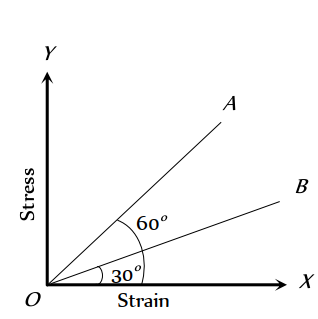
- A
$Y_B=2 Y_A$
- B
$Y_A=Y_B$
- C
$Y_B=3 Y_A$
- ✓
$Y_A=3 Y_B$
AnswerCorrect option: D. $Y_A=3 Y_B$
(d) $\frac{Y_A}{Y_B}=\frac{\tan \theta_A}{\tan \theta_B}=\frac{\tan 60}{\tan 30}=\frac{\sqrt{3}}{1 / \sqrt{3}}=3 \Rightarrow Y_A=3 Y_B$
View full question & answer→MCQ 851 Mark
Young's modulus of perfectly rigid body material is
MCQ 861 Mark
The load versus elongation graph for four wires of the same material is shown in the figure. The thickest wire is represented by the line
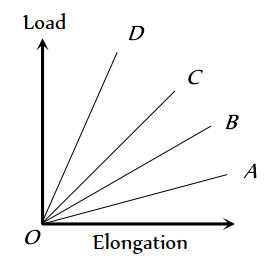
Answer$l=\frac{F L}{A Y} \therefore l \propto \frac{1}{r^2}(Y, L$ and $F$ are constant $)$
i.e. for the same load, thickest wire will show minimum elongation.
So graph $D$ represent the thickest wire.
View full question & answer→MCQ 871 Mark
According to Hook's law of elasticity, if stress is increased, the ratio of stress to strain
Answer(d) $Y=\frac{\text { Stress }}{\text { Strain }}=$ ConstantIt depends only on nature of material.
View full question & answer→MCQ 881 Mark
The mean distance between the atoms of iron is $3 \times 10^{-10} m$ and interatomic force constant for iron is $7 N / m$ The Young's modulus of elasticity for iron is
- A
$2.33 \times 10^5 N / m ^2$
- B
$23.3 \times 10^{10} N / m ^2$
- C
$233 \times 10^{10} N / m ^2$
- ✓
$2.33 \times 10^{10} N / m ^2$
AnswerCorrect option: D. $2.33 \times 10^{10} N / m ^2$
(d) $Y=\frac{k}{r_0}=\frac{7}{3 \times 10^{-10}}=2.33 \times 10^{10} \mathrm{~N} / \mathrm{m}^2$
View full question & answer→MCQ 891 Mark
The material which practically does not show elastic after effect is
MCQ 901 Mark
If Young's modulus of iron is $2 \times 10^{11} N / m ^2$ and the interatomic spacing between two molecules is $3 \times 10^{-10}$ metre, the interatomic force constant is
- ✓
$60 N / m$
- B
$120 N / m$
- C
$30 N / m$
- D
$180 N / m$
AnswerCorrect option: A. $60 N / m$
(a) Interatomic force constant $K=Y \times r_0$$=2 \times 10^{11} \times 3 \times 10^{-10}=60 \mathrm{~N} / \mathrm{m}$
View full question & answer→MCQ 911 Mark
The adjacent graph shows the extension $(\Delta l)$ of a wire of length $1 m$ suspended from the top of a roof at one end with a load $W$ connected to the other end. If the cross sectional area of the wire is $10^{-6} m ^2$, calculate the young's modulus of the material of the wire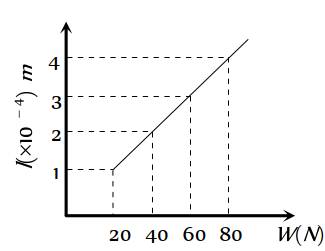
- ✓
$2 \times 10^{11} N / m ^2$
- B
$2 \times 10^{-11} N / m ^2$
- C
$3 \times 10^{-12} N / m ^2$
- D
$2 \times 10^{-13} N / m ^2$
AnswerCorrect option: A. $2 \times 10^{11} N / m ^2$
(a) From the graph $l=10^{-4} \mathrm{~m}, F=20 \mathrm{~N}$$\begin{gathered}A=10^{-6} \mathrm{~m}^2, L=1 \mathrm{~m} \\\therefore Y=\frac{F L}{A l}=\frac{20 \times 1}{10^{-6} \times 10^{-4}}=20 \times 10^{10}=2 \times 10^{11} \mathrm{~N} / \mathrm{m}^2\end{gathered}$
View full question & answer→MCQ 921 Mark
The extension in a string obeying Hooke's law is $x$. The speed of sound in the stretched string is $v$. If the extension in the string is increased to $1.5 x$, the speed of sound will be
- ✓
$1.22 V$
- B
$0.61 v$
- C
$1.50 V$
- D
$0.75 v$
AnswerCorrect option: A. $1.22 V$
(a) Speed of sound in a stretched string $v=\sqrt{\frac{T}{\mu}}$Where $T$ is the tension in the string and $\mu$ is mass per unit length.According to Hooke's law, $F \propto x \quad \therefore T \propto x$From (i) and (ii) $v \propto \sqrt{x} \therefore v^{\prime}=\sqrt{1.5} v=1.22 v$
View full question & answer→MCQ 931 Mark
The dimensions of four wires of the same material are given below. In which wire the increase in length will be maximum when the same tension is applied
- A
Length $100 cm$, Diameter $1 mm$
- B
Length $200 cm$, Diameter $2 mm$
- C
Length $300 cm$, Diameter $3 mm$
- ✓
Length $50 cm$, Diameter $0.5 mm$
AnswerCorrect option: D. Length $50 cm$, Diameter $0.5 mm$
(d)$\begin{aligned}& Y=\frac{F}{A} \frac{L}{A} \Rightarrow l \propto \frac{L}{A} \propto \frac{L}{\pi d^2} \\& \therefore l \propto \frac{L}{d^2} \\& \quad \text { [As } F \text { and } Y \text { are constant] }\end{aligned}$[As $F$ and $Y$ are constant]The ratio of $\frac{L}{d^2}$ is maximum for case (d)
View full question & answer→MCQ 941 Mark
Two wires ' $A$ ' and ' $B$ of the same material have radii in the ratio $2 : 1$ and lengths in the ratio $4: 1$. The ratio of the normal forces required to produce the same change in the lengths of these two wires is
- ✓
$1: 1$
- B
$2: 1$
- C
$1: 4$
- D
$1: 2$
AnswerCorrect option: A. $1: 1$
$ F=Y \times A \times \frac{l}{L}$
$ \Rightarrow F \propto \frac{r^2}{L}(Y \text { and } / \text { are constant }) $
$ \therefore \frac{F_1}{F_2}=\left(\frac{r_1}{r_2}\right)^2\left(\frac{L_2}{L_1}\right)$
$=\left(\frac{2}{1}\right)^2\left(\frac{1}{4}\right)=1 \Rightarrow \frac{F_1}{F_2}=1: 1$
View full question & answer→MCQ 951 Mark
The coefficient of linear expansion of brass and steel are $\alpha_1$ and $\alpha_2$. If we take a brass rod of length $l_1$ and steel rod of length $l_2$ at $0^{\circ} C$, their difference in length $\left(l_2-l_1\right)$ will remain the same at a temperature if
- A
$\quad \alpha_1 l_2=\alpha_2 l_1$
- B
$\alpha_1 l_2^2=\alpha_2 l_1^2$
- C
$\quad \alpha_1^2 l_1=\alpha_2^2 l_2$
- ✓
$\alpha_1 l_1=\alpha_2 l_2$
AnswerCorrect option: D. $\alpha_1 l_1=\alpha_2 l_2$
(d)$ L_2=l_2\left(1+\alpha_2 \Delta \theta\right) \text { and } L_1=l_1\left(1+\alpha_1 \Delta \theta\right)$
$\Rightarrow\left(L_2-L_1\right)=\left(l_2-l_1\right)+\Delta \theta\left(l_2 \alpha_2-l_1 \alpha_1\right) $
$\text { Now }\left(L_2-L_1\right)=\left(l_2-l_1\right) \text { so, } l_2 \alpha_2-l_1 \alpha_1=0$
View full question & answer→MCQ 961 Mark
The possible value of Poisson's ratio is
Answer(d) Poisson's ratio varies between -1 and 0.5
View full question & answer→MCQ 971 Mark
When a uniform wire of radius $r$ is stretched by a $2 kg$ weight, the increase in its length is $2.00 mm$. If the radius of the wire is $r / 2$ and other conditions remain the same, the increase in its length is
- A
$2.00 mm$
- B
$4.00 mm$
- C
$6.00 mm$
- ✓
$8.00 mm$
AnswerCorrect option: D. $8.00 mm$
(d).
$ l=\frac{F L}{\pi r^2 Y} \therefore l \propto \frac{1}{r^2}(F, L \text { and } Y \text { are constant })$
$\frac{l_2}{l_1}=\left(\frac{r_1}{r_2}\right)^2=(2)^2 \Rightarrow l_2=4 l_1=4 \times 2=8 \mathrm{~mm} $
View full question & answer→MCQ 981 Mark
A uniform cube is subjected to volume compression. If each side is decreased by $1 \%$, then bulk strain is
Answer(d) If side of the cube is $L$ then $V=L^3 \Rightarrow \frac{d V}{V}=3 \frac{d L}{L}$ $\therefore \%$ change in volume $=3 \times(\%$ change in length $)$ $=3 \times 1 \%=3 \% \therefore$ Bulk strain $\frac{\Delta V}{V}=0.03$
View full question & answer→MCQ 991 Mark
To keep constant time, watches are fitted with balance wheel made of
Answer(a) Because dimension of invar does not varies with temperature.
View full question & answer→MCQ 1001 Mark
For a given material, the Young's modulus is 2.4 times that of rigidity modulus. Its Poisson's ratio is
Answer(d)$\begin{aligned}& Y=2 \eta(1+\sigma) \\& 2.4 \eta=2 \eta(1+\sigma) \Rightarrow 1.2=1+\sigma \Rightarrow \sigma=0.2\end{aligned}$
View full question & answer→