Questions · Page 5 of 5

MCQ

MCQ 2011 Mark
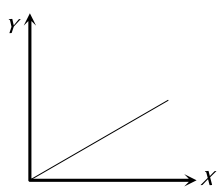
A student plots a graph from his reading on the determination of Young's modulus of a metal wire but forgets to label. The quantities on $X$ and $Y$ axes may be respectively.
Image

  • A
    Weight hung and length increased
  • B
    Stress applied and length increased
  • Stress applied and strain developed
  • D
    Length increased and weight hung
Answer
Correct option: C.
Stress applied and strain developed
(c)
View full question & answer
MCQ 2021 Mark
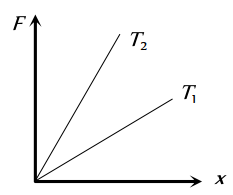
The diagram shows the change ${ }^x$ in the length of a thin uniform wire caused by the application of stress $F$ at two different temperatures $T$ and $T$. The variations shown suggest that

Image

  • $T_1>T_2$
  • B
    $T_1
  • C
    $T_1=T_2$
  • D
    None of these
Answer
Correct option: A.
$T_1>T_2$
(a) Elasticity of wire decreases at high temperature i.e. at higher temperature slope of graph will be less.So we can say that $T_1>T_2$
View full question & answer
MCQ 2031 Mark
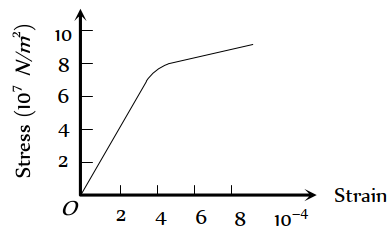
Which one of the following is the Young's modulus (in $N / m$ ) for the wire having the stress-strain curve shown in the figureImage
  • A
    $24 \times 10^{11}$
  • B
    $8.0 \times 10^{11}$
  • C
    $10 \times 10^{11}$
  • $2.0 \times 10^{11}$
Answer
Correct option: D.
$2.0 \times 10^{11}$
(d) Young's modulus is defined only in elastic region and
$Y=\frac{\text { Stress }}{\text { Strain }}=\frac{8 \times 10^7}{4 \times 10^{-4}}=2 \times 10^{11} \mathrm{~N} / \mathrm{m}^2$
View full question & answer
MCQ 2041 Mark
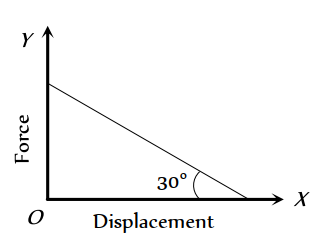
The value of force constant between the applied elastic force $F$ and displacement will be

Image

  • A
    $\sqrt{3}$
  • $\frac{1}{\sqrt{3}}$
  • C
    $\frac{1}{2}$
  • D
    $\frac{\sqrt{3}}{2}$
Answer
Correct option: B.
$\frac{1}{\sqrt{3}}$
(b) Force constant, $\mathrm{K}=\tan 30^{\circ}=1 / \sqrt{3}$
View full question & answer
MCQ 2051 Mark
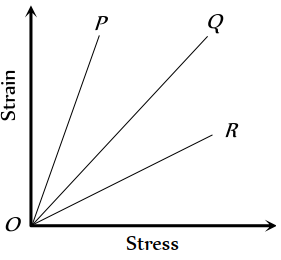
The strain-stress curves of three wires of different materials are shown in the figure. $P, Q$ and $R$ are the elastic limits of the wires. The figure shows that

Image

  • A
    Elasticity of wire $P$ is maximum
  • B
    Elasticity of wire $Q$ is maximum
  • C
    Tensile strength of $R$ is maximum
  • None of the above is true
Answer
Correct option: D.
None of the above is true
(d) As stress is shown on $x$-axis and strain on $y$-axisSo we can say that $Y=\cot \theta=\frac{1}{\tan \theta}=\frac{1}{\text { slope }}$So elasticity of wire $P$ is minimum and of wire $R$ is maximum
View full question & answer
MCQ 2061 Mark
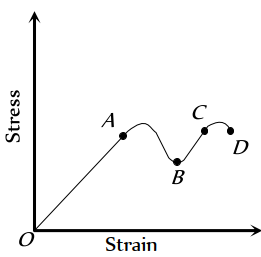
In the above graph, point $D$ indicates
  • A
    limiting point
  • B
    Yield point
  • Breaking point
  • D
    None of the above
Answer
Correct option: C.
Breaking point
(c)
View full question & answer
MCQ 2071 Mark
In the above graph, point $B$ indicates
  • A
    Breaking point
  • B
    Limiting point
  • Yield point
  • D
    None of the above
Answer
Correct option: C.
Yield point
(c)
View full question & answer
MCQ 2081 Mark
A graph is shown between stress and strain for a metal. The part in which Hooke's law holds good is

A graph is shown between stress and strain for a metal. The part in which Hooke's law holds good is

Image

  • $O A$
  • B
    $A B$
  • C
    $B C$
  • D
    $C D$
Answer
Correct option: A.
$O A$
(a) In the region $O A$, stress $\propto$ strain i.e. Hooke's law hold good.
View full question & answer
MCQ 2091 Mark
One end of a uniform wire of length $L$ and of weight $W$ is attached rigidly to a point in the roof and a weight $W_1$ is suspended from its lower end. If $S$ is the area of cross-section of the wire, the stress in the wire at a height $3 L / 4$ from its lower end is
  • A
    $\frac{W_1}{S}$
  • B
    $\frac{W_1+(W / 4)}{S}$
  • $\frac{W_1+(3 W / 4)}{S}$
  • D
    $\frac{W_1+W}{S}$
Answer
Correct option: C.
$\frac{W_1+(3 W / 4)}{S}$
(c) Total force at height $3 L / 4$ from its lower end$=$ Weight suspended + Weight of $3 / 4$ of the chain$=W_1+(3 W / 4)$Hence stress $=\frac{W_1+(3 W / 4)}{S}$
View full question & answer
MCQ 2101 Mark
Two rods of different materials having coefficients of linear expansion $\alpha_1, \alpha_2$ and Young's moduli $Y_1$ and $Y_2$ respectively are fixed between two rigid massive walls. The rods are heated such that they undergo the same increase in temperature. There is no bending of rods. If $\alpha_1: \alpha_2=2: 3$, the thermal stresses developed in the two rods are equally provided $Y_1: Y_2$ is equal to
  • A
    $2: 3$
  • B
    $1: 1$
  • $3: 2$
  • D
    $4: 9$
Answer
Correct option: C.
$3: 2$
(c) Thermal stress $=Y \alpha \Delta \theta$.If thermal stress and rise in temperature are equal then$Y \propto \frac{1}{\alpha} \Rightarrow \frac{Y_1}{Y_2}=\frac{\alpha_2}{\alpha_1}=\frac{3}{2}$
View full question & answer
MCQ 2111 Mark
Ametre $^2$ is suspended vertically. Density of rubber is $D$ $kg /$ metre $^3$ and Young's modulus of rubber is $E$ newton / metre ${ }^2$. If the wire extends by 1 metre under its own weight, then extension $l$ is
  • A
    $L^2 D g / E$
  • $L^2 D g / 2 E$
  • C
    $L^2 D g / 4 E$
  • D
    $L$
Answer
Correct option: B.
$L^2 D g / 2 E$
(b)
View full question & answer
MCQ 2121 Mark
For a constant hydraulic stress on an object, the fractional change in the object's volume $\left(\frac{\Delta V}{V}\right)$ and its bulk modulus $$ are related as
  • A
    $\frac{\Delta V}{V} \propto B$
  • $\frac{\Delta V}{V} \propto \frac{1}{B}$
  • C
    $\frac{\Delta V}{V} \propto B^2$
  • D
    $\frac{\Delta V}{V} \propto B^{-2}$
Answer
Correct option: B.
$\frac{\Delta V}{V} \propto \frac{1}{B}$
(b) $B=\frac{\Delta p}{\Delta V / V} \Rightarrow \frac{1}{B} \propto \frac{\Delta V}{V} \quad[\Delta p=$ constant $]$
View full question & answer
MCQ 2131 Mark
The pressure of a medium is changed from $1.01 \times 10$ Pa to $1.165 \times 10$ $P a$ and change in volume is $10 \%$ keeping temperature constant. The Bulk modulus of the medium is
  • A
    $204.8 \times 10^5\ pa$
  • B
    $ 102.4 \times 10^5\ pa$
  • C
    $51.2 \times 10^5\ pa$
  • $1.55 \times 10^5\ pa$
Answer
Correct option: D.
$1.55 \times 10^5\ pa$
$ K=\frac{\Delta p}{\Delta V / V}=\frac{(1.165-1.01) \times 10^5}{10 / 100}=\frac{0.155 \times 10^5}{1 / 10} $
$ =1.55 \times 10^5\ pa$
View full question & answer
MCQ 2141 Mark
The pressure applied from all directions on a cube is $P$. How much its temperature should be raised to maintain the original volume ? The volume elasticity of the cube is $\beta$ and the coefficient of volume expansion is $\alpha$
  • $\frac{P}{\alpha \beta}$
  • B
    $\frac{P \alpha}{\beta}$
  • C
    $\frac{P \beta}{\alpha}$
  • D
    $\frac{\alpha \beta}{P}$
Answer
Correct option: A.
$\frac{P}{\alpha \beta}$
(a) If coefficient of volume expansion is $\alpha$ and rise in temperature is $\Delta \theta$ then $\Delta V=V \alpha \Delta \theta$
$\Rightarrow \frac{\Delta V}{V}=\alpha \Delta \theta$ Volume elasticity
$\beta=\frac{P}{\Delta V / V}=\frac{P}{\alpha \Delta \theta} \Rightarrow \Delta \theta=\frac{P}{\alpha \beta}$
View full question & answer
MCQ 2151 Mark
In the three states of matter, the elastic coefficient can be
  • A
    Young's modulus
  • Coefficient of volume elasticity
  • C
    Modulus of rigidity
  • D
    Poisson's ratio
Answer
Correct option: B.
Coefficient of volume elasticity
(b)
View full question & answer
MCQ 2161 Mark
The compressibility of a material is
  • A
    Product of volume and its pressure
  • The change in pressure per unit change in volume strain
  • C
    The fractional change in volume per unit change in pressure
  • D
    None of the above
Answer
Correct option: B.
The change in pressure per unit change in volume strain
The fractional change in volume per unit change in pressure
View full question & answer
MCQ 2171 Mark
If the volume of the given mass of a gas is increased four times, the temperature is raised from $27^{\circ} C$ to $127^{\circ} C$. The elasticity will become
  • A
    $4$ times
  • B
    $1/4$ times
  • C
    $3$ times
  • $1/3$ times
Answer
Correct option: D.
$1/3$ times
From the ideal gas equation $\frac{P_1 V_1}{T_1}=\frac{P_2 V_2}{T_2}$
$\frac{E_2}{E_1}=\frac{P_2}{P_1}=\frac{V_1}{V_2} \times \frac{T_2}{T_1}=\left(\frac{1}{4}\right) \times\left(\frac{400}{300}\right)=\frac{1}{3} \Rightarrow E_2=\frac{E_1}{3}$
i.e. elasticity will become $\frac{1}{3}$ times.
View full question & answer
MCQ - Page 5 - JEE physics STD 12 Science Questions - Vidyadip