MCQ 1511 Mark
Young's modulus of rubber is $10^4 N / m ^2$ and area of crosssection is $2 cm ^2$. If force of $2 \times 10^5$ dynes is applied along its length, then its initial length $I$ becomes
Answer(c)$Y=10^4 \mathrm{~N} / \mathrm{m}^2, A=2 \times 10^{-4} \mathrm{~m}^2, F=2 \times 10^5 \text { dyne }=2 \mathrm{~N}$
$ l=\frac{F L}{A Y}=\frac{2 \times L}{2 \times 10^{-4} \times 10^4}=L $
$\therefore \text { Final length }=\text { initial length }+ \text { increment }=2 \mathrm{~L}$
View full question & answer→MCQ 1521 Mark
If the density of the material increases, the value of Young's modulus
- ✓
- B
- C
First increases then decreases
- D
First decreases then increases
Answer(a) If density of the material increases then more force (stress) required for same deformation i.e. the value of young' modulus increases.
View full question & answer→MCQ 1531 Mark
The longitudinal strain is only possible in
MCQ 1541 Mark
For silver, Young's modulus is $7.25 \times 10^{10} N / m ^2$ and Bulk modulus is $11 \times 10^{10} N / m ^2$. Its Poisson's ratio will be
Answer(c)$Y=3 K(1-2 \sigma) $
$ \sigma=\frac{3 K-Y}{6 K}=\frac{3 \times 11 \times 10^{10}-7.25 \times 10^{10}}{6 \times 11 \times 10^{10}}$
$\Rightarrow \sigma=0.39$
View full question & answer→MCQ 1551 Mark
The quality of the material which opposes the change in shape, volume or length is called
MCQ 1561 Mark
The length of a wire is $1.0 m$ and the area of cross-section is $1.0 \times 10^{-2} cm ^2$. If the work done for increase in length by $0.2 cm$ is 0.4 joule, then Young's modulus of the material of the wire is
- A
$2.0 \times 10^{10} N / m ^2$
- B
$4 \times 10^{10} N / m ^2$
- ✓
$2.0 \times 10^{11} N / m ^2$
- D
$2 \times 10^{10} N / m ^2$
AnswerCorrect option: C. $2.0 \times 10^{11} N / m ^2$
(c)$W=\frac{1}{2} \frac{Y A l^2}{L}$
$\Rightarrow 0.4=\frac{1}{2} \times \frac{Y \times 1^{-6} \times\left(0.2 \times 10^{-2}\right)^2}{1}$
$\therefore Y=2 \times 10^{11} \mathrm{~N} / \mathrm{m}^2$
View full question & answer→MCQ 1571 Mark
When compared with solids and liquids, the gases have
- ✓
Minimum volume elasticity
- B
Maximum volume elasticity
- C
- D
Maximum modulus of rigidity
AnswerCorrect option: A. Minimum volume elasticity
(a) A small change in pressure produces a large change in volume.
View full question & answer→MCQ 1581 Mark
A force of $200 N$ is applied at one end of a wire of length $2 m$ and having area of cross-section $10^{-2} cm ^2$. The other end of the wire is rigidly fixed. If coefficient of linear expansion of the wire $\alpha=8 \times 10^{-6} /{ }^{\circ} C$ and Young's modulus $Y=2.2 \times 10^{11} N / m ^2$ and its temperature is increased by $5^{\circ} C$, then the increase in the tension of the wire will be
- A
$4.2 N$
- B
$4.4 N$
- C
$2.4 N$
- ✓
$8.8 N$
AnswerCorrect option: D. $8.8 N$
(d) Increase in tension of wire $=Y A \alpha \Delta \theta$
$=8 \times 10^{-6} \times 2.2 \times 10^{11} \times 10^{-2} \times 10^{-4} \times 5=8.8 \mathrm{~N}$
View full question & answer→MCQ 1591 Mark
In suspended type moving coil galvanometer, quartz suspension is used because
- A
It is good conductor of electricity
- ✓
Elastic after effects are negligible
- C
Young's modulus is greater
- D
There is no elastic limit
AnswerCorrect option: B. Elastic after effects are negligible
View full question & answer→MCQ 1601 Mark
After effects of elasticity are maximum for
MCQ 1611 Mark
- A
Increases with temperature rise
- B
Decreases with temperature rise
- ✓
Does not depend on temperature
- D
AnswerCorrect option: C. Does not depend on temperature
View full question & answer→MCQ 1621 Mark
The force constant of a wire does not depend on
Answer(d) $K=\frac{Y A}{L}=\frac{Y \times \pi r^2}{L} \Rightarrow K \propto \frac{Y r^2}{L}$i.e. force constant of a wire depends on young's modules (nature of the material), radius of the wire and length of the wire.
View full question & answer→MCQ 1631 Mark
The interatomic distance for a metal is $3 \times 10^{-10} m$. If the interatomic force constant is $3.6 \times 10^{-9} N / \mathring A$, then the Young's modulus in $N / m ^2$ will be
- ✓
$1.2 \times 10^{11}$
- B
$4.2 \times 10^{11}$
- C
$10.8 \times 10^{-19}$
- D
$2.4 \times 10^{10}$
AnswerCorrect option: A. $1.2 \times 10^{11}$
(a) $Y=\frac{3.6 \times 10^{-9} \mathrm{~N} / \mathring A}{3 \times 10^{-10} \mathrm{~m}}=1.2 \times 10^{11} \mathrm{~N} / \mathrm{m}^2$
View full question & answer→MCQ 1641 Mark
A steel wire is stretched with a definite load. If the Young's modulus of the wire is $Y$. For decreasing the value of $Y$
- A
Radius is to be decreased
- B
Radius is to be increased
- C
Length is to be increased
- ✓
Answer(d) It is the specific property of a particular metal at a given temperature which can be changed only by temperature variations.
View full question & answer→MCQ 1651 Mark
The ratio of diameters of two wires of same material is $n: 1$. The length of wires are $4 m$ each. On applying the same load, the increase in length of thin wire will be
- ✓
$n^2$ times
- B
$n$ times
- C
$2 n$ times
- D
AnswerCorrect option: A. $n^2$ times
(a) $l \propto \frac{F L}{r^2 Y} \Rightarrow l \propto \frac{1}{r^2} \quad(F, L$ and $Y$ are constant $)$
$\frac{l_2}{l_1}=\left(\frac{r_1}{r_2}\right)^2=(n)^2 \Rightarrow l_2=n^2 l_1$
View full question & answer→MCQ 1661 Mark
If a load of $9 kg$ is suspended on a wire, the increase in length is $4.5 mm$. The force constant of the wire is
AnswerCorrect option: B. $1.96 \times 10^4 N / m$
(b) $F=K x \Rightarrow K=\frac{F}{x}=\frac{9 \times 9.8}{4.5 \times 10^{-3}}=1.96 \times 10^4 \mathrm{~N} / \mathrm{m}$
View full question & answer→MCQ 1671 Mark
A weight of $200 kg$ is suspended by vertical wire of length 600.5 $cm$. The area of cross-section of wire is $1 mm ^2$. When the load is removed, the wire contracts by $0.5 cm$. The Young's modulus of the material of wire will be
- ✓
$2.35 \times 10^{12} N / m ^2$
- B
$1.35 \times 10^{10} N / m ^2$
- C
$13.5 \times 10^{11} N / m ^2$
- D
$23.5 \times 10^9 N / m ^2$
AnswerCorrect option: A. $2.35 \times 10^{12} N / m ^2$
(a)$F=2000 \mathrm{~N}, L=6 \mathrm{~m}, l=0.5 \mathrm{~cm}, A=10^{-6} \mathrm{~m}^2$
$Y=\frac{F L}{A l}=\frac{2000 \times 6}{10^{-6} \times 0.5 \times 10^{-2}}=2.35 \times 10^{12} \mathrm{~N} / \mathrm{m}^2$
View full question & answer→MCQ 1681 Mark
Two wires of copper having the length in the ratio $4: 1$ and their radii ratio as $1: 4$ are stretched by the same force. The ratio of longitudinal strain in the two will be
- A
$1: 16$
- ✓
$16: 1$
- C
$1: 64$
- D
$64: 1$
AnswerCorrect option: B. $16: 1$
(b)strain $\propto$ stress $\propto \frac{\mathrm{F}}{\mathrm{A}}$Ratio of strain $=\frac{A_2}{A_1}=\left(\frac{r_2}{r_1}\right)^2=\left(\frac{4}{1}\right)^2=\frac{16}{1}$
View full question & answer→MCQ 1691 Mark
A rod of length $I$ and area of cross-section $A$ is heated from $0^{\circ} C$ to $100^{\circ} C$. The rod is so placed that it is not allowed to increase in length, then the force developed is proportional to
- A
- B
$l^{-1}$
- ✓
$A[$ MP PMT 1987]
- D
$A^{-1}$
AnswerCorrect option: C. $A[$ MP PMT 1987]
(c) $F=Y A \alpha \Delta \theta \therefore F \propto A$
View full question & answer→MCQ 1701 Mark
An area of cross-section of rubber string is $2 cm ^2$. Its length is doubled when stretched with a linear force of $2 \times 10^5$ dynes. The Young's modulus of the rubber in dyne $/ cm ^2$ will be
- A
$4 \times 10^5$
- ✓
$1 \times 10^5$
- C
$2 \times 10^5$
- D
$1 \times 10^4$
AnswerCorrect option: B. $1 \times 10^5$
(b) If length of the wire is doubled then strain $=1$
$\therefore \mathrm{Y}=\text { Stress }=\frac{\text { Force }}{\text { Area }}=\frac{2 \times 10^5}{2}=10^5 \frac{d y n e}{\mathrm{~cm}^2}$
View full question & answer→MCQ 1711 Mark
Why the spring is made up of steel in comparison of copper
- A
Copper is more costly than steel
- B
Copper is more elastic than steel
- ✓
Steel is more elastic than copper
- D
AnswerCorrect option: C. Steel is more elastic than copper
View full question & answer→MCQ 1721 Mark
The spring balance does not read properly after its long use, because
- A
The elasticity of spring increases
- ✓
- C
Its plastic power decreases
- D
Its plastic power increases
Answer(b) Due to elastic fatigue its elastic property decreases.
View full question & answer→MCQ 1731 Mark
To double the length of a iron wire having $0.5 cm ^2$ area of crosssection, the required force will be $\left(Y=10^{12} d y n e / cm ^2\right)$
AnswerCorrect option: D. $0.5 \times 10^{12}$ dyne
(d) If length of wire doubled then strain $=1$
$Y=\text { stress } \Rightarrow F=Y \times A=10^{12} \times 0.5=0.5 \times 10^{12} \text { dyne }$
View full question & answer→MCQ 1741 Mark
If the length of a wire is reduced to half, then it can hold the load
Answer(b) Breaking force $\propto$ Area of cross section of wire i.e. load hold by the wire does not depend upon the length of the wire.
View full question & answer→MCQ 1751 Mark
The Young's modulus of a rubber string $8 cm$ long and density $1.5 kg / m ^3$ is $5 \times 10^8 N / m ^2$, is suspended on the ceiling in a room. The increase in length due to its own weight will be
- A
$9.6 \times 10^{-5} m$
- ✓
$9.6 \times 10^{-11} m$
- C
$9.6 \times 10^{-3} m$
- D
$9.6 m$
AnswerCorrect option: B. $9.6 \times 10^{-11} m$
(b) $\quad l=\frac{L^2 d g}{2 Y}=\frac{\left(8 \times 10^{-2}\right)^2 \times 1.5 \times 9.8}{2 \times 5 \times 10^8}=9.6 \times 10^{-11} \mathrm{~m}$
View full question & answer→MCQ 1761 Mark
In a wire of length $L$, the increase in its length is $l$. If the length is reduced to half, the increase in its length will be
AnswerCorrect option: C. $\frac{l}{2}$
(c) $l \propto L$ i.e. if length is reduced to half then increase in length will be $\frac{l}{2}$.
View full question & answer→MCQ 1771 Mark
If the temperature increases, the modulus of elasticity
Answer(a) Because due to increase in temperature intermolecular forces decreases.
View full question & answer→MCQ 1781 Mark
A wire suspended vertically from one of its ends is stretched by attaching a weight of $200 N$ to the lower end. The weight stretches the wire by $1 mm$ Then the elastic energy stored in the wire is
- ✓
$0.1 J$
- B
$0.2 J$
- C
$10 J$
- D
AnswerCorrect option: A. $0.1 J$
(a) $U=\frac{1}{2} \times F \times l=\frac{1}{2} \times 200 \times 10^{-3}=0.1 \mathrm{~J}$
View full question & answer→MCQ 1791 Mark
On stretching a wire, the elastic energy stored per unit volume is
- ✓
$F l / 2 A L$
- B
$F A / 2 L$
- C
$F L / 2 A$
- D
$F L / 2$
AnswerCorrect option: A. $F l / 2 A L$
(a) Energy stored per unit volume $=\frac{1}{2}\left(\frac{F}{A}\right)\left(\frac{l}{L}\right)=\frac{F l}{2 A L}$
View full question & answer→MCQ 1801 Mark
If a spring extends by $x$ on loading, then the energy stored by the spring is (if $T$ is tension in the spring and $k$ is spring constant)
- A
$\frac{T^2}{2 x}$
- ✓
$\frac{T^2}{2 k}$
- C
$\frac{2 x}{T^2}$
- D
$\frac{2 T^2}{k}$
AnswerCorrect option: B. $\frac{T^2}{2 k}$
(b) $U=\frac{F^2}{2 K}=\frac{T^2}{2 K}$
View full question & answer→MCQ 1811 Mark
The length of a rod is $20 cm$ and area of cross -section $2 cm$. The Young's modulus of the material of wire is $1.4 \times 10^{11} N / m ^2$. If the rod is compressed by $5 kg$-wt along its length, then increase in the energy of the rod in joules will be
- ✓
$8.57 \times 10^{-6}$
- B
$22.5 \times 10^{-4}$
- C
$9.8 \times 10^{-5}$
- D
$45.0 \times 10^{-5}$
AnswerCorrect option: A. $8.57 \times 10^{-6}$
(a)
$\text { Energy }=\frac{1}{2} F l=\frac{1}{2} \times F \times\left(\frac{F L}{A Y}\right)=\frac{1}{2} \times \frac{F^2 L}{A Y}$
$=\frac{1}{2} \times \frac{(50)^2 \times 20 \times 10^{-2}}{2 \times 10^{-4} \times 1.4 \times 10^{11}}=8.57 \times 10^{-6} J$
View full question & answer→MCQ 1821 Mark
The ratio of Young's modulus of the material of two wires is $2: 3$. If the same stress is applied on both, then the ratio of elastic energy per unit volume will be
- ✓
$3: 2$
- B
$2: 3$
- C
$3: 4$
- D
$4: 3$
AnswerCorrect option: A. $3: 2$
(a)
Energy per unit volume $=\frac{(\text { stress })^2}{2 Y}$
$\frac{E_1}{E_2}=\frac{Y_2}{Y_1}(\text { Stress is constant })$
$\therefore \frac{E_1}{E_2}=\frac{3}{2}$
View full question & answer→MCQ 1831 Mark
The Young's modulus of a wire is $Y$. If the energy per unit volume is $E$, then the strain will be
- ✓
$\sqrt{\frac{2 E}{Y}}$
- B
$\sqrt{2 E Y}$
- C
$E Y$
- D
$\frac{E}{Y}$
AnswerCorrect option: A. $\sqrt{\frac{2 E}{Y}}$
(a) Energy per unit volume $=\frac{1}{2} \times \mathrm{Y} \times(\text { strain })^2$
$\therefore \text { strain }=\sqrt{\frac{2 E}{Y}}$
View full question & answer→MCQ 1841 Mark
In the above question, the ratio of the increase in energy of the wire to the decrease in gravitational potential energy when load moves downwards by $1 mm$, will be
- A
- B
$\frac{1}{4}$
- C
$\frac{1}{3}$
- ✓
$\frac{1}{2}$
AnswerCorrect option: D. $\frac{1}{2}$
(d) Ratio of work done $=\frac{1 / 2 F l}{F l}=\frac{1}{2}$
View full question & answer→MCQ 1851 Mark
A wire is suspended by one end. At the other end a weight equivalent to $20 N$ force is applied. If the increase in length is 1.0 $mm$, the increase in energy of the wire will be
- ✓
$0.01 J$
- B
$0.02 J$
- C
$0.04 J$
- D
$1.00 J$
AnswerCorrect option: A. $0.01 J$
(a) Increase in energy $=\frac{1}{2} \times 20 \times 1 \times 10^{-3}=0.01 \mathrm{~J$
View full question & answer→MCQ 1861 Mark
If one end of a wire is fixed with a rigid support and the other end is stretched by a force of $10 N$, then the increase in length is 0.5 $mm$. The ratio of the energy of the wire and the work done in displacing it through $1.5 mm$ by the weight is
- A
$\frac{1}{3}$
- B
$\frac{1}{4}$
- ✓
$\frac{1}{2}$
- D
AnswerCorrect option: C. $\frac{1}{2}$
(c) Work done in stretching a wire
$W=\frac{1}{2} F l=\frac{1}{2} \times 10 \times 0.5\times 10^{-3}=2.5 \times 10^{-3} \mathrm{~J}$
Work done to displace it through $1.5 \mathrm{~mm}$
$W=F \times l=5 \times 10^{-3} \mathrm{~J}$
The ratio of above two work $=1: 2$
View full question & answer→MCQ 1871 Mark
When shearing force is applied on a body, then the elastic potential energy is stored in it. On removing the force, this energy
- A
Converts into kinetic energy
- ✓
Converts into heat energy
- C
Remains as potential energy
- D
AnswerCorrect option: B. Converts into heat energy
View full question & answer→MCQ 1881 Mark
When strain is produced in a body within elastic limit, its internal energy
Answer(c) Due to increase in intermolecular distance.
View full question & answer→MCQ 1891 Mark
If the tension on a wire is removed at once, then
- A
- B
Its temperature will reduce
- C
There will be no change in its temperature
- ✓
lts temperature increases
AnswerCorrect option: D. lts temperature increases
(d) Due to tension, intermolecular distance between atoms is increased and therefore potential energy of the wire is increased and with the removal of force interatomic distance is reduced and so is the potential energy. This change in potential energy appears as heat in the wire and thereby increases the temperature.
View full question & answer→MCQ 1901 Mark
If the potential energy of a spring is $V$ on stretching it by $2 cm$, then its potential energy when it is stretched by $10 cm$ will be
- A
$V / 25$
- B
$5 V$
- C
$V / 5$
- ✓
$25 V$
AnswerCorrect option: D. $25 V$
(d)
$U=\frac{1}{2}\left(\frac{Y A}{L}\right) l^2 $
$\therefore U \propto l^2 $
$\frac{U_2}{U_1}=\left(\frac{l_2}{l_1}\right)^2=\left(\frac{10}{2}\right)^2=25 \Rightarrow U_2=25 U_1$
i.e. potential energy of the spring will be $25 \mathrm{~V}$
View full question & answer→MCQ 1911 Mark
A $2 m$ long rod of radius $1 cm$ which is fixed from one end is given a twist of 0.8 radians. The shear strain developed will be
Answer(b) $\quad r \theta=L \phi \Rightarrow 10^{-2} \times 0.8=2 \times \phi \Rightarrow \phi=0.004$
View full question & answer→MCQ 1921 Mark
The lower surface of a cube is fixed. On its upper surface, force is applied at an angle of $30^{\circ}$ from its surface. The change will be of the type
Answer(d) There will be both shear stress and normal stress.
View full question & answer→MCQ 1931 Mark
A cube of aluminium of sides $0.1 m$ is subjected to a shearing force of $100 N$. The top face of the cube is displaced through $0.02 cm$ with respect to the bottom face. The shearing strain would be
Answer(d) Shearing strain $\phi=\frac{x}{L}=\frac{0.02 \mathrm{~cm}}{10 \mathrm{~cm}} \therefore \phi=0.002$
View full question & answer→MCQ 1941 Mark
If the Young's modulus of the material is 3 times its modulus of rigidity, then its volume elasticity will be
Answer(b) $Y=2 \eta(1+\sigma) $
$\Rightarrow 3 \eta=2 \eta(1+\sigma) $
$\Rightarrow \sigma=\frac{3}{2}-1=\frac{1}{2}$
Now substituting the value of $\sigma$ in the following expression.
$Y=3 K(1-2 \sigma) $
$\Rightarrow K=\frac{Y}{3(1-2 \sigma)}=\infty$
View full question & answer→MCQ 1951 Mark
The Young's modulus of the material of a wire is $6 \times 10^{12} N / m ^2$ and there is no transverse strain in it, then its modulus of rigidity will be
AnswerCorrect option: A. $3 \times 10^{12} N / m ^2$
(a) $Y=2 \eta(1+\sigma)$For no transverse strain $(\sigma=0)$
$Y=2 \eta \Rightarrow \eta=\frac{Y}{2}=3 \times 10^{12} \mathrm{~N} / \mathrm{m}^2$
View full question & answer→MCQ 1961 Mark
When a spiral spring is stretched by suspending a load on it, the strain produced is called
Answer(a) A small part of the spring bear tangential stress, causing straining strain.
View full question & answer→MCQ 1971 Mark
The ratio of lengths of two rods $A$ and $B$ of same material is $1: 2$ and the ratio of their radii is $2: 1$, then the ratio of modulus of rigidity of $A$ and $B$ will be
- A
$4: 1$
- B
$16: 1$
- C
$8: 1$
- ✓
$1: 1$
AnswerCorrect option: D. $1: 1$
(d) Modulus of rigidity is the property of material.
View full question & answer→MCQ 1981 Mark
Modulus of rigidity of diamond is
MCQ 1991 Mark
The stress- strain curves for brass, steel and rubber are shown in the figure. The lines $A, B$ and $C$ are for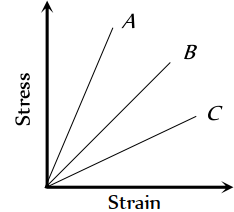
- A
Rubber, brass and steel respectively
- B
Brass, steel and rubber respectively
- ✓
Steel, brass and rubber respectively
- D
Steel, rubber and brass respectively
AnswerCorrect option: C. Steel, brass and rubber respectively
(c)$Y=\tan \theta \text {. According to figure } \theta_A>\theta_B>\theta_C $
$ \text { i.e. } \tan \theta_A>\tan \theta_B>\tan \theta_C \text { or } Y_A>Y_B>Y_C$
$\therefore A, B$, and $C$ graph are for steel, brass and rubber respectively.
View full question & answer→MCQ 2001 Mark
The points of maximum and minimum attraction in the curve between potential energy $(L)$ and distance $(r)$ of a diatomic molecules are respectively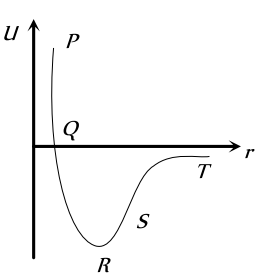
- A
Sand $R$
- B
$T$ and $S$
- C
$R$ and $S$
- ✓
$S$ and $T$
AnswerCorrect option: D. $S$ and $T$
(d) Attraction will be minimum when the distance between the molecule is maximum.Attraction will be maximum at that point where the positive slope is maximum because $F=-\frac{d U}{d x}$
View full question & answer→