Questions

Assertion & Reason

🎯

Test yourself on this topic

31 questions · timed · auto-graded

Question 11 Mark
Assertion : If the temperature of a semiconductor is increased then it's resistance decreases.
Reason : The energy gap between conduction band and valence band is very small
Answer
(a) In semiconductors the energy gap between conduction band and valence band is small $(\approx 1 \mathrm{eV})$. Due to temperature rise, electron in the valence band gained thermal energy and may jump across the small energy gap, goes in to the conduction band. Thus conductivity increases and hence resistance decreases.
View full question & answer
Question 21 Mark
Assertion : The temperature coefficient of resistance is positive for metals and negative for P-type semiconductor.
Reason : The effective charge carriers in metals are negatively charged whereas in $P$-type semiconductor they are positively charged.
Answer
(b)
View full question & answer
Question 31 Mark
Assertion : In a common emitter transistor amplifier the input current is much less than the output current.
Reason : The common emitter transistor amplifier has very high input impedance.
Answer
(c) In common emitter transistor amplifier current gain $\beta>1$, so output current > lnput current, hence assertion is correct.Also, input circuit has low resistance due to forward biasing to emitter base junction, hence reason is false.
View full question & answer
Question 41 Mark
Assertion : The number of electrons in a $P$-type silicon semiconductor is less than the number of electrons in a pure silicon semiconductor at room temperature.
Reason : it is due to law of mass action.
Answer
(a) According to law of mass action, $n_i^2=n_e n_h$. In intrinsic semiconductors $n=n=n$ and for $P$-type semiconductor $n$. would be less than $n$, since $n$ is necessarily more than $n$.
View full question & answer
Question 51 Mark
Assertion : The logic gate NOT can be built using diode.
Reason : The output voltage and the input voltage of the diode have $180^{\circ}$ phase difference.
Answer
(d) In diode the output is in same phase with the input therefore it cannot be used to built NOT gate.
View full question & answer
Question 61 Mark
Assertion : A transistor amplifier in common emitter configuration has a low input impedence.
Reason : The base to emitter region is forward biased.
Answer
(a) Input impedance of common emitter configuration$=\left.\frac{\Delta V_{B E}}{\Delta i_B}\right|_{V_{C E}=\text { constant }}$where $\Delta V_{B E}=$ voltage across base and emitter (base emitter region is forward biased)$\Delta i_B=$ base current which is order of few microampere.Thus input impedance of common emitter is low.
View full question & answer
Question 71 Mark
Assertion : The resistivity of a semiconductor increases with temperature.
Reason : The atoms of a semiconductor vibrate with larger amplitude at higher temperature there by increasing it's resistivity.
Answer
(d) Resistivity of semiconductors decreases with temperature. The atoms of a semiconductor vibrate with larger amplitudes at higher temperatures there by increasing it's conductivity not resistivity.
View full question & answer
Question 81 Mark
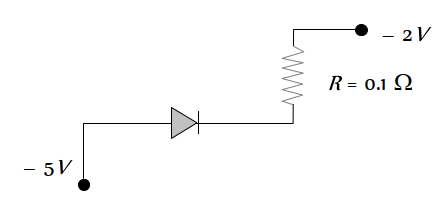
Assertion : In the following circuit the potential drop across the resistance is zero.
Image
Reason : The given resistance has low value.
Answer
(b) Both assertion and reason are true but potential difference across the resistance is zero, because diode is in reverse biasing hence no current flows.
View full question & answer
Question 91 Mark
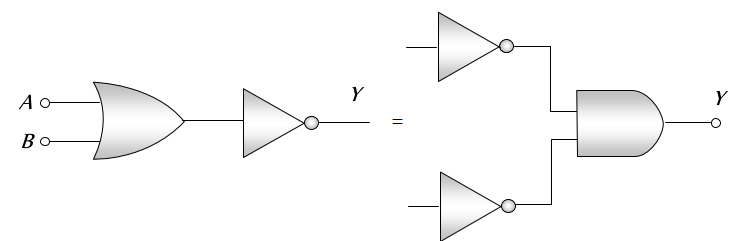
Assertion : De-morgan's theorem $\overline{A+B}=\bar{A} \cdot \bar{B}$ may be explained by the following circuit
Reason : In the following circuit, for output inputs $A B C$ are 101
View full question & answer
Question 101 Mark
Assertion : When $P N$-junction is forward biased then motion of charge carriers at junction is due to diffusion. In reverse biasing. The cause of motion of charge is drifting.
Reason : In the following circuit emitter is reverse biased and collector is forward biased.
Image
Answer
(b) In forward biasing of $P N$ junction current flows due to diffusion of majority charge carriers. While in reverse biasing current flows due to drifting of minority charge carriers.The circuit given in the reason is a $P N P$ transistor having emitter is more negative w.r.t. base so it is reverse biased and collector is more positive w.r.t. base so it is forward biased.
View full question & answer
Question 111 Mark
Assertion : 29 is the equivalent decimal number of binary number 11101.
Reason : $(11101)=(1 \times 2+1 \times 2+1 \times 2+0 \times 2+1 \times 2)$.$=(16+8+4+0+1)=(29)$
Answer
(a)
View full question & answer
Question 121 Mark
Assertion : 29 is the equivalent decimal number of binary number 11101.
Reason $\quad:(11101)=(1 \times 2+1 \times 2+1 \times 2+0 \times 2+1 \times 2)$.$=(16+8+4+0+1)=(29)$
Answer
(a) For detection of a particular wavelength $(\lambda)$ by a $P N$ photo diode, energy of incident light $>E \Rightarrow \frac{h c}{E_g}>\lambda$For $E_g=2.8 \mathrm{eV}, \frac{h c}{E_g}=\frac{6.6 \times 10^{-34} \times 3 \times 10^8}{2.8 \times 1.6 \times 10^{-19}}=441.9 \mathrm{~nm}$i.e. $\frac{h c}{E_g}<6000 \mathrm{~nm}$, so diode will not detect the wavelength of $6000 \ AA$.
View full question & answer
Question 131 Mark
Assertion : A $P-N$ photodiode is made from a semiconductor for which $E=2.8 eV$. This photo diode will not detect the wavelength of $6000 nm$.
Reason : A $P N$ photodiode detect wavelength $\lambda$ if $\frac{h c}{\lambda}>E_g$.
View full question & answer
Question 141 Mark
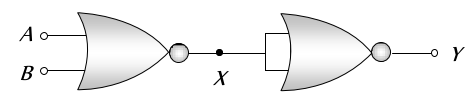
Assertion : The following circuit represents 'OR' gate
Image
Reason : For the above circuit (Y=\bar{X}=\overline{\overline{A+B}}=A+B$
Answer
(b) In vacuum tubes, vacuum is necessary and the working of semiconductor devices is independent of heating or vacuum.
View full question & answer
Question 161 Mark
Assertion : Zener diode works on a principle of breakdown voltage.
Reason : Current increases suddenly after breakdown voltage.
Answer
(a) When the reverse voltage across the zener diode is equal to or more than the breakdown voltage, the reverse current increases sharply.
View full question & answer
Question 171 Mark
Assertion $: V-i$ characteristic of $P-N$ junction diode is same as that of any other conductor.
Reason : $P-N$ junction diode behave as conductor at room temperature.
View full question & answer
Question 181 Mark
Assertion : The current gain in common base circuit is always less than one.
Reason : At constant collector voltage the change in collector current is more than the change in emitter current.
Answer
(c) The current gain in common base circuit $\alpha=\left(\frac{\Delta I_C}{\Delta I_E}\right)_{V_C}$The change in collector current is always less than the change in emitter current.$\Delta I_C<\Delta I_E$. Therefore, $\alpha<1$.
View full question & answer
Question 191 Mark
Assertion : Base in a transistor is made very thin as compared to collector and emitter regions.
Reason : Due to thin base power gain and voltage gain is obtained by a transistor.
Answer
(a) In a transistor, the base is made extremely thin to reduce the combinations of holes and electrons. Under this condition, most of the holes (or electrons) arriving from the emitter diffuses across the base and reach the collector. Hence, the collector current, is almost equal to the emitter current, the base current being comparatively much smaller. This is the main reason that power gain and voltage gain are obtained by a transistor. If the base region was made quite thick, then majority of carriers from emitter will combine with the carriers in the base and only small number of carriers will reach the collector, so there would be little collector current and the purpose of transistor would be defeated.
View full question & answer
Question 201 Mark
Assertion : At o $K$ Germanium is a superconductor.
Reason : At $0 K$ Germanium offers zero resistance.
Answer
(d) At $0 K$, Germanium offers infinite resistance, and it behaves as an insulator.
View full question & answer
Question 211 Mark
Assertion : NAND or NOR gates are called digital building blocks.
Reason : The repeated use of NAND (or NOR) gates can produce all the basic or complicated gates.
Answer
(a) These gates are called digital building blocks because using these gates only (either NAND or NOR) we can compile all other gates also (like OR, AND, NOT, XOR).
View full question & answer
Question 221 Mark
Assertion : A transistor is a voltage-operating device.
Reason : Base current is greater than the collector current.
Answer
(d) A transistor is a current operating device because the action of transistor is controlled by the charge carriers (electrons or holes). Base current is very much lesser than the collector current.
View full question & answer
Question 231 Mark
Assertion : The dominant mechanism for motion of charge carriers in forward and reverse biased silicon $P-N$ junction are drift in both forward and reverse bias.
Reason : In reverse biasing, no current flow through the junction.
Answer
(d) In $P N$-junction, the diffusion of majority carriers takes place when junction is forward biased and drifting of minority carriers takes place across the function, when reverse biased. The reverse bias opposes the majority carriers but makes the minority carriers to cross the $P N$-junction. Thus the small current in $\mu A$ flows during reverse bias.
View full question & answer
Question 241 Mark
Assertion : In transistor common emitter mode as an amplifier is preferred over common base mode.
Reason : In common emitter mode the input signal is connected in series with the voltage applied to the base emitter function.
Answer
(b) Common emitter is prepared over common base because all the current, voltage and power gain of common emitter amplifier is much more than the gains of common base amplifier.
View full question & answer
Question 251 Mark
Assertion : Two $P-N$ junction diodes placed back to back, will work as a NPN transistor.
Reason : The $P$-region of two $P N$ junction diodes back to back will form the base of NPN transistor.
Answer
(d) Two $P N$-junctions placed back to back cannot work as NPN transistor because in transistor the width and concentration of doping of $P$-semiconductor is less as compared to width doping of $\mathrm{N}$-type semiconductor type.
View full question & answer
Question 261 Mark
Assertion : Semiconductors do not Obey's Ohm's law.
Reason : Current is determined by the rate of flow of charge carriers.
Answer
(e) The assertion is not true. In fact, semiconductor Obeys Ohm's law for low values of electric field $(\sim 10 \cdot \mathrm{V} / \mathrm{m})$. Above this, the current becomes almost independent of electric field.
View full question & answer
Question 271 Mark
Assertion : We can measure the potential barrier of a $P N$ junction by putting a sensitive voltmeter across its terminals.
Reason : The current through the $P N$ junction is not same in forward and reversed bias.
Answer
(e) We cannot measure the potential barrier of a $P N$-junction by connecting a sensitive voltmeter across its terminals because in the depletion region, there are no free electrons and holes and in the absence of forward biasing, $P N$ - junction offers infinite resistance.
View full question & answer
Question 281 Mark
Assertion : Silicon is preferred over germanium for making semiconductor devices.
Reason : The energy gap for germanium is more than the energy gap of silicon.
Answer
(c) The energy gap for germanium is less $(0.72 \mathrm{eV})$ than the energy gap of silicon $(1.1 \mathrm{eV})$. Therefore, silicon is preferred over germanium for making semiconductor devices.
View full question & answer
Question 291 Mark
Assertion : The crystalline solids have a sharp melting point.
Reason : All the bonds between the atoms or molecules of a crystalline solids are equally strong, that they get broken at the same temperature.
Answer
(a) At a particular temperature all the bonds of crystalline solids breaks and show sharp melting point.
View full question & answer
Question 301 Mark
Assertion : An N-type semiconductor has a large number of electrons but still it is electrically neutral.
Reason : An N-type semiconductor is obtained by doping an intrinsic semiconductor with a pentavalent impurity.
View full question & answer
Question 311 Mark
Assertion : Electron has higher mobility than hole in a semiconductor.
Reason : Mass of electron is less than the mass of hole.
Answer
(a) The ratio of the velocity to the applied field is called the mobility. Since electron is lighter than holes, they move faster in applied field than holes.
View full question & answer