Questions

Assertion & Reason

🎯

Test yourself on this topic

21 questions · timed · auto-graded

Question 11 Mark
Assertion : The possibility of an electric bulb fusing is higher at the time of switching ON and OFF
Reason : Inductive effects produce a surge at the time of switch ON and OFF
Answer
(a) The possibility of an electric bulb fusing is higher at the time of switching ON and switching OFF because inductive effect produces a surge at the time of switching $\mathrm{ON}$ and OFF.
View full question & answer
Question 21 Mark
Assertion : A laser beam $0.2 W$ power can drill holes through a metal sheet, whereas $1000 W$ torch-light cannot.
Reason : The frequency of laser light is much higher then that of torch light.
Answer
(c) A laser beam is a beam of light which is light amplification by stimulated emission of radiation.The energy per unit area of the laser beam is very high as compared to the torch light.
View full question & answer
Question 31 Mark
Assertion : Electric appliances with metallic body; e.g. heaters, presses etc, have three pin connections, whereas an electric bulb has a two pin connection.
Reason : Three pin connections reduce heating of connecting cables.
Answer
(c) The electrical appliances with metallic body like heater, press etc. have three pin connections. Two pins are for supply line and third pin is for earth connection for safety purposes.
View full question & answer
Question 41 Mark
Assertion : A domestic electrical appliance, working on a three pin will continue working even if the top pin is removed.
Reason : The third pin is used only as a safety device.
Answer
(a) Follow hint of question 15 of this section.
View full question & answer
Question 51 Mark
Assertion : When temperature of cold junction of a thermocouple is lowered, the value of neutral temperature of this thermocouple is raised.
Reason : When the difference of temperature of two junction is raised, more thermo e.m.f. is produced.
Answer
(d) Here assertion and reason are not correct.
View full question & answer
Question 61 Mark
Assertion : Thermocouple acts as a heat engine.
Reason : When two junctions of thermocouple are at different temperature, thermo e.m.f. is produced.
Answer
(b) Here reason is not the correct explanation of the assertion, which is correct.
View full question & answer
Question 71 Mark
Assertion : The presence of water molecules makes separation of ions easier in electrolyte.
Reason : The presence of water molecules in electrolyte decreases the resistance of electrolyte.
Answer
(b) The presence of water molecules reduces force between ions by $1 / 81$ times because the value of dielectric constant of water is 81.That is why the separation between ions becomes easier.
View full question & answer
Question 81 Mark
Assertion : In all conductors, for studying the thermoelectric behaviour or metals, lead is taken as a reference metal.
Reason $\quad:$ In lead, the Thomson effect is negative.
Answer
(c) Thomson e.m.f. in lead is practically zero.
View full question & answer
Question 91 Mark
Assertion : Heat is generated continuously is an electric heater but its temperature becomes constant after some time.
Reason : At the stage when heat produced in heater is equal to the heat dissipated to its surrounding the temperature of heater becomes constant.
Answer
(a)
View full question & answer
Question 101 Mark
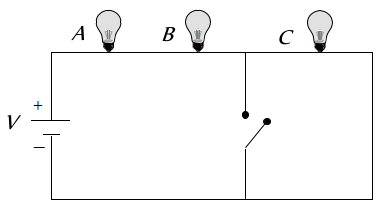
Assertion $\quad:$ If three identical bulbs are connected in series as shown in figure then on closing the switches. Bulb $C$ short circuited and hence illumination of bulbs $A$ and $B$ decreases.Image
Reason $\quad:$ Voltage on $A$ and $B$ decreases
Answer
(d) When switch $S$ is closed, bulb $C$ is short circuited, so voltage $V$ distributes only in two parts i.e. voltage on Bulb $A$ and $B$ increases as compared previously. Hence illumination of Bulb $A$ and $B$ increases.
View full question & answer
Question 111 Mark
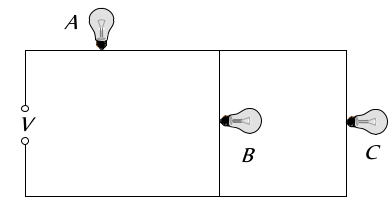
Assertion $:$ In the given circuit if lamp $B$ or $C$ fuses then light emitted by lamp $A$ decreasesImage
Reason : Voltage on $A$ decreases.
Answer
(a) When lamp $B$ or $C$ gets fused equivalent resistance of $B$ and $C$ increases. In series voltage distributes in the ratio of resistance, so voltage appears across $B$ increases or in other words voltage across $A$ decreases.
View full question & answer
Question 121 Mark
Assertion : Leclanche cell is used, when constant supply of electric current is not required.
Reason : The e.m.f. of a Leclanche cell falls, if it is used continuously.
Answer
(a) The e.m.f. of a Leclanche cell falls, because of the partial polarisation due to accumulation of hydrogen gas. In case, Leclanche cell is used in experiment, where current is drawn after short breaks, then during each break, hydrogen gas escapes and $\mathrm{Mn}_2 \mathrm{O}_3$ converts into $\mathrm{MnO}_2$ by taking oxygen from the atmosphere. As a result, the cell regains its original e.m.f.
View full question & answer
Question 131 Mark
Assertion : In practical application, power rating of resistance is not important.
Reason : Property of resistance remain same even at high temperature.
Answer
(d) Because of heat production every resistance has a maximum power rating, the maximum power that can be dissipated without overheating the device. When this rating is exceeded, heat is produced, due to which resistance may change unpredictably.
View full question & answer
Question 141 Mark
Assertion : Neutral temperature of a thermocouple does not depend upon temperature of cold junction.
Reason : lts value is constant for the given metals of the couple.
Answer
(b) Neutral temperature is the temperature of hot junction, at which the thermo e.m.f. produced in the thermocouple becomes maximum. It is independent of cold junction and depends on the nature of materials of two metals used to form thermocouple.
View full question & answer
Question 151 Mark
Assertion : Through the same current flows through the line wires and the filament of the bulb but heat produced in the filament is much higher then that in line wires.
Reason : The filament of bulbs is made of a material of high resistance and high melting point.
Answer
(a) As filament of bulb and line wire are in series, hence current through both is same. Now, because $H=\frac{i^2 R t}{4.2}$ and resistance of the filament of the bulb is much higher than that of line wires, hence heat produced in the filament is much higher than that in line wires.
View full question & answer
Question 161 Mark
Assertion : Current is passed through a metallic wire, heating it red. When cold water is poured on half of its portion, then rest of the half portion become more hot.
Reason : Resistances decreases due to decrease in temperature and so current through wire increases.
Answer
(a) When cold water is poured on half portion of the wire, its resistance decreases due to decrease in temperature. As a result of this total resistance of circuit decreases i.e. current through each portion of wire increases i.e. rest of the half portion becomes still more hot.
View full question & answer
Question 171 Mark
Assertion : An electric bulb is first connected to a dc source and then to a ac source having the same brightness in both the cases.
Reason : The peak value of voltage for an A.C. source is $\sqrt{2}$ times the root mean square voltage.
Answer
(e) Voltage of dc source is constant but in ac, peak value of voltage is $\sqrt{2}$ times the $r m s$. voltage. Hence bulb will glow with more brightness when connected to an ac source of the same voltage.
View full question & answer
Question 181 Mark
Assertion : Two bulbs of same wattage, one having a carbon filament and the other having a metallic filament are connected in series. Metallic bulbs will glow more brightly than carbon filament bulb.
Reason $\quad:$ Carbon is a semiconductor.
Answer
(d) When two bulbs are connected in series, the resistance of the circuit increases and so the voltage in each decreases, hence the brightness and the temperature also decreases. Due to decrease in temperature, the resistance of the carbon filament will slightly increase while that of metal filament will decrease. Hence, carbon filament bulb will glow more brightly $\left(P=i^2 R\right)$. Also carbon is not a semiconductor.
View full question & answer
Question 191 Mark
Assertion : Two electric bulbs of 50 and $100 W$ are given. When connected in series $50 W$ bulb glows more but when connected parallel $100 W$ bulb glows more.
Reason : In series combination, power is directly proportional to the resistance of circuit. But in parallel combination, power is inversely proportional to the resistance of the circuit.
Answer
(a) Resistance of $50 \mathrm{~W}$ bulb is two times the resistance of $100 W$ bulb. When bulbs are connected in series, $50 W$ bulb will glow more as $P=i^2 R$ (current remains same in series). In parallel the $100 \mathrm{~W}$ bulb will glow more as $P=V^2 / R$ (potential difference remain same in parallel).
View full question & answer
Question 201 Mark
Assertion : Fuse wire must have high resistance and low melting point.
Reason : Fuse is used for small current flow only.
Answer
(c) Assertion is true but reason is false. Fuse wire must have high resistance because in series current remains same, therefore according to Joule's law $H=\frac{i^2 R t}{4.2}$, heat produced is high if $R$ is high. The melting point must be low so that wire may melt with increase in temperature. As the current equal to maximum safe value, flows through the fuse wire, it heats up, melts and break the circuit.
View full question & answer
Question 211 Mark
Assertion : The $200 W$ bulbs glows with more brightness then $100 W$ bulbs.
Reason : A $100 W$ bulb has more resistance than a $200 W$ bulb.
Answer
(a) The resistance, $R=\frac{V^2}{P} \Rightarrow R \propto 1 / P$i.e., higher is the wattage of a bulb, lesser is the resistance and so it will glow bright.
View full question & answer