MCQ 2011 Mark
The magnetic field due to the earth is closely equivalent to that due to
- ✓
A large magnet of length equal to the diameter of the earth
- B
A magnetic dipole placed at the centre of the earth
- C
A large coil carrying current
- D
AnswerCorrect option: A. A large magnet of length equal to the diameter of the earth
View full question & answer→MCQ 2021 Mark
The magnetic compass is not useful for navigation near the magnetic poles because
- A
The magnetic field near the poles is zero
- ✓
The magnetic field near the poles is almost vertical
- C
At low temperature, the compass needle looses its magnetic properties
- D
AnswerCorrect option: B. The magnetic field near the poles is almost vertical
View full question & answer→MCQ 2031 Mark
Two magnets of same size and mass make respectively $10$ and $15$ oscillations per minute at certain place. The ratio of their magnetic moments is
- ✓
$4: 9$
- B
$9: 4$
- C
$2: 3$
- D
$3: 2$
AnswerCorrect option: A. $4: 9$
$ T=2 \pi \sqrt{\frac{1}{M B_H}} \Rightarrow \frac{T_1}{T_2}=\sqrt{\frac{M_2}{M_1}} $
$ \Rightarrow \frac{M_1}{M_2}=\frac{T_2^2}{T_1^2}=\frac{(60 / 15)^2}{(60 / 10)^2}=\frac{4}{9}$
View full question & answer→MCQ 2041 Mark
The permanent magnet is made from which one of the following substances
MCQ 2051 Mark
A magnet when placed perpendicular to a uniform field of strength $10^{-4} \mathrm{~Wb} / \mathrm{m}^2$ experiences a maximum couple of moment $4 \times 10^{-5} \mathrm{~N} / \mathrm{m}$. . What is its magnetic moment
- ✓
$0.4 \mathrm{~A} \times \mathrm{m}^2$
- B
$0.2 \mathrm{~A} \times \mathrm{m}^2$
- C
$0.16 \mathrm{A \times m}{ }^2$
- D
$0.04 \mathrm{~A} \times \mathrm{m}^2$ / $0.06 \mathrm{~A} \times \mathrm{m}^2$
AnswerCorrect option: A. $0.4 \mathrm{~A} \times \mathrm{m}^2$
$C_{\max }=M B \Rightarrow 4 \times 10^{-5}=M \times 10^{-4} \Rightarrow M=0.4 \mathrm{~A} \times \mathrm{m}^2$
View full question & answer→MCQ 2061 Mark
Which of the following is true
- A
Diamagnetism is temperature dependent
- ✓
Paramagnetism is temperature dependent
- C
Paramagnetism is temperature independent
- D
AnswerCorrect option: B. Paramagnetism is temperature dependent
With rise in temperature their magnetic susceptibility decreases i.e. $\chi_m \propto \frac{1}{T}$
View full question & answer→MCQ 2071 Mark
The figure illustrate how $B$, the flux density inside a sample of unmagnetised ferromagnetic material varies with $B$, the magnetic flux density in which the sample is kept. For the sample to be suitable for making a permanent magnet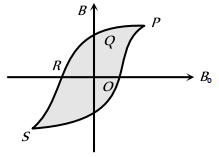
- A
$O Q$ should be large, $O R$ should be small
- ✓
$O Q$ and $O R$ should both be large
- C
$O Q$ should be small and $O R$ should be large
- D
$O Q$ and $O R$ should both be small
AnswerCorrect option: B. $O Q$ and $O R$ should both be large
In the given figure $O Q$ refers to retentivity while $O R$ refers to corecivity, for permanents both retentivity and corecivity should be high.
View full question & answer→MCQ 2081 Mark
The magnetic needle of a tangent galvanometer is deflected at an angle $30$ due to a magnet. The horizontal component of earth's magnetic field $0.34 \times 10^{-} T$ is along the plane of the coil. The magnetic intensity is
- A
$1.96 \times 10^{-7} \mathrm{~T}$
- ✓
$1.96 \times 10^{-5} \mathrm{~T}$
- C
$1.96 \times 10^{3} \mathrm{~T}$
- D
$1.96 \times 10^{4} \mathrm{~T}$
AnswerCorrect option: B. $1.96 \times 10^{-5} \mathrm{~T}$
$B=B_H \tan \theta=0.34 \times 10^{-4} \tan 30^{\circ}=1.96 \times 10^{-5} \mathrm{~T}$
View full question & answer→MCQ 2091 Mark
When a magnetic substance is heated, then it
- A
- ✓
- C
Does not effect the magnetism
- D
View full question & answer→MCQ 2101 Mark
Angle of dip is $90$ at
View full question & answer→MCQ 2111 Mark
Force between two identical bar magnets whose centres are $r$ metre apart is $4.8 \mathrm{~N}$, when their axes are in the same line. If separation is increased to $2 r$, the force between them is reduced to
- A
$2.4 \mathrm{~N}$
- B
$1.2 \mathrm{~N}$
- C
$0.6 \mathrm{~N}$
- ✓
$0.3 \mathrm{~N}$
AnswerCorrect option: D. $0.3 \mathrm{~N}$
In magnetic dipole, force $\propto \frac{1}{r^4}$Hence new force $=\frac{4.8}{2^4}=\frac{4.8}{16}=0.3 \mathrm{~N}$
View full question & answer→MCQ 2121 Mark
liquid oxygen remains suspended between two pole faces of a magnet because it is
MCQ 2131 Mark
A frog can be deviated in a magnetic field produced by a current in a vertical solenoid placed below the frog. This is possible because the body of the frog behaves as
AnswerDiamagnetic substances are repelled by the magnetic field.
View full question & answer→MCQ 2141 Mark
Magnetic permeability is maximum for
MCQ 2151 Mark
A magnet makes $40$ oscillations per minute at a place having magnetic field intensity of $0.1 \times 10^{-6} . T$. At another place, it takes $2.5 \mathrm{sec}$ to complete one vibration. The value of earth's horizontal field at that place is
AnswerCorrect option: B. $0.36 \times 10^{-6} \ T$
$T=2 \pi \sqrt{\frac{I}{M \times B_H}} \Rightarrow T \propto \frac{1}{\sqrt{B_H}}$
$ \Rightarrow \frac{T_1}{T_2}=\sqrt{\frac{\left(B_H\right)_2}{\left(B_H\right)_1}} \Rightarrow \frac{60 / 40}{2.5}=\sqrt{\frac{\left(B_H\right)_2}{0.1 \times 10^{-5}}}$
$\Rightarrow\left(B_H\right)_2=0.36 \times 10^{-6} T$
View full question & answer→MCQ 2161 Mark
Which of the following is most suitable for the core of electromagnets
AnswerSoft iron is highly ferromagnetic.
View full question & answer→MCQ 2171 Mark
A magnetic needle lying parallel to a magnetic field requires $W$ units of work to turn it through $60^{\circ}$. The torque required to maintain the needle in this position will be
- ✓
$\sqrt{3} W$
- B
$w$
- C
$\frac{\sqrt{3}}{2} W$
- D
$2 W$
AnswerCorrect option: A. $\sqrt{3} W$
$ W=M B\left(\cos \theta_1-\cos \theta_2\right)=M B\left(\cos 0^{\circ}-\cos 60^{\circ}\right)$
$ =M B\left(1-\frac{1}{2}\right)=\frac{M B}{2}$
and $\tau=M B \sin \theta=M B \sin 60^{\circ}=M B \frac{\sqrt{3}}{2}$
$\therefore \tau=\left(\frac{M B}{2}\right) \sqrt{3} \Rightarrow \tau=\sqrt{3} W$
View full question & answer→MCQ 2181 Mark
A thin rectangular magnet suspended freely has a period of oscillation equal to $T$. Now it is broken into two equal halves (each having half of the original length) and one piece is made to oscillate freely in the same field. If its period of oscillation is $T^{\prime}$, then ratio $\frac{T^{\prime}}{T}$ is
- A
$\frac{1}{4}$
- B
$\frac{1}{2 \sqrt{2}}$
- ✓
$\frac{1}{2}$
- D
$2$
AnswerCorrect option: C. $\frac{1}{2}$
Oscillation of $n$ part of magnet $T^{\prime}=\frac{T}{n}$
$\Rightarrow \frac{T^{\prime}}{T}=\frac{1}{n}$;
here $n=2$ so $\frac{T^{\prime}}{T}=\frac{1}{2}$.
View full question & answer→MCQ 2191 Mark
The magnetic lines of force inside a bar magnet
- ✓
Are from south-pole to north-pole of the magnet
- B
Are from north-pole to south-pole of the magnet
- C
- D
Depend upon the area of cross-section of the bar magnet
AnswerCorrect option: A. Are from south-pole to north-pole of the magnet
View full question & answer→MCQ 2201 Mark
The magnetic susceptibility is negative for
- A
- ✓
- C
- D
Paramagnetic and ferromagnetic materials
View full question & answer→MCQ 2211 Mark
Magnetic dipole moment is a
MCQ 2221 Mark
lsogonic lines on magnetic map will have
- A
- B
Zero angle of declination
- ✓
Same angle of declination
- D
AnswerCorrect option: C. Same angle of declination
View full question & answer→MCQ 2231 Mark
At which place, earth's magnetism become horizontal
AnswerAt equator angle of dip is zero.
View full question & answer→MCQ 2241 Mark
If a magnet is hanged with its magnetic axis then it stops in
MCQ 2251 Mark
The direction of the null points is on the equatorial line of a bar magnet, when the north pole of the magnet is pointing
MCQ 2261 Mark
Two magnets, each of magnetic moment ' $M$ are placed so as to form a cross at right angles to each other. The magnetic moment of the system will be
- A
$2 \mathrm{M}$
- ✓
$\sqrt{2} M$
- C
$0.5 \mathrm{M}$
- D
$M$
AnswerCorrect option: B. $\sqrt{2} M$
View full question & answer→MCQ 2271 Mark
A bar magnet of magnetic moment $200 A-m$ is suspended in a magnetic field of intensity $0.25 \mathrm{~N} / \mathrm{A}-\mathrm{m}$. The couple required to deflect it through $30$ is
- A
$50 \mathrm{~N}-\mathrm{m}$
- ✓
$25 \mathrm{~N}-\mathrm{m}$
- C
$20 \mathrm{~N}-\mathrm{m}$
- D
$15 \mathrm{~N}-\mathrm{m}$
AnswerCorrect option: B. $25 \mathrm{~N}-\mathrm{m}$
$ \tau=M B \sin \theta$
$ \tau=200 \times 0.25 \times \sin 30^{\circ}=25 N \times m$
View full question & answer→MCQ 2281 Mark
Diamagnetic substances are
- A
Feebly attracted by magnets
- B
Strongly attracted by magnets
- ✓
Feebly repelled by magnets
- D
Strongly repelled by magnets
AnswerCorrect option: C. Feebly repelled by magnets
View full question & answer→MCQ 2291 Mark
Substances in which the magnetic moment of a single atom is not zero, is known as
AnswerThe property of paramagnetism is found in these substances whose atoms have an excess of electrons spinning in the same direction. Hence atoms of paramagnetic substances have a net non-zero magnetic moment of their own.
View full question & answer→MCQ 2301 Mark
Two bar magnets with magnetic moments $2 \mathrm{M}$ and $M$ are fastened together at right angles to each other at their centres to form a crossed system, which can rotate freely about a vertical axis through the centre. The crossed system sets in earth's magnetic field with magnet having magnetic moment $2 M$ making and angle $\theta$ with the magnetic meridian such that
- A
$\theta=\tan ^{-1}\left(\frac{1}{\sqrt{3}}\right)$
- B
$\theta=\tan ^{-1}(\sqrt{3})$
- ✓
$\theta=\tan ^{-1}\left(\frac{1}{2}\right)$
- D
$\theta=\tan ^{-1}\left(\frac{3}{4}\right)$
AnswerCorrect option: C. $\theta=\tan ^{-1}\left(\frac{1}{2}\right)$
View full question & answer→MCQ 2311 Mark
The sensitivity of a tangent galvanometer is increased if
AnswerSensitivity $S=\frac{\theta}{i}=\frac{\theta}{K \tan \theta}$ where $K=\frac{2 R B_H}{\mu_0 N}$
For increasing sensitivity $K$ should be decreased and hence number of turns should be increased.
View full question & answer→MCQ 2321 Mark
The direction of line of magnetic field of bar magnet is
- A
From south pole to north pole
- B
From north pole to south pole
- C
- ✓
From south pole to north pole inside the magnet and from north pole to south pole outside the magnet
AnswerCorrect option: D. From south pole to north pole inside the magnet and from north pole to south pole outside the magnet
View full question & answer→MCQ 2331 Mark
A dip circle is at right angle to the magnetic meridian. What will be the apparent dip
- A
$0^{\circ}$
- B
$30^{\circ}$
- C
$60^{\circ}$
- ✓
$90^{\circ}$
AnswerCorrect option: D. $90^{\circ}$
View full question & answer→MCQ 2341 Mark
A current loop placed in a magnetic field behaves like a
MCQ 2351 Mark
View full question & answer→MCQ 2361 Mark
When a piece of a ferromagnetic substance is put in a uniform magnetic field, the flux density inside it is four times the flux density away from the piece. The magnetic permeability of the material is
Answer$\mu_r=\frac{B}{B_0}=4$
View full question & answer→MCQ 2371 Mark
The materials suitable for making electromagnets should have
- A
High retentivity and high coercivity
- B
Low retentivity and low coercivity
- ✓
High retentivity and low coercivity
- D
Low retentivity and high coercivity
AnswerCorrect option: C. High retentivity and low coercivity
View full question & answer→MCQ 2381 Mark
If a diamagnetic solution is poured into a $U-$ tube and one arm of this $U-$ tube placed between the poles of a strong magnet with the meniscus in a line with the field, then the level of the solution will
View full question & answer→MCQ 2391 Mark
Magnets cannot be made from which of the following substances
MCQ 2401 Mark
Two identical bar magnets are placed on above the other such that they are mutually perpendicular and bisect each other. The time period of this combination in a horizontal magnetic field is $T$. The time period of each magnet in the same field is
- A
$\sqrt{2} T$
- B
$2^{\frac{1}{4}} T$
- ✓
$2^{-\frac{1}{4}} T$
- D
$2^{-\frac{1}{2}} T$
AnswerCorrect option: C. $2^{-\frac{1}{4}} T$
View full question & answer→MCQ 2411 Mark
The length of a magnet is large compared to its width and breadth. The time period of its oscillation in a vibration magnetometer is $2 \mathrm{~s}$. The magnet is cut along its length into three equal parts and three parts are then placed on each other with their like poles together. The time period of this combination will be
- A
$2 s$
- ✓
$2 / 3 s$
- C
$2 \sqrt{3} s$
- D
$2 / \sqrt{3} s$
AnswerCorrect option: B. $2 / 3 s$
Initially, the time period of the magnet$T=2=2 \pi \sqrt{\frac{I}{M B}}$
For each part, it's moment of inertia $=\frac{I}{27}$ and magnetic moment $=\frac{M}{3}$
$\therefore$ Moment of inertia of system $I_s=\frac{I}{27} \times 3=\frac{I}{9}$
Magnetic moment of system $M_s=\frac{M}{3} \times 3=M$Time period of system$T_s=2 \pi \sqrt{\frac{I_s}{M_s B}}=\frac{1}{3} \times 2 \pi \sqrt{\frac{I}{M B}}=\frac{T}{3}=\frac{2}{3} \mathrm{sec}$
View full question & answer→MCQ 2421 Mark
When $2$ amperes current is passed through a tangent galvanometer, it gives a deflection of $30.$ For $60$ deflection, the current must be
AnswerCorrect option: D. $6 a m p$
$i \propto \tan \phi \Rightarrow \frac{i_1}{i_2}=\frac{\tan \phi_1}{\tan \phi_2} $
$ \Rightarrow \frac{2}{i_2}=\frac{\tan 30}{\tan 60} \Rightarrow i_2=6 \mathrm{amp}$
View full question & answer→MCQ 2431 Mark
A magnet freely suspended in a vibration magnetometer makes $10$ oscillations per minute at a place $A$ and $20$ oscillations per minute at a place $B$. If the horizontal component of earth's magnetic field at $A$ is $36 \times 10^{-6} T$, then its value at $B$ is
- A
$36 \times 10^{-6} T$
- B
$72 \times 10^{-6} T$
- ✓
$144 \times 10^{-6} T$
- D
$288 \times 10^{-6} T$
AnswerCorrect option: C. $144 \times 10^{-6} T$
$ \frac{T_A}{T_B}=\sqrt{\frac{\left(B_H\right)_B}{\left(B_H\right)_A}} \Rightarrow \frac{60 / 10}{60 / 20}=\sqrt{\frac{\left(B_H\right)_B}{36 \times 10^{-6}}} $
$ \Rightarrow\left(B_H\right)_B=144 \times 10^{-6} T$
View full question & answer→MCQ 2441 Mark
The time period of a thin bar magnet in earth's magnetic field is $T$. If the magnet is cut into two equal parts perpendicular to its length, the time period of each part in the same field will be
- ✓
(a) $\frac{T}{2}$
- B
(b) $T$
- C
(c) $\sqrt{2} T$
- D
(d) $2 T$
AnswerCorrect option: A. (a) $\frac{T}{2}$
(a) $\quad T^{\prime}=\frac{T}{n}$
View full question & answer→MCQ 2451 Mark
The time period of oscillation of a bar magnet suspended horizontally along the magnetic meridian is $T$. If this magnet is replaced by another magnet of the same size and pole strength but with double the mass, the new time period will be
- A
$\frac{T_0}{2}$
- B
$\frac{T_0}{\sqrt{2}}$
- ✓
$\sqrt{2} T_0$
- D
$2 T_0$
AnswerCorrect option: C. $\sqrt{2} T_0$
$T=2 \pi \sqrt{\frac{I}{M B_H}} \Rightarrow T \propto \sqrt{I} \propto \sqrt{\mathrm{w}} \Rightarrow T^{\prime}=\sqrt{2} T_0$
View full question & answer→MCQ 2461 Mark
The strength of the magnetic field in which the magnet of a vibration magnetometer is oscillating is increased $4$ times its original value. The frequency of oscillation would then become
AnswerThe frequency of oscillation $(ff)$ of a magnet in a vibration magnetometer is given by:
$f\ \alpha \ B \ f \ \alpha\ B$
where $BB$ is the strength of the magnetic field.
If the magnetic field is increased $4$ times $(B′=4B\ B′= 4B),$ then:
$f′=f_0 \ B′B=f_0 \ 4B \ B=f_0 \ \times 2 f′$
$=f_0\ B \ B′=f_0 \ B_4 \ B=f_0 \times 2$
So, the frequency becomes twice its original value.
View full question & answer→MCQ 2471 Mark
A magnet of magnetic moment $M$ oscillating freely in earth's horizontal magnetic field makes $n$ oscillations per minute. If the magnetic moment is quadrupled and the earth's field is doubled, the number of oscillations made per minute would be
- A
$\frac{n}{2 \sqrt{2}}$
- B
$\frac{n}{\sqrt{2}}$
- ✓
$2 \sqrt{2} n$
- D
$\sqrt{2} n$
AnswerCorrect option: C. $2 \sqrt{2} n$
No. of oscillation per minute $=\frac{1}{2 \pi} \sqrt{\frac{M B_H}{I}}$
$\Rightarrow n \propto \sqrt{M B_H} ; M \rightarrow 4 \text { times } $
$B_H \rightarrow 2 \text { times }$
So $v \rightarrow \sqrt{8}$ timesi.e. $v^{\prime}=\sqrt{8} v=2 \sqrt{2} n$
View full question & answer→MCQ 2481 Mark
A bar magnet $A$ of magnetic moment $M$ is found to oscillate at a frequency twice that of magnet $B$ of magnetic moment $M$ when placed in a vibrating magneto-meter. We may say that
- A
$M_A=2 M_B$
- B
$M_A=8 M_B$
- ✓
$M_A=4 M_B$
- D
$M_B=8 M_A$
AnswerCorrect option: C. $M_A=4 M_B$
$ v=\frac{1}{2 \pi} \sqrt{\frac{M B_H}{I}} \Rightarrow v \propto \sqrt{M} $
$ \Rightarrow \frac{v_A}{v_B}=\sqrt{\frac{M_A}{M_B}} \Rightarrow \frac{2}{1}=\sqrt{\frac{M_A}{M_B}} \Rightarrow M_A=4 M_B$
View full question & answer→MCQ 2491 Mark
To compare magnetic moments of two magnets by vibration magnetometer, 'sum and difference method' is better because
- A
Determination of moment of inertia is not needed which minimises the errors
- B
Less observations are required
- C
Comparatively less calculations
- ✓
View full question & answer→MCQ 2501 Mark
If a brass bar is placed on a vibrating magnet, then its time period
- A
- ✓
- C
- D
First increases then decreases
View full question & answer→