MCQ 511 Mark
A particle is projected up with an initial velocity of $80 ft / sec$. The ball will be at a height of $96 ft$ from the ground after
- ✓
2.0 and $3.0 sec$
- B
Only at $3.0 sec$
- C
Only at $2.0 sec$
- D
After 1 and $2 sec$
AnswerCorrect option: A. 2.0 and $3.0 sec$
(a)
$h=u t-\frac{1}{2} g t^2 \Rightarrow 96=80 t-\frac{32}{2}t^2\Rightarrow t^2-5 t+6=0 \Rightarrow t=2 \mathrm{sec} \text { or } 3\mathrm{sec}$
View full question & answer→MCQ 521 Mark
A body $A$ moves with a uniform acceleration $a$ and zero initial velocity. Another body $B$, starts from the same point moves in the same direction with a constant velocity $v$. The two bodies meet after a time $t$. The value of $t$ is
- ✓
$\frac{2 v}{a}$
- B
$\frac{v}{a}$
- C
$\frac{v}{2 a}$
- D
$\sqrt{\frac{v}{2 a}}$
AnswerCorrect option: A. $\frac{2 v}{a}$
(a) $\frac{1}{2} a t^2=v t \Rightarrow t=\frac{2 v}{a}$
View full question & answer→MCQ 531 Mark
A body falls from rest in the gravitational field of the earth. The distance travelled in the fifth second of its motion is $\left(g=10 m / s^2\right)$
- A
$25 m$
- ✓
$45 m$
- C
$90 m$
- D
$125 m$
AnswerCorrect option: B. $45 m$
(b) $h_n=\frac{g}{2}(2 n-1) \Rightarrow h_{5^{\text {th }}}=\frac{10}{2}(2 \times 5-1)=45 \mathrm{~m}$.
View full question & answer→MCQ 541 Mark
The ratio of the numerical values of the average velocity and average speed of a body is always
Answer(b) $\frac{\mid \text { Average velocity } \mid}{\mid \text { Average speed }\mid=\frac{\mid \text { displacement } \mid}{\mid \text { distance } \mid} \leq 1$because displacement will either be equal or less than distance. lt can never be greater than distance.
View full question & answer→MCQ 551 Mark
The path of a particle moving under the influence of a force fixed in magnitude and direction is
MCQ 561 Mark
A man throws a ball vertically upward and it rises through $20 m$ and returns to his hands. What was the initial velocity ( $u$ ) of the ball and for how much time $(T)$ it remained in the air $\left[g=10 m / s^2\right]$
- A
$u=10 m / s , T=2 s$
- B
$u=10 m / s , T=4 s$
- C
$u=20 m / s , T=2 s$
- ✓
$u=20 m / s , T=4 s$
AnswerCorrect option: D. $u=20 m / s , T=4 s$
(d)
$u=\sqrt{2 g h}=\sqrt{2 \times 10 \times 20}=20 \mathrm{~m} / \mathrm{s} $
$\text { and } T=\frac{2 u}{g}=\frac{2 \times 20}{10}=4 \mathrm{sec}$
View full question & answer→MCQ 571 Mark
A body starts to fall freely under gravity. The distances covered by it in first, second and third second are in ratio
- ✓
$1: 3: 5$
- B
$1: 2: 3$
- C
$1: 4: 9$
- D
$1: 5: 6$
AnswerCorrect option: A. $1: 3: 5$
(a) $\quad S_n=u+\frac{g}{2}(2 n-1) ;$ when $u=0, S_1: S_2: S_3=1: 3: 5$
View full question & answer→MCQ 581 Mark
A body of mass $10 kg$ is moving with a constant velocity of $10 m / s$. When a constant force acts for 4 seconds on it, it moves with a velocity $2 m / sec$ in the opposite direction. The acceleration produced in it is
- A
$3 m / \sec ^2$
- ✓
$-3 m / \sec ^2$
- C
$0.3 m / sec ^2$
- D
$-0.3 m / sec ^2$
AnswerCorrect option: B. $-3 m / \sec ^2$
(b) $v=u+a t \Rightarrow-2=10+a \times 4 \Rightarrow a=-3 \mathrm{~m} / \mathrm{sec}^2$
View full question & answer→MCQ 591 Mark
A bullet is fired with a speed of $1000 m / sec$ in order to hit a target $100 m$ away. If $g=10 m / s ^2$, the gun should be aimed
- A
Directly towards the target
- ✓
$5 cm$ above the target
- C
$10 cm$ above the target
- D
$15 cm$ above the target
AnswerCorrect option: B. $5 cm$ above the target
View full question & answer→MCQ 601 Mark
A particle moving with a uniform acceleration travels $24 m$ and 64 $m$ in the first two consecutive intervals of $4 sec$ each. Its initial velocity is
- ✓
$1 m / sec$
- B
$10 m / sec$
- C
$5 m / sec$
- D
$2 m / sec$
AnswerCorrect option: A. $1 m / sec$
(a) Distance travelled in $4 \mathrm{sec}$$24=4 u+\frac{1}{2} a \times 16$Distance travelled in total $8 \mathrm{sec}$$88=8 u+\frac{1}{2} a \times 64$After solving (i) and (ii), we get $u=1 \mathrm{~m} / \mathrm{s}$.
View full question & answer→MCQ 611 Mark
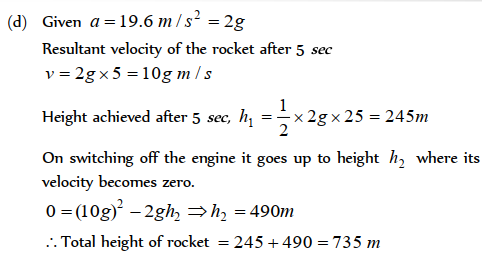
A rocket is fired upward from the earth's surface such that it creates an acceleration of $19.6 m / sec$. If after $5 sec$ its engine is switched off, the maximum height of the rocket from earth's surface would be
- A
$245 m$
- B
$490 m$
- C
$980 m$
- ✓
$735 m$
AnswerCorrect option: D. $735 m$
\
View full question & answer→MCQ 621 Mark
An aeroplane is moving with horizontal velocity $u$ at height $h$. The velocity of a packet dropped from it on the earth's surface will be ( $g$ is acceleration due to gravity)
- ✓
$\sqrt{u^2+2 g h}$
- B
$\sqrt{2 g h}$
- C
$2 g h$
- D
$\sqrt{u^2-2 g h}$
AnswerCorrect option: A. $\sqrt{u^2+2 g h}$
(a) Horizontal velocity of dropped packet $=u$ Vertical velocity $=\sqrt{2 g (\therefore$ Resultant velocity at earth $=\sqrt{u^2+2 g h}$
View full question & answer→MCQ 631 Mark
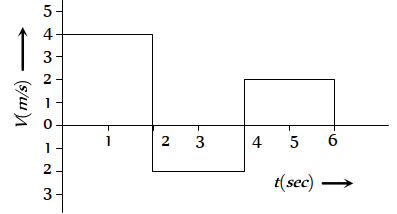
The velocity-time graph of a body moving in a straight line is shown in the figure. The displacement and distance travelled by the body in 6 sec are respectively
- ✓
$8 m , 16 m$
- B
$16 m , 8 m$
- C
$16 m , 16 m$
- D
$8 m , 8 m$
AnswerCorrect option: A. $8 m , 16 m$
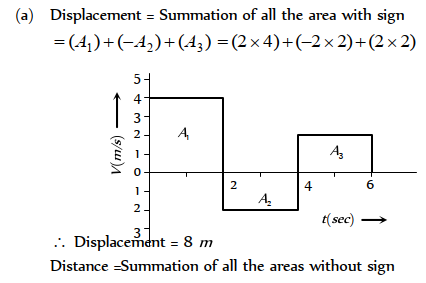
$\Rightarrow A_1|+|-A_2|+| A_3| \neq 8|+|-4|+|4=8+4+4$
$\therefore\text{Distance }=16 \mathrm{~m} .$ View full question & answer→MCQ 641 Mark
The correct statement from the following is
- ✓
A body having zero velocity will not necessarily have zero acceleration
- B
A body having zero velocity will necessarily have zero acceleration
- C
A body having uniform speed can have only uniform acceleration
- D
A body having non-uniform velocity will have zero acceleration
AnswerCorrect option: A. A body having zero velocity will not necessarily have zero acceleration
(a) When the body is projected vertically upward then at the highest point its velocity is zero but acceleration is not equal to zero $\left(g=9.8 \mathrm{~m} / \mathrm{s}^2\right)$.
View full question & answer→MCQ 651 Mark
A stone dropped from the top of the tower touches the ground in 4 sec. The height of the tower is about
- ✓
$80 m$
- B
$40 m$
- C
$20 m$
- D
$160 m$
AnswerCorrect option: A. $80 m$
(a) $h=\frac{1}{2} g t^2=\frac{1}{2} \times 10 \times(4)^2=80 \mathrm{~m}$
View full question & answer→MCQ 661 Mark
A car travels from $A$ to $B$ at a speed of $20 km / hr$ and returns at a speed of $30 km / hr$. The average speed of the car for the whole journey is
- A
$25 km / hr$
- ✓
$24 km / hr$
- C
$50 km / hr$
- D
$5 km / hr$
AnswerCorrect option: B. $24 km / hr$
(b) Distance average speed $=\frac{2 v_1 v_2}{v_1+v_2}=\frac{2 \times 20 \times 30}{20+30}\$=\frac{120}{5}=24 \mathrm{~km} / \mathrm{hr}$
View full question & answer→MCQ 671 Mark
A body falls freely from rest. It covers as much distance in the last second of its motion as covered in the first three seconds. The body has fallen for a time of
- A
$3 s$
- ✓
$5 s$
- C
$7 s$
- D
$9 s$
Answer(b) $\frac{1}{2} g(3)^2=\frac{g}{2}(2 n-1) \Rightarrow n=5 s$
View full question & answer→MCQ 681 Mark
The velocity of a body depends on time according to the equation $v=20+0.1 t^2$. The body is undergoing
Answer(c) Acceleration $a=\frac{d v}{d t}=0.1 \times 2 t=0.2 t$Which is time dependent i.e. non-uniform acceleration.
View full question & answer→MCQ 691 Mark
The acceleration ' $a$ ' in $m / s^2$ of a particle is given by $a=3 t^2+2 t+2$ where $t$ is the time. If the particle starts out with a velocity $u=2 m / s$ at $t=0$, then the velocity at the end of 2 second is
- A
$12 m / s$
- ✓
$18 m / s$
- C
$27 m / s$
- D
$36 m / s$
AnswerCorrect option: B. $18 m / s$
(b)$v=u+\int a d t=u+\int\left(3 t^2+2 t+2\right) d t $
$=u+\frac{3 t^3}{3}+\frac{2 t^2}{2}+2 t=u+t^3+t^2+2 t $
$=2+8+4+4=18 \mathrm{~m} / \mathrm{s} \quad \text { (As } t=2 \mathrm{sec} \text { ) }$
View full question & answer→MCQ 701 Mark
A particle moves along $X$-axis in such a way that its coordinate $X$ varies with time $t$ according to the equation $x=\left(2-5 t+6 t^2\right) m$. The initial velocity of the particle is
- ✓
$-5 m / s$
- B
$6 m / s$
- C
$-3 m / s$
- D
$3 m / s$
AnswerCorrect option: A. $-5 m / s$
(a) The velocity of the particle is$\frac{d x}{d t}=\frac{d}{d t}\left(2-5 t+6 t^2\right)=(0-5+12 t)$For initial velocity $t=0$, hence $v=-5 \mathrm{~m} \mathrm{s$.
View full question & answer→MCQ 711 Mark
A particle is dropped under gravity from rest from a height $h\left(g=9.8 m / sec ^2\right)$ and it travels a distance $9 h / 25$ in the last second, the height $h$ is
- A
$100 m$
- ✓
$122.5 m$
- C
$145 m$
- D
$167.5 m$
AnswerCorrect option: B. $122.5 m$
View full question & answer→MCQ 721 Mark
A ball $P$ is dropped vertically and another ball $Q$ is thrown horizontally with the same velocities from the same height and at the same time. If air resistance is neglected, then
AnswerCorrect option: C. Both reach the ground at the same time
(c) Vertical component of velocities of both theballsaresameandequaltozero.So(t=\sqrt{\frac{2 h}{g}}$
View full question & answer→MCQ 731 Mark
A man in a balloon rising vertically with an acceleration of $4.9 m / sec ^2$ releases a ball $2 sec$ after the balloon is let go from the ground. The greatest height above the ground reached by the ball is $\left(g=9.8 m / sec ^2\right)$
- ✓
$14.7 m$
- B
$19.6 m$
- C
$9.8 m$
- D
$24.5 m$
AnswerCorrect option: A. $14.7 m$
View full question & answer→MCQ 741 Mark
A particle moves for 20 seconds with velocity $3 m / s$ and then velocity $4 m / s$ for another 20 seconds and finally moves with velocity $5 m / s$ for next 20 seconds. What is the average velocity of the particle\
- A
$3 m / s$
- ✓
$4 m / s$
- C
$5 m / s$
- D
AnswerCorrect option: B. $4 m / s$
(b) Time average velocity $=\frac{v_1+v_2+v_3}{3} \quad=\frac{3+4+5}{3}=4 \mathrm{~m}\mathrm{s}$
View full question & answer→MCQ 751 Mark
A car travels the first half of a distance between two places at a speed of $30 km / hr$ and the second half of the distance at $50 km / hr$. The average speed of the car for the whole journey is
- A
$42.5 km / hr$
- B
$40.0 km / hr$
- ✓
$37.5 km / hr$
- D
$180 km / h$
AnswerCorrect option: C. $37.5 km / hr$
(c) Distance average speed $=\frac{2 v_1 v_2}{v_1+v_2}=\frac{2 \times 30 \times 50}{30+50}\$=\frac{75}{2}=37.5 \mathrm{~km} / \mathrm{hr}$
View full question & answer→MCQ 761 Mark
Which of the following four statements is false
- A
A body can have zero velocity and still be accelerated
- ✓
A body can have a constant velocity and still have a varying speed
- C
A body can have a constant speed and still have a varying velocity
- D
The direction of the velocity of a body can change when its acceleration is constant
AnswerCorrect option: B. A body can have a constant velocity and still have a varying speed
(b) Constant velocity means constant speed as well as same direction throughout.
View full question & answer→MCQ 771 Mark
A ball is thrown vertically upwards from the top of a tower at $4.9 ms ^{-1}$. It strikes the pond near the base of the tower after 3 seconds. The height of the tower is
- A
$73.5 m$
- B
$44.1 m$
- ✓
$29.4 m$
- D
AnswerCorrect option: C. $29.4 m$
(c)$h=u t+\frac{1}{2} g t^2, t=3 \mathrm{sec}, u=-4.9 \mathrm{~m} \mathrm{s} $
$\Rightarrow h=-4.9 \times 3+4.9 \times 9=29.4 \mathrm{~m}$
View full question & answer→MCQ 781 Mark
Figures (i) and (ii) below show the displacement-time graphs of two particles moving along the $x$-axis. We can say that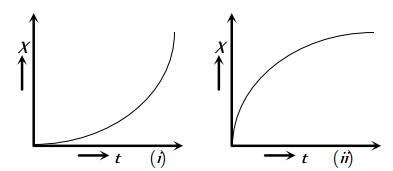
- A
Both the particles are having a uniformly accelerated motion
- B
Both the particles are having a uniformly retarded motion
- ✓
Particle (i) is having a uniformly accelerated motion while particle (ii) is having a uniformly retarded motion
- D
Particle (i) is having a uniformly retarded motion while particle (ii) is having a uniformly accelerated motion
AnswerCorrect option: C. Particle (i) is having a uniformly accelerated motion while particle (ii) is having a uniformly retarded motion
View full question & answer→MCQ 791 Mark
A particle is dropped vertically from rest from a height. The time taken by it to fall through successive distances of $1 m$ each will then be
- A
All equal, being equal to $\sqrt{2 / g}$ second
- B
In the ratio of the square roots of the integers 1, 2, 3.....
- ✓
In the ratio of the difference in the square roots of the integers i.e. $\sqrt{1},(\sqrt{2}-\sqrt{1}),(\sqrt{3}-\sqrt{2}),(\sqrt{4}-\sqrt{3}) \ldots$
- D
In the ratio of the reciprocal of the square roots of the integers $\text { i.e., } \frac{1}{\sqrt{1}}, \frac{1}{\sqrt{2}}, \frac{1}{\sqrt{3}}, \frac{1}{\sqrt{4}}$
AnswerCorrect option: C. In the ratio of the difference in the square roots of the integers i.e. $\sqrt{1},(\sqrt{2}-\sqrt{1}),(\sqrt{3}-\sqrt{2}),(\sqrt{4}-\sqrt{3}) \ldots$
View full question & answer→MCQ 801 Mark
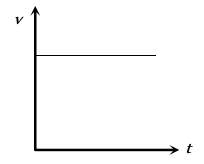
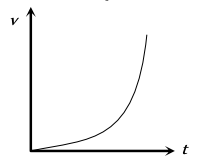
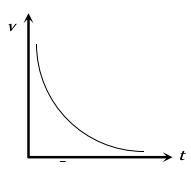
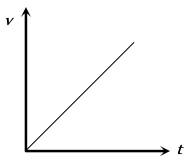
Which of the following velocity-time graphs represent uniform motion
Answer(a) Slope of velocity-time graph measures acceleration. For graph (a) slope is zero. Hence $a=0$ i.e. motion is uniform.
View full question & answer→MCQ 811 Mark
A cricket ball is thrown up with a speed of $19.6 ms$. The maximum height it can reach is
- A
$9.8 m$
- ✓
$19.6 m$
- C
$29.4 m$
- D
$39.2 m$
AnswerCorrect option: B. $19.6 m$
(b) $H_{\max }=\frac{u^2}{2 g}=\frac{19.6 \times 19.6}{2 \times 9.8}=19.6 \mathrm{~m}$
View full question & answer→MCQ 821 Mark
A body starting from rest moves with constant acceleration. The ratio of distance covered by the body during the 5 th $sec$ to that covered in $5 sec$ is
- ✓
$9 / 25$
- B
$3 / 5$
- C
$25 / 9$
- D
$1 / 25$
AnswerCorrect option: A. $9 / 25$
(a) Distance covered in $5^{-}$second,\S_{5^{\text {th }}}=u+\frac{a}{2}(2 n-1)=0+\frac{a}{2}(2 \times 5-1)=\frac{9 a}{2}$and distance covered in 5 second,$\begin{array}{lS_5=u t+\frac{1}{2} a t^2=0+\frac{1}{2} \times a \times 25=\frac{25 a}{2} \\\therefore \frac{S_{5^{\text {th }}}}{S_5}=\frac{9}{25}\end{array}$
View full question & answer→MCQ 831 Mark
The area under acceleration-time graph gives
MCQ 841 Mark
A train moves from one station to another in 2 hours time. Its speed-time graph during this motion is shown in the figure. The maximum acceleration during the journey is
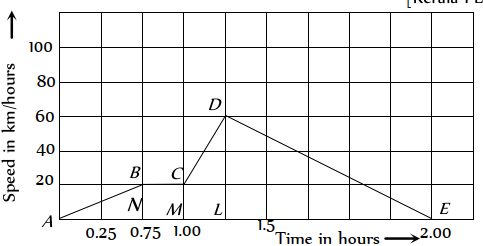
- A
$140 km h$
- ✓
$160 km h$
- C
$100 km h$
- D
$120 km h$
AnswerCorrect option: B. $160 km h$
(b) Maximum acceleration will be represented by $C D$ partofthegraphAcceleration(=\frac{dv}{d t}=\frac{(60-20)}{0.25}=160 \mathrm{~km} / \mathrm{h}^2$
View full question & answer→MCQ 851 Mark
A particle moves along a semicircle of radius $10 m$ in 5 seconds. The average velocity of the particle is
- A
$2 \pi ms ^{-1}$
- B
$4 \pi ms ^{-1}$
- C
$2 ms ^{-1}$
- ✓
$4 ms ^{-1}$
AnswerCorrect option: D. $4 ms ^{-1}$
(d)$\text { Velocity of particle }=\frac{\text { Total diplacemen } t}{\text { Total time }} $
$=\frac{\text { Diameter of circle }}{5}=\frac{2 \times 10}{5}=4 \mathrm{~m} / \mathrm{s}$
View full question & answer→MCQ 861 Mark
A body is thrown vertically upwards with a velocity $u$. Find the true statement from the following
AnswerCorrect option: D. Velocity is zero at the highest point and maximum height reached is $u^2 / 2 g$
(d) At highest point $v=0$ and $H_{\max }=\frac{u^2}{2 g}$
View full question & answer→MCQ 871 Mark
From the top of a tower two stones, whose masses are in the ratio 1 : 2 are thrown one straight up with an initial speed $u$ and the second straight down with the same speed $u$. Then, neglecting air resistance
- A
The heavier stone hits the ground with a higher speed
- B
The lighter stone hits the ground with a higher speed
- ✓
Both the stones will have the same speed when they hit the ground.
- D
The speed can't be determined with the given data.
AnswerCorrect option: C. Both the stones will have the same speed when they hit the ground.
View full question & answer→MCQ 881 Mark
A balloon is rising vertically up with a velocity of $29 ms$. A stone is dropped from it and it reaches the ground in 10 seconds. The height of the balloon when the stone was dropped from it is $(g=9.8 ms )$
- A
$100 m$
- ✓
$200 m$
- C
$400 m$
- D
$150 m$
AnswerCorrect option: B. $200 m$
(b) For stone to be dropped from rising balloon of velocity $29 \mathrm{~m} / \mathrm{s}$.
$u=-29 \mathrm{~m} / \mathrm{s}, t=10 \mathrm{sec} . $
$\therefore h=-29\times 10+\frac{1}{2} \times 9.8 \times 100 $
$=-290+490=200 \mathrm{~m} .$
View full question & answer→MCQ 891 Mark
A person moves $30 m$ north and then $20 m$ towards east and finally $30 \sqrt{2} m$ in south-west direction. The displacement of the person from the origin will be
- A
$10 m$ along north
- B
$10 m$ long south
- ✓
$10 m$ along west
- D
AnswerCorrect option: C. $10 m$ along west
View full question & answer→MCQ 901 Mark
If the velocity of a particle is given by $v=(180-16 x)^{1 / 2} m / s$, then its acceleration will be
- A
- B
$8 m / s$
- ✓
$-8 m / s$
- D
$4 m / s$
AnswerCorrect option: C. $-8 m / s$
(c) $ v=(180-16 x)^{1 / 2}$
As $a=\frac{d v}{d t}=\frac{d v}{d x} \cdot \frac{d x}{d t}$
$\therefore a=\frac{1}{2}(180-16 x)^{-1 / 2} \times(-16)\left(\frac{d x}{d t}\right) $
$=-8(180-16 x)^{-1 / 2} \times v $
$=-8(180-16 x)^{-1 / 2} \times(180-16 x)^{1 / 2}=-8 \mathrm{~m} / \mathrm{s}^2$
View full question & answer→MCQ 911 Mark
Two balls of same size but the density of one is greater than that of the other are dropped from the same height, then which ball will reach the earth first (air resistance is negligible)
- A
- B
- ✓
- D
Will depend upon the density of the balls
Answer(c) Since acceleration due to gravity is independent of mass, hence time is also independent of mass (or density) of object.
View full question & answer→MCQ 921 Mark
A student is standing at a distance of 50metres from the bus. As soon as the bus begins its motion with an acceleration of $1 ms$, the student starts running towards the bus with a uniform velocity $u$. Assuming the motion to be along a straight road, the minimum value of $u$, so that the student is able to catch the bus is
- A
$5 ms$
- B
$8 ms$
- ✓
$10 ms$
- D
$12 ms$
AnswerCorrect option: C. $10 ms$
View full question & answer→MCQ 931 Mark
A very large number of balls are thrown vertically upwards in quick succession in such a way that the next ball is thrown when the previous one is at the maximum height. If the maximum height is $5 m$, the number of ball thrown per minute is (take $g=10 ms ^{-2}$ )
Answer(c) Maximum height of ball $=5 \mathrm{~m}$So velocity of projection $\Rightarrowu=\sqrt{2 g h}=10 \mathrm{~m} / \mathrm{s}$ Time interval between two balls (time of ascent)(=\frac{u}{g}=1 \mathrm{sec}=\frac{1}{60} \mathrm{~min}$.
View full question & answer→MCQ 941 Mark
A balloon starts rising from the ground with an acceleration of 1.25 $m / s$ after $8 s$, a stone is released from the balloon. The stone will $(g=10 m / s )$
AnswerCorrect option: A. Reach the ground in 4 second
View full question & answer→MCQ 951 Mark
A body, thrown upwards with some velocity, reaches the maximum height of $20 m$. Another body with double the mass thrown up, with double initial velocity will reach a maximum height of
- A
$200 m$
- B
$16 m$
- ✓
$80 m$
- D
$40 m$
AnswerCorrect option: C. $80 m$
(c) Mass does not affect on maximum height.$H=\frac{u^2}{2 g} \Rightarrow H \propto u^2$, So if velocity is doubled then height will become four times. i.e. $H=20 \times 4=80 \mathrm{~m}$
View full question & answer→MCQ 961 Mark
A man goes $10 m$ towards North, then $20 m$ towards east then displacement is
- ✓
$22.5 m$
- B
$25 m$
- C
$25.5 m$
- D
$30 m$
AnswerCorrect option: A. $22.5 m$
(a) $\vec{r}=20 \hat{i}+10 \hat{j} \quad \therefore \quad r=\sqrt{20^2+10^2}=22.5 \mathrm{~m}$
View full question & answer→MCQ 971 Mark
A body projected vertically upwards with a velocity $u$ returns to the starting point in 4 seconds. If $g=10 m / sec$, the value of $u$ is
- A
$5 m / sec$
- B
$10 m / sec$
- C
$15 m / sec$
- ✓
$20 m / sec$
AnswerCorrect option: D. $20 m / sec$
(d) Time of flight $T=\frac{2 u}{g}=4 \mathrm{sec} \Rightarrow u=20 \mathrm{~m\mathrm{s$
View full question & answer→MCQ 981 Mark
An elevator car, whose floor to ceiling distance is equal to $2.7 m$, starts ascending with constant acceleration of $1.2 ms$. $2 sec$ after the start, a bolt begins fallings from the ceiling of the car. The free fall time of the bolt is
- A
$\sqrt{0.54} s$
- B
$\sqrt{6} s$
- ✓
$0.7 s$
- D
$1 s$
AnswerCorrect option: C. $0.7 s$
(c) $t=\sqrt{\frac{2 h}{(g+a)}}=\sqrt{\frac{2 \times 2.7}{(9.8+1.2)}}$ $=\sqrt{\frac{5.4}{11}}=\sqrt{0.49}=0.7 \mathrm{sec}$
As $u=0$ and lift is moving upward with acceleration
View full question & answer→MCQ 991 Mark
A boat moves with a speed of $5 km / h$ relative to water in a river flowing with a speed of $3 km / h$ and having a width of $1 km$. The minimum time taken around a round trip is
- A
$5 min$
- B
$60 min$
- C
$20 min$
- ✓
$30 min$
AnswerCorrect option: D. $30 min$
(d) For the round trip he should cross perpendicular to the river$\therefore \text { Timefor trip to that side }=\frac{1 \mathrm{~km}}{4 \mathrm{~km} / \mathrm{hr}}=0.25 \mathrm{hr}$To come back, again he take $0.25 h r$ to cross the river.Total time is $30\mathrm{~min}$,he goes to the other bank and come back at the same point.
View full question & answer→MCQ 1001 Mark
A particle moves along $x$-axis as$x=4(t-2)+a(t-2)^2$ Which of the following is true?
AnswerCorrect option: B. The acceleration of particle is $2 a$
(b)$x=4(t-2)+a(t-2)^2$At $t=0, x=-8+4 a=4 a-8$$v=\frac{d x}{d t}=4+2 a(t-2)$At(t=0, v=4-4 a=4(1-a)$But acceleration, $a=\frac{d^2 x}{d t^2}=2 a$
View full question & answer→