MCQ 1511 Mark
A diatomic gas initially at $18^{\circ} \mathrm{C}$ is compressed adiabatically to oneeighth of its original volume. The temperature after compression will be
- A
$10^{\circ} \mathrm{C}$
- B
$887^{\circ} \mathrm{C}$
- ✓
$668 K$
- D
$144^{\circ} \mathrm{C}$
AnswerCorrect option: C. $668 K$
$T V^{\gamma-1}=\mathrm{constant}[\Rightarrow T_2=T_1\left(\frac{V_1}{V_2}\right)^{\gamma-1}=(273+18)\left(\frac{V}{V} / {8}\right)^{0.4}=668 \mathrm{~K}]$
View full question & answer→MCQ 1521 Mark
A diatomic gas initially at $18^{\circ} \mathrm{C}$ is compressed adiabatically to oneeighth of its original volume. The temperature after compression will be
- A
$10^{\circ} \mathrm{C}$
- B
$887^{\circ} \mathrm{C}$
- ✓
$668 K$
- D
$144^{\circ} \mathrm{C}$
AnswerCorrect option: C. $668 K$
$T V^{\gamma-1}=\mathrm{constant} [\Rightarrow T_2=T_1\left(\frac{V_1}{V_2}\right)^{\gamma-1}=(273+18)\left(\frac{V}{V / 8}\right)^{0.4}=668 \mathrm{~K}]$
View full question & answer→MCQ 1531 Mark
A diatomic gas initially at $18^{\circ} \mathrm{C}$ is compressed adiabatically to oneeighth of its original volume. The temperature after compression will be
- A
$10^{\circ} \mathrm{C}$
- B
$887^{\circ} \mathrm{C}$
- ✓
$668 K$
- D
$144^{\circ} \mathrm{C}$
AnswerCorrect option: C. $668 K$
$T V^{\gamma-1}=\mathrm{constant} [\Rightarrow T_2=T_1\left(\frac{V_1}{V_2}\right)^{\gamma-1}=(273+18)\left(\frac{V}{V / 8}\right)^{0.4}=668 \mathrm{~K}]$
View full question & answer→MCQ 1541 Mark
In which thermodynamic process, volume remains same
MCQ 1551 Mark
A system is provided with $200 \mathrm{cal}$ of heat and the work done by the system on the surrounding is $40 \mathrm{~J}$. Then its internal energy
- A
Increases by $600 \mathrm{~J}$
- B
Decreases by $800 \mathrm{~J}$
- ✓
Increases by $800 \mathrm{~J}$
- D
Decreases by $50 \mathrm{~J}$
AnswerCorrect option: C. Increases by $800 \mathrm{~J}$
$\Delta Q=\Delta U+\Delta W $
$\because \Delta Q=200 \mathrm{cal}=200 \times 4.2=840 \mathrm{~J} \text { and } \Delta W=40 \mathrm{~J} $
$\Rightarrow \Delta U=\Delta Q-\Delta W$
$=840-40$
$=800 \mathrm{~J}$
View full question & answer→MCQ 1561 Mark
In which thermodynamic process, volume remains same
MCQ 1571 Mark
A system is provided with $200 \mathrm{cal}$ of heat and the work done by the system on the surrounding is $40 \mathrm{~J}$. Then its internal energy
- A
Increases by $600 \mathrm{~J}$
- B
Decreases by $800 \mathrm{~J}$
- ✓
Increases by $800 \mathrm{~J}$
- D
Decreases by $50 \mathrm{~J}$
AnswerCorrect option: C. Increases by $800 \mathrm{~J}$
$\Delta Q=\Delta U+\Delta W $
$\because \Delta Q=200 \mathrm{cal}=200 \times 4.2=840 \mathrm{~J} \text { and } \Delta W=40 \mathrm{~J} $
$\Rightarrow \Delta U=\Delta Q-\Delta W$
$=840-40$
$=800 \mathrm{~J}$
View full question & answer→MCQ 1581 Mark
In which thermodynamic process, volume remains same
MCQ 1591 Mark
A system is provided with $200 \mathrm{cal}$ of heat and the work done by the system on the surrounding is $40 \mathrm{~J}$. Then its internal energy
- A
Increases by $600 \mathrm{~J}$
- B
Decreases by $800 \mathrm{~J}$
- ✓
Increases by $800 \mathrm{~J}$
- D
Decreases by $50 \mathrm{~J}$
AnswerCorrect option: C. Increases by $800 \mathrm{~J}$
$\Delta Q=\Delta U+\Delta W $
$\because \Delta Q=200 \mathrm{cal}=200 \times 4.2=840 \mathrm{~J} \text { and } \Delta W=40 \mathrm{~J} $
$\Rightarrow \Delta U=\Delta Q-\Delta W$
$=840-40$
$=800 \mathrm{~J}$
View full question & answer→MCQ 1601 Mark
In an adiabatic process, the state of a gas is changed from $P_1, V_1, T_1$, to $P_2, V_2, T_2$. Which of the following relation is correct
- ✓
$T_1 V_1^{\gamma-1}=T_2 V_2^{\gamma-1}$
- B
$P_1 V_1^{\gamma-1}=P_2 V_2^{\gamma-1}$
- C
$T_1 P_1^\gamma=T_2 P_2^\gamma$
- D
$T_1 V_1^\gamma=T_2 V_2^\gamma$
AnswerCorrect option: A. $T_1 V_1^{\gamma-1}=T_2 V_2^{\gamma-1}$
$T_1 V_1^{\gamma-1}=T_2 V_2^{\gamma-1}$
View full question & answer→MCQ 1611 Mark
In an adiabatic process, the state of a gas is changed from $P_1, V_1, T_1$, to $P_2, V_2, T_2$. Which of the following relation is correct
- ✓
$T_1 V_1^{\gamma-1}=T_2 V_2^{\gamma-1}$
- B
$P_1 V_1^{\gamma-1}=P_2 V_2^{\gamma-1}$
- C
$T_1 P_1^\gamma=T_2 P_2^\gamma$
- D
$T_1 V_1^\gamma=T_2 V_2^\gamma$
AnswerCorrect option: A. $T_1 V_1^{\gamma-1}=T_2 V_2^{\gamma-1}$
$T_1 V_1^{\gamma-1}=T_2 V_2^{\gamma-1}$
View full question & answer→MCQ 1621 Mark
In an adiabatic process, the state of a gas is changed from $P_1, V_1, T_1$, to $P_2, V_2, T_2$. Which of the following relation is correct
- ✓
$T_1 V_1^{\gamma-1}=T_2 V_2^{\gamma-1}$
- B
$P_1 V_1^{\gamma-1}=P_2 V_2^{\gamma-1}$
- C
$T_1 P_1^\gamma=T_2 P_2^\gamma$
- D
$T_1 V_1^\gamma=T_2 V_2^\gamma$
AnswerCorrect option: A. $T_1 V_1^{\gamma-1}=T_2 V_2^{\gamma-1}$
$T_1 V_1^{\gamma-1}=T_2 V_2^{\gamma-1}$
View full question & answer→MCQ 1631 Mark
A thermodynamic system is taken through the cycle $\text{PQRSP}$ process. The net work done by the system is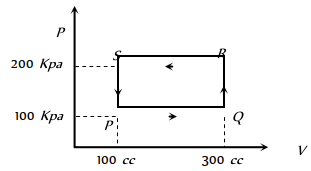
- ✓
$20 \mathrm{~J}$
- B
$-20 \mathrm{~J}$
- C
$400 \mathrm{~J}$
- D
$-374 \mathrm{~J}$
AnswerCorrect option: A. $20 \mathrm{~J}$
Work done by the system $=$ Area of shaded portion on $P-V$ diagram
$[=(300-100)10^{-6} \times(200-10) \times 10^3=20 \mathrm{~J}]$
View full question & answer→MCQ 1641 Mark
A thermodynamic system is taken through the cycle $\text{PQRSP}$ process. The net work done by the system is - ✓
$20 \mathrm{~J}$
- B
$-20 \mathrm{~J}$
- C
$400 \mathrm{~J}$
- D
$-374 \mathrm{~J}$
AnswerCorrect option: A. $20 \mathrm{~J}$
Work done by the system $=$ Area of shaded portion on $P-V$ diagram $[=(300-100)10^{-6} \times(200-10) \times 10^3=20 \mathrm{~J}]$
View full question & answer→MCQ 1651 Mark
A thermodynamic system is taken through the cycle $\text{PQRSP}$ process. The net work done by the system is - ✓
$20 \mathrm{~J}$
- B
$-20 \mathrm{~J}$
- C
$400 \mathrm{~J}$
- D
$-374 \mathrm{~J}$
AnswerCorrect option: A. $20 \mathrm{~J}$
Work done by the system $=$ Area of shaded portion on $P-V$ diagram
$[=(300-100)10^{-6} \times(200-10) \times 10^3=20 \mathrm{~J}]$
View full question & answer→MCQ 1661 Mark
If $\gamma$ denotes the ratio of two specific heats of a gas, the ratio of slopes of adiabatic and isothermal $P V$ curves at their point of intersection is
- A
$1 / \gamma$
- ✓
$\gamma$
- C
$\gamma-1$
- D
$\gamma+1$
AnswerCorrect option: B. $\gamma$
Slope of adiabatic curve $=\gamma \times($ Slope of isothermal curve $)$
View full question & answer→MCQ 1671 Mark
If $\gamma$ denotes the ratio of two specific heats of a gas, the ratio of slopes of adiabatic and isothermal $P V$ curves at their point of intersection is
- A
$1 / \gamma$
- ✓
$\gamma$
- C
$\gamma-1$
- D
$\gamma+1$
AnswerCorrect option: B. $\gamma$
Slope of adiabatic curve $=\gamma \times($ Slope of isothermal curve $)$
View full question & answer→MCQ 1681 Mark
If $\gamma$ denotes the ratio of two specific heats of a gas, the ratio of slopes of adiabatic and isothermal $P V$ curves at their point of intersection is
- A
$1 / \gamma$
- ✓
$\gamma$
- C
$\gamma-1$
- D
$\gamma+1$
AnswerCorrect option: B. $\gamma$
Slope of adiabatic curve $=\gamma \times($ Slope of isothermal curve $)$
View full question & answer→MCQ 1691 Mark
In a reversible isochoric change
- ✓
$\Delta W=0$
- B
$\Delta Q=0$
- C
$\Delta T=0$
- D
$\Delta U=0$
AnswerCorrect option: A. $\Delta W=0$
$\Delta V=0$
$\Rightarrow P \Delta V=0$
$\Rightarrow \Delta W=0$
View full question & answer→MCQ 1701 Mark
In a reversible isochoric change
- ✓
$\Delta W=0$
- B
$\Delta Q=0$
- C
$\Delta T=0$
- D
$\Delta U=0$
AnswerCorrect option: A. $\Delta W=0$
$\Delta V=0$
$\Rightarrow P \Delta V=0$
$\Rightarrow \Delta W=0$
View full question & answer→MCQ 1711 Mark
In a reversible isochoric change
- ✓
$\Delta W=0$
- B
$\Delta Q=0$
- C
$\Delta T=0$
- D
$\Delta U=0$
AnswerCorrect option: A. $\Delta W=0$
$\Delta V=0$
$\Rightarrow P \Delta V=0$
$\Rightarrow \Delta W=0$
View full question & answer→MCQ 1721 Mark
Air in a cylinder is suddenly compressed by a piston, which is then maintained at the same position. With the passage of time
- ✓
- B
- C
The pressure remains the same
- D
The pressure may increase or decrease depending upon the nature of the gas
AnswerDue to compression the temperature of the system increases to a very highvalue.Thiscauses the flow of heat from system to the surroundings, thus decreasing thetemperature.Thisdecrease in temperature results in decrease in pressure.
View full question & answer→MCQ 1731 Mark
Compressed air in the tube of a wheel of a cycle at normal temperature suddenly starts coming out from a puncture. The air inside
- A
- B
Remains at the same temperature
- ✓
- D
May become hotter or cooler depending upon the amount of water vapour present
AnswerPressure is reduced, so the temperature falls.
View full question & answer→MCQ 1741 Mark
Compressed air in the tube of a wheel of a cycle at normal temperature suddenly starts coming out from a puncture. The air inside
- A
- B
Remains at the same temperature
- ✓
- D
May become hotter or cooler depending upon the amount of water vapour present
AnswerPressure is reduced, so the temperature falls.
View full question & answer→MCQ 1751 Mark
Compressed air in the tube of a wheel of a cycle at normal temperature suddenly starts coming out from a puncture. The air inside
- A
- B
Remains at the same temperature
- ✓
- D
May become hotter or cooler depending upon the amount of water vapour present
AnswerPressure is reduced, so the temperature falls.
View full question & answer→MCQ 1761 Mark
In an isothermal process the volume of an ideal gas is halved. One can say that
- A
Internal energy of the system decreases
- B
Work done by the gas is positive
- ✓
Work done by the gas is negative
- D
Internal energy of the system increases
AnswerCorrect option: C. Work done by the gas is negative
(c) For isothermal process
$d U=0 \text { and work done }=d W=P\left(V_2-V_1\right) $
$\because V_2=\frac{V_1}{2}=\frac{V}{2} $
$\therefore d W=-\frac{P V}{2}$
View full question & answer→MCQ 1771 Mark
In an isothermal process the volume of an ideal gas is halved. One can say that
- A
Internal energy of the system decreases
- B
Work done by the gas is positive
- ✓
Work done by the gas is negative
- D
Internal energy of the system increases
AnswerCorrect option: C. Work done by the gas is negative
(c) For isothermal process
$d U=0 \text { and work done }=d W=P\left(V_2-V_1\right) $
$\because V_2=\frac{V_1}{2}=\frac{V}{2} $
$\therefore d W=-\frac{P V}{2}$
View full question & answer→MCQ 1781 Mark
In an isothermal process the volume of an ideal gas is halved. One can say that
- A
Internal energy of the system decreases
- B
Work done by the gas is positive
- ✓
Work done by the gas is negative
- D
Internal energy of the system increases
AnswerCorrect option: C. Work done by the gas is negative
(c) For isothermal process
$d U=0 \text { and work done }=d W=P\left(V_2-V_1\right) $
$\because V_2=\frac{V_1}{2}=\frac{V}{2} \therefore d W=-\frac{P V}{2}$
View full question & answer→MCQ 1791 Mark
In a thermodynamic system working substance is ideal gas, its internal energy is in the form of
- ✓
- B
Kinetic and potential energy
- C
- D
Answer(a) Ideal gas possess only kinetic energy.
View full question & answer→MCQ 1801 Mark
In a thermodynamic system working substance is ideal gas, its internal energy is in the form of
- ✓
- B
Kinetic and potential energy
- C
- D
Answer(a) Ideal gas possess only kinetic energy.
View full question & answer→MCQ 1811 Mark
In a thermodynamic system working substance is ideal gas, its internal energy is in the form of
- ✓
- B
Kinetic and potential energy
- C
- D
Answer(a) Ideal gas possess only kinetic energy.
View full question & answer→MCQ 1821 Mark
Air is filled in a motor tube at $27^{\circ} \mathrm{C}$ and at a pressure of 8 atmospheres. The tube suddenly bursts, then temperature of air is [Given $\gamma$ of air $=1.5$ ]
AnswerCorrect option: C. $150 K$
(c)
$\frac{T_2}{T_1}=\left(\frac{P_2}{P_1}\right)^{\frac{\gamma-1}{\gamma}} $
$\Rightarrow \frac{T_2}{T_1}=\left(\frac{1}{8}\right)^{\frac{1.5-1}{1.5}}=\left(\frac{1}{8}\right)^{\frac{1}{3}}=\frac{1}{2} $
$\Rightarrow T_2=\frac{T_1}{2}=\frac{300}{2}=150 \mathrm{~K} .$
View full question & answer→MCQ 1831 Mark
Air is filled in a motor tube at $27^{\circ} \mathrm{C}$ and at a pressure of 8 atmospheres. The tube suddenly bursts, then temperature of air is [Given $\gamma$ of air $=1.5$ ]
AnswerCorrect option: C. $150 K$
(c)
$\frac{T_2}{T_1}=\left(\frac{P_2}{P_1}\right)^{\frac{\gamma-1}{\gamma}} $
$\Rightarrow \frac{T_2}{T_1}=\left(\frac{1}{8}\right)^{\frac{1.5-1}{1.5}}=\left(\frac{1}{8}\right)^{\frac{1}{3}}=\frac{1}{2} $
$\Rightarrow T_2=\frac{T_1}{2}=\frac{300}{2}=150 \mathrm{~K} .$
View full question & answer→MCQ 1841 Mark
Air is filled in a motor tube at $27^{\circ} \mathrm{C}$ and at a pressure of 8 atmospheres. The tube suddenly bursts, then temperature of air is [Given $\gamma$ of air $=1.5$ ]
AnswerCorrect option: C. $150 K$
(c)
$\frac{T_2}{T_1}=\left(\frac{P_2}{P_1}\right)^{\frac{\gamma-1}{\gamma}} $
$\Rightarrow \frac{T_2}{T_1}=\left(\frac{1}{8}\right)^{\frac{1.5-1}{1.5}}=\left(\frac{1}{8}\right)^{\frac{1}{3}}=\frac{1}{2} $
$\Rightarrow T_2=\frac{T_1}{2}=\frac{300}{2}=150 \mathrm{~K} .$
View full question & answer→MCQ 1851 Mark
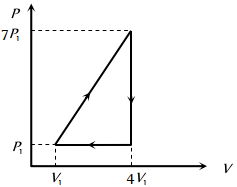
In the cyclic process shown in the figure, the work done by the gas in one cycle is
- A
$28 P_1 V_1$
- B
$14 P_1 V_1$
- C
$18 P_1 V_1$
- ✓
$9 P_1 V_1$
AnswerCorrect option: D. $9 P_1 V_1$
(d) Work done $=$ Area under curve $=\frac{6 P_1 \times 3 V_1}{2}=9 \mathrm{PV}$
View full question & answer→MCQ 1861 Mark
In the cyclic process shown in the figure, the work done by the gas in one cycle is
- A
$28 P_1 V_1$
- B
$14 P_1 V_1$
- C
$18 P_1 V_1$
- ✓
$9 P_1 V_1$
AnswerCorrect option: D. $9 P_1 V_1$
(d) Work done $=$ Area under curve $=\frac{6 P_1 \times 3 V_1}{2}=9 \mathrm{PV}$
View full question & answer→MCQ 1871 Mark
In the cyclic process shown in the figure, the work done by the gas in one cycle is
- A
$28 P_1 V_1$
- B
$14 P_1 V_1$
- C
$18 P_1 V_1$
- ✓
$9 P_1 V_1$
AnswerCorrect option: D. $9 P_1 V_1$
(d) Work done $=$ Area under curve $=\frac{6 P_1 \times 3 V_1}{2}=9 \mathrm{PV}$
View full question & answer→MCQ 1881 Mark
One mole of an ideal gas expands at a constant temperature of 300 $K$ from an initial volume of 10 litres to a final volume of 20 litres. The work done in expanding the gas is $(R=8.31 \mathrm{~J} / \mathrm{mole}-K)$
Answer(b)$W_{i s o}=\mu R T \log _e \frac{V_2}{V_1}=1 \times 8.31 \times 300 \log _e \frac{20}{10}=1728 \mathrm{~J}$
View full question & answer→MCQ 1891 Mark
One mole of an ideal gas expands at a constant temperature of 300 $K$ from an initial volume of 10 litres to a final volume of 20 litres. The work done in expanding the gas is $(R=8.31 \mathrm{~J} / \mathrm{mole}-K)$
Answer(b)$W_{i s o}=\mu R T \log _e \frac{V_2}{V_1}=1 \times 8.31 \times 300 \log _e \frac{20}{10}=1728 \mathrm{~J}$
View full question & answer→MCQ 1901 Mark
One mole of an ideal gas expands at a constant temperature of 300 $K$ from an initial volume of 10 litres to a final volume of 20 litres. The work done in expanding the gas is $(R=8.31 \mathrm{~J} / \mathrm{mole}-K)$
Answer(b)$W_{i s o}=\mu R T \log _e \frac{V_2}{V_1}=1 \times 8.31 \times 300 \log _e \frac{20}{10}=1728 \mathrm{~J}$
View full question & answer→MCQ 1911 Mark
An ideal gas is expanded adiabatically at an initial temperature of $300 K$ so that its volume is doubled. The final temperature of the hydrogen gas is $(\gamma=1.40)$
- ✓
$227.36 K$
- B
$500.30 \mathrm{~K}$
- C
$454.76 K$
- D
$-47^{\circ} \mathrm{C}$
AnswerCorrect option: A. $227.36 K$
(a)$T V^{\gamma-1}=\text {constant}$
$\Rightarrow\frac{T_2}{T_1}=\left(\frac{V_1}{V_2}\right)^\gamma $
$\Rightarrow T_2=T_1\left(\frac{V_1}{V_2}\right)^\gamma $
$\Rightarrow T_2=300\left(\frac{1}{2}\right)^{0.4}=227.36 \mathrm{~K}$
View full question & answer→MCQ 1921 Mark
An ideal gas is expanded adiabatically at an initial temperature of $300 K$ so that its volume is doubled. The final temperature of the hydrogen gas is $(\gamma=1.40)$
- ✓
$227.36 K$
- B
$500.30 \mathrm{~K}$
- C
$454.76 K$
- D
$-47^{\circ} \mathrm{C}$
AnswerCorrect option: A. $227.36 K$
(a)
$T V^{\gamma-1}=\text {constant}$
$\Rightarrow\frac{T_2}{T_1}=\left(\frac{V_1}{V_2}\right)^\gamma $
$\Rightarrow T_2=T_1\left(\frac{V_1}{V_2}\right)^\gamma $
$\Rightarrow T_2=300\left(\frac{1}{2}\right)^{0.4}=227.36 \mathrm{~K}$
View full question & answer→MCQ 1931 Mark
An ideal gas is expanded adiabatically at an initial temperature of $300 K$ so that its volume is doubled. The final temperature of the hydrogen gas is $(\gamma=1.40)$
- ✓
$227.36 K$
- B
$500.30 \mathrm{~K}$
- C
$454.76 K$
- D
$-47^{\circ} \mathrm{C}$
AnswerCorrect option: A. $227.36 K$
(a)
$T V^{\gamma-1}=\text {constant}$
$\Rightarrow\frac{T_2}{T_1}=\left(\frac{V_1}{V_2}\right)^\gamma $
$\Rightarrow T_2=T_1\left(\frac{V_1}{V_2}\right)^\gamma $
$\Rightarrow T_2=300\left(\frac{1}{2}\right)^{0.4}=227.36 \mathrm{~K}$
View full question & answer→MCQ 1941 Mark
Which is the correct statement
- ✓
For an isothermal change $P V=$ constant
- B
In an isothermal process the change in internal energy must be equal to the work done
- C
For an adiabatic change $\frac{P_2}{P_1}=\left(\frac{V_2}{V_1}\right)^\gamma$, where $\gamma$ is the ratio of specific heats
- D
In an adiabatic process work done must be equal to the heat entering the system
AnswerCorrect option: A. For an isothermal change $P V=$ constant
(a) Since $P V=R T$ and $T=$ constant; $\therefore P V=$ constant.
View full question & answer→MCQ 1951 Mark
Which is the correct statement
- ✓
For an isothermal change $P V=$ constant
- B
In an isothermal process the change in internal energy must be equal to the work done
- C
For an adiabatic change $\frac{P_2}{P_1}=\left(\frac{V_2}{V_1}\right)^\gamma$, where $\gamma$ is the ratio of specific heats
- D
In an adiabatic process work done must be equal to the heat entering the system
AnswerCorrect option: A. For an isothermal change $P V=$ constant
(a) Since $P V=R T$ and $T=$ constant; $\therefore P V=$ constant.
View full question & answer→MCQ 1961 Mark
Which is the correct statement
- ✓
For an isothermal change $P V=$ constant
- B
In an isothermal process the change in internal energy must be equal to the work done
- C
For an adiabatic change $\frac{P_2}{P_1}=\left(\frac{V_2}{V_1}\right)^\gamma$, where $\gamma$ is the ratio of specific heats
- D
In an adiabatic process work done must be equal to the heat entering the system
AnswerCorrect option: A. For an isothermal change $P V=$ constant
(a) Since $P V=R T$ and $T=$ constant; $\therefore P V=$ constant.
View full question & answer→MCQ 1971 Mark
A thermodynamic system goes from states (i) $P_1, V$ to $2 P_1, V$ (ii) $P, V$ to $P, 2 V$. Then work done in the two cases is
- A
- ✓
Zero, $P V_1$
- C
$P V_1$, Zero
- D
$P V_1, P_1 V_1$
AnswerCorrect option: B. Zero, $P V_1$
(i) Case $\rightarrow$ Volume $=$ constant $\Rightarrow \int P d V=0$
(ii) Case $\rightarrow P=$ constant $\Rightarrow \int_{V_1}^{2 V_1} P d V=P \int_{V_1}^{2 V_1} d V=P V_1$
View full question & answer→MCQ 1981 Mark
The temperature of an ideal gas is kept constant as it expands. The gas does external work. During this process, the internal energy of the gas
- A
- B
- ✓
- D
Depends on the molecular motion
Answer(c) Internal energy depends only on the temperature of the gas.
View full question & answer→MCQ 1991 Mark
The adiabatic elasticity of hydrogen gas $(\gamma=1.4)$ at NTP is
- A
$1 \times 10^5 \mathrm{~N} / \mathrm{m}^2$
- B
$1 \times 10^{-8} \mathrm{~N} / \mathrm{m} 2$
- C
$1.4 \mathrm{~N} / \mathrm{m}^2$
- ✓
$1.4 \times 10^5 \mathrm{~N} / \mathrm{m}^2$
AnswerCorrect option: D. $1.4 \times 10^5 \mathrm{~N} / \mathrm{m}^2$
(d) $E_\phi=\gamma P=1.4 \times\left(1 \times 10^5\right)=1.4 \times 10^5 \mathrm{~N} / \mathrm{m}^2$
View full question & answer→MCQ 2001 Mark
A thermodynamic system goes from states (i) $P_1, V$ to $2 P_1, V$ (ii) $P, V$ to $P, 2 V$. Then work done in the two cases is
- A
- ✓
Zero, $P V_1$
- C
$P V_1$, Zero
- D
$P V_1, P_1 V_1$
AnswerCorrect option: B. Zero, $P V_1$
(i) Case $\rightarrow$ Volume $=$ constant $\Rightarrow \int P d V=0$
(ii) Case $\rightarrow P=$ constant $\Rightarrow \int_{V_1}^{2 V_1} P d V=P \int_{V_1}^{2 V_1} d V=P V_1$
View full question & answer→