MCQ 2011 Mark
The temperature of an ideal gas is kept constant as it expands. The gas does external work. During this process, the internal energy of the gas
- A
- B
- ✓
- D
Depends on the molecular motion
Answer(c) Internal energy depends only on the temperature of the gas.
View full question & answer→MCQ 2021 Mark
The adiabatic elasticity of hydrogen gas $(\gamma=1.4)$ at NTP is
- A
$1 \times 10^5 \mathrm{~N} / \mathrm{m}^2$
- B
$1 \times 10^{-8} \mathrm{~N} / \mathrm{m} 2$
- C
$1.4 \mathrm{~N} / \mathrm{m}^2$
- ✓
$1.4 \times 10^5 \mathrm{~N} / \mathrm{m}^2$
AnswerCorrect option: D. $1.4 \times 10^5 \mathrm{~N} / \mathrm{m}^2$
(d) $E_\phi=\gamma P=1.4 \times\left(1 \times 10^5\right)=1.4 \times 10^5 \mathrm{~N} / \mathrm{m}^2$
View full question & answer→MCQ 2031 Mark
A thermodynamic system goes from states (i) $P_1, V$ to $2 P_1, V$ (ii) $P, V$ to $P, 2 V$. Then work done in the two cases is
- A
- ✓
Zero, $P V_1$
- C
$P V_1$, Zero
- D
$P V_1, P_1 V_1$
AnswerCorrect option: B. Zero, $P V_1$
(i) Case $\rightarrow$ Volume $=$ constant $\Rightarrow \int P d V=0$
(ii) Case $\rightarrow P=$ constant $\Rightarrow \int_{V_1}^{2 V_1} P d V=P \int_{V_1}^{2 V_1} d V=P V_1$
View full question & answer→MCQ 2041 Mark
The temperature of an ideal gas is kept constant as it expands. The gas does external work. During this process, the internal energy of the gas
- A
- B
- ✓
- D
Depends on the molecular motion
Answer(c) Internal energy depends only on the temperature of the gas.
View full question & answer→MCQ 2051 Mark
The adiabatic elasticity of hydrogen gas $(\gamma=1.4)$ at NTP is
- A
$1 \times 10^5 \mathrm{~N} / \mathrm{m}^2$
- B
$1 \times 10^{-8} \mathrm{~N} / \mathrm{m} 2$
- C
$1.4 \mathrm{~N} / \mathrm{m}^2$
- ✓
$1.4 \times 10^5 \mathrm{~N} / \mathrm{m}^2$
AnswerCorrect option: D. $1.4 \times 10^5 \mathrm{~N} / \mathrm{m}^2$
(d) $E_\phi=\gamma P=1.4 \times\left(1 \times 10^5\right)=1.4 \times 10^5 \mathrm{~N} / \mathrm{m}^2$
View full question & answer→MCQ 2061 Mark
The internal energy of the gas increases $\ln$
Answer(b) In adiabatic process $\Delta U=-\Delta W$. In compression $\Delta W$ is negative, so $\Delta U$ is positive i.e. internal energy increases.
View full question & answer→MCQ 2071 Mark
The internal energy of the gas increases $\ln$
Answer(b) In adiabatic process $\Delta U=-\Delta W$. In compression $\Delta W$ is negative, so $\Delta U$ is positive i.e. internal energy increases.
View full question & answer→MCQ 2081 Mark
The internal energy of the gas increases $\ln$
Answer(b) In adiabatic process $\Delta U=-\Delta W$. In compression $\Delta W$ is negative, so $\Delta U$ is positive i.e. internal energy increases.
View full question & answer→MCQ 2091 Mark
If the amount of heat given to a system be 35 joules and the amount of work done by the system be -15 joules, then the change in the internal energy of the system is
Answer(d) $\Delta Q=\Delta W+\Delta U \Rightarrow 35=-15+\Delta U \Rightarrow \Delta U=50 J$
View full question & answer→MCQ 2101 Mark
The amount of work done in an adiabatic expansion from temperature $T$ to $T_1$ is
AnswerCorrect option: B. $\frac{R}{\gamma-1}\left(T-T_1\right)$
(b) $W_{a d i}=\frac{R}{\gamma-1}\left(T_i-T_f\right)=\frac{R}{\gamma-1}\left(T-T_1\right)$
View full question & answer→MCQ 2111 Mark
If the amount of heat given to a system be $35$ joules and the amount of work done by the system be $-15$ joules, then the change in the internal energy of the system is
- A
$-50$ joules
- B
$20$ joules
- C
$30$ joules
- ✓
$50$ joules
AnswerCorrect option: D. $50$ joules
$\Delta Q=\Delta W+\Delta U \Rightarrow 35=-15+\Delta U \Rightarrow \Delta U=50 J$
View full question & answer→MCQ 2121 Mark
The amount of work done in an adiabatic expansion from temperature $T$ to $T_1$ is
AnswerCorrect option: B. $\frac{R}{\gamma-1}\left(T-T_1\right)$
$W_{a d i}=\frac{R}{\gamma-1}\left(T_i-T_f\right)=\frac{R}{\gamma-1}\left(T-T_1\right)$
View full question & answer→MCQ 2131 Mark
If the amount of heat given to a system be $35$ joules and the amount of work done by the system be $-15$ joules, then the change in the internal energy of the system is
- A
$-50$ joules
- B
$20$ joules
- C
$30$ joules
- ✓
$50$ joules
AnswerCorrect option: D. $50$ joules
$\Delta Q=\Delta W+\Delta U$
$\Rightarrow 35=-15+\Delta U$
$\Rightarrow \Delta U=50 J$
View full question & answer→MCQ 2141 Mark
The amount of work done in an adiabatic expansion from temperature $T$ to $T_1$ is
AnswerCorrect option: B. $\frac{R}{\gamma-1}\left(T-T_1\right)$
$W_{a d i}=\frac{R}{\gamma-1}\left(T_i-T_f\right)=\frac{R}{\gamma-1}\left(T-T_1\right)$
View full question & answer→MCQ 2151 Mark
The first law of thermodynamics is concerned with the conservation of
MCQ 2161 Mark
The first law of thermodynamics is concerned with the conservation of
MCQ 2171 Mark
The first law of thermodynamics is concerned with the conservation of
MCQ 2181 Mark
When an ideal gas in a cylinder was compressed isothermally by a piston, the work done on the gas was found to be $1.5 \times 10^4$ joules. During this process about
- ✓
$3.6 \times 10^3 \mathrm{cal}$ of heat flowed out from the gas
- B
$3.6 \times 10^3 \mathrm{cal}$ of heat flowed into the gas
- C
$1.5 \times 10^4 \mathrm{cal}$ of heat flowed into the gas
- D
$1.5 \times 10^4 \mathrm{cal}$ of heat flowed out from the gas
AnswerCorrect option: A. $3.6 \times 10^3 \mathrm{cal}$ of heat flowed out from the gas
In isothermal compression, there is always an increase of heat. which must flow out the gas.
$\Delta Q=\Delta U+\Delta W$
$\Rightarrow \Delta Q=\Delta W$
$(\because\Delta U=0)$
$\Rightarrow \Delta Q=-1.5 \times 10^4\mathrm{~J}=\frac{1.5\times10^4}{4.18}\mathrm{cal}=-3.6\times10^3\mathrm{cal}$
View full question & answer→MCQ 2191 Mark
When an ideal gas in a cylinder was compressed isothermally by a piston, the work done on the gas was found to be $1.5 \times 10^4$ joules. During this process about
- ✓
$3.6 \times 10^3 \mathrm{cal}$ of heat flowed out from the gas
- B
$3.6 \times 10^3 \mathrm{cal}$ of heat flowed into the gas
- C
$1.5 \times 10^4 \mathrm{cal}$ of heat flowed into the gas
- D
$1.5 \times 10^4 \mathrm{cal}$ of heat flowed out from the gas
AnswerCorrect option: A. $3.6 \times 10^3 \mathrm{cal}$ of heat flowed out from the gas
In isothermal compression, there is always an increase of heat. which must flow out the gas.
$\Delta Q=\Delta U+\Delta W$
$\Rightarrow \Delta Q=\Delta W$
$(\because\Delta U=0)$
$\Rightarrow \Delta Q=-1.5 \times 10^4\mathrm{~J}=\frac{1.5\times10^4}{4.18}\mathrm{cal}=-3.6\times10^3\mathrm{cal}$
View full question & answer→MCQ 2201 Mark
When an ideal gas in a cylinder was compressed isothermally by a piston, the work done on the gas was found to be $1.5 \times 10^4$ joules. During this process about
- ✓
$3.6 \times 10^3 \mathrm{cal}$ of heat flowed out from the gas
- B
$3.6 \times 10^3 \mathrm{cal}$ of heat flowed into the gas
- C
$1.5 \times 10^4 \mathrm{cal}$ of heat flowed into the gas
- D
$1.5 \times 10^4 \mathrm{cal}$ of heat flowed out from the gas
AnswerCorrect option: A. $3.6 \times 10^3 \mathrm{cal}$ of heat flowed out from the gas
In isothermal compression, there is always an increase of heat. which must flow out the gas.
$\Delta Q=\Delta U+\Delta W$
$\Rightarrow \Delta Q=\Delta W$
$(\because\Delta U=0)$
$\Rightarrow \Delta Q=-1.5 \times 10^4\mathrm{~J}=\frac{1.5\times10^4}{4.18}\mathrm{cal}=-3.6\times10^3\mathrm{cal}$
View full question & answer→MCQ 2211 Mark
In changing the state of thermodynamics from $A$ to $B$ state, the heat required is $Q$ and the work done by the system is $\mathrm{W}$. The change in its internal energy is
- A
$Q+W$
- ✓
$Q-W$
- C
$Q$
- D
$\frac{Q-W}{2}$
Answer$\Delta Q=\Delta U+\Delta W $
$\Rightarrow \Delta U=\Delta Q-\Delta W=Q-W \text { (using proper sign) }$
View full question & answer→MCQ 2221 Mark
In changing the state of thermodynamics from $A$ to $B$ state, the heat required is $Q$ and the work done by the system is $\mathrm{W}$. The change in its internal energy is
- A
$Q+W$
- ✓
$Q-W$
- C
$Q$
- D
$\frac{Q-W}{2}$
Answer$\Delta Q=\Delta U+\Delta W $
$\Rightarrow \Delta U=\Delta Q-\Delta W=Q-W \text { (using proper sign) }$
View full question & answer→MCQ 2231 Mark
In changing the state of thermodynamics from $A$ to $B$ state, the heat required is $Q$ and the work done by the system is $\mathrm{W}$. The change in its internal energy is
- A
$Q+W$
- ✓
$Q-W$
- C
$Q$
- D
$\frac{Q-W}{2}$
Answer$\Delta Q=\Delta U+\Delta W $
$\Rightarrow \Delta U=\Delta Q-\Delta W=Q-W \text { (using proper sign) }$
View full question & answer→MCQ 2241 Mark
Heat given to a system is $35$ joules and work done by the system is $15$ joules. The change in the internal energy of the system will be
- A
$-50 \mathrm{~J}$
- ✓
$20 \mathrm{~J}$
- C
$30 \mathrm{~J}$
- D
$50 \mathrm{~J}$
AnswerCorrect option: B. $20 \mathrm{~J}$
$\Delta U=\Delta Q-W=35-15=20 \mathrm{~J}$
View full question & answer→MCQ 2251 Mark
If a cylinder containing a gas at high pressure explodes, the gas undergoes
- A
Reversible adiabatic change and fall of temperature
- B
Reversible adiabatic change and rise of temperature
- ✓
Irreversible adiabatic change and fall of temperature
- D
Irreversible adiabatic change and rise of temperature
AnswerCorrect option: C. Irreversible adiabatic change and fall of temperature
Gas cylinder suddenly explodes is an irreversible adiabatic change and work done against expansion reduces the temperature.
View full question & answer→MCQ 2261 Mark
Heat given to a system is $35$ joules and work done by the system is $15$ joules. The change in the internal energy of the system will be
- A
$-50 \mathrm{~J}$
- ✓
$20 \mathrm{~J}$
- C
$30 \mathrm{~J}$
- D
$50 \mathrm{~J}$
AnswerCorrect option: B. $20 \mathrm{~J}$
$\Delta U=\Delta Q-W=35-15=20 \mathrm{~J}$
View full question & answer→MCQ 2271 Mark
If a cylinder containing a gas at high pressure explodes, the gas undergoes
- A
Reversible adiabatic change and fall of temperature
- B
Reversible adiabatic change and rise of temperature
- ✓
Irreversible adiabatic change and fall of temperature
- D
Irreversible adiabatic change and rise of temperature
AnswerCorrect option: C. Irreversible adiabatic change and fall of temperature
Gas cylinder suddenly explodes is an irreversible adiabatic change and work done against expansion reduces the temperature.
View full question & answer→MCQ 2281 Mark
Heat given to a system is $35$ joules and work done by the system is $15$ joules. The change in the internal energy of the system will be
- A
$-50 \mathrm{~J}$
- ✓
$20 \mathrm{~J}$
- C
$30 \mathrm{~J}$
- D
$50 \mathrm{~J}$
AnswerCorrect option: B. $20 \mathrm{~J}$
$\Delta U=\Delta Q-W=35-15=20 \mathrm{~J}$
View full question & answer→MCQ 2291 Mark
If a cylinder containing a gas at high pressure explodes, the gas undergoes
- A
Reversible adiabatic change and fall of temperature
- B
Reversible adiabatic change and rise of temperature
- ✓
Irreversible adiabatic change and fall of temperature
- D
Irreversible adiabatic change and rise of temperature
AnswerCorrect option: C. Irreversible adiabatic change and fall of temperature
Gas cylinder suddenly explodes is an irreversible adiabatic change and work done against expansion reduces the temperature.
View full question & answer→MCQ 2301 Mark
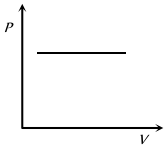
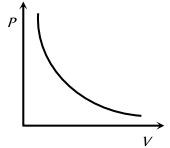
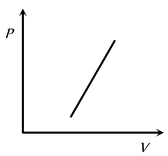
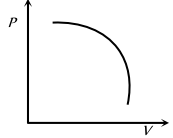
Which of the accompanying $P V$, diagrams best represents an isothermal process
AnswerIn isothermal process $P \propto \frac{1}{V}$.Hence graph between $P$ and $V$ is a hyperbola.
View full question & answer→MCQ 2311 Mark
Which of the accompanying $P V$, diagrams best represents an isothermal process
AnswerIn isothermal process $P \propto \frac{1}{V}$.Hence graph between $P$ and $V$ is a hyperbola.
View full question & answer→MCQ 2321 Mark
Which of the accompanying $P V$, diagrams best represents an isothermal process
AnswerIn isothermal process $P \propto \frac{1}{V}$.Hence graph between $P$ and $V$ is a hyperbola.
View full question & answer→MCQ 2331 Mark
$1 \mathrm{~cm}^3$ of water at its boiling point absorbs $540$ calories of heat to become steam with a volume of $1671 \mathrm{~cm}^3$.If the atmospheric pressure $=1.013 \times 10^5 \mathrm{~N} / \mathrm{m}^2$ and the mechanical equivalent of heat $=4.19 \mathrm{~J} /$ calorie, the energy spent in this process in overcoming intermolecular forces is
- A
$540 \mathrm{cal}$
- B
$40 \mathrm{cal}$
- ✓
$500 \mathrm{cal}$
- D
AnswerCorrect option: C. $500 \mathrm{cal}$
$\Delta Q=\Delta U+\Delta W $
$\therefore \Delta U=\Delta Q-\Delta W=540-\frac{P\left(V_2 / V_1\right)}{J} $
$=540-\frac{1.013 \times 10^5 \times\left[(1671-1) \times 10^{-6}\right]}{4.2} $
$=540-39.7$
$=500 \text { calories }$
View full question & answer→MCQ 2341 Mark
$1 \mathrm{~cm}^3$ of water at its boiling point absorbs $540$ calories of heat to become steam with a volume of $1671 \mathrm{~cm}^3$.If the atmospheric pressure $=1.013 \times 10^5 \mathrm{~N} / \mathrm{m}^2$ and the mechanical equivalent of heat $=4.19 \mathrm{~J} /$ calorie, the energy spent in this process in overcoming intermolecular forces is
- A
$540 \mathrm{cal}$
- B
$40 \mathrm{cal}$
- ✓
$500 \mathrm{cal}$
- D
AnswerCorrect option: C. $500 \mathrm{cal}$
$\Delta Q=\Delta U+\Delta W $
$\therefore \Delta U=\Delta Q-\Delta W=540-\frac{P\left(V_2 / V_1\right)}{J} $
$=540-\frac{1.013 \times 10^5 \times\left[(1671-1) \times 10^{-6}\right]}{4.2} $
$=540-39.7$
$=500 \text { calories }$
View full question & answer→MCQ 2351 Mark
$1 \mathrm{~cm}^3$ of water at its boiling point absorbs $540$ calories of heat to become steam with a volume of $1671 \mathrm{~cm}^3$.If the atmospheric pressure $=1.013 \times 10^5 \mathrm{~N} / \mathrm{m}^2$ and the mechanical equivalent of heat $=4.19 \mathrm{~J} /$ calorie, the energy spent in this process in overcoming intermolecular forces is
- A
$540 \mathrm{cal}$
- B
$40 \mathrm{cal}$
- ✓
$500 \mathrm{cal}$
- D
AnswerCorrect option: C. $500 \mathrm{cal}$
$\Delta Q=\Delta U+\Delta W $
$\therefore \Delta U=\Delta Q-\Delta W=540-\frac{P\left(V_2 / V_1\right)}{J} $
$=540-\frac{1.013 \times 10^5 \times\left[(1671-1) \times 10^{-6}\right]}{4.2} $
$=540-39.7$
$=500 \text { calories }$
View full question & answer→MCQ 2361 Mark
In an adiabatic expansion of a gas initial and final temperatures are $T_1$ and $T_2$ respectively, then the change in internal energy of the gas is
AnswerCorrect option: A. $\frac{R}{\gamma-1}\left(T_2-T_1\right)$
$\Delta U=-\Delta W=-\frac{R(T_1-T_2)}{(\gamma-1)}=\frac{R(T_2T_1)}{\gamma-1}$
View full question & answer→MCQ 2371 Mark
In an adiabatic expansion of a gas initial and final temperatures are $T_1$ and $T_2$ respectively, then the change in internal energy of the gas is
AnswerCorrect option: A. $\frac{R}{\gamma-1}\left(T_2-T_1\right)$
$\Delta U=-\Delta W=-\frac{R(T_1-T_2)}{(\gamma-1)}=\frac{R(T_2T_1)}{\gamma-1}$
View full question & answer→MCQ 2381 Mark
In an adiabatic expansion of a gas initial and final temperatures are $T_1$ and $T_2$ respectively, then the change in internal energy of the gas is
AnswerCorrect option: A. $\frac{R}{\gamma-1}\left(T_2-T_1\right)$
$\Delta U=-\Delta W=-\frac{R(T_1-T_2)}{(\gamma-1)}=\frac{R(T_2T_1)}{\gamma-1}$
View full question & answer→MCQ 2391 Mark
During the adiabatic expansion of $2$ moles of a gas, the internal energy was found to have decreased by $100 \mathrm{~J}$. The work done by the gas in this process is
- A
- B
$-100 \mathrm{~J}$
- C
$200 \mathrm{~J}$
- ✓
$100 \mathrm{~J}$
AnswerCorrect option: D. $100 \mathrm{~J}$
For adiabatic process from $\text{FlOT}$
$\Delta W=-\Delta U \quad(\because \Delta Q=0) $
$\Rightarrow \Delta W=-(-100)=+100 J$
View full question & answer→MCQ 2401 Mark
During the adiabatic expansion of $2$ moles of a gas, the internal energy was found to have decreased by $100 \mathrm{~J}$. The work done by the gas in this process is
- A
- B
$-100 \mathrm{~J}$
- C
$200 \mathrm{~J}$
- ✓
$100 \mathrm{~J}$
AnswerCorrect option: D. $100 \mathrm{~J}$
For adiabatic process from $\text{FlOT}$
$\Delta W=-\Delta U \quad(\because \Delta Q=0) $
$\Rightarrow \Delta W=-(-100)=+100 J$
View full question & answer→MCQ 2411 Mark
During the adiabatic expansion of $2$ moles of a gas, the internal energy was found to have decreased by $100 \mathrm{~J}$. The work done by the gas in this process is
- A
- B
$-100 \mathrm{~J}$
- C
$200 \mathrm{~J}$
- ✓
$100 \mathrm{~J}$
AnswerCorrect option: D. $100 \mathrm{~J}$
For adiabatic process from $\text{FlOT}$
$\Delta W=-\Delta U \quad(\because \Delta Q=0) $
$\Rightarrow \Delta W=-(-100)=+100 J$
View full question & answer→MCQ 2421 Mark
When heat is given to a gas in an isothermal change, the result will be
- ✓
- B
- C
Increase in internal energy
- D
External work done and also rise in temp.
AnswerIn isothermal change, temperature remains constant,
Hence $\Delta U$ $=0$.
Also from $\Delta Q=\Delta U+\Delta W \Rightarrow \Delta Q=\Delta W$
View full question & answer→MCQ 2431 Mark
When heat is given to a gas in an isothermal change, the result will be
- ✓
- B
- C
Increase in internal energy
- D
External work done and also rise in temp.
AnswerIn isothermal change, temperature remains constant,
Hence $\Delta U$ $=0$.
Also from $\Delta Q=\Delta U+\Delta W$
$\Rightarrow \Delta Q=\Delta W$
View full question & answer→MCQ 2441 Mark
When heat is given to a gas in an isothermal change, the result will be
- ✓
- B
- C
Increase in internal energy
- D
External work done and also rise in temp.
AnswerIn isothermal change, temperature remains constant,
Hence $\Delta U$ $=0$.
Also from $\Delta Q=\Delta U+\Delta W$
$\Rightarrow \Delta Q=\Delta W$
View full question & answer→MCQ 2451 Mark
A polyatomic gas $\left(\gamma=\frac{4}{3}\right)$ is compressed to $\frac{1}{8}$ of its volume adiabatically. If its initial pressure is $P_o$, its new pressure will be
- A
$8 P_o$
- ✓
$16 P_0$
- C
$6 P_0$
- D
$2 P_0$
AnswerCorrect option: B. $16 P_0$
$\frac{P_2}{P_1}=\left(\frac{V_1}{V_2}\right)^\gamma$
$\Rightarrow P_2=P_1\left(\frac{V_1}{V_2}\right)^\gamma$
$=P_0(8)^{4 / 3}$
$=16 P_0$.
View full question & answer→MCQ 2461 Mark
A polyatomic gas $\left(\gamma=\frac{4}{3}\right)$ is compressed to $\frac{1}{8}$ of its volume adiabatically. If its initial pressure is $P_o$, its new pressure will be
- A
$8 P_o$
- ✓
$16 P_0$
- C
$6 P_0$
- D
$2 P_0$
AnswerCorrect option: B. $16 P_0$
$\frac{P_2}{P_1}=\left(\frac{V_1}{V_2}\right)^\gamma$
$\Rightarrow P_2=P_1\left(\frac{V_1}{V_2}\right)^\gamma$
$=P_0(8)^{4 / 3}$
$=16 P_0$.
View full question & answer→MCQ 2471 Mark
A polyatomic gas $\left(\gamma=\frac{4}{3}\right)$ is compressed to $\frac{1}{8}$ of its volume adiabatically. If its initial pressure is $P_o$, its new pressure will be
- ✓
$8 P_0$
- B
$16 P_0$
- C
$6 P_0$
- D
$2 P_0$
AnswerCorrect option: A. $8 P_0$
$\frac{P_2}{P_1}=\left(\frac{V_1}{V_2}\right)^\gamma$
$\Rightarrow P_2=P_1\left(\frac{V_1}{V_2}\right)^\gamma$
$=P_0(8)^{4 / 3}$
$=16 P_0$.
View full question & answer→MCQ 2481 Mark
A system is given $300$ calories of heat and it does $600$ joules of work. How much does the internal energy of the system change in this process$(J=4.18$ joules $/ \mathrm{cal})$
- ✓
$654$ Joule
- B
$156.5$ Joule
- C
$-300$ Joule
- D
$-528.2$ Joule
AnswerCorrect option: A. $654$ Joule
$ \Delta Q=\Delta U+\Delta W, $
$\Delta U= \Delta Q-\Delta W $
$\Delta U=4.18 \times 300-600$
$=654 \text { Joule }$
View full question & answer→MCQ 2491 Mark
A system is given $300$ calories of heat and it does $600$ joules of work. How much does the internal energy of the system change in this process$(J=4.18$ joules $/ \mathrm{cal})$
- ✓
$654$ Joule
- B
$156.5$ Joule
- C
$-300$ Joule
- D
$-528.2$ Joule
AnswerCorrect option: A. $654$ Joule
$ \Delta Q=\Delta U+\Delta W, $
$\Delta U= \Delta Q-\Delta W $
$\Delta U=4.18 \times 300-600$
$=654 \text { Joule }$
View full question & answer→MCQ 2501 Mark
A system is given $300$ calories of heat and it does $600$ joules of work. How much does the internal energy of the system change in this process$(J=4.18$ joules $/ \mathrm{cal})$
- ✓
$654$ Joule
- B
$156.5$ Joule
- C
$-300$ Joule
- D
$-528.2$ Joule
AnswerCorrect option: A. $654$ Joule
$ \Delta Q=\Delta U+\Delta W, $
$\Delta U= \Delta Q-\Delta W $
$\Delta U=4.18 \times 300-600$
$=654 \text { Joule }$
View full question & answer→