MCQ 2511 Mark
If $R=$ universal gas constant, the amount of heat needed to raise the temperature of $2$ mole of an ideal monoatomic gas from $273 K$ to $373 K$ when no work is done
- A
$100 R$
- B
$150 R$
- ✓
$300 R$
- D
$500 R$
AnswerCorrect option: C. $300 R$
$\Delta Q=\Delta U+\Delta W \because \Delta W=0 $
$\Rightarrow \Delta Q=\Delta U=\frac{f}{2} \mu R \Delta T$
$=\frac{3}{2} \times 2 R(373-273)=300 R .$
View full question & answer→MCQ 2521 Mark
If $R=$ universal gas constant, the amount of heat needed to raise the temperature of $2$ mole of an ideal monoatomic gas from $273 K$ to $373 K$ when no work is done
- A
$100 R$
- B
$150 R$
- ✓
$300 R$
- D
$500 R$
AnswerCorrect option: C. $300 R$
$\Delta Q=\Delta U+\Delta W \because \Delta W=0 $
$\Rightarrow \Delta Q=\Delta U=\frac{f}{2} \mu R \Delta T$
$=\frac{3}{2} \times 2 R(373-273)=300 R .$
View full question & answer→MCQ 2531 Mark
If $R=$ universal gas constant, the amount of heat needed to raise the temperature of $2$ mole of an ideal monoatomic gas from $273 K$ to $373 K$ when no work is done
- A
$100 R$
- B
$150 R$
- ✓
$300 R$
- D
$500 R$
AnswerCorrect option: C. $300 R$
$\Delta Q=\Delta U+\Delta W \because \Delta W=0 $
$\Rightarrow \Delta Q=\Delta U=\frac{f}{2} \mu R \Delta T$
$=\frac{3}{2} \times 2 R(373-273)$
$=300 R .$
View full question & answer→MCQ 2541 Mark
Two identical samples of a gas are allowed to expand $(i)$ isothermally $(ii)$ adiabatically. Work done is
- ✓
More in the isothermal process
- B
More in the adiabatic process
- C
- D
AnswerCorrect option: A. More in the isothermal process
View full question & answer→MCQ 2551 Mark
Two identical samples of a gas are allowed to expand $(i)$ isothermally $(ii)$ adiabatically. Work done is
- ✓
More in the isothermal process
- B
More in the adiabatic process
- C
- D
AnswerCorrect option: A. More in the isothermal process
View full question & answer→MCQ 2561 Mark
Two identical samples of a gas are allowed to expand $(i)$ isothermally $(ii)$ adiabatically. Work done is
- ✓
More in the isothermal process
- B
More in the adiabatic process
- C
- D
AnswerCorrect option: A. More in the isothermal process
View full question & answer→MCQ 2571 Mark
A gas is compressed at a constant pressure of $50 \mathrm{~N} / \mathrm{m}^2$ from a volume of $10 \mathrm{~m}^3$ to a volume of $4 \mathrm{~m}^3$. Energy of $100 \mathrm{~J}$ then added to the gas by heating. Its internal energy is
- ✓
Increased by $400 \mathrm{~J}$
- B
Increased by $200 \mathrm{~J}$
- C
Increased by $100 \mathrm{~J}$
- D
Decreased by $200 \mathrm{~J}$
AnswerCorrect option: A. Increased by $400 \mathrm{~J}$
From FLOT $\Delta Q=\Delta U+\Delta W=\Delta U+P \Delta V$
$\Rightarrow 100=\Delta U+50 \times(4-10)$
$\Rightarrow \Delta U=400 \mathrm{~J}$
View full question & answer→MCQ 2581 Mark
A gas is compressed at a constant pressure of $50 \mathrm{~N} / \mathrm{m}^2$ from a volume of $10 \mathrm{~m}^3$ to a volume of $4 \mathrm{~m}^3$. Energy of $100 \mathrm{~J}$ then added to the gas by heating. Its internal energy is
- ✓
Increased by $400 \mathrm{~J}$
- B
Increased by $200 \mathrm{~J}$
- C
Increased by $100 \mathrm{~J}$
- D
Decreased by $200 \mathrm{~J}$
AnswerCorrect option: A. Increased by $400 \mathrm{~J}$
From FLOT $\Delta Q=\Delta U+\Delta W=\Delta U+P \Delta V$
$\Rightarrow 100=\Delta U+50 \times(4-10)$
$\Rightarrow \Delta U=400 \mathrm{~J}$
View full question & answer→MCQ 2591 Mark
A gas is compressed at a constant pressure of $50 \mathrm{~N} / \mathrm{m}^2$ from a volume of $10 \mathrm{~m}^3$ to a volume of $4 \mathrm{~m}^3$. Energy of $100 \mathrm{~J}$ then added to the gas by heating. Its internal energy is
- ✓
Increased by $400 \mathrm{~J}$
- B
Increased by $200 \mathrm{~J}$
- C
Increased by $100 \mathrm{~J}$
- D
Decreased by $200 \mathrm{~J}$
AnswerCorrect option: A. Increased by $400 \mathrm{~J}$
From FLOT $\Delta Q=\Delta U+\Delta W=\Delta U+P \Delta V$
$\Rightarrow 100=\Delta U+50 \times(4-10)$
$\Rightarrow \Delta U=400 \mathrm{~J}$
View full question & answer→MCQ 2601 Mark
An adiabatic process occurs at constant
AnswerIn adiabatic process, no heat transfers between system and surrounding.
View full question & answer→MCQ 2611 Mark
The gas law $\frac{P V}{T}=$ constant is true for
- A
- B
- ✓
Both isothermal and adiabatic changes
- D
Neither isothermal nor adiabatic changes
AnswerCorrect option: C. Both isothermal and adiabatic changes
Both isothermal and adiabatic changes
View full question & answer→MCQ 2621 Mark
The gas law $\frac{P V}{T}=$ constant is true for
- A
- B
- ✓
Both isothermal and adiabatic changes
- D
Neither isothermal nor adiabatic changes
AnswerCorrect option: C. Both isothermal and adiabatic changes
Both isothermal and adiabatic changes
View full question & answer→MCQ 2631 Mark
The gas law $\frac{P V}{T}=$ constant is true for
- A
- B
- ✓
Both isothermal and adiabatic changes
- D
Neither isothermal nor adiabatic changes
AnswerCorrect option: C. Both isothermal and adiabatic changes
Both isothermal and adiabatic changes
View full question & answer→MCQ 2641 Mark
The state of a thermodynamic system is represented by
- A
- B
- ✓
Pressure, volume and temperature
- D
AnswerCorrect option: C. Pressure, volume and temperature
Pressure, volume and temperature
View full question & answer→MCQ 2651 Mark
The state of a thermodynamic system is represented by
- A
- B
- ✓
Pressure, volume and temperature
- D
AnswerCorrect option: C. Pressure, volume and temperature
Pressure, volume and temperature
View full question & answer→MCQ 2661 Mark
The state of a thermodynamic system is represented by
- A
- B
- ✓
Pressure, volume and temperature
- D
AnswerCorrect option: C. Pressure, volume and temperature
Pressure, volume and temperature
View full question & answer→MCQ 2671 Mark
A perfect gas contained in a cylinder is kept in vacuum. If the cylinder suddenly bursts, then the temperature of the gas
AnswerDuring free expansion of a perfect gas no, work is done and also no heat is supplied from outside. Therefore, no change in internal energy. Hence, temperature remain constant.
View full question & answer→MCQ 2681 Mark
A perfect gas contained in a cylinder is kept in vacuum. If the cylinder suddenly bursts, then the temperature of the gas
AnswerDuring free expansion of a perfect gas no, work is done and also no heat is supplied from outside. Therefore, no change in internal energy. Hence, temperature remain constant.
View full question & answer→MCQ 2691 Mark
A perfect gas contained in a cylinder is kept in vacuum. If the cylinder suddenly bursts, then the temperature of the gas
AnswerDuring free expansion of a perfect gas no, work is done and also no heat is supplied from outside. Therefore, no change in internal energy. Hence, temperature remain constant.
View full question & answer→MCQ 2701 Mark
Efficiency of Carnot engine is $100 \%$ if
- A
$T_2=273 K$
- ✓
$T_2=0 \mathrm{~K}$
- C
$T_1=273 K$
- D
$T_1=0 \mathrm{~K}$
AnswerCorrect option: B. $T_2=0 \mathrm{~K}$
$ \eta=1-\frac{T_2}{T_1}$ for $100$ efficiency $(\eta=1)$ which gives $(T=0\mathrm{~K})$
View full question & answer→MCQ 2711 Mark
Efficiency of Carnot engine is $100 \%$ if
- A
$T_2=273 K$
- ✓
$T_2=0 \mathrm{~K}$
- C
$T_1=273 K$
- D
$T_1=0 \mathrm{~K}$
AnswerCorrect option: B. $T_2=0 \mathrm{~K}$
$ \eta=1-\frac{T_2}{T_1}$ for $100$ efficiency $(\eta=1)$ which gives $(T=0\mathrm{~K})$
View full question & answer→MCQ 2721 Mark
Efficiency of Carnot engine is $100 \%$ if
- A
$T_2=273 K$
- ✓
$T_2=0 \mathrm{~K}$
- C
$T_1=273 K$
- D
$T_1=0 \mathrm{~K}$
AnswerCorrect option: B. $T_2=0 \mathrm{~K}$
$ \eta=1-\frac{T_2}{T_1}$ for $100$ efficiency $(\eta=1)$ which gives $(T=0\mathrm{~K})$
View full question & answer→MCQ 2731 Mark
In pressure$-$volume diagram given below, the isochoric, isothermal, and isobaric parts respectively, are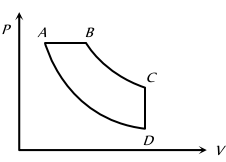
- A
$\text{BA, AD, DC}$
- B
$\text{DC, CB, BA}$
- C
$\text{AB, BC, CD}$
- ✓
$\text{CD, DA, AB}$
AnswerCorrect option: D. $\text{CD, DA, AB}$
Process $\text{CD}$ is isochoric as volume is constant, Process $\text{DA}$ is isothermal as temperature constant and Process $\text{AB}$ is isobaric as pressure is constant.
View full question & answer→MCQ 2741 Mark
A container of volume $1 \mathrm{~m}^3$ is divided into two equal compartments by a partition. One of these compartments contains an ideal gas at $300 K$. The other compartment is vacuum. The whole system is thermally isolated from its surroundings. The partition is removed and the gas expands to occupy the whole volume of the container. lts temperature now would be
- ✓
$300 \mathrm{~K}$
- B
$239 K$
- C
$200 K$
- D
$100 K$
AnswerCorrect option: A. $300 \mathrm{~K}$
This is the case of free expansion and in this case $\Delta W=0$,
$\Delta U=0$
so temperature remains same
i.e. $300 K$.
View full question & answer→MCQ 2751 Mark
In pressure$-$volume diagram given below, the isochoric, isothermal, and isobaric parts respectively, are - A
$\text{BA, AD, DC}$
- B
$\text{DC, CB, BA}$
- C
$\text{AB, BC, CD}$
- ✓
$\text{CD, DA, AB}$
AnswerCorrect option: D. $\text{CD, DA, AB}$
Process $\text{CD}$ is isochoric as volume is constant, Process $\text{DA}$ is isothermal as temperature constant and Process $\text{AB}$ is isobaric as pressure is constant.
View full question & answer→MCQ 2761 Mark
A container of volume $1 \mathrm{~m}^3$ is divided into two equal compartments by a partition. One of these compartments contains an ideal gas at $300 K$. The other compartment is vacuum. The whole system is thermally isolated from its surroundings. The partition is removed and the gas expands to occupy the whole volume of the container. lts temperature now would be
- ✓
$300 \mathrm{~K}$
- B
$239 K$
- C
$200 K$
- D
$100 K$
AnswerCorrect option: A. $300 \mathrm{~K}$
This is the case of free expansion and in this case $\Delta W=0$,
$\Delta U=0$
so temperature remains same.
i.e. $300 K$.
View full question & answer→MCQ 2771 Mark
In pressure$-$volume diagram given below, the isochoric, isothermal, and isobaric parts respectively, are - A
$\text{BA, AD, DC}$
- B
$\text{DC, CB, BA}$
- ✓
$\text{AB, BC, CD}$
- D
$\text{CD, DA, AB}$
AnswerCorrect option: C. $\text{AB, BC, CD}$
Process $\text{CD}$ is isochoric as volume is constant, Process $\text{DA}$ is isothermal as temperature constant and Process $\text{AB}$ is isobaric as pressure is constant.
View full question & answer→MCQ 2781 Mark
A container of volume $1 \mathrm{~m}^3$ is divided into two equal compartments by a partition. One of these compartments contains an ideal gas at $300 K$. The other compartment is vacuum. The whole system is thermally isolated from its surroundings. The partition is removed and the gas expands to occupy the whole volume of the container. lts temperature now would be
- ✓
$300 \mathrm{~K}$
- B
$239 K$
- C
$200 K$
- D
$100 K$
AnswerCorrect option: A. $300 \mathrm{~K}$
This is the case of free expansion and in this case $\Delta W=0$,
$\Delta U=0$ so temperature remains same
i.e. $300 K$.
View full question & answer→MCQ 2791 Mark
An ideal gas heat engine operates in a Carnot's cycle between $227^{\circ} \mathrm{C}$ and $127^{\circ} \mathrm{C}$. It absorbs $6 \times 10 \mathrm{~J}$ at high temperature. The amount of heat converted into work is ....
- A
$4.8 \times 10^4 J$
- B
$3.5 \times 10^4 \mathrm{~J}$
- C
$1.6 \times 10^4 \mathrm{~J}$
- ✓
$1.2 \times 10^4 \mathrm{~J}$
AnswerCorrect option: D. $1.2 \times 10^4 \mathrm{~J}$
$\eta=1-\frac{T_2}{T_1}=1-\frac{400}{500}=\frac{1}{5} (\because \eta=\frac{W}{Q}) $
$\Rightarrow \frac{1}{5}=\frac{W}{Q} $
$\Rightarrow W=\frac{Q}{5}=\frac{6}{5} \times 10^4=1.2 \times 10^4 \mathrm{~J}$
View full question & answer→MCQ 2801 Mark
An ideal gas heat engine operates in a Carnot's cycle between $227^{\circ} \mathrm{C}$ and $127^{\circ} \mathrm{C}$. It absorbs $6 \times 10 \mathrm{~J}$ at high temperature. The amount of heat converted into work is $.....$
- A
$4.8 \times 10^4 J$
- B
$3.5 \times 10^4 \mathrm{~J}$
- C
$1.6 \times 10^4 \mathrm{~J}$
- ✓
$1.2 \times 10^4 \mathrm{~J}$
AnswerCorrect option: D. $1.2 \times 10^4 \mathrm{~J}$
$\eta=1-\frac{T_2}{T_1}=1-\frac{400}{500}=\frac{1}{5} (\because \eta=\frac{W}{Q}) $
$\Rightarrow \frac{1}{5}=\frac{W}{Q} $
$\Rightarrow W=\frac{Q}{5}=\frac{6}{5} \times 10^4=1.2 \times 10^4 \mathrm{~J}$
View full question & answer→MCQ 2811 Mark
An ideal gas heat engine operates in a Carnot's cycle between $227^{\circ} \mathrm{C}$ and $127^{\circ} \mathrm{C}$. It absorbs $6 \times 10 \mathrm{~J}$ at high temperature. The amount of heat converted into work is $......$
- A
$4.8 \times 10^4 J$
- B
$3.5 \times 10^4 \mathrm{~J}$
- C
$1.6 \times 10^4 \mathrm{~J}$
- ✓
$1.2 \times 10^4 \mathrm{~J}$
AnswerCorrect option: D. $1.2 \times 10^4 \mathrm{~J}$
$\eta=1-\frac{T_2}{T_1}=1-\frac{400}{500}=\frac{1}{5} (\because \eta=\frac{W}{Q}) $
$\Rightarrow \frac{1}{5}=\frac{W}{Q} $
$\Rightarrow W=\frac{Q}{5}=\frac{6}{5} \times 10^4=1.2 \times 10^4 \mathrm{~J}$
View full question & answer→MCQ 2821 Mark
A Carnot's engine is made to work between $200^{\circ} \mathrm{C}$ and $0^{\circ} \mathrm{C}$ first and then between $0^{\circ} \mathrm{C}$ and $-200^{\circ} \mathrm{C}$. The ratio of efficiencies of the engine in the two cases is
- ✓
$1.73: 1$
- B
$1: 1.73$
- C
$1: 1$
- D
$1: 2$
AnswerCorrect option: A. $1.73: 1$
In first case $\eta_1=1-\frac{T_2}{T_1}=1-\frac{(273+0)}{(273+200)}=\frac{200}{473}$
In second case $\eta_2=1-\frac{(273-200)}{(273+0)}=\frac{200}{273}$
$\Rightarrow\frac{\eta_1}{\eta_2}=\frac{1}{\left(\frac{473}{273}\right)}=1: 1.73$
View full question & answer→MCQ 2831 Mark
A Carnot's engine is made to work between $200^{\circ} \mathrm{C}$ and $0^{\circ} \mathrm{C}$ first and then between $0^{\circ} \mathrm{C}$ and $-200^{\circ} \mathrm{C}$. The ratio of efficiencies of the engine in the two cases is
- ✓
$1.73: 1$
- B
$1: 1.73$
- C
$1: 1$
- D
$1: 2$
AnswerCorrect option: A. $1.73: 1$
In first case $\eta_1=1-\frac{T_2}{T_1}=1-\frac{(273+0)}{(273+200)}=\frac{200}{473}$
In second case $\eta_2=1-\frac{(273-200)}{(273+0)}=\frac{200}{273}$
$\Rightarrow\frac{\eta_1}{\eta_2}=\frac{1}{\left(\frac{473}{273}\right)}=1: 1.73$
View full question & answer→MCQ 2841 Mark
A Carnot's engine is made to work between $200^{\circ} \mathrm{C}$ and $0^{\circ} \mathrm{C}$ first and then between $0^{\circ} \mathrm{C}$ and $-200^{\circ} \mathrm{C}$. The ratio of efficiencies of the engine in the two cases is
- ✓
$1.73: 1$
- B
$1: 1.73$
- C
$1: 1$
- D
$1: 2$
AnswerCorrect option: A. $1.73: 1$
In first case $\eta_1=1-\frac{T_2}{T_1}=1-\frac{(273+0)}{(273+200)}=\frac{200}{473}$
In second case $\eta_2=1-\frac{(273-200)}{(273+0)}=\frac{200}{273}$
$\Rightarrow\frac{\eta_1}{\eta_2}=\frac{1}{\left(\frac{473}{273}\right)}=1: 1.73$
View full question & answer→MCQ 2851 Mark
An ideal gas is taken around $\text{ABCA}$ as shown in the above $\text{P-V}$ diagram. The work done during a cycle is 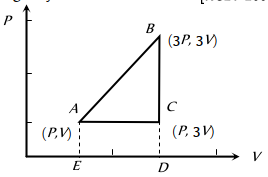
- ✓
$2 P V$
- B
$P V$
- C
$1 / 2 P V$
- D
AnswerCorrect option: A. $2 P V$
Work done $=$ Area enclosed by triangle
$\text{ABC}=\frac{1}{2} A C \times B C$
$=\frac{1}{2} \times(3 V-V) \times(3 P-P)$
$=2 P V$
View full question & answer→MCQ 2861 Mark
An ideal gas is taken around $\text{ABCA}$ as shown in the above $\text{P-V}$ diagram. The work done during a cycle is - ✓
$2 P V$
- B
$P V$
- C
$1 / 2 P V$
- D
AnswerCorrect option: A. $2 P V$
Work done $=$ Area enclosed by triangle
$\text{ABC}=\frac{1}{2} A C \times B C$
$=\frac{1}{2} \times(3 V-V) \times(3 P-P)$
$=2 P V$
View full question & answer→MCQ 2871 Mark
An ideal gas is taken around $\text{ABCA}$ as shown in the above $\text{P-V}$ diagram. The work done during a cycle is - ✓
$2 P V$
- B
$P V$
- C
$1 / 2 P V$
- D
AnswerCorrect option: A. $2 P V$
Work done $=$ Area enclosed by triangle
$\text{ABC}=\frac{1}{2} A C \times B C$
$=\frac{1}{2} \times(3 V-V) \times(3 P-P)$
$=2 P V$
View full question & answer→MCQ 2881 Mark
In an isothermal expansion
- A
Internal energy of the gas increases
- B
Internal energy of the gas decreases
- ✓
Internal energy remains unchanged
- D
Average kinetic energy of gas molecule decreases
AnswerCorrect option: C. Internal energy remains unchanged
In isothermal expansion temperature remains constant, hence no change in internal energy.
View full question & answer→MCQ 2891 Mark
In an isothermal expansion
- A
Internal energy of the gas increases
- B
Internal energy of the gas decreases
- ✓
Internal energy remains unchanged
- D
Average kinetic energy of gas molecule decreases
AnswerCorrect option: C. Internal energy remains unchanged
In isothermal expansion temperature remains constant, hence no change in internal energy.
View full question & answer→MCQ 2901 Mark
In an isothermal expansion
- A
Internal energy of the gas increases
- B
Internal energy of the gas decreases
- ✓
Internal energy remains unchanged
- D
Average kinetic energy of gas molecule decreases
AnswerCorrect option: C. Internal energy remains unchanged
In isothermal expansion temperature remains constant, hence no change in internal energy.
View full question & answer→MCQ 2911 Mark
For which combination of working temperatures the efficiency of Carnot's engine is highest
AnswerCorrect option: D. $40 K, 20 K$
$\eta=1-\frac{T_2}{T_1}$.
for $\eta$ to be max. ratio $\frac{T_2}{T_1}$ should be min.
View full question & answer→MCQ 2921 Mark
For which combination of working temperatures the efficiency of Carnot's engine is highest
AnswerCorrect option: D. $40 K, 20 K$
$\eta=1-\frac{T_2}{T_1}$.
for $\eta$ to be max. ratio $\frac{T_2}{T_1}$ should be min.
View full question & answer→MCQ 2931 Mark
For which combination of working temperatures the efficiency of Carnot's engine is highest
AnswerCorrect option: D. $40 K, 20 K$
$\eta=1-\frac{T_2}{T_1}$.
for $\eta$ to be max. ratio $\frac{T_2}{T_1}$ should be min.
View full question & answer→MCQ 2941 Mark
Which of the following is a slow process
MCQ 2951 Mark
Which of the following is a slow process
MCQ 2961 Mark
An engineer claims to have made an engine delivering $10 \mathrm{~kW}$ power with fuel consumption of $1 \mathrm{~g} / \mathrm{sec}$. The calorific value of the fuel is $ 2 \mathrm{kcal} / \mathrm{g}$. Is the claim of the engineer
View full question & answer→MCQ 2971 Mark
Which of the following is a slow process
MCQ 2981 Mark
An engineer claims to have made an engine delivering $10 \mathrm{~kW}$ power with fuel consumption of $1 \mathrm{~g} / \mathrm{sec}$. The calorific value of the fuel is 2 $\mathrm{kcal} / \mathrm{g}$. Is the claim of the engineer
View full question & answer→MCQ 2991 Mark
For adiabatic processes $\left(\gamma=\frac{C_p}{C_v}\right)$
AnswerCorrect option: C. $T V^{\gamma-1}=$ constant
In adiabatic process $P V^\gamma=$ constant
$\Rightarrow\left(\frac{R T}{V}\right)\cdot V^\gamma=\mathrm{constant}$
$\Rightarrow T V^{\gamma-1}=\mathrm{constant}$
View full question & answer→MCQ 3001 Mark
For adiabatic processes $\left(\gamma=\frac{C_p}{C_v}\right)$
AnswerCorrect option: C. $T V^{\gamma-1}=$ constant
In adiabatic process $P V^\gamma=$ constant
$\Rightarrow\left(\frac{R T}{V}\right)\cdot V^\gamma=\mathrm{constant}$
$\Rightarrow T V^{\gamma-1}=\mathrm{constant}$
View full question & answer→