MCQ 511 Mark
Forces $F_1$ and $F_2$ act on a point mass in two mutually perpendicular directions. The resultant force on the point mass will be
- A
$F_1+F_2$
- B
$F_1-F_2$
- ✓
$\sqrt{F_1^2+F_2^2}$
- D
$F_1^2+F_2^2$
AnswerCorrect option: C. $\sqrt{F_1^2+F_2^2}$
(c) $F=\sqrt{F_1^2+F_2^2+2 F_1 F_2 \cos 90^{\circ}}=\sqrt{F_1^2+F_2^2}$
View full question & answer→MCQ 521 Mark
- ✓
$\hat{j} \times \hat{k}=\hat{i}$
- B
$\hat{i} \cdot \hat{i}=0$
- C
$\hat{j} \times \hat{j}=1$
- D
$\hat{k} \cdot \hat{j}=1$
AnswerCorrect option: A. $\hat{j} \times \hat{k}=\hat{i}$
View full question & answer→MCQ 531 Mark
If $\left|\vec{V}_1 \quad \vec{V}_2\right|\left|\begin{array}{ll}\vec{V}_1 & \vec{V}_2\end{array}\right|$ and $V_2$ is finite, then
- A
$V_1$ is parallel to $V_2$
- B
$\vec{V}_1 \quad \vec{V}_2$
- ✓
$V_1$ and $V_2$ are mutually perpendicular
- D
$\left|\vec{V}_1\right|\left|\vec{V}_2\right|$
AnswerCorrect option: C. $V_1$ and $V_2$ are mutually perpendicular
View full question & answer→MCQ 541 Mark
Following sets of three forces act on a body. Whose resultant cannot be zero
- A
$10,10,10$
- B
$10,10,20$
- C
$10,20,23$
- ✓
$10,20,40$
AnswerCorrect option: D. $10,20,40$
View full question & answer→MCQ 551 Mark
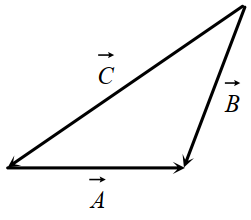
For the figure
- A
$\vec{A}+\vec{B}=\vec{C}$
- B
$\vec{B}+\vec{C}=\vec{A}$
- ✓
$\vec{C}+\vec{A}=\vec{B}$
- D
$\vec{A}+\vec{B}+\vec{C}=0$
AnswerCorrect option: C. $\vec{C}+\vec{A}=\vec{B}$
View full question & answer→MCQ 561 Mark
A particle is simultaneously acted by two forces equal to $4 N$ and 3 $N$. The net force on the particle is
- A
$7 N$
- B
$5 N$
- C
$1 N$
- ✓
Between $1 N$ and $7 N$
AnswerCorrect option: D. Between $1 N$ and $7 N$
(d) If two vectors $\vec{A}$ and $\vec{B}$ are given then the resultant $R_{\max }=$ $A+B=7 N$ and $R_{\min }=4-3=1 N$ i.e. net force on the particle is between $1 N$ and $7 N$.
View full question & answer→MCQ 571 Mark
A particle moves from position $3 \hat{i}+2 \hat{j}-6 \hat{k}$ to $14 \hat{i}+13 \hat{j}+9 \hat{k}$ due to a uniform force of $(4 \hat{i}+\hat{j}+3 \hat{k}) N$. If the displacement in meters then work done will be
- ✓
$100 J$
- B
$200 J$
- C
$300 J$
- D
$250 J$
AnswerCorrect option: A. $100 J$
(a)$\begin{aligned}& S=\overrightarrow{r_2}-\overrightarrow{r_1} \\& W=\vec{F} \cdot \vec{S}=(4 \hat{i}+\hat{j}+3 \hat{k}) \cdot(11 \hat{i}+11 \hat{j}+15 \hat{k}) \\& =(4 \times 11+1 \times 11+3 \times 15)=100 J .\end{aligned}$
View full question & answer→MCQ 581 Mark
A force vector applied on a mass is represented as $\vec{F}=6 \hat{i}-8 \hat{j}+10 \hat{k}$ and accelerates with $1 m / s ^2$. What will be the mass of the body in $kg$.
- ✓
$10 \sqrt{2}$
- B
- C
$2 \sqrt{10}$
- D
AnswerCorrect option: A. $10 \sqrt{2}$
(a) Mass $=\frac{\text { Force }}{\text { Acceleration }}=\frac{|\vec{F}|}{a}$$=\frac{\sqrt{36+64+100}}{1}=10 \sqrt{2} kg$
View full question & answer→MCQ 591 Mark
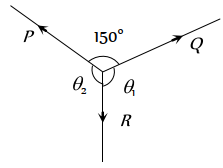
$P, Q$ and $R$ are three coplanar forces acting at a point and are in equilibrium. Given $P=1.9318 kg w t , \sin \theta_1=0.9659$, the value of $R$ is ( in $k g w t)$
View full question & answer→MCQ 601 Mark
If vectors $P, Q$ and $R$ have magnitude 5,12 and 13 units and $\vec{P}+\vec{Q}=\vec{R}$, the angle between $Q$ and $R$ is
- A
$\cos ^{-1} \frac{5}{12}$
- B
$\cos ^{-1} \frac{5}{13}$
- ✓
$\cos ^{-1} \frac{12}{13}$
- D
$\cos ^{-1} \frac{7}{13}$
AnswerCorrect option: C. $\cos ^{-1} \frac{12}{13}$
View full question & answer→MCQ 611 Mark
If a vector $2 \hat{i}+3 \hat{j}+8 \hat{k}$ is perpendicular to the vector $4 \hat{j}-4 \hat{i}+\alpha \hat{k}$. Then the value of $\alpha$ is
- A
- B
$\frac{1}{2}$
- ✓
$-\frac{1}{2}$
- D
AnswerCorrect option: C. $-\frac{1}{2}$
(c) Given vectors can be rewritten as $\vec{A}=2 \hat{i}+3 \hat{j}+8 \hat{k}$ and $\vec{B}=-4 \hat{i}+4 \hat{j}+\alpha\hat{k}$Dot product of these vectors should be equal to zero because they are perpendicular.$\therefore \vec{A} \cdot \vec{B}=-8+12+8 \alpha=0 \Rightarrow 8 \alpha=-4 \Rightarrow \alpha=-1 / 2$
View full question & answer→MCQ 621 Mark
If $|\vec{A} \times \vec{B}|=\sqrt{3} \vec{A} \cdot \vec{B}$, then the value of $|\vec{A}+\vec{B}|$ is
- A
$\left(A^2+B^2+\frac{A B}{\sqrt{3}}\right)^{1 / 2}$
- B
$A+B$
- C
$\left(A^2+B^2+\sqrt{3} A B\right)^{1 / 2}$
- ✓
$\left(A^2+B^2+A B\right)^{1 / 2}$
AnswerCorrect option: D. $\left(A^2+B^2+A B\right)^{1 / 2}$
(d)$\begin{aligned}& |\vec{A} \times \vec{B}|=\sqrt{3}(\vec{A} \cdot \vec{B}) \\& A B \sin \theta=\sqrt{3} A B \cos \theta \Rightarrow \tan \theta=\sqrt{3} \therefore \theta=60^{\circ} \\& \text { Now }|\vec{R}|=|\vec{A}+\vec{B}|=\sqrt{A^2+B^2+2 A B \cos \theta} \\& =\sqrt{A^2+B^2+2 A B\left(\frac{1}{2}\right)}=\left(A^2+B^2+A B\right)^{1 / 2}\end{aligned}$
View full question & answer→MCQ 631 Mark
The vector sum of two forces is perpendicular to their vector differences. In that case, the forces
- ✓
Are equal to each other in magnitude
- B
Are not equal to each other in magnitude
- C
- D
AnswerCorrect option: A. Are equal to each other in magnitude
(a) If two vectors are perpendicular then their dot product must be equal to zero. According to problem$\begin{aligned}& (\vec{A}\vec{B}) \cdot(\vec{A}-\vec{B})=0 \Rightarrow \vec{A} \cdot \vec{A}-\vec{A} \cdot \vec{B}+\vec{B} \cdot \vec{A}-\vec{B} \cdot \vec{B}=0 \\& \Rightarrow A^2-B^2=0 \Rightarrow A^2=B^2\end{aligned}$$\therefore A=B$ i.e. two vectors are equal to each other in magnitude.
View full question & answer→MCQ 641 Mark
If $|\vec{A}+\vec{B}|=|\vec{A}|+|\vec{B}|$, then angle between $\vec{A}$ and $\vec{B}$ will be
- A
$90^{\circ}$
- B
$120^{\circ}$
- ✓
$0^{\circ}$
- D
$60^{\circ}$
AnswerCorrect option: C. $0^{\circ}$
(c) Resultant of two vectors $\vec{A}$ and $\vec{B}$ can be given by$\begin{aligned}& \vec{R}=\vec{A}+\vec{B} \\& |\vec{R}|=|\vec{A}+\vec{B}|=\sqrt{A^2+B^2+2 A B \cos \theta}\end{aligned}$If $\theta=0^{\circ}$ then $|\vec{R}|=A+B=|\vec{A}|+|\vec{B}|$
View full question & answer→MCQ 651 Mark
A particle moves with a velocity $6 \hat{i} \quad 4 \hat{j} \quad 3 \hat{k} m / s$ under the influence of a constant force $\vec{F} \quad 20 \hat{i} \quad 15 \hat{j} \quad 5 \hat{k} N$. The instantaneous power applied to the particle is
- A
$35 J / s$
- ✓
$45 J / s$
- C
$25 J / s$
- D
$195 J / s$
AnswerCorrect option: B. $45 J / s$
(b)$\begin{aligned}P & =\vec{F} \cdot \vec{v}=20 \times 6+15 \times(-4)+(-5) \times 3 \\& =120-60-15=120-75=45 J / s\end{aligned}$
View full question & answer→MCQ 661 Mark
If a unit vector is represented by $0.5 \hat{i}+0.8 \hat{j}+c \hat{k}$, then the value of ' $c$ ' is
- A
- ✓
$\sqrt{0.11}$
- C
$\sqrt{0.01}$
- D
$\sqrt{0.39}$
AnswerCorrect option: B. $\sqrt{0.11}$
(b) Magnitude of unit vector $=1$$\Rightarrow \sqrt{(0.5)^2+(0.8)^2+c^2}=1$By solving we get $c=\sqrt{0.11}$
View full question & answer→MCQ 671 Mark
What is the value of linear velocity, if $\vec{\omega}=3 \hat{i}-4 \hat{j}+\hat{k}$ and $\vec{r}=5 \hat{i}-6 \hat{j}+6 \hat{k}$
- A
$6 \hat{i}-2 \hat{j}+3 \hat{k}$
- B
$6 \hat{i}-2 \hat{j}+8 \hat{k}$
- C
$4 \hat{i}-13 \hat{j}+6 \hat{k}$
- ✓
$-18 \hat{i}-13 \hat{j}+2 \hat{k}$
AnswerCorrect option: D. $-18 \hat{i}-13 \hat{j}+2 \hat{k}$
(d) $\vec{v}=\vec{\omega} \times \vec{r}=\left|\begin{array}{ccc}\hat{i} & \hat{j} & \hat{k} \\ 3 & -4 & 1 \\ 5 & -6 & 6\end{array}\right|=-18 \hat{i}-13 \hat{j}+2 \hat{k}$
View full question & answer→MCQ 681 Mark
A person aiming to reach the exactly opposite point on the bank of a stream is swimming with a speed of $0.5 m / s$ at an angle of 120 with the direction of flow of water. The speed of water in the stream is
- A
$1 m / s$
- B
$0.5 m / s$
- ✓
$0.25 m / s$
- D
$0.433 m / s$
AnswerCorrect option: C. $0.25 m / s$
View full question & answer→MCQ 691 Mark
The torque of the force $\vec{F} \quad(2 \hat{i} \quad 3 \hat{j} \quad 4 \hat{k}) N$ acting at the point $\vec{r} \quad(3 \hat{i} \quad 2 \hat{j} \quad 3 \hat{k}) m$ about the origin be
- A
$6 \hat{i} \quad 6 \hat{j} \quad 12 \hat{k}$
- ✓
$17 \hat{i} \quad 6 \hat{j} \quad 13 \hat{k}$
- C
$6 \hat{i} \quad 6 \hat{j} \quad 12 \hat{k}$
- D
$17 \hat{i} \quad 6 \hat{j} \quad 13 \hat{k}$
AnswerCorrect option: B. $17 \hat{i} \quad 6 \hat{j} \quad 13 \hat{k}$
(b)$\begin{aligned}& \vec{\tau}=\vec{r} \times \vec{F}=\left|\begin{array}{ccc}\hat{i} & \hat{j} & \hat{k} \\3 & 2 & 3 \\2 & -3 & 4\end{array}\right| \\& =[(2 \times 4)-(3 \times-3)] \hat{i}+[(2 \times 3)-(3 \times 4)] \hat{j} \\& +[(3 \times-3)-(2 \times 2)] \hat{k}=17 \hat{i}-6 \hat{j}-13 \hat{k}\end{aligned}$
View full question & answer→MCQ 701 Mark
The position vector of a particle is $\vec{r}=(a \cos \omega t) \hat{i}+(a \sin \omega t) \hat{j}$. The velocity of the particle is
- A
Parallel to the position vector
- ✓
Perpendicular to the position vector
- C
Directed towards the origin
- D
Directed away from the origin
AnswerCorrect option: B. Perpendicular to the position vector
(b)$\begin{aligned}& \vec{r}=(a \cos \omega t) \hat{i}+(a \sin \omega t) \hat{j} \\& \vec{v}=\frac{d \vec{r}}{d t}=-a \omega \sin \omega t \hat{i}+a \omega \cos \omega t \hat{j}\end{aligned}$ As $\vec{r} \cdot \vec{v}=0$ therefore velocity of the particle is perpendicular to the position vector.
View full question & answer→MCQ 711 Mark
Five equal forces of $10 N$ each are applied at one point and all are lying in one plane. If the angles between them are equal, the resultant force will be
- ✓
- B
$10 N$
- C
$20 N$
- D
$10 \sqrt{2} N$
Answer(a) If the angle between all forces which are equal and lying in one plane are equal then resultant force will be zero.
View full question & answer→MCQ 721 Mark
The angle between the vectors $\vec{A}$ and $\vec{B}$ is The value of the triple product $\vec{A} \cdot(\vec{B} \cup \vec{A})$ is
- A
$A^2 B$
- ✓
- C
$\quad A^2 B \sin 7$
- D
$A^2 B \cos 7$
Answer(b) Let $\vec{A} \cdot(\vec{B} \times \vec{A})=\vec{A} \cdot \vec{C}$Here $\vec{C}=\vec{B} \times \vec{A}$ Which is perpendicular to both vector$\vec{A} \text { and } \vec{B} \quad \therefore \vec{A} \cdot \vec{C}=0$
View full question & answer→MCQ 731 Mark
The magnitudes of vectors$\vec{A}, \vec{B}$ and $\vec{C}$ are 3,4 and 5 units respectively. If $\vec{A}+\vec{B}=\vec{C}$, the angle between $\vec{A}$ and $\vec{B}$ is
AnswerCorrect option: A. $\frac{\pi}{2}$
View full question & answer→MCQ 741 Mark
Two forces, each of magnitude $F$ have a resultant of the same magnitude $F$. The angle between the two forces is
- A
$45^{\circ}$
- ✓
$120^{\circ}$
- C
$150^{\circ}$
- D
$60^{\circ}$
AnswerCorrect option: B. $120^{\circ}$
(b) $R=\sqrt{A^2+B^2+2 A B \cos \theta}$By substituting, $A=F, B=F$ and $R=F$ we get$\cos \theta=\frac{1}{2} \therefore \theta=120^{\circ}$
View full question & answer→MCQ 751 Mark
A force $\vec{F}=(5 \hat{i}+3 \hat{j}) N$ is applied over a particle which displaces it from its original position to the point $\vec{s}=(2 \hat{i}-1 \hat{j}) m$. The work done on the particle is
- A
$+11 J$
- ✓
$+7 J$
- C
$+13 J$
- D
$-7 J$
AnswerCorrect option: B. $+7 J$
(b) $W=\vec{F} \cdot \vec{s}=(5 \hat{i}+3 \hat{j}) \cdot(2 \hat{i}-\hat{j})=10-3=7 J$
View full question & answer→MCQ 761 Mark
The vectors $5 i+8 j$ and $2 i+7 j$ are added. The magnitude of the sum of these vector is
AnswerCorrect option: A. $\sqrt{274}$
(a) Sum of the vectors $\vec{R}=5 \hat{i}+8 \hat{j}+2 \hat{i}+7 \hat{j}=7 \hat{i}+15 \hat{j}$ magnitude of $\vec{R}=|\vec{R}=\sqrt{49+225}=\sqrt{274}$
View full question & answer→MCQ 771 Mark
Magnitude of vector which comes on addition of two vectors, $6 \hat{i}+7 \hat{j}$ and $3 \hat{i}+4 \hat{j}$ is
- A
$\sqrt{136}$
- B
$\sqrt{13.2}$
- ✓
$\sqrt{202}$
- D
$\sqrt{160}$
AnswerCorrect option: C. $\sqrt{202}$
(c)$\begin{aligned}& \vec{R}=\vec{A}+\vec{B}=6 \hat{i}+7 \hat{j}+3 \hat{i}+4 \hat{j}=9 \hat{i}+11 \hat{j} \\& \therefore|\vec{R}|=\sqrt{9^2+11^2}=\sqrt{81+121}=\sqrt{202}\end{aligned}$
View full question & answer→MCQ 781 Mark
The position vectors of radius are $2 \hat{i}+\hat{j}+\hat{k}$ and $2 \hat{i}-3 \hat{j}+\hat{k}$ while those of linear momentum are $2 \hat{i}+3 \hat{j}-\hat{k}$. Then the angular momentum is
AnswerCorrect option: B. $4 \hat{i}-8 \hat{k}$
View full question & answer→MCQ 791 Mark
Let $\vec{A}=\hat{i} A \cos \theta+\hat{j} A \sin \theta$ be any vector. Another vector $\vec{B}$ which is normal to $A$ is
- A
$\hat{i} B \cos \theta+j B \sin \theta$
- B
$\hat{i} B \sin \theta+j B \cos \theta$
- ✓
$\hat{i} B \sin \theta-j B \cos \theta$
- D
$\hat{i} B \cos \theta-j B \sin \theta$
AnswerCorrect option: C. $\hat{i} B \sin \theta-j B \cos \theta$
(c) Dot product of two perpendicular vector will be zero.
View full question & answer→MCQ 801 Mark
The value of the sum of two vectors $\vec{A}$ and $\vec{B}$ with $\theta$ as the angle between them is
- ✓
$\sqrt{A^2+B^2+2 A B \cos \theta}$
- B
$\sqrt{A^2-B^2+2 A B \cos \theta}$
- C
$\sqrt{A^2+B^2-2 A B \sin \theta}$
- D
$\sqrt{A^2+B^2+2 A B \sin \theta}$
AnswerCorrect option: A. $\sqrt{A^2+B^2+2 A B \cos \theta}$
View full question & answer→MCQ 811 Mark
Unit vector parallel to the resultant of vectors $\vec{A}=4 \hat{i}-3 \hat{j}$ and $\vec{B}=8 \hat{i}+8 \hat{j}$ will be
- A
$\frac{24 \hat{i}+5 \hat{j}}{13}$
- ✓
$\frac{12 \hat{i}+5 \hat{j}}{13}$
- C
$\frac{6 \hat{i}+5 \hat{j}}{13}$
- D
AnswerCorrect option: B. $\frac{12 \hat{i}+5 \hat{j}}{13}$
View full question & answer→MCQ 821 Mark
A scooter going due east at $10 ms$ turns right through an angle of $90^{\circ}$. If the speed of the scooter remains unchanged in taking turn, the change is the velocity of the scooter is
- A
$20.0 ms$ south eastern direction
- B
- C
$10.0 ms$ in southern direction
- ✓
$14.14 ms$ in south-west direction
AnswerCorrect option: D. $14.14 ms$ in south-west direction
View full question & answer→MCQ 831 Mark
What vector must be added to the two vectors $\hat{i}-2 \hat{j}+2 \hat{k}$ and $2 \hat{i}+\hat{j}-\hat{k}$, so that the resultant may be a unit vector along $x$ axis
- A
$2 \hat{i}+\hat{j}-\hat{k}$
- ✓
$-2 \hat{i}+\hat{j}-\hat{k}$
- C
$2 \hat{i}-\hat{j}+\hat{k}$
- D
$-2 \hat{i}-\hat{j}-\hat{k}$
AnswerCorrect option: B. $-2 \hat{i}+\hat{j}-\hat{k}$
(b)$\begin{aligned}& (\hat{i}-2 \hat{j}+2 \hat{k})+(2 \hat{i}+\hat{j}-\hat{k})+\vec{R}=i \\& \therefore \text{ Required vector } \vec{R}=-2 \hat{i}+\hat{j}-\hat{k}\end{aligned}$
View full question & answer→MCQ 841 Mark
Two vectors $\vec{A}$ and $\vec{B}$ are such that $\vec{A}+\vec{B}=\vec{A}-\vec{B}$. Then
AnswerCorrect option: D. $\vec{B}=0$
View full question & answer→MCQ 851 Mark
Two adjacent sides of a parallelogram are represented by the two vectors $\hat{i}+2 \hat{j}+3 \hat{k}$ and $3 \hat{i}-2 \hat{j}+\hat{k}$. What is the area of parallelogram
- ✓
- B
$8 \sqrt{3}$
- C
$3 \sqrt{8}$
- D
View full question & answer→MCQ 861 Mark
A body is at rest under the action of three forces, two of which are $\vec{F}_1=4 \hat{i}, \vec{F}_2=6 \hat{j}$, the third force is
- A
$4 \hat{i}+6 \hat{j}$
- B
$4 \hat{i}-6 \hat{j}$
- C
$-4 \hat{i}+6 \hat{j}$
- ✓
$-4 \hat{i}-6 \hat{j}$
AnswerCorrect option: D. $-4 \hat{i}-6 \hat{j}$
(d)$\begin{aligned}& F_1+F_2+F_3=0 \Rightarrow 4 \hat{i}+6 \hat{j}+F_3=0 \\& \therefore \vec{F}_3=-4 \hat{i}-6 \hat{j}\end{aligned}$
View full question & answer→MCQ 871 Mark
Two forces $\vec{F}_1=5 \hat{i}+10 \hat{j}-20 \hat{k}$ and $\vec{F}_2=10 \hat{i}-5 \hat{j}-15 \hat{k}$ act on a single point. The angle between $\vec{F}_1$ and $\vec{F}_2$ is nearly
- A
$30^{\circ}$
- ✓
$45^{\circ}$
- C
$60^{\circ}$
- D
$90^{\circ}$
AnswerCorrect option: B. $45^{\circ}$
View full question & answer→MCQ 881 Mark
If $|\vec{A} \times \vec{B}|=|\vec{A} \cdot \vec{B}|$, then angle between $\vec{A}$ and $\vec{B}$ will be
- A
$30^{\circ}$
- ✓
$45^{\circ}$
- C
$60^{\circ}$
- D
$90^{\circ}$
AnswerCorrect option: B. $45^{\circ}$
(b)$\begin{aligned}& |\vec{A} \times \vec{B}|=\vec{A} \cdot \vec{B} \Rightarrow A B \sin \theta=A B \cos \theta \Rightarrow \tan \theta=1 \\& \therefore \theta=45^{\circ}\end{aligned}$
View full question & answer→MCQ 891 Mark
If a body is in equilibrium under a set of non-collinear forces, then the minimum number of forces has to be
MCQ 901 Mark
Three vectors $\vec{a}, \vec{b}$ and $\vec{c}$ satisfy the relation $\vec{a} \cdot \vec{b}=0$ and $\vec{a} \cdot \vec{c}=0$. The vector $\vec{a}$ is parallel to
- A
$\vec{b}$
- B
$\vec{c}$
- C
$\vec{b} \cdot \vec{c}$
- ✓
$\vec{b} \times \vec{c}$
AnswerCorrect option: D. $\vec{b} \times \vec{c}$
(d) $\vec{a} \cdot \vec{b}=0$ i.e. $\vec{a}$ and $\vec{b}$ will be perpendicular to each other $\vec{a} \cdot \vec{c}=0$ i.e. $\vec{a}$ and $\vec{c}$ will be perpendicular to each other
View full question & answer→MCQ 911 Mark
A body, constrained to move in the $\gamma$-direction is subjected to a force given by $\vec{F}=(-2 \hat{i}+15 \hat{j}+6 \hat{k}) N$. What is the work done by this force in moving the body a distance $10 m$ along the $\gamma_{\text {-axis }}$
- A
$20 J$
- ✓
$150 J$
- C
$160 J$
- D
$190 J$
AnswerCorrect option: B. $150 J$
(b) $W=\vec{F} \cdot \vec{r}=(-2 \hat{i}+15 \hat{j}+6 \hat{k})(10 \hat{j})=150$
View full question & answer→MCQ 921 Mark
If $\vec{P} \cdot \vec{Q} \quad P Q$, then angle between $\vec{P}$ and $\vec{Q}$ is
- ✓
$0^{\circ}$
- B
$30^{\circ}$
- C
$45^{\circ}$
- D
$60^{\circ}$
AnswerCorrect option: A. $0^{\circ}$
(a) $\cos \theta=\frac{\vec{P} \cdot \vec{Q}}{ PQ }=1 \therefore \theta=0^{\circ}$
View full question & answer→MCQ 931 Mark
If $\stackrel{\circ}{A} \stackrel{\circ}{ u } \stackrel{\circ}{B} \quad \stackrel{\circ}{B} u A$ then the angle between $A$ and $B$ is
- A
$S _2$
- B
$S 3$
- ✓
$S$
- D
$S _4$
Answer(c) We know that $\vec{A} \times \vec{B}=-(\vec{B} \times \vec{A})$ because the angle between these two is always $90^{\circ$.But if the angle between $\vec{A}$ and $\vec{B}$ is 0 or $\pi$. Then $\vec{A} \times \vec{B}=\vec{B} \times \vec{A}=0$
View full question & answer→MCQ 941 Mark
The vector $\quad \vec{P}=a \hat{i}+\hat{a j}+3 \hat{k} \quad$ and $\quad \vec{Q}=\hat{a i}-2 \hat{j}-\hat{k} \quad$ are perpendicular to each other. The positive value of $a$ is
Answer(a) $\overline{ P } \cdot \overline{ Q }=0 \therefore a ^2-2 a -3=0 \Rightarrow a =3$
View full question & answer→MCQ 951 Mark
A moves with $65 km / h$ while $B$ is coming back of $A$ with $80 km / h$. The relative velocity of $B$ with respect to $A$ is
- A
$80 km / h$
- B
$60 km / h$
- ✓
$15 km / h$
- D
$145 km / h$
AnswerCorrect option: C. $15 km / h$
(c) $\vec{v}_B+\vec{v}_A=\vec{v}_B+\vec{v}_A=80+65=145 km / hr$
View full question & answer→MCQ 961 Mark
Which of the following is a scalar quantity
Answer(d) Displacement, electrical and acceleration are vector quantities.
View full question & answer→MCQ 971 Mark
A body moves due East with velocity $20 km / hour$ and then due North with velocity $15 km / hour$. The resultant velocity
- A
$5 km / hour$
- B
$15 km / hour$
- C
$20 km / hour$
- ✓
$25 km / hour$
AnswerCorrect option: D. $25 km / hour$
(d) Resultant velocity $=\sqrt{20^2+15^2}$$=\sqrt{400+225}=\sqrt{625}=25 km / hr$
View full question & answer→MCQ 981 Mark
A person goes $10 km$ north and $20 km$ east. What will be displacement from initial point
- ✓
$22.36 km$
- B
$2 km$
- C
$5 km$
- D
$20 km$
AnswerCorrect option: A. $22.36 km$
View full question & answer→MCQ 991 Mark
A $150 m$ long train is moving to north at a speed of $10 m / s$. A parrot flying towards south with a speed of $5 m / s$ crosses the train. The time taken by the parrot the cross to train would be:
- A
$30 s$
- B
$15 s$
- C
$8 s$
- ✓
$10 s$
AnswerCorrect option: D. $10 s$
(d) Relative velocity of parrot with respect to train$=5-(-10)=5+10=15 m / sec$Time taken by the parrot $=\frac{d}{v_{\text {rel. }}}=\frac{150}{15}=10 sec$.
View full question & answer→MCQ 1001 Mark
While travelling from one station to another, a car travels $75 km$ North, $60 km$ North-east and $20 km$ East. The minimum distance between the two stations is
- A
$72 km$
- B
$112 km$
- ✓
$132 km$
- D
$155 km$
AnswerCorrect option: C. $132 km$
View full question & answer→