MCQ 1011 Mark
A boat crosses a river with a velocity of $8 km / h$. If the resulting velocity of boat is $10 km / h$ then the velocity of river water is
- A
$4 km / h$
- ✓
$6 km / h$
- C
$8 km / h$
- D
$10 km / h$
AnswerCorrect option: B. $6 km / h$
View full question & answer→MCQ 1021 Mark
A $120 m$ long train is moving towards west with a speed of $10 m / s$. A bird flying towards east with a speed of $5 m / s$ crosses the train. The time taken by the bird to cross the train will be
- A
$16 sec$
- B
$12 sec$
- C
$10 sec$
- ✓
$8 sec$
AnswerCorrect option: D. $8 sec$
(d) Relative velocity $=10+5=15 m / s$.Time taken by the bird to cross the train $=\frac{120}{15}=8 sec$
View full question & answer→MCQ 1031 Mark
A man can swim with velocity $v$ relative to water. He has to cross a river of width $d$ flowing with a velocity $u(u>v)$. The distance through which he is carried down stream by the river is $x$. Which of the following statement is correct
- A
If he crosses the river in minimum time $x=\frac{d u}{v}$
- B
$x$ can not be less than $\frac{d u}{v}$
- C
For $x$ to be minimum he has to swim in a direction making an angle of $\frac{\pi}{2}+\sin ^{-1}\left(\frac{v}{u}\right)$ with the direction of the flow of water
- ✓
View full question & answer→MCQ 1041 Mark
A thief is running away on a straight road on a jeep moving with a speed of $9 m / s$. A police man chases him on a motor cycle moving at a speed of $10 m / s$. If the instantaneous separation of jeep from the motor cycle is $100 m$, how long will it take for the policemen to catch the thief
Answer(d) Relative speed of police with respect to thief $=10-9=1 m / s$Instantaneous separation $=100 m$Time $=\frac{\text { distance }}{\text { veclotiy }}=\frac{100}{1}=100 sec$.
View full question & answer→MCQ 1051 Mark
A river is flowing from east to west at a speed of $5 m / min$. A man on south bank of river, capable of swimming $10 m / min$ in still water, wants to swim across the river in shortest time. He should swim
- ✓
- B
- C
Due north-east with double the speed of river
- D
View full question & answer→MCQ 1061 Mark
A boat is moving with a velocity $3 i+4 j$ with respect to ground. The water in the river is moving with a velocity $-3 i-4 j$ with respect to ground. The relative velocity of the boat with respect to water is
- A
$8 j$
- B
$-6 i-8 j$
- ✓
$6 i+8 j$
- D
$5 \sqrt{2}$
AnswerCorrect option: C. $6 i+8 j$
(c) Relative velocity $=(3 i+4 j)-(-3 i-4 j)=6 i+8 j$
View full question & answer→MCQ 1071 Mark
In the above problem, the speed of raindrops w.r.t. the moving man, will be
- A
$10 / \sqrt{2} km / h$
- B
$5 km / h$
- ✓
$10 \sqrt{3} km / h$
- D
$5 / \sqrt{3} km / h$
AnswerCorrect option: C. $10 \sqrt{3} km / h$
(c) Taking vertical components equation(i) gives$v_{r g} \cos 30^{\circ}=v_{r m}=20\frac{\sqrt{3}}{2}=10 \sqrt{3} km / hr$
View full question & answer→MCQ 1081 Mark
A man standing on a road hold his umbrella at $30^{\circ}$ with the vertical to keep the rain away. He throws the umbrella and starts running at $10 km / hr$. He finds that raindrops are hitting his head vertically, the speed of raindrops with respect to the road will be
- A
$10 km / hr$
- ✓
$20 km / hr$
- C
$30 km / hr$
- D
$40 km / hr$
AnswerCorrect option: B. $20 km / hr$
(b) When the man is at rest w.r.t. the ground, the rain comes to him at an angle $30^{\circ}$ with the vertical. This is the direction of the velocity of raindrops with respect to the ground.Here $\vec{v}_{r g}=$ velocity of rain with respect to the ground $\vec{v}_{m g}=$ velocity of the man with respect to the ground.and $\vec{v}_{r m}=$ velocity of the rain with respect to the man,We have $\vec{v}_{r g}=\vec{v}_{r m}+\vec{v}_{m g}$Taking horizontal components equation (i) gives$\begin{aligned}& v_{r g} \sin 30^{\circ}=v_{m g}=10 km / hr \\& \text { or } v_{r g}=\frac{10}{\sin 30^{\circ}}=20 km / hr\end{aligned}$
View full question & answer→MCQ 1091 Mark
Two cars are moving in the same direction with the same speed 30 $km / hr$. They are separated by a distance of $5 km$, the speed of a car moving in the opposite direction if it meets these two cars at an interval of 4 minutes, will be
- A
$40 km / hr$
- ✓
$45 km / hr$
- C
$30 km / hr$
- D
$15 km / hr$
AnswerCorrect option: B. $45 km / hr$
View full question & answer→MCQ 1101 Mark
Two vector $A$ and $B$ have equal magnitudes. Then the vector $A+B$ is perpendicular to
- ✓
$A \times B$
- B
$A-B$
- C
$3 A-3 B$
- D
AnswerCorrect option: A. $A \times B$
(a) $\vec{A} \times \vec{B}$ is a vector perpendicular to plane $\vec{A}+\vec{B}$ and hence perpendicular to $\vec{A}+\vec{B}$.
View full question & answer→MCQ 1111 Mark
The position of a particle is given by $\vec{r}=(\vec{i}+2 \vec{j}-\vec{k})$ momentum $\vec{P}=(3 \vec{i}+4 \vec{j}-2 \vec{k})$. The angular momentum is perpendicular to
- ✓
$x$-axis
- B
$y$-axis
- C
$z$-axis
- D
Line at equal angles to all the three axes
AnswerCorrect option: A. $x$-axis
(a) $\vec{L}=\vec{r} \times \vec{p}=\left|\begin{array}{ccc}\hat{i} & \hat{j} & \hat{k}\\ 1 & 2 & -1 \\ 3 & 4 & -2\end{array}\right|=-\hat{j}-2 \hat{k}$i.e. the angular momentum is perpendicular to $x$-axis.
View full question & answer→MCQ 1121 Mark
The area of the parallelogram whose sides are represented by the vectors $\hat{j}+3 \hat{k}$ and $\hat{i}+2 \hat{j}-\hat{k}$ is
- A
$\sqrt{61}$ sq.unit
- ✓
$\sqrt{59}$ sq.unit
- C
$\sqrt{49}$ sq.unit
- D
$\sqrt{52}$ sq.unit
AnswerCorrect option: B. $\sqrt{59}$ sq.unit
View full question & answer→MCQ 1131 Mark
What is the unit vector perpendicular to the following vectors $2 \hat{i}+2 \hat{j}-\hat{k}$ and $6 \hat{i}-3 \hat{j}+2 \hat{k}$
- A
$\frac{\hat{i}+10 \hat{j}-18 \hat{k}}{5 \sqrt{17}}$
- B
$\frac{\hat{i}-10 \hat{j}+18 \hat{k}}{5 \sqrt{17}}$
- ✓
$\frac{\hat{i}-10 \hat{j}-18 \hat{k}}{5 \sqrt{17}}$
- D
$\frac{\hat{i}+10 \hat{j}+18 \hat{k}}{5 \sqrt{17}}$
AnswerCorrect option: C. $\frac{\hat{i}-10 \hat{j}-18 \hat{k}}{5 \sqrt{17}}$
View full question & answer→MCQ 1141 Mark
The diagonals of a parallelogram are $2 \hat{i}$ and $2 \hat{j}$. What is the area of the parallelogram
Answer(d) Area $=|2 \hat{i} \times 2 \hat{j}|=|4 \hat{k}|=4$ unit.
View full question & answer→MCQ 1151 Mark
The linear velocity of a rotating body is given by $\vec{v}=\vec{\omega} \times \vec{r}$, where $\vec{\omega}$ is the angular velocity and $\vec{r}$ is the radius vector. The angular velocity of a body is $\vec{\omega}=\hat{i}-2 \hat{j}+2 \hat{k}$ and the radius vector $\vec{r}=4 \hat{j}-3 \hat{k}$, then $|\vec{v}|$ is
- ✓
$\sqrt{29}$ units
- B
$\sqrt{31}$ units
- C
$\sqrt{37}$ units
- D
$\sqrt{41}$ units
AnswerCorrect option: A. $\sqrt{29}$ units
(a)$\begin{aligned}& \vec{v}=\vec{\omega} \times \vec{r}=\left|\begin{array}{ccc}\hat{i} & \hat{j} & \hat{k} \\1 & -2 & 2 \\0 & 4 & -3\end{array}\right|=\hat{i}(6-8)-\hat{j}(-3)+4 \hat{k} \\& -2 \vec{i}+3 \vec{j}+4 \vec{k} \\& |\vec{v}|=\sqrt{(-2)^2+(3)^2+4^2}=\sqrt{29\text { unit }\end{aligned}$
View full question & answer→MCQ 1161 Mark
The position vectors of points $A, B, \quad C$ and $D$ are $A=3 \hat{i}+4 \hat{j}+5 \hat{k}, B=4 \hat{i}+5 \hat{j}+6 \hat{k}, C=7 \hat{i}+9 \hat{j}+3 \hat{k} \quad$ and $D=4 \hat{i}+6 \hat{j}$ then the displacement vectors $A B$ and $C D$ are
AnswerCorrect option: D. Inclined at an angle of $60^{\circ}$
(d)$\begin{aligned}& \overrightarrow{A B}=(4 \hat{i}+5 \hat{j}+6 \hat{k})-(3 \hat{i}+4 \hat{j}+5 \hat{k})=\hat{i}+\hat{j}+\hat{k} \\& \overrightarrow{C D}=(4 \hat{i}+6 \hat{j})-(7 \hat{i}+9 \hat{j}+3 \hat{k})=-3 \hat{i}-3 \hat{j}-3 \hat{k}\end{aligned}$(\overrightarrow{A B}$ and $\overrightarrow{C D}$ are parallel, because its cross-products is 0 .
View full question & answer→MCQ 1171 Mark
Angle between the vectors $(\hat{i}+\hat{j})$ and $(\hat{j}-\hat{k})$ is
- A
$90^{\circ}$
- B
$0^{\circ}$
- C
$180^{\circ}$
- ✓
$60^{\circ}$
AnswerCorrect option: D. $60^{\circ}$
(d) $\cos \theta=\frac{\vec{A} \cdot \vec{B}}{|\vec{A}||\vec{B}|}=\frac{1}{\sqrt{2} \sqrt{2}}=\frac{1}{2} \therefore \theta=60^{\circ}$
View full question & answer→MCQ 1181 Mark
The resultant of the two vectors having magnitude 2 and 3 is 1 . What is their cross product
Answer(d) $\sqrt{2^2+3^2+2 \times 2 \times 3 \times \cos \theta}=1$By solving we get $\theta=180^{\circ} \therefore \vec{A} \times \vec{B=0$
View full question & answer→MCQ 1191 Mark
What is the angle between $(\vec{P}+\vec{Q})$ and $(\vec{P} \times \vec{Q})$
- A
$\pi$
- ✓
$\frac{\pi}{2}$
- C
$\frac{\pi}{4}$
AnswerCorrect option: B. $\frac{\pi}{2}$
(b) Vector $(\vec{P}+\vec{Q})$ lies in a plane and vector $(\vec{P} \times \vec{Q})$ is perpendicular to this plane i.e. the anglebetween given vectors is $\frac{\pi}{2}$.
View full question & answer→MCQ 1201 Mark
The angle between vectors $(\vec{A} \times \vec{B})$ and $(\vec{B} \times \vec{A})$ is
- A
- ✓
$\pi$
- C
$\pi / 4$
- D
$\pi / 2$
Answer(b) $\vec{A} \times \vec{B}$ and $\vec{B} \times \vec{A}$ are parallel and opposite to each other. So the angle will be $\pi$.
View full question & answer→MCQ 1211 Mark
If for two vectors $\vec{A}$ and $\vec{B}, \vec{A} \times \vec{B}=0$, the vectors
AnswerCorrect option: B. Are parallel to each other
(b) $\vec{A} \times \vec{B}=0 \therefore \sin \theta=0 \therefore \theta=0^{\circ}$Two vectors will be parallel to each other.
View full question & answer→MCQ 1221 Mark
The area of the parallelogram represented by the vectors $\vec{A}=2 \hat{i}+3 \hat{j}$ and $\vec{B}=\hat{i}+4 \hat{j}$ is
Answer(d) $|\vec{A} \times \vec{B}|=|(2 \hat{i}+3 \hat{j}) \times(\hat{i}+4 \hat{j})|=|5 \hat{k}|=5$ units
View full question & answer→MCQ 1231 Mark
The angle between two vectors $2 \hat{i} \quad 3 \hat{j} \quad \hat{k}$ and $\hat{i} \quad 2 \hat{j} \quad 4 \hat{k}$ is
- A
$0^{\circ}$
- ✓
$90^{\circ}$
- C
$180^{\circ}$
- D
AnswerCorrect option: B. $90^{\circ}$
(b) $\cos \theta=\frac{\vec{A} \cdot \vec{B}}{|\vec{A}||\vec{B}|}=\frac{-2+6-4{\sqrt{14} \sqrt{21}}=0 \therefore \theta=90^{\circ}$
View full question & answer→MCQ 1241 Mark
Two vectors $\vec{A}$ and $\vec{B}$ are at right angles to each other, when
- A
$\vec{A} \quad \vec{B} \quad 0$
- B
$\vec{A} \quad \vec{B} \quad 0$
- C
$\vec{A} \cup \vec{B} \quad 0$
- ✓
$\vec{A} \cdot \vec{B} 0$
AnswerCorrect option: D. $\vec{A} \cdot \vec{B} 0$
(d) $\vec{A} \cdot \vec{B}=|\vec{A}| \cdot|\vec{B}| \cdot \cos \theta=\vec{A} \cdot \vec{B} \cdot \cos 90^{\circ}=0$
View full question & answer→MCQ 1251 Mark
Consider a vector $\vec{F} \quad 4 \hat{i} 3 \hat{j}$. Another vector that is perpendicular to $\vec{F}$ is
AnswerCorrect option: C. $7 \hat{k}$
(c) Force $F$ lie in the $x-y$ plane so a vector along $z$-axis will be perpendicular to $F$.
View full question & answer→MCQ 1261 Mark
If a particle of mass $m$ is moving with constant velocity $v$ parallel to $x$-axis in $x-y$ plane as shown in fig. Its angular momentum with respect to origin at any time $t$ will be
- A
$m v b \hat{k}$
- ✓
$m v b \hat{k}$
- C
$m v b \hat{i}$
- D
$m v \hat{i}$
AnswerCorrect option: B. $m v b \hat{k}$
View full question & answer→MCQ 1271 Mark
If $\vec{A} u \vec{B} \quad \vec{C}$, then which of the following statements is wrong
AnswerCorrect option: D. $\vec{C} A(\vec{A} \cup \vec{B})$
(d) From the property of vector product, we notice that $\vec{C}$ must be perpendicular to the plane formed by vector $\vec{A}$ and $\vec{B}$. Thus $\vec{C}$ is perpendicular to both $\vec{A}$ and $\vec{B}$ and $(\vec{A}+\vec{B})$ vector also, must lie in the plane formed by vector $\vec{A}$ and $\vec{B}$. Thus $\vec{C}$ must be perpendicular to $(\vec{A}+\vec{B})$ also butthe cross product $(\vec{A} \times \vec{B})$ gives a vector $\vec{C}$ which can not be perpendicular to itself. Thus the last statement is wrong.
View full question & answer→MCQ 1281 Mark
If $\vec{A} \quad 3 \hat{i} \quad \hat{j} \quad 2 \hat{k}$ and $\vec{B} \quad 2 \hat{i} \quad 2 \hat{j} \quad 4 \hat{k}$ then value of $\mid \vec{A} u B$ will be
- A
$8 \sqrt{2}$
- ✓
$8 \sqrt{3}$
- C
$8 \sqrt{5}$
- D
$5 \sqrt{8}$
AnswerCorrect option: B. $8 \sqrt{3}$
View full question & answer→MCQ 1291 Mark
A body, acted upon by a force of $50 N$ is displaced through a distance 10 meter in a direction making an angle of $60^{\circ}$ with the force. The work done by the force be
- A
$200 J$
- B
$100 J$
- C
- ✓
$250 J$
AnswerCorrect option: D. $250 J$
(d)$\begin{aligned}& W=F \cdot S=F S \cos \theta \\& =50 \times 10 \times \cos 60^{\circ}=50 \times 10 \times \frac{1}{2}=250 J\end{aligned}$
View full question & answer→MCQ 1301 Mark
If two vectors $2 \hat{i}+3 \hat{j}-\hat{k}$ and $-4 \hat{i}-6 \hat{j}-\lambda \hat{k}$ are parallel to each other then value of $\lambda$ be
Answer(b) Let $\vec{A}=2 \hat{i}+3 \hat{j}-\hat{k}$ and $\vec{B}=-4 \hat{i}-6 \hat{j}+\lambda \hat{k}$ $\vec{A}$ and $\vec{B}$ are parallel to each other$\frac{a_1}{b_1}=\frac{a_2}{b_2}=\frac{a_3}{b_3} \text { i.e. } \frac{2}{-4=\frac{3}{-6}=\frac{-1}{\lambda} \Rightarrow \lambda=2 .$
View full question & answer→MCQ 1311 Mark
How many minimum number of non-zero vectors in different planes can be added to give zero resultant
MCQ 1321 Mark
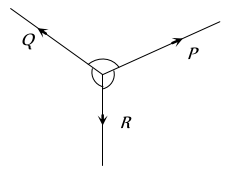
A body is in equilibrium under the action of three coplanar forces $P$, $Q$ and $R$ as shown in the figure. Select the correct statement
- ✓
$P \quad Q \quad R$
- B
$P \quad Q \quad R$
- C
$P \quad Q \quad R$
- D
$P \quad Q \quad R$
AnswerCorrect option: A. $P \quad Q \quad R$
(a) According to Lami's theorem$\frac{P}{\sin \alpha}=\frac{Q}{\sin \beta}=\frac{R}{\sin \gamma}$
View full question & answer→MCQ 1331 Mark
If $\vec{P}=\vec{Q}$ then which of the following is NOT correct
AnswerCorrect option: D. $\vec{P}+\vec{Q}=\hat{P}+\hat{Q}$
(d) $\vec{P}+\vec{Q}=P \hat{P}+Q \hat{Q}$
View full question & answer→MCQ 1341 Mark
Which of the following is a vector
Answer(d) All quantities are tensors.
View full question & answer→MCQ 1351 Mark
Any vector in an arbitrary direction can always be replaced by two (or three)
- A
Parallel vectors which have the original vector as their resultant
- B
Mutually perpendicular vectors which have the original vector as their resultant
- ✓
Arbitrary vectors which have the original vector as their resultant
- D
1t is not possible to resolve a vector
AnswerCorrect option: C. Arbitrary vectors which have the original vector as their resultant
View full question & answer→MCQ 1361 Mark
A vector is represented by $3 \hat{i}+\hat{j}+2 \hat{k}$. Its length in $X Y$ plane is
- A
- B
$\sqrt{14}$
- ✓
$\sqrt{10}$
- D
$\sqrt{5}$
AnswerCorrect option: C. $\sqrt{10}$
(c)$\begin{aligned}& \vec{R}=3 \hat{i}+\hat{j}+2 \hat{k} \\& \therefore \text { Length in } X Y \text { plane }=\sqrt{R_x^2+R_y^2}=\sqrt{3^2+1^2}=\sqrt{10}\end{aligned}$
View full question & answer→MCQ 1371 Mark
The unit vector along $\hat{i}+\hat{j}$ is
AnswerCorrect option: C. $\frac{\hat{i}+\hat{j}}{\sqrt{2}}$
(c) $\hat{R}=\frac{\vec{R}}{|R|}=\frac{\hat{i}+\hat{j}}{\sqrt{1^2+1^2}}=\frac{1}{\sqrt{2}} \hat{i}+\frac{1}{\sqrt{2}} \hat{j}$
View full question & answer→MCQ 1381 Mark
The expression $\left(\frac{1}{\sqrt{2}} \hat{i}+\frac{1}{\sqrt{2}} \hat{j}\right)$ is a
Answer(a) $\vec{P}=\frac{1}{\sqrt{2}} \hat{i}+\frac{1}{\sqrt{2}} \hat{j} \therefore|\vec{P}=\sqrt{\left(\frac{1}{\sqrt{2}}\right)^2+\left(\frac{1}{\sqrt{2}}\right)^2}=1$$\therefore$ lt is a unit vector.
View full question & answer→MCQ 1391 Mark
The magnitude of a given vector with end points $(4,-4,0)$ and $(-$ $2,-2,0)$ must be
- A
- B
$5 \sqrt{2}$
- C
- ✓
$2 \sqrt{10}$
AnswerCorrect option: D. $2 \sqrt{10}$
(d)$\begin{aligned}& \vec{r}=\vec{r}_2-\vec{r}_1=(-2 \hat{i}-2 \hat{j}+0 \hat{k})-(4\hat{i}-4 \hat{j}+0 \hat{k}) \\& \Rightarrow \vec{r}=-6 \hat{i}+2 \hat{j}+0 \hat{k} \\& \therefore|\vec{r}|=\sqrt{(-6)^2+(2)^2+0^2}=\sqrt{36+4}=\sqrt{40}=2 \sqrt{10}\end{aligned}$
View full question & answer→MCQ 1401 Mark
100 coplanar forces each equal to $10 N$ act on a body. Each force makes angle $\pi / 50$ with the preceding force. What is the resultant of the forces
- A
$1000 N$
- B
$500 N$
- C
$250 N$
- ✓
Answer(d) Total angle $=100 \times \frac{\pi}{50}=2 \pi$So all the force will pass through one point and all forces will be balanced. i.e. their resultant will be zero.
View full question & answer→MCQ 1411 Mark
A hall has the dimensions $10 m \times 12 m \times 14 m$. A fly starting at one corner ends up at a diametrically opposite corner. What is the magnitude of its displacement
- A
$17 m$
- B
$26 m$
- C
$36 m$
- ✓
$20 m$
AnswerCorrect option: D. $20 m$
View full question & answer→MCQ 1421 Mark
How many minimum number of coplanar vectors having different magnitudes can be added to give zero resultant
MCQ 1431 Mark
The vector that must be added to the vector $\hat{i}-3 \hat{j}+2 \hat{k}$ and $3 \hat{i}+6 \hat{j}-7 \hat{k}$ so that the resultant vector is a unit vector along the $y$ axis is
- A
$4 \hat{i}+2 \hat{j}+5 \hat{k}$
- ✓
$-4 \hat{i}-2 \hat{j}+5 \hat{k}$
- C
$3 \hat{i}+4 \hat{j}+5 \hat{k}$
- D
AnswerCorrect option: B. $-4 \hat{i}-2 \hat{j}+5 \hat{k}$
(b) Unit vector along $y$ axis $=\hat{j}$ so the required vector $=\hat{j}-[(\hat{i}-3 \hat{j}+2 \hat{k})+(3 \hat{i}+6 \hat{j}-7 \hat{k})]=-4 \hat{i}-2 \hat{j}+5 \hat{k}$
View full question & answer→MCQ 1441 Mark
If $\vec{A}=2 \hat{i}+4 \hat{j}-5 \hat{k}$ the direction of cosines of the vector $\vec{A}$ are
- ✓
$\frac{2}{\sqrt{45}}, \frac{4}{\sqrt{45}}$ and $\frac{-5}{\sqrt{45}}$
- B
$\frac{1}{\sqrt{45}}, \frac{2}{\sqrt{45}}$ and $\frac{3}{\sqrt{45}}$
- C
$\frac{4}{\sqrt{45}}, 0$ and $\frac{4}{\sqrt{45}}$
- D
$\frac{3}{\sqrt{45}}, \frac{2}{\sqrt{45}}$ and $\frac{5}{\sqrt{45}}$
AnswerCorrect option: A. $\frac{2}{\sqrt{45}}, \frac{4}{\sqrt{45}}$ and $\frac{-5}{\sqrt{45}}$
(a)$\begin{aligned}& \vec{A}=2 \hat{i}+4 \hat{j}-5 \hat{k} \quad \therefore|\vec{A}|=\sqrt{(2)^2+(4)^2+(-5)^2}=\sqrt{45} \\& \therefore \cos \alpha=\frac{2}{\sqrt{45}}, \quad \cos \beta=\frac{4}{\sqrt{45}}, \quad \cos \gamma=\frac{-5}{\sqrt{45}}\end{aligned}$
View full question & answer→MCQ 1451 Mark
Vector $\vec{A}$ makes equal angles with $x, y$ and $z$ axis. Value of its components (in terms of magnitude of $\vec{A}$ ) will be
- ✓
$\frac{A}{\sqrt{3}}$
- B
$\frac{A}{\sqrt{2}}$
- C
$\sqrt{3} A$
- D
$\frac{\sqrt{3}}{A}$
AnswerCorrect option: A. $\frac{A}{\sqrt{3}}$
(a) Let the components of $\vec{A}$ makes angles $\alpha, \beta$ and $\gamma$ with $x, y$ and $z$ axis respectively then $\alpha=\beta=\gamma$$\begin{aligned} & \cos ^2 \alpha+\cos ^2 \beta+\cos ^2 \gamma=1 \\ & \Rightarrow 3 \cos ^2 \alpha=1 \Rightarrow \cos \alpha=\frac{1}{\sqrt{3}} \\ & \therefore A_x=A_y=A_z=A \cos \alpha=\frac{A}{\sqrt{3}}\end{aligned}$
View full question & answer→MCQ 1461 Mark
If $A=3 \hat{i}+4 \hat{j}$ and $B=7 \hat{i}+24 \hat{j}$, the vector having the same magnitude as $B$ and parallel to $A$ is
- A
$5 \hat{i}+20 \hat{j}$
- B
$15 \hat{i}+10 \hat{j}$
- C
$20 \hat{i}+15 \hat{j}$
- ✓
$15 \hat{i}+20 \hat{j}$
AnswerCorrect option: D. $15 \hat{i}+20 \hat{j}$
(d) $|B|=\sqrt{7^2+(24)^2}=\sqrt{625}=25$Unit vector in the direction of $A$ will be $\hat{A}=\frac{3 \hat{i}+4 \hat{j}}{5}$So required vector $=25\left(\frac{3 \hat{i}+4 \hat{j}}{5}\right)=15 \hat{i}+20 \hat{j}$
View full question & answer→MCQ 1471 Mark
A force of $5 N$ acts on a particle along a direction making an angle of $60^{\circ}$ with vertical. Its vertical component be
- A
$10 N$
- ✓
$3 N$
- C
$4 N$
- D
$2.5 N$
Answer 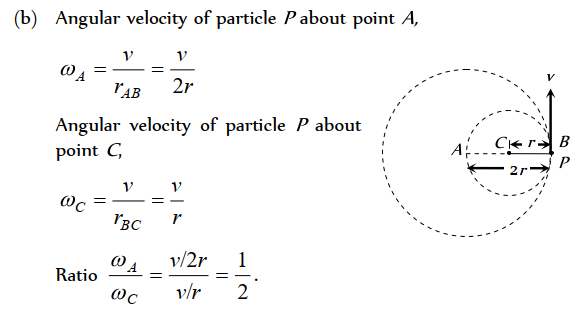
The component of force in vertical direction$=F \cos \theta=F \cos 60^{\circ}=5 \times \frac{1}{2}=2.5 N$
View full question & answer→MCQ 1481 Mark
If a particle moves from point $P(2,3,5)$ to point $Q(3,4,5)$. Its displacement vector be
- A
$\hat{i}+\hat{j}+10 \hat{k}$
- B
$\hat{i}+\hat{j}+5 \hat{k}$
- ✓
$\hat{i}+\hat{j}$
- D
$2 \hat{i}+4 \hat{j}+6 \hat{k}$
AnswerCorrect option: C. $\hat{i}+\hat{j}$
(c) Displacement vector $\vec{r}=\Delta x \hat{i}+\Delta \hat{y j}+\Delta z \hat{k}$$=(3-2) \hat{i}+(4-3) \hat{j}+(5-5) \hat{k}=\hat{i}+\hat{j}$
View full question & answer→MCQ 1491 Mark
Position of a particle in a rectangular-co-ordinate system is $(3,2,5)$. Then its position vector will be
- A
$3 \hat{i}+5 \hat{j}+2 \hat{k}$
- ✓
$3 \hat{i}+2 \hat{j}+5 \hat{k}$
- C
$5 \hat{i}+3 \hat{j}+2 \hat{k}$
- D
AnswerCorrect option: B. $3 \hat{i}+2 \hat{j}+5 \hat{k}$
(b) If a point have coordinate $(x, y, z)$ then its position vector $=x \hat{i}+y \hat{j}+z \hat{k}$.
View full question & answer→MCQ 1501 Mark
The speed of a boat is $5 km / h$ in still water. It crosses a river of width $1 km$ along the shortest possible path in 15 minutes. The velocity of the river water is
- A
$1 km / h$
- ✓
$3 km / h$
- C
$4 km / h$
- D
$5 km / h$
AnswerCorrect option: B. $3 km / h$
View full question & answer→