MCQ 1511 Mark
A metal sphere is hung by a string fixed to a wall. The sphere is pushed away from the wall by a stick. The forces acting on the sphere are shown in the second diagram. Which of the following statements is wrong
AnswerCorrect option: D. $T=P+W$
View full question & answer→MCQ 1521 Mark
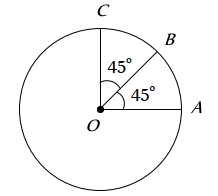
Find the resultant of three vectors $\overrightarrow{O A}, \overrightarrow{O B}$ and $\overrightarrow{O C}$ shown in the following figure. Radius of the circle is $R$.
- A
$2 R$
- ✓
$R(1+\sqrt{2})$
- C
$R \sqrt{2}$
- D
$\quad R(\sqrt{2}-1)$
AnswerCorrect option: B. $R(1+\sqrt{2})$
(b) $R_{\text {net }}=R+\sqrt{R^2+R^2}=R+\sqrt{2} R=R(\sqrt{2}+1)$
View full question & answer→MCQ 1531 Mark
A vector $\vec{a}$ is turned without a change in its length through a small angle $d \theta$. The value of $|\Delta \vec{a}|$ and $\Delta a$ are respectively
- A
$0, \operatorname{ad\theta }$
- ✓
$\operatorname{ad} \theta, 0$
- C
- D
AnswerCorrect option: B. $\operatorname{ad} \theta, 0$
View full question & answer→MCQ 1541 Mark
If a vector $\vec{P}$ making angles $\alpha, \beta$, and $\gamma$ respectively with the $X, \gamma$ and $Z$ axes respectively. Then $\sin ^2 \alpha+\sin ^2 \beta+\sin ^2 \gamma=$
Answer(c) \sin ^2 \alpha+\sin ^2 \beta+\sin \gamma \\& =1-\cos ^2 \alpha+1-\cos ^2 \beta+1-\cos ^2 \gamma \\& =3-\left(\cos ^2 \alpha+\cos ^2 \beta+\cos ^2 \gamma\right)=3-1=2\end{aligned}$
View full question & answer→MCQ 1551 Mark
Two equal forces ( $P$ each) act at a point inclined to each other at an angle of $120^{\circ}$. The magnitude of their resultant is
- A
$P / 2$
- B
$P / 4$
- ✓
$P$
- D
$2 P$
Answer(c) $R=\sqrt{A^2+B^2+2 A B \cos \theta}$If $A=B=P$ and $\theta=120^{\circ}$ then $R=P$
View full question & answer→MCQ 1561 Mark
$y$ component of velocity is 20 and $x$ component of velocity is 10 . The direction of motion of the body with the horizontal at this instant is
- ✓
$\tan ^{-1}(2)$
- B
$\tan ^{-1}(1 / 2)$
- C
$45^{\circ}$
- D
$0^{\circ}$
AnswerCorrect option: A. $\tan ^{-1}(2)$
View full question & answer→MCQ 1571 Mark
What displacement must be added to the displacement $25 \hat{i}-6 \hat{j} m$ to give a displacement of $7.0 m$ pointing in the $x$ direction
- A
$18 \hat{i}-6 \hat{j}$
- B
$32 \hat{i}-13 \hat{j}$
- ✓
$-18 \hat{i}+6 \hat{j}$
- D
$-25 \hat{i}+13 \hat{j}$
AnswerCorrect option: C. $-18 \hat{i}+6 \hat{j}$
View full question & answer→MCQ 1581 Mark
Given that $\vec{A}+\vec{B}=\vec{C}$ and that $\vec{C}$ is $\perp$ to $\vec{A}$. Further if $|\vec{A}|=|\vec{C}|$, then what is the angle between $\vec{A}$ and $\vec{B}$
- A
$\frac{\pi}{4}$ radian
- B
$\frac{\pi}{2}$ radian
- ✓
$\frac{3 \pi}{4}$ radian
- D
$\pi$ radian
AnswerCorrect option: C. $\frac{3 \pi}{4}$ radian
View full question & answer→MCQ 1591 Mark
Two forces, $F_1$ and $F_2$ are acting on a body. One force is double that of the other force and the resultant is equal to the greater force. Then the angle between the two forces is
- A
$\cos ^{-1}(1 / 2)$
- B
$\cos ^{-1}(-1 / 2)$
- ✓
$\cos ^{-1}(-1 / 4)$
- D
$\cos ^{-1}(1 / 4)$
AnswerCorrect option: C. $\cos ^{-1}(-1 / 4)$
View full question & answer→MCQ 1601 Mark
The resultant of two vectors $\vec{P}$ and $\vec{Q}$ is $\vec{R}$. If $Q$ is doubled, the new resultant is perpendicular to $P$. Then $R$ equals
- A
$P$
- B
$(P+Q)$
- ✓
$Q$
- D
$(P-Q)$
View full question & answer→MCQ 1611 Mark
Maximum and minimum magnitudes of the resultant of two vectors of magnitudes $P$ and $Q$ are in the ratio $3: 1$. Which of the following relations is true
- ✓
$P=2 Q$
- B
$P=Q$
- C
$P Q=1$
- D
AnswerCorrect option: A. $P=2 Q$
(a) According to problem $P+Q=3$ and $P-Q=1$By solving we get $P=2$ and $Q=1 \therefore \quad \frac{P}{Q}=2 \Rightarrow P=2 Q$
View full question & answer→MCQ 1621 Mark
The resultant of $\vec{P}$ and $\vec{Q}$ is perpendicular to $\vec{P}$. What is the angle between $\vec{P}$ and $\vec{Q}$
- A
$\cos ^{-1}(P / Q)$
- ✓
$\cos ^{-1}(-P / Q)$
- C
$\sin ^{-1}(P / Q)$
- D
$\sin ^{-1}(-P / Q)$
AnswerCorrect option: B. $\cos ^{-1}(-P / Q)$
View full question & answer→MCQ 1631 Mark
What is the angle between $\vec{P}$ and the resultant of $(\vec{P}+\vec{Q})$ and $(\vec{P}-\vec{Q})$
- ✓
- B
$\tan ^{-1}(P / Q)$
- C
$\tan ^{-1}(Q / P)$
- D
$\tan ^{-1}(P-Q) /(P+Q)$
Answer(a) Resultant $\vec{R}=\vec{P}+\vec{Q}+\vec{P}-\vec{Q}=2 \vec{P}$ The angle between $\vec{P}$ and $2 \vec{P}$ is zero.
View full question & answer→MCQ 1641 Mark
The resultant of two vectors $A$ and $B$ is perpendicular to the vector $A$ and its magnitude is equal to half the magnitude of vector $B$. The angle between $A$ and $B$ is
- A
$120^{\circ}$
- ✓
$150^{\circ}$
- C
$135^{\circ}$
- D
AnswerCorrect option: B. $150^{\circ}$
View full question & answer→MCQ 1651 Mark
When three forces of $50 N , 30 N$ and $15 N$ act on a body, then the body is
- A
- B
Moving with a uniform velocity
- C
- ✓
Moving with an acceleration
AnswerCorrect option: D. Moving with an acceleration
(d) Here all the three force will not keep the particle in equilibrium so the net force will not be zero and the particle will move with an acceleration.
View full question & answer→MCQ 1661 Mark
Let $\vec{C}=\vec{A}+\vec{B}$ then
- A
$|\vec{C}|$ is always greater then $|\vec{A}|$
- ✓
It is possible to have $|\vec{C}|<|\vec{A}|$ and $|\vec{C}|<\vec{B} \mid$
- C
$C$ is always equal to $A+B$
- D
$C$ is never equal to $A+B$
AnswerCorrect option: B. It is possible to have $|\vec{C}|<|\vec{A}|$ and $|\vec{C}|<\vec{B} \mid$
(b) $\vec{C}+\vec{A}=\vec{B}$.The value of $C$ lies between $A-B$ and $A+B$$\therefore|\vec{C}|<|\vec{A}| \text { or }|\vec{C}|<|\vec{B}|$
View full question & answer→MCQ 1671 Mark
The three vectors $\vec{A}=3 \hat{i}-2 \hat{j}+\hat{k}, \vec{B}=\hat{i}-3 \hat{j}+5 \hat{k} \quad$ and $\vec{C}=2 \hat{i}+\hat{j}-4 \hat{k}$ form
View full question & answer→MCQ 1681 Mark
A particle has displacement of $12 m$ towards east and $5 m$ towards north then $6 m$ vertically upward. The sum of these displacements is
AnswerCorrect option: C. $14.31 m$
(c) $R=\sqrt{12^2+5^2+6^2}=\sqrt{144+25+36}=\sqrt{205}=14.31 m$
View full question & answer→MCQ 1691 Mark
The magnitude of vector $\vec{A}, \vec{B}$ and $\vec{C}$ are respectively 12,5 and 13 units and $\vec{A}+\vec{B}=\vec{C}$ then the angle between $\vec{A}$ and $\vec{B}$ is
- B
$\pi$
- ✓
$\pi / 2$
- D
$\pi / 4$
AnswerCorrect option: C. $\pi / 2$
View full question & answer→MCQ 1701 Mark
Let the angle between two nonzero vectors $\vec{A}$ and $\vec{B}$ be $120^{\circ}$ and resultant be $\vec{C}$
- A
$\vec{C}$ must be equal to $|\vec{A}-\vec{B}|$
- B
$\vec{C}$ must be less than $|\vec{A}-\vec{B}|$
- ✓
$\vec{C}$ must be greater than $|\vec{A}-\vec{B}|$
- D
$\vec{C}$ may be equal to $|\vec{A}-\vec{B}|$
AnswerCorrect option: C. $\vec{C}$ must be greater than $|\vec{A}-\vec{B}|$
View full question & answer→MCQ 1711 Mark
If $|\vec{A}-\vec{B}|=|\vec{A}|=|\vec{B}|$, the angle between $\vec{A}$ and $\vec{B}$ is
- ✓
$60^{\circ}$
- B
$0^{\circ}$
- C
$120^{\circ}$
- D
$90^{\circ}$
AnswerCorrect option: A. $60^{\circ}$
View full question & answer→MCQ 1721 Mark
If the resultant of the two forces has a magnitude smaller than the magnitude of larger force, the two forces must be
- A
Different both in magnitude and direction
- B
Mutually perpendicular to one another
- C
Possess extremely small magnitude
- ✓
Point in opposite directions
AnswerCorrect option: D. Point in opposite directions
View full question & answer→MCQ 1731 Mark
Two vectors $\vec{A}$ and $\vec{B}$ lie in a plane, another vector $\vec{C}$ lies outside this plane, then the resultant of these three vectors i.e., $\vec{A}+\vec{B}+\vec{C}$
Answer(b) If $\vec{C}$ lies outside the plane then resultant force can not be zero.
View full question & answer→MCQ 1741 Mark
For the resultant of the two vectors to be maximum, what must be the angle between them
- ✓
$0^{\circ}$
- B
$60^{\circ}$
- C
$90^{\circ}$
- D
$180^{\circ}$
AnswerCorrect option: A. $0^{\circ}$
View full question & answer→MCQ 1751 Mark
An object of $m kg$ with speed of $v m / s$ strikes a wall at an angle $\theta$ and rebounds at the same speed and same angle. The magnitude of the change in momentum of the object will be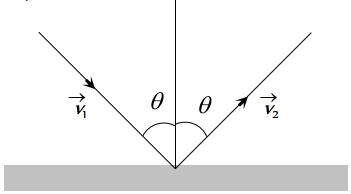
- ✓
$2 m v \cos \theta$
- B
$2 m v \sin \theta$
- C
$2 m v$
AnswerCorrect option: A. $2 m v \cos \theta$
(a)$\begin{aligned}& \vec{P}_1=m v \sin \theta \hat{i}-m v \cos \theta \hat{j} \\& \text { and } \vec{P}_2=m v \sin \theta \hat{i}+m v \cos \theta \hat{j}\end{aligned}$So change in momentum$\overrightarrow{\Delta P}=\vec{P}_2-\vec{P}_1=2 m v \cos \theta \hat{j},\Delta \vec{P}|=2 m v \cos \theta$
View full question & answer→MCQ 1761 Mark
$\vec{A}=2 \hat{i}+\hat{j}, B=3 \hat{j}-\hat{k}$ and $\vec{C}=6 \hat{i}-2 \hat{k}$ Value of $\vec{A}-2 \vec{B}+3 \vec{C}$ would be
- A
$20 \hat{i}+5 \hat{j}+4 \hat{k}$
- ✓
$20 \hat{i}-5 \hat{j}-4 \hat{k}$
- C
$4 \hat{i}+5 \hat{j}+20 \hat{k}$
- D
$5 \hat{i}+4 \hat{j}+10 \hat{k}$
AnswerCorrect option: B. $20 \hat{i}-5 \hat{j}-4 \hat{k}$
(b)$\begin{aligned}& \vec{A}-2 \vec{B}+3 \vec{C}=(2 \hat{i}+\hat{j})-2(3 \hat{j}\hat{k})+3(6 \hat{i}-2 \hat{k}) \\& =2 \hat{i}+\hat{j}-6 \hat{j}+2 \hat{k}+18 \hat{i}-6 \hat{k}=20 \hat{i}-5 \hat{j}-4 \hat{k}\end{aligned}$
View full question & answer→MCQ 1771 Mark
If $\vec{A}=4 \hat{i}-3 \hat{j}$ and $\vec{B}=6 \hat{i}+8 \hat{j}$ then magnitude and direction of $\vec{A}+\vec{B}$ will be
AnswerCorrect option: B. $5 \sqrt{5}, \tan ^{-1}(1 / 2)$
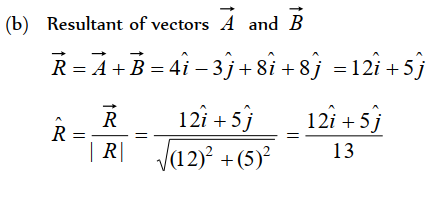
(b) $\begin{aligned} & \vec{A}+\vec{B}=4 \hat{i}-3 \hat{j}+6 \hat{i}+8 \hat{j}=10 \hat{i}+5 \hat{j} \\ & |\vec{A}+\vec{B}|=\sqrt{(10)^2+(5)^2}=5 \sqrt{5} \\ & \tan \theta=\frac{5}{10}=\frac{1}{2} \Rightarrow \theta=\tan ^{-1}\left(\frac{1}{2}\right)\end{aligned}$
View full question & answer→MCQ 1781 Mark
There are two force vectors, one of $5 N$ and other of $12 N$ at what angle the two vectors be added to get resultant vector of $17 N , 7 N$ and $13 N$ respectively
- ✓
$0^{\circ}, 180^{\circ}$ and $90^{\circ}$
- B
$0^{\circ}, 90^{\circ}$ and $180^{\circ}$
- C
$0^{\circ}, 90^{\circ}$ and $90^{\circ}$
- D
$180^{\circ}, 0^{\circ}$ and $90^{\circ}$
AnswerCorrect option: A. $0^{\circ}, 180^{\circ}$ and $90^{\circ}$
(a) For $17 N$ both the vector should be parallel i.e. angle between them should be zero.For $7 N$ both the vectors should be antiparallel i.e. angle between them should be $180^{\circ}$For $13 N$ both the vectors should be perpendicular to each other i.e. angle between them should be $90^{\circ}$
View full question & answer→