Questions · Page 7 of 7

M.C.Q (1 Marks)

MCQ 3011 Mark
Statement-$1$ : ${\cot ^{ - 1}}\left[ {\frac{{\log \left( {e/{x^2}} \right)}}{{\log \left( {e{x^2}} \right)}}} \right] + {\cot ^{ - 1}}\left[ {\frac{{\log (e{x^2})}}{{\log (e/{x^2})}}} \right]$ = $\frac {\pi}{2}$ 

Statement-$2$ : ${\tan ^{ - 1}}\left[ {\frac{{1 + \log {x^2}}}{{1 - \log {x^2}}}} \right]$ = ${\tan ^{ - 1}}\,1 + \,{\tan ^{ - 1}}\left( {\log {x^2}} \right)$

  • A
    Statement-$1$ is true, Statement-$2$ is true;Statement-$2$ is not the correct explanation of Statement-$1$ .
  • B
    Statement-$1$ is false, Statement-$2$ is true.
  • C
    Statement-$1$ is true, Statement-$2$ is false
  • Statement-$1$ is true, Statement-$2$ is true;Statement-$2$ is the correct explanation of Statement-$1$ .
Answer
Correct option: D.
Statement-$1$ is true, Statement-$2$ is true;Statement-$2$ is the correct explanation of Statement-$1$ .
d
View full question & answer
MCQ 3021 Mark
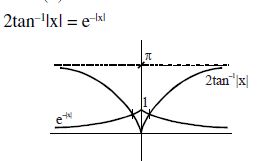
Number of solutions of the equation $2e^{|x|}tan^{-1}|x|=1$ is -
  • A
    $0$
  • B
    $1$
  • $2$
  • D
    $4$
Answer
Correct option: C.
$2$
c

View full question & answer
MCQ 3031 Mark
If $f(n) = \tan ^{{  - 1 }} \left( {\frac{e-1}{e^{-n}+e^{n+1}}} \right)$$\forall n\, \in \,N$ , then $\sum\limits_{n = 1}^\infty  {f\left( n \right)} $ is equal to
  • A
    $ cot^{-1}(\frac{1}{e})$
  • B
    $ cot^{-1}(1)$
  • C
    $ tan^{-1}\frac{2}{e}$
  • $ tan^{-1}\frac{1}{e}$
Answer
Correct option: D.
$ tan^{-1}\frac{1}{e}$
d
$f(\mathrm{n})=\tan ^{-1}\left(\frac{\mathrm{e}^{\mathrm{n}+1}-\mathrm{e}^{\mathrm{n}}}{1+\mathrm{e}^{\mathrm{n}} \cdot \mathrm{e}^{\mathrm{n}+1}}\right)$

$f(n)=\tan ^{-1}\left(e^{n+1}\right)-\tan ^{-1}\left(e^{n}\right)$

$\sum\limits_{n = 1}^\infty  {f\left( n \right)}  = \frac{\pi }{2} - {\tan ^{ - 1}}{\rm{e}} = {\tan ^{ - 1}}\frac{1}{{\rm{e}}}$

View full question & answer
MCQ 3041 Mark
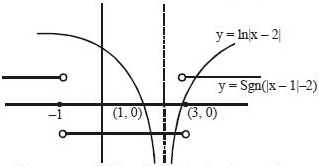
If $f(x) = \cos \left( {{{\tan }^{ - 1}}\left( {\sin \left( {{{\cos }^{ - 1}}x} \right)} \right)} \right) + \sin \left( {{{\cot }^{ - 1}}\left( {\cos \left( {{{\sin }^{ - 1}}x} \right)} \right)} \right)$ has range $\left[ {m,M),} \right.$ then number of solutions of the equation $\operatorname{sgn} \left( {\left| {x - 1} \right| - 2} \right) = \ln \left| {x - 2} \right|$ is (where sgn denotes signum function)
  • A
    $m^2+1$
  • B
    $m^2-M$
  • C
    $M^2+1$
  • $m^2+M$
Answer
Correct option: D.
$m^2+M$
d
$f(x)=\cos \left(\tan ^{-1}\left(\sin \left(\cos ^{-1} x\right)\right)\right)$

$+\sin \left(\cot ^{-1}\left(\cos \left(\frac{\pi}{2}-\cos ^{-1} x\right)\right)\right)$

$=\cos \left(\tan ^{-1}\left(\sin \left(\cos ^{-1} x\right)\right)\right)+\sin \left(\cot ^{-1}\left(\sin \left(\cos ^{-1} x\right)\right)\right)$

$=\cos \left(\tan ^{-1}\left(\sin \left(\cos ^{-1} x\right)\right)\right)+\sin \left(\frac{\pi}{2}-\tan ^{-1}\left(\sin \left(\cos ^{-1} x\right)\right)\right)$

$=\cos \left(\tan ^{-1}\left(\sin \left(\cos ^{-1} x\right)\right)\right)+\cos \left(\tan ^{-1}\left(\sin \left(\cos ^{-1} x\right)\right)\right)$

$=2 \cos \left(\tan ^{-1}\left(\sin \left(\cos ^{-1} x\right)\right)\right)=\frac{2}{\sqrt{2-x^{2}}} \in[\sqrt{2}, 2]$

From graph, Number of solutions of 

Sgn $\left( {\left| {x - 1} \right| - 2} \right) = \ln \left| {x - 2} \right|$ is $4$

View full question & answer
MCQ 3051 Mark
Let $f(x) = tan^{-1}\, (cot\, x - 2\, cot2x)$ then $\left[ {\sum\limits_{r = 1}^7 {f\left( r \right)} } \right]$ is equal to (where [.] represent greatest integer function) 
  • $-1$
  • B
    $1$
  • C
    $0$
  • D
    $-2$
Answer
Correct option: A.
$-1$
a
$\cot x-2 \cot 2 x=\tan x$

$\Rightarrow f(x)=\tan ^{-1} \tan x$

$f(1)=1, \quad f(2)=2-\pi, \quad f(3)=3-\pi,$

$f(4)=4-\pi, \quad f(5)=5-2 \pi$

$f(6)=6-2 \pi, f(7)=7-2 \pi$

$ \Rightarrow \left[ {\sum\limits_{r = 1}^7 {f\left( x \right)} } \right] = [28 - 9\pi ] =  - 1$

View full question & answer
MCQ 3061 Mark
The sum $\sum\limits_{n = 1}^\infty  {{{\cot }^{ - 1}}} \left( {\frac{{2\left( {\sum\limits_{k = 1}^n k } \right) - 1}}{3}} \right)$ is equal to
  • $\frac{{3\pi }}{4} + {\cot ^{ - 1}}2$
  • B
    $\frac{\pi }{2} + {\cot ^{ - 1}}3$
  • C
    $\pi $
  • D
    $\frac{\pi }{2} + {\tan ^{ - 1}}2$
Answer
Correct option: A.
$\frac{{3\pi }}{4} + {\cot ^{ - 1}}2$
a
$\mathrm{T}_{\mathrm{n}}=\tan ^{-1}\left(\frac{3}{\mathrm{n}^{2}+\mathrm{n}-1}\right)$

$=\tan ^{-1}(\mathrm{n}+2)-\tan ^{-1}(\mathrm{n}-1)$

Use $: \mathrm{S}_{\mathrm{n}}=\Sigma \mathrm{T}_{\mathrm{n}}$

View full question & answer
MCQ 3071 Mark
The solution set of inequality $\left( {{{\tan }^{ - 1}}x} \right)\left( {{{\cot }^{ - 1}}x} \right) - \left( {{{\tan }^{ - 1}}x} \right)\left( {1 + \frac{\pi }{2}} \right) - 2{\cot ^{ - 1}}x + 2\left( {1 + \frac{\pi }{2}} \right)\,$$ > \mathop {\lim }\limits_{x \to \infty } \left[ {{{\sec }^{ - 1}}x - \frac{\pi }{2}} \right]\,$ is (where [.] denotes the greatest integer function)
  • A
    $(tan\  1, tan\  2)$
  • B
    $(-cot\  1, cot \ 2)$
  • $(-tan\  1, tan\ 2)$
  • D
    $(-tan\ 1, \infty)$
Answer
Correct option: C.
$(-tan\  1, tan\ 2)$
c
$\left(\tan ^{-1} x-2\right)\left(\cot ^{-1} x-1-\frac{\pi}{2}\right)>0$

$\Rightarrow\left(\tan ^{-1} x+1\right)\left(\tan ^{-1} x-2\right)<0$

$\Rightarrow-1<\tan ^{-1} x<2$

$ \Rightarrow  - \tan 1 < x < \tan 2$

View full question & answer
MCQ 3081 Mark
The value of  $\cot \left( {\sum\limits_{r = 1}^\infty  {{{\tan }^{ - 1}}\left( {\frac{4}{{4{r^2} + 3}}} \right)} } \right)$ is equal to
  • A
    $1$
  • $\frac{1}{2}$
  • C
    $2$
  • D
    $\frac{1}{4}$
Answer
Correct option: B.
$\frac{1}{2}$
b
$\tan ^{-1}\left(\frac{4}{4 r^{2}+3}\right)=\tan ^{-1}\left(r+\frac{1}{2}\right)-\tan ^{-1}\left(r-\frac{1}{2}\right)$

$\sum\limits_{r = 1}^n {{{\tan }^{ - 1}}\left( {\frac{4}{{4{r^2} + 3}}} \right)}  = {\cot ^{ - 1}}\left( {\frac{1}{2}} \right)$

View full question & answer
MCQ 3091 Mark
If $log_{\pi}x > 0$, then the value of ${\log _\pi }\left( {{{\sin }^{ - 1}}\frac{{2x}}{{1 + {x^2}}} + 2{{\tan }^{ - 1}}x} \right)$  is equal to
  • A
    $-1$
  • B
    $0$
  • $1$
  • D
    $\pi$
Answer
Correct option: C.
$1$
c
${\log _\pi }x > 0 \Rightarrow x > 1$

for $x>1, \sin ^{-1} \frac{2 x}{1+x^{2}}=\pi-2 \tan ^{-1} x$

$\log _{\pi}\left(\pi-2 \tan ^{-1} x+2 \tan ^{-1} x\right)=1$

View full question & answer
MCQ 3101 Mark
If $\alpha$ and $\beta$ (where $\alpha > \beta$) are two zeroes of the equation  $3\,cos{^{ - 1}}\left( {{x^2} - 5x - \frac{{11}}{2}} \right) = \pi $ then $(\alpha^2 + \beta^3)$ is -
  • A
    $38$
  • B
    $36$
  • C
    $37$
  • $35$
Answer
Correct option: D.
$35$
d
$\cos ^{-1}\left(x^{2}-5 x-\frac{11}{2}\right)=\frac{\pi}{3}$

$x^{2}-5 x-\frac{11}{2}=\frac{1}{2} \Rightarrow x^{2}-5 x-6=0$

Hence, $\alpha=6$ or $\beta=-1.$

View full question & answer
MCQ 3111 Mark
The solution of the inequallity $(cot^{-1}x)^2 -5cot^{-1}x + 6 > 0$ is :-
  • A
    $(\cot\, 3, \cot\, 2)$
  • $(-\infty, \cot\, 3) \cup (\cot \,2, \infty)$
  • C
    $(\cot\, 2, \infty)$
  • D
    None
Answer
Correct option: B.
$(-\infty, \cot\, 3) \cup (\cot \,2, \infty)$
b
$\left(\cot ^{-1} x\right)^{2}-5 \cot ^{-1} x+6>0$

$\left(\cot ^{-1} x-3\right)\left(\cot ^{-1} x-2\right)>0$

$\cot ^{-1} x<2 $ and $ \cot ^{-1} x>3$

$x>\cot 2 $ and $ x<\cot 3$

$x \in(-\infty, \cot 3) \cup(\cot 2, \infty)$

View full question & answer
MCQ 3121 Mark
The sum of infinite series ${\tan ^{ - 1}}\left( {\frac{2}{{1 - {1^2} + {1^4}}}} \right) + {\tan ^{ - 1}}\left( {\frac{4}{{1 - {2^2} + {2^4}}}} \right) + {\tan ^{ - 1}}\left( {\frac{6}{{1 - {3^2} + {3^4}}}} \right) + .....$ is :-
  • A
    $\frac{\pi}{4}$
  • $\frac{\pi}{2}$
  • C
    $\frac{3\pi}{4}$
  • D
    None
Answer
Correct option: B.
$\frac{\pi}{2}$
b
$\mathop {\lim }\limits_{n \to \infty } \sum\limits_{r = 1}^n {{{\tan }^{ - 1}}\left( {\frac{{2r}}{{1 - {r^2} + {r^4}}}} \right)} $

$\mathop {\lim }\limits_{n \to \infty } \sum\limits_{r = 1}^n {{{\tan }^{ - 1}}\left[ {\frac{{\left( {{r^2} + r} \right) - \left( {{r^2} - r} \right)}}{{1 + \left( {{r^2} + r} \right)\left( {{r^2} - r} \right)}}} \right]} $

$\mathop {\lim }\limits_{n \to \infty } \sum\limits_{r = 1}^n {\left[ {{{\tan }^{ - 1}}\left( {{r^2} + r} \right) - {{\tan }^{ - 1}}\left( {{r^2} - r} \right)} \right]} $

$ = {\tan ^{ - 1}}\infty  - {\tan ^{ - 1}}0 = \frac{\pi }{2} - 0 = \frac{\pi }{2}$

View full question & answer
MCQ 3131 Mark
If $x \geq 1$, then $2 \tan^{-1} x + \sin^{-1} (\frac{2x}{1+x^2})$ is equal to:
  • A
    $4\, \tan^{-1}x$
  • B
    $0$
  • C
    $\frac{2 \pi}{3}$
  • $\pi$
Answer
Correct option: D.
$\pi$
d
We have, $2 \tan ^{-1} x+\sin ^{-1} \frac{2 x}{1+x^{2}}$

We know that

$2 \tan ^{-1} x=\left\{\begin{array}{cc}\sin ^{-1}\left(\frac{2 x}{1+x^{2}}\right) ; & 1 \leq x \leq 1 \\-\pi-\sin ^{-1}\left(\frac{2 x}{1+x^{2}}\right) ; & x<-1 \\\pi-\sin ^{-1}\left(\frac{2 x}{1+x^{2}}\right) ; & x>1\end{array}\right.$

$\Rightarrow f(x)=2 \tan ^{-1} x+\left(\pi-2 \tan ^{-1} x\right)$

$\Rightarrow f(x)=\pi \forall x>1$    $=\pi$

View full question & answer
MCQ 3141 Mark
The sum of infinite series ${\tan ^{ - 1}}\left( {\frac{2}{{1 - {1^2} + {1^4}}}} \right) + {\tan ^{ - 1}}\left( {\frac{4}{{1 - {2^2} + {2^4}}}} \right) + {\tan ^{ - 1}}\left( {\frac{6}{{1 - {3^2} + {3^4}}}} \right) + .....$ is
  • A
    $\frac{\pi}{4}$
  • $\frac{\pi}{2}$
  • C
    $\frac{3\pi}{4}$
  • D
    None
Answer
Correct option: B.
$\frac{\pi}{2}$
b
$\mathop {\lim }\limits_{n \to \infty } \sum\limits_{r = 1}^n {{{\tan }^{ - 1}}\left( {\frac{{2r}}{{1 - {r^2} + {r^4}}}} \right)} $

$\mathop {\lim }\limits_{n \to \infty } \sum\limits_{r = 1}^n {{{\tan }^{ - 1}}\left[ {\frac{{\left( {{r^2} + r} \right) - \left( {{r^2} - r} \right)}}{{1 + \left( {{r^2} + r} \right)\left( {{r^2} - r} \right)}}} \right]} $

$\mathop {\lim }\limits_{n \to \infty } \sum\limits_{r = 1}^n {\left[ {{{\tan }^{ - 1}}\left( {{r^2} + r} \right) - {{\tan }^{ - 1}}\left( {{r^2} - r} \right)} \right]} $

$ = {\tan ^{ - 1}}\infty  - {\tan ^{ - 1}}0 = \frac{\pi }{2} - 0 = \frac{\pi }{2}$

View full question & answer